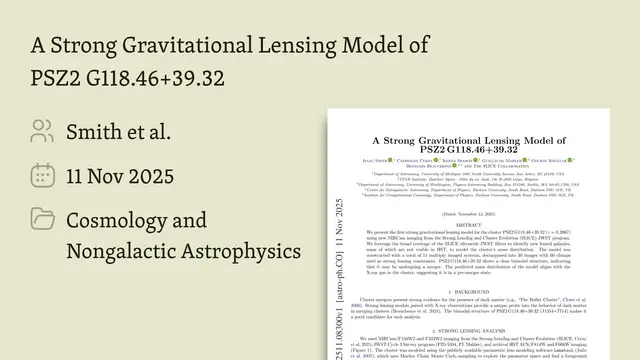
SLICE: Cosmic Magnifying Glasses Revealed
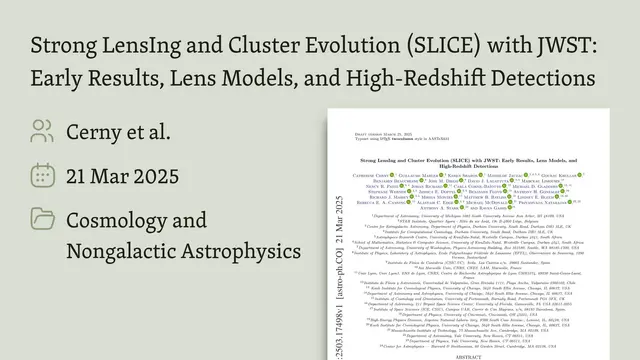
This presentation explores the Strong Lensing and Cluster Evolution (SLICE) program, which uses galaxy clusters as cosmic magnifying glasses to study dark matter, cluster evolution, and the universe's structure. We'll discover how gravitational lensing creates multiple images and giant arcs, enabling precise measurements of mass distributions and testing fundamental physics across cosmic time.Script
Imagine the most massive structures in the universe acting like cosmic magnifying glasses, bending space and time to reveal secrets hidden in the distant cosmos. This is the power of strong gravitational lensing, and it's exactly what the SLICE program harnesses to study how galaxy clusters evolve across billions of years.
Let's start by understanding the fundamental physics that makes this cosmic magnification possible.
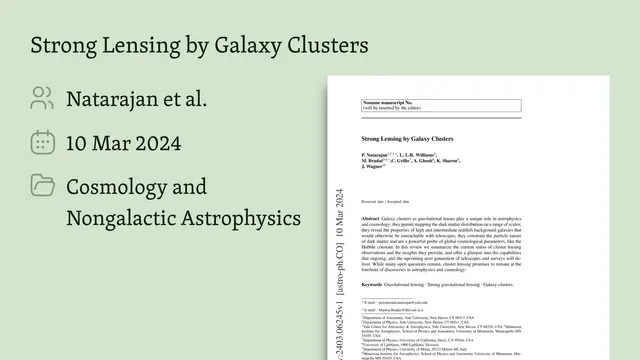
Building on this foundation, gravitational lensing follows precise mathematical relationships where massive clusters deflect light according to their surface mass density. When this density exceeds critical thresholds, we enter the strong lensing regime where single background galaxies appear as multiple images or spectacular giant arcs.
The thin lens approximation provides the mathematical framework, relating source and image positions through deflection angles that directly encode the cluster's mass distribution. These relationships allow us to map dark matter with extraordinary precision on scales from 10 to 100 kiloparsecs.
Now let's explore how SLICE translates this physics into a comprehensive observational program.
SLICE targets over 100 carefully selected clusters spanning a crucial epoch in cosmic history. These clusters are chosen for their exceptional lensing power, allowing us to trace mass assembly from 8 billion years ago to the present day.
The JWST Cycle 3 Treasury Program represents the cutting edge of this effort, combining unprecedented infrared sensitivity with ground-based spectroscopy. Each cluster yields dozens of multiply-imaged background sources that serve as precise probes of the mass distribution.
With these exquisite observations in hand, sophisticated modeling techniques reconstruct the invisible dark matter scaffolding.
SLICE employs both parametric models that assume specific mass profiles and free-form techniques that make minimal assumptions. State-of-the-art models achieve remarkable precision, with image position errors as low as 0.34 arcseconds.
Beyond the main cluster halo, SLICE models reveal intricate substructure including individual galaxy-scale dark matter halos and the complex dynamics of merging systems. These details are crucial for understanding how clusters assemble their mass over cosmic time.
These sophisticated techniques have already yielded remarkable insights into cluster physics and cosmology.
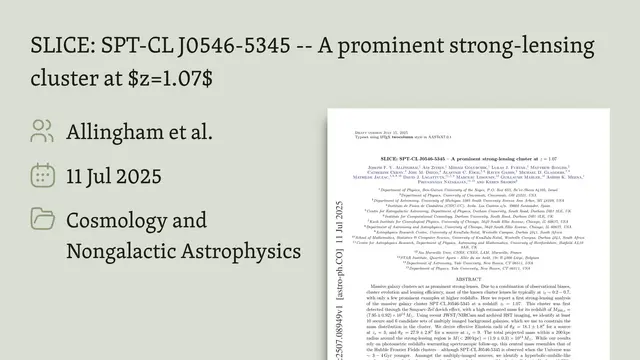
One of SLICE's most striking discoveries is evidence for remarkably rapid early assembly of cluster cores. Clusters like SPT-CL J0546-5345 show Einstein radii and central masses comparable to nearby systems, despite being observed when the universe was only 40 percent of its current age.
SLICE has revealed that the inner slope of cluster mass profiles is more important for lensing strength than total cluster mass. This connection between central concentration and assembly history provides a new window into how these cosmic giants grow.
Joint strong lensing and X-ray analysis uniquely separates dark matter from gas, enabling direct tests of dark matter physics. These measurements provide some of the strongest constraints on dark matter self-interaction cross-sections in the universe.
Beyond cluster physics, SLICE serves as a powerful cosmological laboratory.
SLICE clusters probe the rarest and most massive structures, making them exquisitely sensitive to cosmological parameters that govern structure formation. The frequency and properties of the strongest lenses directly test our understanding of cosmic evolution.
The exceptional magnification provided by SLICE clusters creates natural telescopes for studying the early universe. Multi-image transients enable geometric distance measurements that independently constrain the Hubble constant and dark energy properties.
The future of SLICE promises even more revolutionary capabilities with next-generation facilities.
JWST's unprecedented sensitivity is revolutionizing strong lensing studies, providing hundreds of independent constraints per cluster and extending our reach back to the epoch of reionization. Meanwhile, Euclid will transform this from a boutique field into a statistical science.
Sophisticated new analysis pipelines are keeping pace with the data deluge. Tools like the Strong Lensing Online Tool provide real-time access to magnification maps, while machine learning algorithms automate the discovery process across survey volumes.
Several intriguing tensions have emerged between SLICE observations and theoretical predictions. These include an apparent overabundance of compact subhalos and enhanced central concentrations that challenge our understanding of both dark matter physics and galaxy formation processes.
Let's step back and consider what SLICE reveals about our universe as a whole.
SLICE provides an empirical roadmap of how the universe's most massive structures assemble over cosmic time. By tracking mass growth, substructure evolution, and environmental effects, we're witnessing the formation of today's most extreme environments.
Beyond astronomy, SLICE transforms galaxy clusters into fundamental physics laboratories. These extreme environments test general relativity, probe dark matter properties, and constrain alternative theories of gravity in ways impossible to achieve on Earth.
SLICE represents a remarkable convergence of cutting-edge observations, theoretical sophistication, and computational power that's reshaping our understanding of cosmic evolution. By turning the universe's most massive structures into precision instruments, we're not just mapping dark matter, but uncovering the fundamental processes that shaped the cosmos we inhabit today. To explore more fascinating developments in astrophysics and cosmology, visit EmergentMind.com.