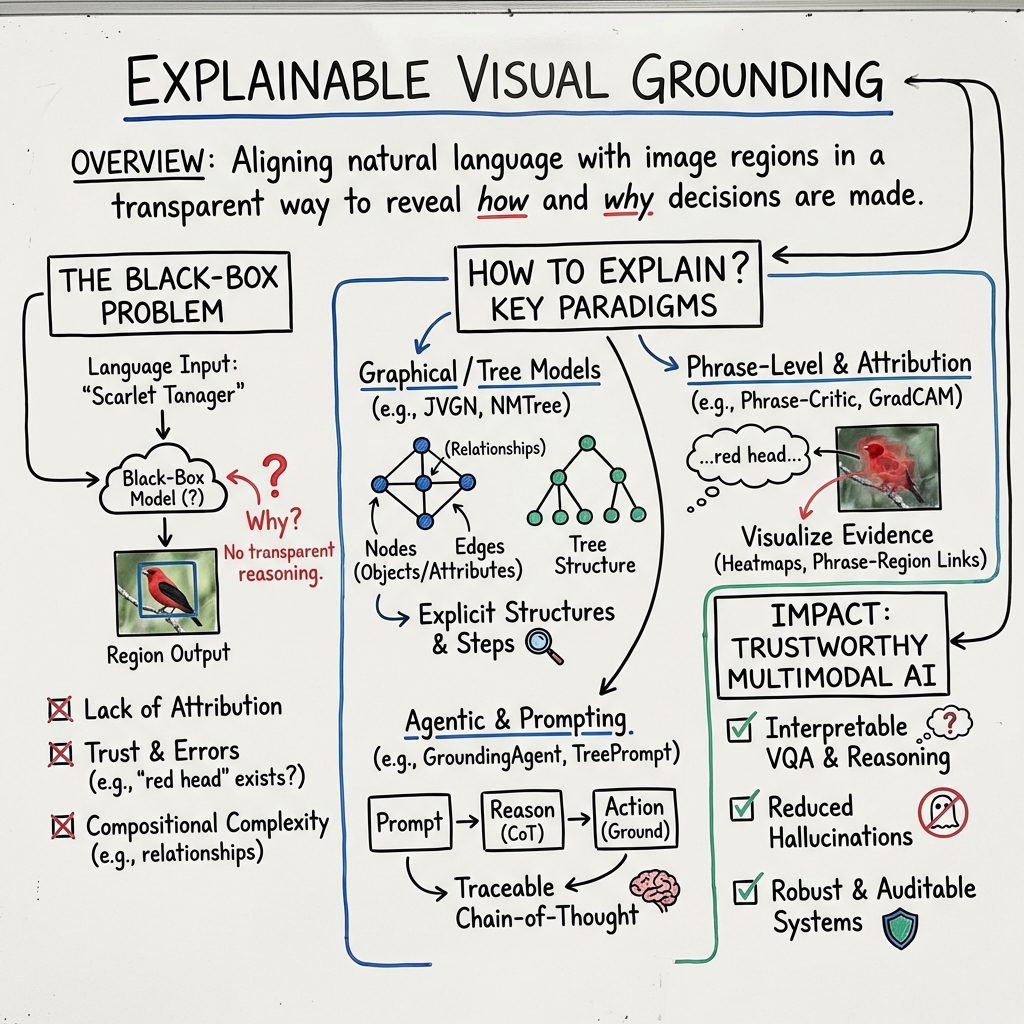
Explainable Visual Grounding
- Explainable visual grounding is the process of aligning natural language with specific image regions while exposing its intermediate reasoning steps for transparent decision making.
- Techniques involve tree-structured neural module networks, graphical model approaches, and attribution methods like GradCAM to provide detailed, stepwise visual explanations.
- Advancements in this area improve trust in multimodal AI by enabling robust error diagnosis, faithful rationale of model decisions, and interpretable localization of objects and attributes.
Explainable visual grounding is the task of aligning natural language descriptions with image regions in a way that reveals, in human-understandable terms, how and why each decision is made. Unlike black-box localization or classification, explainable approaches expose explicit intermediate structures, reasoning steps, or attributions that allow researchers to inspect and analyze the model’s alignment between textual references—such as objects, attributes, or relationships—and their visual counterparts. This area encompasses models from tree-structured neural module networks and factor-graph methods to phrase-grounding critics and self-consistent attribution, spanning both the localization of referring expressions and the justification of visual explanations. Advances in explainable visual grounding are foundational for building trustworthy, interpretable AI in multimodal tasks.
1. Fundamental Concepts and Motivations
Explainable visual grounding addresses the task of mapping free-form language (referring expressions, phrases, or explanations) to precise image regions, with the additional requirement that the alignment process and its intermediate reasoning be transparent and auditable. Motivation for explainability arises from these limitations:
- Holistic models lack attribution: Association-based methods conflate entire phrases with image regions, but cannot disentangle which words or sub-phrases drive localization (Liu et al., 2019, Liu et al., 2018, Hong et al., 2019).
- Trust and error diagnosis: For visual explanations (e.g., “This bird is a Scarlet Tanager because it has a black wing and red head”), it is important to verify that mentioned attributes truly exist in the image (Hendricks et al., 2018, Hendricks et al., 2017).
- Compositional complexity: Referencing objects via context, relationships, or multiple attributes requires models to not only localize the referent, but to explain, e.g., "the white truck in front of the yellow one" by explicitly finding both trucks and their spatial arrangement (Liu et al., 2019).
- Interpretable generalization: Without explainable alignment, models may rely on priors or spurious scene cues, reducing robustness when faced with novel queries or out-of-distribution data (Rajabi et al., 2023, Luo et al., 24 Nov 2025).
Explainable visual grounding thus subsumes both intrinsic interpretability (the model architecture and predictions can be audited stepwise) and faithful rationalization (the output rationales correspond to genuine evidence).
2. Key Methodological Paradigms
Multiple methodological families support explainable visual grounding. Their commonality is the explicit representation of intermediate reasoning steps and fine-grained language-region alignment.
2.1. Graphical Model Approaches
The Joint Visual Grounding with Language Scene Graphs (JVGN) (Liu et al., 2019) constructs a scene-graph representation , where nodes contain object nouns and attributes, and edges encode relationships. Each node is assigned a grounding variable linked to a candidate image region. The joint distribution factorizes over unary and binary potentials:
Marginals for the referent and context objects are computed using sum–product belief propagation, enabling transparent per-node and per-relation grounding.
2.2. Tree-Structured Modular and Recursive Networks
NMTree (Liu et al., 2018) and RvG-Tree (Hong et al., 2019) decompose language into explicit parse or latent binary trees. Each node or sub-phrase is assigned a neural module:
- NMTree uses the dependency parse; at each node, module type (Sum/Comp/Single) is selected end-to-end (Gumbel-Softmax), enabling bottom-up accumulation of grounding evidence.
- RvG-Tree constructs a binary constituency tree via a straight-through Gumbel-Softmax merge policy, recursively grounding sub-phrases and accumulating scores through feature/score node assignments. This yields a completely transparent trace from leaves (words) to root (entire phrase).
2.3. Phrase-Level Grounding and Critique
Phrase-Critic models (Hendricks et al., 2018, Hendricks et al., 2017) parse generated explanations into attribute-phrase chunks, then localize each chunk via an external or trained phrase grounder. A scoring network regresses the overall image-relevance of an explanation based on these grounded phrase-to-region pairs, using ranking losses against “flipped” negative explanations (with incorrect attributes swapped in) to drive faithful visual evidence attribution.
2.4. Self-Consistency and Attribution-Based Grounding
Approaches such as SelfEQ (He et al., 2023) leverage explainability tools (e.g., GradCAM heatmaps) to enforce that paraphrases or equivalent queries must yield consistent spatial attribution maps. Training is driven by pixelwise MSE and RoI-level consistency across paraphrase pairs, acting as a weak equivalence supervision signal entirely without bounding-box labels.
2.5. Prompt Composition and Agentic Reasoning
TreePrompt (Zhang et al., 2023) integrates dependency parse-based tree decomposition with prompt tuning for frozen vision-LLMs, composing prompts bottom-up along the tree to yield inspectable intermediate predictions.
GroundingAgent (Luo et al., 24 Nov 2025) achieves explainable grounding agentically and without training by chaining open-vocabulary detectors, MLLM region captioners, and LLM chain-of-thought reasoning. The full decision trail—proposals, region captions, CoT justifications—is visible, establishing transparency in all stages.
3. Quantitative and Qualitative Evaluation
Explainability is assessed both via standard localization metrics and explicit interpretability measurements.
- Referent and context grounding accuracy: JVGN reports 70.96% accuracy on RefCOCOg (det) for referent grounding, with ∼5–7% improved supporting-object accuracy over tree-structured baselines. NMTree achieves 85.7% RefCOCO val accuracy, RvG-Tree also achieves state-of-the-art grounding (Liu et al., 2019, Liu et al., 2018, Hong et al., 2019).
- Human-rated interpretability: JVGN is rated "mostly clear" or "clear" in ~73% of cases, compared to RvG-Tree’s ~59% (Liu et al., 2019); NMTree intermediate calculations are judged ~3.0/4.0 clarity by raters (Liu et al., 2018).
- Grounded attribute/caption correctness: Phrase-Critic models increase the proportion of actually present attributes in top explanations from 79% to 85% (Hendricks et al., 2017).
- Attribution-based metrics and uncertainty: Q-GroundCAM (Rajabi et al., 2024) introduces IoU, Dice, inside/outside activation ratio (IO_ratio), weighted distance penalty, and ambiguity quantification to evaluate the reliability and compactness of attribution heatmaps, revealing gaps in model confidence and compositionality.
Table: Comparative Performance and Explainability (Selected Methods)
| Model/Method | Grounding Accuracy (RefCOCO/+) | Human Interpretability (%) | Explicit Stepwise Attribution |
|---|---|---|---|
| JVGN (Liu et al., 2019) | 70.96 (RefCOCOg, det) | 73 (“mostly clear/clear”) | Yes (per-node/factor) |
| NMTree (Liu et al., 2018) | 85.7 (RefCOCO val) | 3.0/4.0 avg | Yes (module heatmaps) |
| Phrase-Critic (Hendricks et al., 2018, Hendricks et al., 2017) | - | 85% of NPs image-relevant | Yes (phrase-to-region) |
| Q-GroundCAM (Rajabi et al., 2024) | - | - | Yes (full attribution map) |
| TreePrompt (Zhang et al., 2023) | 78.19–84.85 | Qualitative, nodewise | Yes (sub-prompt, sub-region) |
*GroundingAgent (Luo et al., 24 Nov 2025): Zero-shot avg. 65.1% (RefCOCO/+/g) with stepwise CoT explanations.
4. Practical Interpretability Mechanisms
Several explicit mechanisms ensure transparency:
- Explicit scene-graph/factor assignment: JVGN’s per-node and per-edge potentials enable per-object attribution.
- Tree/module-based decomposition: NMTree and RvG-Tree provide node-level heatmaps and context features, with bottom-up accumulation of evidence and visualization of intermediate attention maps (Liu et al., 2018, Hong et al., 2019).
- Phrase-localization color-coding: Phrase-Critic overlays attributed bounding boxes with color-matched textual chunks (Hendricks et al., 2017).
- Heatmap-based attribution: GradCAM and variants (Q-GroundCAM, SelfEQ) support pixelwise activation visualization, along with continuous/uncertainty metrics (He et al., 2023, Rajabi et al., 2024).
- Prompt/stepwise evaluation: TreePrompt and GroundingAgent reveal every prompt or reasoning step, with user-visible CoT trace (Zhang et al., 2023, Luo et al., 24 Nov 2025).
- Causal-invariance partitioning: EIGV explicitly partitions looked-at video segments as “causal” or “environment,” with model outputs and loss terms enforcing transparency in causal rationale (Li et al., 2022).
5. Challenges, Limitations, and Future Directions
Limitations and open issues include:
- Parser/scene-graph errors: Reliance on off-the-shelf syntactic or scene graph parsers incurs error propagation; joint learning or refinement is needed for robustness (Liu et al., 2019, Zhang et al., 2023).
- Linguistic diversity and compositional generalization: Existing paraphrase-equivalence methods (SelfEQ) are limited by single-noun substitutions; richer sentence-level and structural paraphrase consistency is an open problem (He et al., 2023).
- Attribution method fidelity: GradCAM and its variants can yield diffuse or noisy explanations, and relying on bounding-box annotation restricts evaluation to specific datasets (Rajabi et al., 2024).
- Scaling to video, dialogue, or multi-object scenarios: Extending modular and graph-based frameworks to long-range temporal or hierarchical multi-object grounding remains a frontier (Li et al., 2022, Luo et al., 24 Nov 2025).
- Interpretability metrics: Most studies rely on qualitative inspection or user studies; development of automatic, generalizable interpretability metrics is ongoing (Zhang et al., 2023).
A plausible implication is that the next generation of explainable visual grounding will integrate joint language–vision parse learning, support pixel-level grounding and segmentation, and include intrinsic uncertainty estimates in attribution. Self-consistent explanation (both across phrases and across model outputs) is expected to become a default training signal in weakly supervised or zero-shot settings.
6. Impact and Directions for Broader Multimodal AI
Explainable visual grounding methods are directly enabling robust, transparent vision-language systems:
- Interpretable VQA and spatial reasoning: Latice-based retrieval and compositional ranking approaches expose reasoning chains, facilitating debugging and improved generalization (Reich et al., 2022, Rajabi et al., 2023).
- Attribution-driven explanation and trust: By ensuring that generated textual explanations only mention image-supported attributes, phrase-critic methods reduce “hallucinations” and shallow priors, enhancing trustworthiness in high-stakes AI (Hendricks et al., 2018, Hendricks et al., 2017).
- Zero/Few-shot and open-world grounding: Agentic reasoning chains, as in GroundingAgent, demonstrate that explainability and flexible, transparent decision processes can be maintained in generalist, training-free, or open-vocabulary settings (Luo et al., 24 Nov 2025).
- Causal signaling: EIGV’s explicit decomposition of “causal scene” and “environment” in VideoQA sets precedent for interpretable causal attribution across future multimodal and temporal reasoning tasks (Li et al., 2022).
Explainable visual grounding thus forms a cornerstone for interpretable, human-auditable multimodal intelligence, and its advances are tightly coupled with those in compositional, graph-based, and agentic AI architectures.