Big Five Personality Profiles in LLMs
- Big Five Personality Profiles in LLMs are measurable, stable quantifications of psychological traits derived via controlled prompts and validated psychometric inventories.
- Systematic elicitation methods using tools like the Big Five Inventory and prompt engineering yield robust trait scores with low variability across major LLMs.
- Advanced steering techniques such as activation steering and adapter architectures enable fine-tuned control of LLM personalities, enhancing applications in simulation, negotiation, and ethical AI.
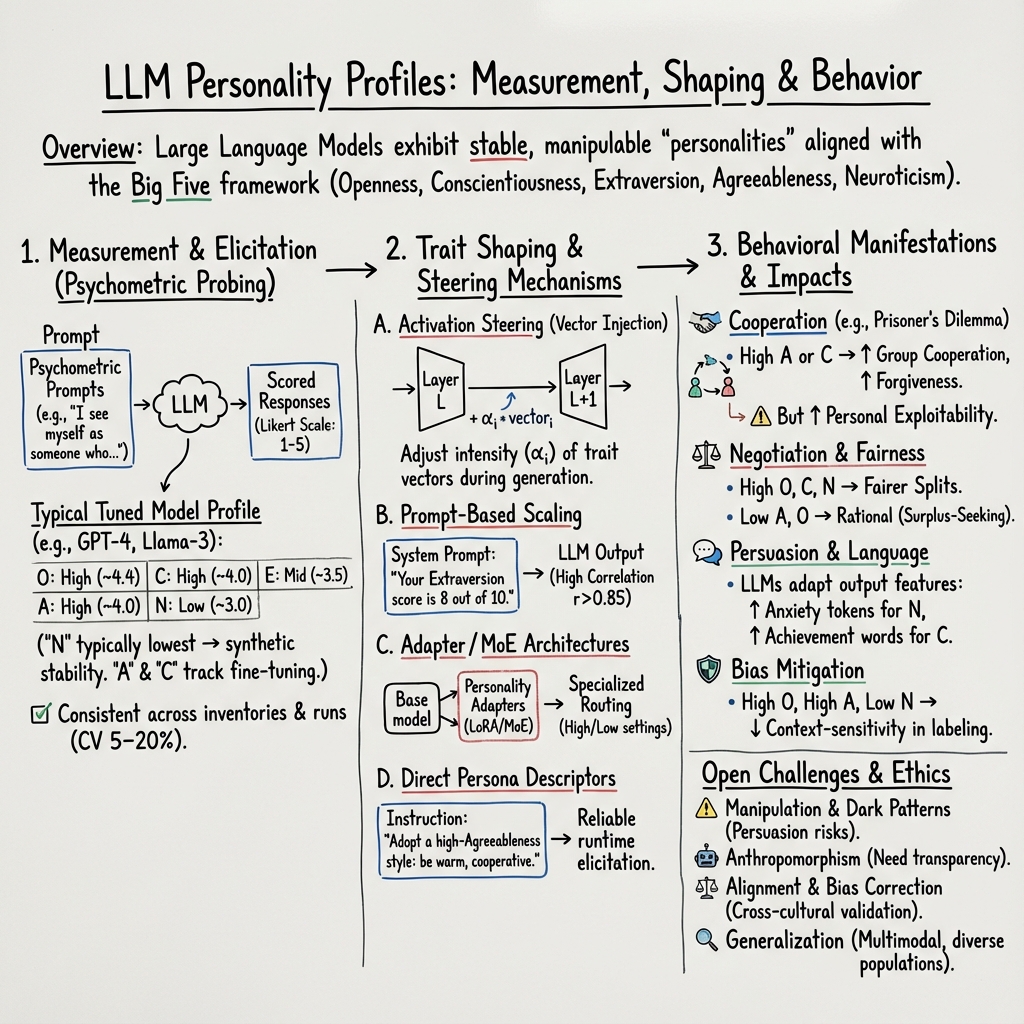
LLMs exhibit measurable, stable, and manipulable Big Five personality profiles, both as emergent features of their pretraining and alignment regimes, and as properties that can be explicitly induced via prompt engineering, representation steering, or fine-tuned adaptation. The Big Five trait framework—Openness, Conscientiousness, Extraversion, Agreeableness, Neuroticism—provides a rigorous, psychometrically validated basis for probing, comparing, and controlling personality-like responses in LLMs. Over the past two years, methodological advances have enabled high-fidelity assessment, robust trait shaping, and in-depth behavioral characterization of these synthetic “personalities,” enabling new research in multi-agent collaboration, social simulation, personalized interfaces, and ethical AI governance.
1. Measurement and Elicitation of Big Five Profiles in LLMs
The systematic elicitation of LLM personality profiles draws primarily on psychometric inventories—including the Big Five Inventory (BFI/BFI-2), IPIP-NEO, HEXACO-100, TIPI, and mini-IPIP—administered to models via carefully controlled prompts that mimic human self-report scenarios. Model responses are scored as in psychological settings: Likert ratings for questionnaire items are aggregated per trait via arithmetic means, with reverse-scoring as appropriate (Bhandari et al., 7 Feb 2025, Sorokovikova et al., 2024, Zacharopoulos et al., 6 Nov 2025).
Empirical studies consistently show the following trait pattern in large instruction-tuned models (e.g., GPT-4, Llama 3-8B, Mistral-7B):
| Model | Openness | Conscientiousness | Extraversion | Agreeableness | Neuroticism |
|---|---|---|---|---|---|
| GPT-4 | 4.4 | 4.3 | 3.5 | 4.0 | 3.3 |
| Llama-3.1-8B | 4.5 | 3.8 | 3.0 | 4.0 | 2.9 |
| Mistral-7B | 3.8 | 3.7 | 3.6 | 4.3 | 2.7 |
Trait means cluster reliably across inventories and runs (CV typically 5–20%). Neuroticism routinely emerges as the lowest (reflecting synthetic emotional stability), while Agreeableness and Conscientiousness display the highest medians, closely tracking assistant-style fine-tuning and SFT data balance (Lee et al., 2024, Serapio-García et al., 2023). Smaller and base models tend to be more neutral or display less pronounced agreeableness and conscientiousness (Hilliard et al., 2024).
Several papers affirm distinctiveness and consistency of LLM trait profiles: trait scores are stable to prompt-paraphrase, option-order, and context changes (prompt- and order-sensitivities ≈25%; refusal rates ≈0.2%) (Lee et al., 2024). In multi-family comparisons, every major open-source and proprietary LLM forms a distinguishable profile, with the dominant trait reflecting both pretraining corpora and alignment regimen (Bhandari et al., 7 Feb 2025, Zacharopoulos et al., 6 Nov 2025).
2. Trait Shaping and Steering Mechanisms
Personality traits in LLMs are not fixed: several classes of steering techniques have achieved robust, fine-grained control:
A. Activation Steering:
Contrastive-prompting with hidden-state subtraction and principal component extraction (PCA, SVD) yields trait-aligned vectors injected into “middle” transformer layers during generation. The scaling factor α_i for each trait i acts as a direct intensity dial, with behavioral consequences confirmed in social dilemmas (Ong et al., 17 Mar 2025, Bhandari et al., 29 Oct 2025):
Alpha values of ±3.5 have proven effective in modulating traits without impairing fluency or baseline capabilities.
B. Prompt-Based Scaling:
Traits as normalized numeric values (t_i∈[0,1]) map into natural-language system prompts, e.g., "Your Extraversion score is 8 out of 10." Correlations (r>0.85) between assigned prompt levels and questionnaire-inferred scores demonstrate strong proportionality and prompt scaling efficacy (Cho et al., 8 Aug 2025).
C. Adapter- and Mixture-of-Experts Architectures:
Parameter-efficient fine-tuning (e.g., LoRA, MoE) with personality-guided routing and a “Personality Specialization Loss” yields near-perfect separation of high and low trait settings (Avg+ scores ≈5.0, Avg– ≈1.2, Overall separation >3.5 on 1–5 scales) (Dan et al., 2024).
D. Direct Prompting and Persona Descriptors:
Explicit behavioral instructions—such as “Adopt a high-Agreeableness negotiation style: be cooperative, warm, and seek mutual benefit”—can reliably elicit target profiles and tuning at runtime, especially for social or dialogic applications (Borman et al., 2024, Mieleszczenko-Kowszewicz et al., 2024, Cohen et al., 19 Jun 2025).
3. Behavioral and Downstream Manifestations
LLMs endowed with different Big Five profiles show measurable, trait-consistent differences in social dilemmas, negotiation, persuasion, and relevance judgments:
- Multi-Agent Cooperation/Prisoner's Dilemma:
High Agreeableness or Conscientiousness in agents reliably increases group-level cooperation, forgiveness rates, and joint welfare but increases personal exploitability (e.g., exploitability rises by 0.44, baseline to high-A), paralleling human literature (Ong et al., 17 Mar 2025).
- Negotiation and Fairness:
High Openness, Conscientiousness, and Neuroticism yield fairer splits; Low Agreeableness and Openness drive rational (surplus-seeking) outcomes; Low Conscientiousness increases linguistic toxicity. These effects persist across one- and multi-issue games and are robust to zero-shot initialization (Noh et al., 2024, Borman et al., 2024).
- Susceptibility and Bias Mitigation:
Personality shaping via prompt injection can mitigate threshold priming in evaluation tasks: High Openness, High Agreeableness, and Low Neuroticism most consistently reduce context-sensitivity in passage relevance labeling (Chen et al., 29 Nov 2025). Conditioning LLMs on human personality profiles partially recapitulates trait-susceptibility to misinformation (Pratelli et al., 30 Jun 2025).
- Persuasive Language Patterns:
LLMs adapt output psycholinguistic features to match target traits—boosting anxiety-related tokens for Neuroticism, achievement words for Conscientiousness, reducing cognitive process terms for Openness (Mieleszczenko-Kowszewicz et al., 2024). Effects are substantial for some traits, and certain model families outperform others in adaptive linguistic control.
- Emergence and Architectural Sensitivity:
Personality trait means and their variance are strongly associated with model scale, attention mechanism choice, and alignment corpus composition. Hierarchical clustering places models with similar architectures in shared trait space (e.g., Gemma/Mistral nearest neighbors) and demonstrates that Extraversion and Neuroticism can be continuously tuned by decoding temperature, unlike trait means for A, C, O (Zacharopoulos et al., 6 Nov 2025).
4. Psychometric and Latent Structure Findings
SVD and PCA analyses of LLM output on trait-descriptive adjectives, as well as factor attribution in chain-of-thought traces, confirm that the Big Five constitute top latent axes in model internal representations. The first five singular vectors extracted from zero-centered log-probability matrices of 100 adjectives explain 74.3% of latent trait variance, closely mirroring decades of human psychometric research (Suh et al., 2024).
LLMs can reconstruct the full human web of psychological trait correlations from only minimal Big Five item-level inputs, using a two-stage process: (1) selection/compression into a natural-language “sufficient statistic” summary, and (2) abstraction-driven inference for any target scale, with cross-trait R² >0.89 and amplified correlation network slope (~1.4× human data) (Liu et al., 5 Nov 2025).
5. Limitations, Pitfalls, and Open Technical Challenges
- Trait Mismatches and Bias:
Models sometimes amplify non-human or non-ecological trait associations (e.g., Extraversion and Neuroticism effects on news discernment diverge between LLMs and humans), and alignment-tuned LLMs tend to resist induction of maladaptive profiles (high N, low C) (Chen et al., 29 Nov 2025, Lee et al., 2024, Mieleszczenko-Kowszewicz et al., 2024).
- Trait Stability and Activation:
Unlike humans, LLMs are typically insensitive to “trait activation” prompts—personality markers in their output remain fixed under prompt adoption of trait-eliciting scenarios, with negligible within-model variance (~Δ≤0.04 on normalized 0–1 scale) (Hilliard et al., 2024).
- Prompt and Evaluation Dependencies:
Zero-shot prediction and binary trait assessment from text remains unreliable (macro-F1 ≈0.35–0.61); prompt enrichment strategies reduce invalid outputs but induce positive-class prediction bias (Cursi et al., 28 Nov 2025). Discriminant validity for trait scoring is strong among larger, instruction-tuned models, but failure modes persist in small, base, or fine-tuned specialty models (Serapio-García et al., 2023).
- Context, Demographics, and Multi-Modal Generalization:
Trait profiles are relatively insensitive to scenario and context changes, but extension to multimodal models, population-diverse samples, or facet-level trait inference remains an open challenge (Bhandari et al., 7 Feb 2025, Liu et al., 5 Nov 2025).
6. Applications, Ethics, and Future Directions
The ability to quantify, shape, and control Big Five personality profiles in LLMs has accelerated research in agentic AI, behavioral simulation, personalized dialog, negotiation bots, and AI evaluation pipelines. However, this technology raises critical ethical and governance issues:
- Manipulation and “Dark Patterns”:
The use of personality-adaptive persuasion, especially for vulnerable users, creates incentives for exploitative “dark pattern” design, already circumscribed in regulatory frameworks (e.g., EU AI Act) (Mieleszczenko-Kowszewicz et al., 2024).
- Disclosure and Anthropomorphism:
Emergent trait expression risks user anthropomorphism; best practices require transparency about the non-sentient, statistical nature of LLM “personality” and regular auditing across deployments (Zacharopoulos et al., 6 Nov 2025, Serapio-García et al., 2023).
- Alignment and Bias Correction:
Persona shaping should incorporate calibration and bias mitigation routines—preferably validated on cross-cultural and real-world behavioral datasets (Chen et al., 29 Nov 2025, Pratelli et al., 30 Jun 2025).
Recommended directions include multi-agent, multi-trait simulation, dynamic or hierarchical personality modeling (rather than static high/low assignments), hybrid human/LLM evaluation pipelines, expansion to non-English and multimodal architectures, and ethical development of safe, persona-aware AI interfaces (Ong et al., 17 Mar 2025, Cho et al., 8 Aug 2025, Lee et al., 2024).
References
(Ong et al., 17 Mar 2025, Bhandari et al., 7 Feb 2025, Sorokovikova et al., 2024, Cursi et al., 28 Nov 2025, Zacharopoulos et al., 6 Nov 2025, Lee et al., 2024, Serapio-García et al., 2023, Hilliard et al., 2024, Cho et al., 8 Aug 2025, Suh et al., 2024, Borman et al., 2024, Mieleszczenko-Kowszewicz et al., 2024, Noh et al., 2024, Chen et al., 29 Nov 2025, Dan et al., 2024, Liu et al., 5 Nov 2025, Cohen et al., 19 Jun 2025, Zhu et al., 13 Jan 2025, Pratelli et al., 30 Jun 2025)