AliceAI-Foundation-80B-A3B-Base
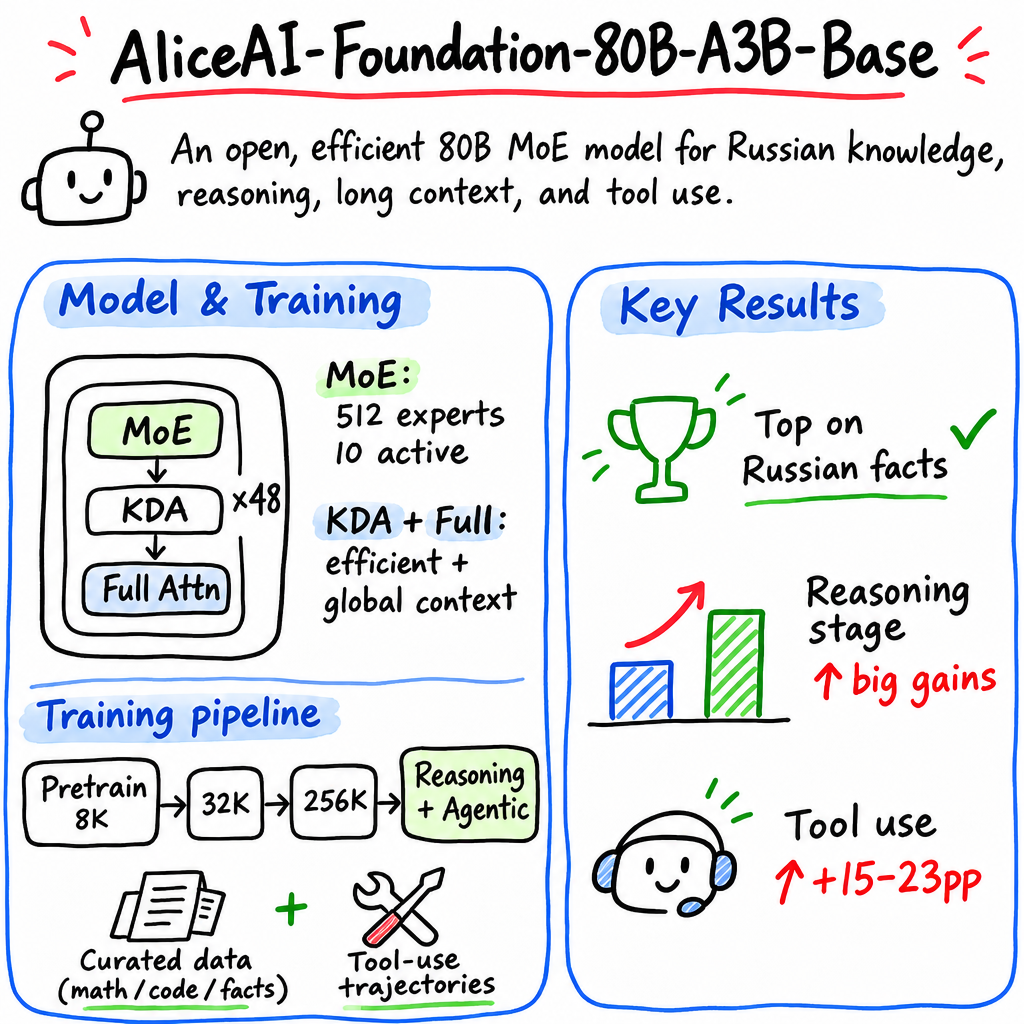
Abstract: We present AliceAI-Foundation-80B-A3B-Base, a mixture-of-experts LLM with 80 billion total parameters and approximately 3 billion active parameters per token, trained from scratch at Yandex and released under the Apache 2.0 license. The model combines Kimi Delta Attention with full attention, uses Attention Residuals, and is trained with Muon. Training comprises general pretraining on 17.5 trillion tokens, two context-extension stages, and a dedicated stage for reasoning and agentic interaction. We describe the data collection and augmentation pipelines, evaluation protocols, architectural ablations, and scaling-law experiments. We identify the limitations of held-out training loss as a proxy for downstream performance and introduce an auxiliary loss on mixture-of-experts outputs to stabilize training at the predicted learning rate. Domain-specific data selection and augmentation improve factual knowledge, mathematics, and programming skills, while agent trajectories introduced during pretraining improve performance on agentic benchmarks after supervised fine-tuning. In zero-shot reasoning evaluation, the model achieves leading results among open base models of comparable size, with 88.7% pass@8 on IMO-AnswerBench and 82.9% pass@8 on LiveCodeBench v5-v6. To evaluate Russian-language factual knowledge, we introduce and release two benchmarks with their evaluation protocols: WikiWebFacts, which tests short factual questions drawn from encyclopedic sources and search queries, and HardMultiQA, which tests more demanding factual questions inspired by user interactions. Our model scores 86.5% on WikiWebFacts and 67.9% on HardMultiQA, compared with 83.2% and 65.4% for DeepSeek-V4-Flash-Base (284B total and 13B active parameters) and 72.8% and 54.5% for Nemotron-3-Super-120B-A12B-Base (120B total and 12B active parameters), outperforming both larger models on these benchmarks.
Paper Prompts
Sign up for free to create and run prompts on this paper.
Explain it Like I'm 14
1. What is this paper about?
This paper introduces AliceAI-Foundation-80B-A3B-Base, a LLM created by Yandex. A LLM is a computer system trained to understand and produce text, answer questions, solve problems, write code, and reason through difficult tasks.
The model was trained from the beginning, rather than being built by making small changes to another model. The researchers wanted to create a strong, publicly available foundation model, especially for:
- Russian-language knowledge
- Mathematics and logical reasoning
- Computer programming
- Understanding very long texts
- Supporting AI assistants that can use tools and complete tasks
The model is released under the Apache 2.0 license, which generally allows people and organizations to use, study, modify, and share it under the license terms.
2. What questions did the researchers investigate?
The researchers mainly wanted to find out:
- How well can a smaller model perform compared with larger models? AliceAI-Foundation has 80 billion total parameters, but only about 3 billion are used for each piece of text it processes. The researchers compared it with models containing up to 284 billion total parameters.
- What training data makes the model better? They studied whether adding more Russian-language facts, educational material, mathematics, programming examples, and other specialized information improved performance.
- Which model design works best? They tested different ways for the model to process information and decide which parts of its “brain” should handle each task.
- Can the model reason through difficult problems? They tested mathematics, programming, academic questions, and other tasks that require several steps of thinking.
- Can the model work with very long texts? They tested whether it could find and combine information spread across long conversations and documents.
- What helps an AI assistant use tools and complete tasks? They investigated whether training with examples of tool use and interactions would help the model behave more like an agent—an AI that can plan and act, not just answer questions.
- How can training be kept stable? Very large models can sometimes become unstable during training. The researchers looked for ways to prevent the model’s internal numbers from growing too large and causing training to fail.
3. How was the research carried out?
Training the model
The model was trained on 17.5 trillion tokens during its main training stage. A token is a small piece of text, such as a word, part of a word, or punctuation mark.
To imagine this, think of training a student by giving them an enormous library to read. The model studies examples of language and learns patterns such as:
- Which words usually go together
- How facts are expressed
- How mathematical solutions are written
- How computer programs work
- How to follow instructions
The researchers then used several additional training stages:
| Training stage | Main purpose |
|---|---|
| General pretraining | Learn language, facts, mathematics, code, and general skills |
| 32K context extension | Learn to handle longer pieces of text |
| 256K context extension | Learn to process extremely long documents or conversations |
| Reasoning and agent training | Improve step-by-step problem solving and tool-based interaction |
Mixture-of-experts design
The model uses a design called mixture of experts, or MoE.
Imagine a school with hundreds of specialist teachers. One teacher might be especially good at mathematics, another at history, and another at programming. For each question, only a small group of teachers is asked to help.
AliceAI-Foundation has 80 billion total parameters, which are like adjustable settings inside the model. However, only about 3 billion active parameters are used for each token. This can make the model cheaper and faster to run than a model that uses all of its parameters every time.
The model contains 512 expert networks, and about ten are selected for each token.
Testing different designs
The researchers did not simply choose one design immediately. They trained smaller experimental versions and compared them. This is called an ablation study.
An ablation study is similar to testing a racing bicycle by changing one part at a time:
- First, use better training data.
- Then, use a different model structure.
- Finally, change the training settings.
This helps researchers estimate which change caused an improvement.
They found that:
- Better data improved factual knowledge, mathematics, programming, and reasoning.
- Architecture changes were especially useful for programming and reasoning.
- Better training settings helped mathematics and factual knowledge.
- Combining all three produced the strongest overall results.
Evaluating the model
The researchers tested the model on many different benchmarks. A benchmark is a collection of questions or tasks used to compare systems.
These included:
- Russian factual questions
- School and university subjects
- Medicine and law
- Mathematics competitions
- Programming problems
- Long conversations and documents
- Planning and tool-use tasks
They also created two Russian-language benchmarks:
- WikiWebFacts: shorter factual questions based on encyclopedias and common search needs.
- HardMultiQA: harder questions requiring comparison, lists, error finding, and combining several facts.
Human reviewers checked many of the questions to make sure they were clear and had reliable answers.
Understanding the scores
For some difficult tasks, the researchers used pass@k. This means the model is allowed to try several times.
For example, pass@8 asks: “Did the model solve the problem correctly in at least one of eight attempts?” This is useful because a reasoning model may sometimes make a mistake even when it is capable of finding the correct answer.
4. What were the main results?
Strong Russian-language knowledge
AliceAI-Foundation performed particularly well on Russian factual and cultural questions.
It scored:
- 86.5% on WikiWebFacts
- 67.9% on HardMultiQA
These results were better than those of two larger comparison models:
| Model | WikiWebFacts | HardMultiQA |
|---|---|---|
| AliceAI-Foundation-80B-A3B-Base | 86.5% | 67.9% |
| DeepSeek-V4-Flash-Base | 83.2% | 65.4% |
| Nemotron-3-Super-120B-A12B-Base | 72.8% | 54.5% |
This is important because it suggests that a model does not automatically become better simply by having more parameters. The quality and relevance of the training data also matter greatly.
The model was especially strong in areas such as:
- Russian history
- Literature
- Culture
- Medicine
- Law
- Russian school subjects
Strong mathematics and programming
The model achieved:
- 91.1% on MATH-500
- 88.7% pass@8 on IMO-AnswerBench
- 82.9% pass@8 on LiveCodeBench
- 60.4% pass@1 on LiveCodeBench
These results show that the model can solve many difficult mathematics and programming problems, especially when it is allowed several attempts.
It tied for first place on the AIME mathematics test and performed very strongly on other advanced mathematics competitions.
Long-context abilities
The model could process contexts of up to 128,000 tokens during evaluation. That is roughly comparable to many long books or very large documents, although the exact number of pages depends on the type of text.
It performed well on tasks requiring it to:
- Search through long conversations
- Connect information from different parts of a document
- Find relevant information in several financial reports
- Answer questions after reading a large amount of text
Training stability
The researchers discovered that the model’s internal values could grow too large during training. This caused a sudden increase in error, known as a loss spike, which can damage or ruin training.
They added an extra mathematical penalty called a Z-loss. In simple terms, this penalty tells the model:
“Do not let certain internal signals become unnecessarily huge.”
This stabilized training without noticeably reducing performance. It worked somewhat like a safety system that stops a machine from accelerating out of control.
Tool use and agent behavior
The researchers found that simply giving the model long reasoning explanations was not enough to create a strong tool-using assistant.
The model improved more when its training examples included agent trajectories—records of an AI interacting with tools, users, websites, or software.
This suggests that an AI assistant needs to learn not only how to think, but also how to:
- Make a plan
- Take an action
- Check the result
- Correct mistakes
- Continue until the task is finished
5. Why are these findings important?
The paper shows several important lessons.
Bigger is not always better
AliceAI-Foundation sometimes outperformed models that were much larger. This suggests that:
- Carefully selected training data matters.
- A good architecture matters.
- Training settings matter.
- A smaller active model may be more efficient.
Local language and culture need special attention
The researchers argue that translating English tests into Russian is not enough. Russian-speaking users may ask about different historical events, writers, laws, geography, and cultural topics.
Their new benchmarks are designed around real Russian-language information needs. This could help researchers build AI systems that work better for specific languages and communities.
AI models need broad testing
A model can be excellent at mathematics but weak at factual questions, or good at short answers but poor at long documents. The researchers therefore used many kinds of tests instead of relying on one score.
This is important because benchmark results do not perfectly predict how useful a model will be in everyday life.
6. Limitations and things to keep in mind
The results are promising, but the paper also reveals some limits.
- Benchmark scores are not the same as real intelligence. A model may score well on tests but still make confident mistakes.
- Results can depend on the prompt. Small changes in the wording of a question or example can change the score.
- Some evaluations used automated judges. Another LLM helped decide whether answers were correct, and such judges can sometimes make mistakes.
- Pass@8 gives the model multiple chances. This shows what the model can solve when it tries repeatedly, but it may not represent the quality of its first answer.
- The model is a base model, not necessarily a finished chatbot. It may need additional instruction training, safety training, and testing before being used directly by the public.
- Long-context performance was tested at 128K tokens. The researchers trained with a 256K-token stage, but the reported results do not prove that the model works equally well at 256K.
7. Overall conclusion
This paper presents a powerful open LLM trained from scratch. AliceAI-Foundation combines a large mixture-of-experts design, carefully selected data, special attention methods, and training techniques intended to improve reasoning and stability.
Its most notable achievement is that it performs better than several larger models on many Russian-language factual tasks, while also showing strong abilities in mathematics, programming, and long documents.
The research could lead to more capable and efficient AI assistants, especially for Russian-speaking users. It also teaches future researchers that building a good AI is not only about adding more parameters. The data, model design, training process, testing methods, and examples of real-world tool use all play an important role.
Practical Applications
Immediate Applications
The released Apache 2.0 checkpoint and public evaluation datasets make several applications feasible now, although most production deployments would still require instruction tuning, retrieval, safety controls, and domain validation.
- Russian-language search and question answering — Search, consumer software, public information services.
- search-result summarization;
- question reformulation and intent classification;
- multilingual information assistants;
- answer drafting over retrieved Yandex or enterprise documents.
- Dependencies: retrieval or browsing is needed for current facts; factual hallucinations and benchmark saturation require citation, abstention, and human-quality monitoring.
- Educational tutoring and examination preparation — Education and edtech. Fine-tune the base model into a Russian-language tutor for school subjects, literature, history, English, and mathematics. Potential products include step-by-step problem explainers, adaptive practice generators, feedback on written answers, and examination-preparation assistants. The model’s performance on Russian educational benchmarks and MATH-500 supports initial pilots. Dependencies: the base checkpoint is not an instruction-following tutor; curricula, age-appropriate safeguards, plagiarism policies, teacher review, and validation against official educational standards are required.
- Mathematical reasoning and technical problem solving — Education, research, engineering, and finance.
- automated solution drafting;
- symbolic or numerical reasoning assistants;
- research-problem exploration;
- checking intermediate steps in educational content.
- Dependencies: pass@k measures whether one of several samples succeeds, not whether the first answer is reliable. A symbolic calculator, theorem prover, or independent verifier should validate outputs.
- Code generation, debugging, and code review — Software engineering and developer tools. Integrate the model into IDE assistants, code-completion systems, test-generation pipelines, documentation tools, and code-review workflows. Its LiveCodeBench, BigCodeBench, and zero-shot programming results indicate usefulness for algorithm design and implementation, particularly when several candidate programs are generated and automatically tested. Dependencies: generated code must run in sandboxed environments with unit tests, static analysis, dependency controls, and secret isolation. The reported BigCodeBench results use a modified test suite, so production performance may differ.
- Long-document and conversation analysis — Legal operations, finance, enterprise knowledge management, and customer support.
- extracting facts and obligations from contracts;
- comparing financial disclosures;
- maintaining context across long customer conversations;
- producing document-grounded executive summaries.
- Dependencies: long context does not guarantee accurate retrieval or reasoning over every passage. Systems should use document chunking, citations, structured extraction, access controls, and targeted evaluations. The paper does not establish reliable performance at the advertised 256K training context.
- Financial-document question answering and analysis — Finance and accounting. Build assistants that identify relevant passages in large financial reports and perform calculations over extracted figures, extending the FinQA-style workflow to enterprise filings and internal reports. Such tools can support analyst research, first-pass due diligence, and report navigation. Dependencies: numerical calculations should be performed by deterministic software; data freshness, accounting-standard differences, document parsing quality, and regulatory review are critical.
- Medicine and law information support — Healthcare and legal services. Use the model for low-risk information retrieval, intake summarization, terminology explanation, case or symptom-question organization, and drafting materials for professional review. Its comparatively strong Russian medicine and law scores indicate potential for internal decision-support prototypes. Dependencies: the reported scores are insufficient for autonomous diagnosis, treatment, legal advice, or adjudication. Deployment requires expert validation, privacy protection, jurisdiction-specific tuning, uncertainty estimation, audit logs, and explicit escalation to qualified professionals.
- Benchmarking and model-development infrastructure — Academia and industrial AI research.
- domain-specific data selection;
- human and expert review of generated data;
- contamination checks;
- multiple-sample evaluation;
- output-activation monitoring during MoE training.
- Dependencies: benchmark leakage, LLM-as-a-judge bias, prompt sensitivity, and limited domain coverage require human audits and independent test sets.
- Open-source enterprise assistants and consumer applications — Software, productivity, and daily life. Because the weights are released under Apache 2.0, organizations can host the model privately for drafting, translation support, summarization, personal knowledge management, and customer-service assistance without depending entirely on a third-party API. Dependencies: an 80B-parameter MoE model still requires substantial GPU memory, inference optimization, quantization, and serving infrastructure. The Apache license does not remove obligations related to privacy, copyright, safety, or sector-specific regulation.
Long-Term Applications
The following applications are technically plausible but require additional post-training, reliability research, scaling, or operational safeguards before broad deployment.
- Tool-using personal and enterprise agents — Productivity software, search, travel, commerce, and customer service.
- a tool-calling policy;
- a planner and execution monitor;
- permissions and approval gates;
- persistent memory;
- trajectory replay and failure analysis.
- Dependencies: the released model is a base model rather than a fully reliable autonomous agent. Tool-use SFT, reinforcement learning, environment-specific testing, authentication controls, and safe rollback mechanisms are required.
- Software-engineering agents capable of repository-level changes — Developer platforms and DevOps. With further SFT and RL, the model could evolve into an agent that investigates issues, edits multiple files, runs tests, proposes pull requests, and updates documentation. Its long-context and coding abilities are promising for repository-scale workflows. Dependencies: SWE-bench-style success does not establish safe production autonomy. Agents need reproducible builds, isolated execution, code-owner approval, secure handling of credentials, regression testing, and defenses against prompt injection in repositories and issue trackers.
- Advanced multilingual search and knowledge systems — Search engines, libraries, education, and public administration. The Russian-focused data pipeline and benchmarks could be extended to other languages and regions, producing culturally adapted retrieval-augmented systems rather than simple translations of English benchmarks. Such systems could provide localized access to government information, historical archives, educational resources, and public knowledge. Dependencies: expansion requires representative local data, expert annotation, rights-cleared corpora, dialect coverage, bias evaluation, and protection against politically or culturally harmful errors.
- High-reliability professional copilots — Healthcare, law, finance, and public policy. Domain-specific post-training could produce systems that draft clinical summaries, legal research memos, regulatory analyses, or financial due-diligence reports while preserving source citations and uncertainty estimates. The paper’s expert-reviewed benchmark methodology provides a template for developing such systems. Dependencies: expert benchmark performance must be supplemented by prospective workflow studies, calibration testing, privacy-preserving training, explainability, liability allocation, and regulatory approval where applicable. Human professionals should remain accountable for consequential decisions.
- Adaptive education platforms — Schools, universities, and lifelong learning. A future system could maintain a learner model, diagnose misconceptions, generate individualized exercises, provide Socratic explanations, and adapt difficulty over time. The model’s mathematics, language, history, and literature capabilities provide a foundation for this type of personalized instruction. Dependencies: longitudinal learning outcomes, age and accessibility considerations, teacher governance, protection of student data, and prevention of overreliance or answer copying must be studied. Benchmark scores alone do not demonstrate improved learning.
- Efficient large-scale AI infrastructure based on sparse MoE models — Cloud computing and AI systems engineering. The architecture—80B total parameters with approximately 3B active parameters per token—could motivate cost-efficient deployment of high-capability models, particularly for high-throughput services. The paper’s output Z-loss may also be reused to stabilize large MoE training at aggressive learning rates. Dependencies: practical gains depend on expert-routing overhead, communication bandwidth, load balancing, memory capacity, quantization quality, and hardware support. The reported stabilization result should be replicated across architectures, datasets, and scales before becoming a general training standard.
- Robotics and embodied agents — Robotics, logistics, and smart environments. After grounding in visual, spatial, and sensor data, the model could serve as a high-level planner for robots that interpret instructions, decompose tasks, call navigation or manipulation tools, and recover from failures. Its agentic-training methodology may transfer to simulated environments. Dependencies: the paper evaluates language and software-agent tasks rather than physical control. Real deployment requires multimodal perception, low-latency control models, simulators, safety constraints, robust state estimation, and extensive physical testing.
- Policy analysis and public-service automation — Government and civic technology. Public agencies could use adapted versions to summarize regulations, compare policy documents, answer routine citizen questions, and identify inconsistencies across large collections of administrative material. Russian-language factual performance is particularly relevant to localized public-information systems. Dependencies: official-source grounding, archival version control, non-discrimination testing, transparency, records retention, accessibility, and human review are essential. The system should not independently determine eligibility, benefits, enforcement, or legal outcomes.
- Automated evaluation and data-generation pipelines — Academic research and AI governance. The paper’s use of anonymized user queries, expert review, adversarial difficulty adjustment, and task-specific grading could become a general workflow for constructing realistic evaluation suites. This may support continuous monitoring of factuality, refusal behavior, robustness to distracting context, and domain-specific regressions. Dependencies: user-query datasets require strong anonymization and consent governance; LLM-based grading can reproduce systematic biases; and benchmarks must be refreshed to limit contamination and prevent optimization to narrow scores.
- Everyday multimodal assistants — Consumer technology and accessibility. With additional vision, speech, browsing, and action modules, the model could support Russian-speaking users with household planning, document interpretation, travel preparation, accessibility assistance, and personal information management. Dependencies: the current paper evaluates a text base model, not a multimodal assistant. Future systems would require speech and vision training, secure personal memory, permissioned device access, robust privacy controls, and reliable handling of ambiguous or safety-critical requests.
Glossary
- Ablation experiment: A controlled study that changes one component at a time to measure its contribution to system performance. “Specifically we quantify the contributions of the corpus, architecture, and hyperparameters through sequential ablation experiments”
- Agentic interaction: Interaction in which a model autonomously performs tasks, often by planning and using tools or services. “a dedicated stage for reasoning and agentic interaction”
- Attention Residuals (AttnRes): A mechanism that replaces ordinary residual addition with learned combinations of representations from different network depths. “Attention Residuals (AttnRes) replaces conventional residual summation with learned weighting of representations across depth.”
- Auxiliary loss: An additional training objective introduced to encourage a desired property, such as stable activations or balanced routing. “We introduce an auxiliary loss on mixture-of-experts outputs to stabilize training”
- Base model: A pretrained LLM that has not undergone instruction tuning or task-specific post-training. “In base-model evaluations, the model outperforms the larger”
- Batch size: The number of training tokens or examples processed in one optimization step. “Batch size is measured in tokens.”
- Benchmark saturation: The condition in which increasingly capable models obtain similar high scores on an evaluation set. “Scores tend to saturate for the strongest models”
- Clipped SwiGLU: A variant of the SwiGLU activation function in which values beyond a threshold are truncated to limit their effect on training. “We also tested hard-clipped SwiGLU as implemented in GPT-OSS.”
- Context extension: Training or adapting a model to process substantially longer input sequences. “The next two stages extend context first to 32K and then to 256K”
- Context window: The maximum number of tokens that a model can process as a single input sequence. “The long-context evaluations reported here use up to 128K tokens.”
- Continued pretraining: Further training of an already pretrained model on additional data. “this model was developed through continued pretraining of Qwen3-235B-A22B”
- Data contamination: The presence of evaluation examples or closely matching material in a model’s training data. “To avoid inflated evaluation scores due to data contamination”
- Down-projection: A neural-network transformation that maps a higher-dimensional representation into a lower-dimensional space. “rapid growth in the MoE down-projection outputs”
- Early checkpoint: An intermediate saved state of a model during training, before the final training stage is complete. “WikiWebFacts remains useful for smaller models and early checkpoints”
- Few-shot prompting: Providing a model with a small number of examples before asking it to solve a new problem. “For standard reasoning benchmarks, we selected demonstrations that produced consistently strong results”
- Float32: A 32-bit floating-point numerical representation commonly used to reduce numerical error in computation. “All operations associated with this loss are computed in float32 to reduce numerical error for large activations.”
- Full attention: The standard attention mechanism in which each token can attend to all relevant tokens in the sequence. “36 use Kimi Delta Attention (KDA) and 12 use full attention.”
- Gated RMSNorm: A normalization method that applies a learned, feature-wise gate to a root-mean-square-normalized representation. “Gated RMSNorm provides an explicit mechanism”
- Greedy decoding: A generation strategy that selects the highest-probability token at every step. “We evaluate base models using five in-context examples and greedy decoding.”
- Held-out loss: The model’s loss measured on data excluded from the training set. “Held-out loss on the training distribution was a poor predictor of downstream benchmark rankings.”
- In-context example: An example included in a prompt to demonstrate the expected task or answer format. “We evaluate base models using five in-context examples and greedy decoding.”
- LLM judge: A LLM used to assess the correctness or quality of another model’s generated answer. “Most questions have short, unambiguous answers, making automated evaluation with an LLM-as-a-judge (LLMaJ) practical.”
- Log-sum-exp: A smooth mathematical approximation to the maximum of a set of values, often used in probabilistic machine learning. “Since log-sum-exp is a smooth approximation to the maximum”
- Long-context processing: The ability to reason over unusually large inputs containing many tokens or documents. “Our evaluations span factual knowledge, educational benchmarks, mathematics, programming, and long-context processing.”
- Macro-average: An unweighted average of scores across multiple tasks or categories. “The configuration incorporating all three components achieves the highest macro-average”
- Mixture of experts (MoE): A neural architecture containing multiple specialized subnetworks, of which only a selected subset is activated for each input. “The model is an MoE Transformer with 80B total parameters and approximately 3B active parameters per token.”
- Muon: An optimizer that uses momentum and approximate matrix orthogonalization based on Newton–Schulz iterations. “Muon (MomentUm Orthogonalized by Newton--Schulz) is an optimizer for matrix-valued neural-network parameters.”
- Newton–Schulz iteration: An iterative numerical procedure used here to approximately orthogonalize a matrix. “It computes momentum from gradients and approximately orthogonalizes the momentum matrix using Newton--Schulz iterations.”
- N-gram overlap: A measure of shared contiguous sequences of tokens between two texts. “we searched the training corpus for benchmark questions and answers using n-gram overlap”
- Orthogonalization: The process of transforming vectors or matrices so that their components are mutually orthogonal under a chosen inner product. “approximately orthogonalizes the momentum matrix”
- Pass@k: The fraction of problems for which at least one of independently generated solutions is correct. “pass@k, defined as the fraction of problems solved in at least one of attempts.”
- Post-training: Training performed after initial pretraining, such as supervised fine-tuning or reinforcement learning. “base-model evaluations predict performance after post-training.”
- Pretraining corpus: The large collection of text or other data used to initially train a LLM. “We constructed the baseline mixture from the pretraining corpus used for YandexGPT 5 Base”
- Random initialization: Starting model training with parameters assigned without using a previously trained model. “We trained the model from random initialization at Yandex”
- Reasoning trace: A sequence of intermediate steps generated to explain or support a model’s answer. “The evaluation prompts include demonstrations with reasoning traces.”
- Reinforcement learning (RL): A training method in which a model is optimized using reward signals associated with its behavior. “adding tool interactions during pretraining improved subsequent supervised fine-tuning (SFT) and reinforcement learning (RL).”
- Residual stream: The sequence of representations passed through the residual connections of a deep neural network. “Large persistent components of the residual stream can dominate the denominator of RMSNorm”
- RMSNorm: A normalization technique that scales activations using their root mean square rather than their mean and variance. “Large persistent components of the residual stream can dominate the denominator of RMSNorm”
- Routing: The process of assigning each token to selected experts in a mixture-of-experts model. “We first investigated whether changes to expert routing could resolve the instability.”
- Scaling law: An empirically observed relationship between model performance and quantities such as parameter count, data size, or compute. “Hyperparameters predicted by scaling laws exposed unstable growth in mixture-of-experts (MoE) activations”
- SFT: Supervised fine-tuning, in which a pretrained model is trained on labeled examples of desired inputs and outputs. “all compared base models therefore receive SFT on the same agentic dataset.”
- SwiGLU: A gated neural activation function that combines the Swish activation with a gated linear transformation. “Replacing SwiGLU with GLU, as recommended in the original work”
- Temperature: A sampling parameter that controls the sharpness of a model’s output probability distribution. “All measurements in this subsection use our internal evaluation infrastructure and vLLM inference with temperature~0 for every model.”
- Token: A unit of text processed by a LLM, such as a word, subword, or punctuation symbol. “approximately 3 billion active parameters per token”
- Top- routing: A mixture-of-experts routing strategy that selects the highest-scoring experts for each token. “retaining the original width and routing top- reproduced the failure.”
- Zero-shot evaluation: Evaluation in which the model receives no task-specific examples in the prompt. “In zero-shot reasoning evaluation, the released model achieves leading results among open base models of comparable size”