Clover-35B-A3B-Preview Technical Report
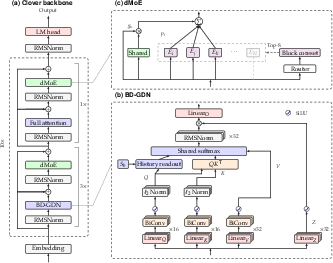
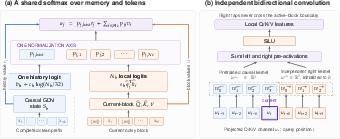
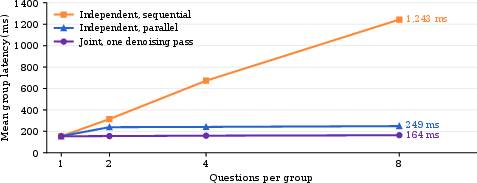
Abstract: We introduce Clover-35B-A3B-Preview (Clover), a mixture-of-experts diffusion LLM with 35 billion total parameters and 3 billion activated parameters, supporting thinking-mode generation. Clover adapts Gated Delta Networks to block diffusion by combining recurrent memory of previously generated context with bidirectional softmax attention inside the current block. Historical memory readout competes with current-block tokens in a shared softmax, with learnable block-size calibration and a separate, zero-initialized right-context convolution branch. Clover leads the seven evaluated agent metrics, including 73.6 on SWE-bench Verified and 51.7 on Terminal-Bench 2.1. On internal agent workloads, it reaches a reported generation speed of 680 tokens/s using one NVIDIA GB300 GPU at BF16 precision and batch size one. We organize the evaluation around model quality, drafting and verification costs, and deployment under constrained memory. We also describe a decision-model variant that generates answers to related questions in one denoising pass. On an internal set of 500 groups, joint prediction raises question accuracy from 90.37% to 93.88% and all-correct group accuracy from 65.4% to 77.0%.
Paper Prompts
Sign up for free to create and run prompts on this paper.
Explain it Like I'm 14
1. Paper overview
This paper introduces Clover-35B-A3B-Preview, a LLM designed especially for tasks where an AI must take actions, such as fixing computer code, using tools, or working inside a software project.
Most LLMs write text one word at a time. Clover uses a different method called a diffusion LLM. Instead of choosing every word in order, it can guess several words at once and gradually improve them, somewhat like filling in a puzzle while checking and correcting the answers.
The model has:
- 35 billion total parameters, which are the adjustable “settings” learned during training.
- About 3 billion active parameters per token, meaning it uses only part of the model for each piece of text.
- A special mixture-of-experts design, where different parts of the model specialize in different kinds of problems.
- A “thinking mode” for solving more difficult tasks.
The paper reports that Clover performs especially well on coding and computer-agent tests.
2. Main research questions and objectives
The researchers wanted to find out whether they could build a diffusion LLM that was both powerful and fast.
Their main questions were:
- Can diffusion LLMs solve difficult real-world tasks? For example, can Clover repair bugs in a software project or use computer tools successfully?
- Can the model generate text efficiently? Predicting many tokens at once could make generation faster than ordinary word-by-word models.
- How can the model remember earlier text? The model needs to understand the previous conversation or code while also examining several unfinished tokens at the same time.
- Can the model work well with limited computer memory? This matters if people want to run it on a single powerful graphics card or possibly on local devices.
- Can related questions be answered together? The researchers also tested a special version that answers a group of connected questions jointly, allowing the answers to help one another.
3. Research methods and approach
Diffusion-based text generation
In a normal LLM, text is usually generated from left to right:
“The cat” → “The cat sat” → “The cat sat on” → ...
Clover instead begins with some words hidden by special mask symbols. It then repeatedly guesses the missing words and improves its guesses. This is similar to solving a sentence with several blanks:
“The [MASK] sat on the [MASK].”
The model might first guess “cat” and “mat,” then check whether the whole sentence makes sense.
Clover works in blocks. A block is a small group of tokens, or pieces of text, that the model tries to generate together. It finishes one block before moving to the next. Inside a block, the model can look both left and right, which helps it understand the local sentence.
Memory for earlier text
To remember completed parts of the prompt and response, Clover uses a method called a Gated Delta Network.
A simple way to imagine this is a notebook:
- The model writes important information into the notebook.
- It can gradually forget information that is no longer useful.
- When generating new text, it searches the notebook for relevant information.
This memory uses less storage than keeping a separate copy of every earlier token. That can make long conversations and long coding tasks more manageable.
Clover combines two kinds of information:
- Compressed memory of the completed earlier text.
- Detailed attention to the unfinished tokens in the current block.
The paper also adds a small “right-context” system so that tokens inside the same block can use information from nearby tokens on both sides.
Mixture of experts
Clover contains many smaller specialist networks called experts. For each token, a router chooses only a few experts that seem useful.
This is like asking a team of specialists for help:
- One expert may be good at mathematics.
- Another may be better at programming.
- Another may understand instructions or general knowledge.
Although the complete model is very large, only some experts are used for each token. This helps reduce the amount of computation needed.
Training
The researchers trained Clover using two goals:
- Denoising training: The model learned to recover hidden or damaged tokens.
- Ordinary next-token training: The model also learned the usual task of predicting the next token in a sequence.
Using both goals was intended to give the model the advantages of diffusion generation while preserving strong ordinary language-model abilities.
Decoding and verification
When Clover generates a block, it first creates a draft containing several possible tokens. It then checks the draft using its more careful causal system.
Only the part of the draft that passes the check is accepted. The rest is generated again.
This is called self-speculative decoding. It is similar to writing several possible answers quickly and then having the same student check which answers are reliable before turning them in.
Evaluation
The researchers compared Clover with several diffusion and ordinary LLMs on 18 benchmarks. These tests covered:
- General knowledge
- Mathematics
- Programming
- Logical reasoning
- Following instructions
- Understanding long documents
- Using tools
- Completing software tasks
They also measured generation speed on NVIDIA GPUs.
4. Main findings
Strong performance on agent tasks
Clover performed best among the compared models on all seven reported agent benchmarks.
An AI agent is a system that does more than answer a question. It may inspect files, run commands, use tools, and change its plan based on the results.
Some important results were:
| Benchmark | Clover’s result | What it tests |
|---|---|---|
| SWE-bench Verified | 73.6 | Fixing real software issues |
| Terminal-Bench 2.1 | 51.7 | Completing tasks in a computer terminal |
| SWE-Pro | 46.5 | Professional software-engineering tasks |
| GDPval-AA v2 | 1091 Elo | Work-related agent performance |
| ZebraLogic | 95.8 | Logical reasoning |
| IFBench | 72.3 | Following detailed instructions |
| AA-LCR | 72.0 | Understanding long documents |
The SWE-bench result is particularly important because the model must often understand a real software repository, decide what to change, write code, and produce a working fix. Simply generating code that looks correct is not enough.
Competitive general abilities
Clover was very strong on several general tests, including:
- GPQA Diamond: 83.8
- MMLU-Pro: 84.8
- MATH-500: 96.2
- LiveCodeBench: 72.6
However, it did not win every test. For example, some Qwen models performed better on the hardest knowledge, mathematics, and standalone coding evaluations.
This suggests that Clover’s biggest advantage is not necessarily every individual academic question. Its greatest strength is combining reasoning with useful actions and tool use.
Fast generation in many situations
On one NVIDIA H200 GPU, Clover produced:
- 465.2 tokens per second on a mathematics workload
- 556.6 tokens per second on an agent replay workload
- 356.7 tokens per second on daily chat
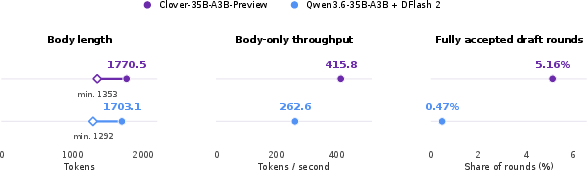
It was faster than the comparison system on agent replay and daily chat, but slower on the mathematics workload. This shows that speed depends on the type of task.
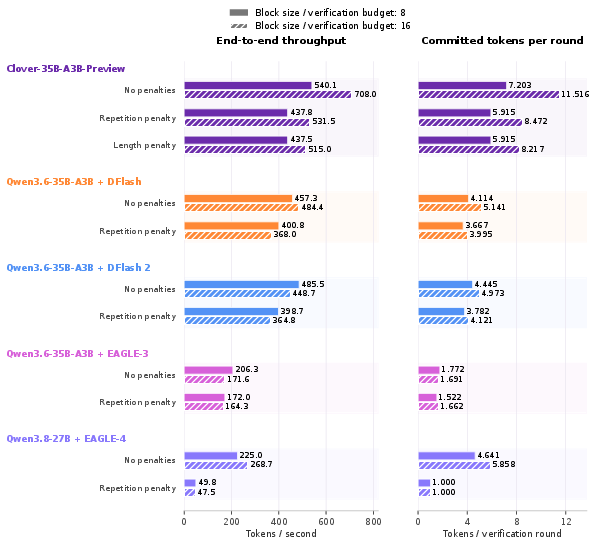
In another test, Clover reached:
- 515 tokens per second on an H200 GPU
- 680 tokens per second on a newer NVIDIA GB300 GPU
These numbers should be interpreted carefully. The tests measured text-generation speed, not whether the model successfully completed a full real-world task.
Joint answers to related questions
The paper also describes a decision-model version that answers related questions together rather than separately.
On an internal test containing 500 groups of questions:
- Accuracy for individual questions rose from 90.37% to 93.88%.
- The percentage of groups where every answer was correct rose from 65.4% to 77.0%.
This is important because connected decisions can support one another. For example, when planning several steps of a task, the model may produce more consistent answers if it considers all the steps together.
5. Why the findings matter
The results suggest that diffusion LLMs may be useful not only for writing text, but also for building fast computer-using agents.
Clover’s design could be helpful when an AI needs to:
- Repair software
- Use command-line tools
- Work with long documents
- Follow complicated instructions
- Produce many tokens quickly
- Run with limited memory compared with a fully active model of the same total size
Its mixture-of-experts structure may lower the amount of computation used for each token, while its diffusion approach allows several tokens to be predicted in parallel.
However, the paper is a technical report about a preview model, so the results should be treated with some caution. The experiments were performed by the model’s developers, and some tests used special decoding settings or internal datasets. Speed tests also do not always measure complete task success. Independent researchers would need to reproduce the results to confirm how well Clover works in other situations.
Overall, the paper presents Clover as a promising step toward AI systems that can combine strong reasoning, fast text generation, and practical computer actions. If these results hold up, models like Clover could make coding assistants and other AI agents faster and more capable.
Practical Applications
Immediate Applications
- Software engineering agents and repository maintenance — software / enterprise IT
- Deploy Clover as an agent that reads repositories, edits code, runs tests, diagnoses failures, and proposes or applies patches. Its reported results on SWE-bench Verified, SWE-Pro, Terminal-Bench, and Terminal-Hard indicate suitability for issue resolution, refactoring, debugging, and command-line workflows.
- A practical workflow could combine Clover with a sandboxed terminal, version-control integration, test runners, and human approval before merging changes.
- Dependencies and assumptions: The model must have secure tool permissions, repository access, reliable test environments, and safeguards against destructive commands. Benchmark results were obtained with specific harnesses and do not guarantee production reliability; human review remains necessary for high-impact code.
- DevOps, system administration, and infrastructure automation — cloud / IT operations
- Use Clover to interpret operational requests, inspect logs, generate shell commands, modify configuration files, and execute multi-step remediation procedures.
- Its strong Terminal-Bench performance and self-speculative decoding are relevant to interactive command-line agents where repeated model-tool exchanges make generation latency costly.
- Dependencies and assumptions: Commands should run in isolated environments with least-privilege credentials, dry-run support, audit logs, and rollback mechanisms. The reported 515–680 tokens/s figures are hardware-, workload-, and decoding-dependent and should not be treated as a general service-level guarantee.
- Tool-calling business assistants — customer support / enterprise productivity
- Integrate Clover with CRM, ticketing, calendar, document, inventory, or finance APIs to perform structured tasks such as updating records, scheduling meetings, preparing reports, and routing support cases.
- The model’s reported performance on tool-agent benchmarks, including and BFCL-v4, supports workflows requiring function selection, argument construction, and multi-step action planning.
- Dependencies and assumptions: APIs must expose validated schemas and authorization controls. Tool calls require argument validation, confirmation for irreversible actions, protection of private data, and monitoring for prompt injection.
- Long-document analysis and knowledge-work assistance — legal, consulting, research, and operations
- Exploit the stated 131,072-token context capacity and competitive AA-LCR result for summarizing large reports, comparing policies, extracting obligations, reviewing technical documentation, and answering questions over long project histories.
- The recurrent memory and compressed historical context may reduce the cost of processing long prompts relative to architectures that retain a full token-level attention cache at every layer.
- Dependencies and assumptions: Long-context capability does not ensure factual completeness or faithful retrieval. Applications should use document chunking, citations, retrieval verification, and evaluation on domain-specific documents. Context-window limits, memory compression, and prompt layout can affect accuracy.
- High-throughput interactive chat and drafting — consumer software / education / productivity
- Use Clover for conversational assistants, explanatory writing, brainstorming, technical drafting, and interactive tutoring where response generation speed matters.
- The reported daily-chat decode rate of 356.7 tokens/s on an H200 and end-to-end rates up to 680 tokens/s on a GB300 suggest potential for low-latency streaming under optimized configurations.
- Dependencies and assumptions: These measurements exclude or separately treat some prefill costs and depend on batch size, hardware, block size, verification budget, and penalties. Quality, repetition control, safety filtering, and moderation must be validated for the intended user population.
- Local or private AI assistants — on-device / edge computing
- Use the released weights and inference engine to build assistants that operate locally or within a private organizational network, reducing dependence on external APIs and potentially improving data confidentiality.
- Potential products include offline coding assistants, private document analysts, local research tools, and secure workplace copilots.
- Dependencies and assumptions: The model has 35B total parameters despite activating approximately 3B per token. Practical deployment therefore depends on quantization, memory management, supported consumer hardware, and optimized kernels. The paper’s on-device section is incomplete in the supplied text, so actual RAM, storage, power, and latency requirements should be measured independently.
- Inference-engine optimization and serving research — AI infrastructure
- Adopt or extend the model’s block-diffusion, confidence-aware decoding, self-speculative verification, recurrent-state caching, and block-aware mixture-of-experts routing in serving systems.
- These techniques can support adaptive decoding policies that trade quality, verification cost, and throughput according to workload requirements.
- Dependencies and assumptions: Throughput gains are not universal: Clover was slower than Qwen3.6 with DFlash 2 on the reported MATH-500 workload, despite being faster on agent replay and daily chat. Production systems should benchmark representative workloads rather than rely on a single tokens-per-second figure.
- Academic experimentation with diffusion LLMs — machine learning research
- Use the released model, weights, supervised fine-tuning code, and inference engine as a platform for studying masked diffusion, block generation, self-speculative decoding, recurrent memory, and sparse expert routing.
- Researchers can reproduce comparisons, test alternate block sizes, modify confidence thresholds, evaluate different verification rules, or fine-tune the model for specialized domains.
- Dependencies and assumptions: Reproducibility requires access to compatible hardware, exact checkpoints, tokenizer and decoding configurations, and the evaluation harnesses used in the report. The results are reported by the model developers and should be independently replicated.
- Joint prediction of related questions — assessment / decision support
- The decision-model variant can generate answers to several related questions in one denoising pass, potentially reducing shared computation in batch assessment, structured classification, survey analysis, and multi-criteria screening.
- The reported internal results improved per-question accuracy from 90.37% to 93.88% and all-correct group accuracy from 65.4% to 77.0%.
- Dependencies and assumptions: The evaluation used an internal set of only 500 groups. Joint prediction may help when questions share context or constraints, but it may introduce correlated errors. It requires task-specific formatting, calibration, and independent validation before use in admissions, hiring, medical, or financial decisions.
Long-Term Applications
- Reliable autonomous software development agents — software engineering
- Develop agents that autonomously decompose issues, modify multiple files, execute tests, inspect failures, revise patches, and open pull requests with evidence of correctness.
- Clover’s agent benchmark results provide a foundation, while block diffusion and fast verification could reduce latency across the many model calls required by repository-level workflows.
- Further requirements: Higher reliability on unseen repositories, robust planning over long trajectories, secure sandboxing, recovery from tool failures, provenance tracking, and formal or test-based verification. Benchmark task completion is not equivalent to safe autonomous deployment.
- General-purpose computer-use and workflow automation — office automation / robotics
- Extend the tool-agent design from APIs and terminals to browser automation, desktop interfaces, robotic control panels, and enterprise workflow systems.
- Parallel generation could be useful for proposing multiple related actions or structured action sequences, while causal verification could filter unsafe or inconsistent actions.
- Further requirements: Multimodal perception, grounding to changing interfaces, real-time control guarantees, action-level uncertainty estimates, and robust handling of ambiguous instructions. The current report evaluates text and tool environments rather than physical robots or visual interfaces.
- Long-horizon embodied agents — robotics
- The recurrent representation of completed context and block-level planning could eventually support robots that maintain compact task history while planning successive action blocks.
- Applications might include warehouse picking, inspection, household assistance, and laboratory automation.
- Further requirements: Multimodal training, sensor fusion, temporal state estimation, deterministic safety constraints, simulation-to-real transfer, and latency guarantees. Text-agent benchmark performance alone does not establish suitability for physical control.
- Decision-support systems requiring internally consistent outputs — healthcare, finance, and public policy
- Adapt joint prediction to produce mutually consistent answers across related clinical questions, risk assessments, policy scenarios, financial projections, or compliance checklists.
- The improved all-correct group accuracy suggests a possible advantage when the correctness of an entire set matters more than isolated question accuracy.
- Further requirements: Large domain-specific evaluations, calibrated probabilities, uncertainty estimation, fairness testing, auditability, expert oversight, and regulatory compliance. The reported internal results are insufficient to justify autonomous high-stakes decisions.
- Efficient private inference at the edge — smartphones, laptops, vehicles, and industrial devices
- With further quantization and kernel optimization, Clover-like sparse diffusion models could provide capable assistants without sending sensitive inputs to cloud servers.
- Potential products include offline coding tools, personal knowledge assistants, vehicle maintenance interfaces, and industrial troubleshooting systems.
- Further requirements: Demonstrated performance on realistic memory and power budgets, thermal management, robust quantized accuracy, secure model packaging, and support for diverse accelerators. The mixture-of-experts design reduces active computation but does not eliminate total model-storage and bandwidth costs.
- Multimodal diffusion agents — healthcare imaging, science, manufacturing, and education
- The report explicitly identifies multimodal expansion as future work. A multimodal Clover-like model could combine text, images, diagrams, logs, audio, or sensor data while retaining block-parallel generation and tool use.
- Possible systems include document-and-image analysis, scientific assistants, visual debugging, manufacturing inspection, and educational tutors that interpret diagrams and handwritten work.
- Further requirements: New multimodal encoders and training data, alignment between modalities, grounding evaluations, copyright and privacy controls, and domain-specific safety validation.
- Adaptive inference and workload-aware model serving — cloud infrastructure
- Build serving systems that dynamically select block size, denoising steps, confidence thresholds, verification budgets, and expert-routing policies based on request type, latency targets, and uncertainty.
- For example, a coding agent could use conservative verification, while casual chat could use larger blocks and looser acceptance to maximize throughput.
- Further requirements: Online quality monitors, calibrated cost-quality models, robust stopping criteria, reproducible latency measurements, and protection against pathological repetition or low-confidence commits.
- Training frameworks for hybrid recurrent-attention diffusion models — academia / industrial AI
- Generalize the paper’s two-stream training, causal-isolation rules, block-aware expert routing, recurrent-state propagation, and structured metadata to other architectures and modalities.
- This could yield models that combine compressed long-range memory with bidirectional local reconstruction while avoiding the full cost of dense attention.
- Further requirements: Ablation studies isolating the contributions of BD-GDN, right-context convolution, block-size calibration, dMoE routing, and self-speculation; scaling-law analysis; comparisons across model sizes; and independent reproduction of the reported gains.
- Energy- and cost-efficient generative AI
- If parallel denoising and recurrent memory reduce the number of expensive sequential decoding steps, Clover-like systems could lower energy and infrastructure cost for high-volume generation.
- This is particularly relevant to customer-service systems, code-generation platforms, and large-scale document processing.
- Further requirements: Full lifecycle energy measurements, including prefill, verification, failed drafts, memory movement, expert communication, and hardware utilization. Tokens per second alone does not establish lower energy consumption or total cost of ownership.
- Policy and standards for agentic AI evaluation
- The paper’s emphasis on agent benchmarks, verification cost, throughput, constrained-memory deployment, and task completion can inform evaluation standards that measure not only language quality but also execution success, action safety, latency, and resource use.
- Policymakers and procurement teams could require reproducible agent evaluations, tool-call audits, failure reporting, and human-override mechanisms for deployed systems.
- Further requirements: Independent benchmarks, transparent reporting of decoding configurations, representative real-world tasks, security testing, and agreed definitions for successful completion, autonomy, and acceptable risk.
Glossary
- Absorbing-mask forward process: A diffusion process in which corrupted tokens are replaced by a special mask token that cannot revert during the forward process. “In an absorbing-mask forward process”
- Agentic application: An application in which a model autonomously performs tasks through reasoning, tool use, and interaction with an environment. “agentic applications provide a demanding test of this progress”
- Autoregressive verification: Checking proposed tokens sequentially using a model that predicts each token conditioned on preceding tokens. “autoregressive verification determines which prefix can be committed”
- Bidirectional attention: An attention mechanism in which a token can incorporate information from positions on both sides of it. “bidirectional softmax attention inside the current block”
- Block diffusion: A diffusion-generation method that processes successive blocks while denoising the tokens within each block in parallel. “Block diffusion combines sequential progress across blocks with parallel denoising inside each block”
- Block-size calibration: A learned adjustment that compensates for changes in attention competition caused by different block sizes. “learnable block-size calibration”
- Causal convolution: A convolution restricted to current and preceding positions so that future tokens cannot affect the output. “We combine a causal depthwise kernel of width with an independent right-context kernel”
- Causal recurrence: A recurrent computation whose state at a position depends only on earlier positions. “A causal recurrence summarizes information to the left of a token”
- Causal replay: Recomputing a block using clean, left-to-right processing after its tokens have been resolved. “causal replay recomputes its clean activations and advances these caches”
- Coreset: A reduced subset intended to preserve the most important elements of a larger set for computation. “This is the block's expert coreset”
- Delta rule: A memory-update rule that adds a scaled residual between a new value and the value retrieved using its key. “The delta rule writes the residual between a new value and the value retrieved with its key”
- Depthwise convolution: A convolution that applies a separate kernel independently to each input channel. “The convolution is bias-free and operates independently on each channel”
- Denoising: The iterative reconstruction of clean data from a corrupted or noisy representation. “reconstructing sequences through iterative denoising”
- Diffusion LLM: A LLM that generates text by progressively removing corruption, often predicting multiple tokens in parallel. “We introduce Clover-35B-A3B-Preview (Clover), a mixture-of-experts diffusion LLM”
- Discrete corruption: A noise process that replaces discrete symbols, such as tokens, with other categorical values or masks. “a bridge between discrete corruption and continuous representations”
- Discrete score modeling: Modeling a score-like quantity over discrete states to guide denoising or sampling. “SEDD and MDLM further developed discrete score modeling”
- Entropy-based verification: A verification method that adjusts token acceptance according to the uncertainty, measured by entropy, of the verification distribution. “In contrast, entropy-based verification adapts the acceptance threshold based on the uncertainty of prediction”
- Expert coreset: A block-specific subset of experts selected for use by tokens in that block. “This is the block's expert coreset”
- Expert parallelism: A distributed-computing strategy that places different mixture-of-experts components on different devices. “Expert parallelism partitions routed experts across devices”
- Fused cross-entropy computation: An optimized implementation that calculates cross-entropy loss in a combined computational operation. “followed by one fused cross-entropy computation and separate reductions”
- Gated Delta Network: A recurrent architecture that combines state decay, key-value memory updates, and learned gates. “Gated Delta Networks combine recurrent state decay with a delta-rule memory update”
- Greedy prediction: Selecting the token with the highest probability from a model’s output distribution. “it matches the causal encoder's greedy prediction”
- Hidden state: An internal vector representation maintained by a neural network for each token or sequence position. “ is the input hidden-state sequence”
- Logit: An unnormalized score used to compute a probability distribution, typically through softmax. “the logits are”
- Masked diffusion model: A diffusion model trained to reconstruct clean tokens from sequences containing masked positions. “A masked diffusion model (MDM) predicts clean tokens from the corrupted sequence”
- Mixture of experts: A neural architecture containing multiple specialized subnetworks, of which only a subset is activated for each input. “a mixture-of-experts diffusion LLM”
- Multimodal capability: The ability of a model to process or generate multiple data modalities, such as text, images, or audio. “expand multimodal capabilities”
- Normalization: A transformation that rescales neural activations to stabilize and improve optimization. “RMSNorm normalizes each token over its feature dimension with a learned feature-wise scale”
- Prefix state: A recurrent memory representation summarizing the completed context before the currently processed block. “This prefix state stays fixed throughout the block's denoising passes”
- Recurrent memory: A fixed-size state that carries information from previously processed sequence elements. “Completed context is represented by recurrent memory”
- Recurrent state propagation: Communicating sequentially dependent recurrent states across distributed sequence partitions. “FLA-KCP preserves ordered state dependencies across sequence shards”
- Residual connection: A neural-network connection that adds a layer’s input to its transformed output. “with pre-normalization and residual connections”
- RMSNorm: Root mean square normalization, which rescales activations using their root mean square rather than their mean and variance. “Backbone normalizations are RMSNorm”
- Routing: Selecting which experts or computational pathways process each token. “dMoE coordinates expert selection across that block”
- Self-speculative decoding: A decoding method in which one model drafts candidate tokens and verifies them using another mode of the same model. “Self-speculative decoding integrates these roles within the same model”
- Softmax attention: An attention mechanism that converts compatibility scores into normalized exponential weights. “tokens in the active block interact through softmax attention”
- Speculative decoding: A generation technique that proposes multiple draft tokens and verifies them with a target model. “Speculative decoding accelerates autoregressive generation by verifying multiple draft tokens in a single target-model pass”
- State decay: Gradual reduction of information stored in a recurrent state according to a learned retention factor. “Gated Delta Networks combine recurrent state decay with a delta-rule memory update”
- Structured categorical corruption: A diffusion-noise process designed around transitions among discrete categories according to a specified structure. “D3PM formalized structured categorical corruption”
- Token-level routing: Choosing experts independently for individual tokens rather than for an entire sequence or block. “Clean causal processing uses ordinary token-level routing”
- Top-eight routing: Routing each token to the eight experts receiving the highest routing scores. “We first identify each valid block token's top-eight experts”
- Ulysses sequence-to-head transpose: A distributed-attention transformation that redistributes sequence and attention-head dimensions across devices. “either a Ulysses sequence-to-head transpose”
- Verification budget: A limit on the amount of verification computation or the number of tokens considered during speculative decoding. “comparing Clover with Qwen3.6-35B-A3B using DFlash, DFlash 2, or EAGLE-3”
- Zero-initialized branch: A newly added computational pathway whose parameters initially produce no contribution, preserving the behavior of the original model. “a separate, zero-initialized right-context convolution branch”