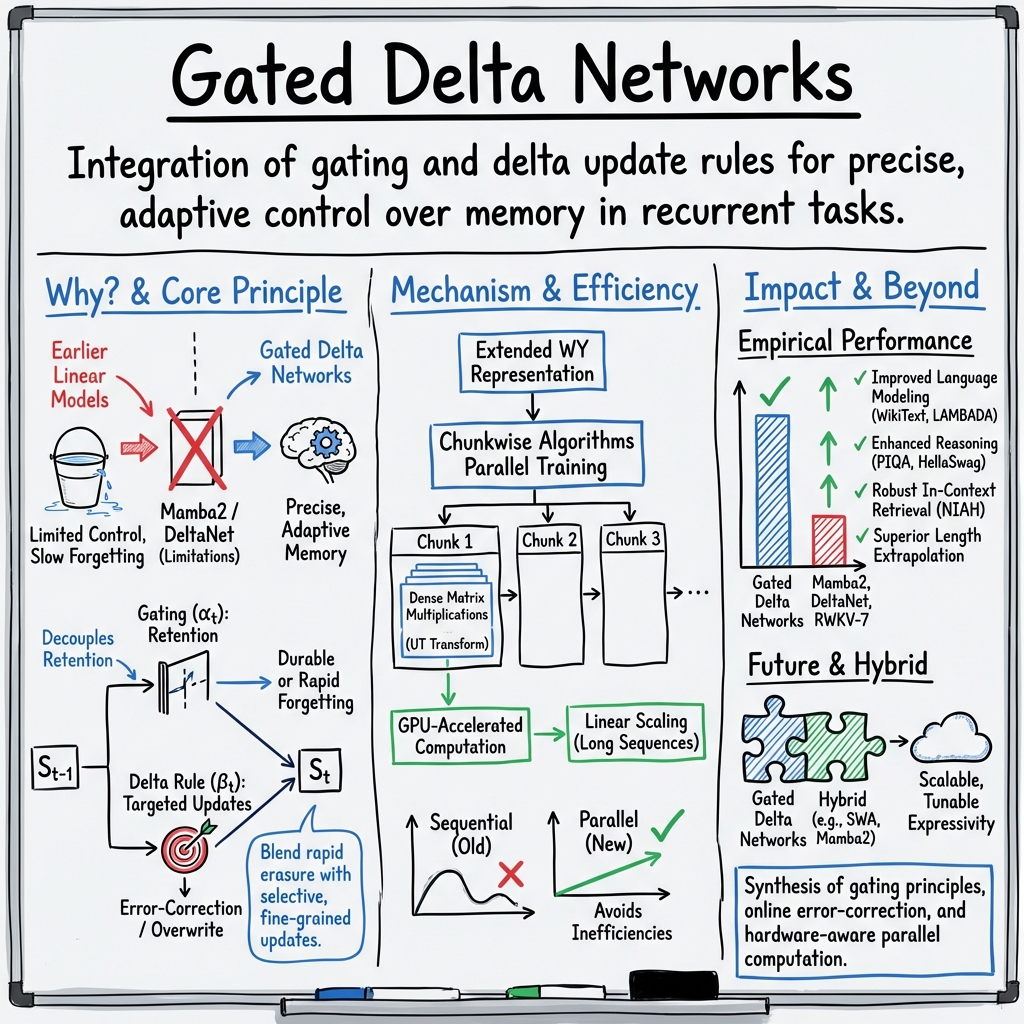
Gated Delta Networks: Adaptive Memory Control
- Gated Delta Networks are neural architectures that integrate gating mechanisms with delta update rules for precise and adaptive control over memory in sequential tasks.
- They use data-dependent multiplicative interactions to dynamically manage memory retention and rapid forgetting, enhancing performance in language modeling and reasoning benchmarks.
- By mapping recurrences to dense matrix multiplications via WY factorization, these networks achieve efficient, scalable long-context modeling.
Gated Delta Networks are neural architectures characterized by the integration of gating mechanisms and delta update rules for precise, adaptive control over memory in recurrent and sequential modeling tasks. Gating applies data-dependent multiplicative or subtractive interactions to dynamically modulate the retention or overwriting of information, while the delta rule enables targeted updates by controlling the degree and direction of change applied to memory states. Developed in response to the limitations of earlier linear recurrent models such as Mamba2 and DeltaNet, Gated Delta Networks blend rapid memory erasure (gating) with selective, fine-grained updates (delta rule), resulting in improved performance on benchmarks involving language modeling, in-context retrieval, and long-context reasoning (Yang et al., 2024).
1. Core Computational Principles
At the foundation of Gated Delta Networks is a recurrence relation that decouples retention and update. The gating component is a data-dependent decay factor (), which determines how much information is retained from the previous state, while the delta rule incorporates a learning rate (), controlling the magnitude of the update.
The update at time is generally of the form: where and are query and key projections, and the cumulative product adjusts the retention rate within an extended WY representation. This construct generalizes earlier bilinear and factorized symmetries encountered in gated network inventories (Sigaud et al., 2015).
The gating mechanism enables rapid forgetting (when is small) and durable retention (when approaches unity), while the delta rule precisely overwrites or corrects memory when new information is encountered. The architecture leverages multiplicative interactions to simultaneously perform gating and update, often recast via compact representations that support hardware-efficient training.
2. Mechanistic Synergy: Gating and Delta Rule
The gating principle in Gated Delta Networks inherits from canonical bilinear architectures, as well as subtractive mechanisms inspired by biological circuits (e.g., subLSTM, where inhibitory signals subtract rather than multiply) (Costa et al., 2017). The delta rule is rooted in online gradient descent, where the update corresponds to the difference between predicted and observed associations. When combined, the two mechanisms allow the network to simultaneously suppress irrelevant or obsolete memory contents and enforce error-correcting updates in a single recurrent step (Yang et al., 2024).
Formally, the extended WY representation for the gated delta rule is: with
0
This structure ensures that the cumulative effect of gating (via 1) and the sequence of delta updates (via 2 and 3) can be efficiently propagated and utilized for memory management.
3. Parallel Training and Efficient Computation
Gated Delta Networks optimize parallel sequence modeling via chunkwise algorithms that generalize the parallel recurrences implemented in DeltaNet. The crucial innovation is mapping the recurrence into a sequence of dense matrix multiplications using an upper triangular (UT) transform and extended WY factorization. This approach permits GPU-accelerated computation, maintaining linear scaling with the sequence length and supporting efficient training for long-context tasks.
By unrolling the recurrence over fixed-size chunks and using the extended WY representation, the network avoids the inefficiencies present in standard recurrent unrolling. This computational scheme is critical for scaling Gated Delta Networks to large data and long sequences, where memory throughput and parallelization dictate practical usability (Yang et al., 2024).
4. Empirical Performance and Applications
Gated Delta Networks surpass prior models—Mamba2, DeltaNet, RWKV-7—in multiple domains. Empirical evidence demonstrates:
- Reduced perplexity on standard language modeling datasets (WikiText, LAMBADA);
- Enhanced accuracy on commonsense reasoning tasks (e.g., PIQA, HellaSwag, ARC-e/c, SIQA, BoolQ);
- Robust associative recall and in-context retrieval capabilities, particularly evident in Needle-In-A-Haystack (NIAH) and document key–value tasks;
- Superior length extrapolation and retention of long-range dependencies, validated on LongBench narrative QA and multi-hop reasoning.
Further, Gated Delta Networks exhibit resilience to memory collisions in retrieval tasks and outperform purely diagonal or rank-1 linear RNN variants on state-tracking formal language challenges, including S₃/S₄ group word problems (Siems et al., 14 Feb 2025). Performance improvements are consistently observed when hybridizing Gated DeltaNet layers with sliding window attention (SWA) or Mamba2 layers, effectively balancing global memory and local context modeling (Yang et al., 2024).
5. Mathematical Foundations and Expressivity
Theoretical characterization of Gated Delta Networks draws upon the spectrum of state-transition matrices. DeltaNet’s recurrence is interpretable as a single step of online gradient descent per token, amounting to a diagonal plus rank-1 structure. DeltaProduct advances this by performing 4 gradient steps per token, yielding a diagonal plus rank-5 matrix constructed as products of Householder transformations: 6 The expressivity improves with higher 7, enabling solutions to group word problems of increasing complexity and greater accuracy on tasks with deep state dependencies. Importantly, the norm of each Householder matrix remains bounded (facilitating stability), and the composition allows for the approximation of rotations and permutations critical for robust sequence modeling (Siems et al., 14 Feb 2025).
Sample complexity analyses for gated architectures employing mixture-of-experts (MoE) offer rigorous guarantees for separate and provably efficient learning of gating and expert parameters, provided appropriately tailored loss functions are used (Makkuva et al., 2019).
6. Hybrid and Extended Architectures
The integration of Gated Delta Networks with other mechanisms—such as sliding window attention or multi-layer combinations with Mamba2 and DeltaProduct—results in architectures that can exploit both the memory efficiency of linear recurrences and the local expressivity of attention-based networks. This facilitates computation-efficient designs suitable for large-scale deployments and enables near-arbitrary context window size without incurring quadratic overhead (Yang et al., 2024).
Further, recent results suggest that varying the number of Householder gradient steps (8) per token in a gated delta architecture is a promising direction for tunable expressivity, enabling adaptation between efficiency and modeling capacity (Siems et al., 14 Feb 2025).
7. Future Directions and Open Challenges
Prospective research avenues include the development of more expressive gating mechanisms, such as those supporting negative eigenvalues for enhanced state tracking, and further refinement of WY-based parallel algorithms for modern hardware. In addition, architectural unification with global and conditional channel gating, as well as federated meta-learning initialization strategies, presents opportunities to expand Gated Delta Networks to domains requiring rapid task adaptation, efficient pruning, and scalable continual learning (Lin et al., 2020).
Contextual learning, modularity, and compositionality, as emphasized in recent gated deep linear network frameworks, remain vital for systematic generalization and multi-task reasoning (Saxe et al., 2022, Li et al., 2022). Finally, rigorous control-theoretic considerations for stability and robustness, particularly in distributed or graph-based settings, complement ongoing efforts to ensure reliable deployment in complex environments (Marino et al., 2023).
Gated Delta Networks thus represent an overview of foundational gating principles, online error-correction via the delta rule, hardware-aware parallel computation, and empirically validated advancements in state-tracking and memory management. Their evolution is tightly connected to ongoing research in efficient sequential modeling, robust reasoning, and scalable architecture design.