Gamer: A Generalist Vision-Language-Action Foundation Model for Long-Horizon Real-Time Game Agent
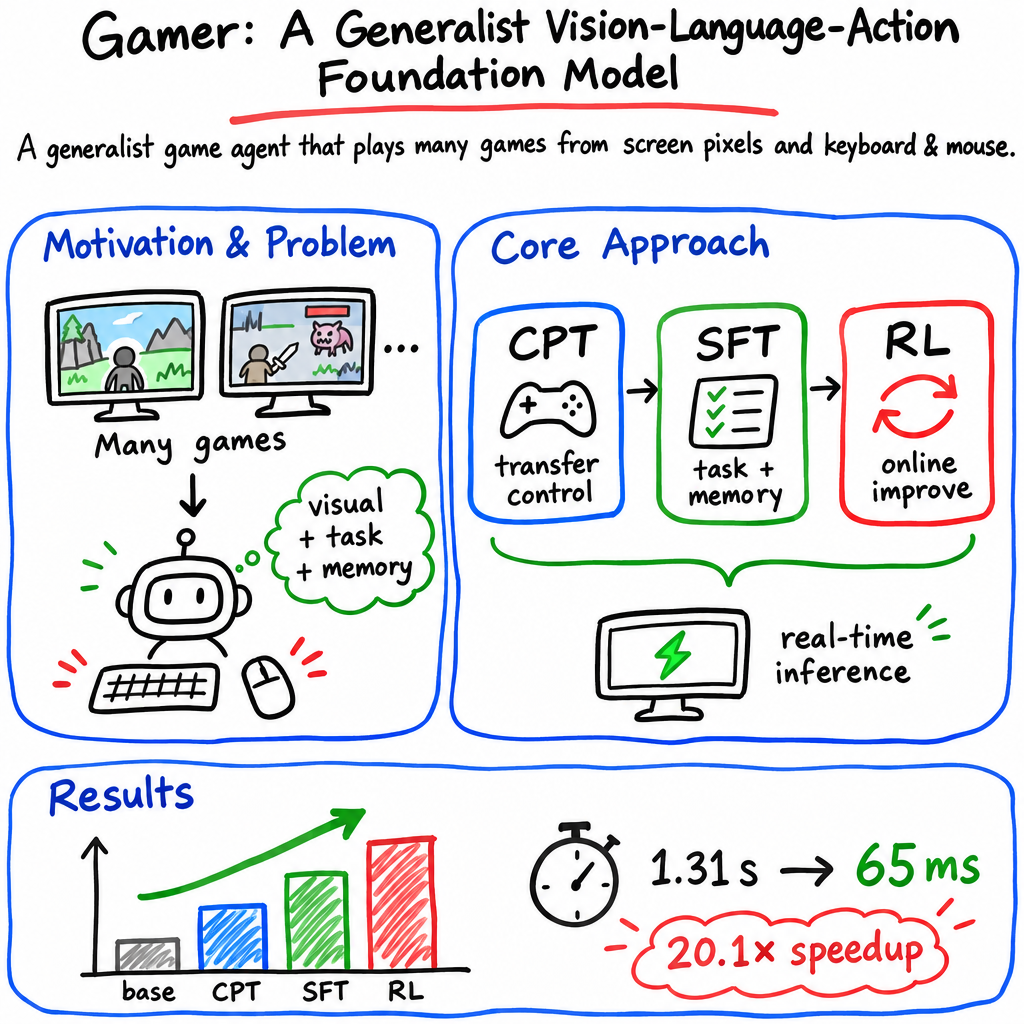
Abstract: We introduce Gamer, a generalist agent framework built for long-horizon tasks in complex interactive environments. Its end-to-end architecture combines perception, memory management, and multi-step reasoning. A shared training and deployment pipeline supports interaction with both conventional 2D graphical interfaces and complex 3D simulated worlds. We first continue pre-training on a dataset constructed from tens of thousands of hours of device-level keyboard and mouse interaction. These trajectories span simulated games and embodied environments, allowing the model to learn environmental dynamics across both physical and virtual domains. Sparse-thinking instruction tuning then substantially reduces redundant computation while preserving the reasoning needed for complex decisions. We train the policy for long-horizon interaction with a stable multi-turn reinforcement learning method that addresses finite context windows, accumulated rollout errors, and sparse rewards. For real-time interaction, a cloud-edge inference engine serves numerous simulated game environments concurrently, supports unbounded-context execution, and keeps online inference latency low. Across multiple challenging 3D open-world games, Gamer demonstrates solid generalization and operational efficiency comparable to skilled players. It also achieves competitive results on a range of conventional 2D game benchmarks. These results suggest that even repetitive keyboard and mouse trajectories can support substantial gains from scaling data and learning algorithms. Training on these trajectories helps Gamer learn complex skills more steadily in environments with both physical and digital properties. This approach offers a path toward generalist agents that can interact across digital and physical worlds.
First 10 authors:
Paper Prompts
Sign up for free to create and run prompts on this paper.
Explain it Like I'm 14
1. What is this paper about?
This paper introduces Gamer, an artificial intelligence system designed to play many different kinds of video games.
Unlike a program made for only one game, Gamer is meant to work across many games, including:
- 2D games with simple screens
- Complex 3D open-world games
- Games involving exploration, fighting, driving, building, and strategy
Gamer plays in a way similar to a human. It looks at the game screen and uses ordinary keyboard and mouse controls. It does not need special access to the game’s hidden code or internal information.
The researchers hope that systems like Gamer could eventually help create general-purpose robots and computer agents that can operate in many different digital and physical environments.
2. What questions are the researchers trying to answer?
The paper focuses on several main questions:
- Can one AI learn to play many different games? The researchers want to know whether knowledge learned in one game can help the AI in another game.
- Can the AI complete tasks that take a long time? Some game missions may last minutes or hours. The AI must remember what it has already done and what it still needs to do.
- Can the AI make decisions from only what appears on the screen? A human player usually sees the screen and controls the game. Gamer must do the same instead of receiving secret information from the game.
- Can the AI react quickly enough for real-time play? If the AI thinks too slowly, the game may change before its action happens. This can cause mistakes.
- Can the AI learn from ordinary gameplay recordings? The researchers investigate whether large amounts of keyboard-and-mouse gameplay can teach the AI useful skills.
3. How did the researchers build and train Gamer?
Gamer is a vision-language-action model, or VLA model. This means it combines three abilities:
- Vision: understanding what is shown on the screen
- Language: understanding instructions and describing plans
- Action: pressing keys and moving the mouse
A simple way to imagine Gamer is as a player following this repeating loop:
- Look at the screen.
- Remember recent events and important past information.
- Decide what to do next.
- Press keys or move the mouse.
- Look at the new screen and repeat.
Learning from gameplay examples
The researchers collected tens of thousands of hours of gameplay from many games. These recordings included the screen, keyboard presses, mouse movements, and timing.
First, Gamer learned by copying these examples. This is similar to learning basketball by watching many skilled players and practicing their movements. This stage is called continued pre-training.
The researchers changed the names of some keyboard keys during training. For example, the key used for “move left” might sometimes be changed from A to another key. This encouraged Gamer to understand the meaning of an action rather than simply memorizing that one particular letter always means “left.”
They also reduced the importance of repeated actions. If a player holds a key for a long time, the same action may appear many times in the recording. Gamer still learns that the key is being held, but it pays more attention to important changes, such as stopping, turning, or interacting with an object.
Adding instructions and explanations
Raw gameplay recordings usually do not explain the player’s goal. To solve this problem, the researchers used LLMs to add information such as:
- The overall task, such as “complete this mission”
- Smaller goals, such as “find the character” or “collect an item”
- Short explanations of important decisions
- Summaries of what has happened so far
Gamer was trained to think only when thinking is useful. During routine movement, it can act directly. When something important happens, it may create a short plan or update its memory.
This is called sparse reasoning. It is similar to a student who does not stop to write down every tiny step, but makes a plan before a difficult problem.
Giving Gamer a long-term memory
Long games create a problem: the AI cannot keep every past screen and action in its working memory forever.
Gamer solves this by creating short summaries. For example, it might remember:
“The player found the key, failed to open the first door, and still needs to reach the castle.”
Older detailed events can then be removed while the important information is saved. This works somewhat like a person keeping notes about a long project.
Learning through trial and error
The researchers also used reinforcement learning, in which the AI receives feedback from the game.
For example:
- Completing a small objective gives a positive reward.
- Failing a mission gives a poor result.
- Reaching an important milestone gives useful feedback.
The researchers created a method called Temporal-Aware Group Relative Policy Optimization, or TA-GRPO. In simple terms, Gamer tries several attempts at the same task, compares their results, and learns which choices led to better outcomes.
Because some tasks are very long, the researchers split them into sections connected by memory summaries. This allows the AI to learn from long missions without needing to remember the entire mission at once.
Making Gamer fast enough
A major technical challenge is speed. A slow AI may decide to move left, but by the time the action happens, the game character may already be somewhere else.
To reduce delays, the researchers built a system called Streaming-vLLM. It helps Gamer by:
- Reusing information it has already processed
- Sending keyboard and mouse actions as soon as parts of them are ready
- Running many game environments at the same time
- Organizing the AI’s memory efficiently
This is like a restaurant preparing several parts of a meal at once instead of waiting for every part to be completely finished before serving anything.
4. What did the researchers find?
The paper reports several important results.
Gamer worked across many different games
Gamer was tested on challenging 3D games and traditional 2D game benchmarks. It was able to perform tasks in several different environments using only:
- Screen images
- Task instructions
- Recent history
- Keyboard and mouse controls
This suggests that one model can learn useful skills that transfer between games.
Gamer handled longer tasks
The memory system helped Gamer continue working on tasks after earlier details were no longer directly visible to the model.
It could remember information such as:
- Which objectives had been completed
- Where important places were located
- Which strategies had failed
- What it planned to do next
This is important because many real-world activities also require remembering earlier steps.
Gamer’s performance was close to skilled human players in some tasks
The researchers state that Gamer achieved performance and efficiency comparable to skilled human players on several difficult 3D game tasks. It also performed competitively on several 2D games.
This does not mean Gamer is better than humans at every game. Instead, it shows that the general approach can work across a wide range of game types.
More gameplay data helped, but not always
The researchers found that adding more training data usually improved performance, especially when the new data came from games similar to the target game.
However, simply adding more data from very different games did not always help with completely unfamiliar environments. This means that the quality and variety of the training data matter, not just the total number of hours.
Fast response was very important
The experiments showed that Gamer’s performance could drop sharply when the game continued changing while the AI was still thinking.
This finding is important because real-time interaction is different from a test where the game pauses after every action. An AI must not only make good decisions; it must make them quickly enough to matter.
5. Why is this research important?
Gamer shows a possible way to build AI systems that can operate in many different environments without needing a special program for each one.
The key idea is to use the same general interface that people use:
- See the world through images
- Understand instructions
- Use ordinary controls
- Remember important information
- Learn from experience
This could eventually be useful beyond video games. Similar abilities might help AI systems:
- Use computer programs
- Control robots
- Navigate virtual worlds
- Operate machines
- Complete long, complicated tasks
Games are useful for this research because they provide safe and repeatable environments. Researchers can test an AI many times without risking damage to people or expensive equipment.
However, there are still limitations. A game is not the same as the real world. Real environments are less predictable, and mistakes can be much more serious. Gamer also depends on large amounts of data, powerful computers, and systems that make decisions very quickly.
Conclusion
The paper presents Gamer as a general-purpose game-playing AI that learns from screens, instructions, memories, and keyboard-and-mouse actions. It combines visual understanding, planning, memory, learning from examples, and real-time control.
The results suggest that AI can learn skills that transfer across many different games, especially when trained on large and varied collections of gameplay. The research may be an important step toward AI agents that can complete long tasks in both digital worlds and, eventually, physical environments.
Practical Applications
Immediate Applications
- Game-playing automation and accessibility tools — entertainment/software
- Deploy a screen-to-keyboard/mouse agent for repetitive or long-running tasks such as navigation, resource collection, inventory management, quest progression, tutorial completion, and routine combat.
- Potential products include an accessibility assistant for players with motor impairments, an automated testing bot for game studios, and an intelligent game companion that executes user-approved subtasks.
- Basis: Gamer operates from raw screen pixels and standard input events rather than privileged game APIs, and combines persistent memory with sparse reasoning for multi-stage objectives.
- Dependencies and assumptions: The target game must expose controllable keyboard/mouse interactions; screen layouts and control rules must be sufficiently stable; deployment must comply with game terms of service and anti-cheat policies. Human approval and rate limits may be necessary in multiplayer environments.
- Automated quality assurance for games and graphical interfaces — software/industry
- Use Gamer-like agents to execute regression tests across menus, quests, tutorials, combat systems, and edge-case sequences that are difficult to cover with scripted tests.
- A testing workflow could provide a task instruction, launch multiple game instances, collect screenshots and action traces, and flag failures such as inaccessible objectives, broken UI transitions, soft locks, or unexpected state changes.
- Basis: The framework supports concurrent environments, verifiable task outcomes, failure-trajectory collection, and real-time interaction through the same interface used by human players.
- Dependencies and assumptions: Reliable success and milestone verifiers are required for automated pass/fail judgments. Agents may still miss rare bugs or produce false positives, so human or deterministic validation remains important.
- Interactive-agent benchmarking and evaluation — academia
- Use diverse commercial-style games as controlled benchmarks for visual grounding, planning, memory, low-level control, sparse-reward learning, and real-time inference.
- Researchers can compare agents using task completion, recovery from errors, latency, action efficiency, memory retention, and performance under altered key mappings or unseen game mechanics.
- Basis: Gamer provides a unified observation-action protocol, multi-level tasks, memory compaction, and a real-time serving pipeline that can support reproducible rollouts.
- Dependencies and assumptions: Benchmark environments must be legally distributable or reproducible, and evaluation must control for model access, hardware, latency, game version, and use of privileged state.
- Training-data and imitation-learning pipelines — AI research/industry
- Adapt the paper’s annotation workflow to convert raw gameplay recordings into training examples containing task descriptions, subgoals, sparse reasoning, and memory summaries.
- The same workflow could be applied to GUI demonstrations, customer-support sessions, simulation traces, or robotics teleoperation data to create multimodal instruction datasets.
- Basis: Gamer uses LLM-assisted segmentation and annotation across local operations, intermediate goals, and complete tasks, while preserving observation-action sequences.
- Dependencies and assumptions: Annotation models must produce accurate descriptions and not invent unavailable state. Data licensing, privacy, quality control, and alignment between timestamps, observations, and actions are essential.
- Low-latency multimodal inference serving — software/infrastructure
- Use the Streaming-vLLM design principles in interactive applications such as game assistants, GUI automation, visual copilots, and real-time simulation control.
- Potential tools include stateful KV-cache reuse, paged per-session context, memory-aware context compaction, architecture-specific kernels, speculative decoding for predictable output structures, and streaming of executable action prefixes.
- Basis: The system is explicitly designed to reduce action latency, preserve state across turns, and serve many concurrent environments.
- Dependencies and assumptions: Benefits depend on suitable GPU infrastructure, efficient client-server communication, stable structured output formats, and careful scheduling so that queueing delays do not make actions stale. Early dispatch must include safety validation before execution.
- GUI automation and digital workflow assistance — enterprise software
- Apply the screen-to-action interface to repetitive workflows in desktop software, browser applications, virtual desktops, and internal tools—for example, data entry, report generation, application navigation, and routine configuration.
- A practical workflow would combine a natural-language task, a restricted application sandbox, visual observations, action logging, and human confirmation before irreversible operations.
- Basis: The model does not require application-specific APIs and can act through ordinary mouse and keyboard events.
- Dependencies and assumptions: GUI layouts must remain sufficiently stable, and robust safeguards are required for authentication, financial transactions, deletion, external communication, and sensitive data. Performance may degrade substantially on interfaces unlike the training distribution.
- Player and developer analytics — games/marketing
- Analyze long interaction trajectories to identify where players abandon quests, repeatedly fail, waste resources, or encounter confusing interfaces.
- Gamer-style memory summaries and milestone verification can support automated reports on progression bottlenecks and difficulty balance.
- Basis: The framework represents task stages, failures, resource states, and remaining plans explicitly enough to support trajectory-level analysis.
- Dependencies and assumptions: Player consent and privacy protections are required. Agent-generated explanations should be treated as hypotheses unless corroborated by event logs or human analysis.
- Training for human operators and interface design — education/UX
- Use the agent as a simulator for teaching interface operation, planning under partial observability, or recovery from failures. Designers can also test whether a new interface exposes enough visual cues for an autonomous user.
- Basis: The model’s evaluation loop naturally records observations, decisions, actions, latency, and task outcomes.
- Dependencies and assumptions: Game-like success metrics may not capture usability, learning outcomes, or human preferences. Educational deployment requires curriculum design and instructor oversight.
Long-Term Applications
- General-purpose embodied control — robotics
- Transfer the shared screen-to-action, memory, and long-horizon reasoning framework to robots operating through camera observations and discrete or continuous control interfaces.
- Potential applications include household robots, warehouse navigation, inspection, manipulation, and multi-step service tasks in partially observed environments.
- Basis: The paper argues that gameplay trajectories can expose agents to environments with both physical and digital properties, and its architecture separates visual decision-making from low-level action execution.
- Dependencies and assumptions: Game controls are substantially safer and more predictable than physical actuation. Real-world deployment requires grounding in 3D geometry, force and contact dynamics, uncertainty estimation, safety-certified controllers, recovery behaviors, and extensive physical testing. Performance in games does not establish reliable physical-world competence.
- Industrial digital-twin and simulation control — manufacturing/energy/logistics
- Deploy Gamer-like agents in high-fidelity simulators to manage multi-stage procedures such as factory configuration, warehouse routing, equipment inspection, grid balancing, or plant operations before limited real-world deployment.
- The agent could receive visual observations and operational goals, maintain state summaries, and optimize milestone completion under delayed rewards.
- Basis: TA-GRPO supports long-horizon rollouts, sparse rewards, segment-level verification, and training without restoring every intermediate state.
- Dependencies and assumptions: Simulators must accurately model failures, costs, and safety constraints. Domain randomization, calibrated digital twins, human approval, and formal constraint handling are needed before any physical actuation.
- Robust web and enterprise agents — software/knowledge work
- Build agents that complete extended cross-application workflows, such as collecting information, updating records, preparing documents, and coordinating steps across multiple graphical systems.
- Persistent summaries could retain task progress, unresolved issues, credentials-independent state, and next actions across long sessions.
- Basis: Gamer’s memory compaction and unified visual-action protocol address context limits and heterogeneous interfaces.
- Dependencies and assumptions: Enterprise workflows require stronger identity, authorization, auditability, data governance, and transactional consistency than games. The agent must distinguish observation from authorization and should use approval checkpoints for consequential actions.
- Assistive technologies for complex digital environments — healthcare/accessibility
- Develop agents that help users with motor, visual, or cognitive impairments navigate software, games, educational platforms, and virtual environments.
- Functions could include translating high-level instructions into mouse/keyboard actions, remembering prior navigation, offering recovery from mistakes, and operating at a user-configurable level of autonomy.
- Basis: Native input control, long-term memory, and adaptive sparse reasoning are well suited to reducing repetitive interaction burdens.
- Dependencies and assumptions: Accessibility systems must support user override, transparent action previews, personalization, privacy, and predictable failure behavior. Medical or clinical use would require regulatory evaluation and should not rely on unverified autonomous decisions.
- Autonomous tutoring and interactive learning environments — education
- Use long-horizon agents in educational simulations, virtual laboratories, strategy environments, and software training to guide learners through multi-step tasks.
- The agent could track progress, identify failed attempts, adapt the next subgoal, and generate feedback based on observable actions rather than only final answers.
- Basis: The paper’s multi-level conditioning distinguishes local operations, intermediate subgoals, and complete tasks, while memory summaries preserve progress across lengthy sessions.
- Dependencies and assumptions: Educational effectiveness must be validated with learning studies. The agent needs pedagogically sound feedback, age-appropriate safeguards, bias evaluation, and mechanisms preventing it from completing assessed work on behalf of students.
- Autonomous cyber-range and emergency-response simulation — security/public safety
- Apply the methodology to sandboxed cyber ranges or crisis-management simulators where agents must plan and execute long sequences under incomplete information.
- Uses may include testing incident-response playbooks, evaluating operator interfaces, and generating difficult scenarios for human training.
- Basis: Gamer supports concurrent environments, sparse rewards, failure-driven improvement, and verifiable milestones.
- Dependencies and assumptions: Deployment should remain isolated from production systems. Cyber or emergency actions require explicit authorization, strong containment, scenario validation, and safeguards against transferring unsafe behavior outside the simulation.
- Financial and operational process automation — finance/business
- In the longer term, visually grounded agents could execute carefully bounded workflows such as reconciling dashboards, monitoring operational indicators, preparing drafts, or escalating anomalies.
- Memory-linked task execution may help with recurring processes that span multiple applications and reporting periods.
- Basis: The framework addresses persistent state, delayed outcomes, and real-time interaction across heterogeneous interfaces.
- Dependencies and assumptions: Direct autonomous trading, payments, lending, or compliance decisions are not established by the paper and would require far stronger verification. Audit trails, segregation of duties, deterministic controls, human approval, and regulatory compliance are mandatory.
- Generalist multi-domain foundation models — AI research
- Extend the unified trajectory-training recipe beyond games by combining digital interfaces, simulated robotics, GUI tasks, and eventually physical demonstrations in a shared vision-language-action model.
- Research directions include learning when to reason, deciding what to store in memory, adapting to unseen action semantics, and combining environment-verifiable rewards with safety constraints.
- Basis: Gamer demonstrates a common device-level action representation, cross-domain trajectory scaling, sparse reasoning, persistent memory, and critic-free temporal credit assignment.
- Dependencies and assumptions: Cross-game transfer does not guarantee transfer to distant domains; the paper itself notes diminishing benefits for unseen environments. Progress depends on diverse and licensed data, better task and reward verifiers, calibrated uncertainty, robust out-of-distribution evaluation, and methods for preventing harmful or irreversible actions.
Glossary
- Autoregressive policy: A model that generates each output token based on previously generated tokens. “The resulting context is”
- Behavior cloning (BC): Learning to imitate actions demonstrated in recorded trajectories. “Here, BC, SFT, CPT, and RL denote behavior cloning, supervised fine-tuning, continued pre-training, and reinforcement learning, respectively.”
- BF16: A 16-bit floating-point numerical format used for efficient deep-learning computation. “Streaming-vLLM combines stateful KV-cache reuse, architecture-aware execution, FSM-guided speculative decoding with BF16 verification, and streaming action dispatch to reduce inference latency.”
- Closed-loop execution: Acting, observing the resulting environment state, and continually updating subsequent actions. “This environment features nested objectives and long-term progression that challenge an agent’s cross-task generalization, long-term memory, and closed-loop execution.”
- Continued pre-training (CPT): Further pre-training of an existing model on domain-specific data. “We first conduct continued pre-training (CPT) on thousands of hours of multi-source gameplay trajectories”
- Context compaction: Compressing or removing older context while preserving important information in summaries. “Context memory compaction preserves task progress across long interactions”
- Critic-free estimate: A reinforcement-learning advantage estimate that does not use a learned value critic. “This critic-free estimate follows GRPO [39].”
- CUDA Graph replay: Reusing a captured sequence of GPU operations to reduce execution overhead. “We combine operator fusion, tensor-parallel execution, communication overlap, and CUDA Graph replay to reduce serial overhead.”
- D-CPT Law: A scaling relation that models how continued-pre-training performance depends on model size, data quantity, and data composition. “a composition-aware scaling relation based on D-CPT Law [35] is adopted.”
- Decoder launch: The initiation of a computational operation that generates the next sequence of model tokens. “Frequent short requests incur costs beyond prefill, including decoder launches, inter-device communication, and architecture-specific operations.”
- Embodied artificial general intelligence (AGI): General-purpose intelligence capable of perceiving and acting in physical or simulated environments. “vision-language-action (VLA) models [24, 28, 46, 58] offer a promising path toward embodied artificial general intelligence.”
- Finite-state machine (FSM): A computational model that transitions among a finite set of states according to defined inputs. “A fast finite-state-machine (FSM) drafter proposes predictable structural tokens in the reasoning–action output.”
- Finite-state-machine speculation: Predicting structurally predictable output tokens with an FSM before the main model verifies them. “FSM-guided speculative decoding with BF16 verification”
- GameScaling: An analysis of how model capacity, gameplay data, and game composition affect control learning. “We then summarize findings from GameScaling [58] on how model capacity, gameplay data, and game composition affect control learning and cross-game generalization.”
- Group Relative Policy Optimization (GRPO): A reinforcement-learning method that estimates advantages by comparing outcomes within groups of sampled trajectories. “This critic-free estimate follows GRPO [39].”
- Held-out prediction: Evaluation on data or environments excluded from the fitting or training process. “The scaling relation fits the training-game distributions and supports held-out prediction within the measured range.”
- Inference latency: The time required for a model to produce an output after receiving an input. “Conventional inference engines introduce high inference latency”
- Instruction tuning: Fine-tuning a model to follow natural-language instructions. “Sparse-thinking instruction tuning then substantially reduces redundant computation”
- KV cache: Stored key and value representations from attention computation that allow previously processed context to be reused. “Streaming-vLLM instead preserves KV states of retained context and computes new states only for newly appended tokens”
- Long-horizon task: A task requiring coordinated decisions and actions over an extended sequence or duration. “We introduce Gamer, a generalist agent framework built for long-horizon tasks in complex interactive environments.”
- Mixture-of-experts (MoE): A neural architecture that selectively activates subsets of specialized model components for each input. “including dense and mixture-of-experts (MoE) backbones.”
- Multimodal LLM (MLLM): A LLM that processes multiple modalities, such as text and images. “Multimodal LLMs (MLLMs) [2, 6, 7, 13, 25, 45] are rapidly evolving from static input processors into interactive agents”
- Online reinforcement learning: Reinforcement learning in which a policy learns from interactions it generates while operating in an environment. “This latency penalty also affects online reinforcement learning (RL)”
- Operator fusion: Combining multiple computational operations into a single optimized operation to reduce execution overhead. “We combine operator fusion, tensor-parallel execution, communication overlap, and CUDA Graph replay to reduce serial overhead.”
- Policy optimization: Adjusting a policy so that it selects actions with greater expected reward. “Temporal-Aware GRPO for Long-Horizon Policy Optimization”
- Privileged internal state: Environment information available to an agent during training but normally hidden from an external player. “these methods typically use privileged internal states”
- Reinforcement learning (RL): Learning a policy through rewards or feedback from interactions with an environment. “Here, BC, SFT, CPT, and RL denote behavior cloning, supervised fine-tuning, continued pre-training, and reinforcement learning, respectively.”
- RoPE: Rotary positional embedding, a technique that encodes token positions by rotating attention representations. “The model-facing interface is shared across Qwen3-VL [3] and Qwen3.5 [36], including dense and mixture-of-experts (MoE) backbones.”
- Rollout: A sequence of actions and observations generated by a policy interacting with an environment. “TA-GRPO divides long rollouts into finite segments linked by the same memory compaction mechanism used during SFT.”
- Sparse rewards: Rewards provided only occasionally, often at milestones or task completion. “address accumulated execution errors and sparse rewards over extended interactions.”
- Speculative decoding: Accelerating autoregressive generation by proposing tokens with a faster mechanism and verifying them with the main model. “The target model verifies FSM proposals using BF16 computation, and only accepted prefixes are committed.”
- Supervised fine-tuning (SFT): Training a pretrained model on labeled examples to improve performance on a specific task or behavior. “We extend Verl [40] to support CPT, SFT, and online RL within a shared training framework”
- TA-GRPO: Temporal-Aware Group Relative Policy Optimization, which distributes group-relative reinforcement-learning advantages across decisions according to their temporal proximity to an outcome. “Finally, we introduce Temporal-Aware Group Relative Policy Optimization (TA-GRPO)”
- Tensor parallelism: Splitting a model’s tensor computations across multiple devices. “We apply tensor parallelism selectively.”
- Token-level clipping: Restricting policy-update probability ratios separately for each generated token to stabilize optimization. “Token-level clipping avoids a single sequence-wide probability ratio”
- Trajectory: A time-ordered sequence of observations, actions, and resulting interactions. “These trajectories span simulated games and embodied environments”
- Transferable control: The ability to apply learned action-selection behavior across different environments or games. “CPT thus provides transferable control”
- Vision-language-action (VLA) model: A model that jointly interprets visual and linguistic inputs to generate actions. “vision-language-action (VLA) models [24, 28, 46, 58] offer a promising path toward embodied artificial general intelligence.”
- Wall-clock collection time: The actual elapsed time required to gather interaction data. “delayed rollouts not only inflate wall-clock collection times”
- W8A8: An 8-bit weight and 8-bit activation quantization format for neural-network computation. “Optional W8A8 paths are evaluated independently because lower precision does not always improve latency”

