How to Loop Your Transformer: Loop Scaling, Specialization, and Parallel Inference
Abstract: Looping in transformer models reuses weights by repeatedly applying the same transformer, or parts of it, making the model deeper without increasing its parameter count. Whether looping is useful depends on which constraint dominates: model size, training compute, or autoregressive inference efficiency. We study these trade-offs jointly in dense decoder-only transformers trained from scratch, varying which parts of the model are looped, how many loops are applied, and how information is passed between loops. Our experiments span models with up to 1B parameters, trained on up to 155B tokens with up to FLOPs and 32 loops. We find that looping the full transformer generally gives the strongest quality at a fixed parameter budget, whereas looping a middle block of layers gives a better return when training FLOPs are constrained. Adding loops is not uniformly beneficial: gains eventually saturate, reverse, or become unstable. This motivates asking whether forcing every loop to use the same weights limits the benefit of deeper looping. We address this by adding small loop-specific low-rank adapters that improve quality, with larger gains as more loops are added. Looped transformers also suffer a decoding slowdown proportional to the number of loops. Parallel Loop Transformers address this by passing hidden states between loops across adjacent token positions, allowing loop stages to run concurrently. However, in our experiments the original formulation does not consistently retain the quality gains of ordinary looping. We find that preserving the current-token embedding and separately normalizing it and the previous-token hidden state before combining them recovers strong performance across model scales and training budgets. Together, these results show that effective looping requires matching the design to the resource constraint and inference setting.
Paper Prompts
Sign up for free to create and run prompts on this paper.
Explain it Like I'm 14
1. What is this paper about?
This paper studies a way to make Transformer LLMs more powerful without making them much larger.
A Transformer is the kind of computer system used in many modern chatbots and language tools. It reads text and predicts what should come next. Usually, a Transformer has many different layers, and each layer has its own settings, called weights.
The paper explores looping: instead of adding many new layers, the model reuses the same layers several times. It is similar to asking the same team of students to check an answer repeatedly. The team does not become larger, but it gets more chances to improve the answer.
The researchers ask three main questions:
- Which parts of a Transformer should be looped?
- Should every loop use exactly the same settings?
- Can looping be made faster when the model is generating text?
2. Main research questions
The study focuses on the trade-offs between several important resources:
- Model size: How much memory is needed to store the model?
- Training computation: How much computer power and time are needed to teach it?
- Training data: How much text must the model read?
- Inference speed: How quickly can the model produce answers?
The researchers wanted to find out whether looping is useful under different limits. For example, a smaller model might be helpful when computer memory is limited, while a different design might be better when training time is limited.
They also wanted to know whether using the same weights again and again eventually becomes a problem. A later loop receives information that has already been changed by earlier loops, so it may need to behave differently.
Finally, they studied whether loops could work in parallel rather than one after another. This matters because ordinary looping can make text generation slower.
3. How did the researchers study this?
Training many different models
The researchers trained Transformer models ranging from 70 million to 1 billion parameters. A parameter is a small number inside the model that helps it make decisions. More parameters usually mean a larger and potentially more capable model.
They trained the models on text containing:
- Natural language
- Computer code
- Mathematics
- Scientific writing
The models were trained with different amounts of data and different numbers of loops. Some models used as many as 32 loops.
Comparing different looping designs
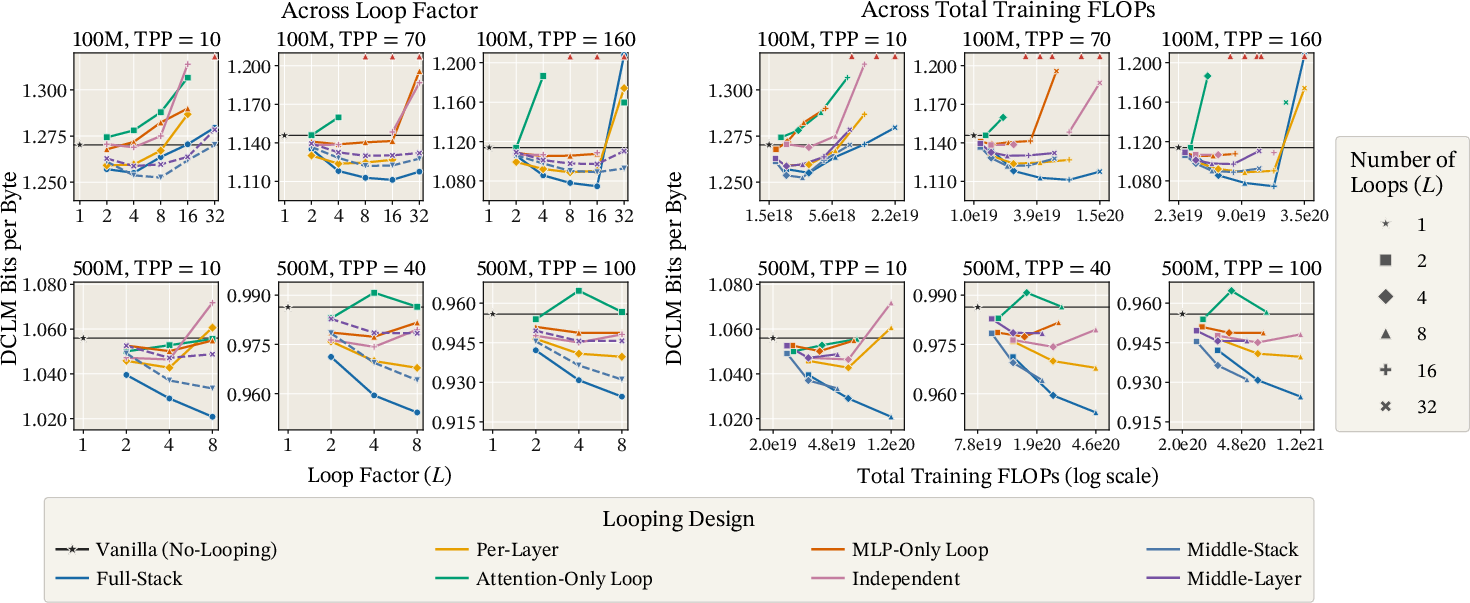
The researchers tested several ways to repeat the Transformer layers:
- Full-stack looping: Repeat the entire Transformer from beginning to end.
- Per-layer looping: Repeat one layer several times before moving to the next layer.
- Middle-stack looping: Repeat a group of layers in the middle of the model.
- Middle-layer looping: Repeat the middle layers individually.
- Partial looping: Repeat only attention, only the MLP part, or both parts separately.
An analogy is a factory with several workstations. The researchers tested whether it was better to send an item through the entire factory repeatedly, repeat only the middle workstations, or repeat each workstation several times before moving on.
Measuring model quality
The main score was called bits per byte, or BPB. This measures how well the model predicts text. A lower score means the model is usually better at guessing the next part of the text.
The researchers also tested the models on tasks involving:
- Reasoning
- Mathematics
- Coding
- Question answering
Giving different loops small adjustments
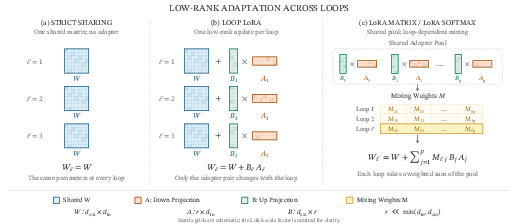
In ordinary looping, every loop uses exactly the same weights. The researchers also tested loop-specific adapters.
These adapters are small extra pieces that allow each loop to make slightly different changes. The main model remains shared, but each loop gets a small “personal adjustment.”
The technique used for this is called LoRA, or Low-Rank Adaptation. In simple terms, LoRA is like giving each repeated team a small instruction card rather than hiring a completely new team.
Testing parallel loops
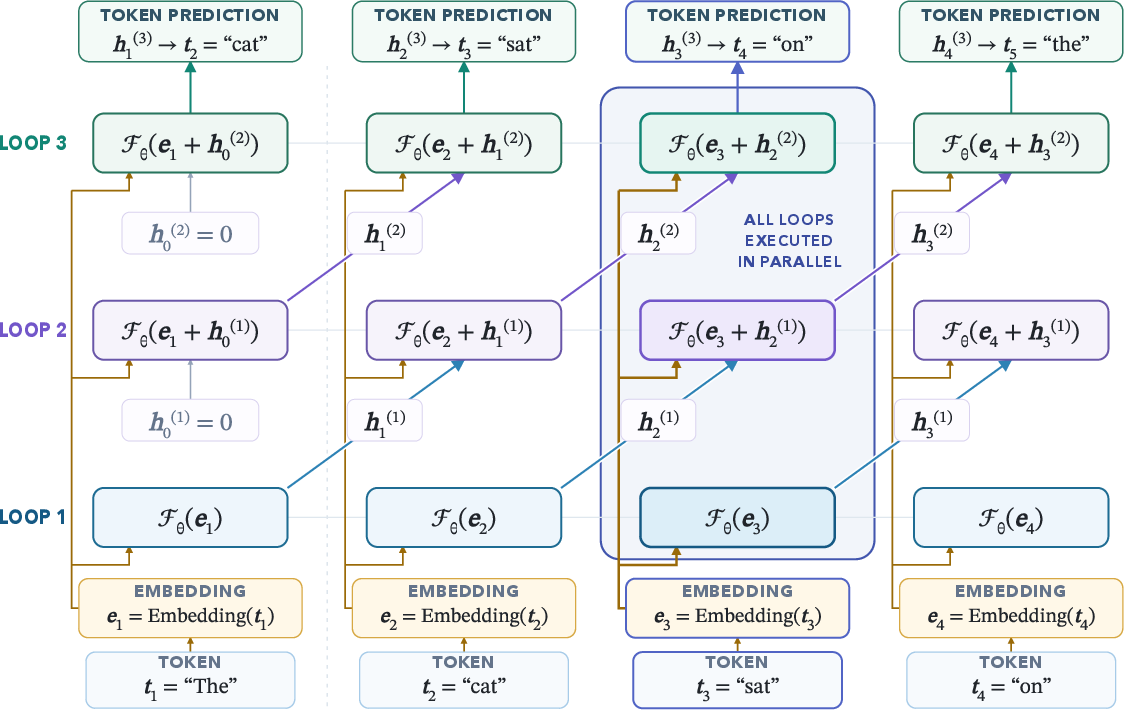
In normal looping, a token must finish loop 1 before entering loop 2, then finish loop 2 before entering loop 3. This creates a long line of steps.
The researchers tested Parallel Loop Transformers, or PLTs. These models pass information between loops using nearby tokens, allowing different loops to work at the same time during text generation.
However, passing information this way can make the model less accurate. The researchers therefore tested ways to stabilize the process, including:
- Keeping the current token’s original information
- Normalizing the information from different sources
- Carefully controlling how those sources are mixed
Normalization is like adjusting two audio recordings so that one is not much louder than the other before combining them.
4. Main findings
Full looping is usually best when model size matters
When the number of stored parameters was kept fixed, full-stack looping generally produced the best quality. Reusing the whole Transformer gives the model many effective layers without storing a separate set of weights for every layer.
This means looping can make a relatively small model behave somewhat like a deeper model.
Middle looping is better when training computation is limited
When the researchers limited the total amount of training computation, middle-stack looping often gave the best improvement for the amount of extra work.
This suggests that the best design depends on the situation:
| Main limitation | Design that generally worked best |
|---|---|
| Limited model size or parameter storage | Full-stack looping |
| Limited training computation | Middle-stack looping |
| Need for faster generation | Parallel looping with modifications |
More loops do not always help
Adding loops usually improved the model at first. However, the improvements became smaller as more loops were added.
Eventually, using too many loops could:
- Stop improving the model
- Make the model worse
- Cause unstable training
This is an important result. Repeating the same process more times is not automatically better. Like checking homework, the first few checks may catch mistakes, but checking endlessly may waste time or even create confusion.
Loop-specific adjustments help more with many loops
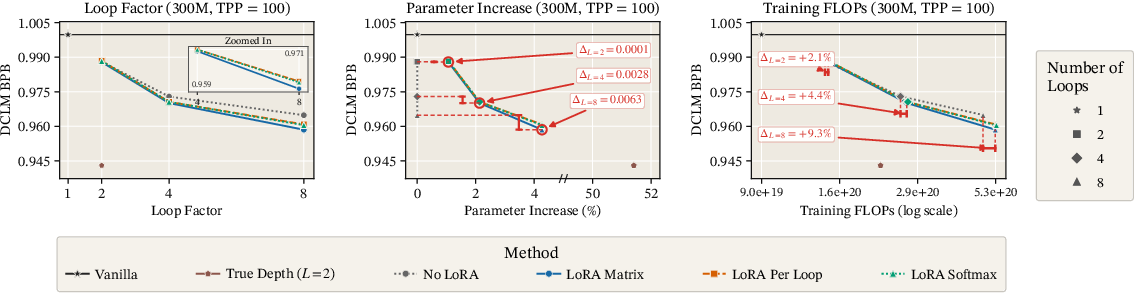
Small loop-specific adapters were not very useful when there were only two loops. But they became more valuable when the model used four or eight loops.
This suggests that exact weight sharing becomes more limiting as the number of loops increases. Later loops benefit from having slightly different behavior.
These adapters added only a small number of extra parameters—much fewer than creating an entirely new set of layers. However, they improved parameter efficiency, not necessarily training-computation efficiency, because the model still had to run every loop.
Parallel looping can make generation faster
Ordinary looping requires each loop to run after the previous one. This can slow down autoregressive generation, which means producing text one token at a time.
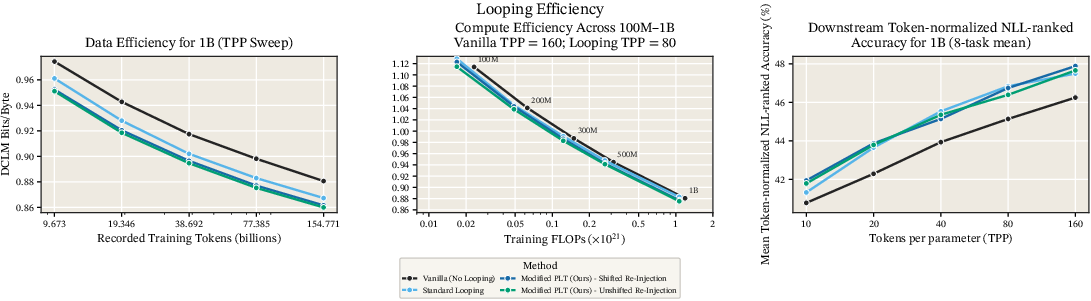
The researchers found that modified Parallel Loop Transformers could allow loop stages to work at the same time while keeping good performance.
The most important improvements were:
- Keep the current token’s original representation.
- Normalize both the current-token information and the previous-token information.
- Control how much information comes from each source.
Without the current token’s original information, errors could build up from one token to the next. With it, each loop remains anchored to the actual token being processed.
Looping can reduce the amount of training data needed
In some experiments, looped models reached a particular quality level using fewer training tokens than ordinary models.
In the researchers’ tested settings, two-loop models could sometimes reach the same quality with fewer total training FLOPs than models without looping but trained on twice as much data.
However, this benefit was not unlimited. More loops could improve the final score while giving less improvement for each unit of computation.
5. Why are these findings important?
The paper shows that looping is not simply a matter of “more loops are better.” The best choice depends on what is scarce:
- If memory is limited, full looping may provide more ability without storing many extra parameters.
- If training computation is limited, looping only a middle section may be more efficient.
- If fast text generation is important, parallel looping may help.
- If many loops are used, small loop-specific adjustments can prevent the shared weights from becoming too restrictive.
The research could help developers build LLMs that are:
- Smaller to store
- Less expensive to train
- More efficient with data
- Faster when generating text
However, the findings do not mean that every future LLM should use loops. Looping adds its own costs, and too many loops can cause instability or poor performance. Designers must choose the looping method based on their goals.
Simple conclusion
The main message is:
A Transformer can become more powerful by reusing its layers, but the best way to reuse them depends on the available memory, training power, and need for speed.
The paper provides a useful guide for designing looped LLMs. It shows how to get more work from a smaller model, how to give repeated loops small differences, and how to make looping faster during text generation.
Practical Applications
Immediate Applications
- Parameter-efficient language-model deployment (software/AI infrastructure). Organizations can replace a conventionally deep decoder-only transformer with a looped transformer when GPU memory, model download size, or serving capacity is the dominant constraint. Full-Stack Looping is the strongest default when parameter count and training-data budgets are fixed, because it reuses the same transformer weights across multiple passes while achieving deeper effective computation. Potential workflow: train a compact model with two to four full-stack loops, benchmark it against a non-looped model with the same parameter count, and deploy the smaller checkpoint in text-generation, coding-assistance, or question-answering services. Dependencies: looping increases execution cost per token and does not automatically reduce latency; the reported experiments cover models up to 1B parameters, so larger-scale behavior requires validation.
- Compute-aware architecture selection for model training (AI research and industry).
- Use Full-Stack Looping when stored parameters and training-data budgets are more restrictive than compute.
- Use Middle-Stack Looping when training FLOPs are tightly constrained, since it provides a better return on additional computation in the reported experiments.
- Avoid assuming that more loops are always better; begin with moderate loop factors, typically two to eight, and stop increasing them when validation loss saturates or becomes unstable.
- Dependencies: the optimal design depends on model scale, token-to-parameter ratio, and the quality metric; the reported results do not establish a universal loop count.
- Smaller models for specialized language and coding systems (software, education, enterprise NLP). A looped model can provide additional effective depth without storing a separately parameterized layer stack. This may support compact models for code completion, document classification, retrieval-augmented generation, tutoring assistants, and domain-specific question answering where deployment hardware is limited. Potential product: an on-premises or edge-oriented LLM with a compact checkpoint and configurable inference loop count. Dependencies: downstream quality must be tested separately because lower language-modeling BPB does not guarantee equal improvements for safety, factuality, long-context behavior, or domain-specific tasks.
- Loop-specific LoRA specialization for parameter-efficient model improvement (ML tooling and model adaptation).
Developers can attach small, loop-specific low-rank adapters to shared transformer weights. This provides each recurrence with a slightly different transformation while retaining most of the parameter savings of weight sharing. The method is particularly useful with deeper looping, where exact sharing becomes restrictive.
Potential tool: a training-library module that supports
shared_transformer + per-loop LoRAand allows adapters to be merged, selectively enabled, or fine-tuned for different domains. Dependencies: the method improves parameter efficiency rather than compute efficiency; a conventionally deeper model may still achieve better quality at comparable training FLOPs. It also requires joint training or compatible initialization of the shared weights and adapters. - Memory-conscious model serving using parallel loop designs (AI serving and cloud infrastructure). The normalized shifted Parallel Loop Transformer (PLT) design can reduce the sequential dependency between loops during autoregressive decoding by passing information from the previous token to later loops. This allows loop stages to execute concurrently and can reduce latency when hardware supports sufficient parallelism. Implementation guidance: preserve the current-token embedding, separately RMS-normalize the embedding and recurrent state, and combine them with a fixed or learned gate. Omitting the current-token embedding can cause severe quality degradation or instability. Dependencies: measured gains depend on GPU scheduling, kernel fusion, batch size, sequence length, communication overhead, and the number of loops. Parallel execution is an architectural opportunity, not a guaranteed wall-clock improvement.
- KV-cache engineering for inference systems (LLM serving).
- Separate KV caches for each loop, which provide the best reported quality.
- KV sharing and gated sliding-window attention, which can reduce cache storage while approaching the quality of separate caches in some settings.
- Potential product: a serving engine with configurable cache modes selected according to context length, batch size, and available accelerator memory.
- Dependencies: cache-sharing behavior is sensitive to sequence length and workload. It should be evaluated with production prompts rather than inferred solely from validation BPB.
- Training-data efficiency in over-trained regimes (AI infrastructure and sustainability). In the reported experiments, two-loop models could reach comparable validation BPB using fewer training tokens, and in some over-trained settings fewer total training FLOPs, than vanilla models trained on substantially more tokens. Organizations can therefore test looping as a way to reduce data acquisition, preprocessing, and storage costs. Dependencies: this finding is regime-dependent. It may not hold for under-trained models, new data distributions, highly contaminated corpora, or tasks where additional data provides capabilities that recurrence cannot substitute for.
- Research and teaching tools for resource-aware neural architecture studies (academia). The paper’s controlled comparison of full-stack, middle-stack, per-layer, attention-only, and MLP-only recurrence can be implemented as an educational or research benchmark. It enables students and researchers to measure quality against parameter count, training FLOPs, data volume, latency, and KV-cache memory rather than comparing architectures under a single budget. Potential workflow: maintain a benchmark dashboard that reports BPB, task accuracy, training FLOPs, peak memory, tokens per second, and latency across loop factors. Dependencies: reproducible conclusions require consistent data mixtures, tokenization, optimization settings, and evaluation protocols.
- Policy and procurement guidance for efficient AI systems (public-sector technology policy). Public-sector buyers can include parameter memory, training energy, inference latency, and cache memory in model procurement requirements. Looped models may be attractive for agencies needing capable language systems on constrained or sovereign hardware, but evaluations should compare total cost of ownership rather than checkpoint size alone. Dependencies: the paper does not measure energy consumption, carbon emissions, security, privacy, or robustness directly. Procurement decisions therefore require independent audits and hardware-specific measurements.
Long-Term Applications
- Low-latency interactive assistants and real-time agents (software, robotics, accessibility). A mature normalized shifted PLT implementation could support faster token generation for voice assistants, autonomous agents, robotic control interfaces, and interactive educational systems. Parallel loop execution may be especially valuable where response latency matters more than maximum batch throughput. Required development: optimized GPU/TPU kernels, pipeline scheduling, quantization support, and end-to-end latency studies under streaming workloads. Dependencies: token generation remains autoregressive across positions, so PLT removes only part of the sequential dependency. Accuracy degradation at larger loop counts also remains a concern.
- Combination of parallel looping with speculative decoding (inference systems). The paper explicitly identifies speculative decoding as a future direction. A possible system would use a lightweight draft model or draft loop configuration to propose tokens while a normalized shifted PLT model verifies them in parallel. This could reduce latency while retaining the quality benefits of additional recurrent computation. Required development: acceptance-rate analysis, synchronization protocols, cache compatibility, and robustness to rejected drafts. Dependencies: speculative decoding is useful only when proposal acceptance is high and the verification overhead does not offset the parallelism benefit.
- Adaptive, token-dependent computation depth (advanced LLMs). Since fixed loop counts eventually saturate, regress, or become unstable, future systems could learn how many loops each token requires. Easy tokens might use fewer passes, while ambiguous mathematical, coding, or reasoning tokens receive additional computation. Potential product: an adaptive inference controller with a per-token halting criterion or a mixture-of-recursions policy. Dependencies: the controller must be calibrated to avoid excessive computation, premature halting, and distribution-dependent failures. Training such policies may introduce optimization instability and complicate latency guarantees.
- Latent reasoning and test-time compute scaling (reasoning systems). Looping can provide additional internal transformations without proportionally increasing stored parameters, making it a candidate mechanism for scaling test-time computation in mathematical reasoning, program synthesis, planning, and verification. Loop-specific adapters could allow successive passes to specialize in stages such as decomposition, computation, checking, and refinement. Required development: explicit reasoning evaluations, verifiable intermediate states, uncertainty estimates, and comparisons with chain-of-thought, recurrent latent-state methods, and external tool use. Dependencies: the reported paper primarily evaluates language modeling and broad downstream benchmarks; it does not prove that looping produces reliable or interpretable reasoning.
- Compact on-device and edge LLMs (mobile, IoT, automotive, robotics). Weight sharing and low-rank loop adapters could reduce storage and model-update costs for devices with limited flash memory or intermittent connectivity. A base model could be installed once, while small loop-specific or domain-specific adapters are downloaded for languages, applications, or users. Required development: quantization-aware training, pruning, thermal and battery measurements, and hardware-specific parallel-loop kernels. Dependencies: repeated execution can increase energy per generated token even when model storage is reduced; the storage–energy trade-off must be measured on actual devices.
- Hardware and compiler co-design for recurrent transformers (accelerators and systems research). The results motivate accelerators and compilers that exploit shared weights across loop iterations, fuse repeated transformer operations, and execute shifted loop stages concurrently. Such systems could reduce weight bandwidth, improve on-chip reuse, and trade surplus parallel compute for lower sequential latency. Required development: specialized kernels, memory layouts, inter-stage communication primitives, and scheduling strategies for separate versus shared KV caches. Dependencies: the benefits depend on hardware utilization. Weight reuse may be offset by synchronization, activation movement, or insufficient parallel workload.
- Energy-aware training and model lifecycle policy (energy and sustainability). If looping consistently achieves a target quality with fewer training tokens or FLOPs in relevant regimes, it could reduce the energy and financial cost of training foundation models. This could inform reporting standards that require architectures to be compared at equal quality, not only equal parameter count. Required development: direct power measurements, carbon accounting across hardware and data centers, and lifecycle analysis including inference energy. Dependencies: fewer training FLOPs do not necessarily imply lower total emissions if inference requires more sequential computation or if the model is used at very high volume.
- General-purpose recurrent architectures beyond decoder-only LLMs (healthcare, science, finance, and multimodal AI). The same principles could be investigated for protein sequences, medical records, time-series forecasting, financial event streams, scientific documents, and multimodal token sequences. Middle-stack recurrence may be useful when compute is constrained, while full-stack recurrence may be useful when parameter memory dominates. Required development: domain-specific pretraining and validation, missing-data handling, modality-specific cache mechanisms, and safety evaluations. Dependencies: the evidence is limited to dense decoder-only transformers trained on mixed text, code, mathematics, and science data; transfer to other modalities is an open research question.
- Stability theory and formal design rules for looped models (academia). The observed sensitivity to loop count, normalization, token reinjection, and training budget suggests a need for theoretical criteria predicting when recurrence will converge, saturate, or diverge. Such theory could yield automated architecture selection based on parameter, FLOP, latency, and memory constraints. Required development: analyses of activation norms, Jacobian spectra, recurrent fixed points, error propagation across tokens, and scaling behavior beyond 1B parameters. Dependencies: empirical trends may change with optimizer, normalization scheme, data distribution, context length, and model scale; formal rules should therefore be validated broadly before being used in safety-critical systems.
Glossary
- Autoregressive decoding: Generating a sequence one token at a time, with each prediction depending on previously generated tokens. “allowing multiple loop stages to be evaluated in parallel during decoding”
- Bits per byte (BPB): A language-modeling metric measuring the average number of bits required to represent each byte of text. “report bits per byte (BPB; lower is better)”
- Cross-Loop Parallelism (CLP): A method that passes hidden states between loops at preceding token positions so that loop computations can run concurrently. “CLP passes the state from the previous loop at the preceding token position.”
- Decoder-only transformer: A transformer architecture consisting only of causal decoding layers, typically used for language generation. “dense decoder-only transformers trained from scratch”
- Diminishing returns: A pattern in which additional resources produce progressively smaller improvements. “This suggests that exact weight sharing may give diminishing returns with deeper looping.”
- FLOP budget: A limit on the number of floating-point operations available for computation. “(b) the total training compute (i.e., a fixed FLOP budget).”
- Gated sliding-window attention (G-SWA): An attention mechanism that combines outputs from a shared cache and a local, limited-context cache using a learned or fixed gate. “gated sliding-window attention (G-SWA) combines the attention outputs from the shared and local caches.”
- Hidden state: An internal vector representation produced by a neural-network layer for a token or sequence position. “CLP passes the state from the previous loop at the preceding token position.”
- Iso-depth scaling: Comparing models with different parameterizations while holding effective network depth constant. “Prior work reflects this trade-off, showing that repeated shared computation can recover some of the benefits of additional depth”
- KV cache: Stored key and value representations used to avoid recomputing attention information during autoregressive generation. “The original PLT combines CLP with two mechanisms that reduce KV-cache memory”
- Low-rank adaptation (LoRA): A parameter-efficient fine-tuning method that represents weight updates as the product of two lower-dimensional matrices. “We instead use Low-Rank Adaptation (LoRA)”
- Low-rank adapter: A small trainable modification to a weight matrix whose update has restricted matrix rank. “small loop-specific low-rank adapters that allow each loop to learn a slightly different transformation”
- Marginal gain: The incremental improvement obtained from adding one more unit of a resource or model capacity. “The gains from loop-specific specialization are marginal at ”
- Mean NLL-ranked accuracy: An accuracy measure in which task outputs are ranked using negative log-likelihood scores and then averaged across tasks. “looping retains or improves mean NLL-ranked accuracy across eight reasoning and question-answering tasks”
- MLP (multilayer perceptron): A feed-forward neural-network submodule, usually composed of multiple linear transformations and nonlinearities. “Finally, we vary which part of a transformer block is looped: the full block, attention only, the MLP only”
- Over-trained regime: A training setting in which the model receives substantially more data or optimization than is required for its parameter count to be compute-optimal. “looping can improve data and compute efficiency (in over-trained regimes)”
- Parameter-efficient: Requiring relatively few additional trainable parameters to achieve a performance improvement. “Loop-specific specialization therefore offers a parameter-efficient, rather than compute-efficient, way to improve quality.”
- Perplexity-related language-modeling metric: A quantitative measure of how well a LLM predicts text, often expressed through log-likelihood or bits per byte. “Our primary metric is DCLM validation bits per byte (BPB; lower is better).”
- Rank-$8$ linear gate: A gating function implemented with a linear transformation constrained to have rank eight. “shifted and unshifted PLT use separate RMS normalization and a rank-$8$ linear gate.”
- Recurrent state: Information carried from an earlier processing step and reused in a later step of a recurrent computation. “separately normalizing it and the recurrent state before combining them recovers strong performance”
- RMSNorm: Root-mean-square normalization, which rescales a vector according to the root mean square of its components. “we define ”
- Scaling law: An empirically observed relationship between model performance and factors such as model size, data, or computation. “Scaling studies ask how much additional looping is worth under different parameter, data, and compute budgets”
- Sequential dependency: A computational dependence that requires one operation to finish before another can begin. “A separate practical concern for looped transformers is the sequential dependency during autoregressive generation”
- Sliding-window cache: A cache that retains attention information only for a bounded number of recent token positions. “Each later loop also keeps a small local sliding-window cache”
- Softmax parameterization: Representing coefficients with the softmax function so that they are nonnegative and sum to one. “Loop Softmax parameterizes these coefficients using a learned score matrix”
- Specialization: Allowing different computational iterations to learn distinct transformations rather than applying exactly the same transformation each time. “We refer to this as loop-specific specialization.”
- Speculative decoding: An inference technique that uses a smaller or faster model to propose tokens and a larger model to verify them. “A promising future direction is to find ways of combining PLT with speculative decoding”
- Token-to-parameter ratio (TPP): The number of training tokens allocated per model parameter. “Training budgets range from 10 to 160 tokens per parameter (TPP).”
- Weight sharing: Reusing the same learned parameters across multiple layers, iterations, or processing steps. “In standard transformer looping, every loop uses the same transformer weights.”
- Zero-shot evaluation: Assessing a model on a task without task-specific training examples; the paper uses related benchmark evaluations but does not explicitly use this term. “We additionally evaluate on other language-modeling corpora and a broader set of mathematical, code, reasoning, and question-answering benchmarks.”

