SuperMimic: Scaling Humanoid Whole-Body Control with One Differentiable World Model
Abstract: Tracking large human-motion datasets has become the dominant route to general, expressive humanoid whole-body control, but scaling across many motions is expensive. Current pipelines use model-free reinforcement learning, either merging per-motion specialists through lossy distillation, or brute-forcing a single policy with cluster-scale compute. SuperMimic amortizes learning across all motions with one differentiable world model of their shared dynamics, fit from logged transitions of a standard rigid-body simulator. The world model and the tracking policy train together in one loop, and backpropagation-through-time over short imagined rollouts gives the policy analytic gradients. Fast imagined rollouts and analytic gradients make policy learning efficient. In 3 hours on a single GPU, SuperMimic surpasses the return of a state-of-the-art motion tracker baseline trained for 7 days on 128 GPUs. It reduces GPU-hours by more than and fails on only 25 of 129,514 benchmark motions, versus 179 failures for the baseline. After 9.8 hours on two GPUs, SuperMimic achieves zero failures. From 1 to 264 hours of motion, the world model's prediction error stays stable, and GPU-hours to a target return grow slowly. Our policy transfers to a physical Unitree G1 across diverse and acrobatic motions. SuperMimic removes compute as the bottleneck to scaling humanoid whole-body control, making it practical to measure motion-tracking scaling laws.

Paper Prompts
Sign up for free to create and run prompts on this paper.
Top Community Prompts
Explain it Like I'm 14
1. What is this paper about?
This paper introduces SuperMimic, a new way to teach humanoid robots to copy many different human movements.
A humanoid robot might need to walk, run, dance, crouch, recover from a push, roll on the floor, or perform a flip. Teaching it all these movements can require enormous computer power. Previous methods needed large computer clusters running for many days.
SuperMimic tries to solve this problem by building a learned world model. This is like a small computer simulation inside the robot’s training system. It learns how the robot’s body moves and predicts what will happen after the robot takes an action.
2. What questions does the research ask?
The researchers mainly wanted to find out:
- Can a learned world model teach one robot controller to perform many different movements?
- Can this method train a robot much faster than standard reinforcement learning?
- Does the method continue to work when the movement library becomes much larger?
- Can a controller trained this way work on a real humanoid robot, not just in a computer simulation?
- Can the same system also help the robot perform other tasks, such as following a requested walking speed?
In simple terms, the researchers asked:
Can we teach a robot many skills more cheaply by letting it practice inside a fast “imaginary world”?
3. How did the researchers do it?
A training loop with three parts
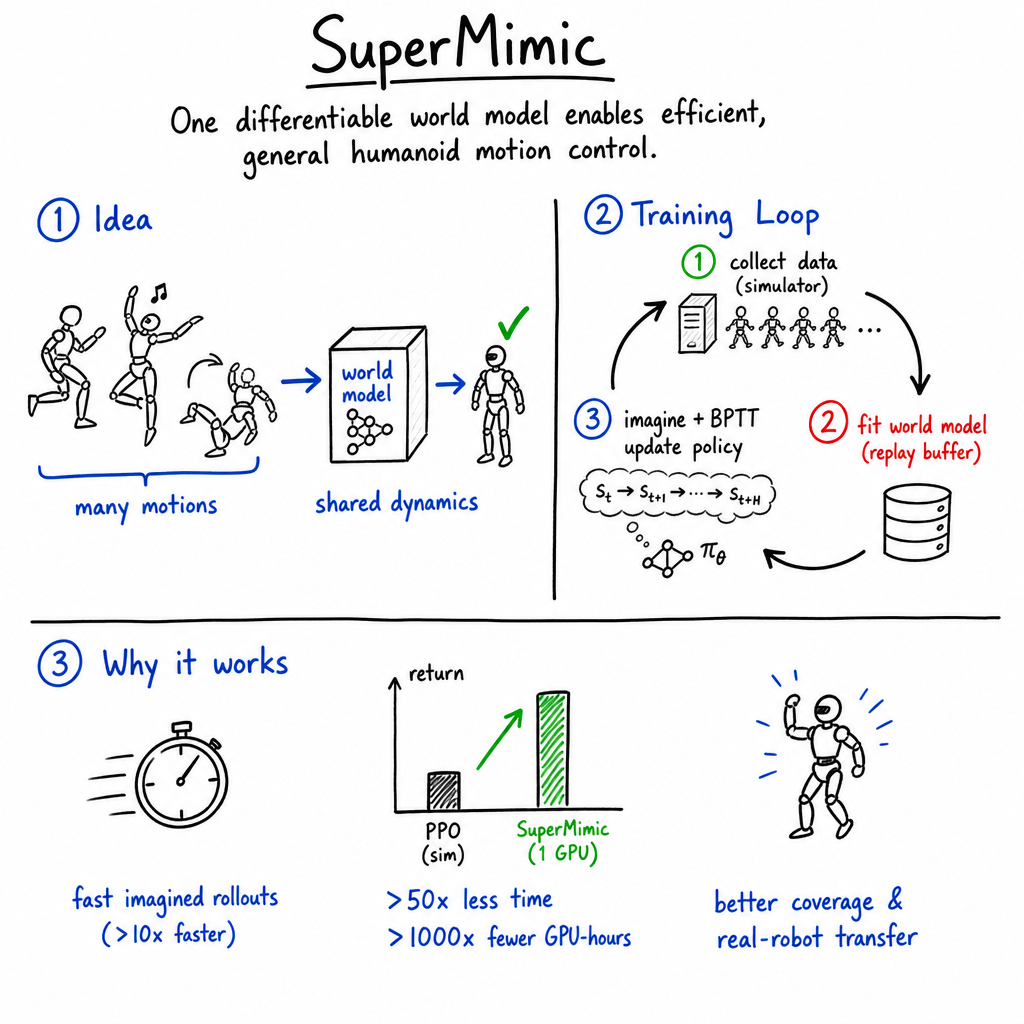
SuperMimic repeatedly performs three steps:
- Collect examples in a simulator. The robot tries actions in a computer simulation. The system records what the robot did and what happened next.
- Learn a world model.
A neural network studies these examples. It learns to predict things such as:
- the robot’s next body position,
- its movements,
- whether it will fall,
- how well it followed the target motion.
- Improve the robot’s controller. The controller practices inside the learned world model instead of always using the slower, detailed simulator.
The controller is the part that decides what the robot should do, such as moving a leg or turning its torso.
What does “differentiable” mean?
The world model is differentiable, which means it can show not only whether an action was good or bad, but also how to change the action to improve it.
An everyday analogy is climbing a hill:
- A normal method might try many random directions and see which one goes uphill.
- A differentiable method can directly estimate which direction is uphill and move that way.
This gives the controller a more useful guide for improving its actions.
What is “backpropagation through time”?
The robot imagines a short sequence of actions, such as:
- Move the leg.
- Shift the body.
- Push off the ground.
- Land.
The system then works backward through this imagined sequence to determine which earlier actions caused success or failure. This is called backpropagation through time.
The researchers used imagined sequences lasting 32 control steps. A second network, called a critic, estimated what might happen after those 32 steps. This helped the robot learn longer-term behaviors, such as recovering after being pushed.
What was the comparison?
The researchers compared SuperMimic with SONIC, a powerful existing motion-tracking system based on a standard method called model-free reinforcement learning.
In model-free learning, the robot repeatedly tries actions in the simulator and learns from the results without first learning a general model of how the body works. It is similar to learning a video game by trying moves again and again without understanding the game’s rules.
4. What did the researchers find?
SuperMimic used far less computing power
The biggest result was that SuperMimic performed as well as or better than the comparison system while using dramatically fewer computers.
According to the paper:
- SuperMimic exceeded SONIC’s performance in about 3 hours on one H100 GPU.
- SONIC used about 128 L40 GPUs for 7 days.
- SuperMimic used more than 1,000 times fewer GPU-hours.
- It used more than 50 times less real-world training time.
A GPU is a powerful computer processor often used for training artificial intelligence. GPU-hours measure how much total computer time was used.
It failed on fewer motions
The researchers tested the systems on 129,514 motions.
- After about 3 hours, SuperMimic failed on 25 motions.
- SONIC failed on 179 motions.
- After about 9.8 hours on two GPUs, SuperMimic failed on zero motions.
This suggests that SuperMimic was not only faster but also more reliable across a very large collection of movements.
It scaled well to larger motion libraries
The researchers increased the amount of motion data from 1 hour to about 264 hours.
The world model’s prediction error stayed fairly stable. In other words, adding many more movements did not make the model much worse or require a huge increase in training power.
This is possible because all the movements use the same basic robot body. Walking, rolling, and flipping are different, but they still depend on shared rules about joints, balance, gravity, and contact with the ground.
The learned world model was much faster than the simulator
The world model could produce imagined robot movements more than 10 times faster than the detailed simulator in the normal training setup. At some very large batch sizes, it was up to 62 times faster.
It also needed about 64 times fewer imagined steps than another approach using ordinary reinforcement learning on the world model. The reason is that SuperMimic used direct, analytic gradients to show the controller how to improve.
The critic improved recovery
The critic helped the robot learn to recover after being pushed.
Without the critic, a robot might only focus on what happens during the next few moments. With the critic, it could also consider future consequences, such as:
“If I move this way now, will I still be able to regain my balance later?”
The critic-based controller recovered from pushes, while the controller without a critic continued stumbling or fell.
It worked on a real robot
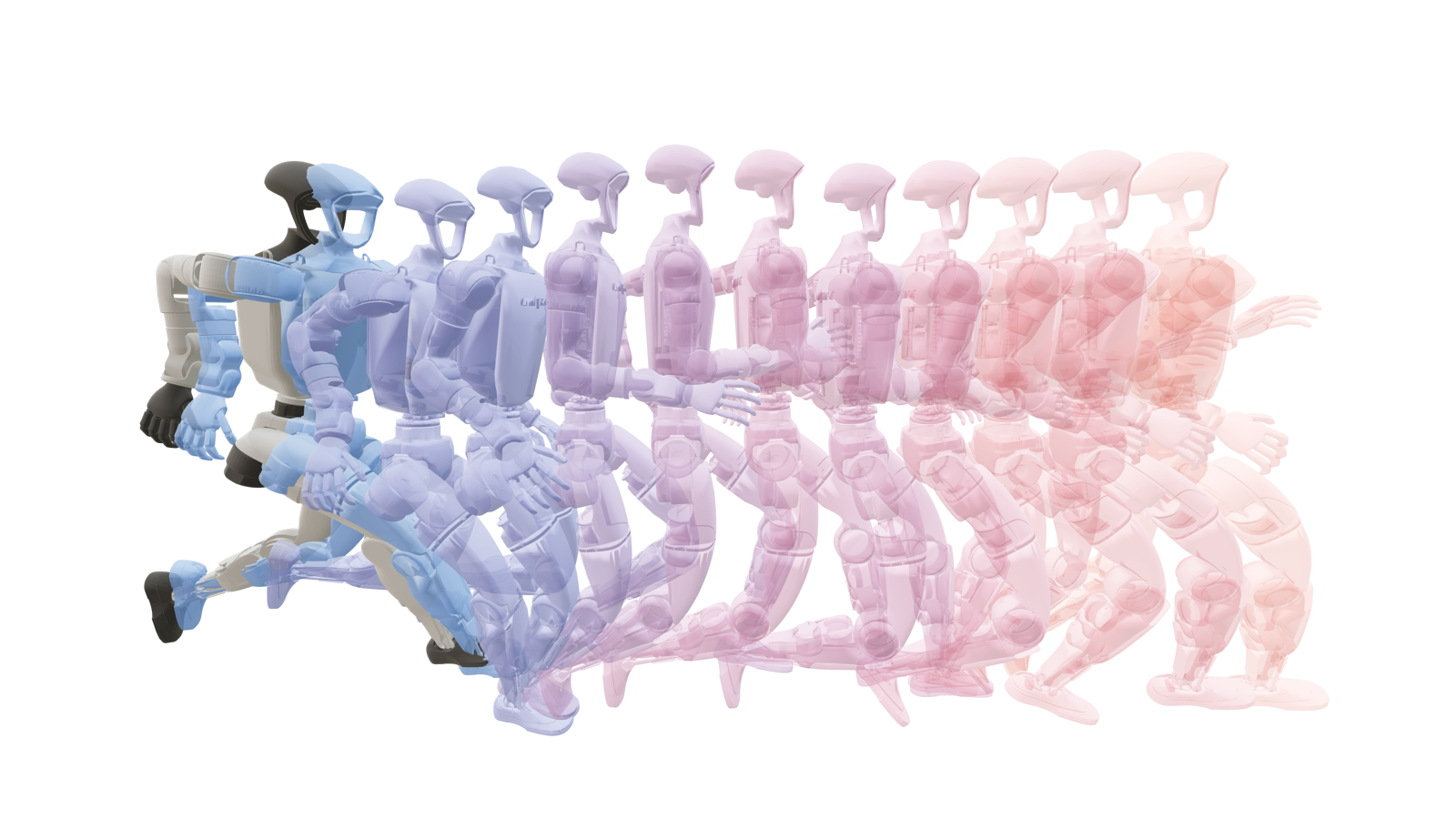
The trained controller was transferred to a real Unitree G1 humanoid robot.
The robot performed several challenging movements, including:
- a skipping jump,
- a side roll,
- a 90-degree flip,
- an in-place 360-degree flip.
Importantly, the researchers used one general controller rather than creating a separately adjusted controller for every movement.
5. Why are these results important?
Training humanoid robots has often been limited by the amount of computer power needed. If every new movement requires enormous amounts of training time, it becomes difficult to build robots that can perform many skills.
SuperMimic suggests that a robot can learn more efficiently by first learning a useful model of its own body and then practicing inside that model. This is similar to how people might learn a sport by first understanding how their body moves and then mentally rehearsing actions before trying them in real life.
The research could make it easier to:
- train robots using much smaller computer clusters,
- teach robots larger libraries of human movements,
- develop robots that walk, recover, dance, roll, and perform acrobatics,
- adapt the same controller to new goals, such as moving at a chosen speed,
- transfer skills from computer simulations to real robots.
Conclusion
SuperMimic is a method for training humanoid robots more efficiently. Instead of learning every movement only through slow trial and error in a simulator, it learns a fast internal model of how the robot’s body works. The controller then practices in this learned model and receives detailed guidance about how to improve.
The paper reports that SuperMimic can match or beat a leading system while using over 1,000 times fewer GPU-hours, handle more than 129,000 motions, and control a real humanoid robot during difficult movements.
If these results continue to hold in larger and more realistic tests, this approach could help researchers build humanoid robots that learn many useful skills without needing enormous computer clusters.
Knowledge Gaps
The paper leaves the following knowledge gaps, limitations, and open questions unresolved:
- Limited real-robot validation: Transfer is demonstrated on only one Unitree G1 and four motions; performance across multiple robots, hardware configurations, payloads, terrains, battery states, and longer uninterrupted deployments is not established.
- No quantitative sim-to-real evaluation: The paper provides visual demonstrations but does not report real-robot tracking error, fall rate, recovery success, latency, energy use, actuator load, or failure frequency.
- Unclear robustness to real-world disturbances: It remains unknown how the controller handles unexpected contacts, uneven or compliant terrain, moving obstacles, occlusions, actuator faults, communication delays, or external pushes outside the tested simulation range.
- Dependence on simulator fidelity: The world model is trained entirely from simulator transitions, so its behavior under unmodeled real-world contact phenomena, friction variations, compliance, backlash, thermal effects, and sensor bias is not characterized.
- Restricted motion and environment coverage: The scaling study varies the amount of motion data up to 264 hours but does not test substantially different humanoid morphologies, environments, object interactions, non-human motions, or motions requiring manipulation.
- Unresolved extrapolation behavior: The paper does not determine whether the learned world model can accurately predict states for actions, contacts, poses, or motion combinations outside the replay-buffer distribution.
- Long-horizon model reliability is insufficiently measured: Although the policy uses 32-step imagined rollouts and the paper claims stable longer rollouts, it does not provide systematic error growth, compounding-error, or stability measurements over the full episode horizon.
- Mismatch between training and imagination horizons: The world model is fitted using 8-step autoregressive windows but used for 32-step policy optimization; the effects of this mismatch, and the optimal relationship between fitting and imagination horizons, remain unexplored.
- World-model uncertainty is not modeled: The method uses deterministic predictions and does not quantify epistemic or aleatoric uncertainty, detect model inaccuracies online, or adapt policy updates when imagined trajectories leave well-supported regions.
- Potential model exploitation is not analyzed: The policy may discover actions that exploit errors in the learned dynamics or reward heads. The paper does not measure the frequency, severity, or mitigation of such model exploitation.
- Limited ablation of world-model design choices: The relative contributions of the state representation, network architecture, context variables, analytically computed versus learned heads, loss weighting, replay-buffer size, and action-noise distribution are not systematically isolated.
- Incomplete analysis of context conditioning: The paper conditions on friction, calibration offsets, and torso center of mass, but does not test which context variables are necessary, how accurately they must be known, or how performance changes when they are misestimated.
- Gradient quality is not directly validated: The claimed advantage of analytic gradients is inferred from learning curves, but the paper does not compare world-model gradients with finite-difference, simulator-differentiation, or policy-gradient estimates in terms of bias, variance, or alignment with the true simulator objective.
- Surrogate-objective bias remains unknown: It is not established how optimizing through the learned model differs from optimizing the true simulator return, especially after substantial policy updates or under rare recovery behaviors.
- Sensitivity to hyperparameters is unclear: The robustness of training to the imagination horizon, discount factor, critic bootstrapping, learning rates, replay-buffer replacement rate, action noise, observation noise, and model-update frequency is not reported.
- Insufficient statistical reporting: The paper states that training is stable but does not provide confidence intervals, per-seed curves, variance estimates, or statistical tests for the main returns, failure counts, scaling trends, and compute comparisons.
- Baseline comparison is not fully controlled at scale: The main SONIC comparison uses different GPU models, data volumes, implementation details, and possibly different optimization pipelines; therefore, the exact source of the reported GPU-hour advantage remains uncertain.
- No comparison with strong alternative model-based methods: The study does not evaluate methods such as latent world models, uncertainty-aware model-based RL, imagined-rollout PPO, MPC, or hybrid model-free/model-based algorithms under matched conditions.
- Compute accounting omits broader costs: The analysis focuses on GPU-hours and does not quantify CPU use, simulator data-generation cost, memory consumption, engineering effort, evaluation cost, model-training overhead, or deployment-time computation.
- Scaling beyond the tested dataset is unresolved: The observed sublinear compute growth from 1 to 264 hours may not continue when the motion library becomes substantially more diverse or includes behaviors with distinct contact modes and dynamics.
- Failure analysis is underdeveloped: The paper reports aggregate failure counts but does not categorize failures by motion type, contact pattern, speed, initial state, motion length, or model-prediction error, limiting insight into which behaviors remain difficult.
- Rare-event performance is not established: Average normalized return and aggregate failure counts may obscure rare but severe failures; robustness to low-probability falls, collisions, unsafe joint configurations, and repeated recovery events is not evaluated.
- Safety constraints are not incorporated explicitly: The training objective does not appear to enforce formal guarantees for joint limits, torque limits, self-collision, ground impact, actuator temperature, or safe stopping behavior.
- The effect of removing the self-collision penalty is unclear: The motion-tracking reward omits the self-collision penalty, but the consequences for physical safety, collision frequency, and transfer quality are not quantified.
- Downstream-task evidence is preliminary: The downstream evaluation is limited to a velocity interface and appears incomplete in the provided text; generalization to navigation, manipulation, object interaction, recovery commands, and multi-objective tasks remains untested.
- Joint training interference is not characterized: It is unclear whether simultaneously training motion-tracking and downstream goal interfaces causes competition for model capacity, degrades tracking, or produces negative transfer as the number of interfaces increases.
- Representation reuse is not compared systematically: The paper does not determine when a shared world model and decoder outperform separately trained controllers, frozen skill representations, distillation, or modular policies.
- Generalization to unseen motions is uncertain: The evaluation uses a large benchmark, but the paper does not clearly separate interpolation among training motion distributions from genuine generalization to held-out motion families, performers, styles, or tempos.
- Sensitivity to reference-motion quality is unknown: The effects of mocap noise, missing frames, retargeting errors, stylistic variation, inconsistent frame rates, and physically implausible reference clips are not investigated.
- Temporal adaptation is unexplored: The controller’s ability to follow motions at changed speeds, phase offsets, time warps, or partial reference availability is not established.
- Observation and goal delays are not evaluated: Real systems commonly experience delayed, asynchronous, or partially missing proprioceptive and reference inputs, but the method’s robustness to these conditions is not reported.
- Training stability under broader rewards is unknown: The method benefits from dense motion-tracking rewards; it remains unclear whether the same world-model and BPTT approach works for sparse, delayed, discontinuous, or highly task-specific rewards.
- Critic reliability is not fully understood: The critic improves push recovery in one simulated setting, but its calibration, extrapolation, and contribution across different horizons, tasks, and failure-recovery scenarios are not systematically evaluated.
- No theoretical scaling law is established: The empirical relationship among motion-library size, world-model error, policy capacity, and compute is suggestive but does not yield a predictive scaling law or explain when amortization will cease to be beneficial.
Practical Applications
Immediate Applications
- Lower-cost training of general-purpose humanoid controllers (robotics industry). Deploy SuperMimic’s training loop as an alternative to cluster-scale PPO for controllers that reproduce locomotion, recovery, floor contact, dance, and acrobatic motions. A robotics team could train a single goal-conditioned controller from a large motion-capture library using one or a few high-end GPUs, rather than hundreds of GPUs. The reported comparison indicates comparable or better tracking return than SONIC with more than fewer GPU-hours. Potential product/workflow: a “motion-library compiler” that converts mocap clips into a deployable whole-body controller for humanoids such as the Unitree G1. Dependencies: access to a compatible rigid-body simulator, sufficiently representative motion data, accurate robot morphology and actuator models, and hardware-specific safety validation. The compute comparison is hardware- and benchmark-dependent and should not be treated as a guaranteed reduction in every setting.
- Rapid prototyping of humanoid behaviors for research laboratories. Academic and industrial labs can use the method to evaluate new reward functions, motion representations, goal interfaces, and robot morphologies without waiting days for cluster-scale model-free RL. The differentiable world model makes short-horizon policy updates substantially more sample- and compute-efficient. Potential workflow: collect simulator transitions, fit the world model, train a policy through imagined rollouts, and validate candidate checkpoints in simulation before hardware deployment. Dependencies: the learned model must remain accurate over the relevant state-action distribution; model error, contact discontinuities, and unmodeled actuator effects can cause failures outside the training distribution.
- One controller covering diverse motion libraries. Robot manufacturers can replace collections of per-motion specialists with a shared controller conditioned on a reference motion or other goal signal. This can simplify software deployment, reduce model-switching logic, and improve behavior coverage across walking, running, jumping, rolling, and balance recovery. Potential product: a unified whole-body control stack in which new motion clips are added to a library rather than requiring a separately tuned controller. Dependencies: the motion clips must be retargetable to the robot’s kinematics and physically feasible. The paper demonstrates transfer to a Unitree G1, but broader generalization across robot platforms remains to be established.
- Mocap-to-robot animation and entertainment systems. Animation, simulation, and interactive robotics companies can use the tracker to convert human motion-capture sequences into physically plausible humanoid behavior. Unlike purely kinematic playback, the controller accounts for contacts, balance, and robot dynamics. Potential tools: real-time motion retargeting, physically grounded digital characters, robotic performers, and simulation-based choreography editors. Dependencies: motion-capture quality, latency constraints, retargeting quality, and the ability to filter unsafe or infeasible motions.
- Fast simulation-based controller iteration. The learned world model can serve as a high-throughput surrogate for policy optimization, running more than faster than the cited simulator at practical batch sizes. This can accelerate hyperparameter sweeps, ablation studies, reward design, and policy evaluation. Potential workflow: use the world model for optimization and early screening, then use the high-fidelity simulator and hardware for final verification. Dependencies: the world model should not replace high-fidelity validation for safety-critical behavior, especially for impacts, self-collisions, hardware limits, and rare recovery events.
- Downstream velocity-command control. The paper’s preliminary downstream study suggests that a goal encoder trained through the shared world model can track velocity commands more accurately than a distillation baseline. This supports practical interfaces in which users specify desired velocity rather than a full reference trajectory. Potential product: a locomotion API accepting commands such as forward speed, lateral speed, and yaw rate while the shared controller selects appropriate whole-body motion. Dependencies: the reported downstream result is preliminary, and broader task rewards, command distributions, terrain types, and hardware conditions require validation.
- More affordable robotics education and experimentation. Universities and small companies can reproduce large-scale humanoid-control experiments with modest GPU resources. This lowers the barrier to studying model-based RL, sim-to-real transfer, differentiable dynamics, and scaling laws. Dependencies: implementation availability, simulator licensing or access, computational memory, and sufficient expertise in robot modeling and reinforcement learning.
- Policy and safety stress testing. The world model and critic can be used to test recovery behavior under simulated pushes, perturbations, sensor noise, friction changes, and calibration offsets before exposing a robot to those conditions. The paper specifically reports improved push recovery when a critic bootstraps beyond the short imagination horizon. Potential workflow: generate perturbation scenarios, rank policies by recovery time and fall probability, and transfer only policies that meet predefined robustness thresholds. Dependencies: simulated disturbances must represent real-world disturbances; robustness metrics should include hardware damage risk, not only reward.
- Reduced energy and infrastructure costs for robotics R&D. Because training can be performed with far fewer GPU-hours, organizations can reduce cloud expenditure, laboratory energy consumption, and dependence on large computing clusters. This is immediately relevant to small robotics firms and academic groups. Dependencies: actual savings depend on GPU pricing, implementation efficiency, model retraining frequency, and the cost of collecting or generating motion data.
Long-Term Applications
- General-purpose humanoids for logistics, manufacturing, and service work. A scalable whole-body controller could become a foundational layer for robots that navigate human environments, manipulate objects, recover from disturbances, and perform physical tasks. The shared motion controller could provide locomotion and balance while task-specific planners handle manipulation and navigation. Potential architecture: high-level task planner → goal encoder → SuperMimic-style whole-body policy → low-level safety and torque controller. Dependencies: the current demonstrations focus primarily on motion tracking and velocity interfaces, not autonomous manipulation, long-horizon task planning, object interaction, or regulatory compliance. Reliable deployment requires stronger guarantees for contact forces, falls, and human proximity.
- Unified interfaces for motion, language, and task goals. The shared world model could support multiple goal encoders: reference motions, velocities, partial-body targets, task rewards, or eventually language-derived goals. This could yield humanoids that combine imitation with reinforcement learning rather than relying only on motion distillation. Potential product: a multimodal humanoid policy accepting commands such as “walk forward,” “turn left,” “ crouch and reach,” or a motion clip. Dependencies: language grounding, multimodal goal representation, reward specification, compositional generalization, and protection against ambiguous or unsafe commands require substantial further research.
- Adaptive online control using a robot-specific world model. Since the method learns from replay-buffer transitions, it could eventually update its dynamics model using data collected on a physical robot. This may allow adaptation to payload changes, actuator wear, floor friction, battery state, or calibration drift. Potential workflow: offline pretraining in simulation → cautious real-world data collection → uncertainty-aware world-model updates → constrained policy adaptation. Dependencies: online model errors can produce unsafe gradients; real-world adaptation needs uncertainty estimation, conservative exploration, rollback mechanisms, and formal safety constraints.
- Digital twins for humanoid fleet management. A differentiable world model could become part of a digital-twin system used to predict failures, compare controller versions, and personalize policies across a fleet of robots. Potential tools: robot-specific calibration services, predictive maintenance models, fleet-level behavior evaluation, and simulation-based software updates. Dependencies: accurate system identification, synchronized sensor logs, scalable data infrastructure, and reliable transfer across units with manufacturing variation.
- Automated motion-library expansion and scaling-law optimization. The paper makes it practical to study how controller capability changes with motion-data quantity and diversity. Future systems could automatically select informative motions, identify missing behaviors, and prioritize data collection where the controller is weak. Potential workflow: evaluate failure clusters → acquire or synthesize targeted mocap → retrain the shared world model and policy → verify improvements on held-out motions. Dependencies: failures must be classified meaningfully, motion datasets must contain sufficient diversity, and improvements on benchmark motions must correlate with real-world capability.
- Whole-body control for assistive and rehabilitation robotics. The approach could support exoskeletons, prosthetic systems, and humanoid assistants that need to reproduce safe, personalized movement patterns while maintaining balance. A learned dynamics model could help optimize motion under user-specific constraints. Dependencies: the paper concerns humanoid robots rather than clinical devices. Medical applications require patient-specific modeling, clinical trials, interpretability, fail-safe behavior, and regulatory approval.
- Physically grounded virtual humans and simulation environments. The controller could drive expressive, contact-aware virtual humans in games, film, training simulators, and virtual reality. Its ability to handle locomotion, floor contact, and acrobatics could reduce the need for manually authored motion transitions. Potential tools: interactive avatar controllers, physically plausible stunt generation, VR avatars that recover from perturbations, and synthetic motion datasets for robotics. Dependencies: real-time inference, visual or pose-based goal tracking, stylistic control, and avoidance of motion artifacts or inappropriate reproduction of copyrighted motion data.
- Safety-certified model-based humanoid control. The world-model approach could eventually be integrated with control-barrier functions, reachability analysis, constrained optimization, or runtime monitors. This would combine fast learned policy updates with explicit limits on joint torque, contact force, workspace, and fall risk. Dependencies: neural world models are approximate and may not provide formal guarantees. Certification would require bounded model error, uncertainty-aware prediction, verified fallback controllers, and extensive hardware testing.
- Transfer to other articulated robots and complex contact systems. The central idea—learning one differentiable surrogate of shared dynamics and optimizing policies through imagined rollouts—could extend to quadrupeds, mobile manipulators, robotic hands, and articulated industrial systems. Dependencies: the favorable scaling result relies partly on many motions sharing the same humanoid dynamics. Robots with highly discontinuous contacts, deformable objects, fluid interaction, or rapidly changing morphology may not exhibit the same stable model-error behavior.
- Industrial policy-design platforms for task-specific robotics. A mature version could let engineers specify task rewards and constraints while reusing a pretrained motion controller. This would reduce the need to retrain low-level behavior for every new task. Potential workflow: select a pretrained motion prior, define a task reward, train a goal encoder or task policy through the world model, and validate under randomized simulation conditions. Dependencies: reward design remains difficult; optimizing an imperfect model can exploit model inaccuracies, and task success must be evaluated under real-world distribution shifts.
- Large-scale synthetic data generation for robotics. Once validated, the world model could generate diverse imagined trajectories for policy pretraining, failure analysis, and representation learning at much lower cost than repeatedly running a full simulator. Dependencies: synthetic trajectories may inherit systematic model bias. They should be combined with simulator and real-robot data, with uncertainty-aware filtering and held-out physical evaluation.
Glossary
- Actor–critic: A reinforcement-learning architecture that jointly learns a policy (actor) and a value estimator (critic). “The policy and critic updates together form a short-horizon actor--critic in the spirit of SHAC”
- Advantage actor–critic (A2C): A policy-learning method that updates actions using estimated advantages over a learned value baseline. “A2C: advantage actor--critic”
- Analytic gradient: A gradient computed by differentiating an explicit computational model rather than estimating it from sampled perturbations. “The resulting analytic policy gradient is the gradient of a surrogate for the expected return in simulation.”
- Autoregressive: Describing a model that generates later predictions using its own or earlier predicted outputs. “We fit the network weights on -step autoregressive replay windows”
- Backpropagation-through-time (BPTT): Backpropagation applied through the sequence of computations in a recurrent or temporally unrolled model. “Backpropagation-through-time (BPTT) through short imagined rollouts provides analytic policy gradients”
- Binary cross-entropy (BCE): A loss function for comparing predicted probabilities with binary labels. “and BCE is the binary cross-entropy.”
- Bootstrapping: Estimating a long-term value using another learned value estimate rather than waiting for a complete episode. “a critic , trained in the same phase, bootstraps the return beyond ”
- Classifier guidance diffusion: A diffusion-generation technique in which a classifier steers samples toward desired conditions. “CGD: classifier guidance diffusion”
- Contact-rich dynamics: Physical dynamics involving frequent or complex interactions between bodies and surfaces. “Physics-based motion imitation learns controllers that reproduce reference motions under contact-rich rigid-body dynamics.”
- Critic: A value function that estimates expected future return and is used to improve policy learning. “The critic estimates the return beyond step ”
- Differentiable surrogate: A differentiable approximation to a simulator or physical process that permits gradient-based optimization. “SuperMimic learns a differentiable surrogate to obtain policy gradients”
- Domain randomization: Training with varied environmental or system parameters to improve robustness to real-world variation. “sim context (domain-randomization parameters)”
- Dyna style: A reinforcement-learning approach that combines real experience with simulated experience generated by a learned model. “with each rollout seeded from a replay-buffer state in the Dyna style”
- Generalized advantage estimation (GAE): A method for estimating policy advantages while trading off bias and variance through a smoothing parameter. “The critic is fit to generalized advantage estimation returns”
- Goal-conditioned: Describing a policy or model whose behavior depends on an explicitly provided target or goal. “SuperMimic trains one goal-conditioned whole-body controller”
- Gradient variance: The variability of gradient estimates across samples, which can make optimization unstable or inefficient. “over short horizons its gradient has much lower variance.”
- Hybrid rigid-body dynamics: Physical dynamics combining continuous rigid-body motion with discrete changes caused by events such as contact. “they share the same humanoid hybrid rigid-body dynamics.”
- Imagination horizon: The number of future steps simulated inside a learned model during an imagined rollout. “This imagination horizon exceeds the -step replay windows”
- Imagined rollout: A simulated sequence of states, actions, and rewards generated by a learned dynamics model rather than by the physical simulator. “The policy is improved by backpropagation-through-time through the frozen world model over imagined steps”
- Likelihood-ratio estimate: A policy-gradient estimator that weights log-policy derivatives by sampled returns or advantages. “a likelihood-ratio estimate.”
- Latent alignment: An objective that encourages internal latent representations from different components or training stages to correspond. “Goal encoders train jointly with the tracker on the motion-tracking reward and latent-alignment losses”
- Model-based reinforcement learning (MBRL): Reinforcement learning that uses a learned model of environment dynamics to improve a policy. “Model-based RL (MBRL) for deployable humanoid control.”
- Model-free reinforcement learning: Reinforcement learning that learns a policy without explicitly learning an environment dynamics model. “Current pipelines use model-free reinforcement learning”
- Motion inpainting: Completing missing or unspecified portions of a motion sequence based on the available portions. “MaskedMimic supports partial-body and multimodal goals through motion inpainting”
- Motion-capture (mocap): Recorded human movement data obtained from motion-capture systems. “drawn from large motion-capture (mocap) datasets”
- Partially observable Markov decision process (POMDP): A sequential decision model in which the agent cannot directly observe the complete underlying state. “We denote the goal-conditioned partially observable Markov decision process (POMDP) by ”
- Policy gradient: A gradient used to adjust policy parameters in the direction of higher expected return. “SuperMimic backpropagates its imagined return through world-model rollouts.”
- Proprioceptive observation: A robot’s sensory observation of its own configuration or motion, such as joint positions and velocities. “State gives the proprioceptive observation ”
- Proximal policy optimization (PPO): A policy-gradient algorithm that constrains policy updates to avoid excessively large changes. “model-free proximal policy optimization (PPO)”
- Replay buffer: A data structure that stores previously collected transitions for reuse during model or policy training. “The current policy collects transitions in simulation into a fixed-size replay buffer”
- Rigid-body dynamics: The physical laws governing the motion and interaction of bodies treated as non-deformable. “the same humanoid hybrid rigid-body dynamics.”
- Sim-to-real transfer: Deploying a policy trained in simulation on a physical robot. “to its sim-to-real deployment”
- Stochastic policy: A policy that samples actions from a probability distribution rather than always producing one fixed action. “PPO treats the dynamics as a black box: it weights the score of a stochastic policy”
- Survival weight: A differentiable factor that discounts or removes rewards after an episode termination. “Returns use a soft survival weight”
- Tensor-core precision (TF32): A numerical format and hardware computation mode optimized for fast matrix operations on NVIDIA GPUs. “the world model runs at the TF32 precision used in SuperMimic's training.”
- World model: A learned model that predicts environment transitions, observations, rewards, or termination conditions. “SuperMimic amortizes learning across all motions with one differentiable world model of their shared dynamics”
- Zero-shot per-motion tuning: Applying a general controller to multiple motions without separately adjusting it for each motion. “deploys on a real Unitree~G1 without per-motion tuning”

