Holi-World: Building Holistic World Intelligence from Human-Ego Experience
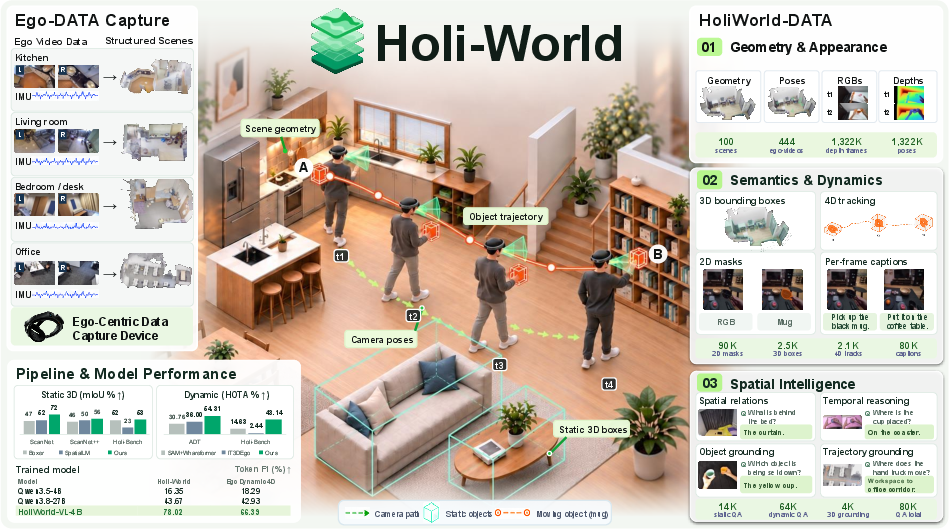
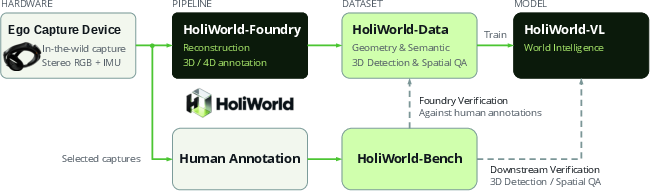
Abstract: Human egocentric experience offers a rich foundation for learning how the world is organized and how it changes through interaction. Realizing this potential at scale requires turning growing volumes of recordings into learning resources that connect scene structure, object semantics, and interaction histories across viewpoints and time, while reducing dependence on costly manual annotation. We introduce HOLI-WORLD, an integrated ecosystem connecting experience capture, world representation, automated data construction, model learning, and independent evaluation. To sup- port learning at scale, HOLIWORLD-Foundry combines complementary static and dynamic perception to automatically construct world records that connect persistent scene structure and evolving object states with interaction histories and supporting observations. HOLIWORLD-Data organizes these records from approximately 100 self-collected scenes into grounded learning resources, including approximately 80K QA pairs used to train HOLIWORLD-VL-4B. Independent human annotations of heldout recordings form HOLIWORLD-Bench, supporting evaluation of both annotation quality and learned spatial and temporal understanding. Experiments on ScanNet, ScanNet++, Aria Digital Twin, and HOLIWORLD-Bench demonstrate strong performance in static perception and dynamic tracking, while training on HOLIWORLD-Data substantially improves HOLIWORLD-VL-4B's spatial and temporal reasoning on HOLI- WORLD-Bench and EgoDynamic4D. HOLIWORLD provides a practical foundation for expanding learning resources from the continuous flow of human experience and advancing machine understanding of the dynamic world.
Paper Prompts
Sign up for free to create and run prompts on this paper.
Top Community Prompts
Explain it Like I'm 14
1. What is this paper about?
This paper introduces HoliWorld, a system designed to help artificial intelligence understand the real world more like people do.
People learn about the world by:
- Looking around different places
- Recognizing objects
- Moving through rooms
- Picking things up and using them
- Remembering how objects and places change over time
HoliWorld tries to teach AI these same kinds of skills using videos recorded from a person’s point of view. This type of recording is called egocentric video—for example, video from a camera worn on someone’s head or chest.
The system turns these videos into useful information about:
- Where objects are
- What objects are
- How objects move
- What a person does with them
- How scenes change over time
2. What questions are the researchers asking?
The researchers mainly want to answer these questions:
- Can computers automatically build a 3D map of a place from videos?
- Can they recognize both objects that stay still and objects that move?
- Can they follow the same object over time, even when it briefly disappears?
- Can automatically created training data help an AI answer questions about space, movement, and interactions?
- Can this process reduce the need for people to label every video by hand?
For example, the system should eventually be able to answer questions such as:
- “Where is the cup?”
- “Is the chair to the left of the table?”
- “Which object did the person pick up?”
- “Did the object move closer or farther away?”
- “What happened before the box was opened?”
3. How does the system work?
HoliWorld has several connected parts. Together, they work like a factory that turns ordinary videos into useful lessons for AI.
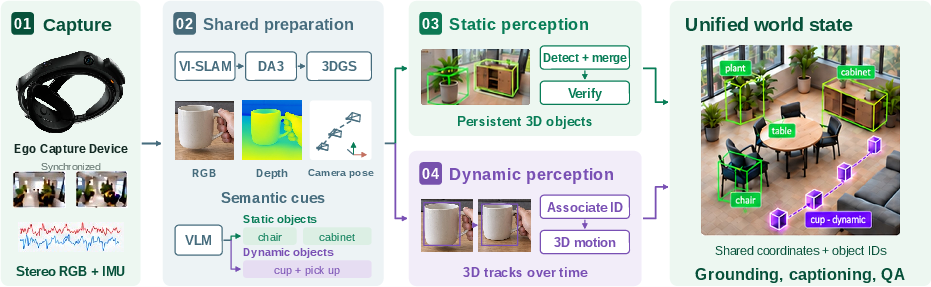
Recording the world
The researchers use a special device called the Eagle Capture Device. It records:
- Regular color video
- Video from two slightly different cameras, called stereo video
- Movement information from sensors
Stereo video works somewhat like human eyesight. Because the two cameras see a scene from slightly different positions, the system can estimate how far away objects are.
The movement sensors help the system understand how the camera itself is moving.
Building a 3D scene
The system uses a method called visual-inertial SLAM. In simple terms, this means:
The computer watches the video and uses movement sensors to figure out where the camera is and what the surrounding space looks like.
It creates a 3D description of the environment, similar to building a digital model of a room.
The researchers also use depth estimation, which means predicting the distance between the camera and each part of the scene. The result is a 3D point cloud—a large collection of points that describes the shapes and positions of surfaces and objects.
Another technique, called 3D Gaussian splatting, represents a scene using many small fuzzy 3D shapes. These shapes can be combined to make a detailed model of the environment.
Finding stationary objects
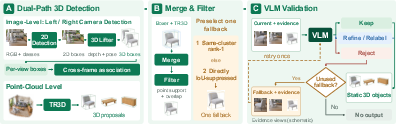
For objects that mostly stay in one place, such as tables, chairs, or shelves, HoliWorld uses two kinds of detection:
- It looks for objects in individual video images.
- It looks for objects in the full 3D point cloud.
Using both methods is like searching for an object with both a flashlight and a map. The image-based method can notice small details, while the 3D method can better understand the complete size and shape of larger objects.
The system then combines repeated observations of the same object. A vision-LLM checks whether the object’s label and shape make sense. For example, it may correct a wrongly identified chair or remove a box that does not have enough evidence.
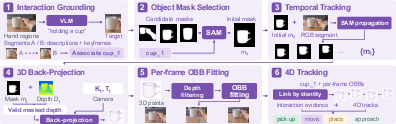
Tracking moving objects
Objects that people pick up or move require a different method.
First, the system uses descriptions of the interaction to decide which object is being handled. It then gives the object a continuing identity, such as “this is the same cup as before.”
A tool called the Segment Anything Model, or SAM, marks the object’s pixels in each video frame. This is similar to coloring in the object so that the computer can follow it.
The system then combines:
- The object’s marked pixels
- Its estimated depth
- The camera’s position
This lets it calculate the object’s position in 3D space at different times. Connecting these positions creates a trajectory, or path, showing how the object moved.
Creating questions and answers
After building these records, HoliWorld creates training examples for an AI model.
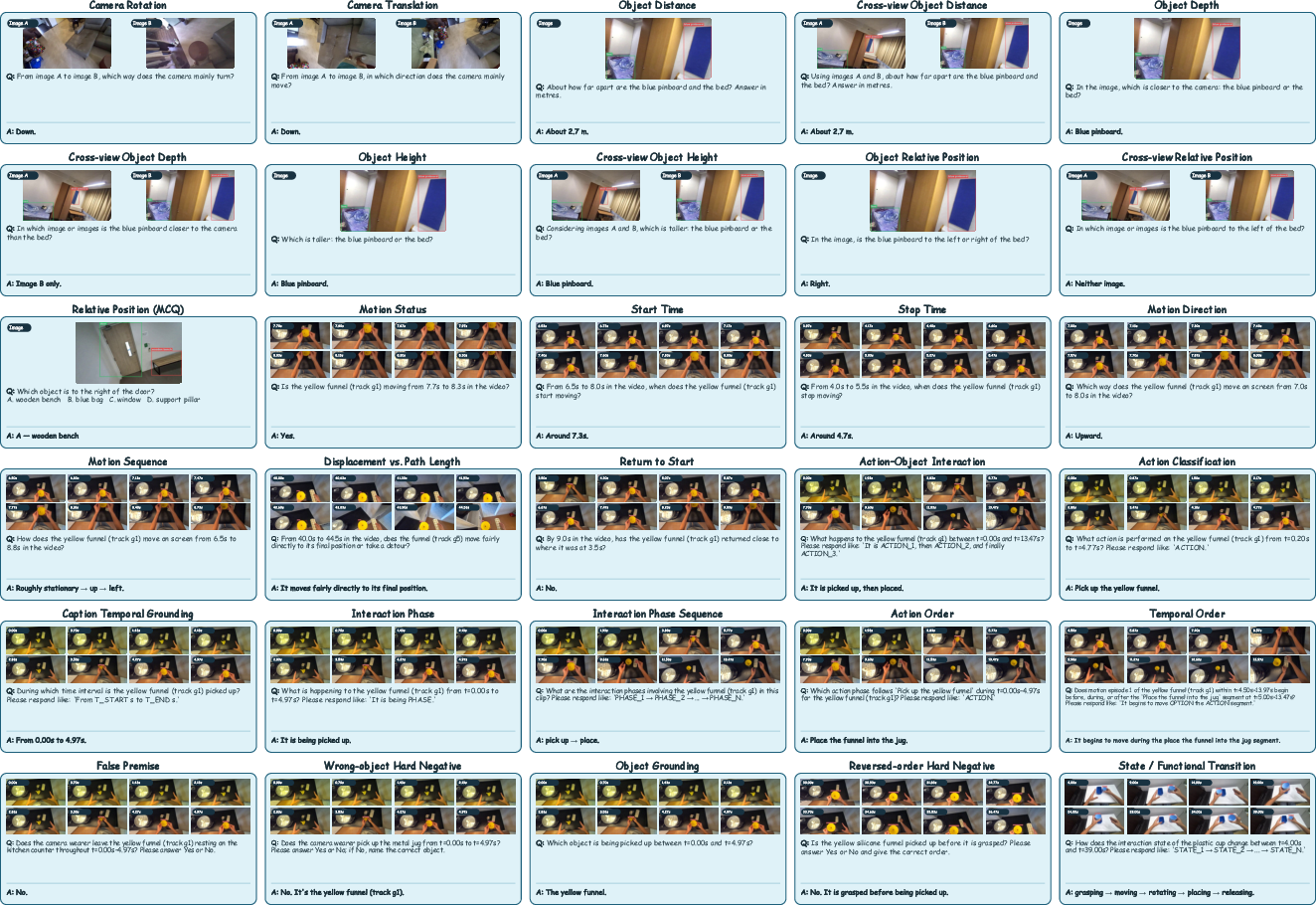
The dataset contains questions about:
- Object locations
- Distances and directions
- Which objects are inside or next to others
- Movement and timing
- Human-object interactions
- Changes in object states
For instance, a training question might ask:
“Which object moved from the table to the floor?”
The answer is linked to the exact video frames and 3D information that support it. This is important because the system can show where its answer came from.
4. What data did the researchers create?
The researchers collected approximately:
- 100 scenes
- 444 first-person videos
- 1.3 million video frames
- 90,000 2D object boxes
- 2,466 stationary 3D object boxes
- 2,095 moving-object tracks
- About 80,000 question-and-answer pairs
They used this information to train a model called HoliWorld-VL-4B.
They also created HoliWorld-Bench, a separate test set. People manually checked recordings in this test set so the researchers could fairly measure how accurate the automatic system was.
This separation is important: the system was tested on examples that were not simply copied from its training data.
5. What were the main findings?
Better recognition of stationary objects
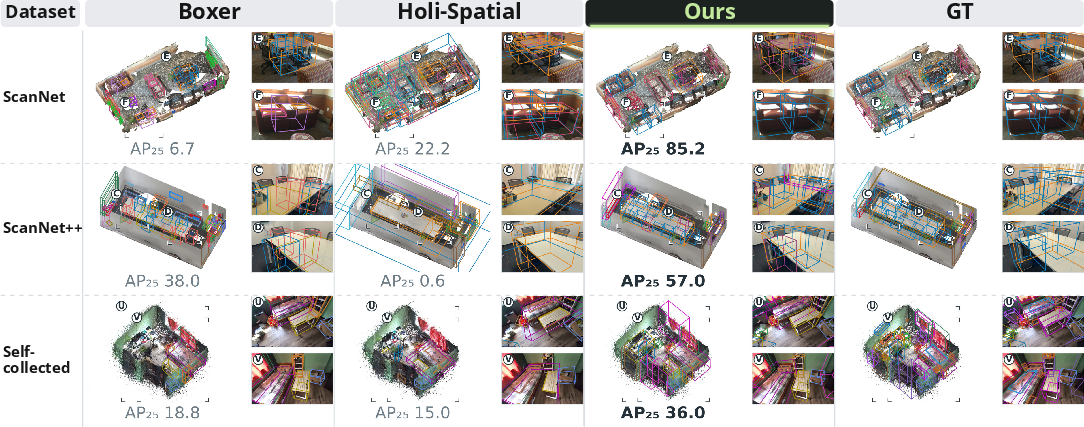
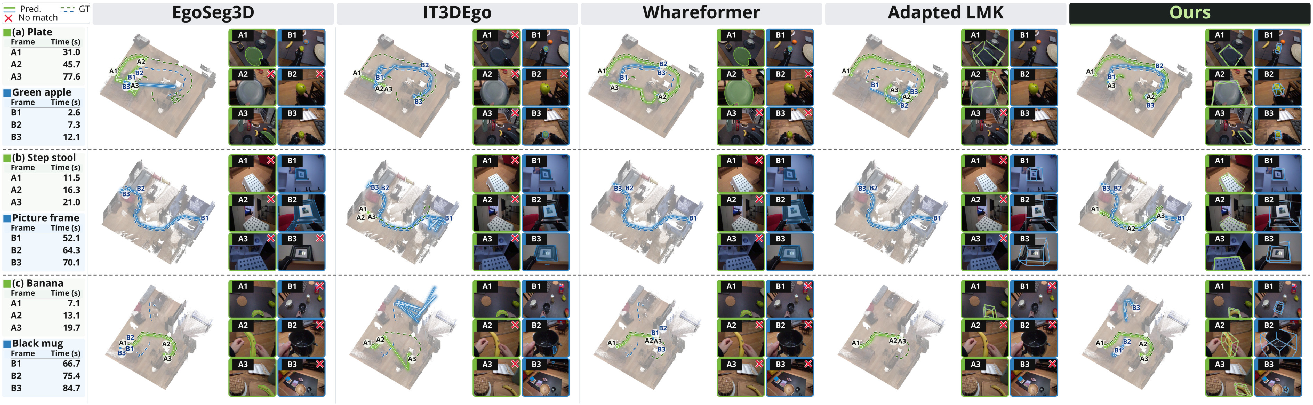
HoliWorld was better than the comparison systems at finding objects in 3D scenes.
On the ScanNet dataset, for example, it achieved an AP25 score of 0.68, while the strongest comparison system scored 0.40.
In everyday language, this means HoliWorld was more successful at finding objects and placing their 3D boundaries in the correct locations.
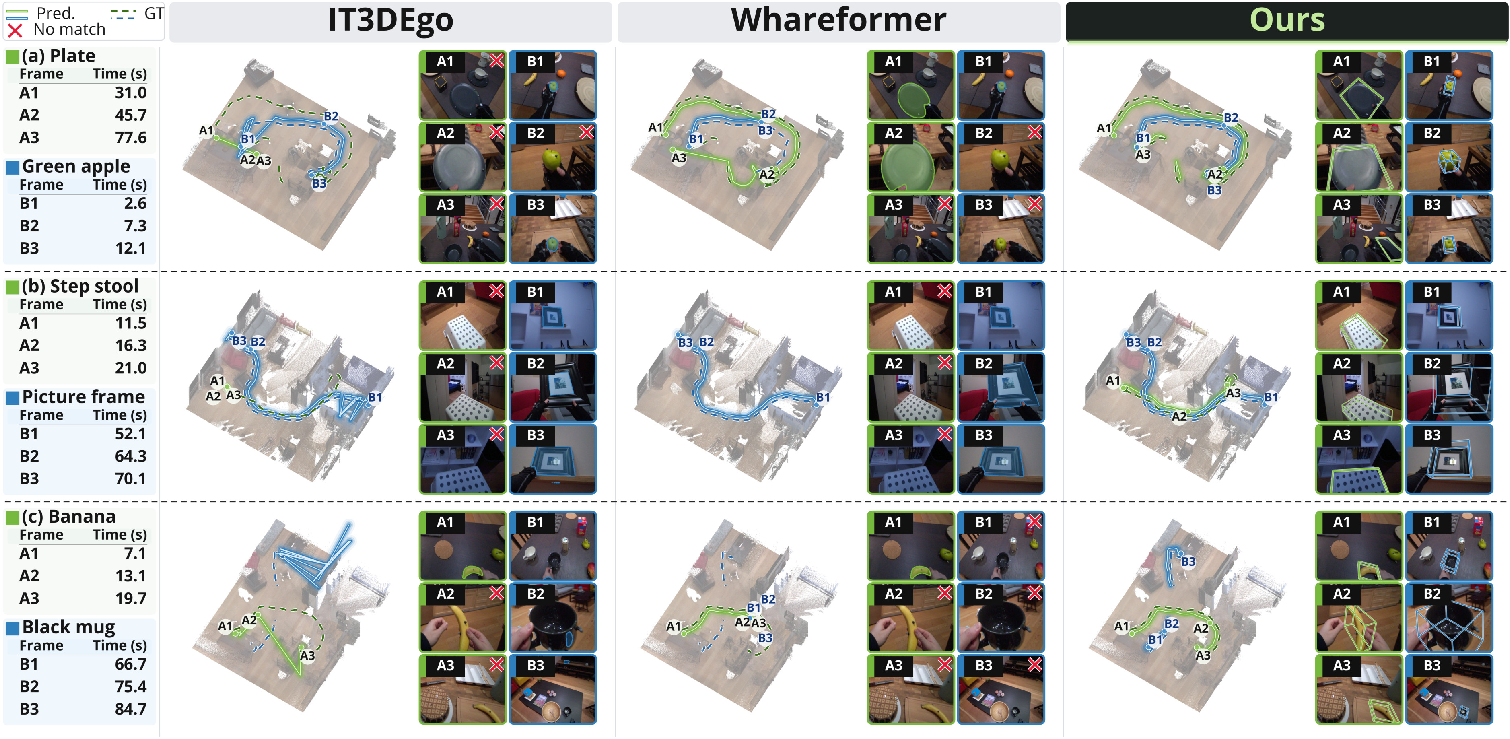
Better tracking of moving objects
HoliWorld also did better at following objects through time.
On the Aria Digital Twin dataset, its tracking score was 54.31%, compared with 36.00% for the strongest comparison method.
On the researchers’ own test set, HoliWorld scored 43.14%, while the strongest comparison method scored 15.13%.
This suggests that the system was better at:
- Keeping track of the same object
- Handling movement
- Recovering an object’s path
- Maintaining the object’s identity across different moments
Training data greatly improved AI reasoning
The researchers trained a vision-LLM using HoliWorld-Data. A vision-LLM is an AI system that connects images and video with language.
Before training on HoliWorld-Data, the model scored 16.35% on one main test of answer quality. After training, it scored 78.02%.
On another test set, its score rose from 18.29% to 66.39%.
The model also improved on yes-or-no questions, multiple-choice questions, and numerical questions.
These results show that the automatically created data was not only large; it was also useful for teaching the AI about space and time.
6. Why are these results important?
Most detailed AI training data is expensive because people must label videos by hand. They may need to draw boxes around objects, name the objects, describe movements, and mark exactly when actions happen.
HoliWorld tries to automate much of this work. It combines computer vision, 3D mapping, object tracking, and LLMs to create detailed training information from new recordings.
This could make it easier to build AI systems that understand real environments instead of only recognizing objects in still pictures.
For example, future systems could help robots:
- Find objects in unfamiliar rooms
- Remember where things are
- Understand that a person has moved an object
- Follow instructions involving directions and locations
- Predict what may happen next during an activity
7. Limitations and responsible use
The system is promising, but it is not perfect.
One important limitation is that its dynamic tracking setup assumes there is at most one moving object at a time. Real scenes can be more complicated, with several people and objects moving at once.
The system may also make mistakes when:
- Objects are hidden for a long time
- Lighting changes
- The camera moves quickly
- Objects look very similar
- Depth estimates are inaccurate
Because the videos show people’s homes, belongings, and activities, privacy is also important. The researchers say that data collection should involve consent, careful review, and removal of identifying information. The system should not be used for non-consensual surveillance or important decisions without additional safety checks.
Conclusion
HoliWorld is a complete system for teaching AI about the changing 3D world. It starts with first-person videos, builds a 3D understanding of scenes, identifies stationary and moving objects, follows interactions, and automatically creates question-and-answer examples.
The experiments show that HoliWorld can find objects, track their movement, and train an AI model to answer spatial and temporal questions much more accurately.
The larger idea is that human experiences can become rich learning material for AI. If the system can be made more reliable and expanded to handle more complex scenes, it could help future robots and AI assistants understand not just what is in the world, but also where things are, how they move, and what people are doing with them.
Knowledge Gaps
Knowledge gaps, limitations, and open questions
- Limited data scale and diversity: HoliWorld-Data contains approximately 100 self-collected scenes and 444 videos, but the paper does not establish how well the pipeline generalizes across larger populations, cultures, homes, workplaces, outdoor environments, lighting conditions, camera users, and activity patterns.
- Capture-device dependence: The method assumes synchronized stereo RGB and IMU data from the Eagle Capture Device; its robustness to monocular cameras, different stereo baselines, handheld devices, head-mounted cameras, dropped frames, motion blur, rolling-shutter effects, or imperfect synchronization remains untested.
- Restricted dynamic-scene model: Dynamic supervision assumes at most one moving object at a time, leaving multi-object interactions, simultaneous motion, object-object collisions, crowd scenes, and independently moving background objects unexplored.
- Incomplete handling of occlusion and disappearance: Identity association relies on hand regions, interaction descriptions, and keyframe evidence, but performance under prolonged occlusion, complete out-of-view intervals, visually similar objects, object replacement, or repeated instances of the same category is not systematically evaluated.
- Dependence on upstream model correctness: Reconstruction, depth estimation, open-vocabulary detection, VLM descriptions, SAM masks, and camera poses are all potential error sources, yet the paper does not quantify how errors at each stage propagate into world records, QA labels, or downstream model behavior.
- Uncertainty is not modeled explicitly: Confidence scores are included in the representation, but the pipeline does not provide calibrated uncertainty estimates or principled mechanisms for rejecting unreliable geometry, identities, trajectories, relations, or generated answers.
- Depth and geometry reliability in dynamic regions: Dynamic regions are completed with DA3 depth estimation and then back-projected into world coordinates, but the accuracy of these depths, especially for thin, reflective, deformable, textureless, or partially occluded objects, is not separately measured.
- Limited evaluation coverage: Static and dynamic results use only 20 sequences per benchmark split, and HoliWorld-Bench is derived from the same general capture ecosystem as the training data; scene-level, participant-level, and activity-level diversity may therefore be insufficient to support broad generalization claims.
- Unclear independence of the held-out benchmark: The paper states that HoliWorld-Bench uses held-out recordings, but it does not fully clarify whether the same environments, participants, object instances, interaction templates, or capture sessions occur in training and evaluation, leaving potential leakage or distribution overlap unresolved.
- Weak performance in some reported settings: Static AP at IoU 0.50 is only 0.13 on ScanNet++, and dynamic tracking performance on HoliWorld-Bench is substantially lower than on ADT; the failure modes responsible for these dataset-specific gaps are not analyzed in sufficient detail.
- Benchmark and baseline comparability: Several dynamic baselines receive ground-truth first-visible masks or category queries, whereas HoliWorld uses no annotation-derived test-time inputs. Although this distinction is documented, the comparison does not isolate the effects of initialization, target specification, architecture, and tracking method under fully matched inputs.
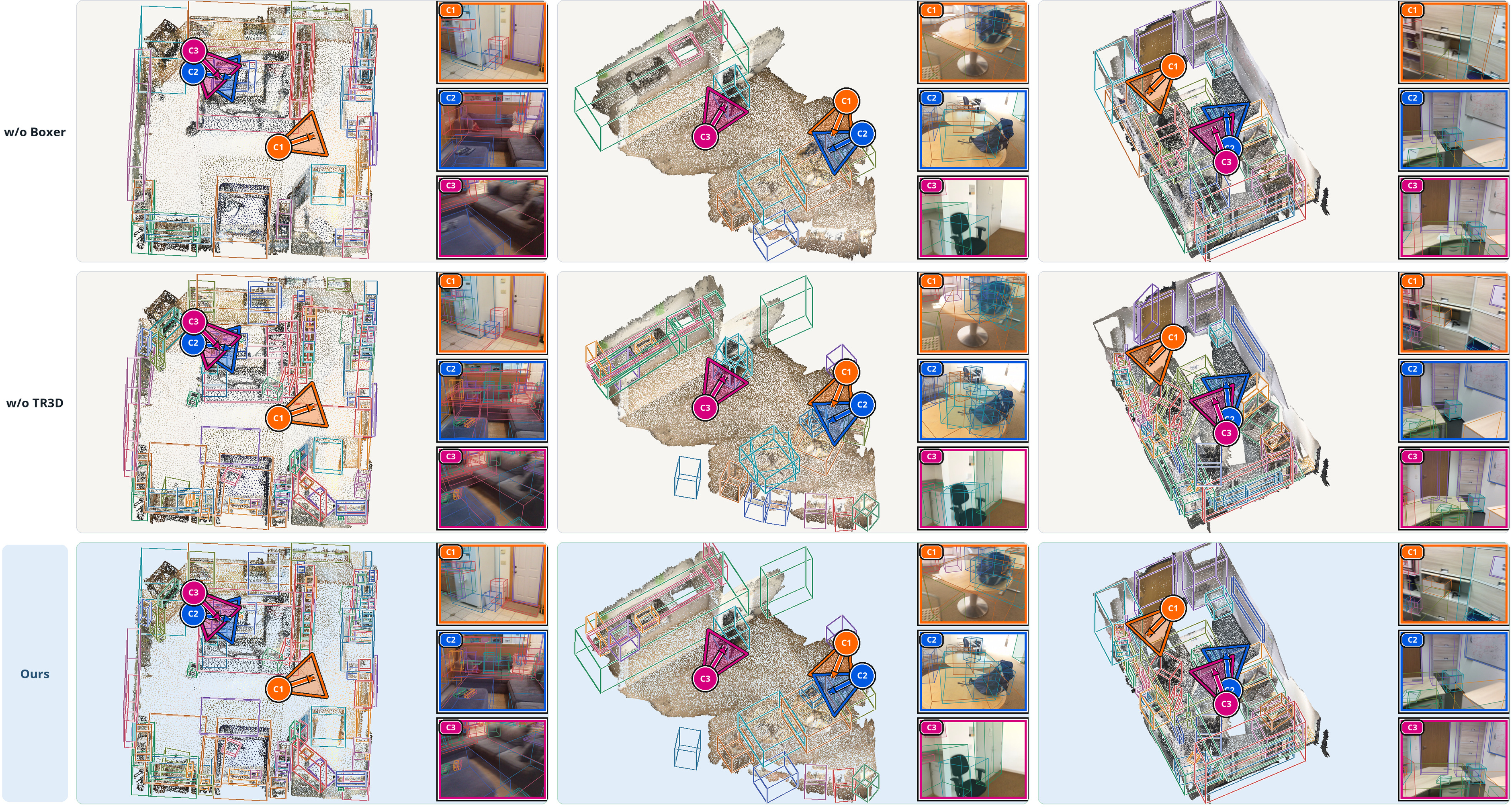
- Incomplete component ablations: The ablations remove individual modules but do not evaluate interactions among components, alternative reconstruction backbones, alternative VLMs, different depth estimators, or the sensitivity of results to thresholds such as geometric support, IoU matching, and the $0.1$ m trajectory tolerance.
- Automated QA quality is insufficiently characterized: The paper reports downstream improvements from approximately 80K generated QA pairs, but does not provide comprehensive precision, recall, ambiguity, contradiction, or human agreement analyses for each of the 30 QA types.
- Potential circularity in supervision and evaluation: QA pairs are generated from Foundry annotations, and Foundry-derived concepts define the model’s training targets; the evaluation does not fully determine whether improvements reflect genuine world understanding or learning the pipeline’s labeling conventions and question templates.
- Narrow reasoning coverage: The supervision focuses on predefined spatial relations, trajectories, interactions, and captions, leaving causal reasoning, physical affordances, object permanence, counterfactual changes, long-horizon planning, and prediction of future states largely unexplored.
- Limited temporal horizon: The paper does not establish how well persistent identities, scene maps, and interaction histories remain consistent across very long recordings, revisited environments, days or weeks of change, or substantial rearrangement of scene contents.
- Insufficient analysis of object categories and attributes: The reported results do not break down performance by object size, category frequency, material, articulation, deformability, reflectance, or degree of visual similarity, making it unclear which classes are reliably represented.
- No systematic study of human and environmental variation: The influence of different users’ movement patterns, heights, hand occlusions, interaction styles, accessibility devices, and cultural differences in object use is not evaluated.
- Model-training attribution remains unclear: The downstream gains are reported for HoliWorld-VL-4B, but the paper does not disentangle the effects of data volume, QA composition, pretraining, fine-tuning strategy, synthetic versus grounded examples, and possible benchmark-specific overlap.
- Generalization beyond the evaluated benchmarks is unresolved: Improvements are shown on HoliWorld-Bench and EgoDynamic4D, but robustness to unseen datasets, unseen camera systems, non-egocentric viewpoints, outdoor settings, and tasks requiring interaction with multiple agents is not demonstrated.
- Numerical and metric reasoning remain challenging: The very low numerical accuracy of the baseline and the relatively modest absolute numerical accuracy reported for HoliWorld-VL on EgoDynamic4D indicate unresolved difficulty in metric estimation, temporal duration reasoning, and quantitative spatial grounding.
- Computational and operational costs are not reported: The paper does not quantify reconstruction time, VLM calls, GPU and storage requirements, energy consumption, annotation-review cost, or scalability as recordings grow from hundreds to millions of videos.
- Privacy and consent risks remain practically unresolved: The paper acknowledges consent and redaction requirements, but does not specify concrete procedures for detecting faces, voices, screens, personal documents, home layouts, or sensitive interactions before releasing reconstructed scenes and evidence-linked records.
- Failure recovery and human-in-the-loop correction are unspecified: The system can reject candidates or fall back to alternatives, but the paper does not describe how users identify, correct, version, and propagate errors in world records without reprocessing entire recordings.
- Semantic representation is relatively rigid: The unified representation mainly stores objects, boxes, masks, trajectories, interactions, and evidence links; richer representations of articulated objects, object parts, relations with uncertainty, physical properties, and scene-level events remain open.
- Causal interpretation of interactions is not established: Interaction descriptions and state changes are derived from visual and VLM cues, but the system does not demonstrate that it can distinguish true causation from temporal co-occurrence or infer why an object changed state.
- Responsible-use safeguards are not empirically validated: The paper provides high-level guidance against surveillance and high-stakes use, but does not evaluate misuse risks, demographic performance disparities, adversarial manipulation, or safeguards against re-identification from 3D scene reconstructions.
Practical Applications
Immediate Applications
- Automated 3D mapping and inventory for indoor environments — robotics, facilities management, and construction
- Deploy HoliWorld-Foundry on stereo-RGB/IMU recordings to produce scene geometry, object categories, 3D bounding boxes, camera poses, and persistent object identities.
- Potential products include handheld or wearable scanning tools for:
- Building inventory and asset tracking
- Construction-progress documentation
- Warehouse and laboratory mapping
- Digital-twin initialization
- Post-occupancy building audits
- The dual static-perception pipeline is particularly useful because image-based detection captures smaller objects while point-cloud detection recovers larger spatial extents.
- Dependencies: A suitable stereo/IMU capture device, adequate lighting and visual texture, reliable SLAM, depth estimation, and manual review for safety-critical inventories. The reported results come from relatively limited scene coverage and should not be assumed to generalize to all building types.
- Egocentric video search and indexing — media, enterprise knowledge management, and research
- Convert first-person recordings into searchable records linking objects, locations, actions, timestamps, and supporting video frames.
- A user could query a video archive with questions such as:
- “Where was the measuring instrument placed?”
- “Which object was moved after the drawer was opened?”
- “What changed between the beginning and end of the recording?”
- HoliWorld-Data’s evidence-linked QA structure supports traceable answers rather than purely free-form captions.
- Dependencies: Consent for recording, privacy filtering, robust handling of out-of-view objects, and confidence thresholds that route uncertain results to human review.
- Robot perception and manipulation support — service robotics, warehouse robotics, and embodied AI
- Use persistent object identities, 3D locations, and interaction histories to help robots understand where objects are, how they move, and which object a person is manipulating.
- Potential workflows include:
- Learning object handover and placement sequences from human demonstrations
- Tracking tools or parts during assembly
- Maintaining spatial memory when an object leaves the camera view
- Generating training data for manipulation policies
- Answering robot queries about object position, motion, or interaction history
- The reported dynamic tracking improvements—particularly in identity association and trajectory coverage—are directly relevant to demonstrations involving repeated object appearances.
- Dependencies: The current dynamic formulation assumes at most one moving object at a time. Multi-object interactions, heavy occlusion, fast motion, reflective surfaces, and safety-critical manipulation require additional validation.
- Digital-twin creation from human walkthroughs — smart buildings, industrial operations, and facility management
- Use wearable recordings to update a digital twin with static geometry and temporally changing object states.
- A practical workflow could combine:
- 1. Egocentric capture during a walkthrough
- 2. SLAM and 3D Gaussian reconstruction
- 3. Object detection and semantic labeling
- 4. Dynamic track generation
- 5. Export to a building-information-model or robotics environment
- The unified world representation is suitable for associating physical entities with observations over time.
- Dependencies: Interoperable data formats, metric-scale calibration, repeated scans for change detection, and procedures for resolving conflicting observations.
- Spatial-temporal assistants for wearable computing — accessibility and productivity
- Integrate HoliWorld-VL-style reasoning into smart glasses or mobile assistants that answer questions about nearby objects, recent actions, and spatial relationships.
- Examples include:
- “What did I just place on the table?”
- “Which container is to the left of the sink?”
- “Did I already pick up the medication?”
- The model’s improvement in yes/no, multiple-choice, numerical, and token-level QA suggests a useful foundation for grounded assistance.
- Dependencies: On-device or low-latency inference, accurate localization, user-specific calibration, privacy-preserving storage, and conservative behavior when confidence is low. Such systems should not provide unsupervised medical or safety advice.
- Automated annotation for computer-vision research — academia and AI engineering
- Use Foundry to generate candidate 2D/3D detections, tracks, captions, and QA pairs from newly collected recordings, substantially reducing the cost of manual annotation.
- Researchers can use the pipeline for:
- Bootstrapping datasets
- Active-learning candidate generation
- Pretraining spatial-temporal vision-LLMs
- Producing hard negatives and interaction examples
- Creating object-centric evaluation subsets
- Evidence links enable annotators to inspect the source frames and geometry behind each generated example.
- Dependencies: Human quality control remains necessary, especially for semantic labels, identity associations, and ambiguous interactions. Automated labels may propagate systematic errors from VLMs, depth models, and tracking modules.
- Benchmarking spatial and temporal reasoning — academia and model evaluation
- HoliWorld-Bench can serve as a template for evaluating whether a model understands:
- 3D object relations
- Camera-relative and world-relative position
- Motion direction and timing
- Object-state changes
- Interaction phases and event ordering
- Organizations can adapt the benchmark design to domain-specific recordings, while preserving independent human annotations and evidence-based evaluation.
- Dependencies: Benchmark diversity, leakage prevention, consistent annotation protocols, and evaluation sets that reflect deployment environments rather than only the self-collected scenes used in the paper.
- Policy and research governance for egocentric data — public-sector and institutional use
- The paper’s capture-to-benchmark workflow can support institutional protocols for collecting embodied-AI data with explicit consent, annotation traceability, and independent evaluation.
- Practical outputs could include:
- Data-governance checklists for wearable-camera studies
- Consent and redaction workflows
- Audit trails connecting model outputs to source observations
- Restrictions against non-consensual surveillance and high-stakes deployment
- Dependencies: Legal review, jurisdiction-specific privacy requirements, secure retention, anonymization of faces and documents, and transparent disclosure of model limitations.
Long-Term Applications
- General-purpose household and workplace robots — robotics
- A scaled HoliWorld-style system could provide robots with a persistent, multimodal world model that combines enduring scene structure with object motion and human interactions.
- This could enable robots to:
- Learn routines from passive observation
- Predict where objects will be after actions
- Recover from temporary visual occlusion
- Coordinate navigation and manipulation using a shared world coordinate system
- Explain the evidence behind their beliefs
- Dependencies: Multi-agent and multi-object tracking, long-horizon memory, uncertainty modeling, robust action prediction, real-time performance, and extensive testing in uncontrolled environments.
- Personalized spatial memory assistants — accessibility, elder care, and daily life
- Future systems could build a user-controlled, continuously updated memory of household objects and activities, helping users locate items or recall recent changes.
- Potential applications include assistance for people with memory impairments, visual impairments, or reduced mobility.
- Example capabilities might include locating misplaced objects, summarizing a sequence of household tasks, or warning that an expected object is absent.
- Dependencies: Explicit opt-in recording, strict local processing or encryption, reliable identity and temporal reasoning, safeguards against false reassurance, and clinical validation before use in healthcare contexts.
- Human-robot collaboration and workflow monitoring — manufacturing and logistics
- Persistent tracks and interaction semantics could support systems that understand worker-robot handoffs, detect misplaced components, and verify whether a sequence of operations occurred correctly.
- Potential products include:
- Demonstration-to-robot-programming systems
- Automatic work-instruction generation
- Assembly verification tools
- Safety-zone and object-state monitors
- Dependencies: High precision and recall requirements, calibration to industrial coordinate systems, compliance with workplace regulations, and careful separation between assistance and employee surveillance.
- Large-scale dynamic digital twins — smart cities, infrastructure, and energy
- With substantially more capture devices and standardized synchronization, HoliWorld’s representation could support digital twins that model not only static geometry but also the changing state of equipment, inventory, and human activity.
- Applications could include:
- Monitoring maintenance actions
- Tracking equipment relocation
- Updating building energy models with occupancy and object-state information
- Inspecting infrastructure through repeated human or robotic walkthroughs
- Dependencies: Cross-session map alignment, temporal consistency over months or years, sensor-network integration, data storage, cybersecurity, and clear ownership of environmental recordings.
- Interactive education and skills training — education and vocational learning
- Egocentric recordings paired with spatial-temporal annotations could support tutors that analyze demonstrations in cooking, laboratory work, crafts, surgery training, or technical maintenance.
- A future system could identify whether a learner:
- Used the correct object
- Performed actions in the correct order
- Changed an object’s state appropriately
- Placed tools or components in safe locations
- Dependencies: Domain-specific ground truth, expert validation, fairness across body types and environments, and strict limitations in medical or hazardous training settings.
- Predictive maintenance and procedural compliance — industrial operations
- Dynamic object histories could be used to compare observed procedures with expected sequences and detect missing, delayed, or anomalous interactions.
- Potential workflows include automatic maintenance logs, evidence-linked incident reconstruction, and early detection of equipment-use anomalies.
- Dependencies: Reliable state recognition, integration with enterprise asset systems, validated anomaly definitions, and safeguards against using imperfect model outputs as sole grounds for disciplinary or safety decisions.
- World-model pretraining from continuous human experience — AI research
- The central long-term contribution is a scalable mechanism for transforming streams of human experience into grounded supervision for models that reason across space, time, objects, and interactions.
- At larger scale, this could support:
- Foundation models for embodied agents
- Predictive models of object state transitions
- Cross-view and cross-session spatial memory
- Unified language, vision, geometry, and action representations
- The evidence-linked QA approach could also provide a route toward more interpretable training data and model outputs.
- Dependencies: Much broader geographic, cultural, occupational, and environmental coverage; improved automatic-label accuracy; balanced sampling; deduplication; robust uncertainty estimates; and methods for preventing models from learning private or identifying information.
- Autonomous change detection and incident reconstruction — security, insurance, and public infrastructure
- Comparing persistent scene records and dynamic tracks across recordings could identify changes, reconstruct sequences of events, or document the condition of physical assets.
- Possible uses include insurance claims support, disaster-response mapping, and infrastructure inspection.
- Dependencies: Strong legal and ethical controls, chain-of-custody procedures, calibrated uncertainty, resistance to adversarial manipulation, and human review. The paper explicitly does not establish suitability for non-consensual surveillance or high-stakes decisions.
- Standardized embodied-AI data ecosystems — academia, industry, and policy
- HoliWorld’s separation of capture, world representation, automated annotation, model training, and independent benchmarking could become a reference architecture for shared datasets and interoperable tools.
- A mature ecosystem might include:
- Common schemas for objects, identities, trajectories, and evidence links
- APIs for converting egocentric recordings into 3D world records
- Domain-specific Foundry modules
- Independent audit benchmarks
- Model cards reporting spatial, temporal, and privacy limitations
- Dependencies: Community standards, licensing agreements, reproducible baselines, representative benchmark design, and governance frameworks for consent, deletion, provenance, and responsible release.
Glossary
- 3D Gaussian splatting (3DGS): A scene-representation technique that models a 3D environment using many oriented Gaussian primitives for rendering and reconstruction. “approximately 100 3D Gaussian splatting (3DGS) reconstructions”
- 4D track: A representation of an object’s spatial trajectory across time, combining three-dimensional position with temporal information. “link boxes with the same identity across time to form a dynamic 4D track.”
- AP (Average Precision): An object-detection metric that summarizes precision across recall levels, often under a specified overlap threshold. “AP uses 3D IoU thresholds of 0.25/0.50”
- AssA (Association Accuracy): A tracking metric measuring the consistency with which predicted detections are associated with the correct object identities. “They measure joint detection and association quality, detection accuracy, and identity association consistency, respectively.”
- back-projection: The process of transforming image pixels with depth information into corresponding three-dimensional points. “we back-project the pixels of each valid tracked mask”
- camera intrinsic matrix: A matrix encoding internal camera parameters such as focal length and optical-center coordinates. “ is the camera intrinsic matrix”
- camera pose: The position and orientation of a camera relative to a reference coordinate system. “we first recover camera poses and sparse points”
- contrastive hard negative: A deliberately difficult incorrect example designed to test whether a model can distinguish closely competing interpretations. “12 caption-based types covering action recognition, object interaction, temporal grounding, interaction phases, event ordering, state transitions, and contrastive hard negatives.”
- cross-segment identity association: The process of determining that observations from separate temporal segments belong to the same physical object. “Cross-segment identity association guides mask selection and within-segment propagation.”
- dense point: A three-dimensional point generated densely across a scene, typically from depth estimation or reconstruction. “then estimate depth and dense points from RGB keyframes”
- depth map: An image in which each pixel stores the distance from the camera to the corresponding scene surface. “ is a depth map”
- egocentric data: Data captured from the first-person viewpoint of a person interacting with an environment. “Egocentric data offers a direct route to learning about the world”
- egocentric tracking: Tracking objects from imagery recorded by a camera worn or carried by a person. “Egocentric tracking provides complementary capabilities”
- evidence-driven QA pair: A question–answer example whose answer is explicitly linked to supporting observations or annotations. “we construct approximately 80K evidence-driven QA pairs”
- Gaussian scene representation: A three-dimensional scene model composed of Gaussian primitives with learned spatial, appearance, and geometric properties. “we optimize a 3D Gaussian scene representation”
- geometric filtering: The removal or retention of object candidates according to spatial and geometric criteria. “Box merging and geometric filtering.”
- geometric matching: The comparison of predicted and reference objects using spatial overlap or positional agreement. “indicating more accurate detection under stricter geometric matching.”
- grounding: Associating language, such as a referring expression, with a specific visual object or location. “HoliWorld-Data organizes these outputs into grounding, captioning, and spatial QA supervision”
- GT (ground truth): Reference annotations regarded as the correct target for training or evaluation. “using their official GT 3D annotations”
- HOTA (Higher Order Tracking Accuracy): A tracking metric that jointly evaluates detection quality and identity association over time. “HOTA, DetA, and AssA follow”
- homogeneous image coordinate: A projective-coordinate representation that enables image points to be transformed using matrix operations. “where $\bar{\mathbf{u}$ is the homogeneous image coordinate”
- identity association: The assignment of observations across frames to persistent object identities. “the associated identities specify which object to follow”
- instance segmentation: The task of assigning pixels to individual object instances rather than only to object categories. “Instance segmentation and tracking pipeline”
- interaction grounding: The localization and identification of an object involved in a described interaction. “Interaction grounding and identity association.”
- intersection over union (IoU): The ratio of the intersection area or volume of two regions to their union, used to measure overlap. “candidate tracks must additionally have maximum 3D IoU .”
- intrinsic matrix: See camera intrinsic matrix; a matrix representing a camera’s internal projection parameters. “ is the camera intrinsic matrix”
- keyframe: A selected video frame used as a representative or computationally important observation. “from RGB keyframes and these poses”
- label continuity: The preservation of a consistent object label across multiple observations or interaction segments. “Cross-interaction label continuity reduces identity fragmentation”
- mask propagation: The process of extending a segmentation mask from an initialized frame to subsequent frames. “then propagates it within each interaction segment”
- metric 3D box: A three-dimensional bounding box expressed in physical units and situated in a metric coordinate system. “Open-vocabulary 2D detections are lifted into metric 3D boxes”
- mIoU (mean Intersection over Union): The average intersection-over-union score over matched predicted and reference regions. “Matched-box mIoU is averaged over box pairs matched at IoU 0.25.”
- multi-view: Involving observations of a scene or object from multiple camera viewpoints. “under single- and multi-view settings.”
- object-centric: Organized around individual objects and their attributes, locations, or states rather than only entire scenes. “generate object-centric 3D annotations”
- open-vocabulary detection: Detection that can identify categories beyond a fixed, predefined label set, often using text descriptions. “Open-vocabulary 2D detections are lifted into metric 3D boxes”
- oriented bounding box (OBB): A bounding box that may rotate to align with an object’s orientation instead of remaining axis-aligned. “we fit an OBB to each point set”
- point cloud: A collection of three-dimensional points representing the geometry or surfaces of a scene or object. “the reconstructed scene point cloud ”
- precision: The proportion of predicted positive detections that are correct. “prediction reliability”
- persistent identity: An object identity maintained consistently across different frames or observations. “through persistent identities and supporting observations”
- point-cloud detection: The detection of objects directly within a three-dimensional point-cloud representation. “point-cloud-based 3D detection”
- recall: The proportion of relevant ground-truth instances successfully detected or retrieved. “Recall R, precision P”
- rigid transformation: A rotation and translation that preserve distances and angles between points. “ applies the camera-to-world rigid transformation”
- scene geometry: The spatial and structural arrangement of surfaces and objects in an environment. “reconstructs scene geometry and camera poses”
- semantic annotation: The assignment of meaningful labels, categories, or attributes to visual data. “static scene reconstruction, semantic annotation, and spatial QA generation”
- semantic cue: Information about object meaning, category, attributes, motion, or interaction used to guide perception. “Geometric Preparation and Shared Semantic Cues”
- SLAM (simultaneous localization and mapping): A method by which a moving sensor simultaneously estimates its own position and builds a map of an environment. “using visual-inertial SLAM”
- sparse point: A relatively small set of reconstructed three-dimensional points used to estimate scene structure or camera motion. “we first recover camera poses and sparse points”
- spatial-temporal supervision: Training information that jointly represents spatial relationships and how they evolve over time. “HoliWorld converts egocentric recordings into spatially and temporally aligned supervision”
- stereo RGB: Synchronized color imagery captured from two cameras with different viewpoints. “records synchronized stereo RGB and IMU measurements”
- temporal grounding: Linking a description or event to the relevant time interval in a video. “12 caption-based types covering action recognition, object interaction, temporal grounding”
- Token F1: An F1 score computed over the tokens shared between a model’s answer and the reference answer. “HoliWorld-VL-4B improves Token F1”
- trajectory: The time-ordered path followed by an object or point through space. “tracks and interaction evidence jointly support motion cues”
- visual-inertial SLAM: SLAM that combines camera imagery with inertial-measurement-unit data to estimate motion and construct a map. “using visual-inertial SLAM”
- vision-LLM (VLM): A model that jointly processes visual inputs and natural-language information. “a vision--LLM (VLM) extracts”
- world coordinates: A shared coordinate system used to express the positions of cameras, objects, and scene points. “recovers 3D states and trajectories in shared world coordinates”

