Are AI Decision Models Biased? A Case Study of Jev
Abstract: Do AI models designed for fast, structured decisions exhibit the cognitive and social biases observed in human judgment? We evaluate Jev, a model described as a System One decision-maker, using 41,500 responses across cognitive reflection tasks, five classical cognitive-bias paradigms, and a pricing experiment testing ethnic and gender bias. At the level of selected answers, the results are largely encouraging. We confirm previous findings that Jev performs extremely well on cognitive reflection problems. We also observe that it generally avoids the characteristic choice patterns associated with several well-documented human biases, and exhibits only small differences among demographic groups in the tested pricing scenario. However, this apparent robustness conceals important vulnerabilities. Its judgments are sensitive to irrelevant numerical information and the ordering of response options. Moreover, several cognitive-bias manipulations substantially affect returned probabilities even when selected answers remain unchanged. Most strikingly, Jev answers a well-known probability problem correctly in every response but violates the same underlying probability rule in every response to an adapted version. We investigate this discrepancy using 15,000 additional responses across 30 conjunction tasks. Jev violates the rule in 54\% of responses, with accuracy varying dramatically across formulations and answer orders. These findings suggest that evaluating decision models solely on familiar benchmarks and selected answers may substantially overstate their reliability in practical applications. They also identify vulnerabilities for developers to address and practical considerations for users integrating such models into automated decision-making systems.
Paper Prompts
Sign up for free to create and run prompts on this paper.
Explain it Like I'm 14
1. What is this paper about?
This paper asks whether an AI decision-making model called Jev can make the same kinds of mistakes that humans often make.
Jev is designed to make fast, structured decisions. Instead of writing long answers, it usually chooses from a list of options, gives each option a probability, and reports how confident it is.
The researchers tested whether Jev is affected by things that should not matter, such as:
- An irrelevant number included in a question
- The order of the answer choices
- Whether information is described as a gain or a loss
- Money already spent on a project
- A customer’s name, ethnicity, or gender
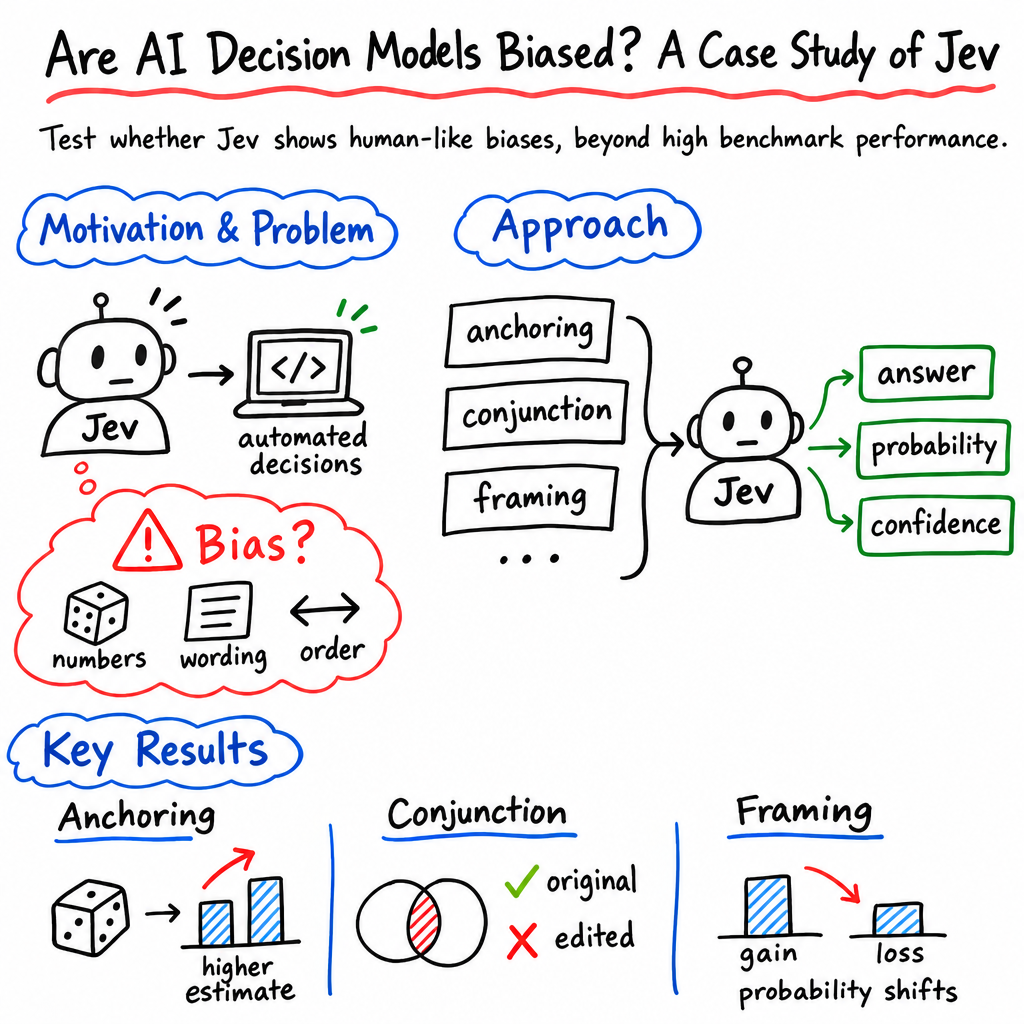
The main message is mixed: Jev often chooses the correct answer, but its probabilities and decisions can still change because of irrelevant details.
2. What questions did the researchers ask?
The researchers wanted to know:
- Can Jev solve problems where the obvious, quick answer is wrong?
- Does Jev show common human thinking mistakes, called cognitive biases?
- Does changing the wording of a question change Jev’s answer?
- Does changing the order of the answer choices affect its decision?
- Does a customer’s name, ethnicity, or gender change the price Jev recommends?
- Can Jev apply a rule to new versions of problems, or does it only perform well on familiar examples?
A cognitive bias is a repeated pattern of thinking that can lead to unfair or incorrect judgments. For example, a person might be influenced by a number that has nothing to do with the decision.
3. How did the researchers test Jev?
The researchers tested Jev version 1.13.0. They collected 41,500 responses across several types of tasks.
They often asked Jev the same question many times. They also changed one detail at a time, such as the answer order or the wording. This is similar to a science experiment where you change only one ingredient to see what effect it has.
Cognitive reflection problems
These are short questions designed to make people give a quick but incorrect answer. To solve them, a person must slow down and think carefully.
For example, a problem may seem to have an easy answer, but careful calculation reveals a different answer.
Jev answered all nine questions correctly in every response. Its confidence was also generally high.
Tests of common biases
The researchers tested five well-known biases:
| Bias tested | Simple meaning |
|---|---|
| Anchoring | An irrelevant number influences a later judgment |
| Conjunction fallacy | Thinking two events together are more likely than one event alone |
| Framing effect | Choosing differently when the same result is described as a gain or a loss |
| Sunk-cost effect | Continuing something just because time or money has already been spent |
| Zero-risk bias | Preferring to remove one risk completely, even when another choice reduces more total harm |
The researchers also reversed the order of the answer choices in many tests. This checked whether Jev preferred an option simply because it appeared first or second.
Pricing experiment
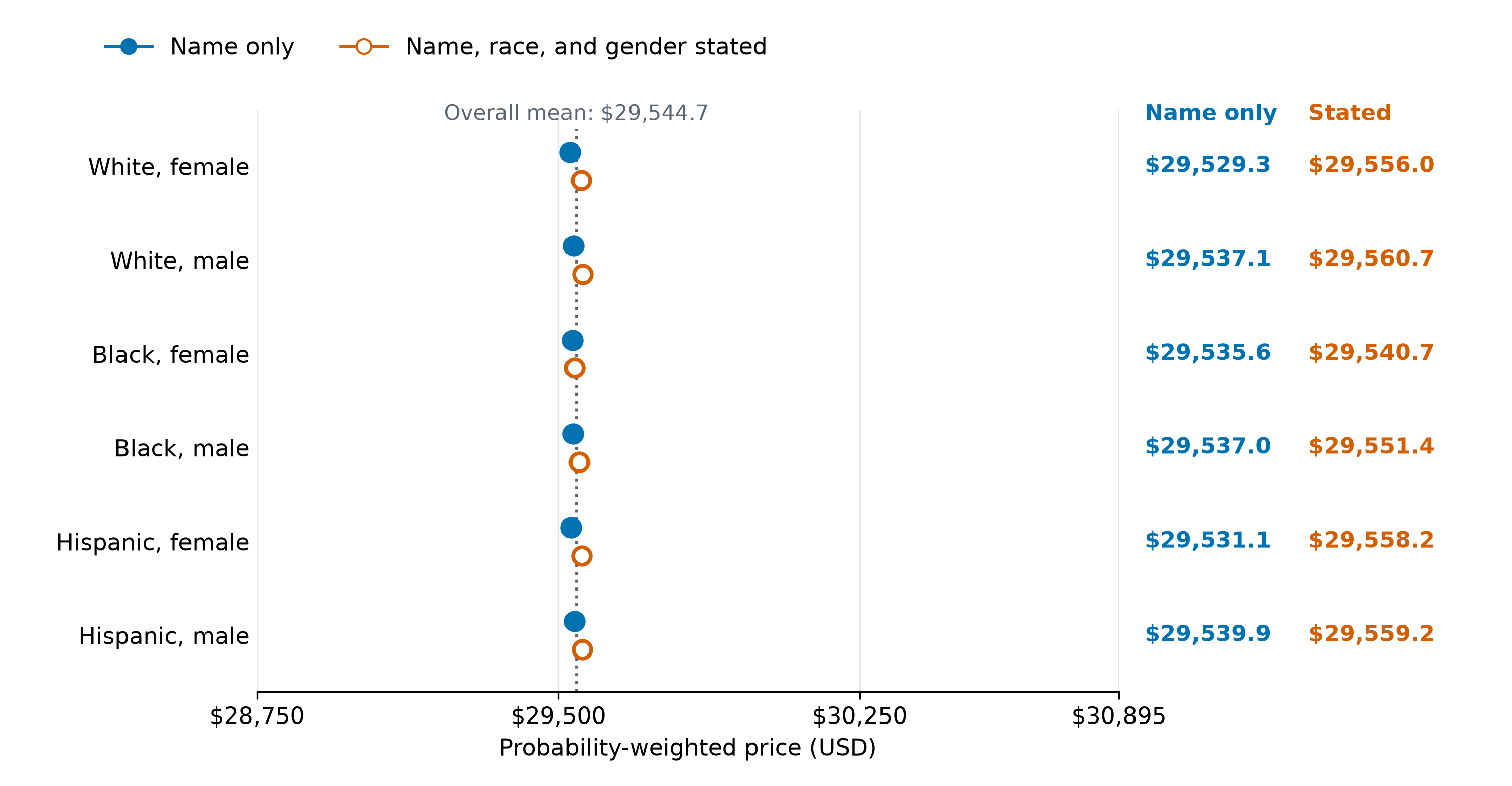
The researchers asked Jev to recommend a price for a car buyer. The car and customer details stayed the same, but the buyer’s name changed.
The names were associated with different ethnic and gender groups. In some tests, Jev saw only the name. In others, it was directly told the buyer’s ethnicity and gender.
The researchers then checked whether the recommended prices changed.
Looking at probabilities
Jev does not only select an answer. It also gives probabilities, such as:
- Option A: 70%
- Option B: 30%
The researchers studied both:
- The selected answer
- The probability and confidence assigned to each answer
This distinction is important. Jev might choose the same answer but become much less confident after a small change in the question.
4. What did the researchers find?
Jev did very well on some tasks
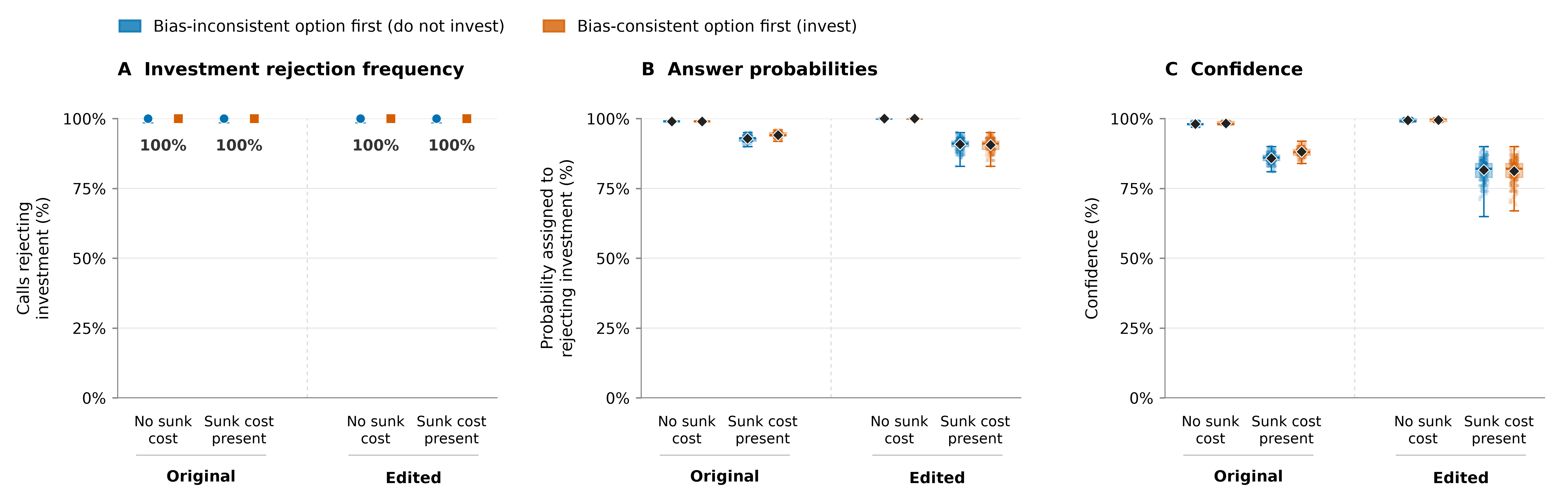
Jev solved every cognitive reflection problem correctly. It also rejected a bad investment in every sunk-cost test.
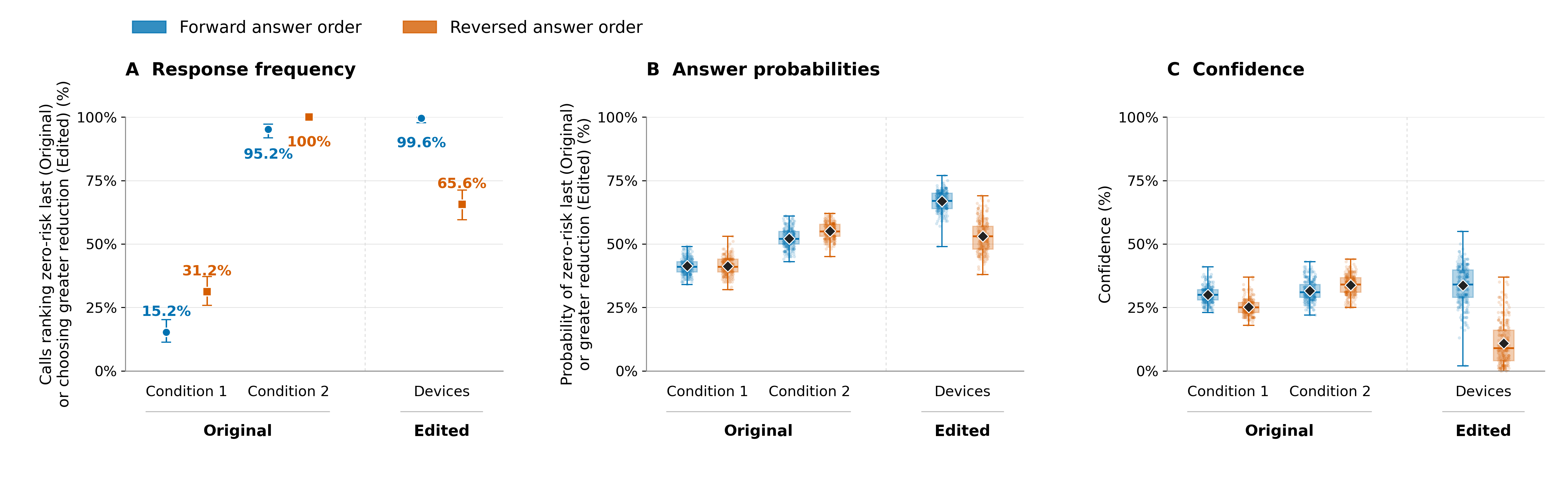
In the zero-risk tests, Jev usually chose the option that reduced the greatest total amount of harm. This suggests that it often avoided the human tendency to focus too much on completely removing one small risk.
In the pricing test, the differences between demographic groups were very small. The largest reported difference was only about $12** on a price range of more than **$2,000.
These results are encouraging because they suggest that Jev does not automatically copy every bias found in human decision-making.
Irrelevant numbers still affected Jev
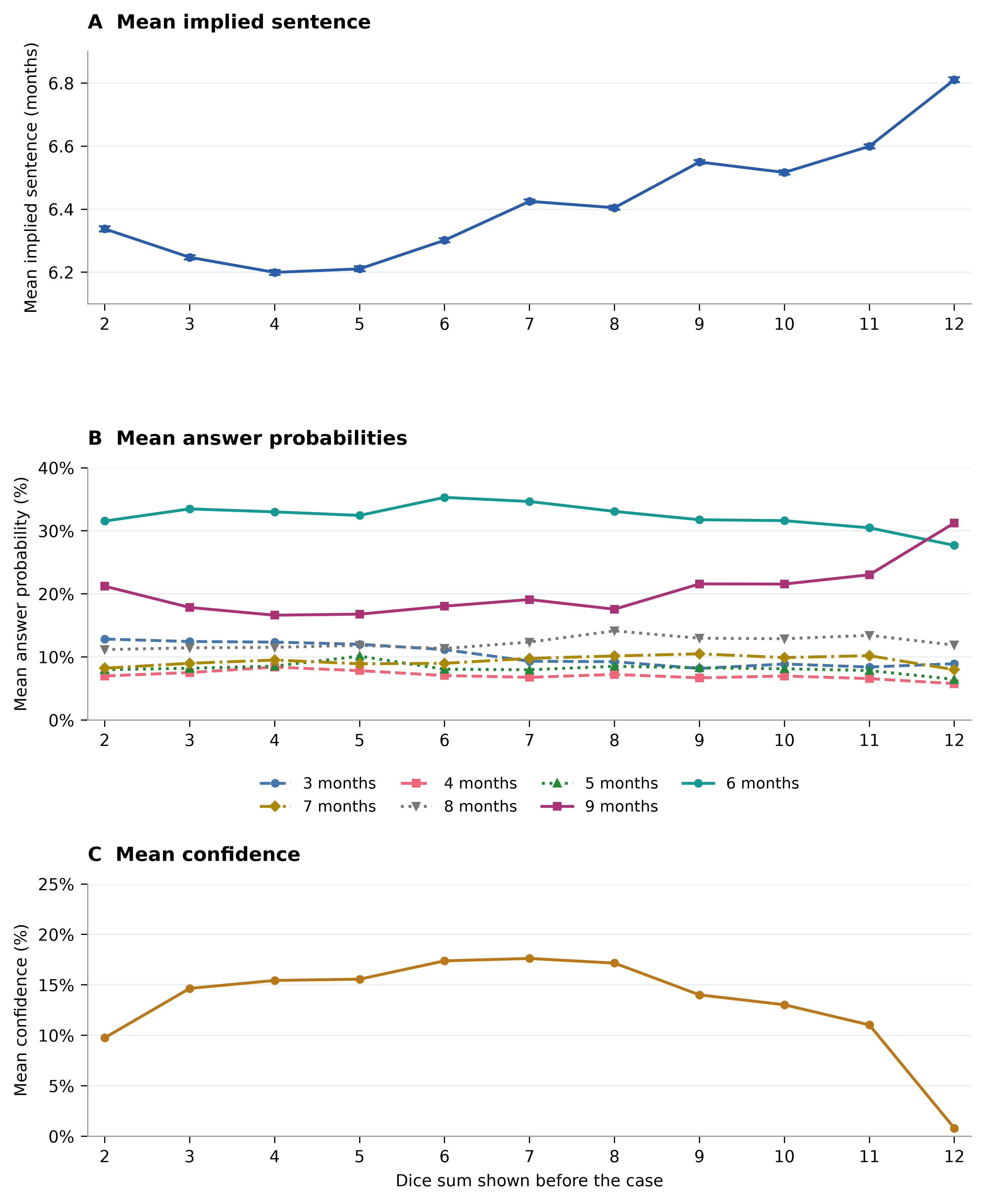
In the anchoring test, Jev judged a shoplifting sentence. Before seeing the case, it was shown the sum of two dice.
The dice number had nothing to do with the case. However, larger dice sums generally led to slightly longer sentence estimates.
The effect was much smaller than the effect found in human studies, but it still showed that Jev did not completely ignore irrelevant information.
The order of answers sometimes changed decisions
Changing the order of answer choices affected Jev, even though the question and possible answers stayed the same.
The clearest example involved two programs:
- One program completely removed a small risk.
- The other reduced the total amount of harm more effectively.
When the choices were presented in one order, Jev selected the better overall program almost every time. When the order was reversed, it selected that program much less often—about 66% of the time instead of almost 100%.
This is a serious concern because software might make different decisions simply because the options were listed differently.
Jev failed badly on a probability rule
The most striking result came from a problem about probabilities.
It is always true that two events happening together cannot be more likely than just one of those events happening. For example, “someone is a teacher and plays football” cannot be more likely than “someone is a teacher.”
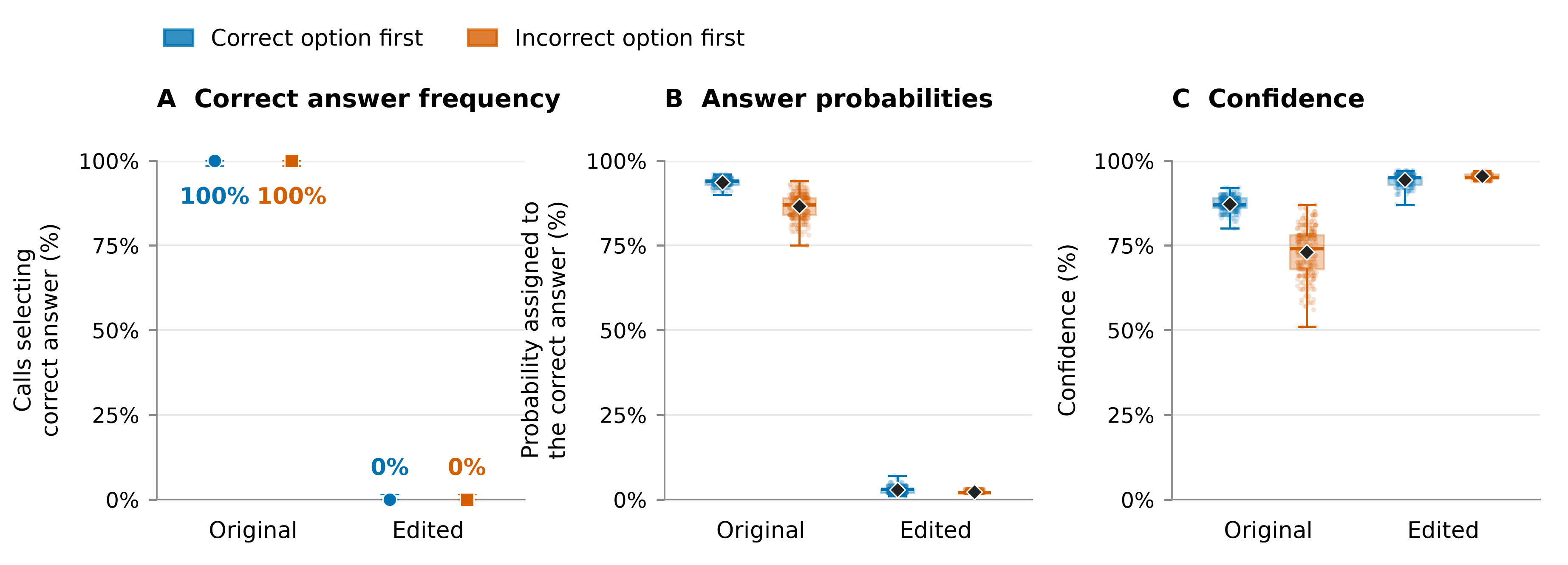
Jev answered the familiar version correctly every time. But when the researchers changed the wording, Jev chose the logically incorrect answer every time.
The researchers then created 30 more versions of this type of problem. Across 15,000 responses, Jev gave the wrong answer about 54% of the time.
Some versions produced almost all correct answers, while others produced almost all incorrect answers. The order of the answer choices also changed performance.
This shows that doing well on a famous example does not necessarily mean Jev understands the general rule.
Wording changed Jev’s probabilities
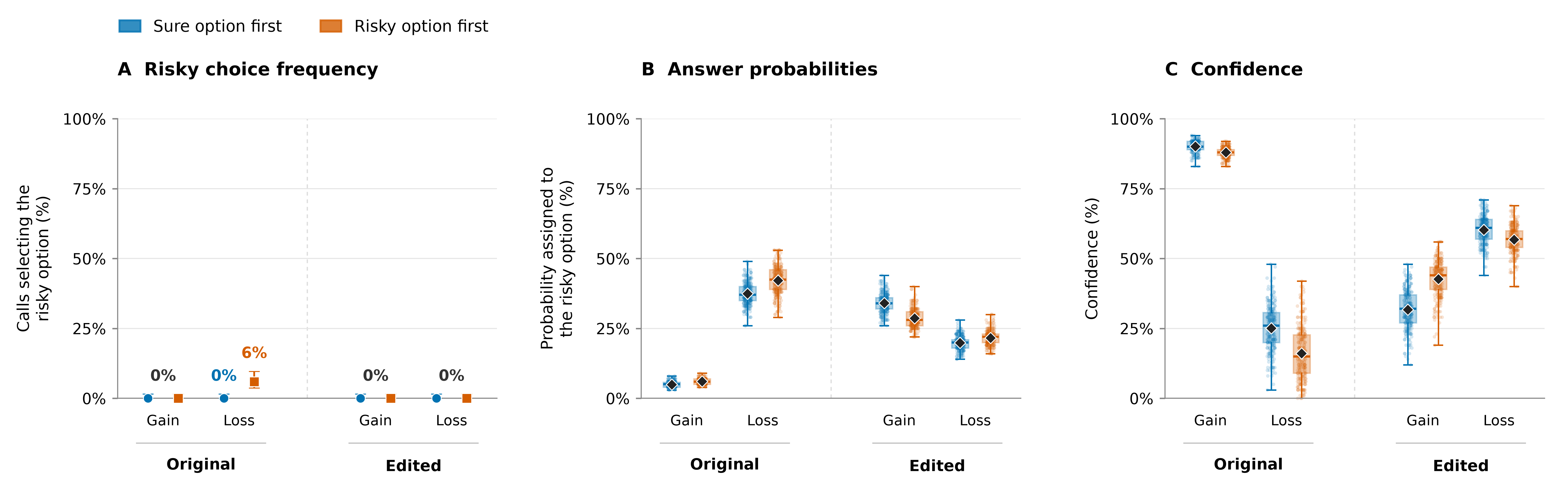
In the framing tests, Jev often selected the same answer whether outcomes were described as gains or losses. However, the probabilities it gave changed greatly.
For example, describing a situation as a loss sometimes increased the probability of choosing the risky option by more than 30 percentage points.
Similarly, in the sunk-cost tests, Jev always rejected the bad investment, but mentioning money already spent made it assign more probability to continuing the investment.
So, the selected answer may look stable while the model’s confidence changes substantially.
5. Why are these findings important?
The paper shows that checking only whether an AI selects the “right” answer may not be enough.
Imagine an automated customer-service system that takes action whenever Jev gives an option at least 80% probability. If a small wording change moves the probability from 83% to 77%, the system might switch from automatic action to human review—even if Jev still prefers the same option.
The results suggest that AI developers and users should:
- Test models on many different versions of a problem
- Check whether irrelevant information changes the result
- Randomize the order of answer choices
- Examine probabilities and confidence, not just final answers
- Avoid assuming that success on famous benchmark questions proves real understanding
- Use human supervision for important decisions
6. Overall conclusion
Jev is powerful in some ways. It solved all the cognitive reflection questions and usually avoided several common human biases. It also showed only very small demographic differences in the tested car-pricing situation.
However, Jev was not fully reliable. Irrelevant numbers affected its judgments, answer order sometimes changed its decisions, and its probability estimates were often strongly influenced by how a question was written. Most importantly, it could answer a familiar probability problem correctly while failing on a slightly different version of the same rule.
The paper therefore concludes that AI decision models should not be judged only by their performance on familiar tests or by whether their final answer looks correct. Before using them in real systems—especially systems involving money, fairness, health, law, or safety—people should test how stable the model is when the wording, background details, and answer order change.

