Jev in the Wild: A Data-Driven Analysis of the Jev Model's Functionality, Applications and Ecosystem
Abstract: Jev is a fast, low-cost decision model that answers natural-language questions with choices, binary judgments, and scores. As its public ecosystem grows rapidly, it remains unclear how Jev is used across applications and how public attention relates to project distribution. To answer these questions, we conduct a large-scale, data-driven analysis of 2,170 publicly available Jev projects collected from GitHub as of September 22, 2026. We find rapid early growth in Jev's public ecosystem, with both new projects and integration into existing repositories. Across diverse domains, projects use Jev for multiple decision purposes and combine its interfaces. Attribute judgment and scoring are widely used, while the use of action selection, content filtering, and model and tool selection varies across domains. These patterns suggest that Jev serves as a reusable decision component whose functionality varies with the surrounding workflow. Meanwhile, public attention is concentrated in routing and interface agents and does not track project counts. Our findings provide a quantitative view of Jev's emerging ecosystem and inform the design and evaluation of general-purpose decision models across diverse application contexts.
Paper Prompts
Sign up for free to create and run prompts on this paper.
Explain it Like I'm 14
1. What is this paper about?
This paper studies Jev, a newer AI model designed to make quick decisions.
Instead of writing long answers like a chatbot, Jev usually gives a small, structured result, such as:
- choosing one option from a list,
- deciding “yes” or “no,” or
- giving a score or rating.
For example, Jev might decide:
- Which AI model should handle a question?
- Is this computer action dangerous?
- Should an old piece of information be kept?
- How risky is a change to a software project?
- Which button should a browser agent click?
The researchers wanted to understand how developers are using Jev in real projects. They examined 2,170 public GitHub projects that used Jev.
2. What questions did the researchers ask?
The paper mainly asks four questions:
- How quickly is the Jev ecosystem growing? The researchers wanted to know how many projects began using Jev and how much attention these projects received.
- What kinds of applications use Jev? They looked at areas such as web browsing, software development, search, games, safety, and automation.
- What kinds of decisions does Jev make? For example, does it judge information, choose an action, filter content, or select a tool?
- Does public attention match the number of projects? The researchers compared the number of projects with their number of GitHub stars. A GitHub star is similar to a “like” or bookmark showing that people are interested in a project.
3. How did the researchers study Jev?
Collecting projects
The researchers searched GitHub using words and code related to Jev. They then removed duplicate results.
However, a project was included only if its code or documentation showed that Jev was being used for a real task. Projects that merely mentioned Jev or provided a general software wrapper were left out.
This produced a dataset of 2,170 verified projects.
Checking and labeling projects
An AI system examined each project and labeled it according to:
- its main application area,
- what kind of decision Jev made,
- which Jev interfaces it used.
A second AI system reviewed important decisions. When the two systems disagreed, the researchers checked the original project materials.
In everyday terms, this is like sorting thousands of books into categories and having a second person check whether the sorting was correct.
Measuring growth and attention
The researchers also recorded:
- when each GitHub project was created,
- whether it was an existing project that later added Jev,
- how many GitHub stars it received.
They used project numbers as a measure of how much development was happening. They used stars as an imperfect measure of public interest.
Understanding Jev’s three interfaces
The paper describes three main ways to use Jev:
| Interface | Simple explanation | Example |
|---|---|---|
| Choice | Picks one option from several possibilities | Choose which model should answer |
| Noul | Makes a yes-or-no judgment | Is this action unsafe? |
| Score | Gives a rating or level | How serious is this problem? |
Most projects used more than one of these interfaces.
4. What did the researchers find?
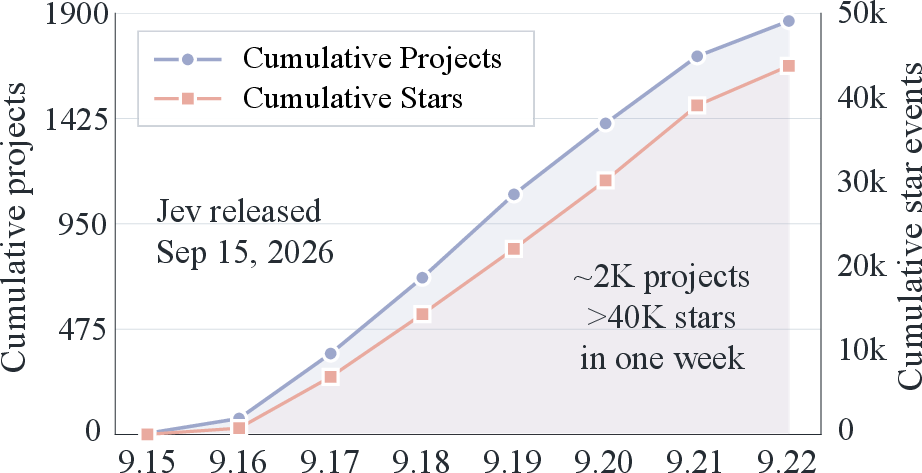
Jev grew very quickly
Jev was released on September 15, 2026. In the week after its release:
- 1,865 new GitHub projects were created using Jev.
- 305 existing projects added Jev.
- These projects received 43,750 GitHub stars.
This suggests that Jev attracted attention very quickly. It was used both in brand-new projects and in projects that already existed.
Jev was used in many different areas
Jev projects appeared in a wide range of fields, including:
- web and desktop agents,
- software engineering,
- search and memory systems,
- safety and security,
- model and tool routing,
- games and simulations,
- professional tasks,
- content and dialogue systems.
No single area contained most of the projects. This means developers were experimenting with Jev for many different purposes.
Jev usually acted as a decision-making part of a larger system
Jev generally did not run an entire application by itself. Instead, it acted like one small part of a larger machine.
For example:
- A program gathers information about the current situation.
- Jev makes a decision.
- The program uses that decision to perform an action.
This is similar to a referee in a game. The referee does not play the whole game, but makes important judgments that affect what happens next.
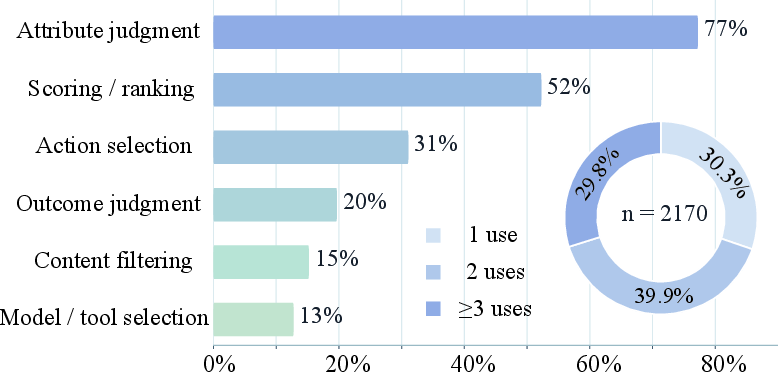
Judging information was the most common task
The most common use was attribute judgment, which appeared in 77% of projects. This means Jev often judged whether something had a certain quality or feature.
Other common purposes included:
- scoring or ranking, used in 52% of projects;
- choosing an action, used in 31% of projects.
Many projects used Jev for several purposes at once. About 69.7% of projects with an identified purpose used Jev for at least two kinds of decisions.
For example, one system might use Jev to:
- decide whether a risk exists,
- rate how serious it is,
- and choose what action to take.
All three interfaces were useful
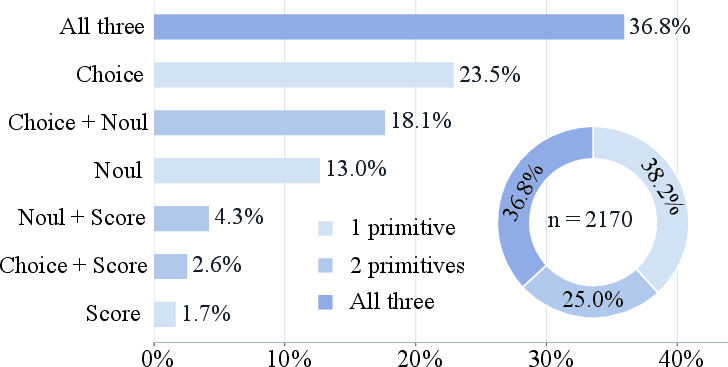
The interfaces were used in these proportions:
- Choice: 81.0% of projects,
- Noul: 72.2% of projects,
- Score: 45.4% of projects.
About 36.8% of projects used all three.
This suggests that developers do not want only one type of decision. They often need a combination of choices, yes-or-no judgments, and scores.
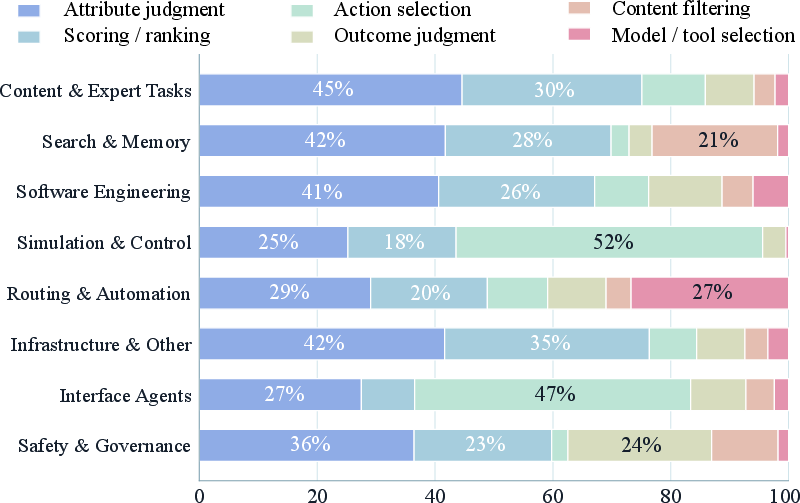
Jev’s role changed depending on the application
The same model could perform different jobs in different systems.
For example:
- In a game, Jev might choose the next move.
- In a safety system, it might judge whether an action is dangerous.
- In a search system, it might filter out unhelpful information.
- In a routing system, it might choose which AI model or software tool to use.
- In a code-review system, it might identify risky changes for a human to inspect.
This shows that Jev is flexible. Its job depends on what the surrounding program asks it to do.
Attention was not evenly distributed
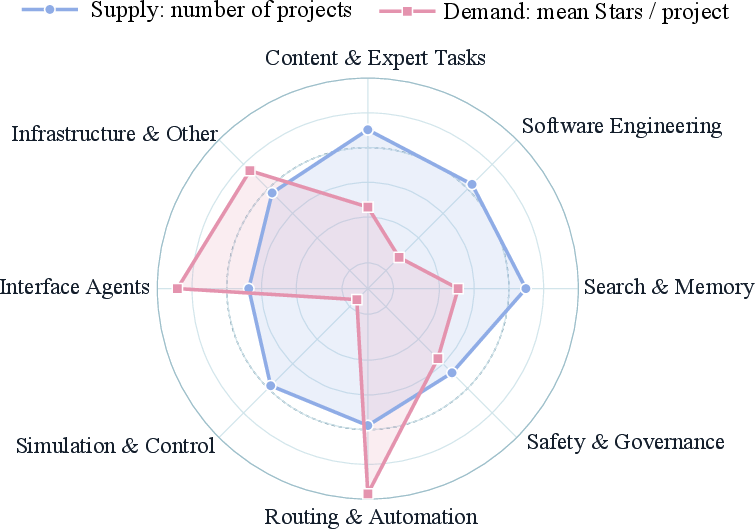
The number of projects and the amount of public interest did not match.
For example:
- Routing and automation had about 250 projects and an average of 364 stars per project.
- Simulation and control had about 252 projects but only 8 stars per project.
- Search and memory had many projects, but each project received relatively few stars.
Routing and interface-agent projects received a very large share of all stars, even though they made up a much smaller share of the total projects.
This means that public attention focused strongly on a few popular areas. A large number of projects does not necessarily mean that the public is paying attention to that area.
5. Why are these findings important?
The paper suggests that Jev works best as a small, reusable decision component.
Instead of asking one large AI model to handle everything, a system can use Jev for simple repeated decisions. This may make the system:
- faster,
- cheaper,
- easier to control,
- easier to connect to ordinary computer programs.
For example, a LLM might explain an answer, while Jev quickly decides which tool to use first. This is like having a specialist make a quick choice instead of asking a very powerful but expensive expert to handle every small decision.
The results also suggest that future decision models should support all three abilities:
- choosing,
- judging,
- and scoring.
They should also be tested in many different real-world settings, not just in one simple laboratory task.
6. Limitations of the research
The study has some important limits:
- It only examined projects that were publicly available on GitHub.
- Private company projects were not included.
- GitHub stars measure attention, but they do not perfectly measure how useful a project is.
- The study is a snapshot from September 22, 2026. The Jev ecosystem could change later.
- AI systems were used to inspect and label projects, so some classifications may still contain mistakes.
Therefore, the paper shows how Jev was being used in public projects at that time, but it does not describe every use of Jev everywhere.
7. Simple conclusion
The paper finds that Jev quickly became popular and was used for many different kinds of decisions. Developers often combined its choice, yes-or-no, and scoring features inside larger applications.
The main idea is that Jev is not usually the whole AI system. It is more like a fast decision-making part that helps another program decide what to do next.
This research could help developers build faster and cheaper AI systems. It also reminds researchers to test decision models in many different situations, including less popular applications that may not receive much public attention.
Practical Applications
Immediate Applications
- Low-latency model and tool routing — software, cloud, and edge computing.
Jev can be deployed as a lightweight routing layer that selects an appropriate LLM, API, service, or edge-computing resource for each request. A practical workflow is: classify the user task with
ChoiceorScore, apply deterministic availability and confidence rules, then invoke the selected model or service. This is especially relevant to service orchestration and 6G/edge systems, where frequent routing decisions must be inexpensive and fast. Dependencies: reliable latency and calibration measurements, a known set of candidate models, fallback behavior for low-confidence or invalid outputs, and up-to-date cost and availability metadata. - Agent action selection for web and desktop automation — software and robotic-process automation.
Jev can select among structured actions such as click, type, scroll, wait, select, or terminate based on the current page state and task goal. An agent can use
Choicefor the operation and a second decision for the compatible target, while a separate component handles text generation and deterministic execution. This can support browser assistants, form completion, internal enterprise workflows, and accessibility tools. Dependencies: accurate structured representations of the interface, validation against currently available controls, protection against unintended actions, and a deterministic executor. The paper’s browser example does not establish general reliability across websites. - Human-in-the-loop code-review triage — software engineering and DevOps. Jev can screen pull requests for possible correctness, security, compatibility, reliability, or test-coverage concerns; select supporting diff hunks; and assign a priority score. The result can be integrated into GitHub or GitLab workflows to rank review leads rather than generate a definitive review. This can reduce reviewer search time when repositories contain many simultaneous changes. Dependencies: human verification remains necessary; Jev outputs should be combined with static analysis, tests, and repository-specific rules. False positives, false negatives, and sensitivity to prompt or option wording must be measured before production use.
- Agent context and tool-history management — AI agents and customer-support systems. Jev can decide whether an older tool call remains useful, whether its result must be retained in full, or whether it can be truncated or removed. This enables a context-compaction middleware component that lowers token use and potentially reduces latency without rewriting every historical interaction. It is applicable to coding agents, research assistants, and long-running support conversations. Dependencies: protected handling of recent, user-pinned, or legally significant information; thresholds must be calibrated to avoid deleting essential evidence; performance should be compared with summarization and retrieval-based memory systems.
- Risk gates for agent tool calls — cybersecurity, enterprise IT, and personal computing. Before executing a shell command, file edit, data transfer, or other tool call, Jev can judge whether the action is destructive, potentially exfiltrates data, exceeds the user’s request, or has high impact. A practical product could operate in warning mode or require explicit confirmation in enforcement mode. Dependencies: Jev should be treated as a screening signal rather than a security guarantee. The system needs allowlists, sandboxing, access controls, audit logs, deterministic policy checks, and conservative handling of uncertainty.
- Document and content classification — finance, government, legal services, and education.
Organizations can use natural-language schemas with
Choice,Noul, andScoreto classify documents, pages, messages, or records without retraining a task-specific classifier whenever categories change. The paper’s tax-document example suggests workflows for identifying form types and page types; analogous uses include invoice routing, records management, email triage, and educational-material categorization. Dependencies: domain-specific validation data, stable label descriptions, privacy-preserving deployment, confidence thresholds, and human review for regulated or high-impact documents. - Content filtering and search-result prioritization — information retrieval and media platforms. Jev can judge whether a document, search result, conversation turn, or memory item satisfies a user-defined criterion, then use the result to filter or rank content. This is suitable for relevance screening, duplicate reduction, memory retrieval, and moderation pre-triage. Dependencies: clearly defined criteria, ongoing bias and drift monitoring, safeguards for protected classes and sensitive content, and escalation for ambiguous cases. GitHub project counts show substantial exploration of this use, but do not demonstrate production-level accuracy.
- Lightweight quality and relevance scoring — media, research, and professional services.
Scorecan rate text, video metadata, code changes, or other structured inputs against predefined levels. Potential products include video-quality estimation, research-paper triage, customer-ticket prioritization, and document completeness checks. Dependencies: score calibration against expert judgments, transparent rubrics, monitoring for inconsistent scores, and recognition that a score is an aid to prioritization—not an objective ground truth. - Workflow automation and approval triage — operations, compliance, and public administration. Jev can combine binary judgments, categorical choices, and scores to route cases to automatic processing, human approval, additional evidence collection, or escalation. For example, an intake workflow could classify a request, assess its risk, and select the next procedural step. Dependencies: explicit organizational policies, traceable decision records, appeal mechanisms, and restrictions against fully automated decisions in legally or ethically sensitive domains.
- Developer and academic evaluation infrastructure — machine learning research.
Researchers can use the paper’s taxonomy to build evaluation suites covering attribute judgment, scoring, action selection, content filtering, and model/tool selection across multiple domains. Implementations should test all three interfaces—
Choice,Noul, andScore—rather than evaluating only categorical selection. Dependencies: independently verified labels, task-specific baselines, calibration and latency metrics, robustness tests for option naming, and datasets that include low-visibility domains rather than only highly starred repositories.
Long-Term Applications
- Adaptive multi-model AI platforms — software, cloud infrastructure, and edge computing. A mature platform could use Jev as a general decision plane coordinating LLMs, vision models, retrieval systems, tools, and specialized services. The platform might jointly optimize quality, latency, cost, privacy, and energy consumption on a per-request basis. Dependencies: larger-scale validation in private and commercial deployments, stable APIs, reliable uncertainty estimates, observability, and evidence that routing gains outweigh the cost of an additional decision layer.
- Autonomous and semi-autonomous robotics — robotics, manufacturing, and logistics. Jev could select among safe, prevalidated actions in structured state spaces—for example, choosing a navigation behavior, inspection routine, warehouse action, or recovery procedure. The game-control example illustrates the basic closed-loop pattern: observe structured state, select a legal action, execute it, and repeat. Dependencies: extensive simulation and real-world testing, hard safety constraints, real-time guarantees, sensor-failure handling, formal verification where required, and a certified fallback controller. The paper provides an integration pattern, not evidence for safety-critical robotic deployment.
- Healthcare decision support — clinical operations and medical administration. A future system could triage referrals, classify medical documents, prioritize cases, or route requests to appropriate clinical tools. Jev might act as a low-cost preliminary judgment layer while clinicians retain authority over diagnosis and treatment. Dependencies: clinical validation, representative demographic data, privacy and regulatory compliance, calibrated uncertainty, auditability, and strict limits on autonomous medical decisions. The paper does not report healthcare experiments, so this remains a prospective application.
- Financial compliance and risk operations — banking, insurance, and accounting. Jev could classify transaction or claim documents, score review priority, select compliance checks, and route ambiguous cases to analysts. Its ability to handle changing natural-language categories could reduce the need for repeated retraining as internal policies evolve. Dependencies: regulatory approval, explainable decision records, bias testing, protection of confidential data, adversarial robustness, and human review for credit, fraud, insurance, or other consequential decisions.
- Energy and network optimization — energy systems, telecommunications, and data centers. Jev could support rapid selection among forecasting models, network-control policies, service tiers, or energy-saving actions. In edge networks, a decision model could route requests according to latency, bandwidth, and resource constraints. Dependencies: integration with real-time telemetry, strict operational constraints, resilience to distribution shift, cost-benefit evidence at scale, and a safe deterministic controller for failures.
- Personalized education and accessibility assistants — education and daily life. Educational software could use Jev to classify learner needs, select an instructional resource, score an answer against a rubric, or decide when to escalate to a teacher. Accessibility assistants could choose interface actions or filter information according to a user’s stated needs. Dependencies: age-appropriate and culturally robust evaluation, teacher or caregiver oversight, privacy protections, avoidance of opaque student profiling, and careful handling of ambiguous or sensitive learner data.
- General-purpose agent operating systems — daily productivity and enterprise automation. A future agent runtime could expose Jev-like decision primitives as standard middleware: action selection, memory retention, risk assessment, model routing, and escalation. Developers would compose these primitives with deterministic policies and specialized generators rather than asking one large model to perform every step. Dependencies: interoperable APIs, standardized confidence semantics, reproducible evaluation, secure permission models, and safeguards against cascading errors when multiple decisions are chained together.
- Public-policy and scientific decision pipelines — government and academia. Jev could help classify public comments, extract structured variables from narratives, prioritize inspection or research cases, and select analytical procedures. The paper’s discussion of crash narratives and scientific semantic decisions suggests a workflow in which natural-language inputs are converted into structured variables for later analysis. Dependencies: transparent annotation standards, reproducibility, public accountability, independent validation, protection against policy bias, and a clear separation between automated triage and final governmental or scientific judgment.
- Standardized benchmarks and governance frameworks for decision models — academia and policy. The observed mismatch between project supply and GitHub attention supports a long-term benchmark strategy that samples applications by functional importance rather than popularity. Such benchmarks could report accuracy, calibration, latency, cost, robustness to option wording, escalation quality, and downstream task performance. Dependencies: access to private-sector and non-GitHub deployments, expert-created test sets, longitudinal monitoring, multilingual coverage, and governance procedures for high-impact uses. The paper’s dataset is a snapshot of public repositories as of September 22, 2026, so it should not be treated as a complete measure of real-world adoption.
Glossary
- Action selection: Choosing an operation or behavior from a set of possible actions. “Action selection accounts for 52\% of purpose labels in Simulation {paper_content} Control and 47\% in Interface Agents”
- Agent loop: An iterative cycle in which an autonomous system observes context, selects an action, executes it, and repeats. “It illustrates how Jev can serve as a lightweight decision layer in an interactive agent loop.”
- Annotation: The process of assigning labels or structured attributes to data. “For each included project, a GPT-6 Luna Max agent annotates its primary application domain, decision purposes, interface usage, and other attributes required by our analyses.”
- Autoregressive generation: Producing a sequence one element at a time, with each output conditioned on preceding outputs. “LLMs provide much stronger zero-shot generalization and avoid task-specific training \cite{NEURIPS2020_1457c0d6}, but their autoregressive generation introduces substantial latency and inference cost”
- Binary judgment: A decision that assigns one of two possible outcomes. “Jev is a fast, low-cost decision model that answers natural-language questions with choices, binary judgments, and scores.”
- Closed-loop controller: A control system that repeatedly uses new observations to select subsequent actions. “TypeSafe Mario uses Jev as part of a closed-loop controller for a game emulator.”
- Confidence calibration: The degree to which predicted confidence values correspond to actual correctness probabilities. “Evaluations of text annotation and model judging assess accuracy, confidence calibration, and inference cost”
- Context filtering: Selecting which contextual information should be retained or supplied to a model. “Together, these interfaces support lightweight decisions such as model routing, context filtering, and action selection”
- Deduplication: Removing repeated records representing the same entity. “We combine repository and code search and deduplicate the retrieved repositories using GitHub repository IDs.”
- Discriminator: A model or component that distinguishes among candidate classes or answers. “Universal classifiers use natural language inference to score label descriptions \cite{laurer2023building}, while UniMC and the Universal Discriminator select or score candidate answers across tasks”
- DOM element: A node in a web page’s Document Object Model representing an HTML or interface component. “After validating the returned choice, the browser executor applies the selected action to the corresponding live DOM element.”
- Dynamic model routing: Selecting among models at runtime according to the characteristics of each request. “It demonstrates how Jev can support dynamic model routing while leaving the final routing policy to deterministic code.”
- Entailment: A semantic relation in which one statement logically supports or implies another. “Benchmarking zero-shot text classification: Datasets, evaluation and entailment approach”
- Inference cost: The computational, financial, or latency expense of using a trained model to produce predictions. “LLMs avoid task-specific training, but autoregressive generation can incur substantial latency and inference cost”
- Instruction tuning: Training a LLM to follow natural-language instructions across tasks. “Instruction tuning improves generalization by training on diverse tasks expressed in natural language”
- Interface adoption: The use of particular model interfaces by projects or applications. “We examine what Jev decides and which interfaces projects use.”
- Latency: The delay between submitting an input and receiving a model’s output. “Jev targets this gap by combining zero-shot generalization with fast and low-cost inference”
- Label space: The set of categories or labels that a classifier can predict. “changes to the label space often require collecting new data and retraining the model”
- Low-latency inference: Model prediction performed with minimal response delay. “Replacing LLMs with Jev Decision Models for Low-Latency Edge Service Orchestration”
- Natural language inference: The task of determining the semantic relationship between textual statements. “Universal classifiers use natural language inference to score label descriptions”
- Option probability: A model’s estimated probability for a candidate choice. “Jev answers Choice questions over candidate IRS forms and seven page kinds, returning selected labels and option probabilities.”
- Parameter update: A modification to a model’s learned weights during training or fine-tuning. “without parameter updates for each target task”
- Probabilistic classifier: A classifier that produces predictions together with probabilities or confidence estimates. “It treats Jev as a probabilistic classifier that predicts both the form identity and page type from extracted document text.”
- Prompt: An input instruction or context supplied to a LLM to elicit a response. “Generative LLMs extend this flexibility through task descriptions and examples supplied in prompts”
- Proxy: An indirect measurement used to represent a variable that is difficult to observe directly. “We use project count as supply and mean GitHub stars per project as a proxy for demand.”
- Retraining: Training a model again, usually after adding data or changing the task. “changes to the label space often require collecting new data and retraining the model”
- Schema: A structured specification defining the types, fields, or organization of information. “GLiNER2 combines classification and extraction through a shared schema”
- Semantic relation: A meaning-based relationship between linguistic or conceptual units. “selecting semantic relations before scientific calculations”
- Selective control: Choosing when and how to intervene or act rather than applying control uniformly. “REFLEX with Jev for Efficient Selective Control in LLM Agents”
- Structured prediction: Predicting outputs that follow a predefined format or set of relationships. “Related models combine flexible task definitions with efficient, structured predictions.”
- Supervised classifier: A classifier trained using examples paired with known labels. “Traditional supervised classifiers require task-specific labeled data and training”
- Task-specific labeled data: Examples annotated with labels for a particular prediction problem. “Traditional supervised classifiers require task-specific labeled data and training”
- Tool orchestration: Coordinating tools or services so that they are selected and executed appropriately to complete a task. “Fast Intent-Driven Service Orchestration with Jev for 6G Edge Networks”
- Tool-call risk gate: A component that evaluates a proposed tool invocation before allowing it to execute. “pi-jev: Tool-Call Risk Gate”
- Zero-shot generalization: Applying a model to a task or category without task-specific training examples. “Jev targets this gap by combining zero-shot generalization with fast and low-cost inference”
- Zero-shot text classification: Classifying text into categories for which the model has not received task-specific training examples. “Zero-shot text classification with generative LLMs”