Jev-as-a-Judge for Brazilian Portuguese Information Retrieval: Relevance Assessment and Reranking
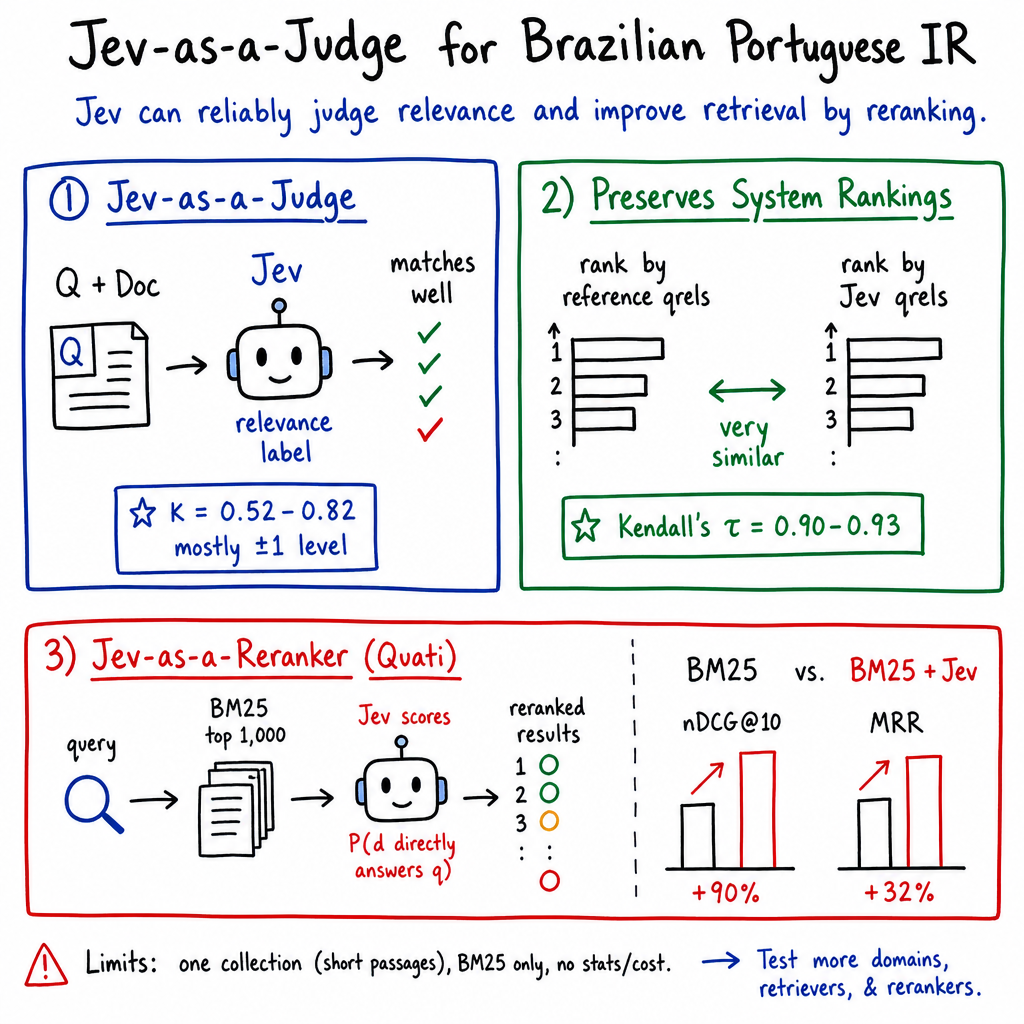
Abstract: This study investigates Jev, a System One model designed for fast, structured decision-making, in information retrieval. We use Jev-as-a-judge to generate relevance judgments for four Brazilian Portuguese IR collections covering different domains and compare them with the official relevance judgments of each collection. We also evaluate Jev as a reranker. For relevance assessment, exact agreement ranged from 52.9% to 64.9%, while quadratic weighted Cohen's kappa ranged from 0.52 to 0.82. Most disagreements involved adjacent relevance levels, with at least 94.5% of annotations matching exactly or differing by only one relevance level. Despite differences at the individual query--document level, Jev-generated qrels produced similar retrieval system rankings, with Kendall's tau ranging from 0.90 to 0.93 for NormasTCU and Ulysses-RFCorpus across the two evaluation metrics. For reranking, Jev reordered the top 1,000 BM25 candidates for each of the 50 Quati test queries, increasing nDCG@10 from 0.3329 to 0.6331 (+90.2%) and MRR from 0.6852 to 0.9033 (+31.8%). These findings support Jev as a relevance assessor and show improved ranking effectiveness over BM25 in the evaluated reranking setting.

Paper Prompts
Sign up for free to create and run prompts on this paper.
Top Community Prompts
Explain it Like I'm 14
1. What is this paper about?
This paper studies whether a computer model called Jev can help search systems find useful documents in Brazilian Portuguese.
When we search online, a search system must decide which documents are useful for our question. This paper tests Jev in two ways:
- As a judge: deciding how relevant a document is to a search question.
- As a reranker: improving the order of search results so that the best documents appear first.
The researchers tested Jev on collections containing web pages, legal documents, government rules, and Brazilian legislative proposals.
2. What questions did the researchers ask?
The study focused on three main questions:
- Can Jev judge document relevance in a way that is similar to human experts or existing systems?
- If Jev creates its own relevance labels, will it rank search systems in roughly the same order as human-created labels do?
- Can Jev improve the results produced by a traditional search method called BM25?
A simple example is searching for:
“What rules explain how a government agency buys computers?”
A document that directly explains these rules would be highly relevant. A document that only mentions computers but does not explain the rules would be less relevant.
3. How did the researchers conduct the study?
Testing Jev as a relevance judge
The researchers used four Brazilian Portuguese collections:
| Collection | Type of information |
|---|---|
| Quati | Short passages from web pages |
| JurisTCU | Court and legal documents |
| NormasTCU | Rules and official regulations |
| Ulysses-RFCorpus | Legislative proposals |
Each document-question pair already had a label showing how relevant the document was. For example, labels could range from:
0: irrelevant1: slightly or partly relevant2: relevant3: highly relevant
The researchers gave the same question and document to Jev and asked it to choose a relevance level.
They then compared Jev’s answers with the existing labels.
One measurement used was accuracy, meaning how often Jev chose exactly the same label. They also used Cohen’s weighted kappa, a score that checks how much two sets of ratings agree while remembering that some mistakes are more serious than others. For example, confusing “relevant” with “highly relevant” is a smaller mistake than calling a completely unrelated document “highly relevant.”
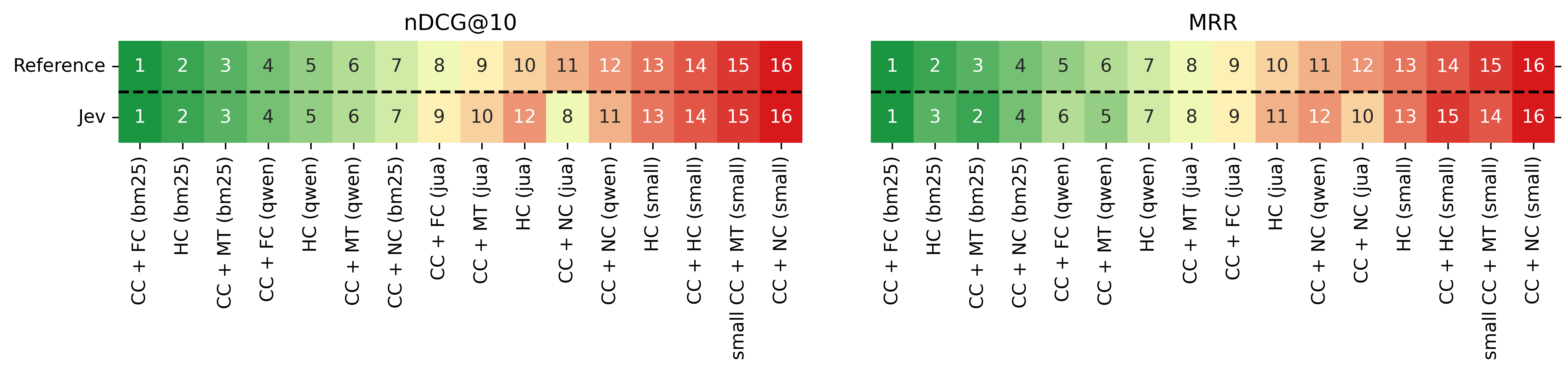
The researchers also checked whether Jev’s labels changed the ranking of different search systems. They used Kendall’s tau, which is like comparing two ordered lists to see how similar they are. A score close to 1.0 means the lists are very similar.
Testing Jev as a reranker
The researchers first used BM25, a traditional search method, to find the top 1,000 possible documents for each question.
BM25 works somewhat like counting and weighting matching words. It usually gives higher scores to documents that contain important words from the question, while also considering how often those words appear.
Jev then examined each of those 1,000 documents and estimated the chance that it directly answered the question. The researchers used these estimates to create a new order for the search results.
This second ordering step is called reranking. It is similar to asking one person to quickly collect possible books and then asking a more careful expert to place the best books at the top.
The researchers measured the results using:
- nDCG@10: how useful the first 10 results are, giving more credit when the best documents appear near the top.
- MRR: how high the first relevant document appears in the results.
4. What did the researchers find?
Jev’s judgments were often close to the reference judgments
Jev gave exactly the same relevance label as the reference label between 52.9% and 64.9% of the time, depending on the collection.
However, exact agreement does not tell the whole story. Many of Jev’s disagreements were small. For example, Jev might call a document “relevant” while the reference label called it “highly relevant.”
Across all collections:
- At least 94.5% of Jev’s labels either matched the reference exactly or differed by only one level.
- Large disagreements were uncommon.
- Jev’s agreement scores were similar to ranges found in some studies of human annotators.
This is important because deciding whether a document is relevant can sometimes be subjective. Two people may disagree slightly even when both are making reasonable judgments.
Jev preserved the ranking of search systems
Even though Jev sometimes disagreed with individual reference labels, it usually produced almost the same overall ranking of search systems.
For the NormasTCU and Ulysses-RFCorpus collections, the Kendall’s tau scores ranged from:
0.90to0.93for nDCG@100.90to0.92for MRR
These are very high scores. This means that researchers would usually reach similar conclusions about which search systems worked best, whether they used Jev’s labels or the original reference labels.
In other words, Jev did not need to agree with every single document label to be useful for comparing search systems.
Jev improved BM25’s search results
For the Quati web-passage collection, Jev reordered the top 1,000 BM25 results.
The results improved considerably:
| Measure | BM25 | BM25 + Jev | Change |
|---|---|---|---|
| nDCG@10 | 0.3329 | 0.6331 | About 90.2% better |
| MRR | 0.6852 | 0.9033 | About 31.8% better |
This means that Jev usually moved more useful documents closer to the top. In particular, the first relevant document was often found earlier.
The Jev-based system scored slightly below a previously published BM25 plus mT5-XL system on nDCG@10. However, the researchers warn that the two experiments used different settings, so this is not a fair, direct competition.
5. Why are these findings important?
The results suggest that Jev could be useful for information retrieval in Brazilian Portuguese.
Its possible uses include:
- Helping create relevance labels for large search collections.
- Reducing the amount of manual work needed from human experts.
- Comparing search systems without requiring every document to be labeled by people.
- Improving the order of search results after a first search method has found possible answers.
- Supporting searches involving legal and government documents.
The study is especially useful because much search research focuses on English. Brazilian Portuguese has fewer research resources, so testing Jev in this language adds important evidence.
6. What are the limitations?
The paper does not prove that Jev will work equally well everywhere.
The reranking experiment used only:
- One collection, Quati
- Web passages rather than full legal documents
- Fifty test questions
- The top 1,000 BM25 results
The researchers also did not measure Jev’s exact speed or operating cost in this experiment. They did not perform statistical significance tests, so the improvements should be understood as promising results rather than final proof.
More research is needed with other languages, document types, search methods, and larger test sets. Researchers should also compare Jev directly with other reranking models under exactly the same conditions.
Conclusion
This paper shows that Jev can make useful decisions about whether Brazilian Portuguese documents answer search questions. Its individual judgments were not always identical to human or reference labels, but they were usually close. More importantly, Jev produced almost the same ranking of search systems.
Jev also greatly improved BM25 results in the Quati experiment by moving relevant documents closer to the top.
Overall, the research suggests that a fast, structured decision-making model like Jev could make search evaluation and search results more effective, especially for Brazilian Portuguese. However, further testing is needed before concluding that it is reliable for all languages, subjects, and types of documents.
Knowledge Gaps
Knowledge gaps, limitations, and open questions
- Limited reranking generalizability: Jev reranking was evaluated only on the 50-query Quati test set, a Brazilian Portuguese web-passage collection; its effectiveness on legal, legislative, normative, multilingual, and full-length document collections remains untested.
- Narrow first-stage retrieval coverage: The reranking experiment used only one BM25 configuration, so it is unclear whether Jev provides similar gains when reranking candidates from dense retrieval, hybrid retrieval, other lexical models, or weaker and stronger initial rankings.
- No controlled comparison with competing rerankers: The study does not directly compare Jev with mT5-XL, BERT-based rerankers, monoT5, RankT5, generative LLM rerankers, or Brazilian Portuguese–specialized models under identical candidate sets, qrels, and configurations.
- Uncontrolled comparison with the published mT5-XL result: The reported Jev and mT5-XL scores come from different BM25 runs and potentially different experimental configurations; therefore, Jev’s relative effectiveness against mT5-XL remains unresolved.
- No statistical significance testing: The reported reranking improvements and differences in system rankings are descriptive. Paired tests across queries, confidence intervals, and effect-size analyses are needed to establish whether the gains are statistically reliable.
- Small reranking query sample: The reranking evaluation uses only 50 queries, limiting the precision of effectiveness estimates and the ability to detect domain- or query-type-specific failures.
- Unexplored sensitivity to candidate-set size: Only the top 1,000 BM25 candidates were reranked. The effects of reranking depths such as 10, 50, 100, 500, and 5,000 on effectiveness, recall, cost, and latency are unknown.
- Unexplored impact of candidate recall: Jev cannot recover relevant documents excluded from the top 1,000 BM25 candidates, but the study does not measure candidate recall or determine how much of the final performance ceiling is imposed by the first-stage retriever.
- Pointwise scoring has not been compared with alternative formulations: The study does not evaluate whether Jev performs better or worse when using pairwise, listwise, choice-based, or hybrid reranking rather than independent pointwise probability estimates.
- Probability calibration is unexamined: Jev’s returned relevance probabilities are used directly as ranking scores, without assessing calibration, reliability, threshold behavior, or whether calibrated scores improve ranking quality.
- No score-fusion experiments: The reranker ignores the original BM25 score. Combining Jev scores with BM25 scores, reciprocal-rank fusion, or learned score interpolation could produce different results but was not investigated.
- Prompt and instruction sensitivity is unknown: The paper uses one Portuguese prompt formulation and one relevance question. The effects of alternative wording, label descriptions, document-ordering instructions, language choice, and explicit grading rubrics remain unexplored.
- Model-version reproducibility is uncertain: The experiments use Jev versions
jev-1.13andjev-1.13.0, but the paper does not assess version-to-version variability, API nondeterminism, model updates, or reproducibility across repeated runs. - Stochastic stability is not measured: Repeated annotations or reranking runs are not reported, so the variance of Jev’s decisions and rankings under identical inputs is unknown.
- Latency and monetary cost are not empirically reported: Although Jev is motivated partly by efficiency, the study does not measure API latency, throughput, token or request usage, monetary cost, hardware requirements, or cost per query-document pair.
- Efficiency is not compared fairly with alternative models: The claim that Jev may be cheaper or faster is not tested against BM25, mT5-XL, encoder rerankers, or other LLM-based judges under comparable hardware and serving conditions.
- Input-length and truncation effects are unresolved: The implementation supports character truncation, but the experiments do not report the chosen text limits or examine how truncation, document length, titles, and omitted passages affect judgments.
- Long-document behavior is not evaluated: The relevance-assessment collections include full-length legal documents, but the reranking experiment does not establish whether Jev can reliably process long documents or identify relevant evidence distributed across them.
- No analysis of relevance-label imbalance: The confusion matrices suggest substantial differences across relevance levels, but the study does not analyze how class imbalance, prevalence of irrelevant documents, or collection-specific label distributions affect accuracy and .
- System-ranking preservation is evaluated on only two collections: Kendall’s analysis excludes Quati and JurisTCU, even though Jev judgments were generated for those collections. It remains unknown whether system-ranking preservation holds there.
- System-ranking analysis uses a limited and inherited system set: The 15 NormasTCU systems and 16 Ulysses-RFCorpus systems come from prior studies and may not represent the broader range of retrieval approaches or performance levels needed to test ranking robustness.
- No uncertainty analysis for Kendall’s : The reported correlations do not include confidence intervals, permutation tests, sensitivity to ties, or topic-level bootstrap analyses, making the reliability of the conclusions unclear.
- System-level agreement may conceal query-level failures: High aggregate Kendall correlations do not show whether Jev changes conclusions for particular queries, difficult topics, or closely competing systems. Query-level rank reversals and worst-case cases remain unexplored.
- No evaluation against independent human judgments for all collections: Quati and JurisTCU reference qrels are themselves LLM-generated, with only JurisTCU receiving expert review. Jev’s agreement with independent human assessors is therefore not established for all datasets.
- Reference qrels may share model or labeling biases: Because some reference labels were generated using LLM-based approaches, agreement between Jev and those labels may reflect shared biases rather than genuine alignment with user relevance judgments.
- Human inter-annotator variability is not directly measured in the current experiments: Comparisons with ranges from prior studies are not equivalent to a controlled human baseline using the same queries, documents, instructions, and relevance scale.
- No investigation of assessor bias or systematic error: The paper does not examine whether Jev systematically over- or under-rates certain domains, document types, query formulations, relevance levels, legal topics, or linguistic constructions.
- No analysis of Brazilian Portuguese linguistic variation: Robustness across regional vocabulary, spelling variation, formal versus colloquial language, legal terminology, abbreviations, named entities, and grammatical or orthographic variation is not assessed.
- Cross-language transfer remains unknown: The conclusions are limited to Brazilian Portuguese; Jev’s performance in European Portuguese, Spanish, English, indigenous Brazilian languages, or cross-lingual retrieval settings is not evaluated.
- Relevance judgments lack explanations or rationales: Jev supplies structured decisions but the study does not assess whether its confidence information, evidence selection, or explanations can help humans verify errors or understand disagreements.
- Confidence-based human escalation is not tested: The paper mentions structured confidence information but does not evaluate selective prediction, abstention, escalation to human assessors, or the accuracy-cost trade-off of human-in-the-loop annotation.
- No evaluation of annotation efficiency: The potential reduction in human labeling time, number of escalated cases, or total assessment cost is not quantified.
- User-oriented relevance is not examined: The experiments use collection-specific qrels and standard metrics, but do not test whether Jev’s judgments reflect actual user satisfaction, task completion, usefulness, or preferences in interactive search.
- Metric dependence is incomplete: System-ranking preservation is tested with nDCG@10 and MRR, while prior work suggests that agreement may vary for metrics such as precision, recall, nDCG at other cutoffs, and deeper-ranking measures. Broader metric sensitivity remains unresolved.
- Binary treatment for MRR may discard useful graded information: MRR treats every document with a relevance label greater than zero as equally relevant, so the impact of Jev’s graded disagreements on other binary thresholds and graded metrics is not fully characterized.
- No robustness analysis across relevance-scale designs: Jev is instructed to use collection-specific labels, but the study does not test whether performance changes with binary, three-level, four-level, or alternative natural-language relevance scales.
- Potential prompt injection and adversarial document content are not evaluated: Although the reranking instruction asks Jev to treat documents as content rather than instructions, the study does not test documents containing malicious instructions, irrelevant boilerplate, misleading claims, or adversarial text.
- Document contamination and memorization are unexamined: The paper does not assess whether Jev’s judgments are affected by prior exposure to collection documents, web content, benchmark queries, or legal materials during model training.
- No fairness or representational-bias analysis: The effects of Jev-based assessment and reranking on queries concerning demographic groups, politically sensitive issues, minority communities, or contested legal topics remain unknown.
- Relevance-assessment and reranking settings are not directly linked: The paper uses discrete labels for qrel generation and probability estimates for reranking, but does not determine whether the best prompting, score transformation, or calibration strategy transfers between the two tasks.
- The source and semantics of Jev’s probabilities remain unclear: The paper assumes that the returned probability of “directly answers the query” is an appropriate relevance score, but does not validate whether it corresponds consistently to graded relevance or user utility across collections.
- No operational deployment evaluation: The study does not examine integration with a live search system, online traffic, changing corpora, query distributions, monitoring, failure recovery, or model/API availability constraints.
Practical Applications
Immediate Applications
- Brazilian Portuguese search reranking for web and enterprise content — Information retrieval/software
- Add Jev as a second-stage reranker after BM25 or another lexical retriever. The paper reports improvements on Quati from nDCG@10 of
0.3329to0.6331and MRR of0.6852to0.9033when reranking the top 1,000 candidates. - A practical workflow is: retrieve the top
Kdocuments with BM25, submit query–document pairs to Jev in batches, use Jev’s relevance probability as the score, and reorder the candidates. - Assumptions/dependencies: The strongest evidence is limited to 50 queries over Brazilian Portuguese web passages. The top-
Kretriever must already retrieve relevant documents; Jev cannot recover documents absent from the candidate set. Production deployment also depends on API latency, request limits, privacy terms, and actual operating cost, none of which were measured.
- Add Jev as a second-stage reranker after BM25 or another lexical retriever. The paper reports improvements on Quati from nDCG@10 of
- Search systems for Brazilian government and legal information — Public sector/legal technology
- Government agencies, courts, legislative bodies, and legal publishers can use Jev to improve search over normative acts, jurisprudence, legislative proposals, and administrative documents.
- Candidate documents can be reranked using domain-specific prompts such as whether a legal text directly answers the user’s question, while retaining the original BM25 score as a fallback.
- Assumptions/dependencies: The study establishes relevance-assessment results on legal collections but does not directly demonstrate reranking effectiveness on full-length legal documents. Deployment should therefore begin with offline evaluation and a human-reviewed pilot, especially for high-stakes legal search.
- Low-cost generation of relevance judgments for IR evaluation — Academia and search engineering
- Research teams can use Jev to produce initial qrels for new Brazilian Portuguese collections, reducing the amount of manual labeling required to compare retrieval systems.
- A reproducible evaluation workflow could use Jev for broad annotation, then send low-confidence, high-impact, or disputed query–document pairs to domain experts.
- The paper found exact agreement of
52.9%–64.9%, but at least94.5%of judgments were either exact matches or within one relevance level of the reference. More importantly, Jev-generated qrels preserved system rankings with Kendall’s values of0.90–0.93in the tested collections. - Assumptions/dependencies: Jev should not automatically replace expert judgments for definitive benchmarks. Its suitability depends on the relevance scale, prompt wording, document domain, confidence calibration, and whether the goal is system-level comparison rather than exact document-level labeling.
- Human-in-the-loop annotation and quality control — Data curation
- Use Jev as a triage layer: automatically accept high-confidence judgments, flag uncertain cases, and route disagreements or adjacent-level ambiguities to human assessors.
- This can support annotation dashboards showing the query, document, Jev label, probability, and disagreement status, allowing experts to focus on difficult cases.
- Assumptions/dependencies: The implementation requires access to reliable confidence or probability outputs and a validated escalation threshold. Human review remains necessary to detect systematic bias, domain misunderstandings, and prompt-sensitive errors.
- Rapid benchmarking of Portuguese-language retrieval models — Academia and R&D
- Researchers can use Jev-generated qrels for early-stage model selection, hyperparameter tuning, and regression testing before investing in a full expert annotation campaign.
- This is particularly useful for comparing BM25 variants, embedding models, document chunking strategies, and rerankers on Brazilian Portuguese data.
- Assumptions/dependencies: Jev-generated evaluations may preserve broad system rankings while still changing individual query outcomes. Final claims should be confirmed with reference or expert qrels, paired significance tests, and multiple collections.
- Internal enterprise search and knowledge-base retrieval — Business software
- Organizations with Portuguese documentation can insert Jev after an existing search engine to improve the ordering of policies, manuals, technical records, or customer-support articles.
- The pointwise design permits a relatively simple integration: each candidate is scored independently, making it compatible with batch APIs and existing search infrastructure.
- Assumptions/dependencies: Documents may contain confidential information, so access control, data retention, and deployment location are critical. The “directly answers the query” criterion may also be unsuitable for exploratory searches unless the scoring policy is adapted.
- Search-result filtering and relevance thresholding — Consumer and professional applications
- Jev’s relevance probability can be used not only for ranking but also for suppressing clearly irrelevant results, identifying likely answer-bearing documents, or triggering a “no strong result found” message.
- This could improve document portals, help desks, public information sites, and internal knowledge systems.
- Assumptions/dependencies: A threshold must be calibrated separately for each domain and query type. False negatives are particularly harmful in legal, medical, governmental, and safety-critical search.
- Evaluation of multilingual and under-resourced-language IR systems — Linguistic technology
- The methodology provides a practical template for applying structured decision models to languages with fewer manually labeled resources, beginning with Brazilian Portuguese and extending to other languages.
- Jev can support preliminary construction of language-specific test collections and comparison of lexical, semantic, and hybrid retrieval methods.
- Assumptions/dependencies: Transfer to other languages is not demonstrated. Performance may depend on model coverage, terminology, morphology, regional variation, and the availability of language-appropriate prompts and relevance definitions.
Long-Term Applications
- Large-scale automated construction of specialized search benchmarks — Academia and public research infrastructure
- Jev could support the creation of qrels for large legal, administrative, scientific, educational, or commercial collections, with experts reviewing only a sampled or strategically selected subset.
- Potential outputs include continuously updated benchmarks for changing legislation, government publications, or domain-specific terminology.
- Assumptions/dependencies: Large-scale use requires validation of sampling strategies, confidence-based escalation, inter-annotator agreement, drift monitoring, and safeguards against systematically reproducing model or source-collection bias.
- Production reranking for legal and regulatory search — Legal technology and government
- A mature system could combine Jev with structured metadata, document hierarchy, effective dates, jurisdiction, authority level, and citation relationships to rank documents according to a user’s precise legal information need.
- Possible products include legal research assistants, regulatory-compliance portals, parliamentary search systems, and administrative case-retrieval tools.
- Assumptions/dependencies: The paper does not establish effectiveness on full-length legal documents or high-stakes queries. Further research must test long-context handling, citations, temporal validity, adversarial documents, explainability, and expert-validated relevance.
- Cost-aware hybrid retrieval architectures — Search infrastructure
- Jev could become a policy-controlled component that reranks only difficult queries, only the top
Kcandidates, or only results whose lexical and semantic scores disagree. - A system might use BM25 for routine queries, embeddings for semantic matching, and Jev for selective final-stage decisions, reducing unnecessary model calls.
- Assumptions/dependencies: This application depends on measured latency and cost, which the paper did not report. It also requires reliable query difficulty detection and evidence that selective invocation preserves quality.
- Jev could become a policy-controlled component that reranks only difficult queries, only the top
- Adaptive listwise, pairwise, and pointwise ranking systems — Information retrieval research
- Future systems could compare Jev’s current pointwise probability scoring with pairwise or listwise formulations, potentially combining individual relevance estimates with explicit competition among candidates.
- Such models could optimize ranking metrics more directly and reduce instability caused by independently scored documents.
- Assumptions/dependencies: Multiple-choice or listwise requests may increase prompt complexity, cost, and sensitivity to candidate ordering. Controlled experiments are needed across candidate-set sizes, domains, languages, and first-stage retrievers.
- Decision-oriented recommendation and personalization — E-commerce and media
- The same structured-decision approach could rank products, articles, courses, jobs, or videos against a user’s request and context, using relevance probabilities as a policy-controlled ranking signal.
- A product could combine user history, query intent, item metadata, and business constraints in a typed decision state.
- Assumptions/dependencies: Search relevance does not automatically translate to preference prediction. Deployment would require research on personalization, fairness, feedback loops, commercial objectives, privacy, and robustness against manipulated item descriptions.
- Domain-specific retrieval assistants with confidence-based escalation — Healthcare, finance, and public services
- Jev could rank evidence for an assistant and decide whether sufficient supporting material exists before allowing an answer or routing the case to a human.
- Potential workflows include retrieving clinical guidelines, financial regulations, procurement rules, or public-service procedures, followed by expert review when confidence is low.
- Assumptions/dependencies: The paper evaluates retrieval, not factual answer generation or safety. High-stakes deployment requires source provenance, temporal validation, audit logs, calibrated uncertainty, access controls, and mandatory human oversight.
- Continuous monitoring of retrieval quality in deployed systems — Industry and policy
- Jev-generated judgments could be used to detect regressions after changes to indexing, chunking, embeddings, ranking policies, or document ingestion.
- A monitoring pipeline could sample live queries, compare current and historical rankings, and flag cases where relevance probabilities or top-result composition deteriorate.
- Assumptions/dependencies: Monitoring must account for query-distribution shift, seasonal changes, new terminology, and feedback bias. Jev should be periodically recalibrated against human judgments rather than treated as an infallible reference.
- Public-sector evidence discovery and policy analysis — Government and academia
- Government analysts could use Jev-reranked retrieval over legislation, regulations, court decisions, committee documents, and public consultations to locate relevant evidence more efficiently.
- Academic policy researchers could use it to construct reproducible corpora and identify documents for systematic reviews.
- Assumptions/dependencies: Results must preserve document provenance and distinguish relevance from legal authority, evidentiary quality, or policy impact. The model’s ranking should not be used as the sole basis for legal or administrative decisions.
- Portable structured-decision APIs and search products — Software ecosystem
- The paper’s implementation pattern could lead to reusable libraries that expose configurable candidate depth, batching, text truncation, relevance labels, probability scoring, and fallback ranking.
- Such tools could integrate with platforms such as Elasticsearch, OpenSearch, Solr, or custom vector databases.
- Assumptions/dependencies: Broader adoption depends on stable model interfaces, predictable pricing, service availability, reproducibility across model versions, and benchmarking against dedicated cross-encoders and generative rerankers.
Glossary
- BM25: A probabilistic term-weighting algorithm commonly used for ranking documents in information retrieval. “BM25 with ”
- Candidate set: The collection of documents retrieved initially and considered for later ranking. “The candidates are then sorted in descending order of their Jev scores.”
- Cohen’s : A statistic measuring agreement between annotators while correcting for agreement expected by chance. “We also calculated quadratic weighted Cohen's across all pairs in each collection using the original ordered labels.”
- Confusion matrix: A table showing the correspondence between predicted and reference class labels. “For each test collection, we compared Jev's selected label with the reference label for each query--document pair using a confusion matrix.”
- Cross-lingual retrieval: Information retrieval in which the query and retrieved documents use different languages. “found that it was effective for cross-lingual retrieval across multiple languages”
- Dense retrieval: Retrieval based on comparing learned vector representations of queries and documents. “They can also be used to support different retrieval tasks, including query expansion, document expansion, and dense retrieval”
- Document expansion: Enriching a document representation with additional terms or generated text to improve retrieval. “LLMs can be used to support different retrieval tasks, including query expansion, document expansion, and dense retrieval”
- Embedding: A numerical vector representation of text used to measure semantic similarity. “Semantic search. Model: text-embedding-3-large”
- Evidence-grounded factuality assessment: Evaluation of whether a claim is factually supported by provided evidence. “evidence-grounded factuality assessment”
- First-stage retriever: An efficient retrieval component that produces an initial candidate list for a later, more expensive ranking stage. “the first-stage retriever provides a ranked list of candidate documents”
- Heatmap: A visualization that represents numerical values through color intensity or patterns. “Figures~\ref{fig:ranking_normas} and \ref{fig:ranking_ulysses} visualize these comparisons as heatmaps.”
- Human-in-the-loop: A workflow in which human judgment is incorporated into an automated system or annotation process. “human-in-the-loop relevance assessment strategies”
- Information need: The underlying information sought by a user, which may be expressed through a query. “relevance judgments indicating how well retrieved documents satisfy a user's information need”
- Kendall’s : A rank-correlation statistic measuring the agreement between two ordered lists. “Finally, we calculated Kendall's between the two rankings as a measure of their agreement.”
- LLM: A large neural LLM trained on extensive text data and capable of processing or generating language. “In recent years, LLMs have been incorporated into several of its stages.”
- Listwise ranking: A ranking method that evaluates or orders an entire list of candidates jointly. “subsequent work explored pairwise, setwise, and listwise ranking strategies”
- Macro-average: An average computed by giving equal weight to each query, class, or other evaluation unit. “All reported scores are macro-averages across queries.”
- MRR (Mean Reciprocal Rank): An evaluation metric based on the reciprocal rank of the first relevant result. “MRR increased from 0.6852 to 0.9033 (+31.8\%), indicating that the first relevant document generally appeared earlier in the reranked lists.”
- nDCG (normalized Discounted Cumulative Gain): A ranking metric that rewards highly relevant documents appearing near the top of a result list. “We computed nDCG using linear relevance gains”
- Pairwise ranking: A ranking strategy that compares candidate items in pairs to determine their relative order. “pairwise and listwise strategies can improve ranking quality”
- Pointwise ranking: A ranking strategy that assigns an independent score to each candidate rather than comparing candidates directly. “We formulate reranking as a pointwise relevance estimation task within a two-stage retrieval pipeline.”
- Probabilistic relevance: A representation of relevance as a probability or likelihood rather than as a single categorical label. “Unlike the discrete relevance labels used in Section~\ref{sec:method_qrels}, reranking uses a probability estimate for each candidate document.”
- Quadratic weighting: An agreement-scoring scheme that penalizes larger disagreements more heavily than smaller ones. “The quadratic weighting assigns greater penalties to disagreements between more distant relevance levels.”
- Query expansion: Adding terms or text to a user query to improve retrieval results. “LLMs can be used to support different retrieval tasks, including query expansion, document expansion, and dense retrieval”
- Query relevance judgment (qrel): An annotation indicating how relevant a document is to a particular query. “These judgments are organized as query relevance judgments (qrels)”
- Reranking: Reordering an initially retrieved set of documents using a more accurate, often more expensive, model. “We also evaluate Jev as a reranker.”
- Relevance assessor: A person or model that determines how relevant a document is to a query. “First, we evaluate Jev as a relevance assessor”
- Relevance gain: The numerical value assigned to a document’s relevance when computing a ranking metric. “We computed nDCG using linear relevance gains”
- Relevance level: An ordered category representing the degree to which a document satisfies a query. “Most disagreements involved adjacent relevance levels”
- Retrieval effectiveness: The degree to which a retrieval system returns relevant documents in useful positions. “These findings support Jev as a relevance assessor and show improved ranking effectiveness over BM25”
- Sequence-to-sequence model: A model that transforms one token sequence into another, commonly used for text generation or translation. “Later work explored sequence-to-sequence models such as monoT5 and RankT5”
- Setwise ranking: A ranking strategy that compares or orders a group of candidates together. “subsequent work explored pairwise, setwise, and listwise ranking strategies”
- System One model: A model designed for rapid, structured, and largely automatic decision-making. “This study investigates Jev, a System One model designed for fast, structured decision-making, in information retrieval.”
- System ranking preservation: The extent to which alternative relevance judgments maintain the ordering of retrieval systems. “We also evaluate whether Jev-generated relevance judgments led to system rankings similar to those obtained using the reference qrels.”
- Term weighting: Assigning numerical importance to terms according to their relevance to a document or query. “BM25 with ”
- Two-stage retrieval pipeline: A retrieval architecture that first produces candidates and then applies a more expensive reranker. “In a typical two-stage architecture, an efficient first-stage retriever generates a smaller candidate set”
- Zero-shot reranker: A reranking model used without task-specific training examples. “More recently, researchers have studied generative LLMs as zero-shot rerankers.”