Towards Foundation Decision Models: Drex
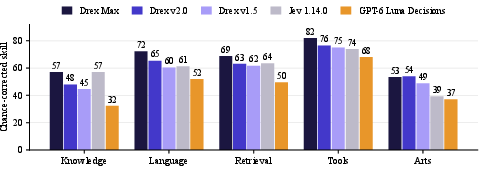
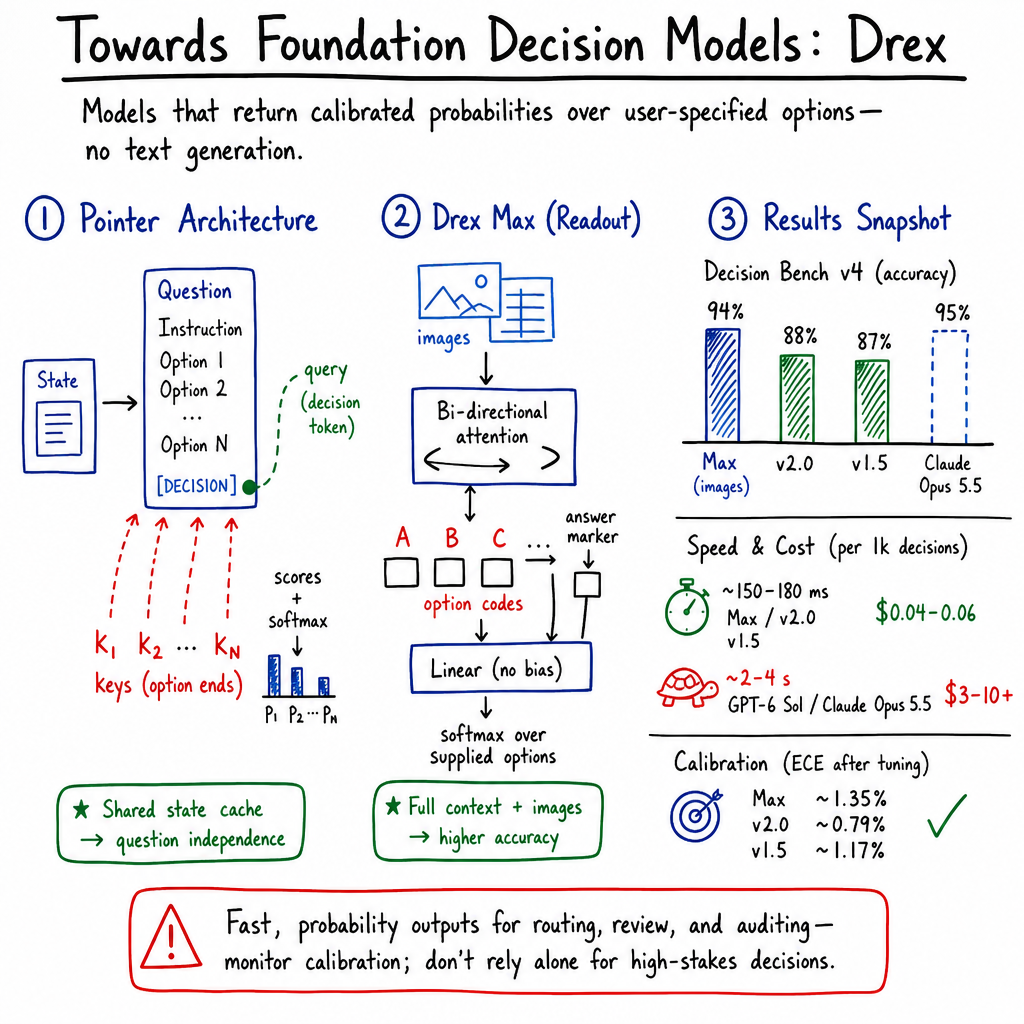
Abstract: Autoregressive approaches with LLMs, such as long chain-of-thought reasoning, have become the default for new AI applications because they reach higher accuracy on a wide range of tasks. In production, however, they give inconsistent answers, require parsing of outputs, and add cost and latency. Decision models address this: given a question and a set of options supplied by the user, they return a probability distribution over the options without autoregressive decoding. We present Drex, a family of four open decision models with 8B (DLM), 9B (v1.5), 35B with 3B active (v2.0), and 27B (Max) parameters. Each request consists of a state (a document, record, or agent context, optionally with images) and questions about it, each asking for a choice among options, a yes/no judgment, or a score on an ordered scale. Training combines supervised fine-tuning with reinforcement learning from adjusted feedback (RLAF), plus vision tuning for Max. Ablations show that RLAF improves accuracy and that consistency losses improve robustness to option order. On Decision Index 0.4.1, Max sets a new state of the art among the decision models we compare (67.52 on the public suite vs. 60.70 for Jev 1.14.0). On Decision Bench v4, it is statistically tied with d3-turbo and GPT-6 Sol and trails Claude Opus 5.5 by 1.6 points, and it has the highest accuracy among decision models on DecideBench. Max answers a typical request in 183 ms, against about 2.0 s for GPT-6 Sol and 3.5 s for Claude Opus 5.5, and its outputs are stable under option reordering. All four models are open source: https://github.com/nace-ai/drex-decision-models
Paper Prompts
Sign up for free to create and run prompts on this paper.
Explain it Like I'm 14
1. What is the paper about?
This paper introduces Drex, a family of AI models designed to make decisions quickly.
Most modern chatbots write an answer word by word. For example, if asked, “Which animal is shown: a dog, cat, or bird?”, a chatbot generates text such as “The answer is probably a dog.”
Drex works differently. It directly gives each choice a probability:
| Option | Probability |
|---|---|
| Dog | 80% |
| Cat | 15% |
| Bird | 5% |
This makes Drex useful for tasks where the computer must choose among known options, give a yes/no answer, or provide a score. The authors call these systems decision models.
Their main goal is to build AI that is:
- accurate,
- fast,
- inexpensive to run,
- reliable,
- honest about its confidence,
- and less affected by the order in which choices are listed.
2. What questions did the researchers study?
The researchers focused on four main questions.
How trustworthy are the probabilities?
If Drex says it is 80% sure, is it actually correct about 80% of the time? This is called calibration.
A well-calibrated model is like a weather forecaster who says “70% chance of rain” and sees rain on about 70% of those days.
Does the order of the options matter?
Suppose the choices are:
- Dog
- Cat
- Bird
Would the model give the same answer if they were rearranged?
The researchers wanted the answer to depend on the information, not on whether an option appeared first or last.
Which training methods help most?
The team tested several training stages:
- Supervised fine-tuning, where the model learns from examples with known correct answers.
- Reinforcement learning from adjusted feedback, where the model is rewarded for making good decisions while being encouraged not to change its behavior too wildly.
- Vision training, which teaches some models to use images as evidence.
What kind of model design works best?
The researchers compared different AI designs. Some models reuse their understanding of a long document when answering many questions. Another model rereads the document for every question but can be more powerful, especially when images are included.
3. How did they conduct the research?
The researchers created four Drex models with different sizes and designs:
- an 8-billion-parameter model,
- a 9-billion-parameter model,
- a 35-billion-parameter model with about 3 billion parameters active at one time,
- and a 27-billion-parameter multimodal model.
A parameter is a number inside an AI model that helps it recognize patterns. More parameters can give a model more ability, although size alone does not guarantee better results.
Each model receives a state, which means the information it should use. This could be:
- a document,
- a database record,
- information about what a computer agent is doing,
- or an image.
The user then asks questions about that information. Drex supports three main kinds of questions:
- Choice questions — choose one option from a list.
- Yes/no questions — decide whether something is true.
- Score questions — give a rating on a scale, such as 0 to 5.
Instead of generating a long written response, the model uses a special output layer to produce a number for each option. This is similar to a judge giving points directly to contestants rather than writing a paragraph explaining the ranking.
The researchers tested the models on several decision-making benchmarks. A benchmark is a common test used to compare AI systems. They measured:
- accuracy,
- calibration,
- speed,
- stability when options were rearranged,
- performance with images,
- and performance compared with other AI models.
They also performed ablation studies. In an ablation study, researchers remove one part of a system to see what changes. This is like taking one ingredient out of a recipe to find out whether it was important.
4. What did they find?
Drex was highly competitive
The largest model, Drex Max, performed very well on several decision-making tests.
On Decision Index 0.4.1, it achieved a score of 67.52, compared with 60.70 for one of the other models. On another independently run test, it scored 64, close to the leading score of 65.
On Decision Bench v4, Drex Max performed better than the other Drex models and an older comparison model. It was statistically similar to some strong models, although one leading model scored slightly higher.
In simple terms, Drex was often as good as much larger or more general-purpose AI systems on tasks involving choices.
It was much faster
A typical Drex request took about 183 milliseconds, or less than one-fifth of a second.
The paper compares this with approximately:
- 2.0 seconds for one other model,
- 3.5 seconds for another large chatbot.
This speed matters in situations where a computer must make thousands or millions of decisions, such as sorting documents, checking records, or helping an automated agent.
Reinforcement learning improved the results
The researchers found that their reinforcement-learning stage improved the Decision Index score by about 2 points in an ablation study.
This suggests that training the model with extra feedback helped it become more accurate and consistent.
Consistency training reduced order sensitivity
The researchers added special training rules that punished the model when its answer changed after the choices or parts of the input were rearranged.
In one experiment, these rules reduced the rate at which the top answer changed from 6.3% to 4.2%.
This is an improvement, but it also shows that the problem was not completely solved. The model can still sometimes be influenced by option order.
The paper reports that order changes were especially likely to affect decisions with:
- many possible choices,
- and low model confidence.
For difficult questions, the model may change its favorite answer when the options are rearranged.
Confidence was useful, but not perfect
The researchers studied whether the model’s confidence could help decide when to trust it.
For example, a system might automatically accept highly confident decisions and send uncertain ones to a human. This is called selective prediction.
The results suggest that confidence can be useful, but it must be measured and calibrated carefully. A high confidence score should not automatically be treated as proof that the answer is correct.
Image training did not harm text performance
Drex Max was trained to work with images as well as text. According to the paper, this extra vision training did not reduce its accuracy on text-only questions.
That is important because a model that supports images should still remain useful for ordinary written information.
Open-source release
The four models, their weights, and inference code were released openly, although different parts use different licenses.
This means other researchers and developers can study the models, test them, and potentially use them in their own applications, subject to the licenses.
5. Why is this research important?
Many AI systems are built to produce long answers. That is useful for writing and conversation, but it can be inefficient when the real task is simply to choose between options.
Drex presents another approach: make the decision directly instead of generating an explanation first.
This could make AI systems:
- faster,
- cheaper to operate,
- easier to connect to software,
- less likely to produce invalid answers,
- and easier to use in large-scale automated systems.
For example, a company might use a decision model to classify customer requests, decide whether a document meets certain rules, rank search results, or judge whether an automated computer action was successful.
However, the results should be interpreted carefully. The paper compares many models and training stages, but much of the evidence shows relationships rather than absolute proof that one specific design caused every improvement. The models can also still make mistakes, become affected by option order, or be overconfident.
Simple conclusion
The paper presents Drex as a new type of AI model that is built to choose, rather than mainly to write. It accepts information and a list of possible answers, then quickly returns probabilities for those answers.
The researchers found that Drex can be accurate, fast, and fairly stable. Training with feedback improved its performance, and special consistency training made it less sensitive to the order of choices.
If these models continue to improve, they could become useful tools for fast and reliable decisions in businesses, software systems, research, and AI agents. Still, people should continue checking their accuracy and confidence, especially when the decisions are important or could affect people’s lives.
Practical Applications
Immediate Applications
The paper’s central innovation is a fast decision-model interface that accepts a state—such as a document, database record, agent context, or image—plus a user-defined set of options, and returns probabilities without autoregressive text generation. The following applications are feasible using the released weights, inference code, or hosted APIs.
- High-throughput document and data classification — Industry, software
- Integrate Drex into document-processing pipelines for tasks such as routing support tickets, classifying contracts, assigning insurance claims, triaging emails, or labeling compliance records.
- A single model can support changing option sets at inference time, avoiding the need to retrain a separate classifier whenever categories change.
- Workflow: ingest document or JSON record → define candidate labels → obtain probabilities and confidence → route high-confidence cases automatically and send uncertain cases to human reviewers.
- Dependency: performance depends on whether the domain, terminology, and label definitions are represented adequately in the model’s training distribution. Domain-specific calibration should be evaluated before production deployment.
- Cost-efficient reranking and candidate selection — Search, recommendation, software
- Use the model to select or rank among retrieved search results, product candidates, knowledge-base articles, code patches, or recommended actions.
- The model’s direct probability output avoids generating and parsing textual labels, while pointer models can encode a shared context once and answer multiple questions efficiently.
- Potential products: a low-latency reranking API, a retrieval-augmented generation (RAG) filtering layer, or an offline relevance-scoring service.
- Dependency: the candidate set should be limited to a manageable number of meaningful alternatives; the interface supports up to 255 options, but accuracy and order sensitivity may degrade as the number of options increases.
- Human-in-the-loop triage and selective automation — Healthcare, finance, public services
- Use calibrated confidence scores to determine when a prediction can be automated and when it must be reviewed by a person.
- Examples include prioritizing medical records for review, routing loan applications, flagging suspicious transactions, or classifying benefits applications.
- The reported calibration and selective-accuracy analyses support threshold-based workflows such as “auto-process above confidence threshold; escalate otherwise.”
- Dependency: calibration must be measured on the target population, since benchmark calibration does not guarantee reliability under distribution shift. The model should assist rather than replace qualified decision-makers in high-stakes settings.
- Customer-service and sales operations — Business software
- Apply yes/no and choice questions to determine whether a customer message requires escalation, which resolution category applies, whether a lead matches a qualification criterion, or which follow-up action is appropriate.
- The low reported latency—approximately 183 ms for a typical request for the largest model—makes synchronous use in agent-assistance tools plausible.
- Potential tools: CRM lead scoring, automated ticket routing, conversation-quality monitoring, and next-best-action recommendation.
- Dependency: commercial deployment must account for the licenses of the model and backbone, privacy obligations, and the need to validate probabilities against actual conversion or resolution outcomes.
- Structured scoring and prioritization — Finance, operations, education
- Use score questions to produce ratings such as risk level, urgency, relevance, quality, or rubric-based performance.
- Because the model returns a full distribution over an ordered scale as well as an expected score, applications can retain uncertainty rather than storing only a single label.
- Examples: supplier-risk scoring, investment-research prioritization, student-work rubric assistance, incident severity assessment, and maintenance priority ranking.
- Dependency: score levels must be defined consistently. An expected score should not be treated as an objective measurement unless the scale has been validated and inter-rater reliability is acceptable.
- Agent action selection — Robotics, computer use, workflow automation
- Provide an agent’s current context and a set of permitted actions—such as “open file,” “send for approval,” “retry,” or “stop”—and use the returned distribution to choose the next step.
- The closed-world interface is useful for constraining an agent to explicitly authorized actions, reducing the need to parse unconstrained language output.
- Confidence thresholds can trigger fallback to a larger LLM, a deterministic policy, or a human operator.
- Dependency: the model does not itself guarantee that an action is safe, executable, or optimal. Action validation, permissions, environment checks, and deterministic safeguards remain necessary.
- Multimodal inspection and visual decision support — Manufacturing, logistics, retail
- Drex Max’s image-tuned variant can make choices from images, such as identifying a defect category, selecting a packaging condition, classifying shelf states, or determining whether visual evidence satisfies a checklist.
- A practical workflow is image capture → structured inspection question → candidate defect or condition options → probability-based routing.
- Dependency: visual accuracy depends on image quality, camera configuration, lighting, and similarity between deployment images and training data. The paper’s evidence supports multimodal capability but does not establish safety or reliability for unsupervised industrial control.
- Local and privacy-preserving decision services — Enterprise IT, academia, regulated sectors
- The open weights, safetensors/GGUF builds, and inference runtimes enable on-premises or local deployment for sensitive documents and records.
- Organizations can use the models without sending all inputs to an external generative API, potentially reducing latency and data-transfer costs.
- Dependency: deployment requires suitable GPU or optimized inference infrastructure, and the applicable license may restrict commercial or certain backbone-dependent uses. Security review and model monitoring are still required.
- Research baselines for discriminative language-model inference — Academia
- Researchers can use the released models as baselines for multiple-choice reasoning, calibration, option-order robustness, selective prediction, multimodal decision-making, and agent evaluation.
- The common interface across four backbones enables controlled comparisons between diffusion, hybrid, mixture-of-experts, pointer, and readout-head architectures.
- Dependency: the paper reports strong benchmark performance but also notes that many comparisons are associative rather than causal. Results should therefore not be interpreted as proving that any single architectural or training component is responsible for all gains.
- Evaluation and monitoring of decision systems — Policy, governance, software quality
- The paper’s metrics—expected calibration error, negative log-likelihood, Brier-style scores, selective accuracy, and option-order flip rate—can be incorporated into model acceptance tests and production monitoring.
- Teams can test whether a deployed classifier changes its top decision when candidate labels are reordered, and whether confidence thresholds correspond to actual accuracy.
- Dependency: monitoring requires representative labeled samples, periodic recalibration, and explicit handling of abstentions and unknown cases.
Long-Term Applications
The following applications are plausible extensions of the findings but require additional validation, domain adaptation, scaling, or safety research before dependable deployment.
- Clinical decision support — Healthcare
- A multimodal decision model could combine clinical notes, laboratory data, medical images, and patient history to rank diagnostic hypotheses, treatment options, or urgency levels.
- The probability distribution and abstention mechanism could support clinician review rather than opaque single-label predictions.
- Required development: prospective clinical validation, subgroup and fairness analysis, calibration by hospital and specialty, auditability, privacy controls, and regulatory approval. Benchmark performance alone is insufficient for patient-care decisions.
- Financial underwriting and fraud detection — Finance
- Candidate-option inference could support credit-risk bands, fraud-alert categories, transaction dispositions, or competing investment scenarios.
- Calibration and selective prediction could be used to automate routine cases while escalating borderline cases.
- Required development: temporal validation, resistance to adversarial behavior, fairness testing, explainability, regulatory compliance, and recalibration during economic regime changes.
- Autonomous robotics and industrial control — Robotics, energy, manufacturing
- A decision model could select among navigation actions, maintenance interventions, grid-control responses, or robotic manipulation plans based on sensor and visual context.
- Shared-state pointer models could answer many related action-selection questions efficiently, while the multimodal model could process raw images.
- Required development: real-time guarantees under worst-case latency, formal safety constraints, simulation-to-real transfer, out-of-distribution detection, and integration with verified planners. Probabilities should not be used as the sole control policy.
- Adaptive education and assessment — Education
- The model could select instructional interventions, classify student misconceptions, score open-ended work against ordered rubrics, or recommend the next exercise.
- Confidence-aware routing could send ambiguous submissions to teachers and automate routine formative feedback.
- Required development: longitudinal studies of learning outcomes, protection against demographic bias, teacher oversight, age-appropriate design, and validation across curricula and languages.
- Policy analysis and public-sector case management — Government
- Agencies could use decision models to prioritize inspections, classify applications, identify missing documentation, or compare policy scenarios.
- The explicit option set could improve procedural consistency and make the decision space auditable.
- Required development: legally defensible explanations, appeal mechanisms, public documentation, bias and disparate-impact analysis, records retention, and human accountability. Automated recommendations should not independently determine access to essential services.
- Foundation decision services for enterprise platforms — Software infrastructure
- The models could become general-purpose decision layers embedded in databases, workflow engines, CRM systems, RAG systems, and agent frameworks.
- A standardized API could allow applications to switch among model sizes and architectures depending on latency, accuracy, image support, and cost requirements.
- Required development: robust schema validation, versioned calibration, monitoring under changing option distributions, batching and caching strategies, and clear semantics for confidence across domains.
- Active learning and data-labeling systems — Academia, industry
- The model’s confidence and option distributions could identify uncertain examples for annotation, prioritize expert review, and construct more informative training datasets.
- Option-order robustness tests could detect unstable labels before they enter a supervised dataset.
- Required development: evidence that model uncertainty correlates with genuine annotation difficulty, safeguards against reinforcing model bias, and methods for detecting cases where the correct answer is absent from the supplied options.
- Decision ensembles and hybrid reasoning systems — AI research
- Decision models could serve as fast first-pass evaluators, with an autoregressive LLM invoked only for low-confidence, high-impact, or explanation-demanding cases.
- Multiple option orderings could be averaged to improve log loss, as reported in the paper, while confidence thresholds could determine escalation.
- Required development: principled routing policies, end-to-end cost and latency studies, calibration after ensembling, and safeguards against correlated errors between the decision model and fallback model.
- Personal productivity and household assistance — Daily life
- Consumer tools could use decision models to compare travel plans, prioritize tasks, categorize messages, select purchases from a user-defined shortlist, or score household maintenance urgency.
- Local inference could enable privacy-preserving assistants that return probabilities over explicitly specified alternatives rather than generating unrestricted recommendations.
- Dependency: users must define meaningful candidate options, and the model may omit the best choice if it is not included. Consumer interfaces should clearly distinguish model confidence from factual certainty and avoid presenting probabilistic outputs as guarantees.
- Policy and safety standards for probabilistic AI decisions — Governance
- The paper supports a broader standard in which AI systems expose option distributions, calibration statistics, selective accuracy, and sensitivity to option ordering rather than only a final answer.
- Such standards could inform procurement requirements and auditing frameworks for AI used in regulated or high-impact environments.
- Required development: consensus on reporting protocols, domain-specific risk thresholds, reproducible evaluation datasets, and methods for measuring calibration under real-world distribution shift.
Glossary
- Ablation: An experiment in which a component of a system is removed or altered to measure its contribution. “Controlled ablations show that RLAF improves accuracy and consistency.”
- Autoregressive decoding: Generating an output sequence one token at a time, with each token conditioned on previously generated tokens. “return the probabilities directly, without autoregressive decoding”
- Backbone model: The primary neural-network architecture that provides learned representations for an application-specific model. “The pointer head is added to the last layer of each of the following backbone models”
- Bidirectional attention: An attention mechanism in which each token can incorporate information from tokens on both sides of it. “a diffusion LLM with bidirectional attention over the context”
- Bootstrap confidence interval: An uncertainty interval estimated by repeatedly resampling observed data. “We report bootstrap confidence intervals”
- Calibrated probabilities: Predicted probabilities that correspond closely to the observed frequencies of correct outcomes. “Can a single model serve arbitrary option sets with calibrated probabilities”
- Calibration: The degree to which predicted probabilities match empirical outcome frequencies. “Calibration. How well do the probabilities returned by decision models match their empirical accuracy”
- Causal attention mask: A masking pattern that prevents a token from attending to subsequent tokens. “The model removes the causal attention mask in its full-attention layers”
- Chance-corrected skill: A performance measure adjusted to account for accuracy expected from random guessing. “Public-suite index and full score with private tests, both chance-corrected skill”
- Constrained decoding: Generation restricted to a predefined set of valid strings or tokens. “another is to generate the option and constrain the generation to the allowed strings”
- Cross-entropy: A loss function measuring the discrepancy between a target probability distribution and a predicted distribution. “the loss functions for training (cross-entropy, squared Cram”
- Cross-encoder: A model that jointly encodes two inputs to directly compute a relationship or score between them. “cross-encoders and pointer networks”
- Diffusion LLM: A LLM that generates or reconstructs text through a diffusion-based process rather than standard left-to-right decoding. “a diffusion LLM with bidirectional attention over the context”
- Discriminative inference: Inference that selects or scores among possible outputs rather than generating a sequence of text. “This has driven a resurgence of discriminative inference in the form of decision models”
- Embedding: A dense vector representation of an input used for comparison, clustering, or search. “Embedding maps an input to a vector that is compared, clustered or searched”
- Expected calibration error (ECE): A statistic that summarizes the difference between predicted confidence and empirical accuracy across confidence bins. “We measure the expected calibration error over 15 equal-width bins (ECE).”
- Forward pass: One computation of a neural network that transforms an input into an output. “but at the cost of one forward pass per option”
- Frontier model: A highly capable model representing the current leading performance in a class of AI systems. “competitive with frontier models on real-data decisions”
- Full attention: An attention mechanism in which tokens can attend broadly to all relevant tokens in the sequence. “dense multimodal backbone with non-causal full attention”
- Hidden state: An internal vector representation produced by a neural network layer. “maps the final hidden state to one logit per code”
- Inference-time intervention: A modification applied during model use rather than during training. “Most of the evidence is comparative, across models, training stages, and inference-time interventions.”
- Kullback–Leibler (KL) divergence: A measure of the difference between two probability distributions. “The objective is regularized by the [ADDRESS] divergence between the output distribution”
- Latency: The time required for a system to produce a response. “such approaches give inconsistent answers, require parsing of outputs, and add cost and latency.”
- Log loss: A probabilistic loss function based on the negative logarithm of the probability assigned to the observed outcome. “Averaging the three probability distributions predicted by the model for the respective three orders improves log loss”
- Logit: An unnormalized score that is typically converted into a probability using softmax. “a bias-free linear layer maps the final hidden state to one logit per code”
- Masked LLM: A LLM trained to predict tokens hidden or removed from their surrounding context. “in the case of masked LLMs, predicting tokens withheld from their context”
- Mixture-of-experts (MoE): A neural architecture that routes each input through a subset of specialized component networks. “a sparse mixture of experts LLM”
- Multimodal backbone: A neural-network backbone designed to process multiple data modalities, such as text and images. “a dense multimodal backbone and bidirectional attention”
- Negative log-likelihood (NLL): The negative logarithm of the probability assigned to the correct outcome. “the log loss (also, negative log-likelihood, abbreviated NLL)”
- Non-causal attention: Attention that is not restricted to preceding tokens and can use information from later tokens. “The model removes the causal attention mask in its full-attention layers”
- Option-order sensitivity: A model’s tendency to change its predictions when candidate options are presented in a different order. “the option-order sensitivity of LLMs”
- Permutation consistency: The property that a model’s output remains appropriately unchanged when inputs are reordered. “permutation consistency”
- Pointer head: A model component that assigns scores or probabilities to positions or explicitly supplied options. “The pointer head is added to the last layer”
- Pointer model: A decision model that encodes context once and reuses that representation across multiple questions. “Pointer models (e.g., [PERSON_NAME], v1.5, v2.0) are decision models where the context is encoded once”
- Proper scoring rule: A scoring function designed to incentivize reporting one’s true probability distribution. “calibration and proper scoring rules”
- Readout head: A final model layer that converts an internal representation into task-specific scores or logits. “reads the answer from a readout head”
- Reinforcement learning from adjusted feedback (RLAF): A reinforcement-learning method that uses feedback modified according to model probabilities or other adjustments. “Training combines supervised fine-tuning with reinforcement learning from adjusted feedback (RLAF)”
- Renormalization: Rescaling scores or probabilities so that they sum to one over a specified set of outcomes. “computing the output probabilities of constrained generation involves renormalizing the per-token probabilities”
- Reranker: A model that assigns a relevance score to each candidate and reorders the candidates accordingly. “a reranker returns one number per candidate”
- Selective accuracy: Accuracy measured on the subset of predictions for which the model is most confident. “selective accuracy, which is the accuracy of the model on the fraction of decisions on which it is most confident.”
- Softmax: A function that converts a vector of scores into a normalized probability distribution. “a linear layer to produce a single score or additionally a softmax over a fixed set of output labels”
- Supervised fine-tuning (SFT): Further training of a pretrained model on labeled examples for a particular task or behavior. “The first stage is supervised fine-tuning (SFT).”
- Temperature parameter: A parameter that adjusts the sharpness or concentration of a predicted probability distribution. “Does a single global temperature, fit on held-out decisions, improve this calibration?”
- Top-1 flip rate: The fraction of decisions for which the highest-probability option changes after the options are reordered. “We measure order robustness with the top-1 flip rate”
- Vision tuning: Training or adapting a model so that it can process and use visual inputs. “plus vision tuning for [PERSON_NAME].”

