Memento 3: Model-Based Recursive Self-Improvement through Reflective Rulebooks
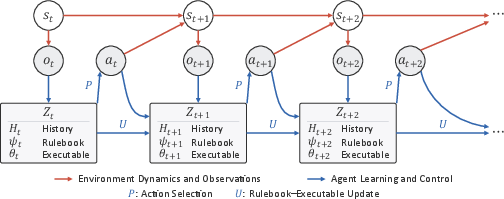
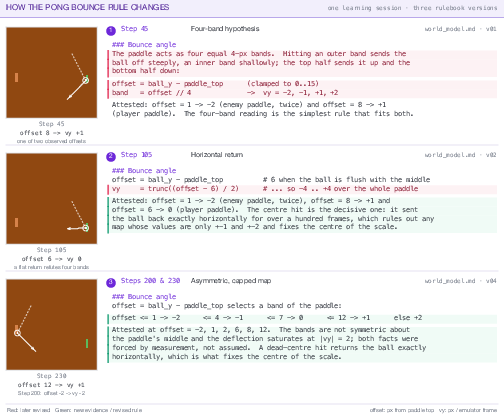
Abstract: Learning to act in unfamiliar environments requires agents to infer how the world works and revise that understanding as new evidence arrives. Yet limited observations can support multiple world models that explain past interactions but predict different outcomes in unseen states. We introduce Memento 3, building on the Memento series to enable frozen LLM agents to continually learn explicit world models through external memory. The agent maintains a natural-language rulebook as persistent semantic memory, recording revisable hypotheses about environment dynamics while leaving unknown aspects underspecified. It compiles this rulebook into executable code for prediction and planning. Through a continual loop of observation, reflection, rule revision, compilation, and verification, the agent uses prediction errors to refine both the rulebook and its code. Updated code is accepted only when the LLM judges it faithful to the rulebook and cell-exact replay reproduces the observed transitions. We investigate this process as a model-based route to recursive self-improvement (RSI): the agent autonomously explores the environment, revises its world model, and uses verified updates to guide subsequent interaction and learning, while the underlying LLM remains fixed. A population extension maintains multiple world models in parallel, sharing interaction evidence and using their predictions to guide exploration. On ARC-AGI-3, the single-model agent clears every level of all 25 public games, achieves a mean Relative Human Action Efficiency (RHAE) of 100.0, and uses 44% of the human action count. In an Atari Pong case study, a learned feedback controller wins 21:0 in each of three evaluated episodes with different openings, without further LLM calls.
Paper Prompts
Sign up for free to create and run prompts on this paper.
Top Community Prompts
Explain it Like I'm 14
1. What is this paper about?
This paper introduces Memento 3, a method for helping an AI learn how an unfamiliar world works.
Imagine giving a robot a new video game without explaining the rules. The robot must discover:
- What the objects do
- Which actions cause which results
- What counts as winning
- How to reach the goal using as few moves as possible
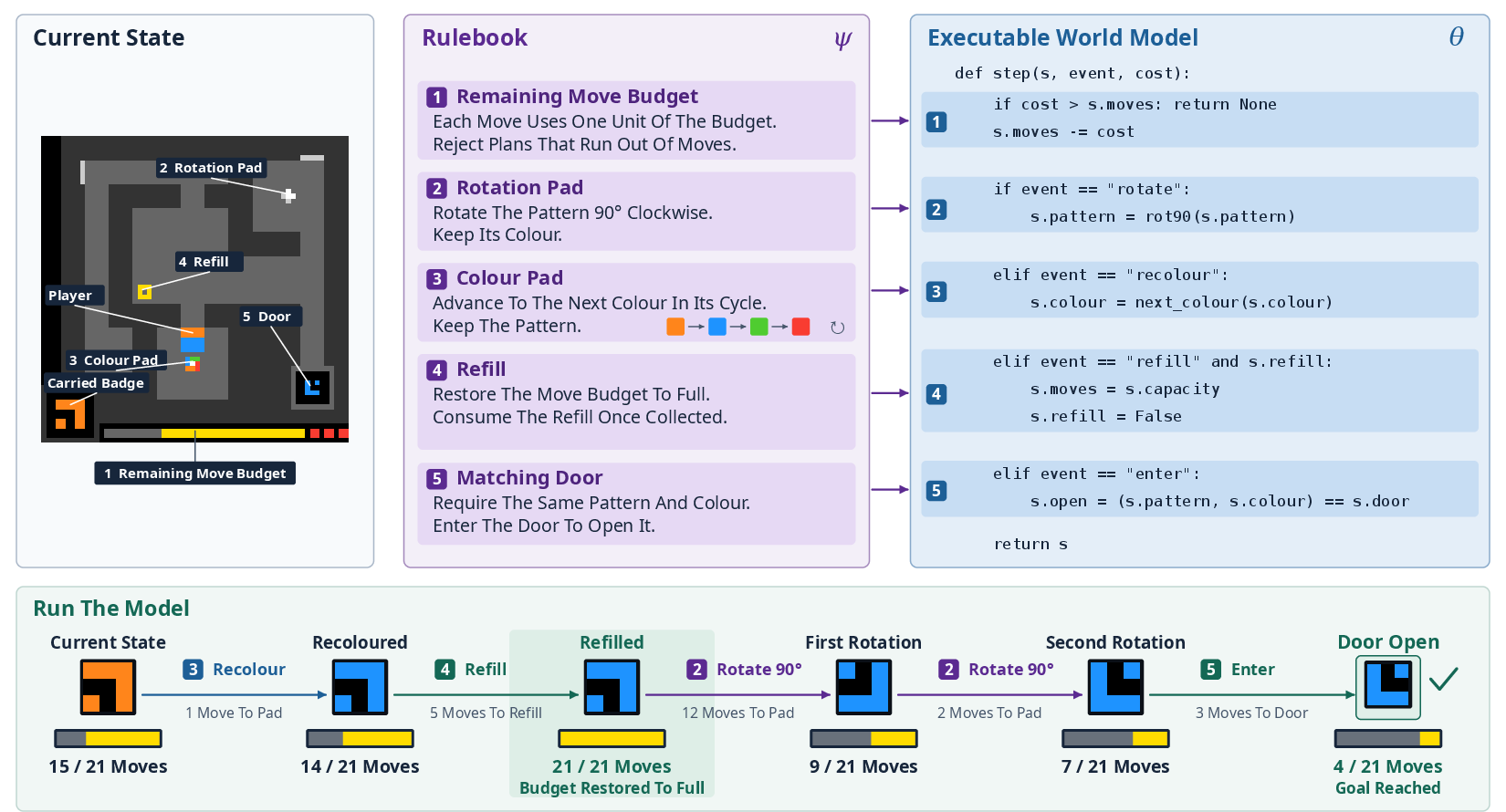
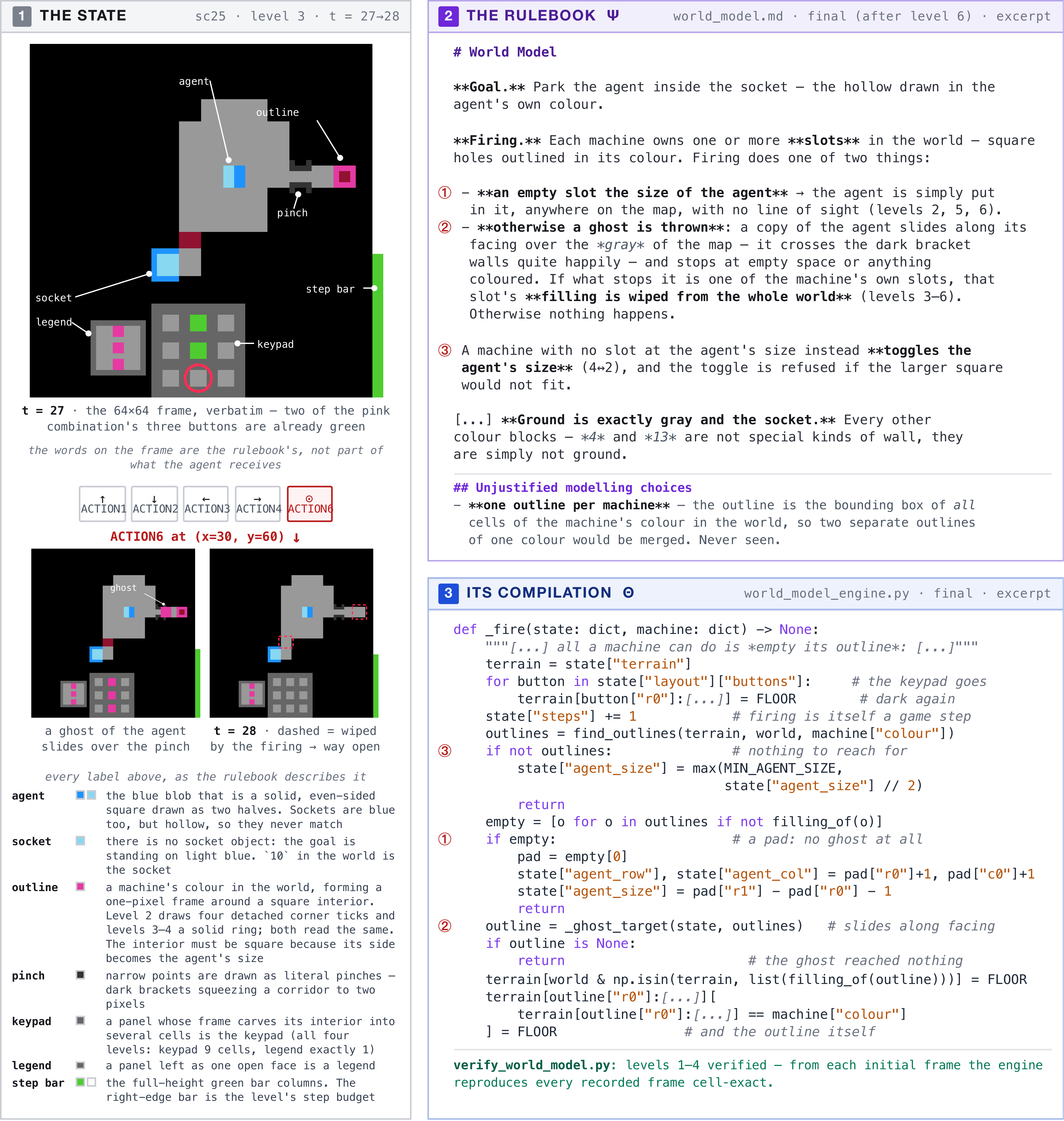
Memento 3 helps the AI do this by keeping a written rulebook about the world. It then turns that rulebook into computer code that can predict what will happen after each action.
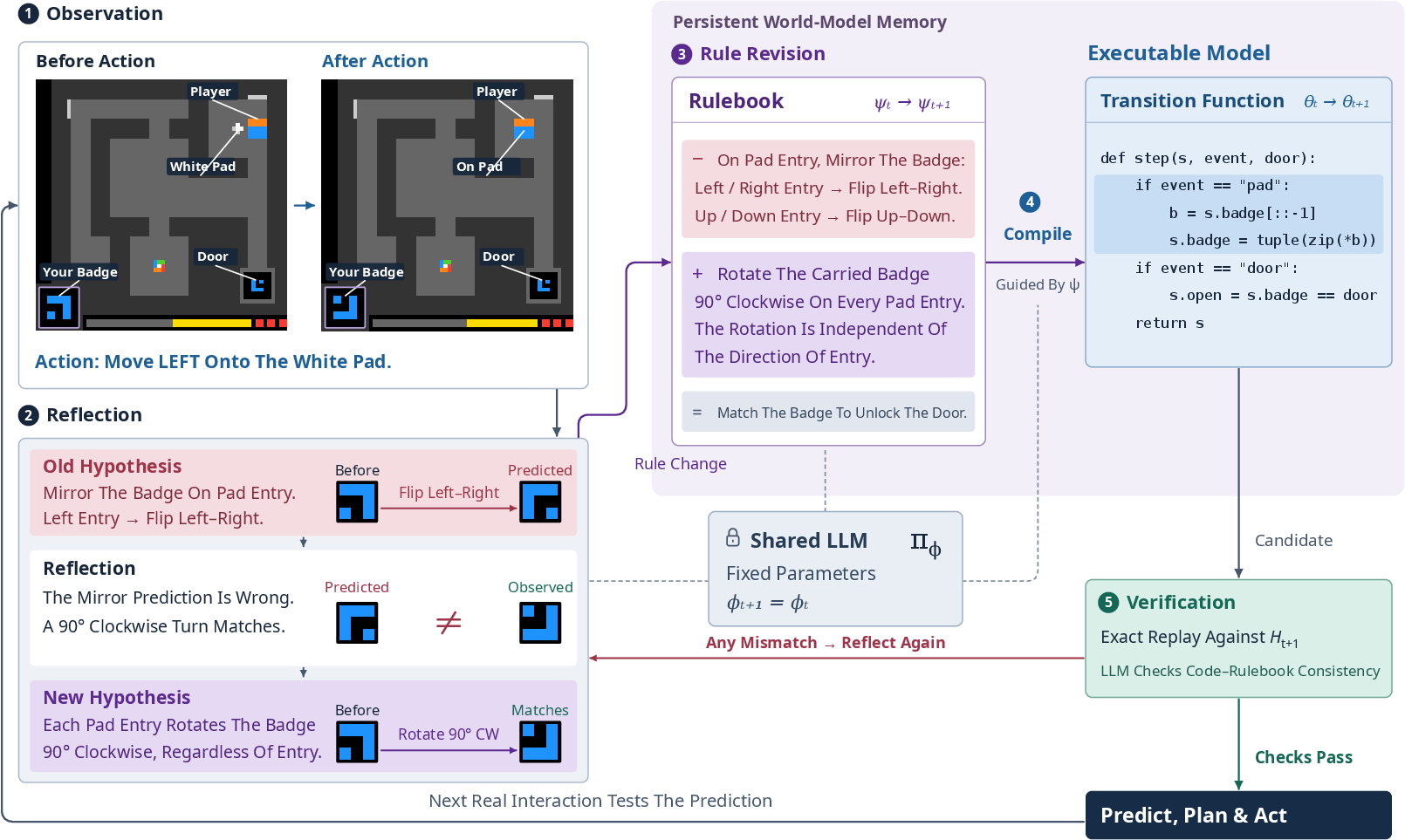
The AI repeatedly:
- Observes what happens
- Thinks about whether its rules were correct
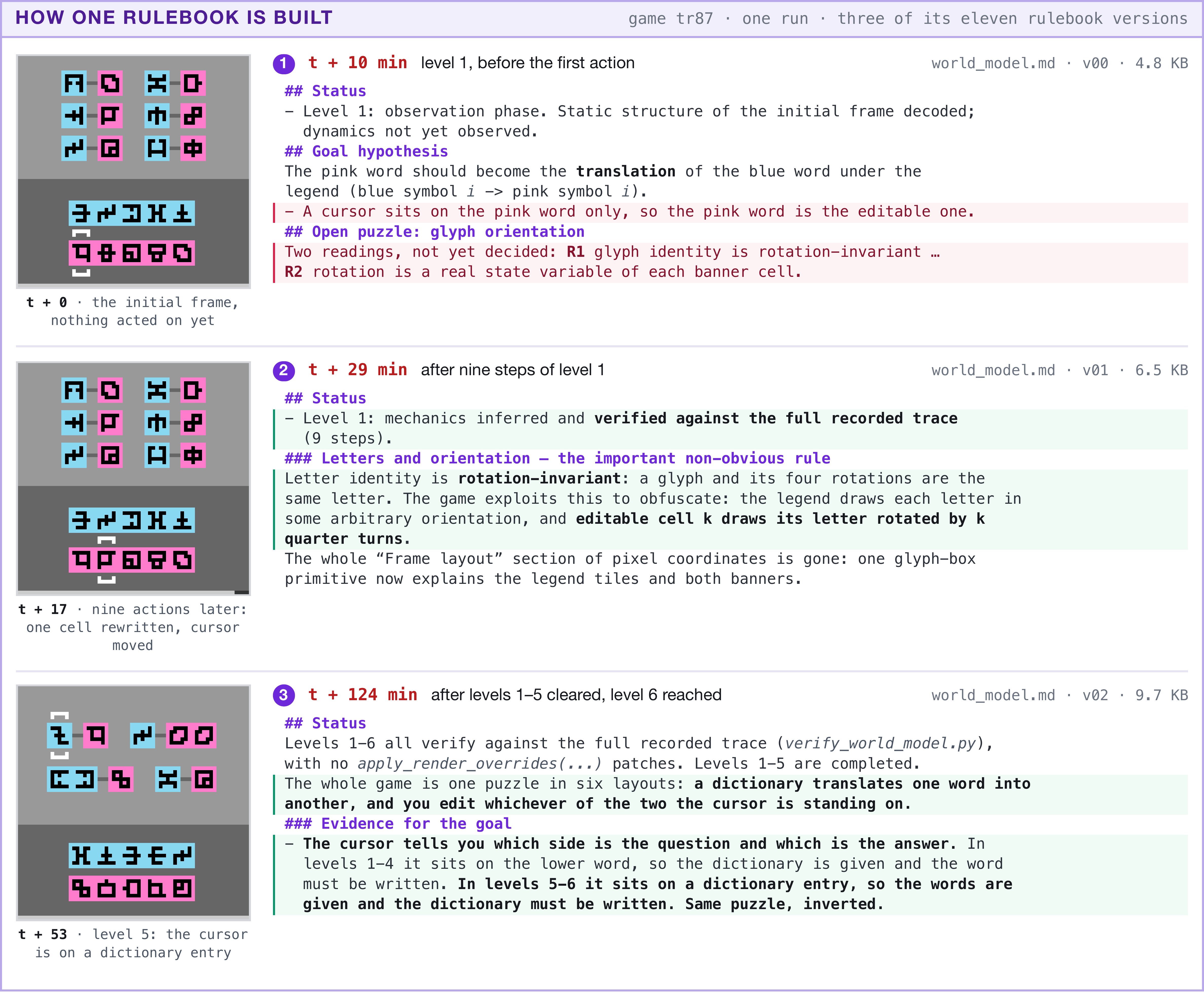
- Changes the rulebook if needed
- Turns the updated rules into code
- Checks whether the code matches everything it has observed
- Uses the improved model to plan its next actions
The LLM itself does not change. Instead, the AI improves by changing its external memory and computer programs.
2. What questions does the research explore?
The paper focuses on several main questions:
- Can an AI learn the rules of a new environment by interacting with it?
- Can it write down its understanding in a clear, changeable rulebook?
- Can it turn that rulebook into working code for prediction and planning?
- Can it notice when its predictions are wrong and repair its understanding?
- Can this process help the AI improve itself over time, even though the underlying LLM stays fixed?
- Would keeping several possible explanations of the world be better than keeping only one?
The last question is important because early evidence can be misleading. For example, suppose an AI sees that a box stops whenever it reaches column 7. It might incorrectly conclude that “boxes always stop at column 7,” even though the real rule is “boxes stop when they hit a wall.” Both explanations fit the first observation, but only one will work in a new situation.
3. How did the researchers approach the problem?
A rulebook and a computer model
The AI keeps two connected forms of knowledge:
- A natural-language rulebook, such as “The blue key opens the blue door.”
- An executable model, which is computer code that uses those rules to simulate the world.
The rulebook is like a student’s written notes. The executable model is like a small practice version of the game that lets the AI test possible actions without using real moves.
The code can answer questions such as:
- “What will happen if I move left?”
- “Where will the character be after three moves?”
- “Can I reach the goal within the remaining action limit?”
Learning through a repeated loop
After every real action, the AI compares what it expected with what actually happened.
For example:
- The model predicts that pressing a button will open a door.
- The AI presses the button.
- The door does not open.
- The AI recognizes a prediction error.
- It reflects on whether the rulebook or the code was wrong.
- It revises one or both.
- It tests the new version against all earlier observations.
This is similar to checking a science theory against experiments. A theory is kept only if it explains the evidence collected so far.
Exact replay and verification
A new program is accepted only if it passes two tests:
- Rulebook fidelity: The code really follows the rules written in the rulebook.
- Exact replay: When the code repeats all earlier actions, it must produce exactly the observations that really happened.
This prevents the AI from accepting code that sounds reasonable but does not match reality.
One model or many models
The researchers tested two versions:
- A single-model system, which chooses one best explanation of the world
- A population system, which keeps several possible explanations at the same time
The population version is like asking several detectives to investigate the same mystery. Each detective may have a different theory. Their theories are tested against the same evidence, and different theories may suggest different actions. Trying those actions can reveal which theories are wrong.
Environments used for testing
The researchers evaluated Memento 3 on:
- ARC-AGI-3, a collection of unfamiliar visual games with hidden rules and limited actions
- Atari Pong, to see whether the learned model could control the paddle without needing more language-model calls during play
4. What were the main findings?
Strong results on ARC-AGI-3
The single-model version:
- Completed every level of all 25 public games
- Achieved a mean Relative Human Action Efficiency score of
100.0 - Used only 44% of the corresponding human action count
In simple terms, it solved the games while using fewer moves than the human reference standard.
The paper also reports that this result was 59.3 points higher in mean RHAE than a comparison system using Claude Opus 5 with the ARC Prize Standard setup.
Successful control of Pong
In the Pong experiment, the learned model was used to create a feedback controller. A feedback controller repeatedly checks what is happening and adjusts its actions, much like a person moving a paddle to follow the ball.
The controller won each of three tested games by a score of:
$21:0$
It did this with different starting situations and without making additional calls to the LLM while playing. This suggests that the learned executable model was able to guide fast decisions on its own.
Why these results matter
These findings suggest that an AI can learn more than just a list of successful actions. It can learn a general explanation of how an environment works and use that explanation to plan new actions.
This is important because memorizing actions may work only in situations the AI has already seen. A world model can potentially help it handle new situations by asking:
“What rule explains what I have seen, and what does that rule predict here?”
Important limitation: several explanations may fit the evidence
The paper also points out that passing all replay tests does not prove that a model is completely correct.
A model may correctly explain every situation seen so far but still make wrong predictions in situations the AI has never tried. This is called an underdetermined problem: the available evidence does not yet tell us which explanation is truly right.
Keeping multiple models can help because the AI can explore different possibilities instead of trusting one explanation too early.
5. What could this research mean for the future?
Memento 3 presents a possible way for AI systems to improve their reasoning without changing the main LLM. The AI improves by updating:
- Its memories
- Its written rules
- Its executable world model
- Its plans for exploring and reaching goals
This could be useful for robots, game-playing systems, and other AI agents that must operate in places they have never seen before.
The biggest idea is that an AI can use its current understanding to improve the tools it uses for future learning. It observes the world, builds a model, uses that model to act, learns from mistakes, and then improves the model again. This is why the authors describe the process as a form of model-based recursive self-improvement.
However, the system still has challenges. It may choose a simple but incorrect explanation, especially when it has not explored enough. It may also fail if the LLM writes a poor rulebook or code. Keeping several models and deliberately taking actions that test uncertain rules may reduce these problems.
Overall, the paper suggests that combining human-readable rules, working computer simulations, and careful testing against real observations can help AI learn unfamiliar environments more flexibly and efficiently.
Knowledge Gaps
Knowledge gaps, limitations, and open questions
The paper leaves the following issues unresolved:
- Limited evaluation scope: The main evaluation is restricted to the 25 public ARC-AGI-3 games and a small Atari Pong case study; performance on substantially different environments, stochastic domains, continuous control tasks, and real-world settings remains unknown.
- No evaluation on hidden or held-out ARC-AGI-3 games: The reported results may not establish generalisation beyond the public levels used for development or tuning.
- Unclear contribution of individual components: The paper does not fully isolate the effects of the rulebook, executable model, reflective revision, replay verification, minimum-description-length selection, exploration strategy, and population extension through comprehensive ablations.
- Insufficient baseline comparisons: The comparison with Claude Opus 5 does not establish how Memento 3 performs against other model-based agents, code-generating world models, Bayesian model-based planners, ensemble methods, or non-LLM exploration algorithms under matched action and compute budgets.
- Unspecified implementation details: The paper does not provide enough information about prompts, model versions, temperature settings, retry policies, context-window management, compiler design, planner implementation, and stopping criteria to ensure reproducibility.
- Unreported computational and monetary costs: Model-inference latency, number of LLM calls, token consumption, compilation time, replay cost, memory growth, and total financial cost are not quantified, making comparisons based solely on real-action counts incomplete.
- Potential mismatch between action efficiency and learning efficiency: The reported action budgets exclude model construction, simulation, replay, and LLM computation, so the claimed efficiency may not reflect end-to-end resource efficiency.
- Reliance on an LLM for semantic verification: Rulebook–code fidelity is assessed by the same type of frozen LLM that generates the rules and code. The reliability, calibration, and failure modes of this semantic judge are not independently validated.
- Possibility of accepted but semantically incorrect programs: Exact replay only tests recorded trajectories, while LLM-based fidelity checking may accept programs that satisfy the wording superficially but implement unintended or underspecified mechanics.
- No formal soundness guarantee: The method provides no proof that accepted executable models preserve the true environment dynamics, goal conditions, or relevant hidden-state information outside the observed history.
- No formal convergence result: It is unknown whether repeated reflection and revision eventually identify the true model, stabilise at a useful hypothesis, or oscillate between incompatible rulebooks.
- Unresolved ambiguity under partial observability: The point-belief approximation commits to one reconstructed internal state despite potentially many hidden states and models being compatible with the same observation history.
- Weak treatment of uncertainty: The population approximation uses equally weighted surviving hypotheses, although replay consistency does not imply equal plausibility. The relationship between this empirical population and a calibrated posterior is not established.
- Population size is not systematically studied: The paper does not determine how performance, exploration quality, memory use, and inference cost vary with the number of retained models.
- Population diversity may be illusory: Behavioural equivalence is defined by currently generated plans, which may group models that differ substantially under other histories or future actions; conversely, syntactically different models with identical current plans may not provide genuinely diverse exploration.
- No principled model-prior specification: The proposed minimum-description-length interpretation depends on an implicit prior over rulebooks and programs, but the actual prior induced by the LLM, prompts, and compiler is neither measured nor characterised.
- Unclear effect of LLM pretraining knowledge: The experiments do not separate learning from interaction from the use of prior knowledge embedded in the frozen LLM, leaving the source of the reported capabilities uncertain.
- Exploration remains largely heuristic: When no plan is available, intermediate-target selection and information-seeking behaviour are delegated to the LLM and auxiliary planner without a formal exploration objective or guarantees on hypothesis discrimination.
- No guarantee against self-confirming models: The population is intended to reduce self-confirming behaviour, but the paper does not quantify how often incorrect models remain unfalsified or show that population sampling systematically improves identifiability.
- Action-budget sensitivity is unexplored: The method’s performance as the available real-action budget changes is not reported, particularly in environments where early exploratory actions are costly.
- Failure recovery is underspecified: The paper does not explain what happens when no proposed revision passes verification, when all population members are falsified, or when the LLM repeatedly generates invalid, nonterminating, or computationally intractable code.
- Executable safety and resource limits are not addressed: Arbitrary generated programs may contain infinite loops, excessive memory use, unsupported operations, or unsafe side effects; the paper does not specify sandboxing or computational safeguards.
- Scalability to long histories is unresolved: Storing and repeatedly replaying the complete interaction record may become expensive, while truncating or summarising histories could remove evidence needed for model revision.
- Multi-trajectory learning is not evaluated: Although the formulation supports multiple trajectories, the experiments do not establish whether cross-trajectory evidence improves model identification or introduces inconsistencies in state reconstruction.
- Stochastic environments are excluded: The formal environment is deterministic, and exact replay is therefore appropriate; the method’s behaviour under stochastic transitions, noisy observations, probabilistic goals, or action failures is unknown.
- Dynamic or nonstationary environments are excluded: The true model is assumed fixed, so the ability to detect and adapt to changing rules, goals, or environment dynamics remains untested.
- Goal inference is underexamined: Completion feedback is treated as available, but the paper does not evaluate environments with ambiguous, delayed, partial, deceptive, or multi-stage success signals.
- State-aliasing limitations are not resolved: Different hidden states can generate identical observations while requiring different actions, and the paper does not provide guarantees that executable replay reconstructs the information needed for optimal control.
- Planning complexity is not analysed: The computational and memory complexity of searching executable state spaces, especially with large action spaces, long horizons, irreversible actions, or deceptive dead ends, is not reported.
- Pong evidence is too narrow: The Atari controller is evaluated on only three episodes with different openings, so its robustness to broader initial-state variation, stochasticity, longer play, and adversarial trajectories remains unknown.
- No independent assessment of controller quality: The Pong case study does not compare the learned controller with standard control or reinforcement-learning baselines, nor does it report reaction time, stability margins, or failure rates across a larger test set.
- Recursive self-improvement is defined narrowly: The system revises external world-model memory but does not improve its underlying architecture, exploration algorithm, planner, compiler, or LLM. Whether this qualifies as recursive self-improvement in stronger senses remains conceptually unresolved.
- No evidence of capability accumulation across tasks: The paper does not test whether rulebooks, executable abstractions, or learned procedures transfer between environments or improve performance on future tasks.
- Dependence on natural-language representation is untested: It remains unclear whether rulebooks provide advantages over structured symbolic representations, probabilistic programs, latent models, or direct executable synthesis.
- Human interpretability is not evaluated: Although rulebooks are described as inspectable, the paper does not measure whether humans can correctly understand, audit, modify, or use them to predict agent behaviour.
- Robustness to misleading or adversarial observations is unknown: The method assumes that observations and completion feedback accurately reflect the environment; resilience to corrupted feedback, visual noise, adversarial interfaces, or deceptive mechanics is not studied.
- Selection bias in reported successes is possible: The paper does not provide a complete distribution of failures, near-failures, aborted runs, invalid proposals, or levels requiring extensive retries, which limits assessment of reliability.
- Statistical uncertainty is insufficiently characterised: The reported aggregate scores lack detailed confidence intervals, run-to-run variance, sample sizes for repeated trials, and sensitivity analyses over random seeds and LLM sampling.
- The relationship between replay consistency and causal understanding remains unclear: A program can reproduce observed transitions without representing the causal factors that govern unobserved interventions; the paper does not test causal generalisation directly.
- Open question of identifiability: It remains unresolved which classes of environments can be uniquely identified under the available observations, action budgets, and interface constraints, and what exploration conditions are sufficient for disambiguating competing rulebooks.
Practical Applications
Immediate Applications
- Autonomous control in unfamiliar software environments — software and robotics
- Deploy the rulebook–executable loop in agents that must operate previously unseen graphical interfaces, simulators, games, or robotic test environments.
- A system could record observations and actions in a natural-language rulebook, compile the rules into a simulator, plan against that simulator, and revise the model when predictions fail.
- Potential tools: GUI automation agents, API-discovery systems, simulator-based robotic controllers, and autonomous testing agents.
- Dependencies and assumptions: The environment must expose reliable observations and action feedback; the action space must be sufficiently discrete or otherwise representable by the executable model. Exact replay is easiest in deterministic environments and may be difficult under sensor noise, latency, or hidden external state.
- Self-correcting workflow automation
- Use prediction errors to detect when an automated workflow no longer matches the behavior of a website, enterprise application, software API, or data pipeline.
- The rulebook can document assumptions such as “submitting this form creates a ticket” or “this API response indicates completion,” while executable verification checks whether those assumptions still hold.
- Potential products: resilient RPA systems, API-monitoring agents, self-healing test scripts, and workflow-maintenance assistants.
- Dependencies and assumptions: Actions must be reversible or safely sandboxed where possible. LLM-based rulebook fidelity assessment is not a substitute for security or correctness guarantees, particularly when workflows have financial or legal consequences.
- Model-based game and simulation agents — entertainment, training, and evaluation
- Apply the method directly to interactive games, training simulators, and benchmark environments whose rules are initially unknown.
- The executable model can support rapid internal rollouts, shortest-path planning, and low-action-cost behavior, while the rulebook provides an inspectable explanation of learned mechanics.
- The paper’s ARC-AGI-3 and Pong results indicate immediate feasibility in deterministic visual environments.
- Dependencies and assumptions: The reported performance is benchmark-specific and does not establish comparable performance in noisy, adversarial, or large-scale commercial games.
- Automated regression testing and debugging — software engineering
- Treat a software system’s observed input–output behavior as interaction history and construct a rulebook describing expected state transitions.
- When a new version violates an expected transition, the system can distinguish between an incorrect specification and an implementation defect, then generate a candidate repair and replay historical tests.
- Potential tools: executable specifications, regression-test generators, model-based fuzzers, and explainable bug-localization systems.
- Dependencies and assumptions: Historical test coverage constrains only observed behavior. Multiple implementations may remain consistent with all tests, so additional exploratory tests are required to detect unobserved regressions.
- Interactive digital-twin prototyping — manufacturing and operations
- Build lightweight executable models of machines, interfaces, or operational processes from technician observations and logged actions.
- A rulebook can capture machine-state hypotheses, while the executable model enables planning and “what-if” analysis before physical actions are taken.
- Potential workflows: maintenance planning, process diagnosis, operator training, and simulation-based scheduling.
- Dependencies and assumptions: The approach is most suitable for systems with stable transition rules and observable feedback. Safety-critical deployment requires independent physical validation, formal constraints, and fail-safe control.
- Human-auditable documentation of learned system behavior — academia and industry
- Use natural-language rulebooks as persistent semantic memory that records what an agent believes about an environment, rather than storing only opaque model parameters.
- Researchers and engineers can inspect, compare, version, and revise rulebooks across experiments or software releases.
- Potential tools: model cards for interactive agents, experiment logs, rulebook version control, and provenance-aware agent memory.
- Dependencies and assumptions: Rulebooks must be kept synchronized with executable code. The paper relies partly on an LLM judgment of whether code faithfully implements the rulebook, which can itself be fallible.
- Information-seeking exploration in research environments
- Use prediction disagreement and unresolved rules to select experiments that distinguish among competing hypotheses.
- This can support laboratory automation, simulation studies, and interactive scientific instruments where each experiment is costly and the system must learn dynamics while pursuing a goal.
- Potential workflows: automated experiment selection, active system identification, and adaptive benchmark generation.
- Dependencies and assumptions: Experiments must have measurable outcomes, and the cost of exploratory actions must be acceptable. The current formulation assumes deterministic transitions more strongly than most physical scientific settings allow.
- Policy and governance prototyping for adaptive AI systems
- Use the rulebook as an explicit record of operational assumptions, decision rules, and goal conditions in an autonomous system.
- Auditors could review which rules changed after an observed failure and whether the revised executable reproduces all prior evidence.
- Potential applications: regulatory sandboxes, AI incident analysis, public-sector process automation, and change-control procedures.
- Dependencies and assumptions: Replay consistency demonstrates compatibility with recorded behavior, not compliance with law, ethics, or safety policy. Formal approval processes and human oversight remain necessary.
Long-Term Applications
- Adaptive robotics in changing or unknown environments — robotics and autonomous systems
- Extend the population of rulebook–executable models to robots operating in homes, warehouses, disaster zones, or unfamiliar facilities.
- Multiple models could represent alternative interpretations of object affordances, navigation rules, or hidden obstacles; sampling different plans would promote information-seeking exploration.
- Potential products: robots that learn local operating rules, adaptive warehouse systems, and field robots that construct task-specific world models.
- Dependencies and assumptions: Major research is needed for continuous dynamics, stochasticity, partial observability, real-time computation, embodiment, safety constraints, and reliable perception. Exact replay is insufficient when the same action can produce different outcomes.
- Healthcare decision-support and clinical workflow adaptation
- Construct explicit models of hospital workflows, patient-monitoring states, or treatment-response hypotheses and revise them as new observations arrive.
- A rulebook could make assumptions about escalation criteria, test results, or care pathways visible to clinicians, while the executable model could simulate possible next steps.
- Potential tools: adaptive clinical workflow assistants, hospital operations simulators, and patient-specific monitoring policies.
- Dependencies and assumptions: This is not ready for autonomous diagnosis or treatment. Clinical data are noisy, interventions have asymmetric risks, patient dynamics are nonstationary, and regulatory validation, privacy protection, calibrated uncertainty, and clinician approval are essential.
- Education systems that learn classroom and student dynamics
- Model how learners respond to instructional actions, hints, assessments, or interface changes, while maintaining alternative hypotheses about engagement and mastery.
- The agent could test competing instructional strategies and revise its executable student model over time.
- Potential products: adaptive tutoring systems, classroom simulators, and teacher-facing intervention planners.
- Dependencies and assumptions: Student behavior is stochastic and socially influenced; a deterministic rulebook may be inadequate. Applications require safeguards against inappropriate profiling, biased assumptions, and experimentation that harms learning outcomes.
- Energy-grid and industrial process control
- Apply verified executable world models to power-distribution networks, storage systems, factories, or process plants whose operating conditions change over time.
- A population of models could represent alternative forecasts of demand, equipment behavior, or fault propagation and guide exploratory sensing or conservative control.
- Potential workflows: predictive maintenance, adaptive dispatch, fault diagnosis, and simulation-based control.
- Dependencies and assumptions: High-frequency continuous dynamics, delayed observations, safety constraints, and rare catastrophic events require probabilistic models, uncertainty quantification, and formal verification beyond the paper’s deterministic setting.
- Financial market and risk-management simulation
- Use rulebooks and executable hypotheses to represent evolving market mechanisms, trading-system behavior, or institution-specific operational processes.
- Prediction discrepancies could trigger model review, while multiple hypotheses could support stress testing and scenario exploration.
- Potential tools: auditable risk simulators, adaptive compliance monitors, and model-risk management systems.
- Dependencies and assumptions: Markets are nonstationary, strategic, and partly adversarial; replay-consistency on historical data cannot establish predictive validity. Deployment would require strict limits, independent validation, and protection against automated feedback loops.
- Autonomous software engineering and self-improving agents
- Use the rulebook–code pair as a controlled intermediate layer for agents that modify planners, tools, tests, or environment models without changing their base LLM.
- A future system could maintain several candidate world models, propose code changes, run replay and regression checks, and promote only verified updates.
- Potential products: self-healing services, autonomous DevOps agents, and agent platforms with versioned reflective memory.
- Dependencies and assumptions: The current verification mechanism checks observable replay and LLM-assessed semantic fidelity, not arbitrary code safety. Strong sandboxing, static analysis, formal specifications, resource limits, and human approval are required before allowing self-modification in production.
- Scientific discovery and automated laboratories
- Maintain competing executable hypotheses about biological, chemical, or physical processes and select experiments that maximally distinguish them while pursuing a target outcome.
- The population extension is especially relevant because it preserves alternative explanations rather than prematurely committing to one model.
- Potential workflows: active experimentation, automated protocol refinement, and closed-loop materials discovery.
- Dependencies and assumptions: Real experiments involve noise, confounding variables, expensive failures, and incomplete observability. Bayesian uncertainty estimates, causal modeling, experimental-design criteria, and laboratory safety controls would need to supplement the current population heuristic.
- Public-policy simulation and adaptive service delivery
- Represent administrative rules, citizen-service workflows, and policy-response hypotheses as inspectable rulebooks with executable simulations.
- Agencies could compare alternative models of how a policy affects service demand, compliance, or resource allocation before changing operational procedures.
- Potential applications: benefits administration, emergency-response planning, transport policy, and regulatory impact analysis.
- Dependencies and assumptions: Social systems are multi-agent, strategic, and ethically sensitive. A model that replays past observations may still encode structural bias or fail under policy changes, so representative data, fairness audits, stakeholder review, and causal validation are required.
- Everyday personal assistants that learn household routines
- A domestic assistant could infer rules about appliance controls, shopping routines, accessibility preferences, and household schedules without retraining its underlying LLM.
- The rulebook would allow users to inspect and correct assumptions, while executable simulation could identify conflicts before taking actions.
- Potential products: adaptive smart-home controllers, personalized accessibility assistants, and routine-planning agents.
- Dependencies and assumptions: Privacy, cybersecurity, ambiguous user goals, and safety-critical actuation are central risks. User confirmation and permission boundaries would be necessary for actions involving locks, appliances, purchases, or medical devices.
- General-purpose model-based recursive self-improvement
- The paper provides a long-term architectural pattern in which persistent semantic memory, executable models, planning, exploration, and verification form a bounded improvement loop while the base LLM remains fixed.
- A scaled system could maintain multiple hypotheses, identify its own blind spots, generate discriminating tests, revise its models, and retain only changes that satisfy behavioral and formal checks.
- Dependencies and assumptions: This should not be interpreted as unrestricted autonomous intelligence. The approach currently depends on a frozen LLM’s proposal quality, a suitable compiler, executable verification, sufficient observability, and a task environment where counterexamples can be obtained. Generalizing from deterministic benchmark tasks to open-world, stochastic, adversarial environments remains an unresolved research problem.
Glossary
- Absorbing state: A state that, once entered, cannot be left and remains unchanged for subsequent transitions. “For this finite-horizon calculation, take completed states to be absorbing.”
- Action budget: A fixed upper limit on the number of real actions an agent may perform. “An agent aims to reach a goal within a limited action budget.”
- Admissible pair: A rulebook–executable pair that satisfies both semantic fidelity and replay-consistency requirements. “Let denote the admissible pairs whose executable both passes replay and faithfully implements its rulebook.”
- Bayes-adaptive POMDP: A partially observable decision process in which uncertainty about the environment model is incorporated into the agent’s belief state. “We formulate learning and control in this unknown environment as a Bayes-adaptive POMDP”
- Belief approximation: A simplified probability distribution representing uncertainty about hidden states or models. “The resulting point belief approximation”
- Belief-space control: Decision-making that selects actions using a probability distribution over possible states and models. “The Bayesian counterpart of the success objective in Eq.~\eqref{eq:problem-objective} averages over the states and models in the joint belief”
- Cell-exact replay: Re-executing a program and checking its predictions against recorded observations at every recorded transition. “cell-exact replay reproduces the observed transitions.”
- Certainty-equivalent approximation: A planning method that treats one selected model and state as if they were known with certainty. “Planning under this certainty-equivalent approximation reduces to finding a goal-reaching action sequence within the remaining budget.”
- Conditional action cost: The expected number of actions needed to reach a goal, conditioned on successful completion. “Conditional action cost breaks ties between policies with equal positive success probability.”
- Deterministic likelihood: A likelihood function that assigns full compatibility or incompatibility rather than probabilistic degrees of support. “For feedback , define the deterministic likelihood under model ”
- Denotation: The set of executable programs that faithfully implement the hypotheses expressed by a rulebook. “For any rulebook , its denotation is the set of programs that faithfully implement its stated hypotheses.”
- Description length: A measure of the amount of information required to encode a rulebook or executable program. “Writing for rulebook description length”
- Empirical belief approximation: A belief distribution formed by assigning equal weight to a finite population of retained hypotheses. “The population induces an empirical belief approximation”
- Executable realisation: Program code that operationalises the rules stated in a natural-language rulebook. “Its executable realisation supplies a transition predictor”
- External learning state: The information stored outside the fixed LLM and used to support continuing learning. “Together with the interaction record, it forms the agent's external learning state”
- Feedback controller: A controller that uses observed outcomes to guide subsequent actions. “a learned feedback controller that wins ”
- Falsification: The rejection of a model after an observation contradicts one of its predictions. “An executable is falsified when its prediction contradicts the new observation.”
- Fog of war: A visibility limitation in which portions of an environment are hidden from the agent. “fog of war masks regions outside the agent's local view”
- Goal-directed POMDP: A partially observable Markov decision process defined around reaching a set of goal states. “We model the agent's interaction with this unknown environment as a deterministic, goal-directed partially observable Markov decision process (POMDP)”
- History-dependent policy: A policy whose action choice depends on the accumulated interaction history rather than only the current observable state. “the history-dependent policy selects its first action”
- Information-seeking action: An action selected primarily to obtain evidence that distinguishes between competing hypotheses. “An information-seeking action can therefore increase the probability of reaching a goal”
- Internal state space: The state representation maintained by an executable model for simulating the environment. “The executable specifies an internal state space ”
- Joint belief: A probability distribution over both the hidden environment state and the unknown environment model. “The joint belief defined in Eq.~\eqref{eq:joint-belief} describes uncertainty over the environment state and model”
- Marginalising: Summing or integrating over variables to obtain a distribution over a smaller set of variables. “Marginalising and over rulebooks”
- Maximum a posteriori (MAP): Selecting the hypothesis with the greatest posterior probability after incorporating prior assumptions and observed evidence. “To make its maximum a posteriori (MAP) interpretation explicit”
- Minimum-description-length bias: A preference for hypotheses that explain the evidence using shorter combined descriptions. “as a practical minimum-description-length bias”
- Model induction: Inferring an environment model from observed interactions. “Continual executable world-model learning thus couples model induction, exploration, and goal-directed planning.”
- Model-based reinforcement learning: Reinforcement learning that uses an explicit model of environment dynamics to predict outcomes and plan actions. “Model-based reinforcement learning represents uncertainty in environment dynamics through probabilistic models or ensembles”
- Model-conditioned shortest-path cost: The shortest number of actions to reach a goal according to a particular executable model. “These model-conditioned shortest-path costs satisfy”
- Observation likelihood: The probability or compatibility assigned to observed data by a candidate model. “replay defines an observation likelihood”
- Partially observable Markov decision process (POMDP): A sequential decision-making framework in which the environment state is hidden and observations provide incomplete information about it. “deterministic, goal-directed partially observable Markov decision process (POMDP)”
- Point-mass distribution: A probability distribution assigning probability one to a single outcome and zero to all others. “Here denotes the point-mass distribution concentrated on the selected hypothesis”
- Posterior sampling: An exploration strategy that samples a model or value function from a posterior distribution and follows it for a period of interaction. “Posterior sampling and related methods retain a sampled model or value function across an episode”
- Predictive probability: The probability assigned to a possible future observation before that observation occurs. “For positive predictive probability, write the update as .”
- Recursive self-improvement (RSI): Autonomous improvement of an AI system’s capabilities or supporting components through repeated feedback and revision. “We investigate this process as a model-based route to recursive self-improvement (RSI)”
- Replay consistency: The property that a model reproduces all recorded observations when the recorded actions are executed again. “The proposal is accepted only if it belongs to this set for the updated record”
- Rulebook fidelity: The degree to which executable code faithfully implements the rules expressed in a natural-language rulebook. “Rulebook fidelity, , is a semantic condition”
- Self-confirming behaviour: Persistence of an incorrect model because the model’s own actions do not expose its erroneous predictions. “A plausible but incorrect model can remain self-confirming if its actions never expose its errors.”
- Semantic memory: Persistent memory that represents knowledge in meaningful, interpretable concepts rather than only raw experiences. “a natural-language rulebook serves as semantic memory”
- State space: The set of possible states in which an environment or internal simulator can exist. “Here is the underlying state space”
- Transition function: A function specifying the next environment state produced by a current state and action. “The unknown transition function acts on the complete environment state”
- Version space: The set of hypotheses that remain consistent with all observed data. “A finite interaction history typically leaves a version space of programs”
- World model: An internal representation of an environment’s dynamics, observations, and goals used for prediction and planning. “A model-based agent learns a world model to predict the consequences of actions before executing them.”

