Shared Geometry As A Rosetta Stone: Cross-Modal Alignment Without Paired Data
Abstract: Multimodal representations enable zero-shot classification and retrieval, but aligning independently trained models usually requires large amounts of paired data. Yet, the Platonic Representation Hypothesis suggests that models trained on different modalities may converge spontaneously toward a shared representation geometry. But then, do we even need paired examples for cross-modal alignment? Remarkably, we show that paired examples are unnecessary for coarse cross-modal alignment. Our simple Wasserstein Procrustes method with a coarse geometric initialization aligns two disjoint embedding sets by estimating a single orthogonal map without seeing any pairs. Across datasets, modalities, and unimodal models, we show that we can consistently align independently trained representations without pairs, and standard geometric alignment metrics accurately predict when this is possible. Nevertheless, we can naturally benefit from paired examples. In the very few-pair regime, our method substantially outperforms existing ones, while staying competitive with pair-based methods with more added examples. Finally, we demonstrate that the resulting alignments can enable text-to-image generation without paired examples. These results show that independently trained models often share enough geometry to establish cross-modal correspondence with little or no paired data.
Paper Prompts
Sign up for free to create and run prompts on this paper.
Explain it Like I'm 14
1. What is the paper about?
The paper studies how to connect different types of information—especially images and text—when the computer models that understand them were trained separately.
Usually, an image and its matching caption are needed. For example, a computer might learn that a picture of a dog matches the sentence “A dog is running.” These matching examples are called paired data.
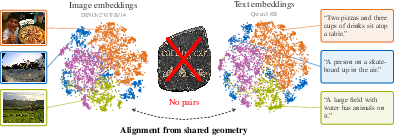
The researchers ask whether computers can connect images and text without seeing any matching image-caption pairs at all. Their idea is that independently trained models may organize information in similar ways. For example, pictures and sentences about dogs might both be near pictures and sentences about pets, even though the two models were trained separately.
The paper calls this shared organization shared geometry. The title compares it to the Rosetta Stone, which helped people understand Egyptian writing by showing how it matched Greek writing.
2. Main research questions
The researchers focus on several important questions:
- Can image and text representations be connected without any paired examples?
- Can the same idea work for other areas, such as biology, medicine, neuroscience, and different languages?
- Does having just a few paired examples make the connection much better?
- Can a measure of geometric similarity predict when this method will work?
- Can the connection be used for practical tasks, such as finding an image from a sentence or generating an image from text?
In simple terms, the main question is:
If two computer models arrange their knowledge in similar patterns, can we connect them without knowing which individual examples match?
3. How did the researchers do it?
Embedding spaces
The computer models turn things into lists of numbers called embeddings. An embedding is like a location on a huge map.
For example:
- A picture of a cat gets one location.
- A picture of a dog gets another nearby location.
- A sentence about a cat also gets a location.
- A sentence about a dog may be near the cat sentence.
The locations do not use the same coordinates in different models. One model’s “north” might be another model’s “left.” The researchers therefore need to rotate or rearrange one map so that it lines up with the other.
Clustering the data
The method first groups similar examples into clusters. This is similar to sorting a large pile of objects into groups such as:
- animals,
- vehicles,
- buildings,
- food,
- outdoor scenes.
The researchers use a technique called k-means, which automatically creates these groups based on how similar the numerical representations are.
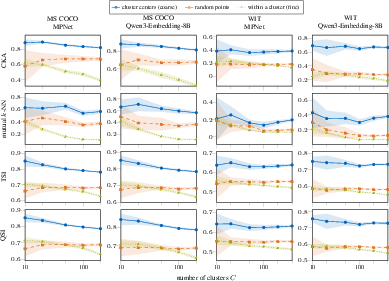
They then compare the shapes and relationships between the groups in the two spaces. For example, if one space has groups for animals and vehicles that are arranged in a certain way, the other space may have groups with a similar arrangement.
Matching the spaces
The researchers use a method called Wasserstein Procrustes alignment. The name sounds complicated, but the basic idea is fairly simple:
- Guess which groups in one space correspond to groups in the other.
- Rotate or stretch the maps so the matched groups are closer.
- Improve the matching using the new map.
- Repeat the process several times.
This is like placing two transparent maps on top of each other and turning one until roads, towns, and regions line up as well as possible.
The method uses an orthogonal map, which mainly rotates and reflects the space without changing the basic distances between points. This helps preserve the original meaning learned by each model.
Measuring geometric similarity
The researchers also use a score called Centered Kernel Alignment, or CKA. This score checks how similarly two spaces organize their examples.
A high CKA score means the two models have similar patterns of neighborhoods and distances. A low score means their organizations are quite different.
The researchers use this score to predict whether their unpaired alignment method is likely to succeed.
Adding a few paired examples
The method can also use a small number of known matches. For example, researchers might provide only 20 image-caption pairs. These examples help correct the rough alignment and improve details.
4. Main findings
Unpaired alignment is possible
The most important result is that independently trained image and text models could often be connected without any paired examples.
The method usually did not identify every exact image-caption match. However, it often learned broader meanings correctly. For example, it could connect:
- animal-related images with animal-related descriptions,
- outdoor scenes with descriptions of outdoor scenes,
- vehicles with vehicle descriptions.
This means the method was good at understanding the general topic, even when it was not perfect at matching one exact picture to one exact sentence.
It performed better than earlier unpaired methods
On many image-text model combinations, the researchers’ method performed better than previous approaches that also tried to work without paired data.
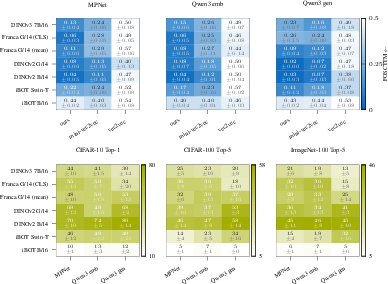
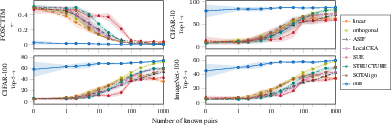
One evaluation score, FOSCTTM, measures how close the correct match is to the top of the list. Lower scores are better. The researchers’ method achieved an average score of 0.154, compared with 0.223 for one previous method. A score near 0.5 would be roughly random matching.
For comparison, a large model trained using hundreds of millions of paired examples performed much better, with a score close to zero. This shows that paired data is still valuable, but the new method can make useful progress without it.
It transferred meaning between images and text
The researchers also tested zero-shot classification. This means asking a model to classify images using text descriptions that it had not been specifically trained with.
For example, the system might compare an image with the text labels “cat,” “car,” and “tree,” then choose the closest one.
The alignment achieved useful results:
- about
47.4%top-1 accuracy on CIFAR-10, - about
30.1%top-5 accuracy on CIFAR-100, - about
26.5%top-5 accuracy on ImageNet-100.
In one experiment, the method increased CIFAR-10 accuracy from 37.3% to 69.1%. This shows that even a rough connection between spaces can transfer useful information.
It worked across different datasets
The researchers did not always use images and captions from the same dataset. They also matched images from one dataset with captions from a completely different dataset.
The performance became somewhat worse, but the method still worked. This is important because it shows the method was not simply discovering hidden matching pairs in the data.
It worked in other scientific areas
The same general method was tested in areas beyond images and text, including:
- LLMs,
- RNA and gene-related data,
- brain activity measured with fMRI,
- medicine,
- chemistry,
- materials science,
- astronomy,
- biology.
The method was competitive with, and sometimes better than, special methods designed specifically for those fields.
Similar geometry predicted success
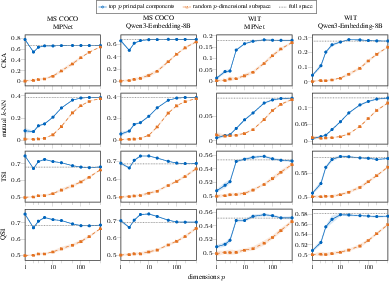
The CKA score was strongly related to performance. In the experiments, CKA explained about 69% of the differences in alignment quality across many scientific settings.
This means that when two models arranged their knowledge in similar patterns, they were easier to connect without paired examples.
However, the researchers also point out an important problem: accurately measuring similarity between two spaces is itself difficult when there are no matching examples.
A few pairs helped a lot
The method became especially powerful when the researchers added a small number of paired examples.
With only a few pairs—sometimes 20, 50, or 100—the method performed much better than competing methods. In some tests, it needed far fewer pairs to reach the same performance as other methods.
This suggests that paired examples are not always needed to create the first connection, but they are very useful for improving precision.
Text could guide image generation
Finally, the researchers used the alignment for a simple text-to-image generation experiment.
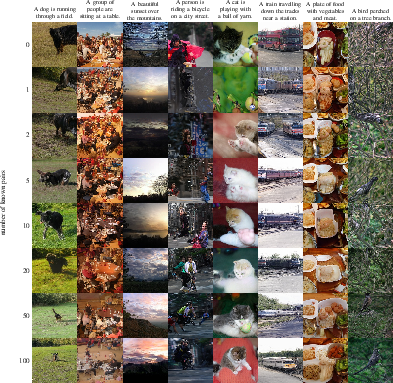
A sentence was first converted into a text embedding. The alignment method then translated that embedding into the image model’s space. A separate image generator used this translated information to create an image.
With no paired examples, the generated images often showed the correct broad scene or object category. For example, a sentence about an outdoor scene could produce an outdoor-looking image.
The images did not always contain the correct small details. Adding a few paired examples made the objects and scene features more accurate.
5. Why are these results important?
Many useful types of data are difficult or expensive to pair. For example, it may be hard to match:
- medical records with brain scans,
- DNA measurements with other biological measurements,
- scientific simulations with real-world observations,
- videos with detailed descriptions,
- different languages describing the same event.
The paper suggests that separate models may already contain enough shared information to be connected without collecting a huge number of matching examples.
This could make it easier to combine different kinds of information while saving time, money, and human effort.
6. Limitations
The method is not perfect. It mainly learns coarse meaning, such as “this is about animals” or “this is an outdoor scene.” It is less reliable at fine details, such as identifying the exact dog, object, or sentence.
It also works best when the two models have learned similar patterns from high-quality data. If one model organizes information very differently from the other, the method may fail.
The researchers also warn that messy or unrelated data—for example, text that does not describe images—may make alignment harder.
Conclusion
The paper shows that a large collection of paired image-text examples is not always necessary to connect different computer models. Independently trained models often organize related ideas in similar ways, creating a kind of shared map.
The researchers use this shared map to align the models without paired data. The result is usually a rough connection rather than a perfect one, but it is good enough for tasks such as image-text retrieval, zero-shot classification, and basic text-to-image generation.
The broader impact is that future AI systems may be able to combine images, text, biology, medical information, and other data types with far fewer matching examples. A small number of paired examples can then be used mainly to sharpen the connection rather than build it from scratch.
Practical Applications
Immediate Applications
- Low-data cross-modal retrieval for industry (software, search, and media). Organizations can align separately trained image and text encoders using only their existing, unpaired embedding collections. This enables approximate text-to-image and image-to-text search across archives whose images and descriptions were collected independently. A practical workflow would be: generate normalized embeddings, measure geometric similarity with CKA or a related metric, run the paper’s cluster-based geometric initialization, refine the orthogonal map with Wasserstein Procrustes, and expose the mapped embeddings through a vector database. Dependencies: The two encoders must organize semantic concepts similarly; performance is expected to be coarse rather than exact, particularly for fine-grained attributes, names, counts, and spatial relations. Data distributions and embedding preprocessing must also be compatible.
- Zero-shot classification when paired multimodal data are unavailable (software and education technology). An image encoder can be mapped into a language embedding space and classified using text prompts or class descriptions, without training on image–label or image–caption pairs. This could support rapid prototyping of visual classifiers for new domains, such as industrial inspection, museum collections, or educational image datasets. The reported results—up to 69.1% Top-1 accuracy on one CIFAR-10 setting and meaningful performance on CIFAR-100 and ImageNet-100—indicate that coarse semantic transfer is practically useful even when it is below paired foundation-model performance. Dependencies: Class names or textual descriptions must be represented meaningfully by the LLM. Predictions should be treated as assistive rather than safety-critical because alignment errors and model bias can produce systematic misclassification.
- Cross-dataset semantic search and archive integration. The method can connect embeddings from different datasets, not merely recover hidden pairings within a common dataset. For example, a company could search a video or image archive using descriptions from a separately curated text corpus, or connect scientific records produced by different institutions. This is useful when privacy, licensing, or historical data silos prevent construction of paired examples. Dependencies: The datasets must share sufficient semantic coverage. Domain mismatch, noisy descriptions, and modality-specific concepts can reduce alignment quality; CKA is useful as a screening diagnostic but does not yet provide a fully unsupervised guarantee of success.
- Few-pair multimodal adaptation (healthcare, biology, and enterprise AI). When a small number of trusted correspondences can be collected, the method can use them to refine an initially unpaired alignment. The paper reports substantial gains with fewer than 100 pairs and, in some experiments, performance comparable to baselines trained with hundreds or 1,000 pairs. This supports workflows such as aligning a medical-image encoder with a clinical-language encoder using a small expert-labeled set, or connecting laboratory measurements with textual experiment descriptions. Dependencies: The few pairs must be representative and accurately annotated. In healthcare and other regulated sectors, the resulting system still requires clinical validation, privacy protections, bias testing, and human oversight.
- Cross-model compatibility testing and model selection (MLOps and software engineering). CKA and related geometric scores can be used before deployment to estimate whether two independently trained encoders are likely to be alignable. An MLOps tool could compare candidate model pairs, report expected alignment difficulty, and recommend whether zero-pair, few-pair, or full multimodal retraining is necessary. This can reduce experimentation costs when replacing proprietary or outdated encoders. Dependencies: The reported relationship between geometric similarity and alignment quality is empirical rather than a formal guarantee. Evaluation should include held-out paired data when possible, especially before production use.
- Scientific and biomedical representation integration (academia and research infrastructure). The method can align independently learned representations such as RNA and ATAC profiles, cross-subject fMRI embeddings, and other scientific or medical modalities. Potential tools include exploratory dashboards that place measurements from different assays or subjects into a shared semantic space, enabling retrieval of related samples and coarse transfer of annotations. The paper reports competitive performance against specialized methods on PBMC RNA-to-ATAC and NSD fMRI benchmarks. Dependencies: Representations must encode related biological structure and have comparable geometric organization. Alignment should support exploratory analysis, not replace biological validation or clinical interpretation; batch effects, cohort differences, and demographic confounding remain important risks.
- Unpaired text-conditioned image generation prototypes (creative tools and research). A text encoder can be mapped into the embedding space used to condition an image generator, even when the aligner sees no image–text pairs. This can produce broad scene and object categories and serve as a rapid proof-of-concept for text-to-image conditioning when paired training data are unavailable. The paper’s experiments show that a few paired examples improve object identity and scene details. Dependencies: The generator must already accept embeddings from the target visual encoder. The unpaired mapping is coarse, so generated images may omit fine details, misinterpret prompts, or inherit biases from both pretrained models. It is not yet a substitute for large-scale paired training in commercial image generation.
- Unpaired multimodal dataset auditing and discovery (policy, libraries, and organizations). Institutions can use cross-modal alignment to identify broad semantic correspondences between independently held image, text, audio, or scientific collections without centralizing raw data. This may help locate duplicate topics, discover missing metadata, and prioritize records for manual annotation. Dependencies: Embedding exchange may still reveal sensitive information, so privacy and governance controls are required. Coarse semantic similarity must not be interpreted as proof that two records describe the same individual, event, or medical condition.
- Educational and accessibility tools based on approximate semantic transfer. Mapped image and language spaces could support prototype tools that generate searchable descriptions for visual collections, retrieve relevant illustrations from textual questions, or offer alternative text for educational materials. Such tools can be deployed as candidate-generation systems whose outputs are reviewed by teachers, editors, or accessibility specialists. Dependencies: The method may miss fine visual details and can reproduce representational bias. Human review is necessary for accessibility compliance, safety, and factual accuracy.
Long-Term Applications
- General-purpose alignment across audio, video, language, and vision. The framework could become a modality-agnostic adapter for independently trained audio, video, text, and image foundation models. A future product might connect a speech encoder to a video archive, align sensor embeddings with maintenance reports, or support cross-modal retrieval across all enterprise records without retraining every model jointly. Dependencies: The paper provides evidence beyond vision–language but does not establish universal reliability. Temporal structure, variable sampling rates, modality-specific information, and non-isometric geometries may require extensions beyond a single orthogonal map and current cluster-based initialization.
- Robotics and embodied AI without synchronized demonstrations. Robot perception, language, tactile, and action representations could potentially be aligned using independently collected datasets—for example, linking visual states to natural-language task descriptions or tactile embeddings to manipulation events. This could reduce the need for expensive synchronized robot demonstrations and support transfer between robot platforms. Dependencies: Robotics requires precise local and temporal correspondence, whereas the paper primarily recovers coarse semantic structure. Safety-critical control would require fine-grained alignment, uncertainty estimation, closed-loop validation, and substantially stronger guarantees than those demonstrated.
- Clinical decision-support systems integrating heterogeneous medical data. Future systems could align imaging, electronic health records, pathology, genomic assays, and physician notes when paired multimodal records are scarce or legally difficult to share. A shared geometry might support cohort discovery, retrieval of analogous cases, and transfer of annotations between modalities. Dependencies: Clinical data are highly heterogeneous and may not satisfy the shared-geometry assumption. Deployment requires prospective validation, calibration, explainability, patient-consent compliance, security, and careful assessment of subgroup performance. The paper’s results do not justify autonomous diagnosis or treatment recommendations.
- Privacy-preserving and federated multimodal learning. Institutions could exchange embeddings or geometric summaries rather than raw images, text, or patient records, then align independently trained models across organizations. This could enable cross-institutional scientific collaboration while limiting direct data sharing. Dependencies: Embeddings can leak sensitive information, and geometric alignment may still encode population-level privacy risks. Federated protocols, secure aggregation, differential privacy, and formal leakage evaluations would be needed. Alignment quality may also degrade when institutional data distributions differ substantially.
- Automatic construction of multimodal foundation models with minimal paired supervision. The method could serve as an initialization stage for large multimodal models: align pretrained unimodal encoders geometrically, then use a small paired dataset for refinement rather than training from billions of pairs. This may lower annotation, compute, and licensing costs for specialized domains such as law, engineering, climate science, and medicine. Dependencies: Coarse alignment may be insufficient for token-level generation, compositional reasoning, grounding, and precise cross-modal interaction. Additional objectives, nonlinear maps, hard-negative mining, calibration, and extensive paired or synthetic data would likely be required.
- Alignment of scientific instruments and digital twins (energy, materials, and manufacturing). Independently trained representations of sensor streams, simulations, microscopy, chemical structures, and textual reports could be connected to build retrieval and monitoring systems. For example, sensor embeddings might retrieve relevant maintenance reports, or materials embeddings might connect experimental observations with simulation outputs. Dependencies: Scientific modalities often have different scales, uncertainty structures, and physical constraints. An orthogonal transformation may not preserve the relationships needed for quantitative prediction. Domain-specific validation and physics-informed extensions would be necessary.
- Cross-subject and cross-device neuroscience applications. Improved alignment could support shared neural representational spaces across people, scanners, or experimental protocols, enabling transfer of stimulus annotations and more efficient population-level analyses. The reported fMRI results suggest feasibility for coarse alignment across subjects. Dependencies: Subject variability, scanner artifacts, and temporal alignment are substantial challenges. Applications involving diagnosis, cognitive-state inference, or neural interfaces require strict privacy protections, neuroscientific validation, and safeguards against overinterpreting coarse representational similarity.
- Automated alignment-quality certification and benchmark standards. A future research direction is to develop fully unsupervised criteria that predict alignment success from the two unpaired embedding sets alone. Such a system could certify whether a model pair is suitable for zero-pair integration, estimate uncertainty, and automatically select among linear, nonlinear, Gromov-Wasserstein, or few-pair methods. Dependencies: The paper explicitly notes that current CKA-style metrics generally require matched samples or comparable evaluation procedures. Reliable certification will require new theory, calibration across domains, robustness to distribution shift, and benchmarks that separate coarse semantic alignment from exact correspondence.
- Fine-grained multimodal generation and reasoning. Extending the approach beyond coarse category and scene alignment could enable detailed captioning, precise image editing, grounded question answering, and multimodal agents built from independently trained components. These applications would benefit from preserving local neighborhoods and modality-specific attributes, rather than only global geometry. Dependencies: The paper finds that shared geometry is stronger at coarse scales than at fine scales. Achieving fine-grained performance will likely require nonlinear or hierarchical maps, local geometric objectives, explicit compositional constraints, and at least a small amount of high-quality paired supervision.
Glossary
- Adversarial alignment: An alignment approach in which a discriminator is trained to distinguish mapped source representations from target representations, while the mapping attempts to fool it. “Adversarial methods~\citep{conneau2017word, zhang2017adversarial, zhang2017earth, xu2018unsupervised, mohiuddin2019revisiting} learn a transformation such that a discriminator cannot distinguish mapped source from target embeddings.”
- Centered Kernel Alignment (CKA): A similarity measure for comparing the representational geometry of two sets of embeddings. “In fact, our unpaired alignment quality is strongly predicted by geometric similarity between embedding spaces, measured by common scores like Centered Kernel Alignment (CKA)~\citep{kornblith2019similarity}.”
- Conditional-gradient step: An iterative optimization step that approximately optimizes a constrained objective by selecting an extreme point of the feasible set. “Sample-level pseudo-pairs are found by one conditional-gradient step on \cref{eq:gromov_wasserstein} from the averaged low-rank plan, reducing to linear assignment for scores .”
- Cross-modal alignment: The process of mapping representations from different modalities into a shared coordinate system or correspondence structure. “These results show that independently trained models often share enough geometry to establish cross-modal correspondence with little or no paired data.”
- Embedding geometry: The structure of relationships, distances, and neighborhoods among vectors in a representation space. “This question is challenging as both embedding spaces have no shared coordinates, no known sample correspondences, and potentially different numbers of samples and dimensions.”
- FOSCTTM: The Fraction of Samples Closer Than the True Match, a normalized rank-based measure of correspondence quality. “We measure cross-modal correspondence using Fraction of Samples Closer Than the True Match (FOSCTTM; \citet{liu2019jointly}).”
- Geometric initialization: An initialization strategy that uses similarities between the geometric structures of two embedding spaces to produce an approximate correspondence. “By introducing a simple alignment procedure based on Wasserstein Procrustes~\citep{rangarajan1997softassign, cohen1999earth}, we jointly infer a correspondence between samples and an orthogonal mapping between embedding spaces.”
- Gromov–Wasserstein (GW) alignment: An optimal-transport method that matches two spaces by preserving relationships within each space rather than relying on shared coordinates. “GW seeks a transport plan that preserves within-space similarity:”
- Hilbert–Schmidt Independence Criterion (HSIC): A kernel-based statistic for measuring statistical dependence between two variables or representation spaces. “Given the definition of CKA, we have that \begin{equation*} \cka(, ) = \frac{\hsic(_A, _B {\top})}{\sqrt{\hsic(_A, _A)\hsic( _B {\top}, _B {\top})}.”
- Isometry: A transformation that preserves distances between points. “Common initializations from word translation assume a high degree of isometry.”
- Jonker–Volgenant algorithm: An algorithm for solving linear assignment problems efficiently. “We randomly block partition them and solve independent one-to-one assignments between pairs of corresponding blocks via the Jonker-Volgenant algorithm~\citep{jonker1988shortest}.”
- Linear assignment: The optimization problem of finding a minimum-cost or maximum-score one-to-one matching between two sets. “Given a map, the optimal correspondence is found by linear assignment.”
- Low-rank approximation: An approximation of a matrix or transport plan using a representation of smaller rank. “We average the resulting plans to get $=\frac{1}{SC}\sum_s_s^\top_s_s$, which summarizes a low-rank approximation to the sample-level GW correspondence without materializing an transport matrix.”
- Non-convex optimization: Optimization in which the objective or feasible region is not convex, so local optima may differ from the global optimum. “Due to non-convex~\citep{alvarez2019towards} optimization, random initialization is insufficient.”
- Orthogonal Procrustes: A matrix-estimation problem that finds the orthogonal transformation best aligning two paired point sets. “Given a correspondence, the optimal map is given in closed form by orthogonal Procrustes~\citep{schonemann1966generalized}.”
- Polar factor: The orthogonal or semi-orthogonal component of a matrix obtained through its polar decomposition. “We can transform a matrix into a semi-orthogonal matrix with the polar factor $\polar() = ^{\top}$ using the singular value decomposition.”
- Platonic Representation Hypothesis (PRH): The hypothesis that independently trained models converge toward a shared representation geometry as model and dataset scale increase. “The Platonic Representation Hypothesis (PRH)~\citep{huh2024platonic} proposes that models spontaneously converge to a shared representation as model and dataset scale increase.”
- Quadratic assignment problem (QAP): A combinatorial optimization problem that assigns items between two sets while optimizing pairwise interaction costs or similarities. “This is a quadratic assignment problem (QAP).”
- Semi-orthogonal matrix: A rectangular matrix whose rows or columns are orthonormal, depending on its dimensions. “with $\in\St(d_X, d_Y)$ a semi-orthogonal matrix.”
- Stiefel manifold: The set of matrices with orthonormal rows or columns, generalizing the set of orthogonal matrices to rectangular matrices. “Moreover, we use the Stiefel manifold $\St(d_X, d_Y)$, which is the set of semi-orthogonal matrices.”
- Transport plan: A nonnegative matrix specifying how mass or probability is distributed when mapping one set of points to another. “We jointly estimate a map .”
- Transport polytope: The set of nonnegative transport plans satisfying prescribed marginal constraints. “We use and to denote the uniform marginals and for the transport polytope.”
- Unimodal representation: A representation learned from data belonging to a single modality, such as only images or only text. “The resulting procedure requires only the two sets of unimodal embeddings.”
- Wasserstein Procrustes: An alignment method that jointly estimates an orthogonal transformation and a correspondence using optimal transport. “Our simple Wasserstein Procrustes method with a coarse geometric initialization aligns two disjoint embedding sets by estimating a single orthogonal map without seeing any pairs.”
- Zero-shot classification: Classification performed on categories or tasks for which the model received no task-specific labeled training examples. “We also evaluate zero-shot classification by mapping image embeddings to the language space and selecting the closest class prompt.”