Decoding Looped Transformers Better for (Almost) Free
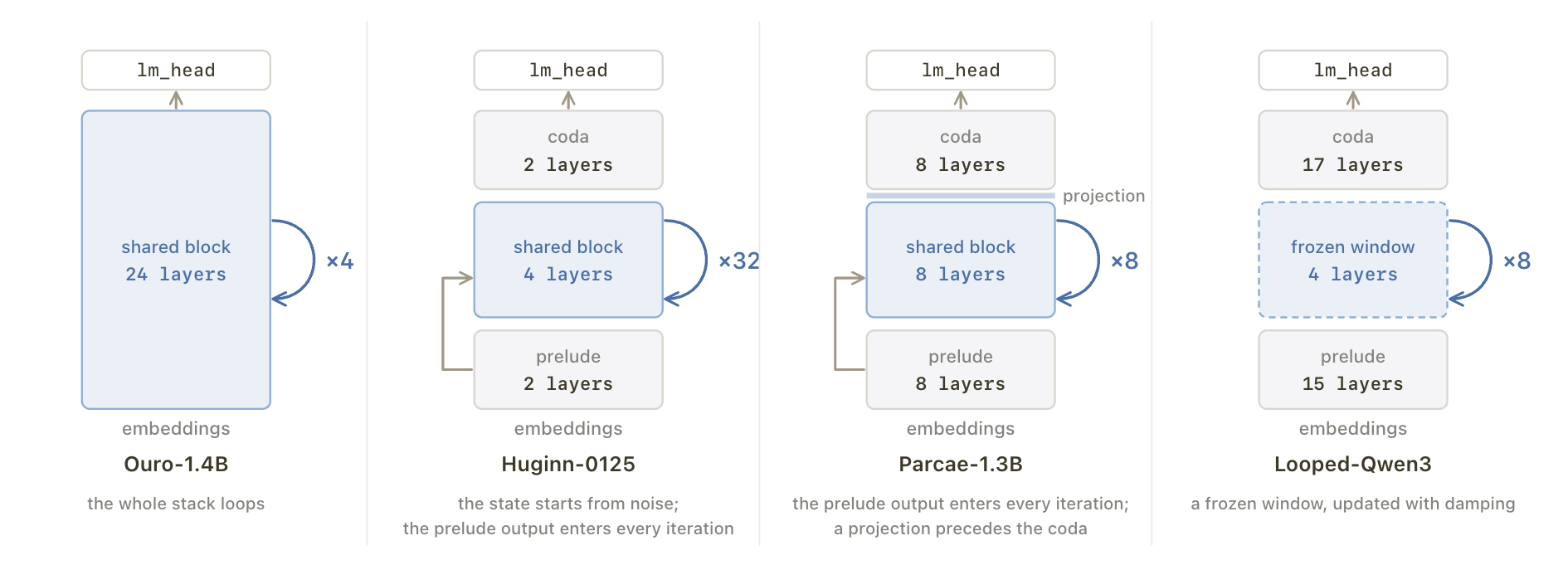
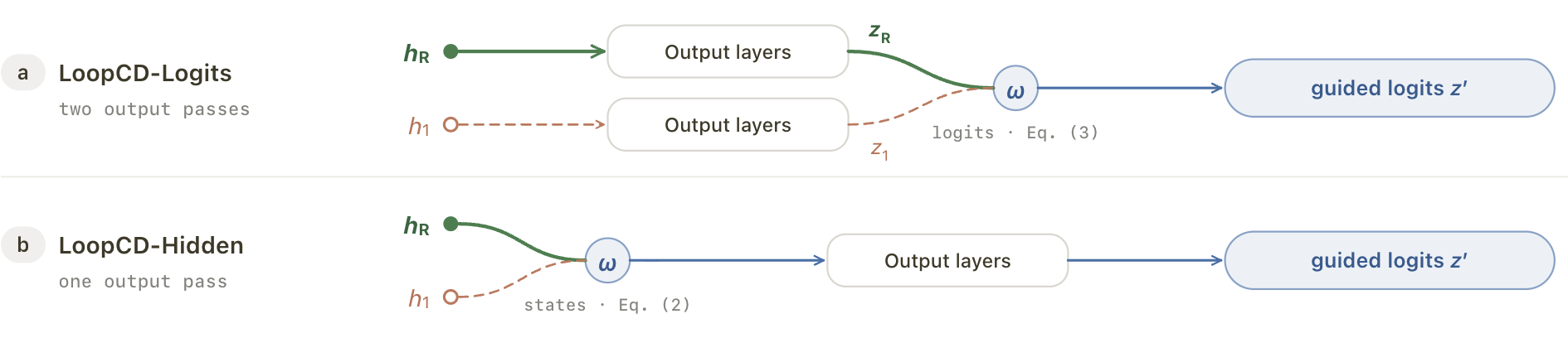
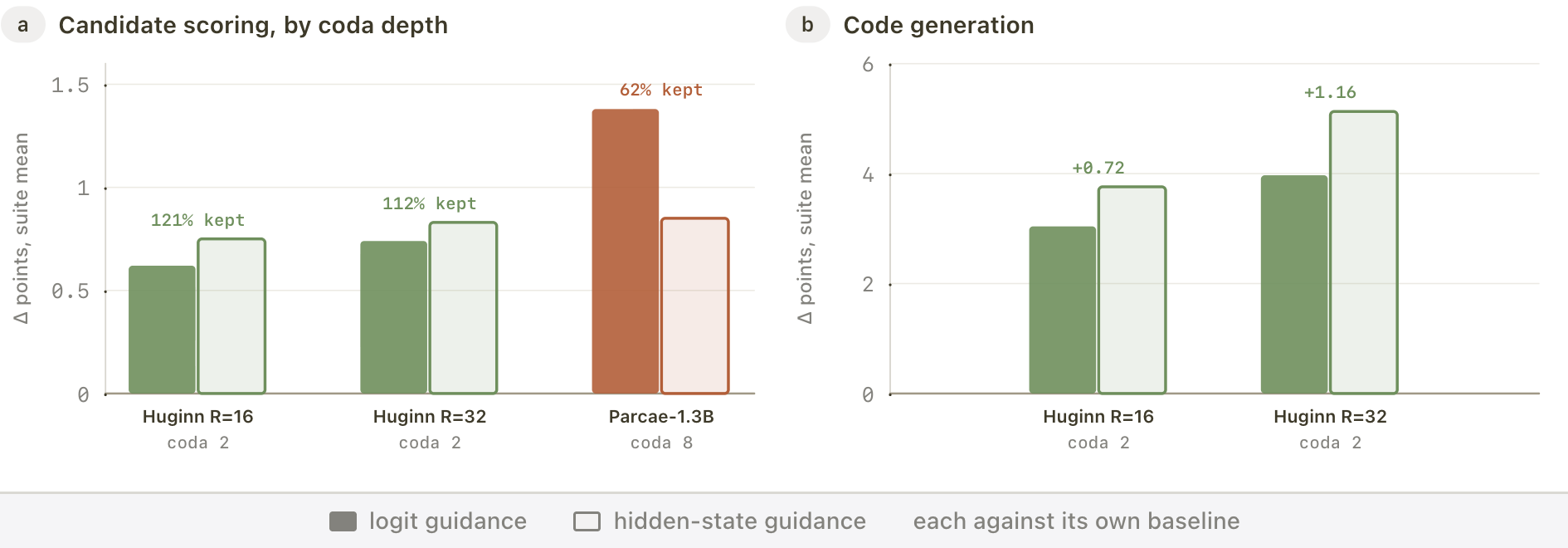
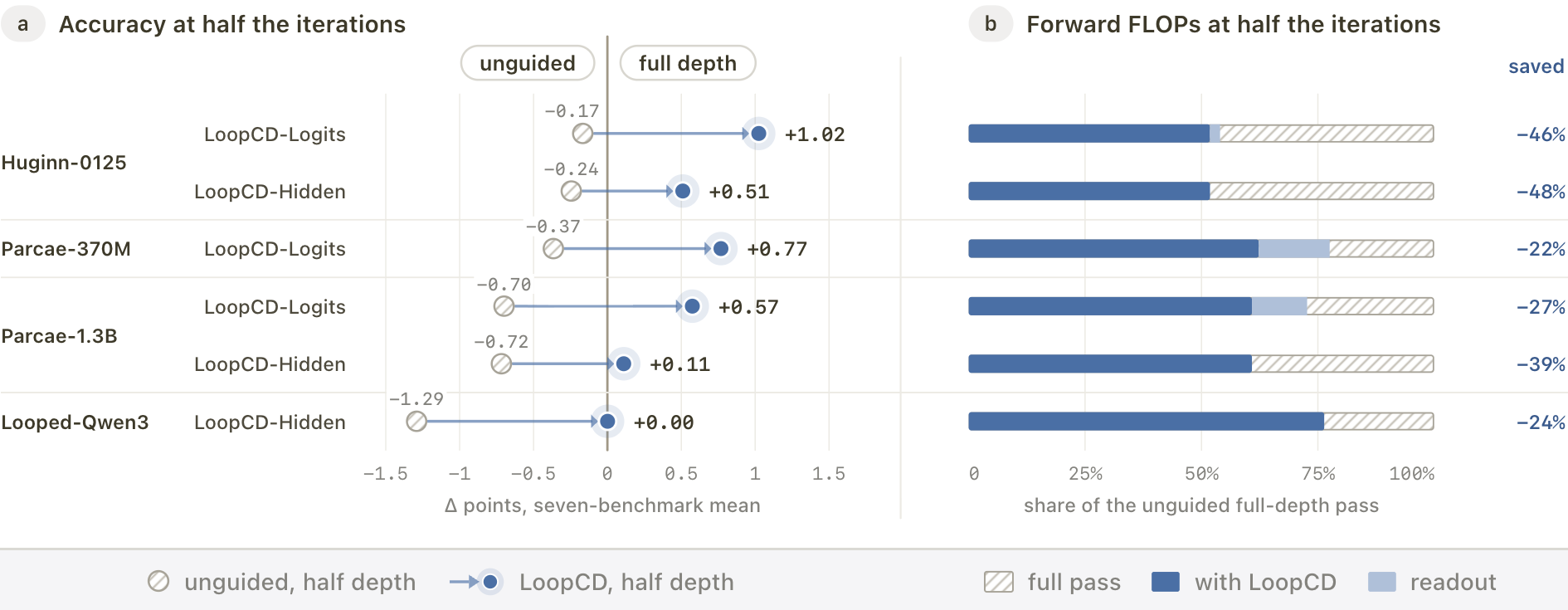
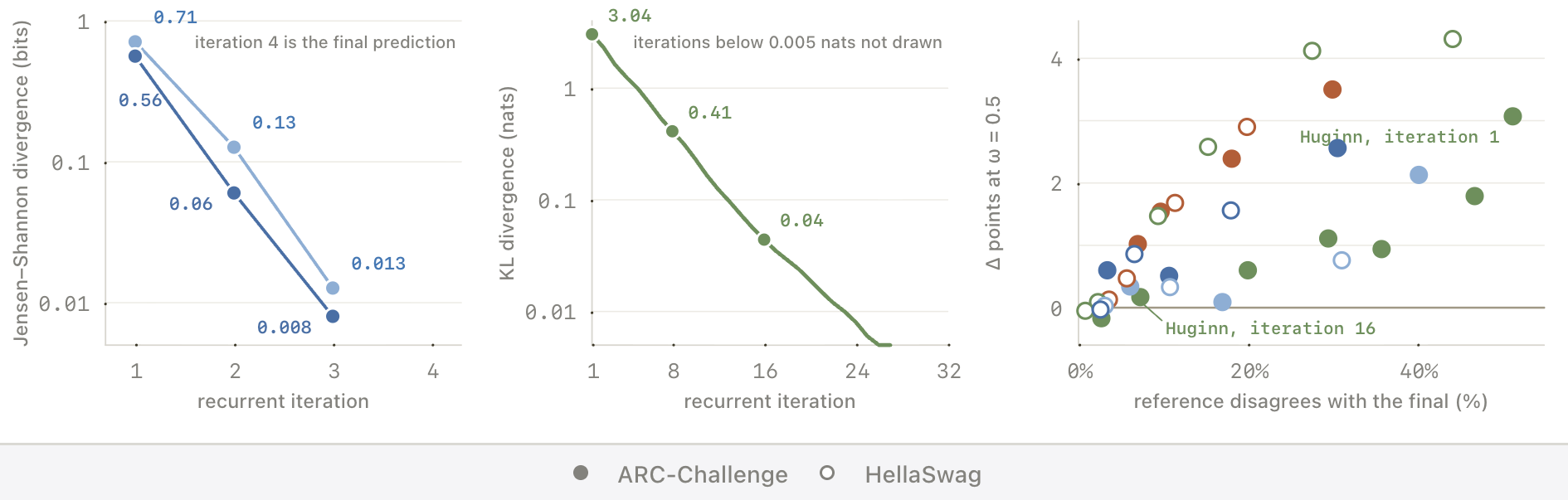
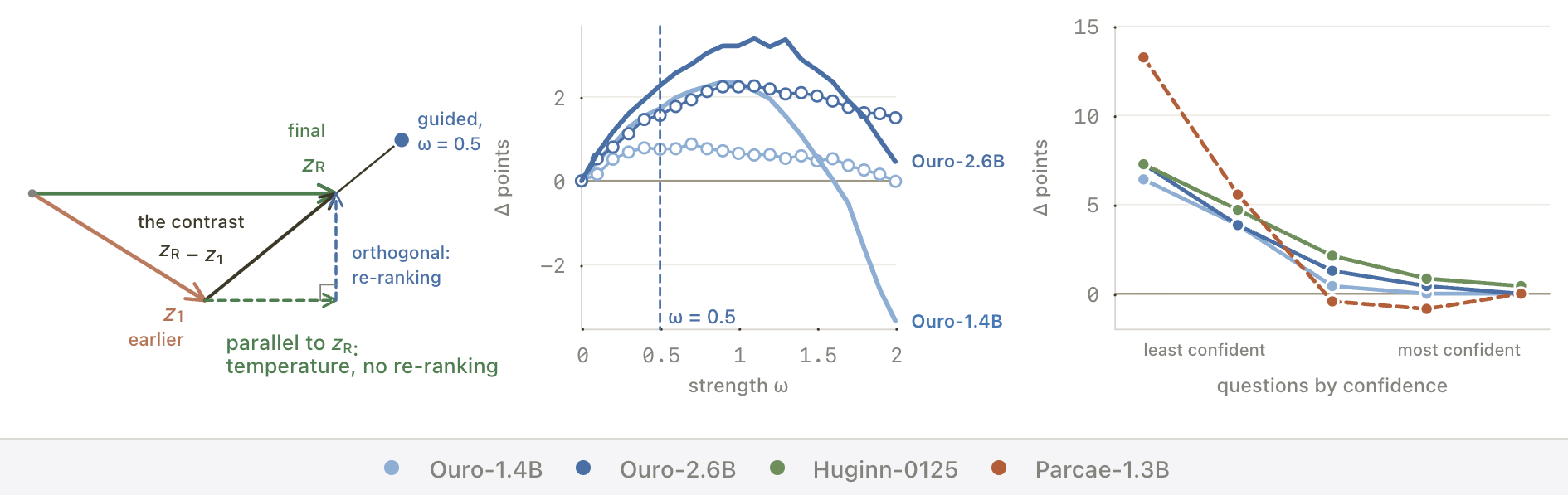
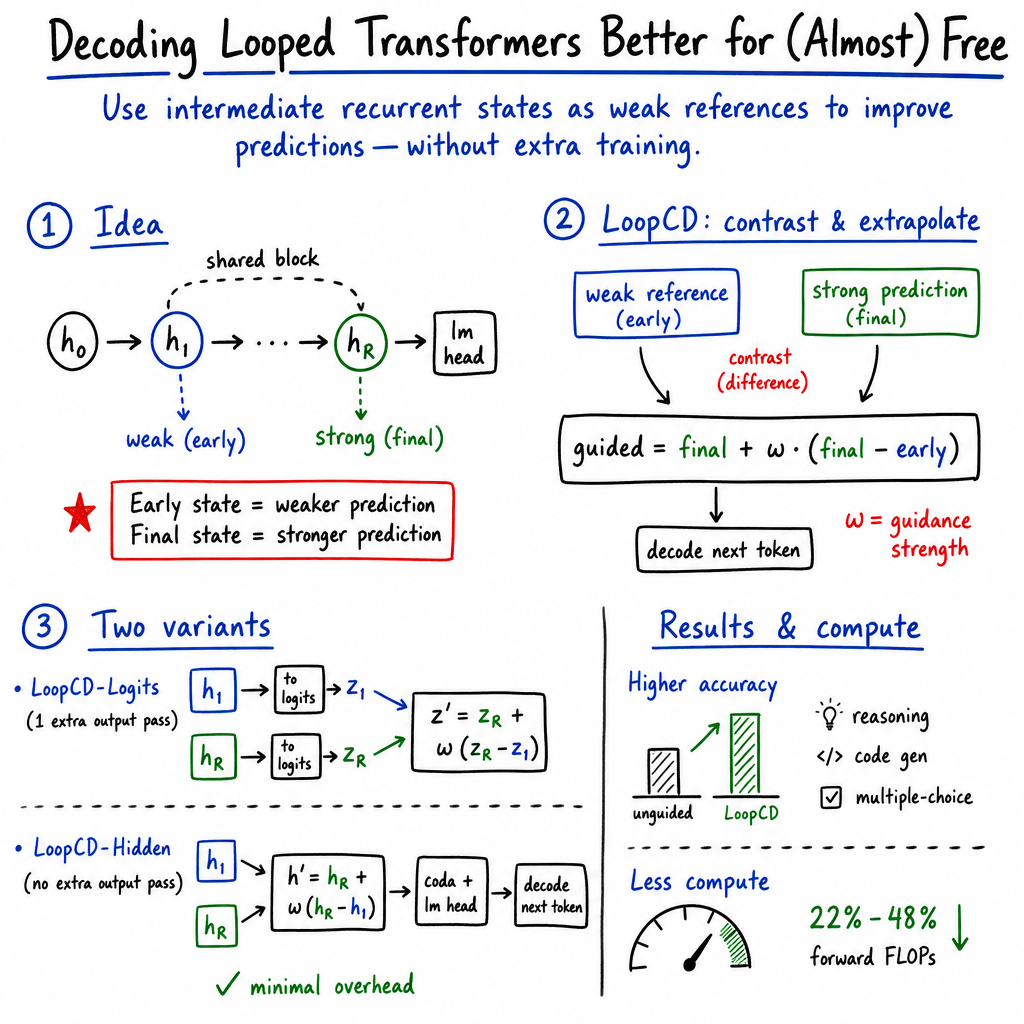
Abstract: Looped Transformers achieve parameter efficiency by repeatedly executing a shared block across recurrent loops. Each loop yields an intermediate representation decodable for the same next token, yet standard decoding discards earlier states. Because earlier loops embody less computation, recurrence inherently supplies aligned weak-and-strong prediction pairs without auxiliary models or external training. We introduce LoopCD, a training-free contrastive decoding framework that guides token selection by contrasting the final prediction with an earlier recurrent pass, operating either in logit space with one extra output pass (LoopCD-Logits) or in hidden-state space with zero output overhead (LoopCD-Hidden). Across four looped Transformer families, LoopCD delivers substantial, consistent gains at full recurrent depth: LoopCD-Logits raises Ouro-2.6B-Thinking's AIME 2024 pass@1 from 61.88% to 73.33%, while LoopCD-Hidden lifts Huginn's HumanEval pass@1 from 22.56% to 31.71%. Crucially, these performance gains enable halving the number of recurrent loops while still matching or exceeding full-depth unguided baselines, reducing forward FLOPs by 22.5% to 48.2%. By transforming intermediate recurrent states into effective guidance signals, LoopCD achieves superior decoding quality while substantially reducing inference compute.
Paper Prompts
Sign up for free to create and run prompts on this paper.
Top Community Prompts
Explain it Like I'm 14
1. Main topic
The paper, “Decoding Looped Transformers Better for (Almost) Free,” studies a way to make some LLMs give better answers without greatly increasing their cost.
The models are called looped Transformers. Instead of using many completely different layers, they repeatedly use the same block of neural-network code. It is like asking the same team of students to check an answer several times. Each time they review it, their understanding may improve.
The paper introduces a method called LoopCD, short for Loop Contrastive Decoding. It uses information from the model’s repeated “review steps” to choose better words while generating text.
2. Research questions and objectives
The researchers mainly ask:
- Can the model use its earlier loop states instead of throwing them away?
- Do the later loop states usually contain better information than the earlier ones?
- Can comparing different loop states help the model avoid weak or incorrect answers?
- Can this improvement be achieved with almost no extra computation?
- Does the method help with both:
- Reasoning tasks, such as mathematics and multiple-choice questions?
- Generation tasks, such as writing computer programs?
The central idea is simple: rather than trusting only the model’s final answer prediction, compare predictions made at different stages of the model’s internal thinking.
3. Research method
Looped Transformers
A normal Transformer LLM processes information through a sequence of different layers. A looped Transformer repeatedly runs the same group of layers:
- The model reads the input.
- It updates its internal representation.
- It sends that representation through the same block again.
- It repeats this for several loops.
An analogy is solving a difficult puzzle. On the first pass, you make a rough guess. On later passes, you inspect the puzzle again and improve your guess.
Each loop produces an internal state. This state can be used to predict the next word or token. A token is a small piece of text, such as a word, part of a word, or punctuation mark.
Contrastive decoding
The proposed method compares predictions from two loop states:
- a later state, which is usually more thoughtful or refined;
- an earlier state, which acts like a simpler or weaker version of the model’s prediction.
The method then favors tokens that the later state supports more strongly than the earlier state.
This is similar to comparing two students’ answers and asking:
“Which answer is supported by the student who had more time to think, but not by the student who only made a quick guess?”
The difference between the two predictions helps the model select the next token.
Why the cost is low
The model already computes the intermediate states while it is looping. The paper’s method reuses these states rather than running a completely separate model.
According to the paper’s description, LoopCD can work in two ways:
- One extra output pass: a small additional calculation is made after the normal model computation.
- No extra pass: the method uses results the model has already produced.
This is why the title says the improvement comes “for almost free.”
The researchers test the approach on several kinds of benchmarks, including reasoning questions, mathematics-style problems, general knowledge, language understanding, and code-generation tasks. They also study how the method behaves when changing the strength of the guidance and when choosing different pairs of loop states.
4. Main findings
The supplied paper text is incomplete: it contains the beginning of the abstract and links to later sections, tables, and figures, but not the actual numerical results or full conclusions. Therefore, the exact accuracy improvements cannot be reported reliably from the provided excerpt.
However, the paper’s stated contribution is that:
- Intermediate states in looped Transformers are useful rather than disposable.
- Comparing an earlier state with a later state can improve token selection.
- This comparison can guide the model toward better answers.
- The method requires little or no additional computation.
- The approach is studied for both reasoning and text-generation tasks.
These findings are important because looped Transformers are designed to save model parameters by reusing the same block. A possible weakness of this design is that the model may need more repeated steps to think carefully. LoopCD attempts to take advantage of those repeated steps without requiring a much larger model.
5. Possible impact
If the method works as described, it could make LLMs:
- more accurate on difficult questions;
- better at reasoning through problems;
- better at generating code;
- cheaper to run than methods that use a second model for guidance;
- more efficient, because they reuse information already produced inside the model.
The broader lesson is that a LLM’s internal process may contain useful information at several stages, not only in its final state. Instead of ignoring those earlier stages, researchers can compare them to help the model make better decisions.
In simple terms, the paper suggests that a model can improve its answers by learning from its own earlier guesses—without needing a completely new model or a large amount of extra computer power.
Knowledge Gaps
Knowledge gaps, limitations, and open questions
- Limited evidence across model families and scales: It remains unclear whether LoopCD consistently improves decoding for looped Transformers of different parameter counts, depths, architectures, and training procedures, rather than only the evaluated model configurations.
- Dependence on loop design: The paper does not establish how LoopCD behaves when recurrent loops use different normalization schemes, residual connections, parameter-sharing patterns, or loop counts.
- Unclear causal mechanism: The relationship between intermediate recurrent states and improved final predictions is not fully explained. Future work should identify whether LoopCD benefits arise from better calibration, error correction, increased confidence, or specific representational changes across loops.
- No general theory of reference-state selection: The method depends on selecting an earlier or reduced-loop state as a reference, but the paper does not provide a principled rule for choosing the optimal reference loop across tasks, prompts, model sizes, or decoding settings.
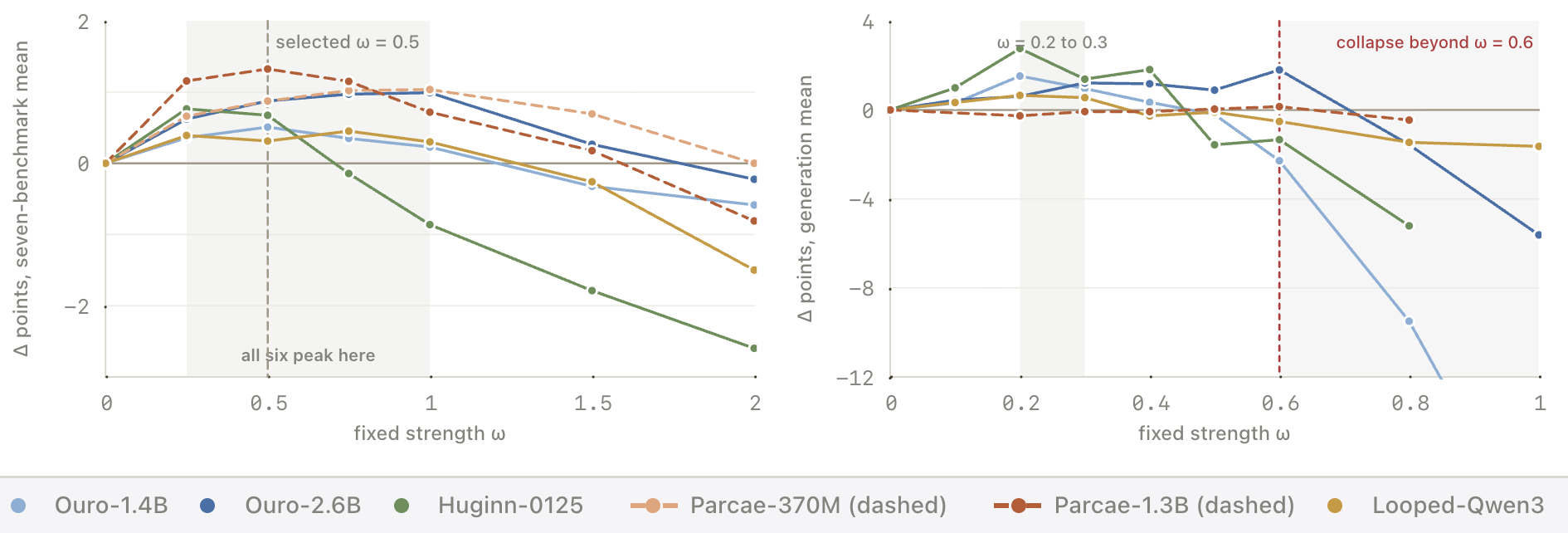
- Sensitivity to guidance strength: Although the paper studies guidance-strength sweeps, the robustness of the selected strength across datasets, model checkpoints, temperatures, sampling methods, and prompt types remains unresolved.
- Need for task- or token-adaptive guidance: The proposed guidance strength may vary substantially across tokens and examples. More systematic methods are needed to predict or learn the appropriate tokenwise strength without validation-time tuning.
- Unclear behavior under stochastic decoding: The extent to which LoopCD improves nucleus sampling, top- sampling, temperature sampling, beam search, and other decoding strategies is not fully established.
- Interaction with long-context inputs is unexplored: The method’s effectiveness, memory requirements, and latency are uncertain for long prompts, long generations, and contexts involving substantial retrieval or multi-document reasoning.
- Limited assessment of factuality and hallucination: Improvements on benchmark accuracy do not establish whether LoopCD reduces hallucinations, unsupported claims, citation errors, or factual inconsistency in open-ended generation.
- Insufficient evaluation of generation quality beyond exact-match metrics: The paper leaves unresolved how LoopCD affects coherence, relevance, diversity, verbosity, stylistic quality, and human preference in free-form text generation.
- Potential trade-off between accuracy and diversity: Contrastive guidance may suppress plausible alternatives. The impact of LoopCD on output diversity, creative generation, minority answers, and calibrated uncertainty requires dedicated evaluation.
- Calibration effects are not fully characterized: It remains unknown whether LoopCD improves probability calibration, selective prediction, abstention quality, or confidence estimates, especially when its contrastive scores alter the model’s native probability distribution.
- Robustness to distribution shift is unclear: The reported results do not establish whether LoopCD retains its benefits on out-of-domain data, adversarial prompts, noisy inputs, multilingual tasks, or domains absent from training.
- No systematic analysis of failure cases: The paper does not fully identify when intermediate states provide misleading signals and when contrastive decoding degrades the final model’s predictions.
- Possible amplification of shared errors: Because all loop states originate from the same model and input, they may share systematic biases or incorrect beliefs. The extent to which LoopCD can correct versus reinforce such errors remains unknown.
- Limited multilingual and multimodal validation: Generalization beyond English text-only language modeling is not demonstrated, leaving open whether the approach applies to multilingual, code-mixed, vision-language, or other multimodal looped Transformers.
- Unclear compatibility with modern reasoning models: The method’s effects on explicit chain-of-thought, latent reasoning, tool use, self-consistency, and test-time scaling are not fully investigated.
- Interaction with supervised fine-tuning and reinforcement learning is unresolved: It is unclear whether LoopCD remains effective after instruction tuning, preference optimization, reinforcement learning, or domain-specific fine-tuning.
- Training-time implications are unexplored: The method is presented primarily as an inference-time technique, but the paper does not determine whether training objectives could explicitly improve the usefulness, separability, or calibration of intermediate loop states.
- Inference-cost claims need broader hardware validation: The “almost free” characterization may depend on implementation details such as memory bandwidth, kernel fusion, caching, batch size, sequence length, and hardware. End-to-end wall-clock latency and energy consumption should be measured across deployment environments.
- Memory overhead is insufficiently characterized: Retaining intermediate states or logits may impose substantial activation-memory costs, particularly for large batches, long contexts, and large vocabularies. The practical memory–quality trade-off remains open.
- Throughput under production workloads is unclear: The paper does not establish how LoopCD affects throughput, latency variance, batching efficiency, and serving cost under realistic concurrent-generation workloads.
- Numerical and implementation sensitivity is unresolved: The stability of the method under mixed precision, quantization, speculative decoding, distributed inference, and approximate softmax implementations requires further study.
- Comparison with alternative inference-time methods is incomplete: More controlled comparisons are needed against speculative decoding, self-consistency, early-exit methods, logit lens approaches, layerwise contrastive decoding, reranking, and adaptive computation methods at matched quality and compute budgets.
- Ablation of contrastive components is needed: The individual contributions of the chosen score transformation, reference state, normalization, tokenwise formulation, and guidance coefficient are not fully disentangled.
- Benchmark coverage may not represent real deployment tasks: Results on reasoning, generation, and standard language benchmarks may not predict performance in interactive assistants, coding agents, retrieval-augmented systems, or safety-critical applications.
- Safety implications are not established: The method’s influence on refusal behavior, toxicity, bias, jailbreak susceptibility, privacy leakage, and harmful instruction following remains unexamined.
- Reproducibility and portability require validation: It remains uncertain whether the reported gains can be reproduced with independently implemented kernels, different tokenizers, alternative inference frameworks, and publicly available looped models.
- No criterion for when LoopCD should be disabled: Future work should develop a low-cost predictor of whether contrastive decoding will help on a given prompt or token, allowing systems to avoid degradation and unnecessary computation.
Practical Applications
Immediate Applications
The supplied paper text is truncated after the beginning of the abstract, but the visible material identifies the central contribution: LoopCD, a contrastive-decoding method that reuses intermediate recurrent states already computed by looped Transformers. The following applications are therefore derived from the stated method and the referenced evaluation areas, while recognizing that quantitative claims and implementation details are unavailable in the excerpt.
- Drop-in inference-time quality improvement for looped LLMs — software/AI infrastructure
- Integrate LoopCD into an existing looped Transformer decoder to compare logits from an early recurrent state with those from the final state.
- Use the contrastive score to suppress tokens favored by shallow or less-refined representations and favor tokens strengthened by additional recurrent computation.
- This could improve reasoning, coding, mathematical generation, and general text generation without retraining the base model.
- Feasibility assumptions: the model must expose intermediate loop states or logits; the tokenizer, output head, normalization, and recurrent-state representations must be compatible across loops.
- Higher-quality code-generation assistants — software engineering
- Apply loop-wise contrastive scoring when generating code, tests, patches, or SQL.
- Candidate tokens that appear plausible in an early loop but are rejected or weakened by later loops can be down-weighted, potentially reducing syntax errors and shallow completions.
- A practical workflow would add LoopCD as a configurable decoding option in an inference server or coding assistant.
- Dependencies: gains must be validated on project-specific code, repository-context tasks, and execution-based tests; improved benchmark accuracy does not automatically imply safer production code.
- Improved mathematical and scientific problem solving — education and research
- Use LoopCD for arithmetic, algebra, theorem-style reasoning, and science-question answering, particularly where the paper reports evaluations on reasoning benchmarks.
- A system could use ordinary decoding for routine tokens and stronger loop contrast only for uncertain reasoning steps, balancing quality and latency.
- Assumptions: benchmark gains generalize beyond the reported datasets; contrastive scores correlate with correctness rather than merely selecting longer or more conservative answers.
- Inference-time quality/cost trade-off controls — cloud AI services
- Expose the contrastive guidance strength, number of recurrent loops, or reduced-loop configuration as service-level parameters.
- Providers could offer modes such as
fast,balanced, andreasoning, allowing customers to trade latency and compute for output quality. - Because intermediate states are already computed by the looped model, the method may require only one additional output projection or, in some configurations, no extra model pass.
- Dependencies: the claimed “almost free” overhead depends on memory bandwidth, output-vocabulary size, batching behavior, and whether intermediate logits are materialized.
- Candidate reranking for existing generation pipelines — search, retrieval, and agents
- Generate several candidate continuations using standard sampling or beam search, then rerank them with loop-wise contrastive scores.
- This can be used in retrieval-augmented generation, tool selection, planning, and agent action selection without replacing the entire generation stack.
- Assumptions: contrastive scores remain meaningful across candidates of different lengths and do not introduce systematic biases toward particular tokenization patterns or response styles.
- Adaptive decoding based on token-level confidence — conversational systems
- Use the paper’s token-wise guidance formulation to apply stronger contrast only to tokens where early and late loop predictions disagree.
- For predictable tokens, use the standard final-loop distribution; for ambiguous tokens, invoke stronger contrastive correction.
- This could reduce unnecessary computation in chatbots, summarizers, and autocomplete systems.
- Dependencies: a robust disagreement or uncertainty metric is needed, and adaptive thresholds must be calibrated across domains and languages.
- Evaluation and debugging tools for recurrent-depth models — academia and model development
- Build visualization tools that compare token probabilities, hidden-state geometry, and prediction changes across recurrent loops.
- Researchers can inspect where additional recurrent depth improves decisions, where it causes regressions, and whether the model’s “reasoning” behavior is concentrated in particular loops.
- Assumptions: intermediate states are semantically comparable and can be logged without prohibitive storage or privacy costs.
- Energy- and latency-aware local deployment — edge AI and daily productivity tools
- Use reduced-loop decoding or selective LoopCD on laptops, phones, and embedded devices to obtain better outputs from relatively small looped models.
- Potential products include offline writing assistants, code completion, document summarizers, and accessibility tools.
- Dependencies: the method must provide a favorable quality-per-watt trade-off in real hardware; additional memory movement can offset theoretical savings.
Long-Term Applications
- Training looped Transformers specifically for contrastive decoding — model architecture and training
- Future models could be trained with objectives that preserve useful information at intermediate loops while ensuring that later loops correct shallow errors.
- This would make the recurrent trajectory intentionally suitable for contrastive guidance rather than relying on emergent compatibility.
- Dependencies: new training objectives, stability analyses, and evidence that improvements transfer across model sizes, tasks, languages, and training distributions.
- Adaptive compute systems with learned loop termination — efficient AI
- Combine LoopCD with an early-exit controller that decides whether additional recurrent loops are needed for each token or sequence.
- Easy tokens could terminate early, while ambiguous reasoning steps receive more recurrent computation and stronger contrastive guidance.
- This could produce dynamic latency and energy savings in large-scale serving.
- Assumptions: early termination can be predicted reliably; stopping criteria do not disproportionately affect minority languages, specialized domains, or difficult inputs.
- Safety-oriented decoding and hallucination reduction — healthcare, law, finance, and public-sector AI
- Compare shallow and deep loop predictions to identify unstable or weakly supported tokens, then route uncertain outputs for retrieval, verification, or human review.
- In a clinical assistant, for example, disagreement could trigger citation retrieval or refusal rather than unrestricted generation.
- Dependencies: loop disagreement is not a validated hallucination detector; deployment would require domain-specific calibration, auditability, privacy safeguards, and human oversight.
- Reasoning-aware agent planning — robotics and autonomous software agents
- Use intermediate-loop predictions to distinguish quick heuristic actions from actions supported by deeper recurrent processing.
- An agent could apply stronger guidance when selecting tools, decomposing tasks, or planning multi-step actions, while using faster decoding for routine interaction.
- Assumptions: token-level contrastive improvements translate into better complete plans and real-world actions; downstream state estimation and execution errors remain manageable.
- Cross-model or cross-depth decoding frameworks — general generative AI
- Extend the idea beyond a single looped model by contrasting predictions from models of different sizes, depths, or training stages.
- Potential products include universal decoding middleware that combines a fast “draft” model with a deeper verifier or recurrent refinement model.
- Dependencies: distributions must be aligned sufficiently for meaningful subtraction or comparison; calibration, vocabulary compatibility, and additional memory/communication costs may be substantial.
- Domain-specific quality controllers — healthcare, finance, education, and enterprise knowledge systems
- Learn task-specific guidance strengths or token-wise policies for medical terminology, financial disclosures, educational explanations, or enterprise documents.
- Such controllers could select among standard decoding, LoopCD, reranking, retrieval, and human review.
- Assumptions: domain tuning does not overfit benchmark distributions; organizations can provide representative validation data and define acceptable error and abstention rates.
- Hardware and compiler support for recurrent-state reuse — accelerators and inference systems
- Develop kernels and compiler passes that retain intermediate loop states, fuse multiple output projections, and avoid redundant memory transfers.
- Specialized serving hardware could make contrastive decoding genuinely low-overhead at high batch sizes.
- Dependencies: actual benefits depend on hardware architecture, quantization, cache capacity, sequence length, and vocabulary projection cost.
- Interactive learning and tutoring systems — education
- Use loop disagreement and intermediate predictions to estimate when a learner’s question is ambiguous or when an explanation requires deeper reasoning.
- A tutor could respond briefly to straightforward questions and produce worked explanations, checks, or alternative strategies for uncertain ones.
- Assumptions: model confidence must be validated against pedagogical quality; the system should not present internal disagreement as a reliable measure of student understanding without educational evaluation.
- Policy and governance standards for recurrent-depth decoding — public policy and AI assurance
- Establish reporting requirements for inference-time guidance strength, loop counts, adaptive stopping, calibration, and failure rates.
- Evaluation protocols could require testing not only final accuracy but also robustness, demographic parity, hallucination behavior, energy use, and latency.
- Dependencies: standards should be based on broader empirical evidence than the supplied excerpt provides, including independent replication and testing outside academic benchmarks.
Glossary
- Contrastive decoding: A decoding method that contrasts outputs or scores from different model states or models to improve generation quality. “contrastive decoding”
- Intermediate representation: A hidden computational state produced within a model that can be used for further processing or prediction. “Each loop yields an intermediate representation decodable for the same next token”
- Looped Transformer: A Transformer architecture that repeatedly applies the same block across multiple computational iterations. “Looped Transformers achieve parameter efficiency by repeatedly executing a shared block across recurrent loops.”
- Next token: The subsequent text unit that an autoregressive LLM predicts. “the same next token”
- Parameter efficiency: The ability to achieve a desired model capacity or performance using relatively few trainable parameters. “Looped Transformers achieve parameter efficiency”
- Recurrent depth: The number of repeated computational iterations through a shared model block. “recurrent depth”
- Recurrent loop: A repeated execution cycle in which a model reuses a computational block to update its internal representation. “recurrently loops”
- Shared block: A neural-network component whose parameters are reused across multiple computational iterations. “repeatedly executing a shared block”
- Standard decoding: The conventional procedure for generating output from a LLM, typically using only the final model state. “standard decoding discards earlier states”

