Looped Diffusion Transformer
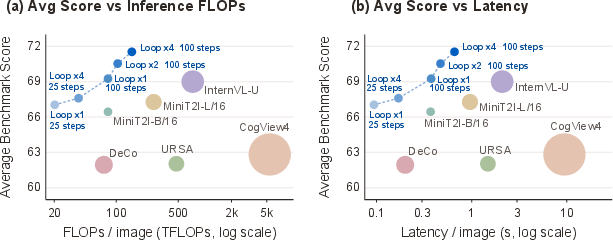
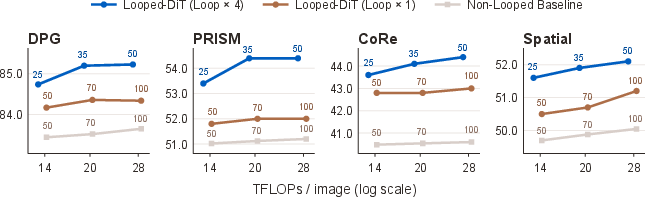
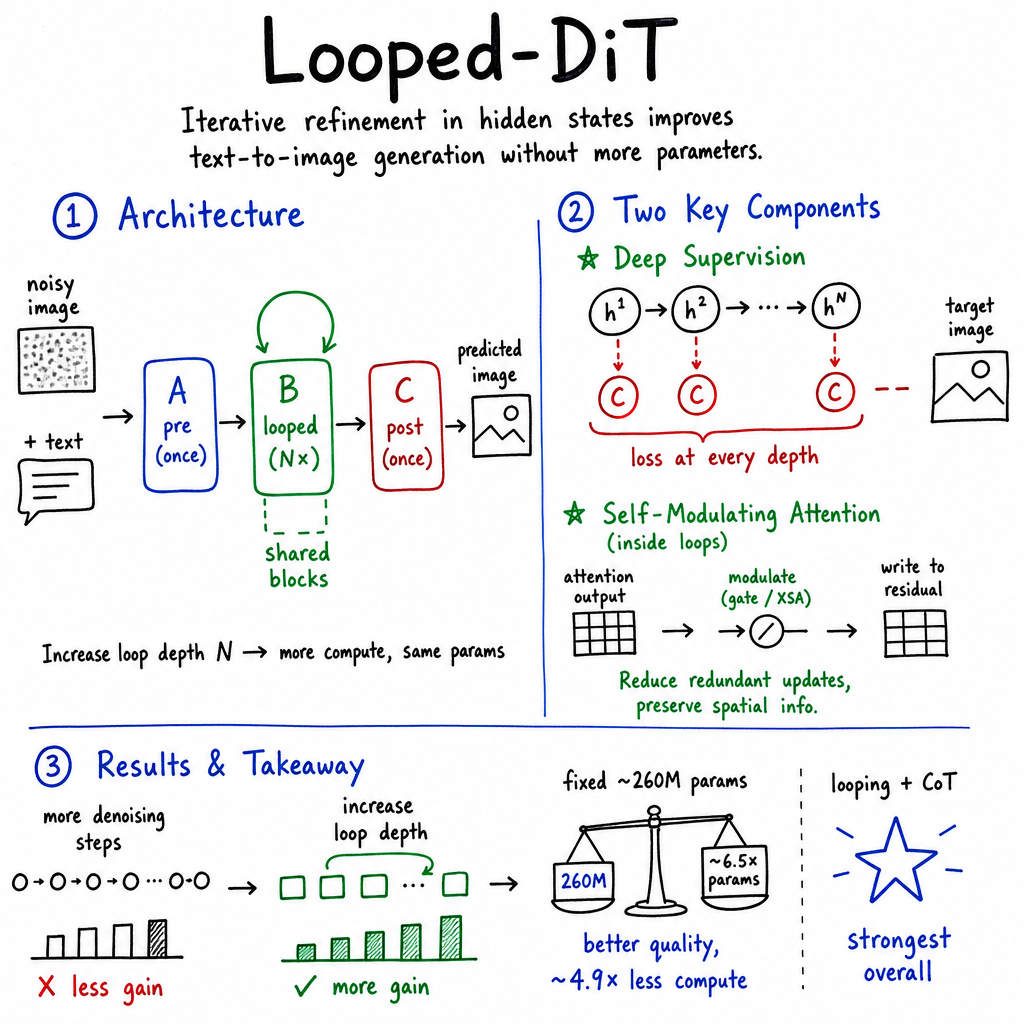
Abstract: Improving text-to-image models has traditionally relied on increasing model size or the number of denoising steps. In this work, we explore an alternative way to scale computation by repeatedly running shared Transformer blocks within each denoising step, effectively increasing computational depth while keeping the parameter count fixed. This looped computation enables iterative refinement of internal representations without explicit reasoning tokens. However, naive looping fails to consistently improve image quality. We trace this problem to weak supervision across intermediate loops and unregulated attention updates that progressively erode local information. To overcome these challenges, we propose Looped Diffusion Transformer (Looped-DiT), which combines deep supervision across intermediate loops with self-modulating attention to stabilize looped feature updates. Under matched-parameter and matched-compute settings, Looped-DiT consistently outperforms non-looped baselines. Notably, a 260M-parameter looped model can surpass a model 6.5x larger across multiple text-to-image benchmarks while requiring 4.9x lower inference compute. Beyond this performance gain, we find that looped computation can offer a more effective form of iterative computation for diffusion models, with increasing loop depth yielding larger gains than adding more denoising steps under a fixed inference budget. Furthermore, deeper loops can progressively correct mistakes made in earlier loops, exhibiting behaviors suggestive of latent reasoning. Together, these results show that looped computation offers a promising way to scale visual generation models.
Paper Prompts
Sign up for free to create and run prompts on this paper.
Top Community Prompts
Explain it Like I'm 14
1. What is this paper about?
This paper introduces Looped Diffusion Transformer, or Looped-DiT, a way to make text-to-image AI models better without making them much larger.
Text-to-image models turn a written description, such as “a red ball under a blue table,” into an image. Usually, researchers improve these models by:
- adding more parameters, which makes the model bigger and more expensive; or
- using more denoising steps, meaning the model slowly improves a noisy image over many stages.
The paper explores a different idea: make part of the model run repeatedly during each denoising step. It is similar to asking an artist to look at a drawing several times and fix it little by little.
2. Main research questions
The researchers wanted to find out:
- Can repeatedly using the same Transformer layers improve image quality?
- Can this make a small model perform like a much larger model?
- Is repeating the model more useful than simply adding more denoising steps?
- Can the model correct its own mistakes as it repeats its calculations?
- What problems happen when the model is looped, and how can they be fixed?
The paper also investigates whether this repeated processing acts like a kind of hidden or “latent” reasoning. The model does not write out a chain of thoughts, but its internal information may gradually become more accurate.
3. How did the researchers do it?
The basic looping idea
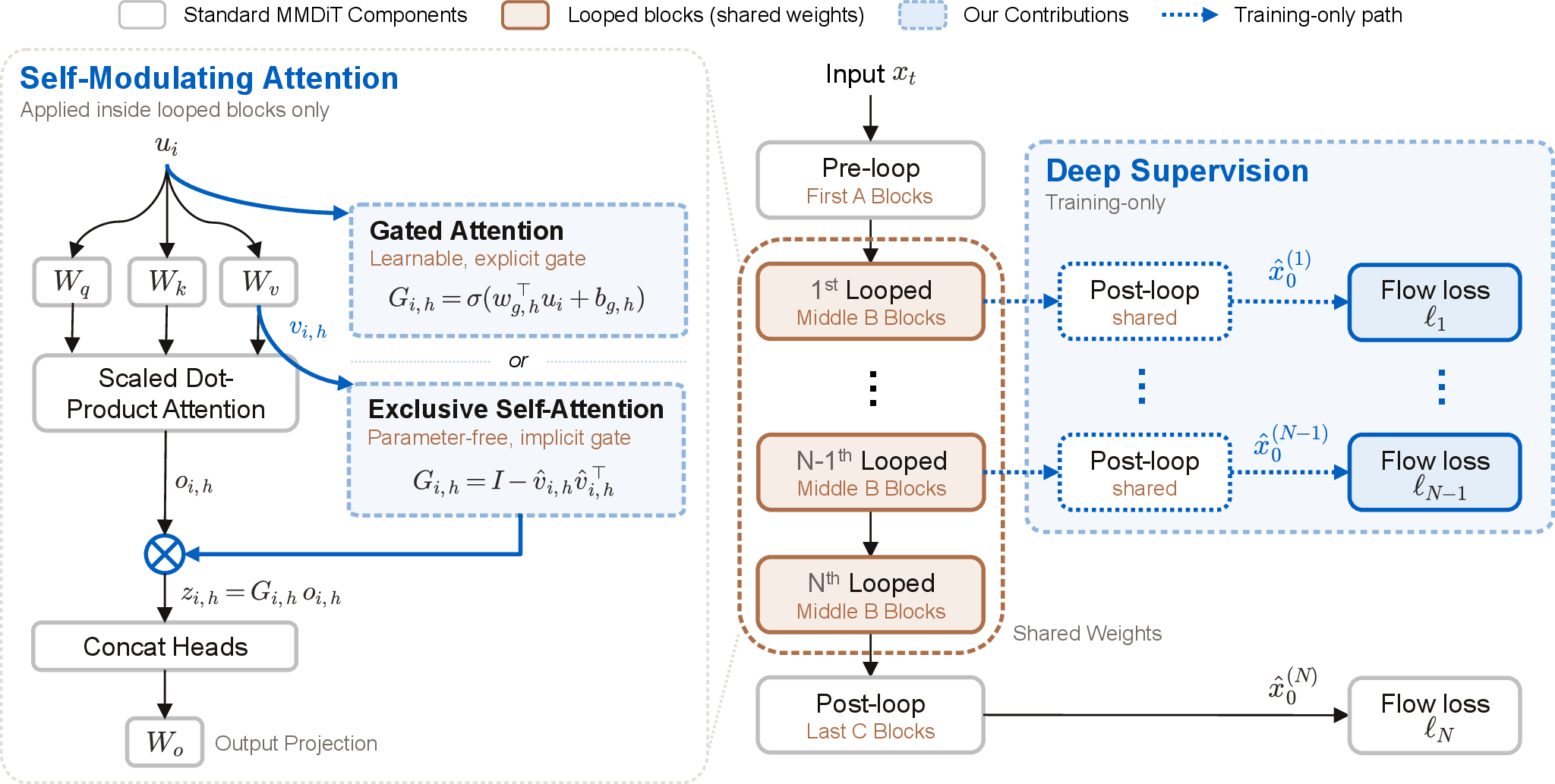
The model is a type of Transformer, a neural network that processes pieces of information called tokens. In this case, the tokens describe both the text prompt and parts of the image.
The researchers divided the model into three sections:
- A beginning section that runs once.
- A middle section that runs repeatedly.
- An ending section that turns the model’s internal information into an image prediction.
Suppose the middle section has a loop depth of 4. It works like this:
1 |
Input → Beginning → Middle → Middle → Middle → Middle → Ending → Image |
The important detail is that the same middle section is reused each time. This increases the amount of computation without storing four separate copies of those layers.
An analogy is using one calculator four times instead of buying four calculators. You still do more work, but you do not need as much extra equipment.
Diffusion and denoising
The model begins with a noisy or partly formed image. During denoising, it repeatedly tries to make the image clearer and more consistent with the text.
For example, if the prompt says “three apples to the left of a cup,” the model needs to create:
- three apples;
- a cup;
- the correct left-right arrangement; and
- a sensible-looking image.
The loops allow the model to reconsider the image during each denoising stage.
The problem with simple looping
The researchers first tried repeatedly applying the same layers without any special changes. This was called naive looping.
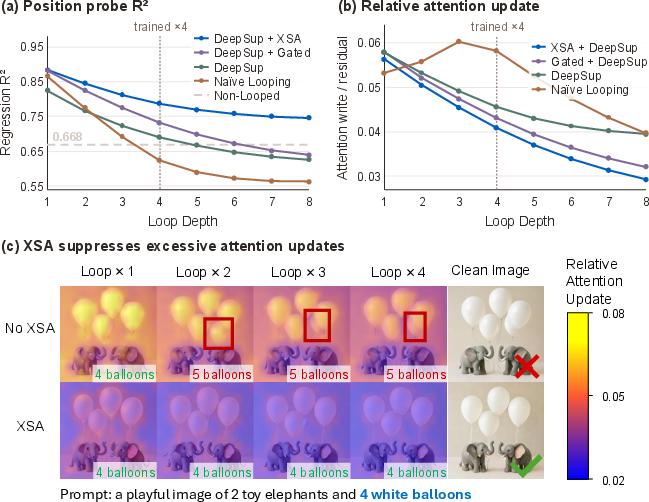
It sometimes helped, but it could also make the image worse. Repeated updates might overwrite useful information, such as where objects are located in the image. This is similar to editing a drawing so many times that important details become blurred or accidentally erased.
Two improvements
To solve this problem, Looped-DiT uses two main techniques.
Deep supervision
Normally, the model is mainly judged by its final answer. The researchers instead check the model’s prediction after every loop.
This is like giving feedback to a student after each step of solving a problem rather than only marking the final answer. Each intermediate version is compared with the correct image, helping every loop learn what it should do.
Self-Modulating Attention
Transformers use attention to decide which pieces of information are important. For example, when generating the word “left,” the model may need to focus on the positions of objects.
However, repeated attention can make overly large changes. Self-Modulating Attention controls how strongly each update is applied. If the model already has a good image structure, it can make smaller changes instead of damaging it.
The paper tests two versions:
- Gated Attention, which learns a control value for each attention head.
- Exclusive Self-Attention, or XSA, which removes certain unnecessary self-updates.
XSA generally worked better in the experiments.
Testing the models
The researchers compared Looped-DiT with other models using several text-to-image tests. These tests checked things such as:
- whether the image matches the prompt;
- whether objects appear in the correct positions;
- whether multiple relationships are handled correctly; and
- whether the image contains the right details.
They also compared models with similar numbers of parameters or similar amounts of computing power. This helped show whether the benefits came specifically from looping rather than simply from using more resources.
4. Main findings
A small model performed like a much larger model
The paper’s 260-million-parameter Looped-DiT model performed better than several much larger models.
In particular, it outperformed a model with about 6.5 times more parameters on the paper’s collection of tests. It also required about 4.9 times less computation during image generation.
This suggests that reusing layers intelligently may be more efficient than continually making models larger.
Looping improved text-to-image results
The main Looped-DiT model achieved an average score of 71.5 across six benchmarks. The researchers report that it had the best result on five of those six tests.
The model was especially strong at tasks involving:
- spatial relationships;
- multiple objects;
- long or complicated descriptions;
- procedural instructions; and
- correcting mistakes in an image.
More loops were often better than more denoising steps
When the researchers had a fixed computing budget, spending more computation on loops often helped more than simply adding extra denoising steps.
In simple terms, asking the model to think more deeply during each stage was often more useful than asking it to perform more stages of image cleanup.
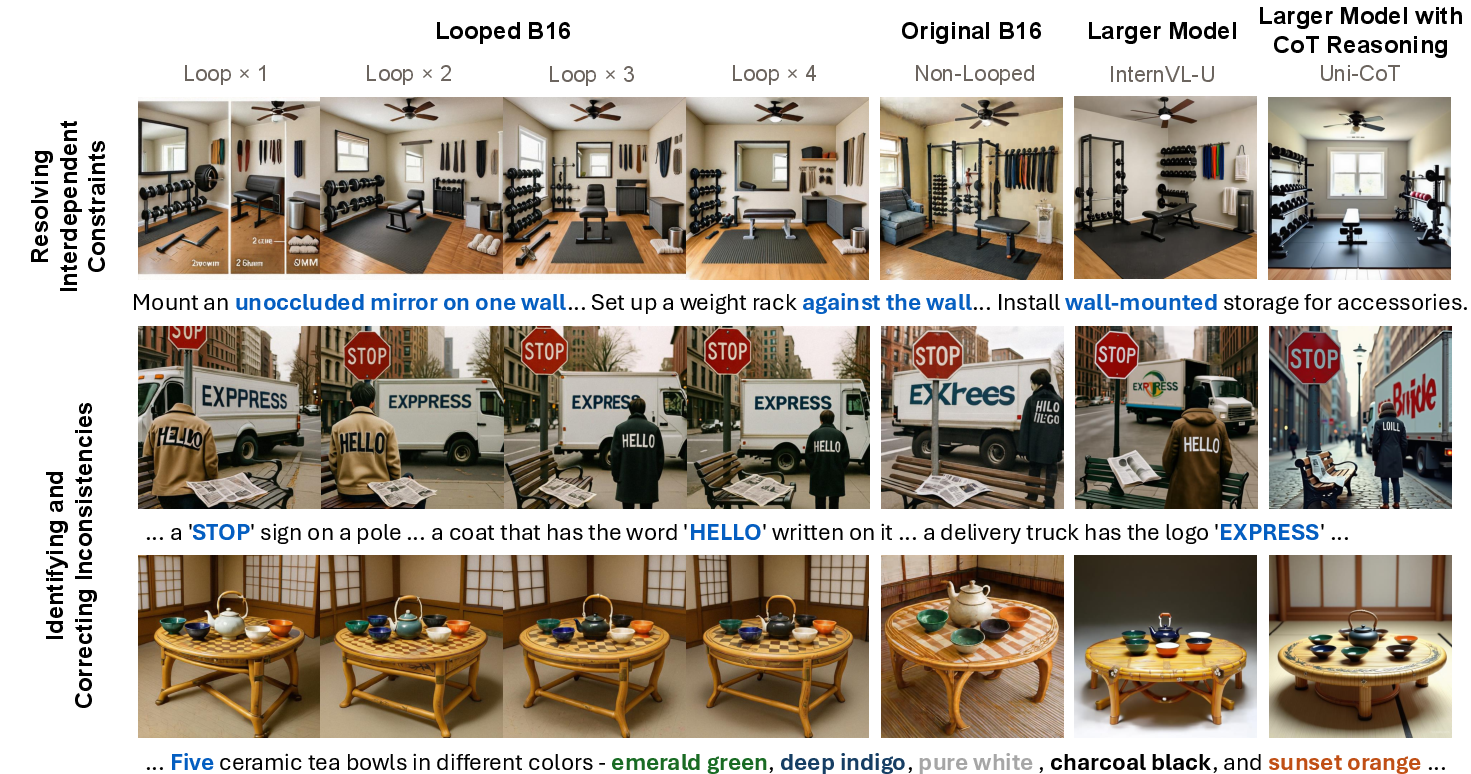
The model showed signs of self-correction
As the model went through more loops, it could:
- add missing objects;
- move objects into better positions;
- fix incorrect relationships;
- remove extra objects; and
- correct visual mistakes.
For example, later loops could change an image so that one object was correctly placed relative to another. This behavior resembles reasoning, although the model does not produce written explanations or visible thoughts.
The researchers call this latent visual reasoning: the model improves its hidden internal information without writing a step-by-step explanation.
The special techniques were important
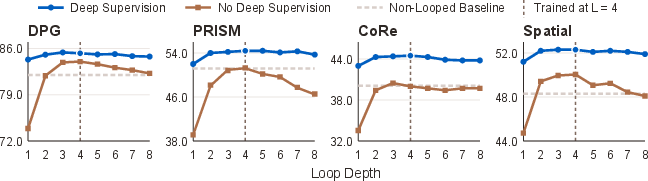
Looping by itself was not enough. The experiments showed that both improvements mattered:
- Deep supervision helped the model learn useful behavior at every loop.
- Self-Modulating Attention helped prevent later loops from damaging information that was already correct.
The best combination used deep supervision and XSA. Its average score was 59.1 in one controlled experiment, compared with 55.2 for the ordinary non-looped model.
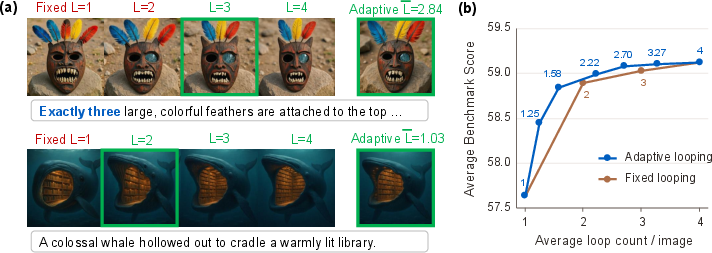
Adaptive looping saved computation
The researchers also tested adaptive looping. Instead of always using the same number of loops, a small extra system decides whether another loop is likely to help.
If the image is already good enough, the model can stop early. If the prompt is difficult, it can continue looping.
This is similar to a student stopping once an answer is clearly correct, but spending more time on a difficult problem.
5. Why this research matters
The main message is that AI image models may not need to become enormous in order to improve. A smaller model can become more capable by repeatedly refining its internal calculations.
This could make future image-generation systems:
- cheaper to run;
- faster to use;
- easier to deploy on less powerful hardware; and
- better at following complicated instructions.
The work also suggests that repeated hidden processing can help AI models solve visual problems without requiring written chain-of-thought reasoning.
However, the paper does not show that the model truly “thinks” like a person. The self-correction results are evidence of useful internal refinement, but they are not proof of human-like reasoning. More research would be needed to understand exactly what happens inside the loops and whether the method works equally well for different kinds of images and prompts.
Overall, Looped-DiT shows that repeating carefully controlled computations can be a powerful alternative to simply making AI models bigger.
Knowledge Gaps
Knowledge gaps, limitations, and open questions
- Limited architectural generality: The method is evaluated primarily on MiniT2I, a small pixel-space MMDiT backbone with 17 Transformer blocks; it remains unclear whether the gains transfer to latent diffusion models, larger DiT/MMDiT architectures, U-Net-based systems, mixture-of-experts models, or multimodal generation systems.
- Limited model-scale validation: The main results center on a 260M-parameter model, so it is unresolved whether looping remains advantageous at billion-parameter scales or whether its benefits diminish as conventional width and depth increase.
- Narrow training and data regime: The paper does not establish how performance depends on dataset size, data diversity, image resolution, caption quality, or training duration. It is therefore unknown whether looping changes the scaling laws governing data and optimization compute.
- Incomplete compute accounting: FLOP comparisons do not fully characterize deployment cost. The paper does not report comprehensive measurements of wall-clock latency, memory usage, peak activation memory, throughput, energy consumption, or hardware-specific efficiency for looped versus deeper or wider models.
- Unclear fairness of external-model comparisons: Comparisons with state-of-the-art systems use their official inference settings, architectures, training data, samplers, and possibly different evaluation pipelines. The contribution of looping is therefore not fully isolated from differences in data, resolution, guidance, sampler choice, and model implementation.
- Insufficient statistical analysis: Benchmark results are presented largely as single scores without confidence intervals, repeated training runs, seed sensitivity, or significance testing. The reproducibility and robustness of the reported improvements remain uncertain.
- Limited ablation of loop placement: The model loops a fixed middle group of five blocks using a $6$-$5$-$6$ partition. The effects of looping early, middle, late, or noncontiguous blocks, as well as varying the number and composition of shared blocks, are not systematically studied.
- Unresolved optimal loop depth: The experiments mainly train with four loops and evaluate a limited range of depths. The compute-performance relationship at much larger depths, the location of the eventual saturation point, and whether the optimal depth varies with timestep, prompt type, resolution, or model size remain unknown.
- Training–inference depth mismatch is incompletely characterized: Although deep supervision improves extrapolation beyond the training depth, the paper does not determine how far loop depth can be increased safely, whether training with a distribution of loop counts is superior, or whether performance eventually becomes unstable at substantially larger depths.
- Unclear role of deep-supervision weights: Only a small number of weighting schemes are evaluated. The optimal weighting schedule, its dependence on loop depth, whether loop-specific weights should vary with diffusion timestep, and whether learned or adaptive weights improve results remain open questions.
- Deep supervision may alter the optimization objective in confounded ways: Intermediate predictions are decoded through shared post-loop blocks and trained against the same target, but the paper does not disentangle the benefit of additional gradient signals from the benefit of explicitly training early exits.
- Incomplete comparison with alternative recurrent designs: The study does not compare against residual scaling, layer normalization changes, recurrent-state parameterizations, learned loop embeddings, per-loop adapters or LoRA modules, stochastic depth, recurrent memory, or other mechanisms that could stabilize repeated transformations.
- Mechanism of Self-Modulating Attention remains uncertain: The reported evidence is correlational. Reduced update norms and improved position decodability do not establish that excessive attention updates cause the performance degradation or that preservation of linearly decodable spatial coordinates is the relevant mechanism.
- Insufficient analysis of Gated Attention versus XSA: XSA outperforms the tested gated variant, but the comparison does not control for gate parameterization, initialization, normalization, saturation, modality-specific capacity, or alternative gate functions. It remains unclear whether XSA is intrinsically better or simply better configured.
- Restricted scope of attention modulation: Self-modulation is applied only within the looped stage and primarily to attention outputs. The effects of modulating MLP updates, residual branches, cross-modal interactions, normalization statistics, or the pre- and post-loop stages are not evaluated.
- Spatial-information probe is limited: The ridge-regression probe measures linear decodability of patch coordinates, not actual spatial fidelity, object identity, compositional structure, or causal information retention. Nonlinear probes and task-based measures could yield different conclusions.
- Latent “reasoning” is not directly demonstrated: The claim that loops perform latent visual reasoning is based on benchmark gains, qualitative examples, and progressive correction. The paper does not provide causal evidence that loops carry out intermediate constraint solving rather than simply applying additional denoising or iterative feature refinement.
- No explicit intermediate reasoning representation is identified: The study does not determine what information is represented at each loop, whether loops correspond to distinct computational stages, or whether hidden states encode interpretable plans, object relations, or constraint satisfaction signals.
- Self-correction may be prompt- and seed-dependent: The qualitative examples do not establish how frequently loops correct errors, how often they introduce new errors, or whether correction behavior is robust across random seeds, prompt complexity, object count, and image composition.
- Limited evaluation of failure modes: The benchmarks focus mainly on alignment, spatial relations, and compositional reasoning. Hallucinated objects, text rendering, fine-grained attributes, human anatomy, image aesthetics, diversity, mode collapse, artifacts, and long-tail prompts are not comprehensively assessed.
- No systematic robustness evaluation: The paper does not test sensitivity to paraphrased prompts, adversarial prompts, ambiguous instructions, negative prompts, multilingual text, out-of-distribution concepts, noisy captions, or unusual aspect ratios.
- Evaluation may not isolate reasoning from image quality: Aggregate benchmark scores combine different capabilities, and the paper does not report detailed per-category or per-difficulty analyses sufficient to determine which improvements arise from better reasoning, better visual fidelity, or improved prompt adherence.
- Additional denoising-step comparisons are narrow: The conclusion that loop depth is more effective than additional denoising steps is tested under selected step ranges and one model family. The result may depend on the sampler, timestep schedule, guidance scale, noise parameterization, or whether the baseline is retrained for the new number of steps.
- Interaction with modern fast-sampling methods is unexplored: Looped-DiT is not systematically combined with consistency distillation, progressive distillation, flow matching variants, one-step generators, or specialized few-step samplers, leaving its value in low-step generation uncertain.
- Adaptive looping is only preliminarily validated: The adaptive controller is trained using reconstruction-loss reductions, which are unavailable at inference time and may not correlate with perceptual quality or text-image alignment. Its calibration, generalization, overhead, and behavior under distribution shift are not reported.
- Adaptive stopping is not compared with simpler policies: The paper does not compare the learned gating network with fixed per-timestep schedules, confidence thresholds, token-level halting, random early exit, or policies based on update norms and prediction consistency.
- Adaptive looping may introduce training or inference overhead: The additional cross-attention controller and its memory, latency, and failure costs are not quantified relative to the computation saved by early exits.
- Granularity of adaptive computation is limited: The controller selects a single loop count for an image and denoising step. Token-level, region-level, head-level, or timestep-dependent computation allocation remains unexplored.
- No analysis of prompt-conditioned loop allocation: It is unknown which prompt properties cause the controller to select more loops and whether those decisions reflect genuine difficulty, object count, relational complexity, ambiguity, or merely visual complexity.
- Optimization stability at larger depths is not established: The paper reports degradation for naive looping but does not analyze gradient norms, Jacobian spectra, activation distributions, fixed-point behavior, or training instabilities as loop depth increases.
- Theoretical understanding of shared-block recursion is absent: There is no formal account of why parameter sharing produces better compute allocation than adding distinct layers, under what conditions recursive application is beneficial, or how loop depth affects the representational capacity of the denoiser.
- Effects across diffusion timesteps are not sufficiently separated: Looping may be more useful at particular noise levels, but the paper does not provide a detailed timestep-wise analysis of performance, update norms, spatial-information retention, or optimal loop depth.
- Text-token behavior is underexplored: Because both image and text states are updated inside the loop, the paper does not determine whether looping improves text representations, causes prompt information loss, changes cross-modal alignment, or disproportionately benefits image-token processing.
- No analysis of conditioning mechanisms: The method’s interaction with classifier-free guidance, cross-attention conditioning, textual inversion, adapters, ControlNet-like controls, or multiple conditioning modalities is not established.
- Resolution and patch-size effects are insufficiently studied: Only B/16 and B/32 variants are used, leaving open whether looping benefits high-resolution generation, smaller patches, variable resolutions, or models with hierarchical tokenization.
- Generalization across domains is unknown: The experiments do not evaluate specialized domains such as medical, scientific, industrial, satellite, animation, or fine-art imagery, where the value and risks of iterative correction may differ.
- Safety and misuse implications are not addressed: The paper does not examine whether deeper looping increases the generation of harmful, deceptive, biased, copyrighted, or privacy-sensitive content, nor whether iterative refinement makes safety filters easier or harder to bypass.
- Reproducibility is potentially constrained by incomplete or inconsistent presentation: The supplied manuscript contains apparent formatting, notation, citation, and equation issues, and the experimental description does not expose all implementation choices needed to independently verify the results.
- Long-term deployment behavior is unknown: The paper does not study how looped inference interacts with batching, caching, quantization, compilation, distributed execution, or serving systems, all of which may change the practical efficiency advantage.
- No investigation of continual or fine-tuning settings: It remains unclear whether looped models are as easy to fine-tune, instruction-tune, distill, quantize, prune, or adapt to new domains as conventional non-looped models.
- The persistence of gains under model compression is unresolved: Since looping trades parameters for repeated computation, it is unknown whether quantization or weight sharing introduces larger numerical errors or destabilizes later loops.
- The relationship between parameter efficiency and total training cost is incomplete: Although some training FLOPs are matched, the paper does not evaluate full training time, optimizer-state memory, checkpoint size, hyperparameter-search cost, or the cost of training multiple loop depths and auxiliary predictors.
- No evidence establishes that looping scales favorably with image resolution: Repeated attention over larger token sequences could increase memory and compute substantially, potentially reducing or eliminating the claimed efficiency advantage at high resolutions.
Practical Applications
Immediate Applications
The paper’s results support several applications that could be implemented now using the released Looped-DiT codebase and existing text-to-image infrastructure. These applications assume access to suitable GPUs, training data, and a production pipeline capable of exposing loop depth as an inference parameter.
- Lower-cost text-to-image generation for cloud APIs and creative tools — Industry/software. Deploy a roughly 260M-parameter Looped-DiT model as an alternative to substantially larger diffusion models for advertising, graphic design, game assets, product mockups, and social-media content. The reported results indicate competitive or superior benchmark performance with fewer parameters and lower inference compute.
- Potential product: an image-generation API with configurable quality and cost tiers.
- Dependencies: reproduction of the reported training setup, adequate image quality at the target resolution, GPU kernel optimization, and validation on proprietary prompts and safety datasets.
- Edge and workstation image-generation assistants — Consumer software, education, design, and mobile/edge computing. The smaller parameter count can reduce memory requirements, making local or semi-local generation more feasible on workstations, laptops, lab servers, or specialized edge hardware.
- Potential workflow: an offline design assistant for concept sketches, educational illustrations, presentations, and UI prototypes.
- Dependencies: model quantization, memory-efficient attention, acceptable latency, and licensing or privacy review for the training data and generated outputs.
- Dynamic quality–latency control through adaptive looping — Software infrastructure. Integrate the paper’s exit-prediction mechanism into an inference server that stops looping when additional refinement is unlikely to improve the result. Easy prompts could receive fewer loops, while complex spatial or relational prompts receive more.
- Potential product: an inference scheduler that meets a latency or GPU-budget target while preserving quality.
- Dependencies: calibration of the gating network, a threshold appropriate to the application, and monitoring for cases where the predicted improvement is inaccurate.
- Per-request compute allocation for commercial image services — Cloud operations and sustainability. Use loop depth as a controllable compute axis rather than relying only on additional denoising steps. A service could allocate more loops to premium requests and fewer loops during traffic spikes.
- Potential workflow: automatic scaling policies based on queue length, user tier, image complexity, or energy availability.
- Dependencies: the reported advantage must persist across hardware, resolutions, samplers, and production traffic; actual latency and energy savings require measurement rather than inference from benchmark GFLOPs alone.
- Improved compositional and spatial image generation — Advertising, e-commerce, publishing, and game development. Looped refinement is particularly applicable to prompts requiring object relationships, orientation, procedural arrangements, multiple attributes, or long textual descriptions.
- Potential tools: generation of product scenes with specified layouts, diagrams and storyboards, game-world concept art, and instructional illustrations.
- Dependencies: image-text alignment, typography and fine-detail limitations, domain-specific evaluation, and human review for commercially important outputs.
- Hybrid prompt-processing pipelines combining textual CoT and visual looping — Creative software and multimodal AI. Use a LLM to rewrite ambiguous prompts and Looped-DiT to resolve visual constraints and self-correct during image generation. The paper reports complementary gains: textual reasoning helps infer implied content, while looping helps satisfy spatial and relational constraints.
- Potential workflow: prompt expansion → structured layout extraction → looped image generation → optional human editing.
- Dependencies: prompt-rewriting latency and cost, preservation of user intent, prevention of unwanted prompt additions, and evaluation across languages and domains.
- A research and teaching baseline for efficient generative-model scaling — Academia and ML engineering. Researchers can use the open implementation to study parameter sharing, recurrent computation, deep supervision, self-modulating attention, early exits, and inference-time scaling without building billion-parameter models.
- Potential experiments: compare loop depth with width, depth, denoising steps, quantization, distillation, or mixture-of-experts routing.
- Dependencies: careful reproduction of matched-parameter and matched-compute comparisons; benchmark results alone do not establish universal superiority.
- Intermediate-loop monitoring and debugging tools — Model development and evaluation. Because the model produces predictions at intermediate loops, developers can inspect where objects appear, disappear, or move, and identify excessive updates or loss of spatial information.
- Potential tool: a visualization dashboard showing per-loop images, attention-update norms, token-position probes, and exit decisions.
- Dependencies: diagnostic measures such as linear position decodability are proxies rather than direct measures of semantic correctness; they should be combined with human and task-specific evaluation.
- Public-sector and organizational content production with controlled compute budgets — Government communications, education, and nonprofit work. Institutions can generate diagrams, campaign illustrations, accessibility materials, and explanatory visuals using a smaller model and predictable compute allocation.
- Dependencies: procurement and deployment validation, copyright and provenance controls, bias and accessibility testing, and human approval for public-facing materials.
- Everyday personal image creation and editing — Daily life. A local or hosted assistant could create invitations, lesson visuals, travel mockups, personalized stories, and simple product visualizations while allowing users to choose “fast,” “balanced,” or “high-quality” loop settings.
- Dependencies: privacy protection for uploaded images, content moderation, clear disclosure that images are synthetic, and robustness to ambiguous or unsafe requests.
Long-Term Applications
The following applications require additional research, larger-scale validation, or integration with downstream systems. The paper demonstrates promising behavior, but it does not yet establish reliability, safety, or generalization in these settings.
- Parameter-efficient scaling of high-resolution and professional image models — Commercial media, design, and visual effects. Extend the looped architecture to larger resolutions, latent-space diffusion, video generation, 3D assets, and multimodal generation. Shared blocks could increase effective depth without multiplying parameter storage.
- Potential products: high-resolution design systems, video storyboard generators, and 3D scene-prototyping tools.
- Dependencies: memory and bandwidth costs may dominate at high resolution; temporal consistency, fine detail, and long-range structure require separate validation.
- Interactive visual reasoning and iterative design agents — Robotics, CAD, architecture, and creative automation. A future system could repeatedly inspect its own generated representation, identify constraint violations, and refine a scene or design without generating explicit textual reasoning traces.
- Potential workflow: user specifies constraints → model proposes a design → verifier identifies violations → looped refinement produces a corrected design.
- Dependencies: the current evidence for “latent reasoning” is behavioral and indirect; reliable deployment requires explicit verifiers, interpretable constraints, and guarantees against silent failures.
- Text-to-image generation for robotics and simulation — Robotics and autonomous systems. Looping could generate visually coherent training scenes, synthetic sensor data, or environment variations satisfying spatial constraints such as object placement, orientation, and interaction relationships.
- Potential tool: a simulation-data generator for warehouse, domestic, or industrial robots.
- Dependencies: generated images must be physically plausible and distributionally representative; simulator validation, safety testing, and sim-to-real transfer remain unresolved.
- Adaptive computation across tokens, regions, or denoising steps — Efficient AI accelerators and model architecture. The current method varies loop depth at the image level. Future systems could allocate more recurrent computation only to difficult tokens, regions, objects, or parts of the denoising trajectory.
- Potential product: hardware-aware generation with region-specific refinement and sparse execution.
- Dependencies: token-level stopping criteria, load-balancing overhead, stable training, and efficient GPU/accelerator support for dynamic control flow.
- Specialized generation for healthcare, engineering, and scientific visualization — Healthcare, energy, manufacturing, and research. Domain-adapted looped models could generate constrained anatomical illustrations, engineering concepts, laboratory schematics, or energy-system visualizations.
- Dependencies: domain data quality, expert validation, regulatory requirements, provenance, and the risk that visually plausible outputs encode incorrect scientific or clinical information. These systems should initially support—not replace—expert review.
- Energy-aware and carbon-aware inference scheduling — Cloud infrastructure and sustainability policy. Since loop depth provides a quality–compute trade-off, generation jobs could be scheduled according to electricity price, renewable-energy availability, or carbon intensity.
- Potential workflow: choose a loop threshold based on service-level objectives and current datacenter energy conditions.
- Dependencies: direct energy measurements, hardware-specific profiling, user acceptance of variable quality, and evidence that reduced model size translates into lower total lifecycle emissions.
- Continual and personalized image generation with shared recurrent modules — Consumer products and enterprise design systems. Shared loop blocks could be adapted to a brand, institution, or user with comparatively small parameter updates, potentially lowering fine-tuning and storage costs.
- Potential product: personalized brand-asset generators with configurable style and layout constraints.
- Dependencies: protection against catastrophic forgetting, safeguards against memorization, robust personalization data, and rights management for style and identity.
- Cross-modal recurrent reasoning architectures — Multimodal assistants and education. The same looped-computation principle could be applied jointly to text, images, audio, or structured data, enabling iterative refinement of explanations, diagrams, and demonstrations.
- Potential workflow: generate an explanation and visual aid, check consistency between them, and refine both representations.
- Dependencies: alignment between modalities, objective evaluation of factuality, and stronger theoretical understanding of what recurrent hidden-state refinement is computing.
- Policy standards for compute-scalable generative AI — AI governance and procurement. Organizations could require vendors to report quality at several loop depths, inference FLOPs, latency, energy use, early-exit behavior, and failure rates rather than comparing only parameter counts.
- Potential policy tool: standardized “quality per joule,” “quality per dollar,” and “quality per latency” reporting for generative models.
- Dependencies: agreed benchmarks, reproducible hardware measurements, and safeguards against optimizing benchmark scores while degrading real-world reliability.
- Formal verification and safety control for self-correcting generation — AI safety and regulated applications. The apparent ability of later loops to correct earlier errors could motivate verifiers that check object counts, spatial relations, prohibited content, or identity consistency after each loop.
- Potential system: generation with loop-level safety gates that stop, regenerate, or escalate questionable outputs.
- Dependencies: reliable verifiers, resistance to adversarial prompts, calibrated uncertainty, and evidence that additional loops do not introduce new errors—as the paper shows can happen with unregulated attention updates.
- Distillation of looped models into fast single- or few-step generators — Deployment and embedded AI. Intermediate-loop supervision may provide useful targets for progressive distillation, allowing a loop-trained model to produce high-quality outputs with fewer denoising steps or a smaller runtime model.
- Dependencies: distillation may lose the iterative correction behavior that produces the reported gains; performance must be tested under real latency, memory, and energy constraints rather than only parameter matching.
Glossary
- Adaptive looping: A strategy that dynamically chooses how many recurrent iterations to perform for each input. “The model's robust performance across different loop counts also enables adaptive looping”
- Attention head: An individual parallel attention mechanism within a multi-head attention layer. “The output of attention head is ”
- Backpropagation: The process of computing gradients through a neural network to update its parameters. “Supervising only the final prediction requires gradients to backpropagate through all subsequent iterations”
- Chain-of-thought (CoT): A reasoning method that generates intermediate textual reasoning steps before producing an answer. “chain-of-thought reasoning”
- Clean-image prediction: Predicting the original, uncorrupted image from a noisy input during diffusion-model training. “We express the flow-matching loss~\citep{lipman2022flow} in terms of clean-image prediction.”
- Computational depth: The amount of sequential computation performed by a model, often corresponding to the number of transformation layers applied. “Looped-DiT increases computational depth by repeatedly applying a shared group of Transformer blocks.”
- Cross-attention: An attention operation in which queries from one representation attend to keys and values from another representation. “The network consists of a cross-attention layer that extracts information from post-loop activations using 4 learnable queries”
- Denoising step: One iteration in a diffusion-generation process that transforms a noisy sample toward a clean image. “This looped computation occurs within each denoising step before the sampler advances”
- Diffusion model: A generative model that learns to create data by reversing a gradual noise-adding process. “looped computation can provide a more effective form of iterative computation for diffusion models.”
- Effective depth: The total number of sequential block applications executed by a model, including repeated applications of shared blocks. “Effective\depth”
- Exclusive Self Attention (XSA): An attention mechanism that projects out the component of an update aligned with a token’s own value vector. “Exclusive Self Attention, which applies a state-dependent projection that removes the component along the token's own value direction.”
- Flow matching: A generative-training objective that learns a vector field connecting noisy samples to data samples along a specified probability path. “we introduce Deep Supervision, which applies the flow-matching objective to predictions at every loop depth”
- Forward computation: The sequence of operations used to transform a model input into an output. “The forward computation is”
- Gated Attention: An attention variant that scales each attention-head output using a learned, token-dependent gate. “Gated Attention~\citep{qiu2026gated}, which explicitly scales each attention-head output with a learned gate”
- Hidden dimension: The number of features in each internal representation or hidden state. “the wider baseline increases the hidden dimension to approximately match the forward-pass compute.”
- Hidden state: An internal vector representation maintained and transformed by a neural network. “At each iteration, updates both image and text hidden states”
- Inference compute: The computational resources required to generate an output at test time. “loop depth and denoising steps providing flexible control over the inference budget.”
- Latent visual reasoning: Reasoning about visual content through internal representations rather than explicit textual reasoning traces. “looping can support latent visual reasoning through iterative hidden-state refinement”
- Linearly decodable: Recoverable from a representation using a linear predictive function. “spatial position becomes progressively less linearly decodable.”
- Loop depth: The number of times a shared group of network blocks is applied sequentially. “Here, denotes loop depth.”
- MMDiT (Multimodal Diffusion Transformer): A Transformer architecture that processes image and text representations within a diffusion model. “a minimal pixel-space Multimodal Diffusion Transformer (MMDiT)”
- Modulation factor: A scalar or operator that adjusts the magnitude or direction of an attention update. “where denotes the corresponding modulation factor.”
- Noisy input: An input produced by adding noise to a clean data sample, as used in diffusion training. “All loop predictions share the same noisy input and timestep”
- Parameter sharing: Reusing the same learned weights across multiple computations or iterations. “Since the parameters of are shared across iterations”
- Pareto frontier: The set of configurations that cannot improve one performance objective without worsening another. “Looped-DiT B/16 traces the Pareto frontier under both metrics”
- Pixel-space denoiser: A diffusion model that directly processes image pixels rather than a compressed latent representation. “a pixel-space denoiser based on MMDiT”
- Residual update: The change added to an existing neural representation, commonly through a residual connection. “The resulting scalar explicitly controls the strength of each head contribution to the residual update.”
- Ridge-regression probe: A diagnostic linear regression model trained with L2 regularization to test what information is encoded in hidden representations. “by fitting a ridge-regression~\citep{hastie01statisticallearning} probe at each loop depth”
- Self-modulating attention: Attention whose update strength is dynamically adjusted according to the current hidden states. “we introduce Looped Diffusion Transformer (Looped-DiT), combines intermediate-loop Deep Supervision with Self-Modulating Attention”
- Softmax attention: An attention mechanism that converts compatibility scores into normalized weights using the softmax function. “Standard softmax attention controls the relative contributions of source tokens”
- Spatial information: Representation information concerning the positions and arrangement of visual elements. “we examine how well spatial information is preserved across loops”
- State-dependent projection: A projection operator whose form depends on the current representation or hidden state. “XSA regulates the update through a parameter-free, state-dependent projection.”
- Text-to-image generation: The synthesis of an image conditioned on a textual prompt. “looped computation for text-to-image generation”
- Token-position decodability: The extent to which a token’s spatial or sequence position can be inferred from its representation. “the strongest decline in token-position decodability”
- Training loop depth: The number of recurrent iterations used while optimizing a model. “The model trains at 4 loops and infers at 1--8 loops.”
- Transformer block: A neural-network module composed primarily of attention and feed-forward sublayers. “repeatedly applying a shared group of Transformer blocks”
- Unmodulated attention: Attention whose output updates are not adaptively scaled or otherwise regulated. “unmodulated attention produces excessive updates across loops”
- Vector field: A function assigning a direction and magnitude to each point in a space, used in flow-based generative modeling. “the flow-matching objective”
- Width scaling: Increasing a model’s internal feature dimension to increase capacity and computation. “whether its gains can be reproduced by increasing model depth or width”

