OBLIQ-IR: Training a Dense Retriever for Oblique Queries
Abstract: Oblique retrieval, as exemplified by OBLIQ-Bench, asks a retriever to find documents whose relevance is determined by a latent attribute (an implicit stance, an analogous reasoning technique, an authorial fingerprint, or a vague tip-of-the-tongue recollection) that has little or no surface expression in the document. State-of-the-art dense encoders and agentic search pipelines built around frontier LLMs exhibit a large first-stage bottleneck on these tasks, while the same LLMs reliably verify relevance when shown candidates. We address this with OBLIQ-IR, a single-vector dense retriever whose training mixture combines per-mechanism synthetic queries with a new form of cross-model supervision: kNN-graph distillation from a frozen authorship encoder, which transfers a style-versus-topic inductive bias into the student. A 3B retriever fine-tuned reaches 0.211 NDCG@10 on Writing-Style, 0.171 on Math, 0.177 on Twitter, and 0.281 on Congress, improving over the GPT-5.2 Multi-Hop Agent by \xr{0.010 to 0.150} NDCG@10 and over Gemini-2-Embedding by 0.027 to 0.222 NDCG@10 on every reported task. The code, data and checkpoints are available https://github.com/DataScienceUIBK/obliq-ir
Paper Prompts
Sign up for free to create and run prompts on this paper.
Explain it Like I'm 14
1. What is this paper about?
This paper introduces OBLIQ-IR, a computer system designed to find documents that match a hidden or difficult-to-describe feature.
Most search engines look for topic matches. For example, if you search for “volcanoes,” they find documents containing words related to volcanoes.
But sometimes the important feature is not the topic. A search might ask for:
- A post that secretly supports one side of a political conflict
- A math problem solved using the same type of reasoning
- A passage written in the same author’s style
- A speech that matches a vague memory of a conversation
These are called oblique queries. The answer depends on something hidden beneath the obvious words.
The paper’s main goal is to train a search system that can find these difficult matches quickly.
2. What questions does the research ask?
The researchers mainly ask:
- Can a search system learn to find documents based on hidden features instead of just topics?
- Can specially written training questions help the system learn these hidden features?
- Can a separate writing-style model teach the system to recognize authors’ styles?
- Can one search system work across several different kinds of difficult searches?
- Can this system outperform larger language-model-based search systems?
3. How did the researchers build and test the system?
Training special search questions
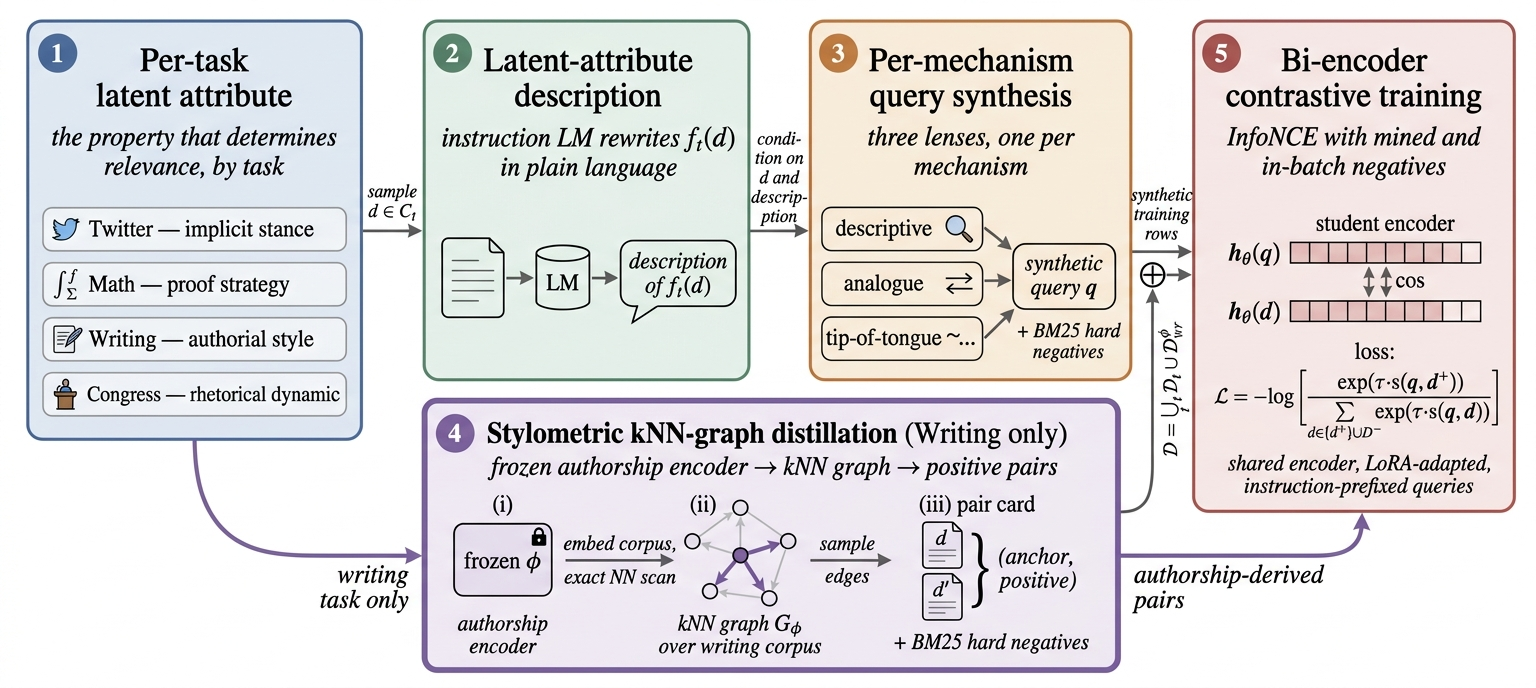
The researchers used a LLM to create artificial training questions.
For each document, the LLM first described the hidden feature that mattered. For example, it might describe:
- The document’s political attitude
- The method used to solve a math problem
- The author’s writing style
- The general feeling or argument in a remembered speech
Then it created a search question based on that description. The question was told not to copy important names or unusual words from the original document.
This is similar to showing a student a painting, asking them to describe its style, and then asking them to find other paintings with a similar style rather than the same subject.
The researchers used three types of questions:
- Descriptive questions: describe an unstated idea, such as a political position
- Analogy questions: ask for something with a similar structure or style
- Tip-of-the-tongue questions: describe a vague memory without giving exact names or phrases
Training the search encoder
OBLIQ-IR uses a bi-encoder, which is a model that turns both the search question and each document into lists of numbers called vectors.
Documents with similar hidden properties should have vectors that are close together. At search time, the system compares the question vector with document vectors and returns the closest ones.
An everyday analogy is placing books on a giant map. Books about similar topics might be near each other, but OBLIQ-IR tries to place books near each other based on harder features, such as writing style or reasoning method.
The system learns by comparing:
- A correct document
- Several incorrect documents, called negative examples
It is trained to move the correct document closer to the question and push the incorrect documents farther away.
Teaching the system writing style
Writing style was especially difficult because it may have little connection to the subject of a document. The same author can write about sports, politics, or science while still using a recognizable voice.
To help with this, the researchers used a separate authorship encoder. This model had already learned to recognize whether passages were written by the same person.
The researchers created a k-nearest-neighbor graph from this model. In simple terms, for every passage, they found the few other passages that looked most similar in writing style.
They then used these pairs as examples for OBLIQ-IR:
“These two passages have similar writing styles, so the new search system should also place them near each other.”
Importantly, the authorship model was used only as a teacher during training. OBLIQ-IR itself remained a single general search model.
Testing the system
The researchers tested the system on four tasks:
| Task | What the system had to match |
|---|---|
| Twitter-Conflict | Hidden political opinions |
| Math Meta-Program | The abstract method used to solve a math problem |
| Writing-Style | An author’s writing voice |
| Congress Hearings | A vague memory of a congressional exchange |
The researchers measured performance using NDCG@10. This score checks how many useful documents appear near the top 10 results, while giving extra credit when the best results appear first. Higher scores are better.
They compared OBLIQ-IR with regular search methods, embedding models, and large language-model agents.
4. What did they find?
OBLIQ-IR performed best overall
OBLIQ-IR achieved the best reported non-oracle results on all four tasks:
| Task | OBLIQ-IR NDCG@10 |
|---|---|
| Writing-Style | 0.211 |
| Math | 0.171 |
| Twitter-Conflict | 0.177 |
| Congress Hearings | 0.281 |
It improved over the strongest earlier systems, although the improvement was much larger on some tasks than others.
For example:
- The improvement was large for Writing-Style and Congress Hearings.
- The improvement was small for Math.
- On one Twitter evaluation, the result was very close to the previous best system.
The writing-style teacher was extremely helpful
Without the authorship-based training examples, the Writing-Style score was only 0.096.
With them, it rose to 0.211.
This shows that ordinary topic-based training was not enough. The extra authorship model gave OBLIQ-IR the information it needed to focus on style rather than subject matter.
However, using too many of these style examples caused problems. The system became too focused on writing style and performed worse on the other tasks. This is similar to studying one school subject so much that performance in every other subject declines.
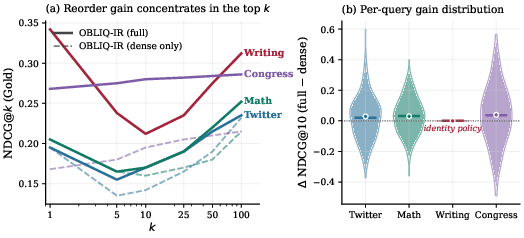
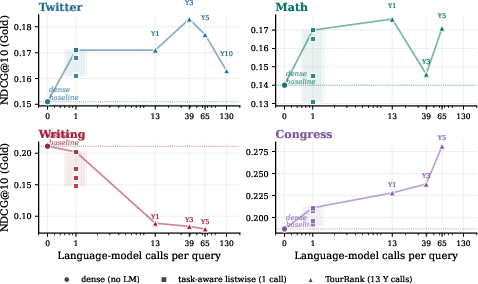
Reranking helped some tasks but hurt writing-style search
After OBLIQ-IR produced its first 100 results, the researchers sometimes used a LLM to reorder them. This process is called reranking.
Reranking improved:
- Twitter-Conflict
- Math
- Congress Hearings
But it hurt Writing-Style. The LLM tended to judge documents by their topics instead of their authorial voice. For example, it might prefer two documents about the same subject even if they were written by different people.
Because of this, the final system used reranking for three tasks but skipped it for Writing-Style.
Finding candidates was still the biggest problem
A reranker can only rearrange documents that the first search stage already found. It cannot recover a relevant document that was left out.
The researchers found that many correct documents appeared in the top 1,000 results but not in the top 100. This means the system often had the right document somewhere in its larger list, but failed to place it high enough.
This is called a recall bottleneck. In simple terms, the search system sometimes misses the right answer before the more careful checking stage begins.
The system was faster than agentic search
The dense-search part of OBLIQ-IR took about 48 milliseconds per query on the tested hardware.
The more expensive reranking stage took about 8.2 seconds, while a competing language-model agent took around 20–40 seconds.
Therefore, OBLIQ-IR can be much faster, especially when used without reranking.
5. Why is this research important?
This paper shows that search systems do not always need to match exact words or topics. They can also be trained to search for less visible features, such as:
- Writing voice
- Reasoning style
- Hidden opinions
- The structure of an argument
- The feeling of a vague memory
The paper also presents a useful general idea:
If a small specialist model already understands a hidden feature, its knowledge can be transferred to a more general search model.
For example, a future system might use a specialist that recognizes humor, scientific reasoning, emotional tone, or legal argument style.
However, the system has important limits. It was designed and tested on known task types, so it has not yet been proven to work on completely new kinds of oblique searches. Its training questions were also generated by one LLM, which may introduce biases.
The writing-style component also raises privacy concerns. A tool that recognizes authors can potentially be used to connect anonymous writing to a real person. In addition, writing style can be related to dialect, culture, or demographic background, so these systems should be carefully tested for unfair behavior.
Simple conclusion
OBLIQ-IR is a new search system for questions where the answer cannot be found just by matching words or topics. It learns from specially created questions and, for writing-style search, from a model that already understands authorship.
The system performs better than several strong existing methods, especially for finding similar writing styles and matching difficult conversational clues. Its biggest remaining weakness is that it still sometimes fails to place the correct document in its first group of results.
Overall, the research suggests that future search engines could become much better at finding documents that are similar in meaning, reasoning, style, or hidden characteristics, not just in vocabulary.
Practical Applications
Immediate Applications
- Oblique enterprise and institutional search — software and knowledge management. Organizations can deploy the fine-tuned bi-encoder as a first-stage retriever for queries based on implicit stance, reasoning strategy, rhetorical similarity, or writing style rather than keywords. Example workflows include finding prior legal arguments with a similar reasoning pattern, locating policy documents expressing a comparable position, or retrieving meeting transcripts based on a vague recollection of an exchange. The dense-only system is the most practical deployment target: it requires one encoder, supports vector indexing, and reports approximately 48 ms end-to-end latency on the tested hardware. Dependencies: The target latent attribute must be defined clearly, documents must be encoded in advance, and the model should be fine-tuned with representative examples from the organization’s corpus. Performance is not established for unseen mechanisms or arbitrary domains.
- Semantic search over technical and mathematical knowledge — education, research, and engineering. The analogue-query training strategy can support searches for documents that use the same proof technique, algorithmic idea, experimental design, or reasoning pattern even when terminology differs. A possible product is a “find similar solution strategies” tool for mathematics platforms, programming documentation, scientific literature, or engineering incident reports. Dependencies: The synthetic-query generator must accurately describe the underlying reasoning structure and avoid copying surface vocabulary. The reported Math improvement is relatively small and marginal in statistical significance, so human evaluation and domain-specific validation remain necessary.
- Rhetorical and political archive exploration — government, journalism, and policy research. The tip-of-the-tongue query lens can retrieve Congressional or public-hearing passages from incomplete recollections such as “an exchange where the witness repeatedly redirected the question” or “a tense discussion in which both sides appealed to budget constraints.” This could become a search interface for legislative archives, investigative journalism, historical research, and policy analysis. Dependencies: The system must have access to sufficiently complete transcript collections and may require task-specific instructions describing the rhetorical phenomenon. The reported Congress performance is substantially above baselines, but Recall@100 remains low; a relevant passage may still never enter the reranking pool.
- Implicit-stance retrieval for social-media and public-opinion analysis — communications, policy, and trust-and-safety. The Twitter-Conflict configuration can retrieve posts with a comparable implicit stance toward a geopolitical conflict even when they do not share entities or distinctive terms. Potential workflows include qualitative opinion analysis, discovery of coordinated rhetorical patterns, and monitoring changes in narratives. Dependencies: Use requires careful annotation and auditing for political, cultural, and linguistic bias. The model should not be treated as a definitive stance classifier; retrieved items require human or downstream-model verification. Performance may degrade across languages, conflicts, or rapidly changing events.
- Authorship- and style-based document discovery — publishing, digital humanities, and literary research. The kNN-graph distillation method can be used to retrieve passages with a similar authorial fingerprint across different topics. Immediate uses include finding stylistically similar passages, supporting literary scholarship, clustering large archives, and identifying editorially consistent samples for comparative analysis. The paper reports Writing-Style NDCG@10 of 0.211, compared with 0.096 without distillation. Dependencies and risks: A suitable frozen authorship or style encoder is required. Style representations can encode demographic or dialectal correlates, and the capability can facilitate deanonymization. Deployment over personal or pseudonymous writing requires consent, privacy safeguards, bias audits, and restrictions on identity inference.
- Cost-efficient retrieval architecture for AI assistants — software and enterprise AI. The model can replace expensive agentic search pipelines as the candidate-generation stage of retrieval-augmented generation systems. A practical workflow is: encode the user’s oblique query, retrieve the top 100–1,000 documents with the bi-encoder, then pass only a selected subset to a verifier or language-model reranker. This separates inexpensive candidate retrieval from more costly reasoning. Dependencies: Reranking is not a universal improvement. TourRank improves Math, Twitter, and Congress but reduces Writing performance from 0.211 to 0.080. The reranking policy must therefore be selected by mechanism, and the dense retriever’s candidate recall imposes a hard upper bound.
- Research tooling for latent-attribute retrieval — academia. Researchers can use the released code, data, and checkpoints to build controlled experiments on retrieval by reasoning strategy, style, stance, or rhetorical dynamics. The paper supplies a reproducible workflow involving synthetic query generation, BM25 hard negatives, contrastive bi-encoder training, and optional specialist-graph distillation. Dependencies: The benchmark results are supervised with knowledge of the task taxonomy, lenses, instruction prefixes, and reranking policies. The method should not be interpreted as zero-shot transfer to unseen oblique tasks without leave-one-task-out evaluation.
- Pre-deployment diagnostic for specialist models — industry and academia. Before investing in distillation, teams can encode a small labeled probe set with a candidate specialist and measure kNN-graph purity: the proportion of nearest neighbors sharing the target attribute relative to the random-pair baseline. In the paper, the authorship graph achieved a 25.4× lift over its base rate. This provides an actionable screening tool for deciding whether a classifier’s penultimate layer, domain encoder, or specialist embedding model contains useful latent structure. Dependencies: The probe labels must accurately represent the desired attribute. High purity demonstrates alignment with the target attribute but does not guarantee the absence of privacy-sensitive or discriminatory correlates.
Long-Term Applications
- General-purpose latent-attribute search platforms — enterprise software and digital libraries. A future retrieval platform could expose several query modes—“same reasoning,” “same stance,” “same voice,” “same rhetorical situation,” or “similar failure mode”—using a shared bi-encoder plus specialist adapters or graph-distilled variants. This could support cross-domain search over legal, scientific, educational, media, and organizational corpora. Dependencies: The current model is trained for four known mechanisms and does not establish transfer to unseen mechanisms. Future systems need held-out-mechanism benchmarks, automatic mechanism detection, multilingual evaluation, and methods for combining multiple latent attributes without catastrophic interference.
- Specialist-guided retrieval for healthcare and biomedical literature — healthcare and life sciences. The graph-distillation recipe could transfer structure from specialist encoders trained to recognize clinical phenotypes, molecular interaction patterns, diagnostic reasoning, or treatment-response profiles. A clinician might search for cases with a similar diagnostic trajectory rather than matching symptoms lexically; a researcher might retrieve studies using comparable experimental designs. Dependencies: Specialist neighborhoods must be validated for clinical relevance, not merely statistical similarity. Deployment requires privacy protection, expert review, calibration, and regulatory validation. Errors could cause missed evidence or inappropriate clinical recommendations, so the retriever should support—not replace—professional judgment.
- Behavioral-failure retrieval for conversational AI — AI safety and customer support. The paper identifies WildChat-Errors as an unresolved case. A future specialist model could represent behaviors such as hallucination, refusal failure, instruction hijacking, unsafe compliance, or loss of conversational context. Graph distillation could then retrieve historical conversations exhibiting the same failure mode for red-teaming, incident response, and model evaluation. Dependencies: The latent behavior must be consistently annotated, and a specialist encoder must produce a high-purity neighborhood graph. The reported WildChat-Errors setting has very low Recall@100 and only 40 queries, so substantial work is required in data construction, scaling, and statistical evaluation.
- Personalized learning by reasoning strategy — education. An educational search system could retrieve worked examples that use the same abstract solution strategy as a student’s attempted solution, even when the surface problem differs. It could also find explanations matching a learner’s preferred rhetorical or pedagogical style. This could support adaptive tutoring, teacher-assistance tools, and curriculum authoring. Dependencies: Student work is sensitive data, and similarity by reasoning strategy must be distinguished from copying or plagiarism. The system needs age-appropriate explanations, pedagogical validation, and safeguards against reinforcing misconceptions.
- Robotics and embodied-agent memory retrieval — robotics and autonomous systems. A robot could retrieve past episodes with similar task structure, failure dynamics, or recovery strategy even when objects and environments differ. For example, a manipulation system might search for prior episodes involving the same abstract grasping failure rather than the same object name. Dependencies: Text-only oblique retrieval must be extended to multimodal trajectories, sensor streams, and action representations. The retrieved episode must be verified in the current physical context; domain shift and safety constraints make direct action reuse risky.
- Finance and risk-analysis search by scenario structure — finance and compliance. Financial analysts could retrieve historical disclosures, regulatory decisions, or incident reports with similar reasoning patterns, implicit risk postures, or negotiation dynamics. This could support due diligence, fraud investigation, stress testing, and compliance research. Dependencies: Financial language changes over time, and latent similarity may produce spurious analogies. Results require traceable evidence, audit logs, temporal validation, and human review; the system should not independently make lending, trading, or regulatory decisions.
- Large-scale cultural and historical archive exploration — humanities and public institutions. Style- and rhetoric-aware retrieval could connect passages across authors, periods, genres, and topics, enabling research on intellectual influence, rhetorical traditions, and evolution of public discourse. It could also help archivists find documents related by voice or argument structure when metadata is incomplete. Dependencies: Historical corpora often contain dialectal, colonial, gendered, or politically biased language. The encoder’s learned notion of “similar style” requires interpretability studies and careful separation of literary similarity from author identification.
- Adaptive multi-stage retrieval over larger candidate pools — search infrastructure. Because Recall@1000 is substantially higher than Recall@100 across the reported tasks, future systems could use a staged architecture: inexpensive dense retrieval to the top 1,000, lightweight compression or clustering, and selective verification or reranking over a smaller subset. This may reduce the first-stage bottleneck more effectively than simply applying a LLM to the top 100. Dependencies: The paper reports that naively widening the reranking pool does not automatically improve accuracy. Efficient approximate-nearest-neighbor indexing, learned candidate selection, batching, and latency-aware reranking policies are needed to make the larger pool operationally viable.
- Privacy-preserving and accountable authorship retrieval — policy and security. If style retrieval is deployed, future systems could support legitimate provenance analysis, plagiarism investigation, or coordinated-influence research while explicitly limiting identity exposure. Possible safeguards include opt-out registries, encrypted indexes, access controls, differential privacy, and reporting similarity without naming likely authors. Dependencies: Privacy protection is technically difficult because the underlying capability is inherently useful for cross-document linkage. Governance must address consent, pseudonymity, misuse by employers or investigators, demographic bias, and legal restrictions on biometric- or identity-like inference from text.
Glossary
- Anchor-positive pair: A training pair in which an anchor item is matched with a related positive item. “Each directed edge is interpreted as a stylistic anchor-positive pair”
- Bi-encoder: An encoder architecture that independently embeds queries and documents into a shared vector space. “the first bi-encoder retriever trained specifically for oblique queries”
- BM25: A probabilistic term-weighting and ranking function commonly used for lexical information retrieval. “For each pair we mine hard negatives by BM25 over ”
- Contrastive learning: A learning paradigm that brings representations of related items closer while separating them from unrelated items. “The training objective is the contrastive log-likelihood used by recent reasoning-oriented retrievers”
- Cosine similarity: A similarity measure based on the cosine of the angle between two vectors. “rank by cosine similarity ”
- Cross-model supervision: Training supervision transferred from one model to another model. “our single-vector dense retriever whose training mixture combines per-mechanism synthetic queries with a new form of cross-model supervision”
- Dense retriever: An information-retrieval model that represents queries and documents as continuous vectors and ranks them by vector similarity. “Obliq-IR, a 3B single-vector dense retriever for oblique queries”
- Distillation: The transfer of knowledge or structural information from a teacher model to a student model. “kNN-graph distillation from a frozen authorship encoder”
- Embedding: A numerical vector representation of text or another data object. “The encoder is contrastively trained so that two passages by the same author across topics are closer under ”
- First-stage retrieval: The initial candidate-generation phase of a multi-stage information-retrieval pipeline. “The bottleneck is first-stage search”
- Frozen encoder: An encoder whose parameters remain unchanged during subsequent training. “cross-model supervision from a frozen authorship encoder ”
- Hard negative: A non-relevant example that resembles a relevant example and therefore provides a challenging training instance. “mine hard negatives by BM25 over ”
- Inductive bias: A modeling preference or assumption that guides a learning algorithm toward particular kinds of solutions. “which transfers a style-versus-topic inductive bias into the student”
- In-batch negative: An example treated as non-relevant for a query because it is the positive example of another query in the same training batch. “with both mined and in-batch negatives”
- Instruction-tuned LLM: A LLM trained or adapted to follow natural-language instructions. “generated by prompting an open instruction-tuned LLM through one of three lenses”
- k-nearest-neighbor (kNN) graph: A graph in which each item is connected to its most similar neighboring items. “We construct the style-space kNN graph”
- Latent attribute: An underlying property that affects relevance but is not explicitly expressed in the document’s surface text. “The relevance of such queries is determined by a latent property”
- Late interaction: A retrieval architecture that computes fine-grained interactions between token-level representations after separately encoding queries and documents. “including late-interaction retrieval”
- Listwise reranker: A ranking model that evaluates and reorders a whole list of candidate documents jointly. “a single-pass task-aware listwise reranker”
- LoRA adapter: A parameter-efficient fine-tuning module that trains low-rank updates instead of modifying all model parameters. “We fine-tune with LoRA adapters”
- MarginMSE: A distillation method that trains a student model to reproduce a teacher’s pairwise score differences using mean squared error. “to distinguish it from the score-distillation tradition of MarginMSE”
- NDCG: Normalized Discounted Cumulative Gain, a ranking metric that rewards placing highly relevant documents near the top of a result list. “Quality is measured by NDCG@ and Recall@”
- Oblique query: A query whose relevance depends on an implicit or latent property rather than direct topical or lexical overlap. “Oblique retrieval, as exemplified by OBLIQ-Bench, asks a retriever to find documents whose relevance is determined by a latent attribute”
- Oracle evaluation: An evaluation setting that provides unusually strong information or access and represents an approximate upper bound. “the Oracle GPT-5.2 Tournament (a verification-only ceiling)”
- Pooled relevance judgments: Relevance labels created by judging documents gathered from multiple retrieval systems. “Quality is measured by NDCG@ and Recall@ under both Gold and Pooled relevance judgments”
- Query mechanism: The type of indirect linguistic formulation used to express a latent retrieval criterion. “The benchmark groups these tasks by query mechanism”
- Recall: The proportion of relevant documents retrieved within a specified cutoff. “Recall@$1000$ is roughly double Recall@$100$ on every task”
- Reranker: A model that reorders an initial set of retrieved candidates according to a more detailed relevance assessment. “At inference time the dense retriever returns the top-100 candidates per query, and a task-specific reranker reorders that pool”
- Stylometry: The computational analysis of writing style to identify authors or stylistic characteristics. “The writing task is the only one of the four whose latent attribute is purely stylistic rather than semantic”
- Synthetic query: An artificially generated search query created from an existing document or training example. “OBLIQ-IR is trained on a mixture of two complementary signals: per-mechanism synthetic queries”
- Temperature scale: A parameter that controls the sharpness of the probability distribution in a contrastive or softmax-based objective. “where is a temperature scale”
- Topological structure: The pattern of connections or neighborhood relationships in a graph, considered independently of exact numerical scores. “only the topology of its kNN graph over the writing corpus”
- Zero-shot transfer: Applying a model or method to a new task without task-specific training or adaptation. “we make no claim of zero-shot transfer to unseen oblique tasks”