SoL-Pi: Recursively Scaling Auto-Research Loops for Efficient Agent Harness
Abstract: As coding agents move from supervised code completion to unattended, around-the-clock exploration, their work expands from isolated predictions into long trajectories of reasoning, tool use, and feedback. Token efficiency therefore becomes important for scaling recursive self-improvement. We take an RSI-inspired approach at the harness layer, scaling auto-research loops across increasingly numerous and diverse environments for harness rollouts. At this scale, the process yields reusable improvements that transfer beyond their development setting, moving automated harness discovery toward production-level outcomes. Four mechanisms survive selection and form SoL-Pi, spanning action execution, context compaction, observation handling, and delegated reading. On the 51-task EdgeBench evaluation, SoL-Pi achieves performance comparable to Pi across GPT-5.6 Sol and Opus 5 while reducing recorded token traffic by 44.7-49.0% and API cost by about one third. In other words, estimated hourly savings are $8.75-$13.50 relative to native Codex and Claude Code harnesses, and $4.36-$5.71 relative to Pi.

Paper Prompts
Sign up for free to create and run prompts on this paper.
Top Community Prompts
Explain it Like I'm 14
1. What is this paper about?
This paper introduces SoL-Pi, a system that helps AI coding agents work more efficiently.
An AI coding agent is a program that can read files, edit code, run tests, and use computer tools to solve tasks. These agents may need to work for a long time, and every message they send to an AI model uses tokens—small pieces of text that cost money and take time to process.
The paper’s main idea is:
Instead of training a new AI model, improve the “harness” around the model.
A harness is the set of tools and rules that controls how an AI agent interacts with its environment. It decides how the agent receives information, uses tools, remembers earlier events, and handles results.
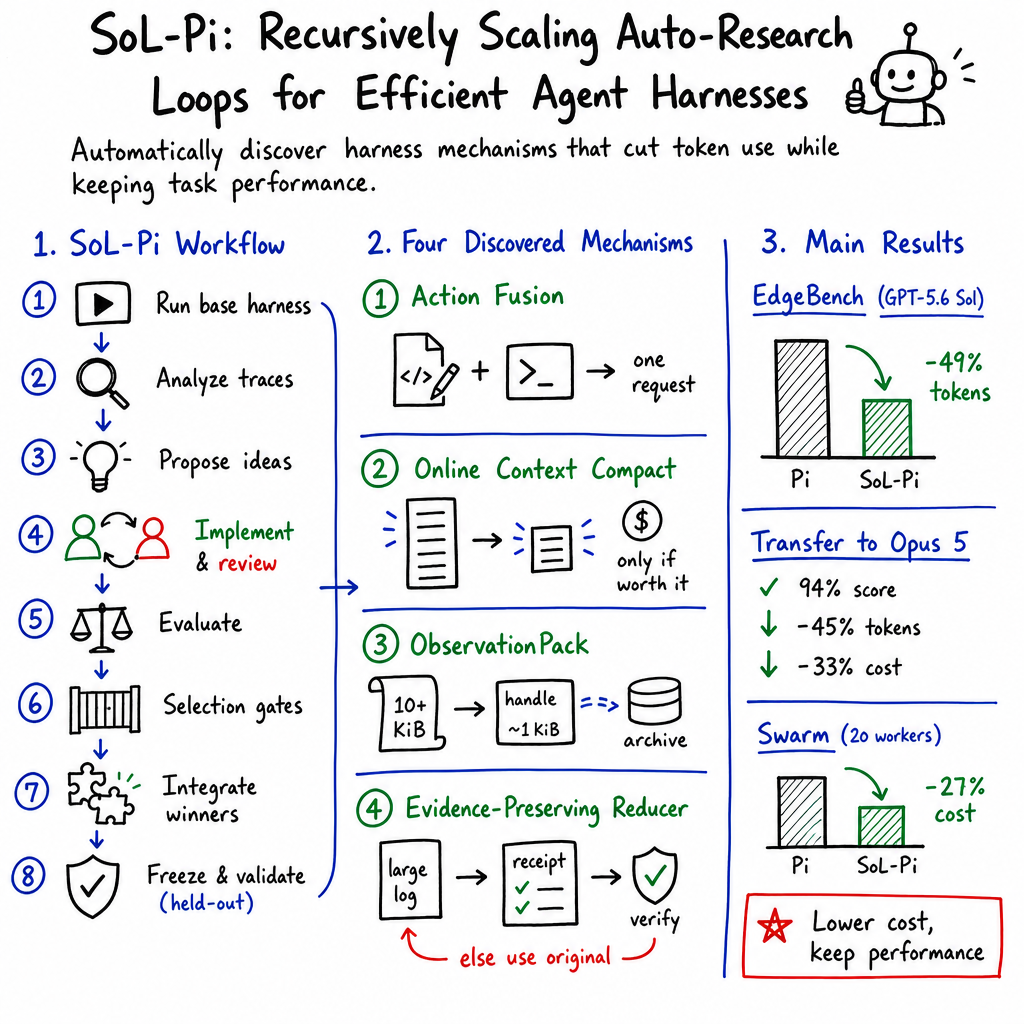
SoL-Pi uses AI-powered research loops to discover better ways for this harness to save tokens without making the agent worse at solving tasks.
2. What questions did the researchers ask?
The researchers mainly wanted to find out:
- Can an AI system automatically discover improvements to an agent’s harness?
- Can these improvements reduce the number of tokens used?
- Can they lower API costs while keeping the agent’s problem-solving ability?
- Do improvements discovered on one set of tasks also work on new tasks?
- Do the improvements still work when the underlying AI model is changed?
- Can several efficiency improvements work well together?
A major concern was overfitting. This happens when a system becomes very good at the exact practice problems it saw, but performs poorly on new problems. The researchers therefore kept their final test tasks separate from the tasks used while developing SoL-Pi.
3. How did the researchers conduct the study?
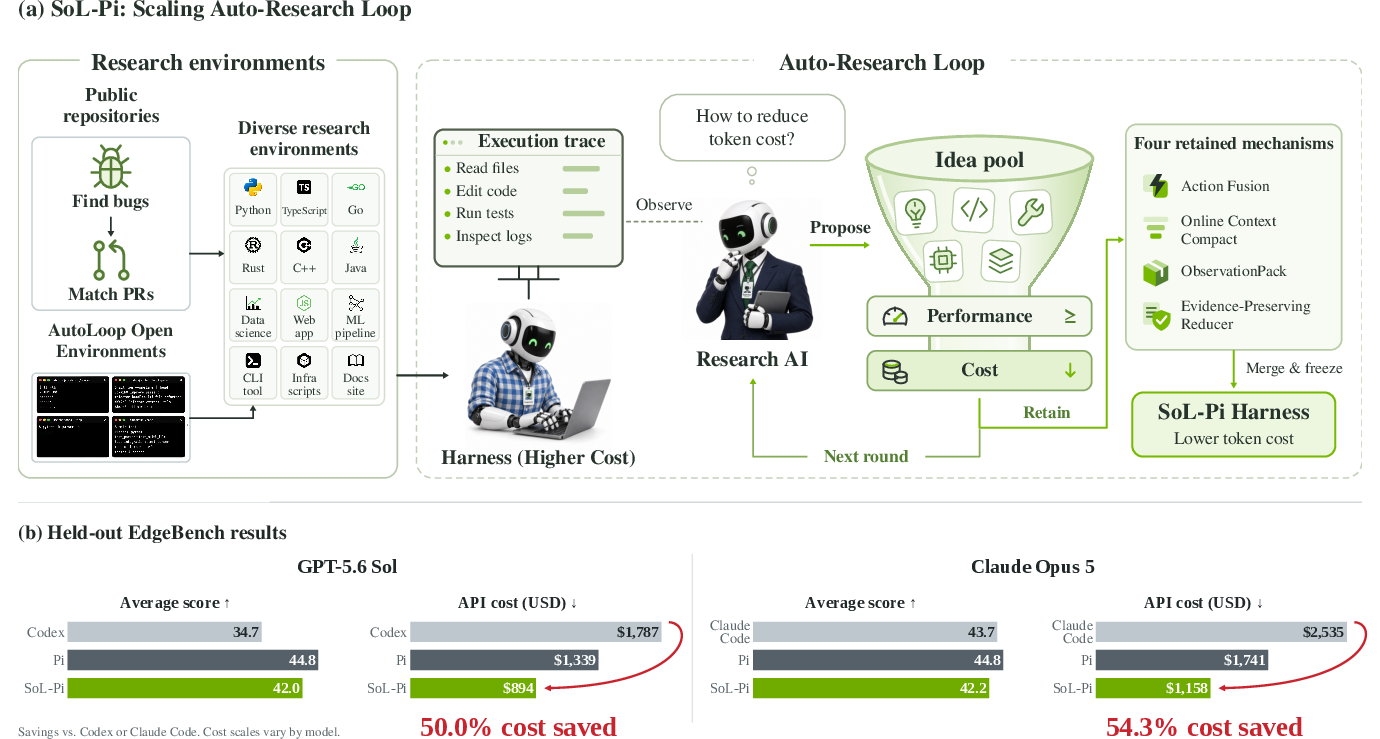
The auto-research process
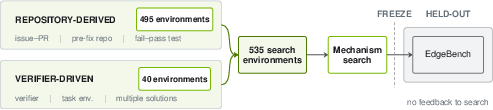
The researchers created a large collection of coding and computer-use environments. These were like practice playgrounds where the AI could try different ideas.
The process worked roughly like this:
- An AI researcher examined records of another AI agent solving tasks.
- It looked for repeated or wasteful actions.
- It suggested a possible improvement to the harness.
- The improvement was programmed and tested.
- The researchers checked whether it saved tokens without hurting performance.
- Weak ideas were discarded, while promising ideas were improved.
- The final version was tested only after it had been frozen.
This is similar to a science fair: researchers form many ideas, test them fairly, keep the successful ones, and then use new problems for the final test.
The researchers explored about 152 possible ideas, used around 535 development environments, and conducted more than 3,000 experiments.
How did they decide whether an idea was good?
Each proposed improvement had to pass two checks:
- Capability check: The agent still had to complete tasks successfully.
- Efficiency check: The change had to reduce at least one type of waste, such as tokens, model requests, or cost.
The final benchmark, called EdgeBench, was not used to improve the system. It was held back until the end, like a final exam that students have not seen before.
The four improvements in SoL-Pi
The research process produced four main mechanisms.
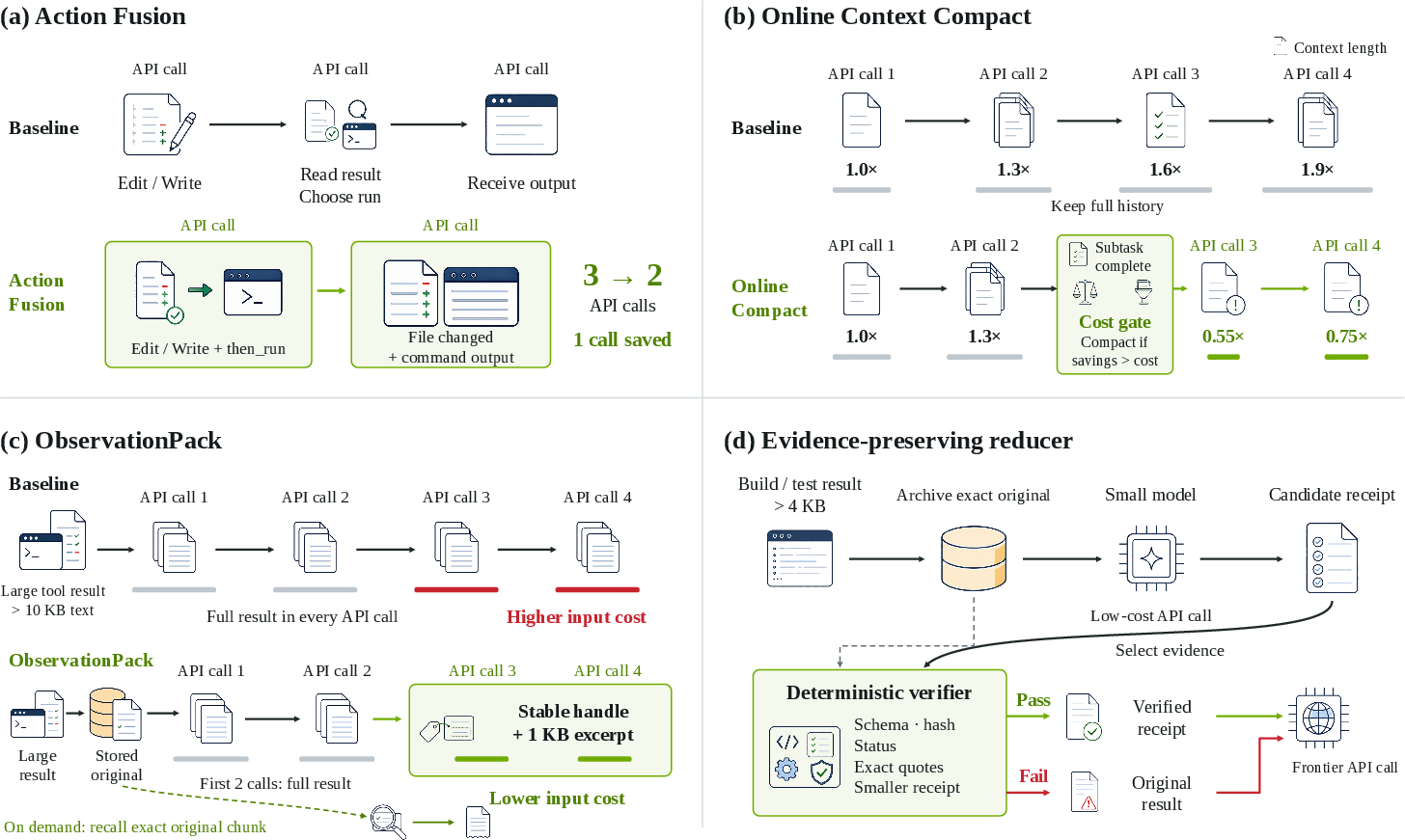
1. Action Fusion
Sometimes an agent edits a file and then sends a separate request to test or build the program.
Action Fusion combines these steps into one request when possible. It is like telling someone, “Change the light bulb and then check whether the light works,” in one instruction instead of sending two separate messages.
This can remove an unnecessary back-and-forth between the model and the computer.
2. Online Context Compact
An AI agent keeps a history of what it has seen and done. This history is called its context. As tasks become longer, the context can become very large.
Online Context Compact checks whether shortening this history would save more tokens than the shortening process costs. If so, it summarizes or compacts the earlier information.
It does not compact the context blindly. It tries to do so only when the expected savings are worthwhile.
3. ObservationPack
Tools can sometimes produce very large outputs, such as long test logs. The agent may not need to see the entire output again and again.
ObservationPack stores the full result separately. At first, it shows the agent the complete output, but later it sends only:
- a short beginning and ending,
- the original size,
- and a reference, or “handle,” that allows the agent to retrieve the complete result if needed.
This is similar to putting a large book in a library and giving someone a summary plus the book’s shelf location.
4. Evidence-Preserving Reducer
Build and test logs can also be very long. This mechanism uses a cheaper AI model to create a short summary containing the most important evidence.
A computer program then checks the summary. It verifies details such as:
- whether the test succeeded,
- whether quoted messages really appeared in the original log,
- whether the summary came from the correct file,
- and whether the summary is actually shorter.
If the summary seems unsafe or incorrect, the system keeps the original log instead.
4. What did the researchers find?
Large savings in tokens and money
On the 51-task EdgeBench evaluation, the complete SoL-Pi system used about 44.7% to 49.0% fewer tokens than the Pi harness.
It also reduced API costs by about one third, while achieving a similar overall task score.
For example, with the GPT-5.6 Sol model:
- Pi used about 2.15 billion recorded tokens.
- SoL-Pi used about 1.10 billion tokens.
- Pi cost about $1,339.
- SoL-Pi cost about $894.
- Pi’s average score was 44.8.
- SoL-Pi’s average score was 42.0.
SoL-Pi was slightly less successful on average in this efficiency-focused version, but it used far fewer tokens and cost much less.
The researchers also tested a performance-focused version. It achieved an average score of 47.2, higher than Pi’s 44.8, while still using slightly fewer tokens.
The improvements worked on another AI model
SoL-Pi was mainly developed using GPT-5.6 Sol. The researchers then tested it on a different model, Opus 5, without changing the harness.
On Opus 5, SoL-Pi:
- kept about 94% of Pi’s average score,
- reduced token usage by about 44.7%,
- and reduced API cost by about 33.5%.
This suggests that the improvements were not useful only for one particular model.
Results on other benchmarks
The researchers also tested SoL-Pi on other tasks.
On Terminal-Bench 4:
- Pi solved 18 out of 63 tasks.
- SoL-Pi solved 15 out of 63.
- SoL-Pi cost less overall and had a lower cost per solved task.
On six formal mathematics problems that had to be checked using Lean 4:
- SoL-Pi solved 3 problems.
- Pi also solved 3 problems.
- SoL-Pi had the lowest cost per solved problem.
These results show a trade-off: SoL-Pi did not always solve the largest number of tasks, but it often solved tasks more cheaply.
Results with groups of agents
The researchers also tested a team of 20 AI workers.
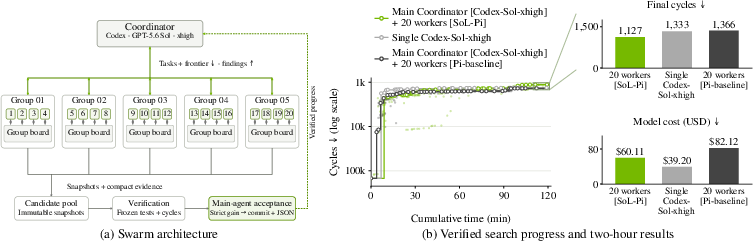
The SoL-Pi group achieved a better result than a group using the ordinary Pi harness, while costing about 26.8% less. This suggests that making each individual agent more efficient may also help larger teams of agents.
5. Why are these findings important?
AI agents are increasingly being used for long and complicated jobs. If an agent spends many tokens repeating information or sending unnecessary messages, the cost can become very high.
The paper shows that efficiency does not always require:
- building a larger AI model,
- training the model from scratch,
- or buying more powerful computers.
Instead, carefully changing how the agent uses tools, stores information, and handles results can make a large difference.
The study is also important because it uses separate development and testing tasks. This makes the results more believable: the system was not simply adjusted to memorize the final test.
6. What could this mean for the future?
SoL-Pi suggests that AI systems may eventually be able to improve the software that controls them. Rather than having humans design every part of an agent’s workflow, an AI researcher could test many possible designs and keep the most useful ones.
This could lead to:
- cheaper coding assistants,
- faster computer-using agents,
- more affordable teams of cooperating AI agents,
- and systems that improve their own efficiency over time.
However, the research is still an early step. The harness was mainly developed using one AI model, so it may not work equally well with every model. The researchers also need to test it on more tasks and in more real-world settings.
Overall, the paper’s main message is that smarter organization can make AI agents much cheaper and more efficient, even when the underlying AI model stays the same.
Knowledge Gaps
Knowledge gaps, limitations, and open questions
- Limited evaluation coverage: The main EdgeBench evaluation uses only 51 of 134 tasks, with 11 used for one-way acceptance and 40 for final evaluation; it remains unclear whether results hold across the unreleased tasks or the broader EdgeBench distribution.
- Small and heterogeneous held-out samples: Several evaluations are based on very small sets—six IMO problems, one kernel-optimization run per configuration, and 40 final EdgeBench tasks—making performance differences and generalization claims statistically uncertain.
- No uncertainty estimates: The paper reports point estimates for scores, token traffic, and API cost but does not provide confidence intervals, variance across random seeds, repeated runs, or significance tests.
- Potential benchmark contamination and temporal dependence: The paper does not establish whether the models, harnesses, or research environments had prior exposure to EdgeBench, Terminal-Bench, IMO 2026, or their associated repositories and solution patterns.
- Incomplete baseline comparisons: The study compares against selected native and third-party harnesses but does not systematically compare with other context-compression, tool-use, caching, delegation, or automated harness-optimization methods under matched models, prompts, budgets, and evaluation conditions.
- Unclear fairness of baseline configurations: The paper does not fully specify whether all competing harnesses received equivalent time limits, retry policies, context windows, tool permissions, model settings, temperature, system prompts, and infrastructure conditions.
- Single-model search dependence: Mechanism discovery is performed using trajectories from GPT-5.6 Sol, so it is unresolved whether the discovered mechanisms would differ when the search process uses other model families, model sizes, reasoning settings, or open-weight models.
- Narrow backend transfer evidence: Transfer is demonstrated primarily from GPT-5.6 Sol to Opus 5, leaving open whether SoL-Pi generalizes across additional providers, model architectures, context-window sizes, tool APIs, and pricing regimes.
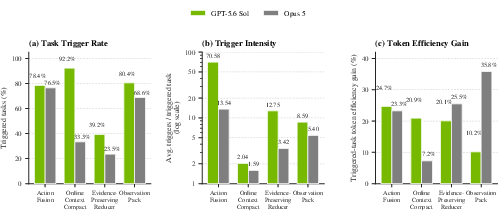
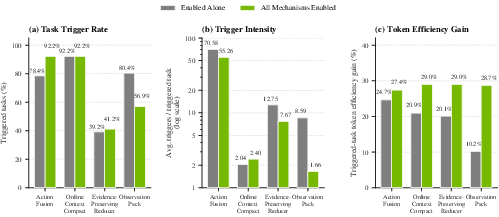
- Backend-specific mechanism behavior is unexplained: Trigger rates and intensities decrease under Opus 5, but the paper does not determine whether this reflects differences in reasoning style, prompt interpretation, tool-call behavior, context usage, or incompatibilities in the triggering logic.
- No systematic scaling law: Although the search uses approximately 152 directions, 535 environments, more than 3,000 runs, and over 60,000 interactions, the paper explicitly does not establish how performance changes with search breadth, search depth, environment count, or compute budget.
- Marginal value of additional research is unknown: The study does not report learning curves showing when additional candidate directions, environments, or refinement iterations stop producing useful mechanisms.
- Search-resource accounting is incomplete: The reported evaluation-time savings do not clearly include the full cost of auto-research, candidate implementation, reviewer calls, failed experiments, environment preparation, infrastructure, and human or engineering oversight.
- Cost results may be price-sensitive: API cost comparisons use prices from August 17, 2026, but the paper does not analyze how conclusions change under alternative model prices, cache pricing, local inference, rate limits, or future pricing changes.
- Recorded token traffic is not equivalent to total system cost: The analysis focuses on model tokens and API cost, while omitting or incompletely quantifying latency, CPU and GPU usage, storage, network traffic, auxiliary-model overhead, queueing, and human supervision.
- Latency and responsiveness are not evaluated: Mechanisms such as context compaction, evidence reduction, archival retrieval, and delegated reading may reduce tokens while increasing wall-clock latency; this trade-off is not reported.
- Auxiliary-model effects are underexplored: Evidence-Preserving Reducer invokes GPT-5.6 Luna, but the paper does not isolate the cost, latency, failure rate, and quality contribution of this model or test cheaper and stronger alternatives.
- Capability preservation is narrowly defined: Acceptance relies on predefined capability metrics and tolerances, but the paper does not show whether these metrics capture subtle regressions such as degraded solution quality, incomplete fixes, brittle behavior, reduced reliability, or poorer recovery from unexpected states.
- No task-level success distribution: Aggregate average scores can conceal failures concentrated in particular task types; per-task success rates, score distributions, and regressions are not sufficiently reported.
- Failure modes are not characterized: The paper does not provide a systematic taxonomy of cases where SoL-Pi loses capability, over-compresses evidence, misuses archived observations, applies an inappropriate fused action, or compacts context prematurely.
- Action Fusion safety is incompletely established: The mechanism combines mutations with follow-up commands, but its behavior under commands requiring intermediate inspection, failed mutations, partial execution, interactive programs, side effects, or nondeterministic environments remains unclear.
- ObservationPack retrieval behavior is unresolved: The paper does not quantify how often agents retrieve archived content, whether retrieval introduces extra turns or errors, or which task types are most vulnerable to relying on the excerpt rather than the full observation.
- ObservationPack’s fixed thresholds may not generalize: The 10 KiB archive threshold, two full requests, and 1 KiB excerpt are presented as fixed choices; their sensitivity across context windows, task domains, output formats, and models is not evaluated.
- Evidence compression may discard useful information: Deterministic verification checks schema, hashes, status, quotes, and size, but it does not establish semantic completeness or whether diagnostically important evidence absent from the receipt causes downstream errors.
- Reducer coverage is limited: Evidence-Preserving Reducer applies only to logs from a predefined command set and bypasses file reads and search results; the benefits and risks of extending it to other observation types remain unexplored.
- Context compaction quality is not directly measured: Online Context Compact uses projected token savings and native compaction, but the paper does not evaluate whether compaction preserves plans, constraints, commitments, error histories, or long-range dependencies.
- Cache accounting may depend on provider implementation: The context-compaction gate assumes particular cache rewrite and read-cost behavior; its effectiveness under different caching semantics, cache invalidation policies, or providers is unknown.
- Interactions among mechanisms are not causally isolated: The add-one ablation evaluates individual mechanisms, but there is no complete factorial study of all combinations, so complementarity, redundancy, and negative interactions cannot be identified reliably.
- Component comparisons use different triggered subsets: The paper acknowledges that triggered-task subsets differ across configurations; consequently, reported per-trigger efficiency gains cannot establish causal component effects without matched-task or counterfactual analyses.
- The “Performance” configuration is selected post hoc: The highest-scoring single mechanism is selected separately for each backend, which may overstate performance relative to a prespecified model-selection procedure and complicate fair comparison with the fixed complete stack.
- Selection bias in retained mechanisms is not quantified: The paper reports four mechanisms that survived the search but does not provide the full candidate-level distribution, rejection reasons, or holdout results for discarded candidates.
- Candidate evaluation may overfit development environments despite held-out validation: The large search set is used repeatedly for proposal refinement and selection; the paper does not report environment-level deduplication, repository-family separation, or tests for leakage across related tasks.
- Environment diversity is not fully characterized: Most search environments are repository-derived GitHub issue–pull request pairs, while only 40 are synthetic; the relevance of this mixture to non-software-engineering agents and open-ended environments remains uncertain.
- Verifier quality is a potential confound: Synthetic tasks depend on generated executable verifiers, but the paper does not measure verifier correctness, false positives, false negatives, or whether harness mechanisms exploit verifier artifacts.
- Human involvement is underspecified: The extent of human intervention in designing proposal families, defining metrics and tolerances, preparing environments, debugging candidates, and selecting configurations is not clearly separated from autonomous discovery.
- Reproducibility is incomplete: The paper does not provide enough detail about prompts, model versions and snapshots, random seeds, full configurations, environment manifests, failed runs, or exact API-call accounting to independently reproduce all results.
- Robustness under adversarial or malformed observations is unknown: The mechanisms are not evaluated against misleading logs, extremely large outputs, corrupted archives, hostile repository content, prompt injection, or tools that return unexpected schemas.
- Security and privacy implications are unexamined: Local archiving and stable observation handles may retain sensitive command output or credentials, but retention policies, access controls, deletion behavior, and leakage risks are not discussed.
- Long-horizon stability is not established: Evaluations use bounded tasks and time budgets; it remains unknown whether repeated compaction, archiving, reducer fallback, and fused actions remain reliable over substantially longer autonomous runs.
- Multi-agent benefits are based on a single swarm experiment: The swarm result uses one two-hour run per configuration, preventing conclusions about reproducibility, scaling with worker count, coordinator quality, communication overhead, or performance across other collaborative tasks.
- Worker and coordinator effects are confounded: The swarm experiment changes both the harness and the resulting interaction patterns, but does not isolate whether gains arise from lower worker cost, altered worker behavior, reduced communication, or coordinator-level effects.
- Quality–efficiency trade-offs are not optimized under a unified objective: The acceptance rule requires preserving capability within fixed tolerances and improving at least one efficiency metric, but the paper does not study alternative Pareto objectives, user-specific quality thresholds, latency constraints, or risk-sensitive utility functions.
- The durability of discovered mechanisms is unknown: The paper does not test whether mechanisms continue to perform after model updates, API changes, altered tool schemas, new task distributions, or changes in cache and pricing infrastructure.
- Recursive improvement remains hypothetical: The proposed use of SoL-Pi to build a successor harness is not evaluated, so it is unknown whether reduced evaluation cost actually leads to compounding improvements or instead amplifies search bias and error accumulation.
- No evidence establishes that scaling produces sustained gains: The conclusion frames “pre-training the harness” as a future direction, but the paper does not show whether increasing environment and idea diversity yields monotonic, transferable, or diminishing returns.
Practical Applications
Immediate Applications
- Lower-cost autonomous software engineering (software industry). Deploy SoL-Pi-style harness components in coding agents for repository maintenance, bug fixing, testing, refactoring, and dependency upgrades.
Action Fusioncan combine file edits with subsequent build or test commands, whileObservationPackandEvidence-Preserving Reducerreduce repeated transmission of large logs and tool outputs. Dependency: The agent must expose compatible mutation and follow-up tools, and exact archived outputs must remain retrievable. Cost savings may vary with model pricing, task type, and trigger frequency. - Token- and API-cost optimization for existing agents (AI infrastructure and SaaS). Add the four mechanisms as a middleware layer around existing agent frameworks rather than retraining the underlying model. The reported results indicate approximately 44.7–49.0% lower recorded token traffic and roughly one-third lower API cost relative to the Pi baseline, with broadly comparable task performance in the evaluated setting. Dependency: The system needs access to prompt construction, caching, tool-result processing, and context-compaction stages. Production users should validate quality and cost on their own workloads rather than assume benchmark-level savings.
- Efficient CI/CD and automated debugging workflows (software engineering). Integrate the Evidence-Preserving Reducer into continuous integration pipelines to convert long build and test logs into compact, verifiable “receipts” containing exit status, source hashes, exact quotations, and structured evidence. Agents can then diagnose failures without repeatedly consuming the complete logs. Dependency: Deterministic verification, secure log archiving, and a reliable fallback to the original log are essential. Sensitive credentials and secrets must be redacted or blocked before delegation to an auxiliary model.
- Long-running terminal and repository agents (developer tooling). Use
ObservationPackto archive large command outputs locally and expose stable handles, excerpts, and on-demand retrieval. This is immediately useful for package installation, test execution, data processing, infrastructure management, and command-line troubleshooting. Dependency: Handle storage must be durable and access-controlled, and the agent must be capable of requesting exact pages when an excerpt is insufficient. - Adaptive context management for productivity assistants (enterprise software and daily life). Apply Online Context Compact at task or plan-step boundaries to decide whether rewriting the context will save more tokens than it costs. Potential products include meeting assistants, document-analysis tools, research assistants, and personal task agents that operate over extended sessions. Dependency: The cost gate must be calibrated to the provider’s cache-read, cache-write, and context-rewrite prices. Over-aggressive compaction could remove information needed for later decisions, so quality checks and near-limit fallbacks are required.
- Cost-controlled agent swarms (software optimization and engineering research). Use the SoL-Pi mechanisms in multi-agent systems in which workers independently explore solutions and share verified findings. The paper’s kernel-optimization experiment suggests that more efficient workers can reduce swarm API costs while retaining collaborative search capability. Dependency: A coordinator, isolated workspaces, shared evidence boards, immutable candidate snapshots, and independent correctness verification are needed. Swarm overhead may outweigh savings for small or short-lived tasks.
- Efficient formal reasoning and verification workflows (education, mathematics, and formal methods). Apply compacted contexts and evidence-preserving outputs to Lean 4 development, theorem proving, automated grading, and formal verification. The evaluation demonstrates lower cost per passed IMO problem, although not higher success than the strongest baseline in every comparison. Dependency: Exact proof states and compiler messages must remain available; compression should never replace authoritative formal verification.
- Reproducible evaluation of agent systems (academia). Researchers can adopt the paper’s broad-to-deep search methodology: fixed capability metrics, predeclared tolerances, independent development lineages, nondominated candidate selection, and a fully held-out final benchmark. This provides a practical workflow for testing whether agent-harness improvements generalize rather than overfit development tasks. Dependency: Held-out tasks must remain inaccessible to the optimization loop, and all costs, model versions, prompts, and activation statistics should be logged.
- Operational monitoring and budgeting for deployed agents (industry and public-sector IT). Track total task cost, cache reads and writes, context-compaction frequency, reducer fallback rate, trigger intensity, quality outcomes, and cost per successful task. These metrics can support routing, budget controls, and automatic selection between performance-oriented and efficiency-oriented harness configurations. Dependency: Organizations need reliable telemetry and task-level success measures; token reduction alone is not sufficient if it increases failures or human review costs.
- Open-source reusable agent middleware (developer ecosystem). Package the mechanisms as framework plugins for coding agents and terminal agents, with configurable thresholds such as the 10 KiB observation boundary and 4 KiB log-reduction boundary. This could produce tools for local archiving, verified summaries, adaptive compaction, and combined edit-and-test calls. Dependency: The implementation must be adapted to different APIs, model providers, cache semantics, operating systems, and security policies.
Long-Term Applications
- “Pretraining” or continual training of general-purpose agent harnesses (AI research and industry). Scale the SoL-Pi auto-research loop across much larger and more diverse collections of executable environments to create harnesses that improve before deployment across software, research, operations, and reasoning tasks. The resulting workflow could function as a reusable harness-development pipeline rather than a one-off optimization experiment. Dependency: Larger-scale search requires substantial compute and API budgets, robust automatic verifiers, diverse tasks, and strict separation between development and final evaluation. The paper explicitly presents this as a hypothesis rather than an established scaling law.
- Multi-backend and model-agnostic harness optimization (AI platforms). Train and validate harness mechanisms across multiple model families, providers, context-window designs, and pricing structures. A future system could select activation policies dynamically based on model behavior, backend latency, cache economics, and task characteristics. Dependency: The current harness was optimized primarily from one model backend; lower activation rates on Opus 5 indicate that transfer is promising but incomplete. Multi-backend optimization may require model-specific calibration or learned routing.
- Self-improving agent development platforms (recursive AI systems). Use an efficient harness to reduce the cost of the next auto-research cycle, creating a controlled loop in which agents propose, implement, test, review, and integrate improvements to their own orchestration software. Potential products include autonomous agent-platform engineering systems and continuously optimized enterprise automation stacks. Dependency: Recursive modification requires sandboxing, version control, rollback, independent evaluation, access controls, and immutable acceptance criteria. Without these safeguards, the system could optimize cost at the expense of reliability or safety.
- Autonomous scientific research assistants (academia, pharmaceuticals, and R&D). Apply long-horizon harnesses to literature review, experiment planning, code execution, simulation, data analysis, and hypothesis testing. Evidence-preserving reductions could maintain traceable experimental results while limiting repeated transmission of large datasets, logs, and reports. Dependency: Scientific use requires provenance, uncertainty reporting, domain validation, reproducibility, and human approval for consequential decisions. Compact evidence must not obscure negative results or methodological limitations.
- Robotics and embodied-agent control (robotics and manufacturing). Adapt Action Fusion and observation management to combine compatible control actions with immediate checks, while compressing repetitive sensor or diagnostic data and retaining exact records on demand. This could reduce communication and inference costs in warehouse robots, industrial inspection, and field systems. Dependency: Real-time safety constraints, latency, actuator semantics, sensor fidelity, and deterministic fallback behavior are more stringent than in software tasks. Any fused action must be proven safe before deployment.
- Healthcare workflow agents (healthcare administration and clinical decision support). Use verified evidence receipts and adaptive context management for long patient-record reviews, medical coding, prior authorization, literature synthesis, and clinical documentation. Exact source fragments could remain retrievable while the active context contains only relevant evidence. Dependency: This requires privacy-preserving storage, regulatory compliance, auditability, clinician oversight, and rigorous validation against information omission and hallucination. The paper does not evaluate medical data or clinical safety, so this remains a development direction.
- Energy and infrastructure operations (energy, telecommunications, and cloud operations). Deploy agents that monitor logs, execute maintenance procedures, summarize repeated diagnostics, and coordinate remediation across long-running infrastructure tasks. Reduced context and API traffic could lower operational costs in data centers and distributed systems. Dependency: Agents need strict permission boundaries, reliable simulators or digital twins, deterministic rollback, and human escalation for unsafe or irreversible actions.
- Education and personalized tutoring (education technology). Build long-session tutors that retain compact, evidence-linked learning histories rather than resending entire interaction logs. The harness could decide when to summarize a student’s progress and when to retrieve exact prior work. Dependency: Educational quality requires protection against losing misconceptions or important context, age-appropriate safeguards, teacher controls, and assessment beyond token cost.
- Policy and public-sector procurement standards for agent efficiency (policy and governance). Establish evaluation protocols requiring agents to report cost per successful task, total token traffic, cache behavior, failure rates, and generalization to unseen tasks. The paper’s held-out validation design could inform procurement criteria for government-use coding, analysis, and administrative agents. Dependency: Metrics must be standardized across providers and should include labor, infrastructure, energy, privacy, and error-correction costs—not only API expenditure.
- Carbon- and energy-aware agent orchestration (sustainability and cloud computing). Combine harness-level token reduction with carbon-intensity-aware scheduling, model routing, and context policies. Lower token traffic could reduce inference demand, particularly for unattended research loops and agent swarms. Dependency: The paper measures API cost and tokens, not energy or emissions. Real environmental benefits require measurements of provider infrastructure, hardware utilization, caching, and workload displacement.
Glossary
- Action Fusion: A mechanism that combines a file mutation with a subsequent command into one tool request. “Action Fusion combines both actions into one tool request and returns their outcomes in a single observation”
- Agent harness: The software layer that manages an agent’s interaction with its model, tools, context, and environment. “improving token use through the agent harness that mediates interactions between the model and its environment”
- Agent swarm: A coordinated collection of agents that collaborate on a shared task. “We evaluate SoL-Pi in a multi-agent kernel-optimization experiment measured in simulated machine cycles”
- API cost: The monetary cost charged for requests made to a model-serving interface. “Token efficiency is measured as API cost per unit of aggregate task score”
- Auto-research loop: An iterative process in which an AI proposes, implements, evaluates, and refines system changes. “The research AI observes execution traces from a separate agent running the base harness, proposes candidate changes, and tests them in prepared research environments.”
- Cache rewrite: The process of replacing or reconstructing a previously stored prompt-cache entry after context changes. “The cost gate compares projected input savings with the estimated extra cost of rewriting the prompt cache.”
- Capability metric: A quantitative measure of whether an agent can still perform its required task after an optimization. “Before experimentation begins, capability metrics, acceptable tolerances, and efficiency metrics are fixed and remain unchanged throughout the search.”
- Cache-read traffic: Tokens retrieved from a previously written model prompt cache. “the complete stack reduces cache-read traffic from 2.1326~B to 1.0605~B tokens”
- Cache-write traffic: Tokens written into a model prompt cache for possible reuse. “cache-write traffic increases from 0.0141~B to 0.0316~B”
- Candidate freeze: The point at which a proposed system change is fixed so that it can undergo independent evaluation. “The harness and acceptance rule are frozen before evaluation.”
- Context compaction: Reducing the size of an agent’s accumulated interaction context while retaining information needed for future decisions. “Online Context Compact uses plan-step completion to reconsider when to compact the context.”
- Context window: The maximum amount of input and output context a LLM can process in a request. “It caps this estimate by the requests that would fill the current context window at the observed growth rate.”
- Delegated reading: Using an auxiliary model or process to summarize or extract information from tool outputs for the primary agent. “They target action execution, context management, observation storage, and delegated reading, respectively”
- Deterministic verifier: A verification procedure that produces reproducible results according to fixed rules rather than subjective judgment. “A deterministic verifier checks the receipt's schema, source hash, exit status, exact quotes, and size.”
- Development environment: An executable task setting used to build and test candidate mechanisms during system development. “To qualify for acceptance, a mechanism must improve efficiency beyond a single development environment while preserving the agent's ability to complete the required work.”
- Disposable lineage: An isolated, temporary experimental branch whose modified orchestration code is discarded after the experiment. “We run each independent search as a disposable instance of a shared skill template”
- EdgeBench: The benchmark used in the paper for evaluating agent-harness performance and efficiency. “On the 51-task EdgeBench evaluation, SoL-Pi achieves performance comparable to Pi”
- Efficiency gate: A selection criterion requiring a candidate to improve at least one predefined efficiency measure. “the candidate must improve at least one declared efficiency metric”
- Evidence-Preserving Reducer: A mechanism that compresses tool output while retaining verifiable evidence and reverting to the original when verification fails. “Evidence-Preserving Reducer compresses build and test logs of at least 4~KiB from a predefined set of commands.”
- Execution trajectory: The chronological record of an agent’s actions, observations, model interactions, and outcomes. “The research agent analyzes execution trajectories from the base harness to identify recurring sources of overhead”
- Fallback: A predefined alternative behavior used when an optimization cannot be safely applied. “The harness falls back to the original log if verification fails, credentials are suspected, or the receipt provides no size reduction.”
- Foundation model: A broadly trained model that can be adapted to perform many downstream tasks. “Advances in foundation models enable agents to tackle increasingly open-ended tasks”
- Held-out validation: Evaluation on data or tasks deliberately excluded from the optimization or development process. “Held-out results never feed back into the Auto-Research Loops”
- Hyperparameter: A configuration value selected or refined outside the ordinary execution of a model or algorithm. “we combine retained mechanisms into SoL-Pi and refine its hyperparameters and implementation while preserving capability.”
- Immutable candidate snapshot: A fixed version of a candidate that cannot be changed after submission for verification. “The shared best result is updated only when the coordinator submits an immutable candidate snapshot”
- Independent validation: Evaluation performed separately from the search process to reduce overfitting and biased feedback. “These findings motivate a clear separation between search feedback and final evaluation”
- Kernel optimization: The improvement of low-level computational routines to reduce runtime or resource usage. “We evaluate SoL-Pi in a multi-agent kernel-optimization experiment measured in simulated machine cycles”
- Lean 4: A theorem-proving and formal-programming language used to express and verify mathematical proofs. “requiring each solution to be formalized and verified in Lean 4”
- Long-horizon task: A task requiring an agent to perform many sequential actions over an extended interaction period. “These design choices become increasingly consequential in long-horizon tasks”
- Model backend: The particular LLM and serving configuration underlying an agent system. “To test transfer, we apply SoL-Pi, developed with GPT-5.6 Sol, to Opus 5 without further search or adaptation.”
- Nondominated result: A candidate that is not strictly worse than another candidate across all evaluated objectives. “Among candidates that pass both gates, the pipeline retains the nondominated results under the declared metrics.”
- Observation boundary: The interface boundary at which environment outputs are captured, transformed, or presented to the agent. “ObservationPack originates from two context hypotheses but ultimately modifies the observation boundary.”
- ObservationPack: A mechanism that archives large tool outputs and replaces repeated transmissions with handles and excerpts. “From the third request onward, it substitutes a stable handle, the original size, and a short excerpt of complete head and tail lines.”
- Oracle Analysis: An analysis stage that examines prior execution traces to identify avoidable work and promising optimization directions. “Before rollout budgets are assigned, Oracle Analysis examines existing development trajectories to identify avoidable work in the base harness.”
- Pareto frontier: The set of solutions that are not dominated when evaluated across multiple objectives. “maintaining a Pareto frontier over task performance and context cost”
- Prompt cache: Stored model-input content that can be reused across requests to reduce repeated processing or cost. “Shortening context can reduce prompt-cache reuse when it changes a previously cached prefix”
- Recursive self-improvement (RSI): A process in which a system improves the procedure or system used to produce subsequent improvements. “We take an RSI-inspired approach at the harness layer”
- Regression test: A test that checks whether previously fixed functionality remains correct after a change. “The pull request and regression test are hidden from the agent.”
- Repository-derived environment: An executable task environment constructed from a real software repository and a historical issue–patch pair. “Each environment pairs a GitHub issue with its pre-fix repository state and offline dependencies”
- Ralph Loop: An iterative implementation procedure in which a candidate is repeatedly refined until it satisfies an explicit completion condition. “We extend this cycle with an iterative implementation loop based on the Ralph Loop”
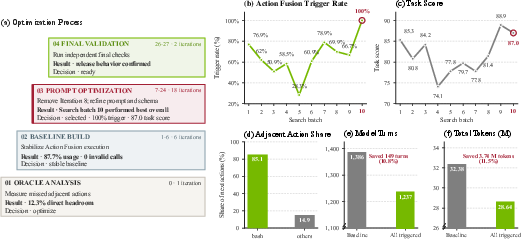
- Search lineage: An isolated sequence of experiments tracing the development of one candidate idea. “the recorded lineage spans 27 iterations across four stages”
- Synthetic task: An artificially constructed task with a programmatic success condition rather than a naturally occurring software issue. “40 synthetic tasks with executable success verifiers”
- Token efficiency: The amount of task performance achieved per unit of model-token usage or cost. “Token efficiency is measured as API cost per unit of aggregate task score.”
- Token traffic: The total number of input, cached, and output tokens processed during execution. “while reducing recorded token traffic by 44.7--49.0\%”
- Trigger intensity: The average number of times a mechanism activates among tasks where it activates at least once. “trigger intensity is the mean number of activations per triggered task”
- Trigger rate: The fraction of tasks on which a mechanism activates. “Trigger rate is the fraction of tasks on which a mechanism activates”
- Verifier-driven environment: A task environment whose success is determined by an executable verifier rather than a reference solution trajectory. “Verifier-driven environments allow multiple solution paths under executable success criteria.”

