ScientistTwo: Pioneering the Human Knowledge Frontier with Autonomous AI
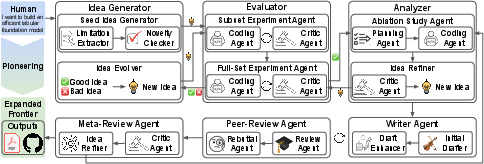
Abstract: Scientific discovery is defined by the ability to identify the boundaries of existing knowledge and venture into unexplored territory. The ultimate vision for AI in science is problem-driven autonomous research: given a fundamental challenge by a human expert, the AI independently navigates the scientific landscape, uncovers theoretical and empirical bottlenecks, and systematically expands the frontier of knowledge. In this paper, we introduce ScientistTwo, a fully autonomous multi-agent framework designed to realize this vision. Specifically, ScientistTwo takes an initial problem as input, establishes state-of-the-art baselines, formulates novel hypotheses, and coordinates specialized agents to orchestrate an end-to-end discovery cycle without human intervention. Moreover, the framework rigorously conducts experiments using diverse datasets and metrics, refines methodologies through automated ablation studies, and validates research findings via a closed-loop simulated peer-review rebuttal engine. To evaluate ScientistTwo's capabilities against the highest standards of human scientific achievement, we benchmark it across papers accepted at top-tier conferences such as ICLR, ICML, and NeurIPS. As a result, ScientistTwo autonomously generates expert-level, publishable papers and fully verified, executable codebases. Its solutions consistently outperform human state-of-the-art models, and achieve higher average review ratings than human-authored papers under automated AI review agents. These results show that ScientistTwo is not merely an assistive tool but an autonomous scientific pioneer capable of pushing the frontiers of human discovery. Project website: https://scientist-two.github.io/

Paper Prompts
Sign up for free to create and run prompts on this paper.
Top Community Prompts
Explain it Like I'm 14
1. What is the paper about?
This paper introduces ScientistTwo, an artificial intelligence system designed to carry out scientific research with very little human help.
A human gives the system a research problem, such as “How can we make a LLM more accurate?” ScientistTwo then tries to:
- Find weaknesses in existing research
- Think of new solutions
- Write computer code to test those solutions
- Run experiments
- Improve its ideas
- Write a research paper
- Pretend to be peer reviewers and respond to criticism
The authors describe ScientistTwo as a team of specialized AI workers. Each AI worker has a different job, similar to how a real research team might include programmers, scientists, experimenters, and editors.
2. What questions does the research ask?
The paper mainly asks whether AI can do more than help human researchers with small tasks. It asks whether AI can complete a large part of the research process on its own.
The main questions are:
- Can ScientistTwo find better methods than existing human-designed methods?
- Can it test ideas carefully using different datasets and measurements?
- Can it learn from failed experiments and improve its ideas?
- Can it understand which parts of a new method actually make it work?
- Can it write papers that receive good evaluations from AI reviewers?
- Can it produce working and repeatable computer code?
In simple terms, the researchers want to know whether ScientistTwo can act like an independent junior scientist—or even a complete research team.
3. How does ScientistTwo work?
ScientistTwo follows a series of steps. The process is similar to trying different inventions, testing them, fixing them, and then writing a report about the best one.
Step 1: Find weaknesses in existing research
First, ScientistTwo examines an existing “state-of-the-art” method. This means the best known method for solving a particular problem.
It looks for limitations, such as:
- The method being too slow
- The method working poorly on some types of data
- The method depending on unrealistic assumptions
- The method having parts that may not be necessary
It then creates possible ideas for fixing these weaknesses.
Step 2: Test ideas on a small amount of data
Testing every idea on every possible example would take a lot of time and computer power. Therefore, ScientistTwo first tests ideas on a smaller part of the dataset.
This is like testing a new bicycle on a quiet street before entering a major race.
Ideas that clearly perform badly are discarded. Ideas that look promising are improved or tested more carefully.
Step 3: Test the best ideas fully
Promising ideas are then tested using the complete benchmark. A benchmark is a standard test used to compare different methods fairly.
ScientistTwo compares its new method with the original human-designed method. If the new method does not perform better, it is rejected or changed.
Step 4: Improve ideas using experiment results
ScientistTwo keeps records of what happened in earlier experiments. It uses those records to create better versions of its ideas.
This is similar to learning from mistakes:
- If an idea worked well, the system tries to strengthen it.
- If an idea failed, the system studies why it failed.
- It also tries new ideas so that it does not focus too narrowly on one approach.
Step 5: Perform ablation studies
An ablation study means removing parts of a method one at a time to see what each part contributes.
For example, imagine a cake recipe with flour, sugar, eggs, and chocolate. An ablation study would make versions of the cake without one ingredient at a time. If removing chocolate makes little difference, chocolate may not be important.
ScientistTwo uses this process to discover which parts of its method are actually responsible for improvements.
Step 6: Write and review the paper
After choosing the best method, ScientistTwo writes a research paper.
The system then uses several AI agents to imitate academic peer review:
- A reviewer agent searches for problems in the paper.
- A rebuttal agent tries to answer those criticisms by running more experiments.
- A paper editor agent updates the paper.
- A meta-review agent decides whether the final paper is good enough.
This cycle can repeat several times, much like a student revising an essay after receiving feedback from a teacher.
4. What did the researchers find?
The researchers tested ScientistTwo on 107 research problems taken from papers published or accepted at major machine-learning conferences, including ICLR, ICML, and NeurIPS.
The paper reports several important results.
Better performance on many tasks
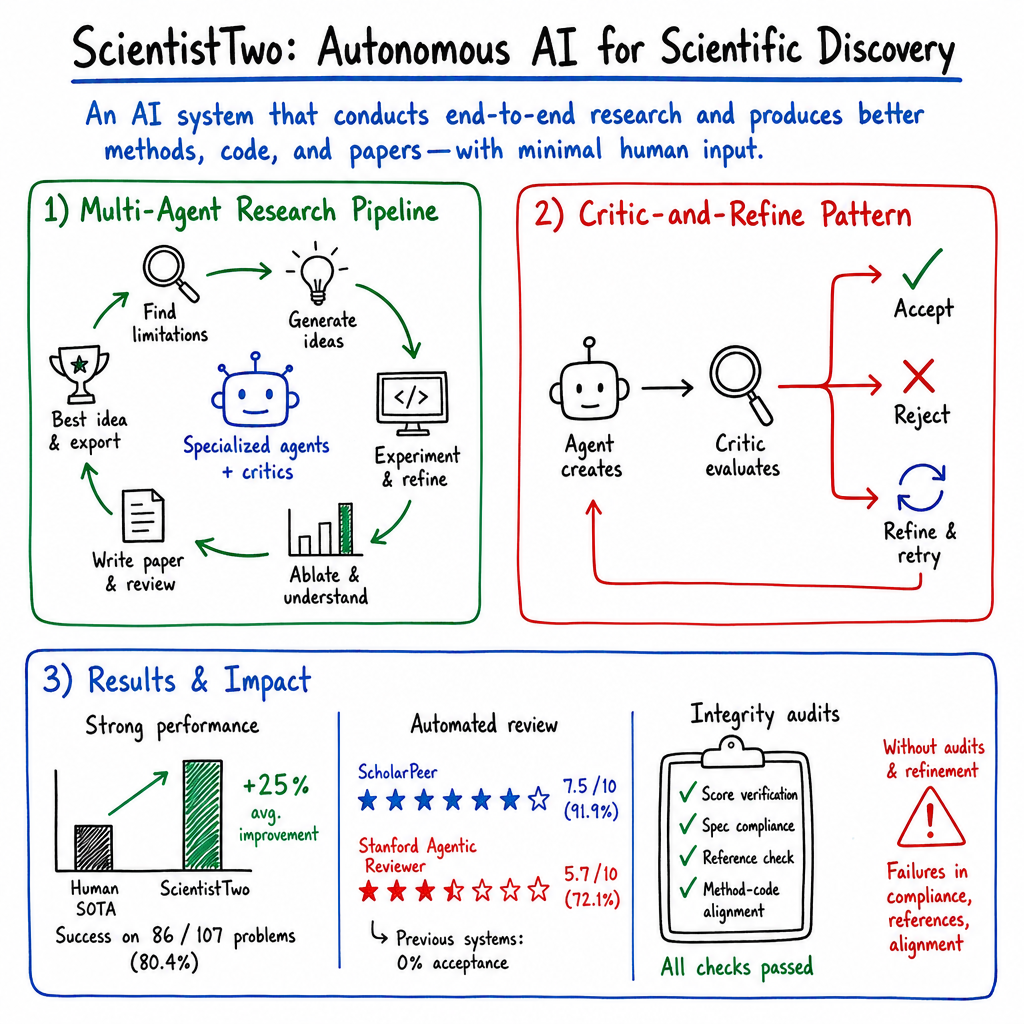
ScientistTwo successfully improved the human-designed method on 86 out of 107 problems. This is an 80.4% success rate.
Across the successful cases, the new methods showed an average improvement of 25.2% compared with the original methods.
This suggests that ScientistTwo was often able to discover useful changes rather than merely copy existing work.
Stronger results than earlier AI research systems
The researchers compared ScientistTwo with other systems that also try to conduct research automatically.
ScientistTwo received higher scores from the paper-reviewing AI systems:
| System | Average score from ScholarPeer | Acceptance rate |
|---|---|---|
| ScientistOne | 3.8 out of 10 | 14.3% |
| ScientistTwo | 7.5 out of 10 | 91.9% |
A second reviewer, called the Stanford Agentic Reviewer, gave ScientistTwo an average score of 5.7 out of 10, with 72.1% of its papers meeting that reviewer’s acceptance standard.
More detailed experiments
The paper says that ScientistTwo produced broader experiments than earlier systems. For example, it used:
- More datasets
- More measurements
- More comparisons with other methods
- More tables and figures
- More ablation studies
This is important because a method that works only in one special situation may not be truly useful. Testing many situations gives researchers more confidence in the result.
Peer-review feedback improved the papers
The researchers also tested what happened when ScientistTwo used its simulated review-and-rebuttal process.
Without this process, the system received weaker scores. After one or two rounds of review and extra experiments, the scores became higher.
This suggests that criticism and revision helped ScientistTwo produce clearer and more complete papers.
5. Why are these findings important?
If the results are reliable, ScientistTwo could change how scientific research is done.
A research team might use a system like this to:
- Explore many ideas quickly
- Run experiments continuously
- Find useful improvements humans might overlook
- Reduce the amount of routine programming
- Help researchers study difficult problems more efficiently
For example, scientists could spend more time choosing important problems and checking whether the results make sense, while the AI handles many experiments and revisions.
The system could also make research more accessible. A small research group might be able to test as many ideas as a much larger laboratory with more programmers and computers.
Important limitations and cautions
The paper makes very strong claims, but its results should be interpreted carefully.
First, the papers were mainly judged by AI reviewers, not only by human experts. AI reviewers can make mistakes and may reward certain writing styles without fully understanding whether the scientific ideas are correct.
Second, the system was tested mostly on machine-learning research problems. It is not yet clear whether it could conduct reliable research in areas such as medicine, chemistry, biology, or physics.
Third, ScientistTwo uses a large amount of computing power and depends on powerful AI models. This could make it expensive to operate.
Fourth, improving a score on a benchmark does not always mean that the method has made a deep scientific discovery. A system might find a clever technical trick without truly explaining why it works.
Finally, the paper’s claims would be stronger if independent researchers repeated the experiments and confirmed the results. Scientific discoveries become more trustworthy when other people can reproduce them.
Conclusion
ScientistTwo is an AI system that attempts to complete the full research process: finding problems, inventing ideas, writing code, running experiments, improving methods, and writing papers.
The paper reports that it improved existing methods on most of the 107 tasks it tested and produced papers that received high scores from automated reviewers. Its most important feature is its repeated cycle of testing, learning from mistakes, performing extra experiments, and revising its work.
If future studies confirm these findings, systems like ScientistTwo could become powerful research assistants or even partly independent research teams. However, humans would still need to choose meaningful questions, check whether the results are truly correct, and consider the ethical and social effects of using AI in science.
Knowledge Gaps
Knowledge gaps, limitations, and open questions
- The paper does not provide the complete benchmark specification for all 107 tasks, including task-selection criteria, dataset identities, baseline versions, data splits, and preprocessing procedures, making the evaluation difficult to independently reproduce.
- It is unclear whether the 107 benchmark problems were selected retrospectively because they were especially suitable for automated improvement, creating possible selection bias and limiting generalization to problems outside top-tier machine-learning papers.
- The evaluation is concentrated on machine-learning research, despite claims about autonomous scientific discovery across broad domains such as neuroscience, robotics, speech, and theory; performance on genuinely non-ML scientific problems remains untested.
- The system is evaluated primarily on problems with existing codebases, datasets, metrics, and human state-of-the-art baselines. Its ability to formulate and investigate problems lacking these resources is unresolved.
- The paper does not establish that ScientistTwo produces genuinely novel scientific contributions rather than combinations, adaptations, or rediscoveries of methods present in its training data or retrieved literature.
- The novelty-checking procedure is not formally defined or validated against expert judgments, so the reliability of the reported “novelty scores” is unknown.
- The paper does not report human expert assessments of novelty, correctness, significance, or scientific insight; automated review scores alone cannot establish expert-level scientific discovery.
- The claimed improvements over human baselines are not supported by statistical significance tests, confidence intervals, effect-size analyses, or repeated trials across random seeds.
- The reported relative gains may be affected by hyperparameter tuning, repeated experimentation, or selective reporting, but the paper does not quantify or control for these sources of multiple-comparison and researcher-degree-of-freedom bias.
- The method evaluates candidate ideas on benchmark subsets before full datasets, but it does not show how representative those subsets are or measure the rate at which subset performance incorrectly predicts full-set performance.
- The procedure for choosing benchmark subsets, including whether the agent can adapt them during experimentation, is unspecified and could introduce evaluation leakage or overfitting.
- The paper does not clearly distinguish improvements due to new algorithmic ideas from gains caused by hyperparameter optimization, implementation changes, additional compute, data augmentation, or improved training procedures.
- Comparisons with human state-of-the-art methods may not be compute-, data-, or tuning-budget matched; the effect of ScientistTwo’s additional search and experimentation budget is therefore unresolved.
- The computational cost, wall-clock time, token usage, GPU/TPU consumption, and monetary cost of the complete pipeline are not reported in sufficient detail to assess practical feasibility.
- The paper does not analyze the relationship between resource expenditure and performance gain or compare ScientistTwo with equally resourced human or automated baselines.
- The ablation studies evaluate selected pipeline components, but they do not provide a complete factorial analysis of interactions among idea generation, subset screening, evolution, ablation, rebuttal, and meta-review stages.
- It remains unclear whether the apparent benefit of iterative idea evolution results from genuine scientific reasoning or simply from repeated optimization and selection over a large number of trials.
- The system’s stopping criteria and acceptance thresholds are largely determined by its own critic, reviewer, and meta-review agents, creating a risk of self-confirmation and circular validation.
- The reviewer used for in-distribution refinement, ScholarPeer, is also used for evaluation, so the high ScholarPeer scores may partly reflect optimization to the evaluator rather than broad research quality.
- The paper does not quantify how often ScientistTwo overfits to the held-out Stanford Agentic Reviewer or whether performance transfers to independent human reviewers, alternative review systems, or real conference decisions.
- Automated reviewers may reward polished writing, extensive tables, or familiar methodological patterns without verifying whether the underlying scientific claims are correct; this construct-validity problem is not investigated.
- The comparison with accepted human papers is potentially confounded by differences in paper topics, experimental budgets, writing style, publication venue, and evaluation conditions; no matched or paired statistical analysis is provided.
- The baseline comparisons involve very different numbers of papers and tasks, making average review scores and acceptance rates difficult to interpret without task-level paired analyses.
- The reported “80.4% success rate” is based on 86 successful outputs, but the criteria for success, failure, early termination, and exclusion are not fully specified.
- The paper does not report results for all 107 tasks in a task-level table, preventing analysis of which domains, baseline types, or problem characteristics predict success or failure.
- The 21 unsuccessful tasks are not analyzed in detail, leaving unresolved whether failures arise from coding errors, weak ideas, inadequate compute, benchmark incompatibility, reviewer rejection, or irreproducible baselines.
- The paper does not test robustness to noisy, incomplete, contradictory, or low-quality scientific problem descriptions, although such inputs are likely in realistic autonomous research settings.
- The system assumes that baseline code can be executed and modified reliably; its behavior when dependencies are unavailable, datasets are inaccessible, licenses restrict use, or baseline implementations are incorrect is not examined.
- “Fully verified” codebases are not independently audited for hidden errors, nondeterminism, data leakage, security vulnerabilities, or faithful implementation of the manuscript’s claims.
- Reproducibility is demonstrated mainly through the agent’s own execution traces; independent replication by external researchers or separate computational environments is not reported.
- The paper does not evaluate whether reported gains persist across random seeds, hardware platforms, software versions, or independently reimplemented code.
- The ablation framework treats component removal as evidence about causal contribution, but it does not address interactions, redundancy, order effects, or confounding among components.
- The system’s causal interpretations of ablation results are not validated against controlled synthetic settings or expert-designed ground truths.
- The paper does not assess the factual accuracy of generated literature reviews, citations, theoretical explanations, limitations, or related-work discussions.
- The possibility of fabricated, outdated, or misattributed citations is not systematically measured.
- The method’s ability to generate valid theoretical results—such as correct proofs, assumptions, bounds, or counterexamples—is asserted but not evaluated separately from empirical performance.
- The evaluation does not examine whether generated methods remain effective under distribution shift, adversarial conditions, corrupted data, or changes in task formulation.
- The system may optimize benchmark metrics without improving real-world scientific usefulness, interpretability, efficiency, safety, or downstream utility; these dimensions are largely absent from the evaluation.
- The paper does not investigate whether ScientistTwo can identify when a proposed improvement is statistically insignificant, practically irrelevant, or incompatible with the assumptions of the target problem.
- The agent’s tendency to produce incremental benchmark improvements rather than high-impact conceptual advances is not measured.
- The framework relies on proprietary or incompletely specified models, including Gemini 3.6 Flash and Claude Opus 4.8, limiting transparency and reproducibility.
- The paper does not conduct controlled experiments isolating the contribution of the underlying foundation models from the ScientistTwo orchestration architecture.
- Sensitivity to model version, prompting strategy, context length, temperature, agent ordering, and critic randomness is not reported.
- The system’s behavior under adversarial or strategically misleading reviewer feedback is unknown, including whether it will make unjustified methodological changes to satisfy automated reviewers.
- The review-rebuttal loop may encourage p-hacking or post hoc experimentation by allowing new experiments to be chosen after observing reviewer concerns and prior results; safeguards against this are not described.
- The paper does not report the frequency of discarded experiments, failed code executions, contradictory results, or revisions that weaken rather than improve scientific validity.
- There is no comparison with human researchers operating with the same initial problem, codebase, compute budget, and time budget, so the claim that ScientistTwo surpasses human achievement is not causally established.
- The role of human input is narrower than in most real research workflows, but the paper does not test how performance changes when humans provide partial guidance, corrections, or oversight.
- The ethical, legal, and governance implications of deploying an autonomous system that generates and submits scientific work are not addressed, including authorship, accountability, intellectual property, and misuse.
- The paper does not define who is responsible for validating claims, correcting errors, or retracting outputs when ScientistTwo’s autonomous research conclusions are wrong.
- Long-horizon reliability is unresolved: the experiments cover bounded pipeline runs, but they do not establish whether performance remains stable across many sequential research cycles or self-generated follow-up studies.
- The framework’s ability to accumulate knowledge across tasks, avoid repeating failed ideas, and transfer discoveries between domains is not evaluated.
- The paper does not test whether generated methods remain scientifically valuable after independent human peer review, real-world conference evaluation, or subsequent replication by the research community.
Practical Applications
Immediate Applications
- AI/ML research acceleration — industry and academia
- Deploy ScientistTwo as an internal research workflow for improving existing models, algorithms, and open-source codebases. A researcher could provide a target problem, baseline repository, datasets, and evaluation metrics; the system would generate candidate ideas, run subset experiments, scale promising approaches, perform ablations, and produce a draft report.
- Potential tools include an “autonomous experiment manager,” an experiment-trace database, code-generation agents, and dashboards showing candidate hypotheses, compute costs, failure modes, and performance gains.
- Dependency: The target problem must have executable baselines, reliable datasets, well-defined metrics, and sufficient compute. Performance improvements must be independently verified rather than accepted solely on the basis of the paper’s AI-generated review scores.
- Automated benchmark improvement and model selection — software and cloud services
- Use the subset-first evaluation strategy to screen large numbers of model modifications, prompting strategies, hyperparameter configurations, or data-processing pipelines before committing to full-scale evaluation.
- This could support automated ML platforms that rank candidate changes by validation performance, robustness across datasets, and resource consumption rather than by a single metric.
- Dependency: Representative subsets must correlate with full-benchmark outcomes. Otherwise, early filtering may discard ideas that perform well only at scale or on rare cases.
- Regression testing for machine-learning systems — software engineering
- Integrate the framework into continuous integration pipelines for ML. When a model or data pipeline changes, specialized agents could reproduce baselines, run targeted tests, identify performance regressions, generate ablation studies, and update experiment documentation.
- A practical product could be an “ML research CI” system that automatically produces reproducible reports containing code versions, datasets, random seeds, metrics, and comparison tables.
- Dependency: Safe deployment requires sandboxed execution, versioned data, deterministic or statistically controlled experiments, and protections against agents modifying evaluation code to obtain misleading gains.
- Automated technical reporting and documentation — industry and academia
- Use the drafting and review components to convert experiment logs into internal technical reports, model cards, reproducibility packages, supplementary material, or preliminary conference manuscripts.
- The simulated reviewer can identify missing baselines, unclear claims, incomplete ablations, and unsupported conclusions before human review.
- Dependency: The system should be treated as a documentation and critique aid, not as an authority on novelty, correctness, or publication readiness. Human authors remain responsible for factual accuracy, attribution, and disclosure of AI assistance.
- Research triage and prioritization — corporate R&D and public research organizations
- Apply limitation extraction and novelty-ranked idea generation to decide which research directions deserve experimentation. Failed candidates and diagnostic traces can be stored to prevent teams from repeatedly exploring unproductive approaches.
- This is especially useful in large research groups managing many possible projects and limited accelerator capacity.
- Dependency: Novelty scores generated by LLMs may reflect textual similarity rather than genuine scientific originality. Human researchers should validate literature coverage and intellectual-property implications.
- Educational research training — universities and professional education
- Use a constrained version of ScientistTwo to teach students the research cycle: reproducing a baseline, forming hypotheses, designing experiments, interpreting ablations, responding to critique, and writing results.
- Students could inspect the agent’s execution traces and compare successful and failed hypotheses rather than receiving only a final answer.
- Dependency: Assignments should require students to explain and verify the agent’s decisions. Otherwise, the system may encourage superficial acceptance of generated code or fabricated claims.
- Automated pre-submission review — academic publishing
- Research groups and workshops could use reviewer and rebuttal agents to perform an initial quality check for missing experiments, weak comparisons, unclear causal claims, and reproducibility problems.
- Publishers could use such systems for administrative screening, such as checking whether code links work, tables match the text, and reported metrics are internally consistent.
- Dependency: Automated review must not replace independent peer review. The paper evaluates against AI reviewers, including one used during development, so reviewer agreement may be inflated and does not establish real-world acceptance or scientific validity.
- Policy and public-sector evidence workflows
- Government research agencies could use the framework to organize reproducibility checks and structured evidence reviews for technical projects, such as climate modeling, cybersecurity, public-service optimization, or digital infrastructure.
- The system could generate an audit trail connecting each recommendation to a dataset, experiment, metric, and code revision.
- Dependency: Policy decisions require transparent provenance, legal and ethical review, domain experts, and evaluation of social impacts. Benchmark improvements alone do not establish that an intervention is desirable or safe.
- Personal and small-team productivity
- Independent developers, students, and small research teams could use a lightweight version to compare implementation alternatives, test algorithms on sample data, generate ablation reports, and prepare reproducible project documentation.
- Dependency: Access to suitable compute, clean data, and technically valid evaluation procedures may be more limiting than access to the LLM itself.
Long-Term Applications
- Autonomous discovery in scientific and engineering domains — healthcare, materials, energy, and robotics
- Extend the framework from software experiments to laboratory or simulator-in-the-loop research. An agent could propose materials, schedule robotic experiments, analyze measurements, refine hypotheses, and maintain a continuously updated research record.
- Potential systems include autonomous materials-discovery laboratories, robot-learning research platforms, battery-optimization pipelines, and simulation-driven aerospace design tools.
- Dependencies: Reliable laboratory automation, validated simulators, instrument interfaces, safety constraints, sample-efficient experiment design, and human approval for hazardous or irreversible actions. The present evaluation is primarily on machine-learning research problems and does not demonstrate this capability.
- Clinical and biomedical research support — healthcare
- A future system could generate and test hypotheses across biomedical datasets, propose diagnostic-model improvements, conduct subgroup and robustness analyses, and prepare preregistration or study documentation.
- It might assist with biomarker discovery, medical-imaging model development, drug-repurposing hypotheses, and clinical-trial design.
- Dependencies: Patient privacy, secure data governance, biological validity, prospective clinical validation, regulatory approval, and strict human oversight. Improved benchmark performance cannot be directly translated into improved patient outcomes.
- Autonomous software and algorithm research — software infrastructure
- ScientistTwo-like agents could continuously improve compilers, databases, distributed systems, security tools, optimization libraries, and foundation-model architectures by generating code changes, benchmarking them, and retaining only robust improvements.
- A mature product could maintain a repository of hypotheses, automated pull requests, benchmark results, ablation evidence, and rollback paths.
- Dependencies: Strong sandboxing, protection against benchmark overfitting, reproducibility across hardware, security review, licensing compliance, and safeguards against changes that improve a benchmark while degrading reliability or maintainability.
- Energy-system optimization — energy and climate
- The framework could search for improved forecasting, grid-control, storage-dispatch, building-efficiency, and renewable-integration methods across changing conditions and multiple objectives.
- Future workflows could combine historical data, digital twins, and constrained optimization to propose operational policies before human or regulatory approval.
- Dependencies: High-fidelity simulations, real-time data, safety and reliability constraints, explainability, and validation under rare events. Deployment should begin in simulation or advisory modes rather than direct autonomous control.
- Financial modeling and risk analysis — finance
- Financial institutions could use the approach to test forecasting models, portfolio-risk methods, fraud-detection systems, and stress-testing procedures across multiple historical periods and scenarios.
- Ablation and multi-dataset evaluation could help distinguish genuine model improvements from gains caused by a particular time period or data artifact.
- Dependencies: Non-stationary markets, data leakage risks, fairness requirements, model-risk governance, auditability, and regulatory approval. A higher backtest score does not guarantee profitability or lower real-world risk.
- Robotics and reinforcement learning — robotics and autonomous systems
- Agents could generate policies, reward functions, training curricula, and perception modules; test them in diverse simulators; conduct component ablations; and transfer only robust candidates to physical robots.
- Potential applications include warehouse automation, industrial manipulation, agricultural robotics, and assistive systems.
- Dependencies: Sim-to-real transfer, safe exploration, robust perception, hardware access, physical safety, and formal or empirical guarantees. The paper’s benchmark results do not establish reliable operation in open-world physical environments.
- Scientific publishing infrastructure
- A future publishing platform could connect research agents with versioned code, datasets, experiment logs, reviewer feedback, and machine-checkable claims. Manuscripts could include executable evidence packages that automatically reproduce key tables and figures.
- This could reduce reporting errors and make rebuttals more evidence-based.
- Dependencies: Community standards for AI authorship, provenance, disclosure, intellectual-property ownership, plagiarism detection, and independent human review. Automated acceptance scores should not become a substitute for scholarly judgment.
- Large-scale knowledge-frontier mapping — academia and policy
- By aggregating limitation analyses, failed experiments, ablations, and successful ideas across projects, future systems could construct maps of unresolved technical bottlenecks and identify underexplored research areas.
- Funding agencies might use these maps to identify neglected problems or coordinate research portfolios.
- Dependencies: Broad and unbiased literature access, reliable metadata, protection against popularity and publication bias, interpretable evidence aggregation, and mechanisms for correcting erroneous or duplicated discoveries.
- Autonomous, multi-agent research organizations
- In the long term, specialized agents could operate as a coordinated research team: literature analysts, experimental designers, coders, statisticians, reviewers, safety officers, and project managers. Humans would define goals, constraints, and approval gates while agents execute bounded research programs.
- Such organizations could support continuous research in fields where experiments are digital, repeatable, and relatively low risk.
- Dependencies: Reliable agent coordination, calibrated uncertainty, causal rather than purely correlational reasoning, robust statistical controls, compute and energy budgets, cybersecurity, and clear accountability for errors. The reported success rate of 86 out of 107 tasks is promising for the tested setting but does not by itself establish general autonomous scientific capability.
Glossary
- Ablation study: An experiment that removes or varies individual components of a system to measure their specific contributions. “ScientistTwo autonomously designs and executes ablation studies to isolate individual component contributions”
- Agentic reviewer: An automated reviewing system that evaluates research manuscripts using autonomous AI agents. “Stanford Agentic Reviewer serves as a held-out evaluator”
- Autonomous research agent: An AI system capable of performing multiple stages of scientific research with limited or no human intervention. “ScientistTwo is an expert-level autonomous research agent”
- Baseline: A reference method or result used for comparison when evaluating a new approach. “To establish a reliable reference, ScientistTwo first employs a Baseline Coding Agent”
- Benchmark subset: A selected portion of a benchmark dataset used for preliminary evaluation. “it validates the ideas on a benchmark subset before scaling to the full dataset”
- Closed-loop process: A system that repeatedly uses evaluation feedback to modify and re-evaluate its outputs. “current agents lack the closed-loop empirical rigor of human scientists who continuously iterate based on evidence”
- Codebase: The complete collection of source code and related files implementing a software system or research method. “a reproducible codebase $\mathcal{C}_{\mathrm{base}$”
- Computational bottleneck: A stage or operation that limits the efficiency or scalability of a computational process. “uncovers theoretical and empirical bottlenecks”
- Causal mechanism: The underlying process through which one factor produces an observed effect. “to isolate causal mechanisms for improvement”
- Empirical validation: Verification of a claim through experiments or observations. “each assigned to distinct phases of the research life cycle (e.g., limitation extraction, idea generation, code modification, empirical validation, etc.)”
- Execution trace: A record of the actions, outputs, and feedback generated during program execution. “we propose an evolution strategy that uses these execution traces as feedback”
- Exploration–exploitation trade-off: The tension between trying novel possibilities and improving the best-known possibilities. “Exploration and Exploitation.”
- Foundation model: A large, broadly trained model that can be adapted to many downstream tasks. “With the rapid advancement of foundation models”
- Full-set evaluation: Evaluation performed on an entire benchmark rather than on a preliminary subset. “Scaling Up to the Full-Set.”
- Hallucinated writing: Text generated by an AI system that contains unsupported, fabricated, or factually incorrect claims. “suffered from execution instability and issues with hallucinated writing”
- Held-out evaluator: An evaluation system or dataset excluded from development so that it can provide an independent assessment. “Stanford Agentic Reviewer serves as a held-out evaluator”
- Hyperparameter tuning: The process of adjusting configuration values that control how a model or algorithm operates. “requires hyperparameter tuning or code adjustments”
- Indicator function: A mathematical function that returns one when a condition is true and zero otherwise. “where is the indicator function”
- In-distribution evaluation: Assessment using data or conditions similar to those encountered during system development. “ScholarPeer serves as an in-distribution evaluation”
- Iterative refinement: Repeatedly improving an artifact based on feedback from previous versions. “This refinement loop repeats for a maximum of $N_{\mathrm{abl}$ iterations”
- Local optimum: A solution that is better than nearby alternatives but may not be the best solution in the entire search space. “risks trapping the optimization process in local optima centered around early seed ideas”
- Meta-review: A higher-level assessment that synthesizes peer reviews and determines whether a manuscript satisfies publication criteria. “ScientistTwo integrates a Meta-Review Agent”
- Multi-agent framework: A system in which multiple specialized AI agents collaborate to complete a complex task. “a fully autonomous multi-agent framework designed to realize this vision”
- Novelty score: A numerical estimate of how original or distinct an idea is relative to existing work. “computes its novelty score using the Novelty Checker”
- Peer review: Expert or simulated expert evaluation of a research manuscript before publication. “ScientistTwo simulates an interactive peer-review and rebuttal process”
- Rebuttal: A response to reviewers that addresses criticisms, questions, or requests for additional evidence. “a dedicated Rebuttal Agent actively conceives, codes, and executes targeted supplementary experiments”
- Reproducibility: The ability to obtain consistent results by following the same procedures, using the same data, and executing the same code. “maintaining execution reproducibility and demonstrating measurable performance gains”
- Scalar metric: A single numerical measure used to evaluate a system or method. “Existing systems primarily focus on optimizing single-scalar metrics on isolated benchmarks”
- State of the art (SOTA): The best currently reported performance or method for a given task. “ScientistTwo must independently discover meaningful advancements beyond the established state-of-the-art”
- Supplementary experiment: An additional experiment conducted to answer reviewer concerns or provide further evidence. “to formulate a set of supplementary experimental tasks”
- Top-tier venue: A highly selective and influential academic conference or publication outlet. “accepted at top-tier conferences such as ICLR, ICML, and NeurIPS”
- Verifiability: The degree to which a result, implementation, or claim can be independently checked. “even verifiability-centric systems like ScientistOne”
- Workflow orchestration: The coordination and sequencing of multiple computational or organizational processes. “ScientistTwo effectively orchestrates specialized AI agents throughout the scientific discovery pipeline”

