WFM: Wiki Foundation Model for Complex Agentic Reasoning
Abstract: Real-world agents fundamentally require persistent non-parametric knowledge for dynamic reasoning, i.e., long-term memory and retrieval-augmented generation. While graphs have shown reliable advantages in providing structured evidence, the sparse graph representations naturally restrict machine readability and semantic density required for complex agentic workflows. Driven by this limitation, the entire industry is witnessing a paradigm shift from traditional sparse graphs to LLM Wiki, an agent-native knowledge representation that couples dense document contexts with markdown files containing multi-layered topological linkages. However, parameterizing such rich semantics is challenging to encode dense textual contexts using traditional sparse graph embeddings. Moreover, learning LLM Wiki with existing graph encoders could overwhelm distributed system overheads that hinder deployment in large-scale commercial scenarios. To this end, we propose a novel paradigm Wiki Foundation Model, i.e., WFM, tailored for scalable, agent-native representation and retrieval. Specifically, (i) we formalize a Wiki Graph schema that seamlessly bridges fine-grained structures with dense contexts, maintaining explicit topologies alongside continuous semantics; (ii) A query-conditioned attentive aggregation is tailored for rich wiki message passing and explicit attention variance regularization; (iii) We engineer an infrastructural NCCL boundary exchange protocol that hoists static partition indices and leverages fixed-shape GPU-to-GPU collectives, bypassing CPU serialization and memory copy overheads. Extensive evaluations across five long-term agent memory and multi-hop reasoning benchmarks demonstrate the remarkable performance of WFM, while achieving a 10.5 times training acceleration on distributed clusters.
Paper Prompts
Sign up for free to create and run prompts on this paper.
Top Community Prompts
Explain it Like I'm 14
论文主题概述
这篇论文介绍了一种叫 WFM(Wiki Foundation Model,Wiki 基础模型) 的系统。它的目标是让人工智能助手更好地记住信息、寻找资料,并回答需要多步推理的问题。
普通的大语言模型(LLM)有两个主要问题:
- 它们的知识通常停留在训练结束的时间,不能自然地记住新的信息。
- 它们有时会“胡编”(这叫做幻觉),因为回答时没有找到可靠的证据。
为了解决这些问题,WFM 把两种信息结合起来:
- 实体和关系:例如“爱因斯坦—发明了—相对论”。
- 完整的文字段落:保留文章中的详细背景和上下文。
这样,AI 不仅知道“谁和谁有什么关系”,还能够阅读相关的完整文字。
研究想解决什么问题?
这项研究主要想回答以下问题:
- 如何把知识图谱中的关系和完整文章内容放在同一个系统中?
- AI 如何在多个文件之间寻找线索,完成“多跳推理”?
- AI 如何从很长的聊天记录中找回以前的重要信息?
- 如何让这种系统在很多 GPU 上快速训练,而不会因为设备之间传输数据太慢而卡住?
- 如何避免模型对所有信息“一视同仁”,而不能分辨哪些内容更重要?
可以把这个问题想象成:让一个学生在巨大的图书馆里找答案。普通知识图谱像是目录卡片,查找关系很快,但信息太少;完整文章信息很多,但不容易快速找到重点。WFM 试图同时利用目录和文章正文。
研究方法:WFM 是如何工作的?
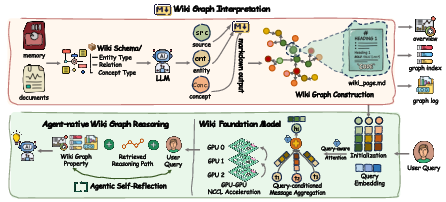
1. 建立 Wiki Graph
WFM 首先把资料整理成一种特殊的网络结构,叫 Wiki Graph。
其中包括两类节点:
- 实体节点:人物、地点、物品、事件等。
- 文章段落节点:描述这些实体的文字内容。
节点之间有不同的连接方式。例如:
- “牛顿”连接到“万有引力”;
- “牛顿”连接到介绍他的某个文章段落;
- 一个段落也可以连接到多个实体。
这比只保存简单的三元组更丰富。三元组类似于:
1 |
牛顿 —— 研究 —— 物理学 |
而 WFM 还会保留完整的句子和上下文,因此不会丢掉重要细节。
2. 使用注意力机制寻找重点
WFM 会根据用户的问题,判断哪些邻居信息更重要。这种方法叫做注意力机制。
可以把它理解成学生做题时给不同资料打分:
- 和问题直接有关的段落,分数更高;
- 关系较远或不太相关的信息,分数更低。
模型会把这些信息组合起来,逐步从一个实体走到另一个实体。这就是多跳推理。
例如,问题是:
谁影响了某位科学家,而这位科学家后来在哪里工作?
模型可能需要经过这样的路径:
1 |
人物 A → 影响了 → 科学家 B → 工作于 → 研究机构 C |
同时,它还要阅读介绍人物 A、科学家 B 和研究机构 C 的文章段落。
3. 防止模型把所有信息看得一样
论文发现,在资料很多时,注意力机制可能出现“注意力塌缩”。意思是模型给所有邻居几乎相同的权重,就像老师批改作业时把所有答案都当成一样重要。
为了解决这个问题,WFM 加入了一个特殊的训练规则,要求不同信息之间的分数保持一定差别。这样,模型更容易学会:
- 哪个信息最相关;
- 哪条关系最有用;
- 哪个段落应该优先阅读。
4. 分阶段训练模型
WFM 不是一开始就把所有任务混在一起训练,而是采用了类似“先打基础,再做难题”的方法:
- 先让实体和文字段落的表示互相对应。
- 再让模型学习实体之间的关系、文字内容以及注意力分配。
这样可以减少训练初期的混乱,让模型更稳定地学习。
5. 使用 GPU 之间直接传输数据
当模型在很多 GPU 上训练时,不同 GPU 需要互相交换节点信息。传统方法经常先把数据传到 CPU,再传回 GPU,这就像:
1 |
GPU A → CPU → GPU B |
中间步骤很多,因此速度较慢。
WFM 使用一种叫 NCCL 的 GPU 通信技术,让数据直接在 GPU 之间传输:
1 |
GPU A → GPU B |
研究人员还提前准备好数据传输的位置,避免每次训练时重新整理数据。这样可以明显减少等待时间。
6. 让 AI 进行多轮检索和自我检查
WFM 还设计了一个自我反思循环:
- AI 先根据问题寻找资料。
- 它尝试生成答案。
- 如果发现资料不够,就提出一个更具体的新问题。
- 再次检索资料。
- 信息足够时停止。
这就像学生先查一次资料,如果发现缺少某个关键事实,就继续查找,而不是立刻猜答案。
主要实验和结果
研究人员在五类任务上测试了 WFM:
- HotpotQA
- 2WikiMultihopQA
- MuSiQue
- PersonaMem
- RHELM
前三个主要测试多步问题回答,后两个测试 AI 能否从很长的对话和个人记忆中找回信息。
多步问题回答效果更好
在多个数据集上,WFM 的表现都优于其他方法。
例如,在开放式问答任务中,WFM 的准确率为:
| 数据集 | WFM 准确率 |
|---|---|
| HotpotQA | 89.6% |
| 2Wiki | 90.2% |
| MuSiQue | 69.8% |
在要求答案必须完全依靠检索证据的任务中,WFM 也表现最好。这说明它不只是凭原来的“记忆”猜答案,而是确实找到了更多有用证据。
找资料的能力更强
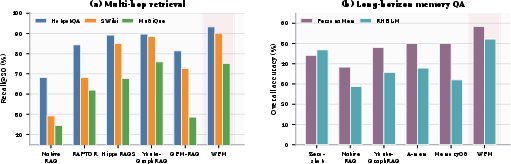
在 HotpotQA 和 2Wiki 上,WFM 找到正确支持材料的比例最高。在最多返回 20 条资料时:
- HotpotQA 的召回率达到 93.20%
- 2Wiki 的召回率达到 90.15%
这里的“召回率”可以理解为:正确答案所需要的资料,有多少被系统成功找了回来。
长期记忆能力更强
在 PersonaMem 和 RHELM 这两个长期记忆数据集上,WFM 也超过了其他记忆系统:
- PersonaMem 总体准确率:58.49%
- RHELM 总体准确率:52.17%
这说明 WFM 更擅长从很长的聊天记录中找到:
- 用户以前说过的事实;
- 用户喜好的变化;
- 某件事发生的时间;
- 分散在不同对话中的相关信息。
自我反思确实有帮助
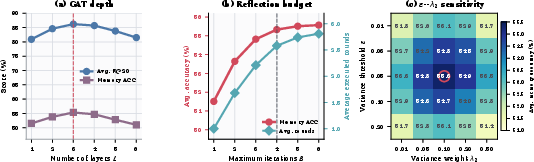
如果去掉自我反思功能,模型的长期记忆表现会下降。这说明多轮搜索能够帮助模型找到第一次检索时遗漏的资料。
不过,系统并不会总是执行完整的四轮搜索。如果已经找到足够证据,它会提前停止,因此可以节省时间和计算资源。
训练速度提高了很多
WFM 的 GPU 通信方法将训练速度从每一步 2.40 秒 降低到 0.23 秒,大约快了:
这很重要,因为大型 AI 系统通常需要处理非常多的数据。如果每一步都等待通信,训练成本会非常高。
组件测试说明每个设计都有作用
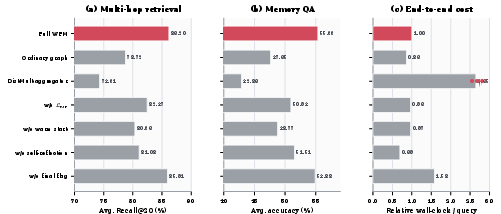
研究人员还进行了“消融实验”,也就是一次去掉一个功能,观察效果是否下降。
结果显示:
- 去掉文章段落节点,只保留实体关系,效果明显下降;
- 去掉注意力方差规则,模型更容易失去区分重点的能力;
- 不使用预先对齐文字和实体的训练阶段,效果也会下降;
- 去掉自我反思,多步记忆问题的准确率会降低;
- 强制每次都执行所有检索轮次,会增加计算成本。
这些结果说明 WFM 的不同部分不是多余的,而是共同帮助系统提升效果。
研究为什么重要?
这项研究的重要性在于,它提出了一种更适合 AI 助手的知识组织方式。
传统知识图谱擅长表示清楚的关系,但可能丢失文章中的详细含义。普通文字检索保留了内容,却可能难以发现跨文章的复杂关系。WFM 把两者结合起来,使 AI 能够:
- 读取完整文字;
- 沿着实体关系寻找线索;
- 进行多步推理;
- 记住长时间的对话;
- 在证据不足时继续查找;
- 在大型 GPU 集群上更快训练。
未来,这类技术可能用于个人助理、客服、研究工具、企业知识库和教育软件。例如,一个 AI 助手可以记得用户过去的需求,并从公司的大量文档中找到准确答案,而不是只凭猜测回答。
不过,论文中的结果也需要在更多真实环境中继续验证。实际使用时,系统仍然可能受到资料质量、错误信息、计算成本和隐私保护等问题的影响。总体来说,WFM 展示了一条有前景的路线:让 AI 不仅“会说话”,还能够更可靠地查找、记忆和使用信息。
Knowledge Gaps
Knowledge Gaps, Limitations, and Open Questions
- The paper does not provide a precise, reproducible specification of how raw LLM Wiki documents are converted into entities, relations, passages, and entity–passage links, leaving the impact of graph-construction quality unresolved.
- It is unclear how WFM performs when entity linking, relation extraction, passage segmentation, or cross-layer linking contains realistic noise, ambiguity, or omissions.
- The claimed “foundation model” generality is not demonstrated across domains beyond Wikipedia-style corpora and personal-memory benchmarks; transfer to specialized, multilingual, temporal, or enterprise knowledge bases remains untested.
- No zero-shot or cross-domain transfer experiments isolate whether the learned graph representations generalize without retraining, despite this being a central motivation for the GFM formulation.
- The experiments do not compare WFM against strong general-purpose dense retrieval and reranking systems using current large embedding models, leaving the source of the reported gains uncertain.
- All methods use
all-MiniLM-L6-v2for embeddings, so it is unknown whether the results persist with stronger or domain-adapted text encoders. - The answer-generation and judging pipeline relies on DeepSeek models, but the robustness of the results to different generators, judges, prompting strategies, and judge calibration is not evaluated.
- The paper reports LLM-judged accuracy for PersonaMem because turn-level evidence labels are unavailable, but does not quantify judge agreement, bias, or consistency with human evaluation.
- The reported memory benchmarks contain limited coverage of real users and interaction patterns; the robustness of WFM to larger populations, longer histories, concurrent users, and continuously arriving data remains unresolved.
- The system is evaluated primarily on benchmark queries with annotated supporting evidence; open-ended, ambiguous, adversarial, and evolving real-world queries are not examined.
- The paper does not evaluate temporal consistency, including whether WFM can distinguish outdated memories from current preferences or correctly resolve contradictions across time.
- The treatment of contradictory, duplicate, or mutually inconsistent passages is unspecified, and the model’s behavior under conflicting evidence is unknown.
- The method does not explicitly address provenance, source attribution, or evidence traceability, so it remains unclear whether retrieved reasoning paths can be audited by users or system operators.
- The paper does not measure hallucination rates, citation correctness, or factuality independently from aggregate answer accuracy, especially when the model is permitted to use parametric knowledge in Open mode.
- Reject-mode evaluation measures abstention performance, but the paper does not report calibration metrics such as selective accuracy, coverage, precision–recall trade-offs, or false-abstention rates.
- The proposed attention-variance regularizer enforces dispersion rather than relevance; the paper does not establish that higher logit variance consistently improves evidence selection or prevents attention from concentrating on irrelevant neighbors.
- The interaction between attention variance, neighborhood degree, relation type, and graph heterogeneity is not analyzed; a fixed threshold may not be appropriate across different local graph structures.
- The paper does not report attention distributions, gradient statistics, or training trajectories that directly verify the claimed “uniform attention collapse” and “gradient lock” mechanisms.
- The theoretical claim that the variance penalty eliminates gradient locks is not formally proven, and no convergence or optimization analysis is provided.
- The effects of the warm-start curriculum are only reported through aggregate ablations; the paper does not determine whether its benefit comes from alignment pretraining, parameter freezing, loss scheduling, or improved initialization.
- The loss weights, margin, temperature, negative-sampling strategy, and variance threshold are not systematically studied together, leaving the method’s sensitivity and reproducibility uncertain.
- The contrastive alignment loss assumes that all entity–passage links are positive and that other passages in the batch are negatives, which may create false negatives when passages describe related entities or shared concepts.
- The topological structure loss and document alignment loss may impose competing geometric objectives, but the paper does not analyze their trade-offs or whether one objective dominates learning in different data regimes.
- The method uses a single shared propagation space after a linear projection, but the adequacy of this representation for preserving both fine-grained relation semantics and long textual contexts is not independently evaluated.
- Passage embeddings are initialized with a frozen or externally pretrained language-model representation, but the paper does not clarify whether the text encoder is trained end to end or quantify the effect of fine-tuning it.
- The computational and memory cost of storing passage nodes, text embeddings, relation parameters, and multi-layer ghost states is not reported as a function of corpus size.
- The claimed
10.5×acceleration is based on one latency comparison and lacks a complete systems benchmark covering different GPU counts, interconnects, graph partition strategies, batch sizes, and graph scales. - It is unclear whether the
2.40 sversus0.23 scomparison includes identical computation, input preparation, synchronization, padding, logging, and evaluation overheads. - The NCCL protocol assumes static graph topology and fixed communication shapes; its performance and correctness under dynamic memory insertion, deletion, graph updates, or changing partition layouts remain unexplored.
- The effect of padding fixed-shape communication buffers on memory consumption and scalability is not quantified, particularly for highly imbalanced boundary-node distributions.
- The protocol’s fault tolerance, process recovery behavior, and compatibility with heterogeneous GPU clusters or non-NCCL environments are not discussed.
- The paper does not report scaling efficiency, communication-to-computation ratios, or weak- and strong-scaling results beyond the single acceleration figure.
- The distributed implementation is described at a high level without sufficient details to reproduce partitioning, buffer allocation, overlap of communication with computation, or collective scheduling.
- The inference-time computational cost of query-conditioned graph induction and multi-layer propagation is not reported separately from LLM generation and reflection costs.
- The self-reflection loop depends on the generator correctly identifying missing evidence and emitting a reliable completion flag, but error cases involving premature termination, repetitive follow-up queries, or endless semantic drift are not analyzed.
- The paper does not compare WFM’s self-reflection strategy with alternative query-planning methods, such as explicit chain-of-thought retrieval, learned stopping policies, beam search, or verifier-guided retrieval.
- The maximum reflection budget is tuned on the reported benchmarks, but no evaluation examines cost–accuracy trade-offs under strict latency, token, or energy constraints.
- The accumulated evidence set grows across reflection rounds, yet the paper does not examine context-window pressure, redundancy, evidence conflicts, or answer degradation as more passages are retained.
- Multi-hop propagation depth is studied only up to six layers; the method’s ability to handle substantially longer reasoning chains or graphs with extreme diameter remains unknown.
- The reported results do not disentangle improvements from the Wiki Graph, attentive aggregation, variance regularization, warm-start training, self-reflection, and stronger implementation through fully controlled factorial experiments.
- The DistMult ablation uses a capped neighborhood while the uncapped version runs out of memory, making the comparison potentially confounded by different computational budgets and incomplete baseline implementations.
- The paper provides limited statistical reporting: it does not include multiple random seeds, confidence intervals, significance tests, or variance across benchmark subsets.
- The newly completed cells and diagnostic sweeps are explicitly described as “planning values” requiring validation, which leaves some reported parameter-analysis and ablation conclusions provisional.
- The notation and equations contain apparent LaTeX and definition inconsistencies, including malformed loss expressions and ambiguous tensor dimensions, which hinder independent implementation and verification.
- The paper does not release or fully specify the WFM graph-construction pipeline, training data, preprocessing code, partitioning code, or evaluation prompts, limiting reproducibility.
- Privacy, security, and access-control risks for applying WFM to long-term personal memory are not addressed, including retrieval of sensitive information, cross-user leakage, membership inference, and deletion guarantees.
- The paper does not investigate catastrophic forgetting or representation drift when the Wiki or memory store is updated continually after deployment.
- The environmental and economic costs of pretraining and maintaining WFM at commercial scale are not reported, despite the paper’s emphasis on production deployment.
- The relationship between retrieval recall and end-to-end answer quality is reported only through aggregate scores; failure analysis is needed to determine which graph, memory, and reasoning errors most limit performance.
- The approach’s behavior on queries requiring negative evidence, numerical aggregation, multi-entity coreference, or fine-grained temporal reasoning remains insufficiently characterized.
- It remains unresolved whether the dense passage-node representation genuinely improves reasoning over simpler architectures that combine a strong text retriever with a separately trained graph reranker.
Practical Applications
Immediate Applications
- Evidence-grounded enterprise question answering — software, customer support, and knowledge management. Organizations can convert internal documentation, product manuals, tickets, policies, and entity relationships into a Wiki Graph, then use WFM for multi-hop retrieval and citation-supported answers. The query-conditioned attention mechanism can retrieve both relational evidence and full text passages, reducing the information loss associated with representing documents only as triples. Potential workflow: ingest documents → extract entities and typed relations → link entities to source passages → retrieve supporting passages with WFM → generate an answer with evidence and, where necessary, abstain. Dependencies: reliable entity/relation extraction, current documentation, access controls, passage-level provenance, and validation on domain-specific data. The reported results are primarily on Wikipedia-style and memory benchmarks rather than production enterprise corpora.
- Long-term conversational memory for personal assistants and productivity agents — consumer software. WFM can maintain structured, persistent memory of user preferences, prior decisions, temporal facts, and past interactions. Its iterative self-reflection loop is particularly applicable when an answer requires combining information from multiple conversations or recovering a detail missed during the first retrieval pass. Potential products: personal scheduling assistants, preference-aware recommendation systems, meeting-history assistants, and project copilots. Dependencies: explicit consent, privacy-preserving storage, mechanisms for correcting or deleting memories, temporal conflict resolution, and safeguards against retrieving information from the wrong user or conversation.
- Internal research and technical support copilots — academia and industry. Scientific papers, technical reports, code documentation, experiment logs, and datasets can be represented as linked entities and dense passages. WFM can answer questions such as which method depends on a particular assumption, which experiment supports a claim, or how a component relates to another across several documents. Potential workflow: construct a domain Wiki → index passages and relations → retrieve multi-hop evidence → return answers with document and passage references. Dependencies: high-quality metadata and entity linking; human review remains necessary for scientific, legal, or safety-critical conclusions.
- Policy and regulatory information retrieval — public administration, compliance, and legal operations. Regulations, amendments, agencies, cases, obligations, exemptions, and effective dates naturally form a hybrid structure of typed relations plus dense legal text. WFM could help users trace a requirement across multiple statutes or policy documents and identify the passages supporting a compliance interpretation. Potential tools: compliance assistants, policy-change monitors, audit preparation systems, and regulator-facing document navigation interfaces. Dependencies: jurisdiction-specific validation, versioning and effective-date tracking, authoritative sources, explainable citations, and human legal review. The system should support retrieval and analysis rather than autonomous legal decisions.
- Multi-hop customer-service resolution — telecommunications, banking, insurance, and e-commerce. Support agents often need to combine customer history, product configuration, troubleshooting procedures, eligibility rules, and previous cases. WFM’s entity–passage representation can connect these heterogeneous sources while retaining the original procedural text. Potential workflow: identify the customer, product, and issue entities → propagate through service and policy relations → retrieve relevant passages → generate a proposed resolution or escalation recommendation. Dependencies: strict authorization boundaries, low-latency inference, integration with CRM systems, and evaluation for incorrect or unsafe recommendations.
- Faster distributed training of text-augmented graph retrieval systems — machine-learning infrastructure.
The NCCL-native boundary exchange protocol can be adopted independently of the full WFM model for distributed graph encoders whose partitions and cross-partition layouts are static. Precomputing boundary indices and using fixed-shape GPU collectives can reduce CPU serialization and host-to-device transfer overhead.
Potential engineering artifact: a GPU-resident graph message-passing communication layer for PyTorch/NCCL-based training systems.
Dependencies: multi-GPU hardware with efficient NVLink or InfiniBand, sufficiently static graph partitions, fixed or padded communication shapes, and careful handling of dynamic graph updates. The reported
10.5×speedup is hardware- and workload-dependent. - Evidence-aware answer abstention and retrieval budgeting — safety and operations. The self-reflection loop can be deployed with a maximum retrieval budget and an adaptive final-answer flag. Simple questions can terminate early, while incomplete multi-hop questions trigger follow-up retrieval. This provides a practical control over latency, token consumption, and retrieval cost. Potential workflow: set a maximum budget → retrieve and draft an answer → assess missing evidence → continue or stop → expose retrieved sources and confidence indicators. Dependencies: reliable completion and evidence-sufficiency judgments; the final-answer flag is not by itself a calibrated uncertainty estimate.
- Personal information organization and daily-life search — individual users. A local or encrypted Wiki Graph could connect notes, receipts, appointments, messages, household devices, and documents. Users could ask questions requiring multiple steps, such as identifying which purchase is covered by a warranty and locating the associated receipt and expiry date. Dependencies: local deployment or strong encryption, fine-grained permissions, accurate temporal reasoning, user control over memory retention, and protection against exposing sensitive information in generated responses.
Long-Term Applications
- Healthcare decision-support and longitudinal patient memory — healthcare. A privacy-preserving WFM-like system could connect patient history, diagnoses, medications, laboratory results, clinical guidelines, and encounter notes while preserving the underlying passages. It could retrieve evidence for questions involving multiple visits or interacting conditions. Potential products: clinician-facing evidence retrieval, longitudinal chart summarization, medication-history assistants, and research cohort navigation. Dependencies: clinical validation, structured interoperability standards, provenance and auditability, patient consent, bias testing, regulatory approval, and strict human oversight. The paper does not evaluate clinical data, so deployment would require substantial additional research.
- Robotics and embodied agents with persistent world models — robotics. Robots could maintain a Wiki-like memory linking objects, locations, people, actions, task procedures, and textual instructions. Query-conditioned propagation could support multi-step tasks such as finding an object, recalling how it should be handled, and adapting the plan based on prior interactions. Potential systems: household robots, warehouse assistants, maintenance robots, and service robots with episodic and semantic memory. Dependencies: grounding language and graph entities in sensor observations, real-time inference, uncertainty handling, continual updates, and robustness to changing environments. Static graph assumptions in the NCCL design may not hold for rapidly changing robot environments.
- Autonomous software engineering agents — software development. Source code entities, APIs, commits, tests, issues, configurations, and documentation can form a hybrid graph. WFM could support multi-hop tasks such as tracing an API call through several modules, locating the relevant regression-inducing change, and retrieving associated tests and design rationale. Potential tools: repository navigation, bug triage, dependency-impact analysis, change planning, and test-generation assistants. Dependencies: precise code parsing, repository versioning, access control, reproducible evaluation, protection against unsafe code changes, and integration with build and testing systems.
- Financial research, risk analysis, and fraud investigation — finance. A Wiki Graph could link companies, transactions, securities, filings, executives, market events, and regulatory documents while retaining source text. WFM may help analysts trace relationships across filings and news or retrieve dispersed evidence relevant to a risk hypothesis. Potential products: analyst copilots, know-your-customer investigation tools, transaction-network exploration, and compliance alert triage. Dependencies: real-time data ingestion, provenance, temporal consistency, strict privacy controls, explainability, fairness testing, and human approval. It should not autonomously make trading, lending, or enforcement decisions without independent validation.
- Adaptive education and tutoring — education. Course concepts, prerequisites, readings, assignments, misconceptions, and student interaction history can be represented as linked entities and explanatory passages. WFM could retrieve prerequisite knowledge and tailor explanations requiring several reasoning steps. Potential workflow: diagnose the learner’s question → traverse prerequisite and concept relations → retrieve explanatory passages → generate a scaffolded explanation and follow-up question. Dependencies: pedagogical evaluation, age-appropriate safeguards, teacher oversight, protection of student data, and methods for distinguishing genuine understanding from retrieval success.
- Energy-system operations and infrastructure maintenance — energy and industrial systems. Equipment, sensors, maintenance records, failure modes, operating procedures, and engineering manuals could be connected in a persistent Wiki Graph. A future system could retrieve evidence for fault diagnosis or recommend maintenance procedures across multiple documents and historical events. Dependencies: integration with operational technology, trustworthy sensor data, real-time constraints, cybersecurity, safety certification, and strict separation between advisory outputs and direct control actions.
- Continual learning and dynamically updated knowledge bases. The combination of explicit topologies and dense passages could become a foundation for systems that continuously ingest new documents, revise relations, and preserve historical versions. This would support evolving regulations, scientific literature, product catalogs, and organizational knowledge. Dependencies: incremental training without catastrophic forgetting, conflict detection, provenance-aware updates, dynamic partitioning, deletion guarantees, and evaluation under distribution shift. The current protocol benefits from static partition layouts, so dynamic updates require further systems development.
- General-purpose agent memory infrastructure at commercial scale. WFM could evolve into a reusable foundation layer for agents that combine episodic memory, semantic knowledge, document retrieval, and multi-hop planning across domains. A shared model might transfer structural reasoning across organizations or tasks, with domain-specific Wiki data supplied at inference or fine-tuning time. Dependencies: larger and more diverse pretraining data, robust cross-domain transfer, cost-efficient indexing, security isolation between tenants, standardized Wiki schemas, and independent testing for hallucination and retrieval failures.
- Standardized benchmarks and research tools for agent-native knowledge representation — academia. The Wiki Graph schema, attention-variance objective, self-reflection loop, and GPU communication design provide components for studying dense graph representations and long-term memory. Future research could compare WFM with conventional RAG, GraphRAG, and memory systems under controlled tests of evidence coverage, abstention, latency, and updateability. Dependencies: reproducible implementations, public training and evaluation data, measured rather than planned diagnostic results, standardized cost metrics, and ablations across more domains and hardware configurations. The paper itself notes that some newly completed cells and diagnostic sweeps require validation before external use.
Glossary
- Agentic reasoning: Reasoning performed by an autonomous system that plans, retrieves information, and takes iterative actions. “WFM: Wiki Foundation Model for Complex Agentic Reasoning”
- Attention collapse: A failure mode in which attention weights become nearly uniform and lose selectivity. “To explicitly prevent attention collapse, we penalize low variance in attention logit distributions”
- Attention variance regularization: A training technique that prevents attention logits from becoming insufficiently diverse. “Attention Variance Regularization Loss”
- Bi-Interaction aggregator: An aggregation mechanism that combines additive and element-wise multiplicative interactions between a node and its message. “To preserve self-node identity while incorporating the aggregated context, we employ a Bi-Interaction aggregator”
- Boundary exchange: Communication of representations belonging to nodes that connect separate graph partitions. “Infrastructural NCCL-Native Boundary Exchange Protocol”
- Catastrophic uniform attention collapse: A severe loss of attention selectivity caused by attention weights flattening toward a uniform distribution. “their aggregation mechanisms suffer from catastrophic uniform attention collapse”
- Contrastive loss: An objective that brings matching representations closer while separating nonmatching representations. “we minimize InfoNCE contrastive loss over entity-document pairs”
- Cross-layer hyper-edge: An edge connecting nodes or structures from different representational layers in a graph. “via explicit cross-layer hyper-edges”
- Dual-space embedding: A representation that maintains separate structural and semantic embedding spaces before projecting them into a shared space. “We construct a continuous dual-space embedding initialization for each node”
- End-to-end training: Optimization of all relevant components jointly from input to final output. “achieving a end-to-end training speedup”
- Feature propagation: The process of transmitting and transforming node representations through graph connections. “GFM Message Passing and Feature Propagation”
- Fixed-shape tensor: A tensor whose dimensions remain constant, enabling predictable and efficient hardware communication. “WFM pads the per-peer boundary layouts to fixed-shape tensors”
- Foundation model: A broadly pretrained model intended to support transfer across tasks or domains. “We introduce the Wiki Foundation Model (WFM)”
- Graph attention mechanism: A graph-neural-network method that weights neighboring nodes according to learned relevance scores. “WFM parameterizes message passing via a relation-aware graph attention mechanism”
- Graph Foundation Model (GFM): A model that learns generalizable representations of graph structures across domains. “A Graph Foundation Model (GFM), parameterized by $\mathbf{\Theta}_{\text{GFM}$, projects the discrete graph structure into a continuous -dimensional embedding space”
- Graph partition: A division of a graph into subsets distributed across computational devices. “Training continuous encoders over text-augmented graph partitions requires frequent boundary node state synchronization”
- GraphRAG: A retrieval-augmented generation approach that uses graph structure to organize and retrieve evidence. “GraphRAG has been extensively studied for complex multi-hop reasoning tasks across multiple documents”
- Gradient lock: An optimization failure in which gradients become ineffective and representation learning effectively stalls. “creating paralyzing gradient locks that freeze representation learning”
- GPU collective: A coordinated communication operation involving multiple GPUs. “Their stable shapes permit direct GPU-to-GPU collectives over NVLink or InfiniBand”
- GPU-resident buffer: A memory buffer stored directly in GPU memory rather than host memory. “The resulting sparse gather/scatter layouts map local node IDs to contiguous GPU-resident buffers”
- Hadamard product: Element-wise multiplication of two vectors or tensors. “Here, denotes element-wise Hadamard product”
- Hinge loss: A loss function that contributes a penalty only when a constraint is violated. “The hinge is active only when a neighborhood's logits are insufficiently dispersed”
- InfoNCE: A contrastive-learning objective that distinguishes a positive pair from negative examples. “we minimize InfoNCE contrastive loss over entity-document pairs”
- Knowledge graph: A graph representation of entities and typed relations used to encode structured knowledge. “While traditional knowledge graphs (KGs) have demonstrated reliable advantages in organizing structured evidence”
- LeakyReLU: A neural activation function that retains a small nonzero gradient for negative inputs. “$\mathbf{h}_v{(l)} &= \text{LeakyReLU}”
- Logit: An unnormalized scalar score used before applying a probability-normalization function such as Softmax. “converts the resulting compatibility vector to a scalar logit”
- Long-horizon planning: Planning over extended sequences of actions, states, or interactions. “in long-horizon planning and execution scenarios”
- Message passing: A graph-learning procedure in which nodes exchange information with their neighbors. “GFM Message Passing and Feature Propagation”
- Multi-hop reasoning: Reasoning that requires traversing or combining evidence across multiple graph links or documents. “Extensive evaluations across five long-term agent memory and multi-hop reasoning benchmarks”
- Non-parametric knowledge: External knowledge stored outside a model’s learned parameters and accessed during inference. “They require persistent, non-parametric knowledge bases to support dynamic reasoning”
- NCCL: NVIDIA’s communication library for efficient collective operations among GPUs. “We engineer an infrastructural NCCL-native boundary exchange protocol”
- NVLink: A high-bandwidth interconnect technology for communication between GPUs. “Their stable shapes permit direct GPU-to-GPU collectives over NVLink or InfiniBand”
- Parametric knowledge: Knowledge encoded within a model’s learned parameters. “Open mode additionally permits parametric knowledge”
- Pareto frontier: The set of solutions that cannot improve one objective without worsening another. “WFM remarkably advances the Pareto frontier of reasoning accuracy, memory recall, and system throughput”
- Query-conditioned aggregation: Neighbor aggregation whose participating nodes or weights depend on the current query. “A query-conditioned attentive aggregation is tailored for rich wiki message passing”
- Recall@: The proportion of relevant supporting items found among the top retrieved results. “Retrieval quality is measured by Recall@”
- Relation-aware propagation: Message propagation that incorporates the type of relation connecting two nodes. “The relational attention score measures how much information propagates from to re \in \mathcal{E}_wr \in \mathcal{R}_w\text{sim}(\mathbf{a}, \mathbf{b}) = \frac{\mathbf{a}^T \mathbf{b}{\|\mathbf{a}\| \|\mathbf{b}\|}\tau\alpha(v,r,u)=1/|\mathcal{N}(v)|\mathbf{H} \in \mathbb{R}^{|\mathcal{V}| \times d}$ that supports zero-shot domain transfer”

