NCP-ArchPreview Technical Report: Moving towards Latent Space Language Models through Next Concept Prediction
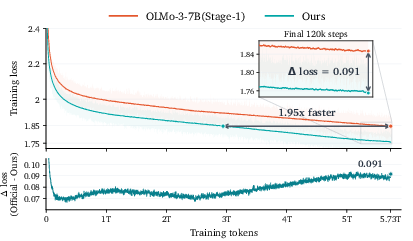
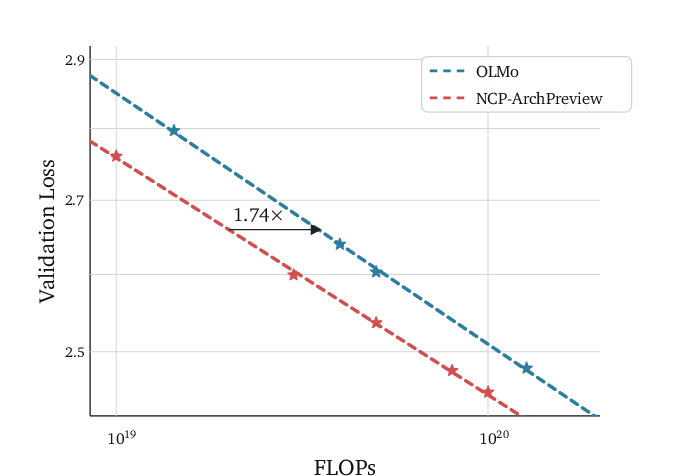
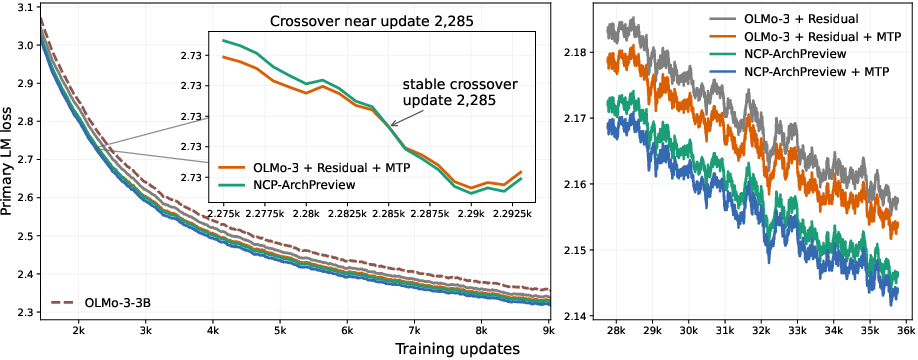
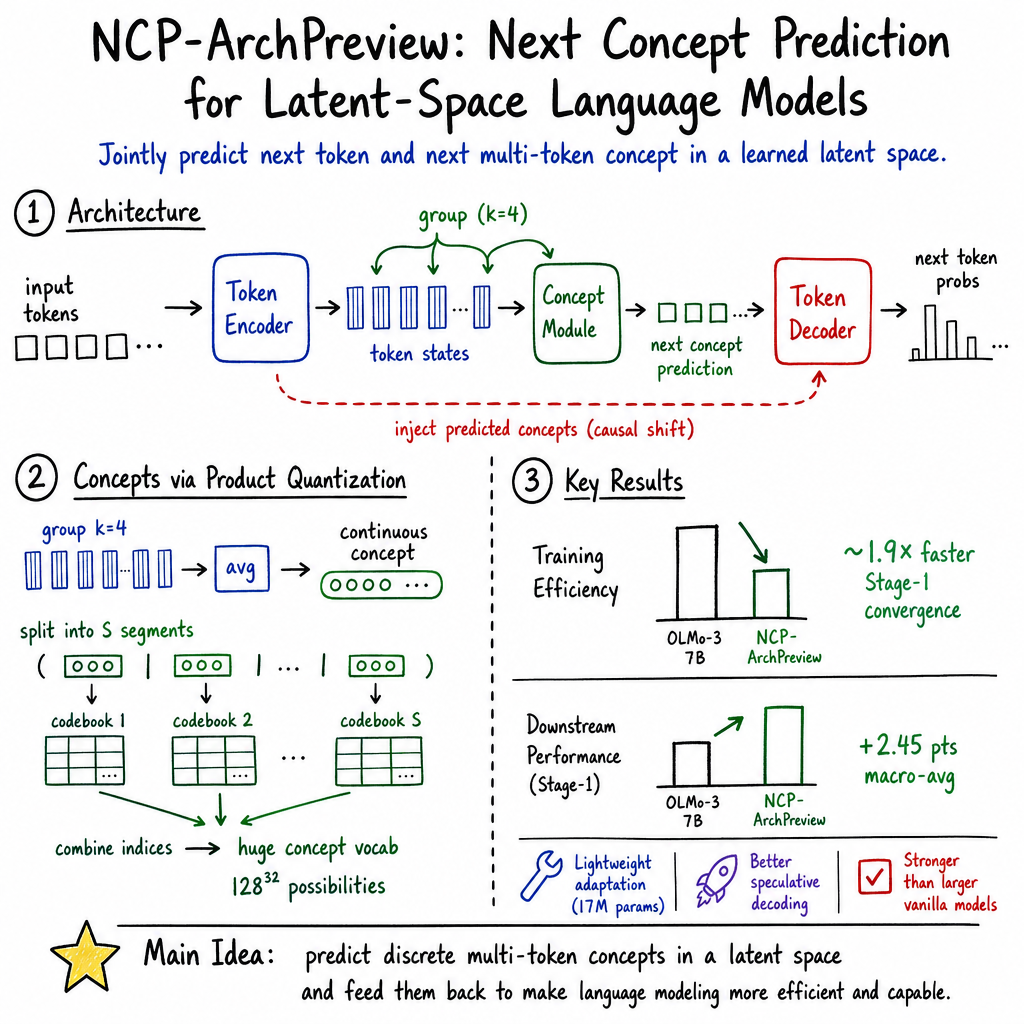
Abstract: We introduce NCP-ArchPreview, a latent-space LLM that pushes autoregressive pretraining beyond standard next-token prediction (NTP). Alongside NTP, the model learns through Next Concept Prediction (NCP) to predict discrete concepts that span multiple tokens, introducing an explicit and more challenging concept-level objective while preserving standard token-level autoregressive generation. NCP-ArchPreview builds a latent space by constructing a product-quantized concept vocabulary directly from its hidden states, and subsequently learns to predict future concepts via a dedicated Concept Module. These predicted concepts are then fed back to the token level to guide subsequent generation, with NTP and NCP trained jointly end-to-end. We scale this architecture to 8.9B parameters and train it on 5.73T tokens from the Dolma-3 dataset, marking the largest demonstration of a latent-space LLM to date. Remarkably, by consuming only 51.3% of the total training tokens, NCP-ArchPreview achieves the final pretraining loss of OLMo-3-7B. Following full pretraining, it outperforms OLMo-3-7B by 2.45 points on the downstream macro-average, including a notable 5.99-point gain on GSM8K. Controlled experiments isolate a clear progression of performance gains stemming from both the latent architecture and the NCP objective. Furthermore, utilizing only 85% of the standard computation, NCP-ArchPreview approaches the training loss of a strictly parameter-aligned 8.9B baseline. The learned latent space remains highly valuable after the pretraining stage: updating just the 17M-parameter VQ module yields a novel, lightweight interface for domain adaptation, while a simple injection of concept representations into a DFlash2 drafter improves the mean accepted length by 4.17% with negligible overhead.
First 10 authors:
Paper Prompts
Sign up for free to create and run prompts on this paper.
Top Community Prompts
Explain it Like I'm 14
1. What is this paper about?
This paper introduces a new kind of LLM called NCP-ArchPreview.
Most LLMs learn by predicting the next token. A token is a small piece of text, such as a word, part of a word, or punctuation mark. For example, given:
“The cat sat on the…”
the model might predict the next token, “mat.”
The researchers argue that predicting one small piece at a time may not be enough. Language also contains larger ideas, such as “a cat sitting on a mat.” Their model therefore learns in two ways:
- Next Token Prediction (NTP): predict the next small piece of text.
- Next Concept Prediction (NCP): predict the next larger idea or group of words.
The model combines these two types of prediction to try to understand and generate language more efficiently.
2. What questions did the researchers ask?
The researchers mainly wanted to find out:
- Can a LLM predict larger concepts, not just individual tokens?
- Does learning concepts help the model train faster?
- Does this approach improve abilities such as mathematics, coding, general knowledge, and reasoning?
- Are the improvements caused by the new architecture, rather than simply by giving the model more parameters or computing power?
- Can the learned concepts also be useful for adapting the model to new subjects or making it generate text faster?
In simple terms, they were asking:
Would a model learn better if it studied both letters and words, and also the bigger ideas those words form?
3. How did they do the research?
The basic model design
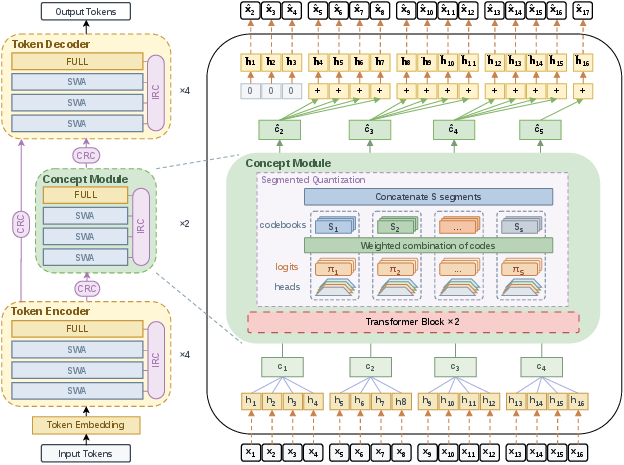
NCP-ArchPreview has three main parts:
- A Token Encoder, which reads the input text and turns each token into a numerical representation.
- A Concept Module, which groups several tokens together and tries to predict the next group.
- A Token Decoder, which uses both token information and concept information to predict the next token.
The model groups every four tokens into one concept-like representation. This is similar to summarizing four short notes into one larger note.
For example, a sentence might be divided like this:
| Tokens | Concept-like group |
|---|---|
| “The cat sat” | Group 1 |
| “on the soft” | Group 2 |
| “blue mat.” | Group 3 |
The groups are not ordinary human-readable words. They are numerical patterns inside the model that represent information about several tokens at once.
Building a concept vocabulary
The researchers used a technique called vector quantization. This can be understood as creating a large set of “example concept cards.”
When the model creates a new concept representation, it finds the closest cards in this collection. The cards act like building blocks for concepts.
They also used product quantization, which divides each concept into smaller parts. Each part chooses one item from its own smaller collection. Combining the choices creates many possible concepts without needing one enormous collection.
Predicting concepts
The Concept Module looks at earlier concepts and predicts what the next concept should be. It does not simply choose one concept card. Instead, it creates a weighted mixture of several possible cards.
This is useful during training because the model can gradually improve its guesses. It is similar to saying:
“I am 60% sure the next idea is about mathematics and 30% sure it is about science.”
Feeding concepts back into text generation
The predicted concepts are sent back into the token-generation part of the model. This gives the model extra information when it predicts the next token.
The researchers made sure the model could not accidentally “peek” at future text. This is called maintaining causality: the model may use only information that would already be available at that point in the sentence.
Training
The researchers trained the model using three learning goals:
- Next-token loss: how wrong the model was when predicting the next token.
- Next-concept loss: how wrong it was when predicting the next concept.
- Quantization loss: how well the concept cards matched the model’s internal concept representations.
These goals were trained together, so the model learned token-level and concept-level patterns at the same time.
Size and training data
The model had about 8.9 billion parameters. Parameters are adjustable numbers inside a neural network; they are similar to many tiny “knobs” that the model changes while learning.
It was trained on about 5.73 trillion tokens from the Dolma-3 dataset. The researchers compared it with OLMo-3-7B, a standard LLM with about 7 billion parameters.
They tested both models on many tasks, including:
- General knowledge questions
- Mathematics
- Coding
- Reading comprehension
- Common-sense reasoning
- Science questions
4. What did they find?
The model learned faster
NCP-ArchPreview reached the final training performance of OLMo-3-7B after using only about 51.3% as many training tokens in the first training stage.
This means it learned at almost twice the speed in terms of the amount of text it needed to study.
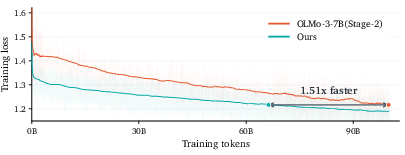
In the second stage, it reached a similar point after about 66.2% of the tokens, which was still faster than the standard model.
It performed better on many tests
After the first training stage, NCP-ArchPreview achieved an overall score about 2.45 percentage points higher than OLMo-3-7B.
Some especially large improvements included:
- GSM8K mathematics: nearly 6 points higher
- General mathematics: about 3.75 points higher on average
- Coding: about 2.64 points higher
- Commonsense and other multiple-choice tasks: about 4.63 points higher
These results suggest that learning larger concepts may help with tasks requiring several steps of reasoning.
The improvement was not only because of extra size
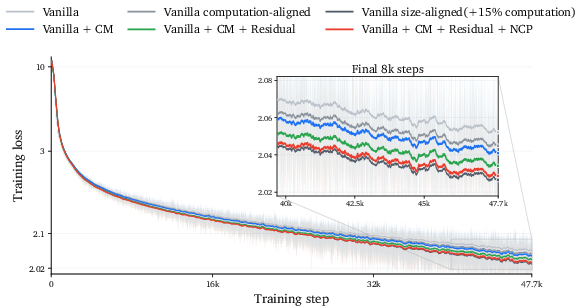
The researchers performed ablation studies. An ablation study is like removing parts from a machine one at a time to see which parts are important.
They compared versions of the model with:
- Only the basic LLM
- The Concept Module
- The Concept Module plus improved connections
- The full model with Next Concept Prediction
The results showed that the improvements came from several parts working together, especially:
- The Concept Module
- The special connections between layers
- The Next Concept Prediction objective
The researchers also compared models with similar numbers of parameters and similar computing costs. This suggested that the gains were mainly caused by the new learning method, not just by making the model bigger.
Some results were mixed
The model did not improve on every task. In the second training stage, its average coding score was slightly lower than the standard model, and some individual benchmarks also declined.
This shows that a lower training loss does not always guarantee better results on every real-world task. A model can become better at the kind of text it was trained on while becoming less suited to a different type of test.
The concept system had uses beyond training
The researchers found two additional benefits:
- Only a small part of the model, about 17 million parameters, could be updated to adapt the model to a new subject or field.
- Adding concept information to a faster-generation system increased the average number of accepted generated tokens by about 4.17%, with very little extra cost.
This suggests that the concept representations could be useful even after the main training process is finished.
5. Why is this research important?
Most current LLMs predict text one small token at a time. This works well, but it can require a lot of computation and may not directly encourage the model to think about larger ideas.
NCP-ArchPreview tries to give the model a second level of understanding:
- Tokens are like individual bricks.
- Concepts are like parts of a building made from several bricks.
- The final text is the whole building.
By learning both levels, the model may be able to:
- Learn from text more quickly
- Understand relationships across several words
- Perform better on mathematics and reasoning
- Use less training data for similar performance
- Adapt more easily to specialized subjects
- Generate text more efficiently
The research does not prove that concept prediction is always better. Some tasks, especially coding in the later training stage, showed weaker results. More experiments are also needed to see whether the same approach works for much larger models and different kinds of data.
Overall, however, the paper suggests that future LLMs may benefit from predicting not only what word comes next, but also what idea comes next.
Knowledge Gaps
Knowledge gaps, limitations, and open questions
- Limited baseline diversity: The main comparisons are centered on OLMo-3-7B and parameter/computation-matched variants; the architecture is not systematically compared with other latent-language approaches such as BLT, LCM, ConceptLM, MTP, H-Net, or hierarchical Transformer models under identical data, scale, and compute conditions.
- Unclear attribution between NCP and architectural changes: Although progressive ablations are reported, the paper combines several modifications—Token Encoder/Decoder factorization, Concept Module, VQ, IRC, CRC, and concept injection—without fully isolating their interactions across model scales and training stages.
- Insufficient hyperparameter analysis: The effects of the concept compression factor , number of codebooks, codebook size, segment dimension, NCP weight , VQ weight , and concept-module depth are not systematically characterized.
- Unresolved product-quantization quality: The paper does not report codebook utilization, perplexity, dead-code frequency, quantization error over training, or the degree to which different codebook segments capture complementary information.
- Concept semantics are not directly analyzed: It remains unclear whether the learned discrete concepts correspond to coherent linguistic, syntactic, semantic, or reasoning units, or whether they are primarily optimization-oriented hidden-state clusters.
- No comparison of pooling and chunking strategies: Mean pooling over fixed, contiguous four-token spans is used throughout, but the paper does not test learned pooling, attention pooling, variable-length segmentation, boundary prediction, or input-adaptive chunking.
- Exposure bias in concept prediction is underexplored: During training, the Concept Module consumes continuous ground-truth concept histories, whereas inference feeds back its own predicted concepts. The effect of this train–inference mismatch on long-context stability and generation quality is not quantified.
- Effect of soft codeword expectations is unknown: Predictions are formed as weighted averages of codebook entries rather than discrete selections. The paper does not establish whether this improves optimization, causes ambiguous mixtures of concepts, or differs from argmax, sampling, Gumbel-softmax, or straight-through quantization.
- Long-range error propagation is not evaluated: Because predicted concepts are autoregressively reused, errors may accumulate across concept steps. Generation quality, calibration, and degradation as a function of sequence length are not reported.
- Causal alignment warrants empirical validation: The shifted concept-broadcasting mechanism is intended to prevent information leakage, but there is no explicit leakage audit or comparison against alternative shifts and alignment schemes.
- The source of downstream gains remains uncertain: Improvements in aggregate benchmark scores are attributed to latent hierarchy and NCP, but the paper does not determine whether they arise from better optimization, implicit regularization, altered data exposure, increased effective depth, or improved representations.
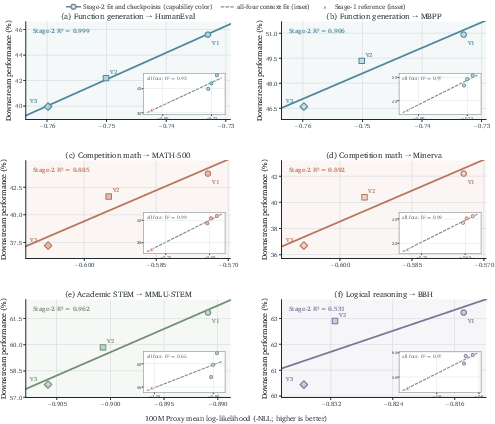
- Training-loss improvements do not consistently transfer to capabilities: Stage-2 experiments show lower loss but worse performance on several tasks, especially code and some reasoning benchmarks. The conditions under which token loss predicts downstream capability remain unresolved.
- Domain and language coverage is narrow: Evaluation is concentrated on English-centric benchmarks and selected domains. The robustness of the concept space for multilingual, cross-lingual, code-heavy, low-resource, noisy, or highly specialized data is not established.
- Limited evidence for broad reasoning benefits: The strongest reported gains are on selected mathematics and commonsense tasks, but there is no detailed analysis of whether NCP improves compositional reasoning, planning, theorem proving, multi-step factual reasoning, or merely benchmark-specific pattern learning.
- Code-generation degradation is unexplained: After Stage-2 training, NCP-ArchPreview underperforms the baseline on several code benchmarks. The paper does not identify whether this results from concept compression, data-mixture effects, decoder interference, or inadequate code-specific adaptation.
- No robustness and distribution-shift evaluation: The model is not tested against adversarial prompts, corrupted inputs, changing document structure, unseen domains, temporal shifts, or out-of-distribution sequence lengths.
- Scaling behavior is incomplete: Although the paper presents an 8.9B-parameter model, it does not establish how NCP behaves across substantially smaller and larger parameter scales, different context lengths, or different token budgets.
- Compute-efficiency accounting is not fully transparent: Claims such as Pareto compute efficiency and 85% computation are not accompanied in the provided text by complete wall-clock measurements, hardware details, communication costs, memory overhead, or energy comparisons.
- Inference overhead is insufficiently characterized: The additional Concept Module, codebook operations, residual connections, and concept autoregression may affect latency, memory, batch throughput, and maximum context handling; these costs are not comprehensively reported.
- Speculative-decoding gains are preliminary: The reported 4.17% increase in mean accepted length with DFlash2 is not evaluated across diverse tasks, temperatures, drafter sizes, target models, acceptance thresholds, or end-to-end latency and energy metrics.
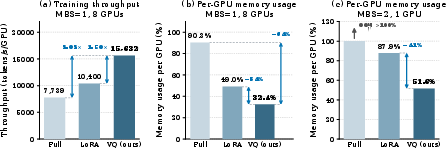
- Lightweight domain adaptation is only partially validated: Updating the 17M-parameter VQ module is presented as a domain-adaptation interface, but comparisons with adapter tuning, LoRA, prompt tuning, codebook-only alternatives, and full fine-tuning are not provided.
- Adaptation trade-offs are unknown: The paper does not quantify how VQ-only adaptation affects catastrophic forgetting, retention of general capabilities, transfer to unrelated domains, or performance when the target domain has limited data.
- Stability of jointly learned codebooks is unclear: Because the Token Encoder and codebooks evolve jointly while NCP targets are detached, the training dynamics may be sensitive to initialization, optimizer choice, update frequency, or codebook collapse; these factors are not analyzed.
- Optimizer dependence is unresolved: Results rely on Moonlight Muon/Muon for matrix parameters, with limited evidence that the reported advantages persist under AdamW, Shampoo, Adafactor, or other optimization schemes.
- Residual-routing interpretability is missing: The learned IRC and CRC coefficients are not analyzed to determine which depths and modules are actually used, whether routing patterns are stable across inputs, or whether the added connections contribute uniformly across layers.
- Architectural complexity may reduce reproducibility: The many dynamic residual and cross-module components introduce additional implementation choices, but the paper does not provide a complete sensitivity analysis or sufficiently detailed failure-mode discussion for reproducing training reliably.
- Evaluation uncertainty is not reported: The benchmark results lack confidence intervals, repeated-seed measurements, or statistical significance tests, making it difficult to determine whether smaller gains—particularly the 0.59-point Stage-2 improvement—are robust.
- Data contamination and memorization are not examined: The relationship between Dolma-3 training data and downstream benchmarks is not discussed, and no contamination checks or memorization analyses are reported.
- Concept-level interpretability and controllability remain open: The paper does not test whether concepts can be inspected, edited, reused across tasks, or manipulated to control generation, limiting claims that the learned latent space constitutes a useful semantic interface.
- The optimal prediction target is unresolved: It remains unknown whether predicting future concepts at one fixed horizon is preferable to predicting multiple future concepts, variable horizons, hierarchical concepts, or jointly learned latent targets at several granularities.
- Benefits for actual generation quality are underreported: Most evidence concerns loss and benchmark accuracy; human evaluations of coherence, factuality, instruction following, repetition, stylistic control, and factual consistency during free-form generation are absent.
- Safety and alignment implications are unexplored: The effect of latent concept prediction on refusal behavior, harmful-content generation, bias, transparency, and post-training alignment is not evaluated.
Practical Applications
Immediate Applications
- Compute-efficient foundation-model pretraining (AI infrastructure/software).
- Potential workflow: replace or augment a conventional Transformer backbone with a Token Encoder, Vector-Quantized Concept Module, and Token Decoder; train using the combined NTP, NCP, and VQ losses.
- Relevant sectors: cloud AI, enterprise model development, open-source foundation models, research laboratories.
- Dependencies: substantial engineering effort, distributed-training infrastructure, careful tuning of the concept compression factor, codebook size, loss weights, and optimizer stability. The reported results were obtained at large scale on Dolma-3 data and may not transfer directly to smaller datasets or different domains.
- Open-source experimentation with latent-space LLMs (academia and research).
- Potential tools: benchmark suites for NCP objectives, visualization tools for product-quantized concepts, ablation frameworks, and reusable latent-language-model training libraries.
- Use cases: comparing token-level, multi-token, and concept-level objectives; investigating representation structure; reproducing scaling-law studies.
- Dependencies: released artifacts must remain compatible with current inference and training frameworks; researchers should verify benchmark results independently because the paper reports some domain-specific gains and losses rather than uniform improvement.
- Lightweight domain adaptation through the VQ module (enterprise NLP and specialized models).
- Potential products: domain-adapted assistants for legal, technical, financial, scientific, or customer-support terminology; private-sector LLMs that reduce fine-tuning storage and GPU requirements.
- Workflow: collect domain text, update the codebooks or VQ-related parameters, evaluate both target-domain performance and retention of general capabilities, then deploy the frozen backbone with the adapted concept interface.
- Dependencies: the domain must be sufficiently represented in the model’s hidden-state distribution; codebook updates may cause catastrophic forgetting or distributional mismatch. The paper’s adaptation results are promising but do not establish safety, robustness, or performance across all domains.
- Speculative decoding acceleration (inference systems).
- Potential tools: concept-aware speculative decoders, optimized inference kernels, and serving configurations for chatbots, code assistants, and document-generation systems.
- Dependencies: gains depend on compatibility with the target model, drafter architecture, hardware, batch size, sequence length, and acceptance-rate implementation. The reported improvement should not be interpreted as a universal 4.17% latency reduction.
- Lower-cost deployment of language-model services (software and cloud operations).
- Potential workflow: use NCP during pretraining or continued pretraining, then combine the resulting model with concept-aware speculative decoding and standard quantization or batching.
- Dependencies: inference memory remains dominated by the approximately 8.9B-parameter model; the architecture is not, by itself, a replacement for quantization, pruning, or hardware acceleration. Cost benefits must be measured end-to-end rather than inferred solely from training-loss improvements.
- Mathematical reasoning and educational assistance (education and productivity).
- Potential products: step-by-step math tutors, teacher-authoring tools, feedback systems, and question-generation pipelines.
- Dependencies: benchmark gains do not guarantee reliable solutions to novel or high-stakes problems. Systems should use answer verification, calculator or symbolic tools, uncertainty communication, and human review. They should not be used as unsupervised educational assessors without validation for bias and correctness.
- Code-generation and developer assistance (software engineering).
- Potential workflow: integrate the model into an IDE with retrieval from the local repository, unit-test execution, static analysis, and speculative decoding.
- Dependencies: code performance was not uniformly better: Stage-2 showed declines on HumanEval, BigCodeBench, and some related measures. Deployment therefore requires language-, repository-, and task-specific evaluation, sandboxing, security scanning, and license/compliance checks.
- Capability-aware data-curation research (academia and model operations).
- Potential tools: automated training dashboards that track loss, domain-specific validation sets, capability regressions, and data-mixture changes.
- Use cases: detecting over-specialization, choosing when to stop training, and designing curriculum schedules.
- Dependencies: proxy datasets must represent the intended deployment distribution; benchmark contamination and narrow metrics can produce misleading conclusions.
- Policy and public-sector model procurement.
- Potential workflow: require vendors to report compute-aligned baselines, adaptation-resource requirements, and performance across both general and public-sector tasks.
- Dependencies: reported results are not a complete governance or safety evaluation. Procurement should additionally require privacy, security, documentation, auditability, robustness, energy consumption, and human-oversight provisions.
- Personal productivity and daily-life assistants.
- Dependencies: these are indirect applications of general language-model capability, not tasks specifically validated in the paper. Privacy-preserving deployment, factuality checks, and protection against prompt injection remain necessary.
Long-Term Applications
- Hierarchical or “concept-first” foundation models (AI architecture).
- Potential products: planners that generate latent outlines before text, long-context assistants, hierarchical code-generation systems, and models with explicit semantic-transition monitoring.
- Dependencies: the current method uses fixed-size groups of four tokens and mean pooling. More flexible boundaries, learned compression rates, multilingual concept vocabularies, and stronger long-context evaluations are needed before claiming general hierarchical reasoning.
- Latent-space planning for robotics and embodied agents (robotics).
- Potential workflow: encode sensor/action histories into quantized concepts, predict future concept sequences, and condition a low-level controller on those predictions.
- Dependencies: language concepts may not correspond naturally to physical states; real-time latency, safety guarantees, sensor grounding, action uncertainty, and closed-loop evaluation would require substantial new research.
- Multimodal latent forecasting (vision, video, and audio).
- Dependencies: the paper demonstrates the method only for language. Cross-modal codebook alignment, temporal coherence, modality-specific quantization, and evaluation of perceptual quality and factual grounding remain unresolved.
- Adaptive-compute LLMs (edge AI and energy efficiency).
- Potential products: dynamically routed LLMs, early-exit generation systems, and hardware accelerators for codebook lookup and latent prediction.
- Dependencies: the current paper does not establish reliable difficulty estimates or guaranteed energy savings. Dynamic routing must preserve quality, avoid worst-case latency spikes, and be supported by specialized kernels or hardware.
- Concept-based model interpretability and auditing (policy, safety, and research).
- Potential tools: concept dashboards, latent-space drift monitors, bias detectors, and alerts for anomalous concept transitions.
- Dependencies: codebook entries are learned vectors, not guaranteed human-interpretable concepts. Interpretability requires alignment studies, labeling methods, causal validation, and safeguards against mistaking convenient clusters for faithful explanations.
- Continual and federated domain adaptation (healthcare, finance, and enterprise).
- Potential workflow: locally update domain-specific concept parameters, validate them against a shared test suite, and distribute only the compact adapter or codebook changes.
- Dependencies: privacy leakage through updates, codebook incompatibility, continual-learning stability, regulatory validation, and protection against malicious adapter updates are significant barriers. High-stakes deployment would require extensive clinical, financial, or legal evaluation.
- Specialized reasoning models with domain-specific concept vocabularies (healthcare, law, science, and finance).
- Dependencies: domain concepts are often compositional, ambiguous, and culturally or institutionally dependent. The reported product-quantization mechanism does not demonstrate that codebook entries correspond to valid domain abstractions or that codebooks can be safely composed across models.
- Training-data and compute policy standards (public policy and academia).
- Dependencies: standardized accounting must include preprocessing, failed runs, hyperparameter searches, inference overhead, and data-quality differences. Independent replication across datasets, languages, model sizes, and hardware platforms is necessary.
- Next-generation language-model hardware and compiler support (semiconductor and systems software).
- Potential products: accelerators or compiler passes that jointly optimize token and latent streams, reduce memory movement, and fuse quantization with attention operations.
- Dependencies: hardware benefits depend on actual workload profiles, memory bandwidth, codebook access patterns, numerical precision, and whether the additional concept pathway offsets savings from sequence compression.
- Reliable long-horizon generation and autonomous agents (long-term AI systems).
- Dependencies: the paper demonstrates improved benchmark performance and training efficiency, not persistent planning or agent reliability. Long-horizon deployment would require memory management, tool-use verification, resistance to compounding errors, explicit uncertainty estimates, and strong human-override mechanisms.
Glossary
- Abnormal autoregression: A sequence-generation process in which predictions are conditioned on preceding outputs or representations. “The Concept Module then predicts the next concept autoregressively in the resulting structured latent space.”
- Ablation study: An experiment that removes or changes components to measure their individual contributions. “We ablate the key components of NCP-ArchPreview and conduct parameter- and computation-aligned comparisons against standard OLMo-3.”
- Autoregressive decoding: Generating each output sequentially using previously generated or observed elements. “ensuring the overall input and output remain consistent with canonical autoregressive decoding.”
- Causal shift: An offset applied to representations so that a prediction cannot access information from the future. “We first repeat every predicted concept times and then apply a causal shift.”
- Codebook: A finite collection of representative vectors used to discretize continuous representations. “For segment , let denote its codebook.”
- Codeword: An individual vector in a quantization codebook. “We assign each continuous segment to its nearest codeword.”
- Concept compression factor: The number of token representations grouped together to form one concept representation. “Let be the concept compression factor.”
- Concept-level objective: A training objective that supervises predictions over semantic units spanning multiple tokens. “introducing an explicit and more challenging concept-level objective while preserving standard token-level autoregressive generation.”
- Continuous latent representation: A numerical vector in an intermediate representation space rather than a discrete token space. “The resulting concept sequence has length , which is shorter than the token sequence by a factor of .”
- Cross-Module Residual Connections (CRC): Connections that transfer learned representations between separate model modules. “Cross-Module Residual Connections (CRC), which transfer representations between modules.”
- Differentiable discrete representation: A representation associated with discrete alternatives but constructed in a way that permits gradient-based optimization. “The Concept Module then predicts a differentiable representation of the next concept by a weighted combination of codebook entries.”
- Dynamic dense connections: Connections whose structure or weights adapt according to the current hidden representations. “Inspired by the dynamic dense connections of MUDDFormer.”
- End-to-end optimization: Jointly training all relevant components using gradients propagated through the complete computational system. “The resulting token-level and concept-level predictions are under an end-to-end optimization of the concept pathway.”
- Feature segment: A partition of a vector used to perform separate quantization operations on its components. “Each concept vector is partitioned into feature segments.”
- Foundation model: A large pretrained model intended to support many downstream tasks and applications. “NCP-ArchPreview scales latent-space language modeling up to 5.73T pretraining tokens, establishing the architectural viability and scalability of this paradigm at frontier scale.”
- Gradient flow: The propagation of optimization signals through a neural network during backpropagation. “The following subsections define these components.”
- Hierarchical residual connection: A residual pathway that combines information across layers or modules at different abstraction levels. “Together, IRC and CRC define the hierarchical residual connection mechanism.”
- Hidden state: An internal vector representation produced by a neural network for an input position or sequence. “The Token Encoder maps the input sequence to token-level hidden states.”
- Inference-time autoregression: Sequential prediction during model use, where earlier predictions become inputs to later predictions. “At inference time, previously predicted concepts are fed back autoregressively.”
- Intra-Module Residual Connections (IRC): Residual connections that combine representations from multiple layers within one module. “Intra-Module Residual Connections (IRC), which combine representations from different layers within the same module.”
- Joint-Embedding Predictive Architecture (JEPA): A representation-learning framework that predicts future or missing embeddings directly instead of reconstructing raw inputs. “Joint-Embedding Predictive Architectures (JEPA) offer a principled alternative: predict future representations directly in latent space to capture invariant, semantic structures.”
- Latent diffusion: A diffusion-based generative approach that operates on compressed latent representations rather than raw data. “In visual synthesis, latent diffusion shifts generation from raw pixels into compact continuous representations.”
- Latent space: An intermediate vector space in which a model represents abstract features or concepts. “NCP-ArchPreview, a latent-space LLM that pushes autoregressive pretraining beyond standard next-token prediction (NTP).”
- Latent-space LLM: A LLM that predicts or processes intermediate representations in addition to, or instead of, surface tokens. “We introduce NCP-ArchPreview, a latent-space LLM that couples token-level modeling with concept-level prediction in a discrete latent space.”
- Mean pooling: Averaging multiple vectors to produce a single aggregate representation. “For the -th concept, we aggregate a contiguous group of token states using mean pooling.”
- Matrix optimizer: An optimization algorithm designed specifically for parameters represented as matrices. “We use Moonlight Muon, built on the Muon optimizer, for the matrix-valued parameters.”
- Multi-Token Prediction (MTP): A training method that predicts several future token positions rather than only the immediately next token. “While Multi-Token Prediction (MTP) supervises multiple future positions, its loss is still tethered to individual surface tokens.”
- Next Concept Prediction (NCP): The objective of predicting a future multi-token concept representation. “By jointly pretraining with both NTP and Next Concept Prediction (NCP), NCP-ArchPreview scales latent-space language modeling up to 5.73T pretraining tokens.”
- Next Token Prediction (NTP): The standard language-modeling objective of predicting the next token in a sequence. “Under standard Next Token Prediction (NTP), however, these abstractions arise purely as an indirect byproduct.”
- Orthogonalized update: An optimization update transformed to have orthogonalized matrix structure, often to improve matrix-parameter training. “where is the orthogonalized Muon update.”
- Parameter-aligned baseline: A comparison model designed to have a similar number of parameters as the evaluated model. “Compute-aligned and parameter-aligned ablations confirm that these gains stem fundamentally from the latent hierarchy and the NCP objective.”
- Product quantization: A vector-quantization method that divides vectors into segments and quantizes each segment independently. “To increase the capacity of this discrete concept space without using a large monolithic codebook, we adopt product quantization.”
- Quantization loss: A loss measuring the difference between continuous vectors and their assigned quantized codebook vectors. “The quantization loss and its stop-gradient operations are given in Sec.~\ref{subsec:model_training}.”
- Residual routing: The movement or combination of representations through residual connections across depths or modules. “Section~\ref{sec:architecture} details the modular architecture and hierarchical residual routing.”
- Scaling law: An empirical relationship describing how model performance changes with scale, such as parameters, data, or computation. “Section~\ref{sec:evaluation} presents empirical validations across trillion-token pretraining, component ablations, scaling laws, and downstream evaluations.”
- Semantic abstraction: A representation capturing higher-level meaning rather than surface form. “Modern LLMs similarly induce high-level abstractions, such as semantic concepts and latent world representations, in their hidden states.”
- Speculative drafter: A smaller or auxiliary model that proposes tokens for a larger model to verify, accelerating inference. “a simple injection of concept representations into a DFlash2 drafter improves the mean accepted length by 4.17\% with negligible overhead.”
- Stop-gradient: An operation that prevents gradients from propagating through a specified tensor during optimization. “The stop-gradient operation prevents the VQ objective from updating the Token Encoder.”
- Token-level autoregressive generation: Sequentially generating language one token at a time based on prior tokens. “while preserving standard token-level autoregressive generation.”
- Vector quantization (VQ): Mapping continuous vectors to representative vectors selected from a finite learned codebook. “We use Vector Quantization (VQ) to learn a finite concept space.”
- Weighted codeword combination: Forming a continuous representation by combining codebook vectors according to predicted probabilities. “Rather than taking an argmax or sampling a codeword, we form a differentiable predicted segment by taking the expectation under this distribution.”
- Weight decay: A regularization method that penalizes large parameter values during optimization. “ denotes weight decay.”

