Principia: Relational Physics Tests for Video Models
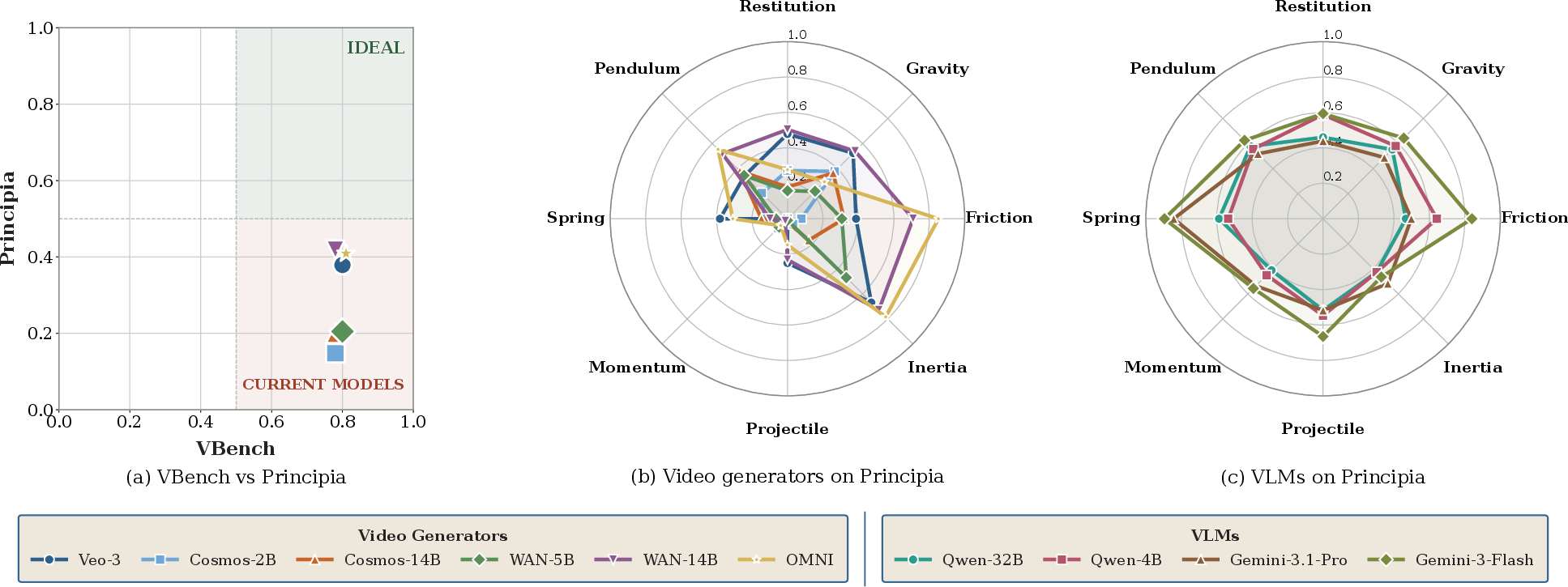
Abstract: Evaluating physical reasoning in video models is difficult because absolute motion measurements depend on frame rate, object scale, and camera calibration, all of which are often ambiguous or unavailable in generated video. We propose a different approach. When two objects in the same scene obey the same physical law, their motions must satisfy predictable relationships, and these relationships hold independent of calibration. We introduce Principia, a benchmark that evaluates Newtonian physics through relational consistency between paired objects. Principia spans eight phenomena - gravity, restitution, friction, rotational inertia, projectile motion, momentum, pendulum, and mass-spring oscillation - across translational, rotational, collisional, and oscillatory dynamics, using real-world scenes recorded under controlled protocols. We also introduce a calibration-independent consistency score that quantifies physical violation directly in image space. Across thousands of generations from six state-of-the-art video generators, no model exceeds 0.42 on Principia despite all scoring around 0.8 on VBench. Vision-LLMs are evaluated on their ability to detect relational physics violations, with the best model achieving only 67% accuracy and most performing near chance level.

Paper Prompts
Sign up for free to create and run prompts on this paper.
Top Community Prompts
Explain it Like I'm 14
1. What is this paper about?
The paper introduces Principia, a test for checking whether AI video models understand basic physics.
Modern AI can create videos that look very realistic. For example, it might generate a ball rolling down a ramp or two objects falling through the air. However, a video can look real while breaking the laws of physics.
The researchers ask an important question:
Do AI video models understand how objects really move, or do they only create pictures that look convincing?
2. What questions did the researchers investigate?
The paper focuses on several main questions:
- Can AI-generated videos follow basic laws of Newtonian physics?
- Can video models keep the correct relationship between two objects in the same scene?
- Does a video that looks realistic also behave realistically?
- Can larger or more advanced AI models understand physics better?
- Can vision-LLMs—AI systems that can watch videos and answer questions—spot physical mistakes?
The researchers tested eight kinds of physical behavior:
- Gravity, such as objects falling.
- Bouncing, or restitution, such as how high a ball rebounds.
- Friction, such as blocks sliding down ramps.
- Rotational inertia, which affects how easily objects roll or spin.
- Projectile motion, such as balls launched through the air.
- Momentum, such as what happens when one object hits another.
- Pendulums, which swing back and forth.
- Mass-spring systems, where weights stretch springs.
3. How did the researchers study this?
Testing relationships between pairs of objects
Instead of asking whether one object’s movement looked reasonable, the researchers compared two objects in the same scene.
This is useful because exact measurements in a video can be difficult. The camera may be zoomed in or moving, and the researchers may not know the real size of the objects or the exact speed of the recording.
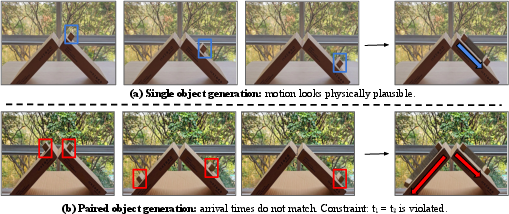
For example, imagine two blocks with different masses sliding down identical ramps. According to physics, their masses should not affect how quickly they slide if the ramps and surfaces are the same. Therefore, the two blocks should reach the bottom at about the same time.
If one block arrives much earlier, the video has broken a physical rule—even if each block’s motion looks believable on its own.
This kind of expected relationship is called an invariant. In simple terms, an invariant is something that should stay true even when other details change.
Building the dataset
The researchers recorded more than 750 real-world videos of carefully controlled experiments. They kept 529 scenes after removing videos with problems such as:
- Objects being released at slightly different times.
- Ramps not having exactly the same angle.
- Objects drifting sideways.
- A pendulum being pushed unevenly.
- Balls slipping or spinning unexpectedly.
They used paired objects and carefully matched equipment so that the comparison would be fair.
They also created computer-simulated videos using Isaac Sim, a physics simulator. Some simulated videos followed physics, while others were deliberately changed to contain “anti-physics” mistakes. These videos were mainly used to test whether AI systems could recognize violations.
Measuring physical consistency
The researchers tracked objects in each video by measuring their positions in pixels. They then compared the two objects using a consistency score.
The score ranges from 0 to 1:
- A score near 1 means the relationship follows physics closely.
- A score near 0 means the relationship is badly broken.
This method does not require knowing the camera’s exact distance, the real size of the objects, or the recording speed. It only checks whether the objects have the correct relationship to each other.
Testing AI systems
The researchers tested:
- Six video generators, which create videos from text and images.
- Four vision-LLMs, which watch videos and answer questions about them.
The video generators were asked to produce clips showing the physical experiments. The vision-LLMs were asked whether a video obeyed or violated the relevant physical rule.
4. What did the researchers find?
Realistic appearance did not mean correct physics
The most important finding was that the AI videos often looked good but failed the physics tests.
The video generators scored around 0.8 on VBench, a common test of visual quality. However, on Principia, their scores were only between 0.14 and 0.42.
This shows a large difference:
| What was tested | Typical result |
|---|---|
| How realistic and attractive the video looked | About 0.8 |
| Whether the video followed physical relationships | Below 0.5 |
In other words, AI systems can make a video that looks like a real experiment without making the objects behave like real objects.
No video generator performed well across all physics tasks
The best overall video generator scored about 0.42, which is still fairly low. No model was good at every type of physics.
Some models did relatively well with friction or rolling objects, while struggling with bouncing, momentum, or projectile motion. The momentum tests were especially difficult because they involved one object hitting another.
The best overall model in this study was Wan2.2-14B, with a score of about 0.42. It performed slightly better than the other tested systems, but it still made many physical mistakes.
Bigger models were not always better
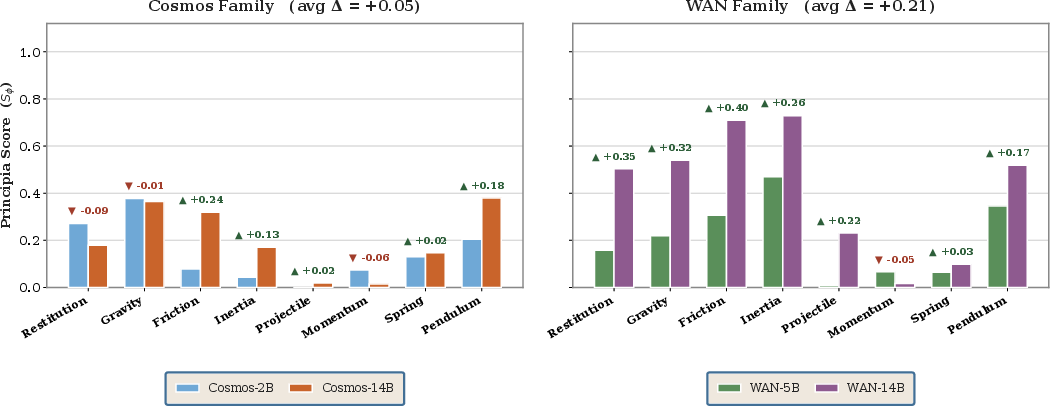
The researchers compared smaller and larger versions of some models. Increasing the model size sometimes improved performance on certain tasks, but not on all of them.
For example, a larger model might become better at understanding friction but worse at understanding bouncing or momentum. This means that simply adding more computer power or making a model larger does not automatically give it a better understanding of physics.
AI judges also struggled
The vision-LLMs were asked to decide whether videos obeyed physics. Their performance was also limited.
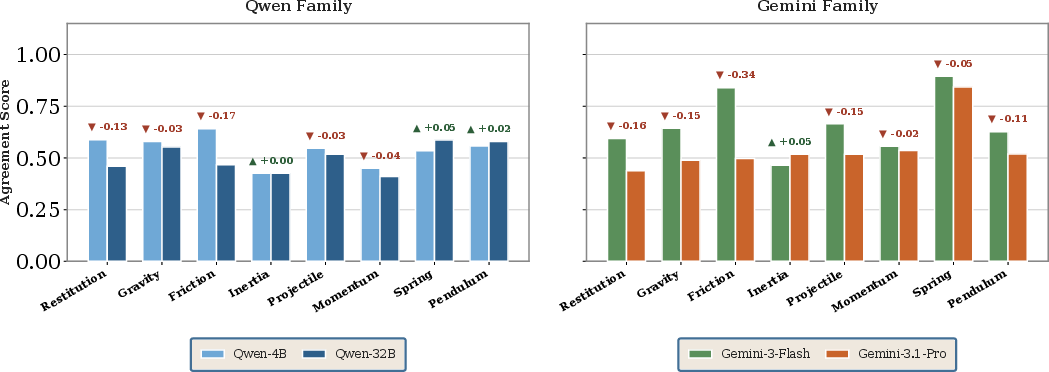
The best model was correct about 67% of the time, while some others performed close to random guessing for certain tasks.
This means that AI systems had trouble not only creating physically correct videos, but also recognizing when physics had been violated.
5. Why are these findings important?
Many researchers hope that video-generating AI can become a world model—an AI system that understands how the real world works and can predict what will happen next.
For example, a useful world model might predict:
- Where a ball will land.
- Whether a block will tip over.
- How far an object will move after being hit.
- How quickly a pendulum will swing.
- What will happen when two objects collide.
The paper suggests that current video generators are not yet reliable world models. They are good at copying the appearance of motion, but they often do not understand the rules behind that motion.
This matters because physically incorrect AI could cause problems if used for:
- Robots learning to interact with objects.
- Simulations for science or engineering.
- Predicting the results of actions.
- Training systems for driving or physical tasks.
- Planning in real-world environments.
Conclusion
Principia provides a new way to test whether AI video models truly follow physics. Instead of judging only whether a video looks realistic, it compares pairs of objects and checks whether their movements obey the same physical laws.
The study found that current AI video models can produce attractive and believable videos, but they often fail at basic relationships involving gravity, collisions, motion, and oscillation. Vision-LLMs also struggle to detect these mistakes.
The main lesson is simple:
Making a video look real is not the same as understanding how the real world works.
Future AI systems may need special training methods that teach them physical relationships directly, rather than expecting them to learn physics only by watching or generating realistic-looking videos.
Knowledge Gaps
Knowledge gaps, limitations, and open questions
- Limited physical scope: The benchmark covers selected macroscopic Newtonian phenomena but leaves fluid dynamics, soft-body deformation, thermodynamics, electromagnetism, turbulence, granular materials, and relativistic or quantum effects unexplored.
- Incomplete phenomenon accounting: The paper alternates between describing eight phenomena and presenting separate momentum-by-height and momentum-by-mass tests; some figures also refer to seven phenomena. The exact benchmark composition and aggregation scheme require clarification.
- Restricted experimental configurations: Each law is tested in highly controlled, simple paired-object arrangements. It remains unknown whether the findings generalize to cluttered scenes, unconstrained object interactions, noncanonical geometries, or multi-object systems.
- Potential selection bias from filtering: Videos with nonconforming motion, tracking failures, lateral drift, asymmetric release, and other anomalies are removed before scoring. This may exclude precisely the difficult cases that models encounter in practice and may inflate measured performance.
- Unquantified real-world experimental error: The paper reports manufacturing tolerances and qualitative validation, but does not provide systematic uncertainty estimates for release timing, surface friction, camera perspective, object segmentation, trajectory extraction, or parameter matching.
- Unvalidated image-space assumptions: The claim that the invariants are calibration-independent is not tested across substantial camera perspective changes, lens distortion, camera motion, occlusion, or out-of-plane motion. Image-space ratios may not remain physically meaningful under these conditions.
- Sensitivity to camera viewpoint: The benchmark does not establish how scores change when paired objects move at different depths, are viewed obliquely, or undergo perspective-dependent scale changes.
- Tracking and segmentation confounds: All trajectories depend on SAM3 initialized with hand-annotated points. The paper does not separate errors caused by object detection, identity switches, occlusion, or segmentation drift from genuine model physics violations.
- Unclear robustness of the consistency score: The normalized score can behave differently depending on the magnitude and sign of the measured quantities, and its relationship to perceptual or physical error is not fully characterized. Sensitivity analyses and calibration against known perturbation levels are missing.
- Weak treatment of qualitative invariants: Projectile and momentum tests use ordering-based scores rather than continuous physical measures. These metrics may conceal large quantitative errors and are not directly comparable with the equality-based scores for other phenomena.
- No human or expert validation of score meaning: The paper does not test whether higher Principia scores correspond to judgments by physics experts or human observers about physical correctness.
- No ablation of individual benchmark design choices: The effects of paired-object structure, first-frame conditioning, apparatus removal, visual augmentation, scenario complexity, and qualitative filtering are not isolated through controlled ablations.
- Limited diversity of real data: Although the dataset contains 529 scenes, the experiments appear to originate from a relatively small number of controlled apparatuses and experimental protocols. Generalization across laboratories, object materials, cultures, environments, and recording devices remains unknown.
- Potential contamination from edited data: Backgrounds, lighting, and visual contexts are diversified using image-editing models, but the paper does not establish that these edits preserve geometric accuracy, object identity, contact relationships, or physical cues.
- Synthetic-to-real validity is unresolved: VLM evaluation relies substantially on Isaac Sim videos and simulated anti-physics examples. The paper does not show that performance on these synthetic cases predicts performance on real-world violations.
- Simulator dependence: The synthetic benchmark inherits the assumptions, rendering biases, contact models, and parameterization of Isaac Sim. The robustness of results across alternative simulators or real-world counterfactual constructions is not evaluated.
- Artificial anti-physics examples: Simulated violations may be easier or qualitatively different from naturally occurring model errors. It remains unclear whether VLMs detect physical inconsistency or merely recognize artifacts associated with the anti-physics generation procedure.
- Confounding visual artifacts in generated videos: The study acknowledges hallucinated objects, missing objects, and severe deformations but does not automatically distinguish these from physical violations. Consequently, low scores may reflect general generation failures rather than failures to model physics.
- Effect of the qualitative pre-filter is unknown: Generated videos that fail basic motion requirements are excluded, but the paper does not report how many samples are removed per model or whether filtering disproportionately affects particular generators or phenomena.
- Prompt and preprocessing confounds: Models receive edited first frames and text prompts, but the paper does not compare alternative prompt formulations, unedited versus edited inputs, text-only inputs, or different levels of apparatus visibility.
- Unclear fairness of model comparisons: The evaluated systems differ in architecture, training data, conditioning interface, parameter count, sampling procedure, and inference settings. The results therefore do not isolate whether performance differences arise from model scale, architecture, training, or interface design.
- Unsupported architectural conclusions: The claim that VLM limitations are architectural and that scaling does not help is based on only four VLMs and two within-family generator scaling comparisons. Larger samples, matched training conditions, and broader model families are needed before drawing this conclusion.
- No causal analysis of scaling: The observed regressions with model size are descriptive. The paper does not determine whether they result from optimization, data composition, sampling variance, architecture changes, compute allocation, or benchmark-specific overfitting.
- Insufficient statistical analysis: Results are reported as means and standard deviations, but confidence intervals, significance tests, effect sizes, correlations among scenarios, and power analyses are not provided.
- Unclear independence of samples: Multiple takes, seeds, edited variants, and scenes derived from the same physical setup may not be statistically independent. The reported variability may therefore overstate the effective sample size.
- No analysis of seed-level reliability: Scores are averaged across multiple seeds, but the number of seeds, their variance, and the stability of model rankings across seeds are not fully reported.
- Limited reproducibility: The real-world videos are withheld to preserve benchmark integrity, preventing independent verification of tracking, filtering, scene validity, and score computation. Secure evaluation or partial release protocols are not explored.
- No test-retest or laboratory replication: The benchmark has not been independently reproduced using new apparatuses, recording sessions, or laboratories, so its reliability under collection variation remains uncertain.
- VLM evaluation may be prompt-sensitive: VLMs receive phenomenon-specific PASS/FAIL prompts, but the effect of wording, chain-of-thought instructions, multiple-choice formats, temporal sampling, and repeated questioning is not measured.
- Incomplete VLM error analysis: The paper reports aggregate agreement but does not analyze false positives, false negatives, class imbalance, confidence calibration, explanations, temporal localization of violations, or whether models rely on superficial visual cues.
- Binary VLM labels discard useful information: PASS/FAIL agreement does not measure whether a VLM can estimate violation magnitude, identify the relevant objects, locate the violating interval, or distinguish competing physical explanations.
- No evaluation of multimodal reasoning transfer: It remains unknown whether VLMs can apply the learned relational principles to novel object types, unseen camera views, different scales, or combinations of multiple physical laws.
- No link to downstream world-model utility: Low benchmark scores are not connected to action planning, counterfactual prediction, control, or decision-making performance. It is unresolved whether Principia predicts practical failures in interactive environments.
- No intervention or improvement study: The paper identifies failures but does not test whether physics-aware fine-tuning, simulator-generated data, relational architectural biases, trajectory losses, or inference-time correction improves Principia performance without harming visual quality.
- Unknown benchmark learnability: Because the benchmark uses recurring experimental templates and a limited set of invariants, it is unclear whether models can memorize visual patterns or prompts rather than learn general physical relations.
- Unexamined sensitivity to object appearance: The effects of texture, color, shape, material cues, object size, and semantic category are not systematically varied, leaving open whether models use appearance-based shortcuts.
- No assessment of temporal resolution requirements: The benchmark claims independence from frame rate, but the minimum temporal resolution needed to detect collisions, rebounds, oscillations, and release-time differences is not established.
- No evaluation under occlusion and long-horizon prediction: The scenes are short and controlled, leaving unresolved whether models preserve relational consistency over longer durations, partial visibility, interruptions, or repeated interactions.
- Ambiguity in physical ground truth for some scenarios: Several protocols rely on assumptions such as identical friction, no-slip rolling, negligible air resistance, equal launch angles, or constant spring stiffness. The extent to which these conditions hold quantitatively is not fully documented.
- Limited treatment of model uncertainty: The benchmark produces point scores but does not assess whether models know when their generated motion is physically unreliable or whether uncertainty estimates predict relational violations.
Practical Applications
Immediate Applications
- Quality assurance for video-generation products (software, media, advertising) Integrate Principia-style tests into model-release and regression-testing pipelines. Generated clips can be evaluated for gravity, friction, restitution, rolling inertia, projectile motion, momentum, pendulum motion, and spring behavior using paired-object relations rather than absolute calibration. This would identify models that look realistic but produce physically impossible motion before deployment in advertising, film previsualization, games, or educational content. Dependencies: reliable object tracking and basic qualitative-motion filtering; benchmark coverage must be expanded beyond the eight tested phenomena and macroscopic Newtonian mechanics.
- Physics-fidelity dashboards for model selection (AI platforms and enterprise procurement) Add a physics-consistency score alongside visual-quality metrics such as VBench when comparing video generators. The paper shows that high visual quality does not predict physical fidelity: models scoring around 0.8 on visual benchmarks remained below 0.45 on Principia. A dashboard could report an overall score and a per-phenomenon profile, enabling users to select models suited to particular workflows. Dependencies: standardized evaluation protocols, representative prompts, and careful interpretation of scores across different model architectures.
- Automated dataset and output auditing (content moderation and synthetic-data generation) Use relational checks to flag generated clips containing violations such as unequal fall times for objects under matched conditions, incorrect rebound ratios, or impossible rolling behavior. Human reviewers could then focus on flagged samples rather than inspecting every video manually. This is particularly useful when synthetic videos are used to train perception, robotics, or autonomous-driving systems. Dependencies: the method assumes that objects are visible, trackable, and subject to sufficiently matched conditions; hallucinated or severely deformed objects may be mistaken for physics failures.
- Physics-aware training and fine-tuning of video generators (generative AI research and engineering) Use the invariant score as a reward or loss during post-training. For example, a model could be penalized when paired objects violate expected time, distance, period, or displacement relationships. The synthetic Isaac Sim pipeline can provide physically correct and deliberately anti-physics examples for supervised or preference-based training. Dependencies: differentiable or reliably estimated object trajectories, sufficient training diversity, and safeguards against optimizing for benchmark-specific patterns rather than general physical reasoning.
- Evaluation of vision-LLM judgment (AI assistants and video analytics) Deploy Principia-Synth-style pass/fail tests to measure whether a VLM can identify physical inconsistencies in instructional, scientific, or user-generated videos. Such tests could be used in model certification, prompt evaluation, and monitoring. The current results indicate that this capability is immature, with the best evaluated model reaching only approximately 67% agreement. Dependencies: VLMs must receive adequate temporal information; performance may depend on phenomenon-specific prompts and may not generalize from simulated to natural videos.
- Interactive physics education and laboratory instruction (schools, universities, and online learning) Convert the paired-object experiments into inexpensive computer-vision laboratory activities. Students can record pendulums, rolling cylinders, collisions, springs, or inclined-plane experiments with ordinary cameras and compare measured image-space relations against Newtonian predictions. Because the score does not require camera calibration or metric scale, the activities can be performed in classrooms with limited equipment. Dependencies: controlled releases, matched apparatus, suitable lighting, and instructional guidance concerning friction, air resistance, slip, and measurement noise.
- Research benchmarking for computer vision and robotics (academia and embodied AI) Use the released first frames, prompts, synthetic scenes, and relational scoring code to test object tracking, temporal reasoning, physical-violation detection, and video prediction. The benchmark is particularly useful for separating perceptual realism from causal or physical competence. Dependencies: access to withheld real videos or equivalent evaluation data is important for preventing overfitting; current coverage is limited to macroscopic Newtonian settings.
- Camera-agnostic inspection of simple physical processes (manufacturing, laboratory automation, and maintenance) Adapt the invariant framework to monitor paired components or repeated operations—for example, whether two matched actuators move synchronously, whether two springs extend proportionally to applied loads, or whether paired rolling elements exhibit expected timing relationships. This can provide low-cost anomaly detection without full camera calibration. Dependencies: industrial conditions must preserve the relevant matched-object assumptions; real equipment may involve vibration, wear, nonlinear materials, and external forces not represented in the benchmark.
Long-Term Applications
- Physics-grounded world models for robotics (robotics, autonomous vehicles, and warehouse systems) Incorporate relational-physics tests into training and validation for models that predict the consequences of actions. A robot planning to push, drop, roll, or manipulate objects could use a video world model only after it demonstrates reliable predictions of momentum, collisions, friction, rotational inertia, and oscillatory motion. Dependencies: substantial advances are required because current generators perform poorly on multi-object interactions, especially momentum. Real deployment also requires 3D reasoning, uncertainty estimation, contact modeling, and handling of non-rigid objects.
- Physics-aware video generation for engineering and scientific visualization (engineering, architecture, energy, and simulation) Develop generators that produce visually realistic but mechanically valid simulations of mechanisms, structural motion, fluid systems, or energy devices. Principia could serve as an initial validation layer before extending to structural dynamics, fluid mechanics, thermodynamics, and soft-body deformation. Dependencies: the present benchmark does not cover fluids, soft bodies, heat, electromagnetism, or material failure; engineering use would require metric accuracy and domain-specific validation, not only unit-free relational consistency.
- Synthetic training data for autonomous systems (robotics, transportation, and industrial AI) Generate large collections of physically consistent counterfactual videos for training perception and planning systems. For each scene, a simulator could vary mass, release height, friction, collision parameters, or object geometry while preserving the underlying physical law. Anti-physics examples could be used as hard negatives for anomaly detection. Dependencies: simulator fidelity, domain randomization, and transfer from rendered scenes to real environments; anti-physics examples must avoid introducing superficial visual artifacts that make classification unrealistically easy.
- Physics-based safety certification for generative models (policy, standards, and AI governance) Regulators or industry consortia could establish minimum physical-consistency thresholds for models marketed as world simulators or used to generate safety-critical training data. Certification could require reporting per-phenomenon results rather than a single aggregate number, since the paper finds distinct failure profiles across models. Dependencies: agreement on task definitions, statistically robust thresholds, protection against benchmark contamination, and expansion to application-specific hazards such as vehicle dynamics, biomechanics, and structural collapse.
- Video evidence analysis and forensic reconstruction (legal, insurance, and public safety) A mature version of the method could assess whether events depicted in footage are compatible with basic mechanics—for example, fall timing, collision outcomes, projectile range, or rebound behavior. It could assist investigators by identifying physically inconsistent edits or prioritizing footage for expert review. Dependencies: this must remain an advisory tool rather than definitive evidence. Occlusion, unknown forces, camera motion, non-ideal materials, editing, and incomplete scene information can all invalidate the assumed relational constraints.
- Assistive everyday physics analysis (consumer applications and smart devices) Smartphone applications could use camera video to explain or verify ordinary physical behavior: whether two objects should fall together, whether a rolling object is slipping, whether a swing period matches its length, or whether a spring is loaded proportionally. Such tools could support household troubleshooting, DIY projects, and science learning. Dependencies: robust mobile tracking, user-friendly experiment setup, handling of uncontrolled conditions, and clear communication that benchmark-style checks cannot replace professional engineering advice.
- Physics-aware game engines and virtual environments (gaming, virtual reality, and digital twins) Combine generative visual models with relational constraints so that generated characters, objects, and environments preserve plausible collisions, gravity, rolling, and oscillation. In digital twins, relational scores could monitor whether learned visual simulators remain consistent with the underlying physical system during long-horizon prediction. Dependencies: real-time computational efficiency, integration with explicit physics engines, and extension from simple paired objects to complex scenes with articulated bodies, deformable materials, and fluid interactions.
- New architectures with explicit relational representations (academic machine-learning research) The findings motivate architectures that represent object pairs, invariant quantities, and interactions explicitly rather than relying solely on appearance-based video prediction. Possible tools include object-centric latent states, graph neural networks, differentiable physics modules, and hybrid neural-simulation systems. Dependencies: research must establish whether such biases improve generalization rather than merely benchmark performance. The paper’s result that larger models do not consistently improve physics suggests that scaling alone is unlikely to solve the problem.
- A broader scientific benchmark ecosystem (academia and open evaluation) Principia could become a template for calibration-independent testing in additional domains, including fluid flow, soft-body deformation, thermodynamics, biomechanics, and energy transfer. Paired-object or multi-object invariants may provide robust evaluation where absolute scale, camera calibration, or full physical parameters are unavailable. Dependencies: each new domain requires carefully controlled real-world data, validated assumptions, reliable segmentation, and invariant definitions that distinguish true law violations from experimental asymmetry.
Glossary
- A100-hours: A unit measuring the computational time consumed by an NVIDIA A100 GPU. “Total inference compute exceeds 2{,}600 A100-hours”
- Analytic expectations: Predictions derived mathematically from an explicit model or physical law. “facilitate comparison against analytic expectations”
- Autoregressive model: A generative model that produces a sequence by predicting each element from previously generated elements. “Recent video diffusion and autoregressive models”
- Calibration-independent: Not requiring camera parameters or measurements that convert image coordinates into real-world units. “We also introduce a calibration-independent consistency score”
- Camera intrinsics: Internal camera parameters, such as focal length and optical-center location, that determine image formation. “without any dependence on metric scale, velocity, or camera intrinsics”
- Counterfactual scenario: A simulated situation representing what would happen under altered or physically incorrect conditions. “both controlled and counterfactual”
- Diffusion model: A generative model that creates data by iteratively removing noise from a random signal. “Recent video diffusion and autoregressive models”
- Elastic restoring force: A force that tends to return a deformed object to its equilibrium configuration. “mass-spring dynamics investigate oscillatory dynamics under gravity and elastic restoring forces”
- Equivalence principle: The principle that objects under the same gravitational conditions have the same acceleration regardless of their mass. “to isolate Galileo's principle”
- Fidelity: The degree to which generated content accurately preserves the relevant properties of its reference or intended phenomenon. “visual quality and physical fidelity are nearly orthogonal”
- Frame rate: The number of video frames recorded or displayed per unit of time. “all of which are often ambiguous or unavailable in generated video”
- Galileo’s principle: The gravitational invariant that objects in free fall have the same acceleration, independent of their mass. “the mass-independence invariant of gravitational acceleration”
- Hallucinated object: An object incorrectly invented or introduced by a generative model. “Generators sometimes produce videos with hallucinated objects”
- Image-space measurement: A measurement made directly in pixel coordinates rather than in calibrated physical units. “Such invariants can be computed from image-space measurements”
- Inpainting: The process of filling in or modifying selected image regions using a generative model. “with the experimenter, suspension strings, and visible release mechanisms inpainted out”
- Invariant: A quantity or relationship that remains unchanged when specified conditions vary. “This equality is an invariant of the underlying physical law”
- Isaac Sim: A physics-based simulation platform used to generate rendered physical scenarios. “We additionally build a synthetic testbed in Isaac Sim”
- Law-based evaluation: Assessment of model outputs by comparing them with explicit scientific laws. “law-based evaluation often requires recovering or assuming metric quantities”
- Metric scale: A real-world distance scale that maps image measurements to physical lengths. “without any dependence on metric scale, velocity, or camera intrinsics”
- Moment of inertia: A measure of an object’s resistance to changes in rotational motion, dependent on its mass distribution. “the interaction between translational and rotational motion under no-slip rolling conditions”
- Newtonian mechanics: The classical framework describing motion using Newton’s laws and related physical principles. “Principia tests macroscopic Newtonian mechanics”
- No-slip condition: A rolling constraint in which the contact point has no relative sliding against the surface. “under no-slip rolling conditions”
- Oscillatory dynamics: The study of repeated motion around an equilibrium position. “Pendulum and mass-spring dynamics investigate oscillatory dynamics”
- Pendulum period: The time required for a pendulum to complete one full oscillation. “The period is independent of bob mass”
- Physical plausibility: The degree to which motion appears consistent with everyday physical expectations, without necessarily satisfying an exact law. “plausibility is subjective”
- Physical violation: A departure from a relationship required by a physical law. “The physics simulator allows us to render both physically correct videos and corresponding anti-physics videos”
- Projectile motion: The motion of an object launched through the air under the influence of gravity. “Projectile Motion.”
- Relational consistency: Agreement between the motions or measurements of paired objects as required by a shared physical law. “An invariant score of relational consistency”
- Restitution: The behavior describing how much kinetic energy is retained when objects collide and rebound. “Restitution measured from motion during and after collisions”
- Rotational inertia: Resistance to angular acceleration caused by an object’s mass distribution. “A solid and a hollow cylinder of matched mass and radius roll down opposite faces of a no-slip ramp”
- Stroboscopic composite: A single image combining successive positions from a video to visualize motion over time. “shown at three timesteps and as a stroboscopic composite”
- Synthetic testbed: An artificially generated experimental environment used for controlled evaluation. “We additionally build a synthetic testbed in Isaac Sim”
- Trajectory matching: Evaluation that compares a generated motion path with a recorded reference path. “trajectory matching penalizes deviation from a single reference”
- Translational dynamics: The study of motion involving changes in an object’s position without necessarily involving rotation. “Principia covers four types of Newtonian dynamics: translational, rotational, collisional, and oscillatory dynamics”
- Unit-free: Expressed through ratios or normalized quantities so that physical units and scale cancel out. “The normalization makes unit-free and bounded in ”
- Vision-LLM: A model that jointly processes visual inputs and natural-language instructions or questions. “Vision-LLMs are evaluated on their ability to detect relational physics violations”
- World model: A model intended to represent how an environment behaves and to predict the consequences of actions within it. “given their potential use as world models for predicting the consequences of actions”

