NeoMME: A Single-Tower Multimodal-Native Multilingual Foundation Encoder for Efficient Fine-Tuning and Inference
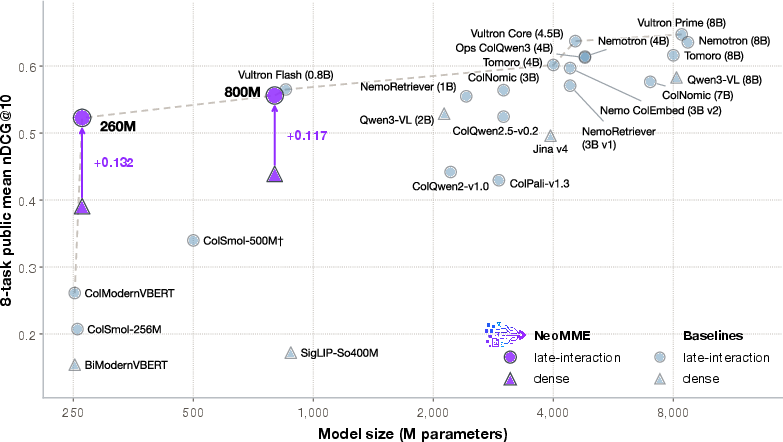
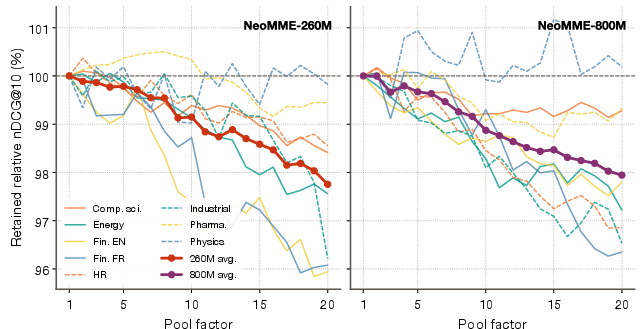
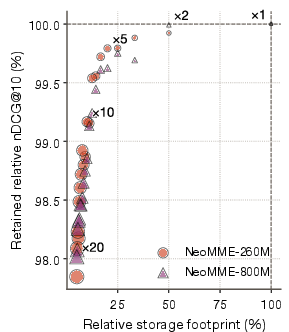
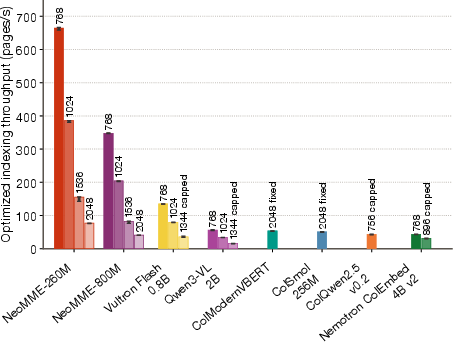
Abstract: Multimodal models often build on architectures designed for generative vision-language modeling, typically combining separately pretrained vision encoders with causal LLMs. Visual document retrievers such as ColPali repurpose these models as encoders, carrying over the parameter and compute overhead of a VLM for a non-generative task. We introduce NeoMME, a family of 260M and 800M-parameter Multimodal and Multilingual bidirectional Encoders that process multilingual text and raw image patches in a single bidirectional Transformer encoder. Both models are pretrained from scratch with a masked discrete-diffusion text objective, conditioned on visible image patches for multimodal examples. Both support a 16,384-token context, enough to encode up to two standard 4K UHD images. To demonstrate its downstream capabilities, we fine-tune NeoMME with jointly trained dense and late-interaction heads. On the ViDoRe v3 benchmark, the resulting NeoMME-Retriever 260M outperforms all evaluated models strictly below 800M parameters with 0.523 nDCG@10, while NeoMME-Retriever 800M reaches 0.556. At a matched 2048x2048 image input size on an NVIDIA L40S, NeoMME-260M encodes pages with about 2x the throughput of ColModernVBERT. Hierarchical token pooling and asymmetric quantization compress late-interaction multimodal document embeddings by 255x while preserving over 95% of baseline nDCG@10. We contribute NeoMME to Hugging Face Transformers and release the pretrained backbone and retrieval-compatible checkpoints under Apache 2.0 at https://hf.co/collections/Hcompany/neomme.
Paper Prompts
Sign up for free to create and run prompts on this paper.
Top Community Prompts
Explain it Like I'm 14
1. What is the paper about?
This paper introduces NeoMME, a new artificial intelligence model that can understand both text and images.
The model is designed especially for searching documents that are stored as images, such as scanned PDFs, reports, slides, forms, and pages containing tables or diagrams. Instead of reading only the words extracted from a document, NeoMME looks at the whole page image. This helps it notice information about:
- Words and sentences
- Page layout
- Tables
- Pictures
- Charts
- Fonts and positions of text
The researchers created two versions of the model, with about 260 million and 800 million adjustable parts, called parameters. They aimed to make these models accurate while using less computer memory and processing power than many existing systems.
2. What questions did the researchers investigate?
The paper mainly asks:
- Can one model understand text and images together? Many AI systems use one separate model for images and another for language. NeoMME tries to use one shared model for both.
- Can the model learn without a separate pretrained vision model? NeoMME does not begin with a ready-made image encoder. Instead, it learns to process images from the beginning.
- Can NeoMME retrieve the right document pages for a search question? For example, if someone asks, “Which page shows the company’s yearly revenue?”, can the system find the correct page?
- Can the model be faster and smaller than similar models?
- Can its document representations be compressed? A representation is a numerical description of a document that a computer can store and compare. The researchers wanted to shrink these descriptions without losing much search quality.
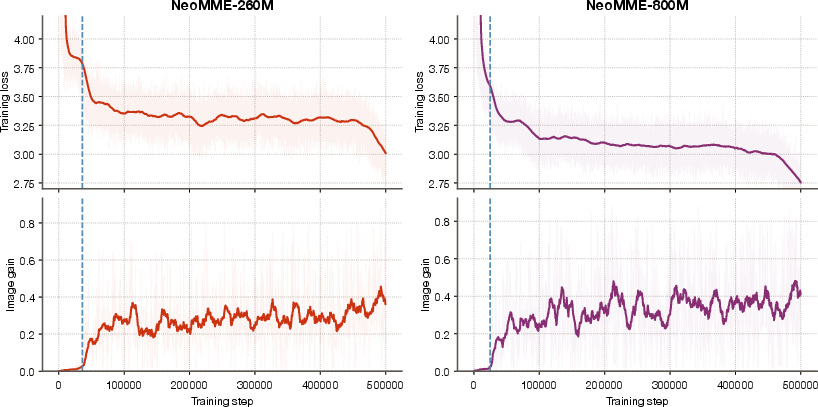
- Does the model actually use image information? The researchers tested whether the model performs better when it can see the page image, especially when much of the written text is hidden.
3. How did the researchers build and test NeoMME?
A single shared model for text and images
Many multimodal AI systems use separate “towers”:
- One tower processes the image.
- Another tower processes the text.
- The two outputs are combined later.
NeoMME uses a different design called a single-tower architecture. Text tokens and image pieces are placed into the same Transformer model.
An analogy is a school project where two students work separately and combine their work at the end. In NeoMME, the students work in the same room from the beginning, so they can directly compare their ideas while working.
Turning images into pieces
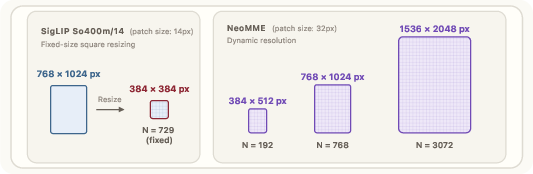
NeoMME divides an image into small, square pieces called patches. Each patch is pixels.
For example, a page image is like a large mosaic. The model examines each tile of the mosaic and turns it into numbers. These numbers are then processed alongside text tokens.
The model does not use a separate pretrained vision encoder. It learns how to interpret these image patches during its own training.
Bidirectional attention
NeoMME is a bidirectional Transformer. This means that when it examines one part of the input, it can use information from both earlier and later parts.
This is different from many text-generating models, which usually read from left to right and can only use previous words when predicting the next one.
Bidirectional attention is useful for understanding and retrieval because the model can examine the whole input at once, more like reading an entire page rather than writing a sentence one word at a time.
Training by hiding words
During pretraining, the researchers often hid some words from a sentence and asked the model to guess them. This is similar to a “fill in the blanks” exercise.
For multimodal examples, the image remained visible while parts of the text were hidden. The model had to use the page image to help predict the missing words.
The researchers hid at least 30% of the text in image-and-text examples, and sometimes hid as much as 90%. This made it harder for the model to guess using surrounding words alone, encouraging it to look at the image.
The paper calls this process masked discrete diffusion. In simple terms, the model sees text that has been gradually damaged with mask symbols and learns to restore the original words.
Training data
The model was trained on a mixture of:
- Web pages and PDF text
- Wikipedia
- Mathematics
- Programming code
- Question-answering examples
- Natural images
- Scanned documents
- OCR data, meaning text recognized from images
- Multilingual material
About 55% of the training input was text-only, and about 45% included images and text. The planned training used roughly 524 billion tokens, where a token is a small piece of text, such as a word, part of a word, or punctuation mark.
Testing document search
After pretraining, the researchers fine-tuned NeoMME for visual document retrieval.
Retrieval means finding the best documents for a question. For example:
- Query: “Find the page containing the train schedule.”
- Result: The system ranks document pages, placing the most useful pages near the top.
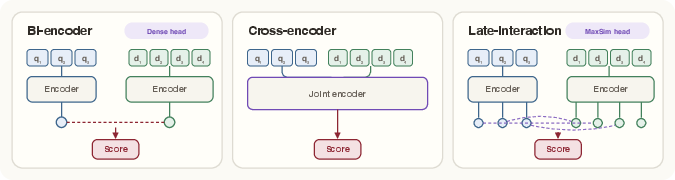
The researchers tested two types of document descriptions:
- Dense representation: The entire document is summarized as one long list of numbers.
- Late-interaction representation: The document keeps many smaller numerical descriptions, one for each word or image area.
Late interaction is like comparing a question with many individual clues on a page instead of comparing it with only one overall summary. It can preserve more detail, but it usually needs more storage and computation.
The models were evaluated on ViDoRe v3, a benchmark designed to test visual document retrieval.
4. What were the main findings?
NeoMME performed well at document retrieval
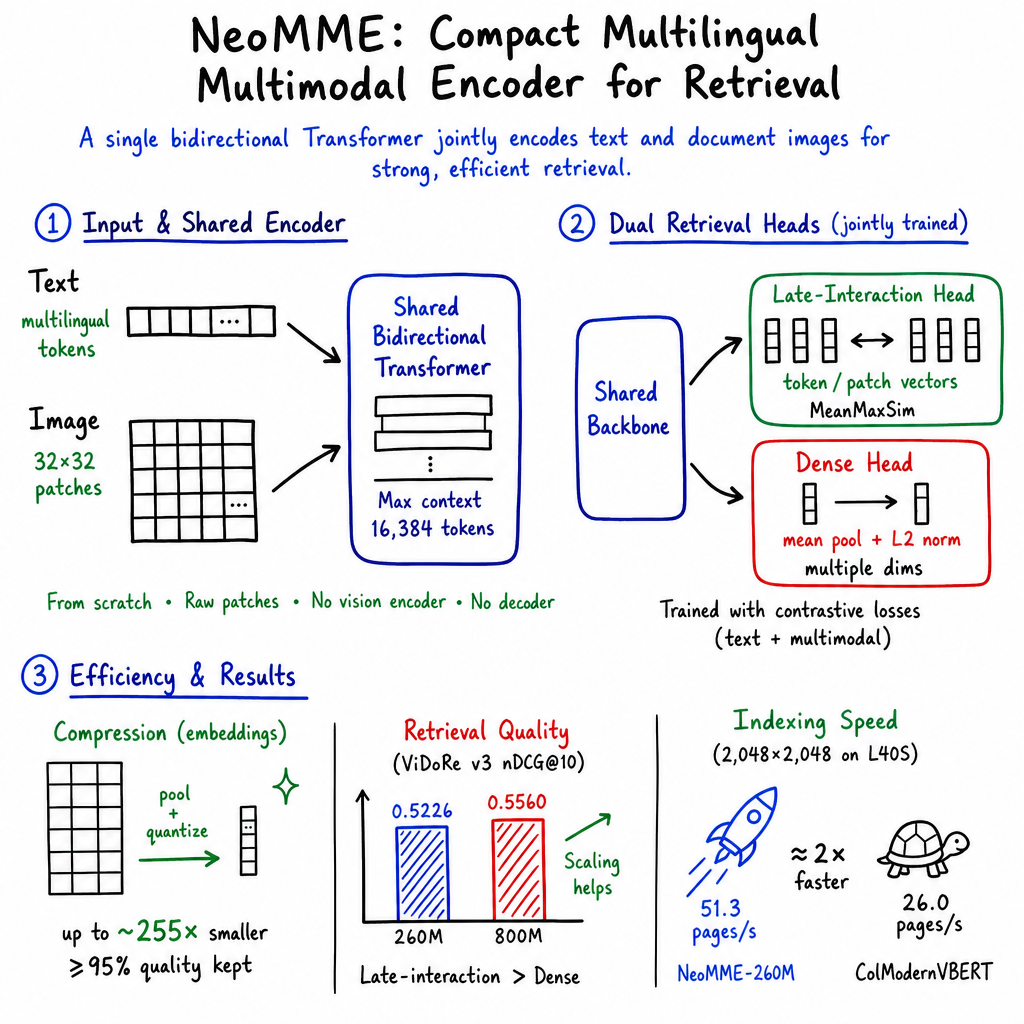
The 260-million-parameter model achieved a score of 0.523 nDCG@10, while the 800-million-parameter version achieved 0.556 on ViDoRe v3.
nDCG@10 is a measurement of how well a search system places useful results among its first ten answers. A higher score means that relevant pages are more likely to appear near the top.
The 260M version performed better than all the other evaluated models with fewer than 800 million parameters. This is important because smaller models are generally cheaper and easier to run.
The smaller model was faster
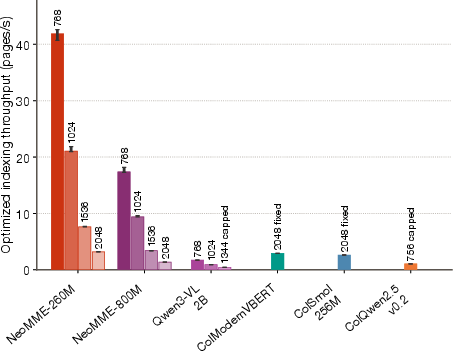
When processing pages sized at pixels on an NVIDIA L40S GPU, NeoMME-260M processed about 51.3 pages per second.
It was about 1.97 times faster than the compared ColModernVBERT system under the same image-size conditions.
This matters for large collections. A company may have millions of document pages to organize, so even a small speed improvement can save a lot of time and money.
The model used image information
The researchers compared the model’s predictions in two situations:
- The model could see the page image.
- The image was removed, but the masked text stayed the same.
When 90% of the text was hidden, seeing the image improved word-recovery accuracy by:
- 38.4 percentage points for NeoMME-260M
- 40.5 percentage points for NeoMME-800M
This shows that the model was not simply relying on nearby visible words. It was using information from the image itself, such as the appearance and position of words on the page.
Document representations could be made much smaller
The late-interaction representation normally required about 1.5 megabytes per document in one of the experiments.
The researchers used two techniques:
- Hierarchical token pooling: Combining nearby or similar token descriptions into fewer summaries.
- Quantization: Storing numbers in a simpler format that uses fewer bits.
Together, these reduced the storage requirement to about 6 kilobytes per document—a 255-fold reduction.
Despite this large reduction, the system kept more than 95% of its original retrieval quality. In other words, the compressed version used far less storage while still finding nearly the same relevant pages.
The model could produce simple image-based text
The researchers also tested whether NeoMME could generate captions or describe document images. The model could produce examples of text based on images without special captioning or OCR fine-tuning.
However, the paper clearly says that these examples were demonstrations, not a complete measurement of generation quality. Therefore, the strongest evidence in the paper concerns representation learning and document retrieval, rather than text generation.
5. Why are these results important?
NeoMME could be useful for systems that need to search documents while preserving their visual information.
Traditional document search often extracts words using OCR. This can lose important details, such as:
- Which words belong in a table
- How headings are arranged
- Information shown only in a diagram
- The relationship between labels and images
- Formatting that changes the meaning of a page
Because NeoMME looks at the page as an image, it may be better at handling documents where layout matters.
The model’s efficiency is also significant. Faster processing and much smaller document representations could make it practical to search very large collections, such as:
- Company archives
- Legal records
- Scientific papers
- School or government documents
- Manuals and technical reports
- Scanned historical collections
It could also support visual retrieval-augmented generation, or Visual RAG. In such a system, a user asks a question, NeoMME finds the most relevant pages, and another AI model uses those pages to create an answer.
Conclusion
The paper presents NeoMME as a compact and efficient AI model that learns to understand language and images together using one shared Transformer.
Its main achievements are:
- Strong visual document retrieval
- Faster page processing than a comparable system
- Evidence that it uses image information, not only text
- Very large storage savings through compression
- Support for multilingual text and long documents
The research suggests that future search systems may not need to convert every document into plain text first. Instead, they could search the original page images directly, preserving tables, layouts, diagrams, and other visual clues. This could make document search more accurate, cheaper, and more useful in real-world situations.
Knowledge Gaps
Knowledge gaps, limitations, and open questions
- The reported pretraining mixture is described as a plan of 524B tokens, but the paper does not establish whether the full token budget was completed, how much data was actually consumed, or whether dataset repetition and deduplication affected the results.
- The effects of individual pretraining data sources are not isolated; it remains unclear how much performance comes from document images, natural images, OCR data, multilingual text, code, mathematics, or synthetic data.
- No ablation study determines the contribution of the masked discrete-diffusion objective relative to standard masked-language modeling, contrastive pretraining, autoregressive pretraining, or multimodal objectives with explicit image reconstruction.
- The choice of sampling multimodal corruption rates from is not compared against alternative masking distributions, fixed masking rates, or modality-adaptive masking strategies.
- The inverse-rate loss weighting and the cap at 20 are not ablated, leaving their effects on optimization stability, text quality, and image utilization uncertain.
- Positive image gain in masked-token accuracy does not demonstrate robust semantic visual understanding; the probe does not measure whether the model uses image information for reasoning, layout interpretation, table understanding, chart reading, or visually grounded retrieval.
- The image-ablation probe compares real patches with zero tensors, but does not compare against shuffled, corrupted, blurred, or semantically mismatched images; therefore, it is unclear whether the measured gain reflects meaningful visual grounding or sensitivity to low-level image statistics.
- Image gain is reported primarily from the final 50 probe events, without confidence intervals, dataset-level breakdowns, statistical significance tests, or analysis of variance across languages, document types, and image resolutions.
- The paper provides only qualitative examples for image-conditioned generation and explicitly does not report average generation quality; generation accuracy, factuality, calibration, diversity, and robustness remain unmeasured.
- The model’s ability to generate text from images is evaluated without comparisons to specialized OCR, image-captioning, or multimodal generative baselines under matched decoding and compute conditions.
- The impact of omitting masked-image modeling and pixel or latent visual reconstruction targets is not experimentally quantified.
- The relative contribution of the single-tower design is unresolved because the experiments do not provide controlled comparisons with dual-tower models, cross-attention models, or shared-backbone models having the same parameter count, data, and training budget.
- It is unclear whether the reported gains arise from the architecture itself or from differences in tokenizer, data mixture, image resolution, optimization method, context length, or fine-tuning procedure relative to competing models.
- The architecture contains many simultaneous innovations—factorized embeddings, dynamic resolution, two-dimensional RoPE, sliding-window/global attention, QK normalization, gated attention, token-indexed value embeddings, residual mixing, exclusive self-attention, and zero-initialized projections—but their individual and interaction effects are not ablated.
- The use of image patches is motivated qualitatively, but there is no systematic comparison with smaller or larger patches across OCR accuracy, retrieval quality, memory use, and throughput.
- The fixed 16,384-token context limit is not evaluated for documents longer than two 4K images, multi-page documents, long text passages, or sequences containing many heterogeneous images.
- The paper does not quantify how sliding-window attention affects long-range cross-page reasoning and retrieval compared with full attention at shorter or equivalent contexts.
- Dynamic-resolution sampling is not compared with fixed-resolution training or alternative token-budget allocation strategies, so its effect on robustness and efficiency is uncertain.
- The tokenizer evaluation covers FLORES languages but does not establish downstream retrieval or representation quality for low-resource, unseen, code-switching, morphologically complex, or non-target languages.
- Tokenization efficiency is reported mainly as token-count reduction; the paper does not determine whether fewer tokens preserve linguistic information, spelling fidelity, numerical precision, code structure, or retrieval effectiveness across all 204 languages.
- The vocabulary and byte-fallback behavior may introduce unequal computational and representational costs across languages, but these disparities are not analyzed.
- The paper does not report pretraining loss, retrieval quality, or multimodal grounding as a function of training compute, preventing comparison of compute efficiency with alternative objectives and architectures.
- Only 260M and 800M parameter configurations are evaluated; the scaling behavior between and beyond these sizes, including whether performance saturates or improves predictably, remains unknown.
- The choice of model sizes and width-dominated scaling is not compared with deeper, narrower, or vision-specialized configurations at matched parameter and compute budgets.
- The retrieval fine-tuning data, number of examples, negative-mining strategy, query/document construction, training duration, and hyperparameter sensitivity are not sufficiently detailed to assess reproducibility or data dependence.
- The joint dense and late-interaction objectives are not separated through comprehensive ablations, leaving unclear whether joint training improves both representations or creates trade-offs between them.
- The paper does not compare NeoMME-Retriever against a dense-only model, a late-interaction-only model, and independently fine-tuned models under identical training conditions.
- The retrieval evaluation is centered on ViDoRe v1–v3 and may not establish generalization to non-document image retrieval, web-scale multimodal search, enterprise documents, scanned historical archives, handwritten documents, or noisy real-world PDFs.
- The excerpt does not provide sufficient detail on benchmark contamination, pretraining overlap with ViDoRe, or safeguards against memorization, leaving the validity of benchmark gains uncertain.
- Performance is reported primarily using nDCG@10; recall at larger cutoffs, precision, latency–quality trade-offs, calibration, query difficulty, and failure rates are not comprehensively characterized.
- The paper does not evaluate end-to-end Visual RAG, so improved retrieval scores are not shown to translate into better answer accuracy, citation correctness, or downstream generation quality.
- Comparisons with competing retrievers may not be fully controlled for image resolution, token limits, embedding dimensions, hardware, software kernels, batch size, quantization, and indexing implementation.
- Throughput measurements are reported on an NVIDIA L40S, while pretraining uses H100 systems; cross-hardware reproducibility, energy consumption, cost per indexed page, and performance under production workloads remain unexamined.
- The claim of approximately indexing throughput over ColModernVBERT is not accompanied by a full accounting of preprocessing, image decoding, memory transfer, batching, compilation, and warm-up costs.
- Query latency and document-indexing throughput are not jointly evaluated under realistic corpus sizes and concurrent workloads, leaving system-level scalability uncertain.
- The proposed hierarchical pooling and asymmetric quantization are evaluated mainly through aggregate nDCG retention; their effects on specific document types, rare visual details, numerical content, multilingual text, and long documents are unknown.
- The compression results do not establish robustness to different pooling factors, quantization schemes, embedding widths, corpus sizes, or ANN/multi-vector indexing methods.
- Binary document embeddings with int8 queries may substantially alter score distributions and candidate ranking, but recall loss at different retrieval depths and under approximate search is not reported.
- The paper does not compare its compression approach against product quantization, scalar quantization, MUVERA, PLAID, residual compression, or other multi-vector storage methods under equal memory and latency budgets.
- No adversarial or distribution-shift evaluation tests sensitivity to image compression, blur, skew, rotation, unusual layouts, low resolution, color changes, OCR errors, or document scans.
- The model’s handling of tables, charts, mathematical notation, small fonts, handwriting, multilingual scripts, and overlapping visual elements is not separately evaluated.
- Robustness to irrelevant, misleading, or visually conflicting text accompanying an image is not tested, so the model’s reliance on textual shortcuts remains uncertain.
- The paper does not analyze whether late-interaction vectors correspond to interpretable regions, words, layout elements, or visual evidence, limiting understanding of why retrieval succeeds or fails.
- Calibration and uncertainty estimates are absent; the system’s ability to identify unanswerable queries, ambiguous documents, or out-of-distribution inputs remains unknown.
- The released checkpoints and code do not by themselves resolve licensing, privacy, copyright, or personally identifiable information risks inherited from the large-scale web, OCR, PDF, and synthetic training sources.
- The environmental and economic costs of training approximately 524B tokens on multi-node H100 infrastructure are not reported.
- The paper’s claims about multilingual and multimodal foundation capability exceed the scope of the presented evaluations, which focus primarily on masked-token probes, qualitative generation examples, and visual document retrieval.
Practical Applications
Immediate Applications
The paper’s released Apache 2.0 checkpoints, Hugging Face integration, retrieval heads, and reported inference efficiency make the following uses deployable with existing hardware and engineering workflows, subject to domain validation.
- Visual document search for enterprise knowledge bases — software, legal, finance, and public administration.
Index PDF pages or document screenshots with
NeoMME-Retriever-260Mor800M, then retrieve pages using natural-language queries. This is particularly useful for contracts, annual reports, invoices, technical manuals, regulations, and scanned records where OCR may lose tables, figures, layout, or typography. Workflow: PDF rendering → page encoding → compressed late-interaction or dense index → query encoding → top- retrieval → optional reranking or answer generation with a VLM. Feasibility dependencies: representative document and query data, sufficient GPU capacity for initial indexing, and privacy controls for confidential documents. - Visual Retrieval-Augmented Generation (Visual RAG). Use NeoMME as the first-stage retriever to select relevant pages for a multimodal LLM. The retrieved page images can then be supplied to the generator, preserving visual evidence such as charts, diagrams, signatures, tables, and page layout. Potential product: an internal “chat with PDFs” system that cites source pages rather than relying solely on extracted text. Feasibility dependencies: the generator must correctly interpret retrieved images; retrieval quality does not by itself guarantee factual answers, so citation verification and hallucination monitoring remain necessary.
- Low-storage indexing of large visual corpora — cloud search and digital libraries. Hierarchical token pooling combined with asymmetric quantization reduces a reported document representation from approximately 1.5 MB to 6 kB while retaining more than 95% of baseline nDCG@10. Organizations can therefore index substantially larger collections of scanned pages, research papers, product catalogs, or archived websites. Potential tools: compressed multi-vector indexes, binary document stores, GPU MaxSim services, and hybrid dense/late-interaction search systems. Feasibility dependencies: the reported compression-quality trade-off may vary by corpus, language, image resolution, and query distribution; production systems should measure recall and ranking degradation on their own data.
- Faster offline indexing of document repositories. The 260M model reportedly encodes pages at about 51.3 pages per second on an NVIDIA L40S, approximately twice the throughput of ColModernVBERT under the stated conditions. This can reduce the cost and time of indexing institutional archives or continuously updated document collections. Feasibility dependencies: throughput depends on GPU model, batch size, image preprocessing, storage bandwidth, and sequence-length distribution. Real-world pipelines must also account for PDF rendering and image decoding overhead.
- OCR-free or OCR-light document retrieval. Since the model consumes raw image patches, it can retrieve documents without requiring a separate OCR pipeline. This is useful for handwritten annotations, unusual fonts, multilingual pages, complex layouts, and documents containing information embedded in figures or tables. Potential sectors: insurance claims, historical archives, healthcare records, logistics paperwork, and government forms. Feasibility dependencies: OCR-free retrieval does not mean reliable text transcription; applications requiring exact extraction, legal evidence, or clinical interpretation should retain OCR or human review as a complementary process.
- Multilingual search across text and document images. The tokenizer and pretraining mixture target multiple languages, while the shared encoder can represent both text queries and visual documents. This supports cross-lingual search, such as querying an English interface for documents written in selected supported languages. Potential workflows: multilingual customer-support search, international regulatory research, and cross-border document discovery. Feasibility dependencies: the paper notes weaker tokenizer coverage outside its original 14-language evaluation set. Language-specific benchmarking and fine-tuning are required before deployment in low-resource languages.
- Hybrid retrieval systems combining dense and late-interaction representations. A single NeoMME forward pass produces both a pooled dense representation and a token-level late-interaction representation. Teams can use dense ANN retrieval for a fast broad candidate set and late interaction for more precise matching, or select one representation according to latency and storage constraints. Potential workflow: dense retrieval of thousands of candidates → compressed MaxSim scoring of the top few hundred → cross-encoder or human review for final ranking. Feasibility dependencies: late interaction requires specialized indexing and scoring infrastructure; dense retrieval remains preferable where extremely low latency or billion-scale ANN search is the dominant requirement.
- Domain-specific fine-tuning for academic and industrial search. Researchers and companies can fine-tune the released backbone or predecay checkpoints on proprietary queries, relevance judgments, or domain documents. The paper’s joint dense and late-interaction objectives provide a starting point for building specialized retrievers. Examples: scientific literature retrieval, patent search, medical guideline discovery, software documentation search, and technical support. Feasibility dependencies: high-quality positive and hard-negative pairs are important; fine-tuning should evaluate both retrieval quality and demographic, linguistic, and document-source coverage.
- Multimodal classification and document routing. The encoder’s bidirectional representations can be adapted for classification, clustering, duplicate detection, document type identification, and workflow routing. For example, an insurance company could classify incoming page images as claims, receipts, correspondence, or supporting evidence before sending them to downstream systems. Feasibility dependencies: these applications are suggested by the encoder design but are not directly established by the reported benchmark. Task-specific training and calibration are required.
- Research and teaching infrastructure for multimodal encoders. The open implementation in Hugging Face Transformers enables academic groups to reproduce experiments, compare single-tower and dual-tower architectures, study long-context attention, and develop retrieval baselines without implementing the complete model stack from scratch. Potential outputs: coursework laboratories, multilingual retrieval benchmarks, efficient multimodal indexing libraries, and ablation studies on patch size, pooling, quantization, or masking schedules. Feasibility dependencies: reproducibility depends on access to compatible checkpoints, documented preprocessing, and sufficiently detailed training data and evaluation protocols.
- Image-conditioned text completion and captioning prototypes. The pretrained model can iteratively predict masked tokens conditioned on visible image patches. This supports experimental captioning, form completion, page summarization, or image-to-text interfaces without a causal decoder. Feasibility dependencies: the paper explicitly states that the examples do not measure average generation quality. These capabilities should therefore be treated as prototypes rather than production-grade captioning or transcription systems.
Long-Term Applications
The following applications are plausible extensions of the paper’s innovations but require additional research, scaling, validation, or safety controls before dependable deployment.
- End-to-end multimodal enterprise assistants. NeoMME could serve as the retrieval and evidence-selection layer in assistants that search across PDFs, images, spreadsheets, diagrams, code, and multilingual records. A future system could combine the encoder with a generator, structured extraction module, and citation verifier. Dependencies: robust grounding, document-level access control, freshness guarantees, resistance to prompt injection in retrieved documents, and evaluation on domain-specific factuality.
- Healthcare record and medical-literature retrieval. Visual retrieval could help locate relevant pages containing clinical charts, scanned reports, pathology images, medication tables, or medical guidelines. Multilingual support could improve access across healthcare systems. Dependencies: clinical validation, HIPAA/GDPR-compliant processing, calibrated uncertainty, audit logs, strong protection against missed evidence, and explicit human oversight. The paper’s retrieval benchmark is not sufficient evidence for autonomous clinical use.
- Legal discovery and regulatory compliance. A compressed late-interaction index could support searching large collections of contracts, filings, exhibits, correspondence, and scanned regulations for clauses, obligations, dates, or visual annotations. Dependencies: near-complete recall requirements, jurisdiction-specific validation, defensible audit trails, document provenance, and safeguards against treating approximate retrieval as legal advice.
- Robotics and embodied document interaction. Robots operating in warehouses, laboratories, or industrial facilities could visually search manuals, labels, safety instructions, and forms using camera images and text queries. The model’s raw-patch processing could reduce dependence on a separate OCR stack. Potential workflow: camera capture → document/page retrieval → instruction grounding → robotic action planning. Dependencies: robust performance under blur, perspective distortion, glare, occlusion, and unusual lighting; low-latency edge deployment; and independent safety verification before actions are taken.
- On-device multimodal search. The 260M model, quantized representations, and efficient attention design could eventually support private search on laptops, mobile devices, scanners, or edge gateways. Users might search locally stored receipts, notes, manuals, or photographs without uploading them to a cloud service. Dependencies: model quantization beyond document embeddings, memory and thermal constraints, mobile accelerator support, energy consumption, and validation of accuracy after compression.
- Universal multilingual document infrastructure for governments and NGOs. Large public archives could use the model to make historical, administrative, and multilingual documents searchable, including pages with layouts that conventional text pipelines fail to represent. Dependencies: language coverage beyond the paper’s strongest target languages, digitization quality, culturally appropriate evaluation, public-sector procurement constraints, and protection of sensitive personal information.
- Financial and insurance automation. Future systems could retrieve evidence across claims, policies, invoices, market reports, financial statements, and scanned correspondence, supporting fraud investigation, underwriting, audit preparation, and customer-service workflows. Dependencies: explainable ranking, regulatory compliance, bias and disparate-impact testing, immutable evidence links, and human approval for decisions affecting coverage, credit, or payment.
- Multimodal code and technical-support search. Because pretraining includes code, mathematics, and document images, future fine-tuned systems could retrieve both textual implementation details and visual artifacts such as architecture diagrams, screenshots, logs, and UI designs. Potential product: an engineering assistant that searches source code, issue tickets, API documentation, screenshots, and PDF specifications through one interface. Dependencies: code-language coverage, repository privacy, version awareness, license compliance, and protection against retrieving obsolete or insecure implementation guidance.
- Learned document compression and adaptive retrieval infrastructure. The reported 255-fold representation reduction suggests a broader research direction in which documents receive different embedding precision or token budgets according to estimated importance. Frequently queried or high-risk pages could retain full multi-vector representations, while rarely used pages receive binary or pooled representations. Dependencies: dynamic indexing policies, quality guarantees under distribution shift, efficient update mechanisms, and methods for identifying when compression removes legally, medically, or operationally important evidence.
- Unified multimodal representation models beyond documents. The single-tower architecture could be adapted for product search, image-text recommendation, educational content discovery, scientific data retrieval, and multimodal similarity learning. Shared processing may simplify training and serving compared with systems that maintain separate vision and language towers. Dependencies: validation on non-document tasks, scaling laws, modality imbalance, catastrophic interference between text and vision capabilities, and comparison with specialized dual-tower models.
- New bidirectional masked-diffusion interfaces. The image-conditioned masked-token objective may enable interactive editing rather than strictly left-to-right generation—for example, filling missing form fields, revising captions, completing structured reports, or generating multiple text regions in parallel. Dependencies: controllable decoding, reliable length and format control, factuality evaluation, multilingual generation quality, and improved benchmarks for bidirectional multimodal generation.
Glossary
- Absorbing-mask training: A diffusion-training method in which corrupted tokens are replaced by a special mask state that the model learns to reverse. “the general absorbing-mask training paradigm exemplified by MDLM, MD4, and LLaDA”
- Approximate nearest-neighbor (ANN) index: A data structure that efficiently retrieves vectors similar to a query without exhaustively comparing every vector. “one-vector form also allows approximate nearest-neighbor (ANN) indexes to search large corpora”
- Asymmetric quantization: A compression method that uses different numerical representations or precisions for different types of vectors. “Hierarchical token pooling and asymmetric quantization compress late-interaction multimodal document embeddings by ”
- Bfloat16: A 16-bit floating-point format designed to retain a wide numerical range for machine-learning computation. “Compute precision & bfloat16 & bfloat16”
- Bidirectional attention: An attention mechanism in which each token can attend to tokens both before and after it in a sequence. “The encoder uses bidirectional attention.”
- Byte fallback: A tokenizer mechanism that represents otherwise unsupported text using individual bytes. “Its 131,072-entry vocabulary uses byte fallback”
- Byte-pair encoding (BPE): A subword-tokenization algorithm that repeatedly merges frequent symbol pairs into larger tokens. “we trained a whitespace-unconstrained byte-level byte-pair encoding (BPE) tokenizer.”
- Causal decoder: A Transformer component that predicts tokens using only preceding tokens, enforcing a left-to-right generation order. “without a pretrained vision tower or causal decoder.”
- Contrastive adaptation: Fine-tuning that trains representations by bringing matching examples closer and separating nonmatching examples. “LLM2Vec enables bidirectional attention before masked and contrastive adaptation”
- Cross-encoder: A retrieval model that jointly processes a query and document in one forward pass to compute their relevance. “A cross-encoder processes every query--document pair jointly”
- Cross-modal input-ablation probe: An evaluation that removes one modality and measures the resulting change in model performance. “We measure this behavior using a cross-modal input-ablation probe”
- Dense bi-encoder: A model that independently encodes queries and documents into single vectors whose similarity is used for retrieval. “A dense bi-encoder maps and independently to normalized vectors”
- Discrete diffusion: A diffusion process operating over discrete symbols, such as text tokens, rather than continuous values. “NeoMME was pretrained as a discrete masked-diffusion denoiser over text”
- Dynamic-resolution encoding: Image processing that varies image dimensions or patch counts according to the input resolution. “long-context dynamic-resolution encoding”
- Embedding rank: The dimensionality of the intermediate factorized representation used for token embeddings. “Embedding rank & 256 & 256”
- Factorized embedding: An embedding design that decomposes a large token-to-hidden mapping into a smaller lookup table followed by a projection. “text tokens use an ALBERT-style factorized embedding”
- Fused kernel: An optimized computational operation that combines multiple steps into one GPU kernel to reduce memory movement and execution overhead. “a suite of fused MaxSim kernels”
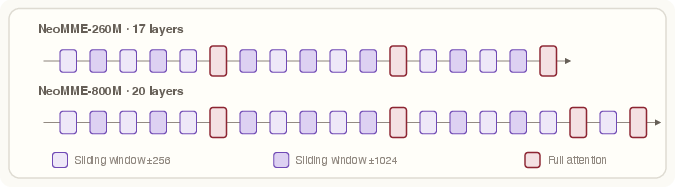
- Global attention: Attention in which a token can attend to all tokens in the sequence rather than only to a local window. “every sixth layer and the final layer use global attention.”
- Grouped-query attention (GQA): An attention configuration in which multiple query heads share a smaller number of key-value heads. “Both sliding-window and global layers use grouped-query attention (GQA)”
- Hierarchical token pooling: A multi-level aggregation method that combines groups of token vectors to reduce the number of stored representations. “Hierarchical token pooling at factor 8”
- Image-conditioned generation: Text generation whose predictions are influenced by visual input. “image-conditioned text generation”
- Late-interaction retrieval: Retrieval in which query and document token vectors are encoded independently but compared at token level during scoring. “Late-interaction encodes and independently as normalized token-vector matrices”
- Masked discrete-diffusion objective: A training loss that predicts text tokens after they have been randomly replaced by mask symbols at varying corruption levels. “Both models are pretrained from scratch with a masked discrete-diffusion text objective”
- Masked image modeling: A self-supervised vision objective that reconstructs image content hidden during training. “Neither masked image modeling nor a pixel-prediction head is used”
- MaxSim: A late-interaction score that sums, or averages, the maximum similarity between each query token and any document token. “ColBERT and ColPali use MaxSim”
- Modality-specific projection: A learned transformation that maps inputs from one modality into a shared model representation space. “Modality-specific input layers map text tokens and RGB image patches into a shared hidden space”
- Multi-vector representation: An embedding consisting of multiple vectors, commonly one for each input token, rather than a single pooled vector. “The model can output both late-interaction and dense representations”
- nDCG@10: Normalized discounted cumulative gain measured over the top ten ranked results. “with 0.523 nDCG@10”
- Nucleus sampling: A text-generation sampling strategy that restricts choices to the smallest set of tokens whose cumulative probability exceeds a threshold. “using either greedy or nucleus sampling”
- Optical character recognition (OCR): Technology that converts text appearing in images into machine-readable characters. “without captioning or optical character recognition fine-tuning.”
- Pareto-optimal: Describing a system that cannot be improved on one evaluated objective without worsening another. “show that NeoMME-Retriever is Pareto-optimal on ViDoRe v1, v2, and v3”
- Patchification: The process of dividing an image into fixed-size, usually non-overlapping, patches. “Images are decoded and patchified in background workers”
- Query--key normalization: Normalizing attention queries and keys before calculating their dot-product similarities. “implementing query--key (QK) normalization”
- Quantization: Representing numerical values with lower-precision formats to reduce memory use and computation. “asymmetric quantization to int8 queries and binary documents”
- RMS normalization: A parameter-free normalization based on the root mean square of a vector’s components. “Each block uses parameter-free root-mean-square pre-normalization”
- Rotary position embedding (RoPE): A positional-encoding method that rotates query and key representations according to token positions. “NeoMME extends rotary position embeddings (RoPE) to two coordinate axes”
- Sliding-window attention: Attention restricted to a local neighborhood of tokens to reduce the cost of processing long sequences. “most layers use symmetric sliding-window attention”
- Squared-ReLU: An activation function obtained by squaring the output of the rectified linear unit. “a squared-ReLU MLP”
- Tied decoder: An output layer that reuses the parameters of the input embedding table instead of learning a separate output matrix. “the tied, factorized masked-token decoder reuses both factors”
- Token pooling: The aggregation or reduction of multiple token-level vectors into fewer vectors. “hierarchical token pooling and MUVERA reduce or transform stored multi-vector representations.”
- Tokenizer vocabulary: The finite collection of token units that a tokenizer can emit. “Its 131,072-entry vocabulary uses byte fallback”
- Vision-LLM (VLM): A model designed to process or connect visual inputs and natural-language inputs. “generative Visual LLMs (VLMs) often project the output of a pretrained visual encoder”
- Visual document retrieval: Retrieval of document pages represented directly as images rather than only as extracted text. “we fine-tune NeoMME for visual document retrieval”
- Warmup--stable--decay (WSD) schedule: A learning-rate schedule consisting of an initial increase, a constant high-rate period, and a final decay. “We use a warmup--stable--decay (WSD) learning-rate schedule”
- Weight decay: An optimization regularizer that discourages large parameter values, often by shrinking model weights during training. “MasterAdamW applies decoupled weight decay to embedding tables”

