Harness-of-Harness: Multi-Day Autonomous Software Development with Continual Improvement
Abstract: This paper studies autonomous software development, in which LLM-based coding agents transform high-level requirements into complete, functional, and usable software systems without human intervention. We introduce Harness-of-Harness (HoH), a framework that enables coding agents to continually improve software during autonomous development. HoH operates on existing coding-agent harnesses, and organizes their executions into iterative planning-coding-testing loops. To sustain improvement across loops, HoH balances repair with capability growth, scopes development into small and verifiable increments, separates implementation-time testing from independent evaluation, and constrains verifiable outputs rather than prescribing agent workflows. It progressively exposes deliverables, role-specific tools, and skills, encourages reuse rather than recreation, and maintains versioned project histories. On GameCraft-Bench, FrontierSWE, and ProgramBench, three harness-model pairs (Codex with GPT-5.5, OpenCode with DeepSeek-V4-Pro, and Pi with MiniMax-M3), HoH consistently outperforms the corresponding standalone harnesses, achieving an average relative gain of 52.25 percent and a maximum gain of 82.86 percent after three iterations. In a multi-day deployment with more than 70 iterations, HoH autonomously develops a first-person-shooter game, featuring a coherent storyline, fully implemented core mechanics, human-playable experience, polished visuals and integrated audio. Github: https://github.com/Flesymeb/HarnessOfHarness Project Page: https://flesymeb.github.io/HarnessOfHarness/
Paper Prompts
Sign up for free to create and run prompts on this paper.
Top Community Prompts
Explain it Like I'm 14
1. What is this paper about?
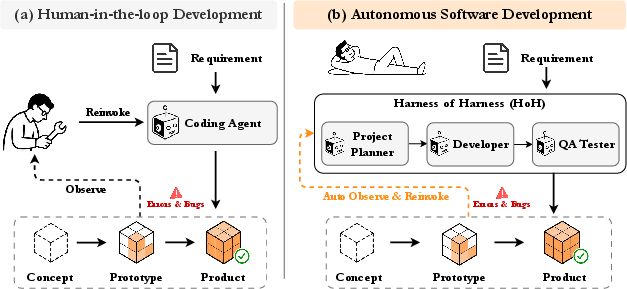
This paper studies whether AI coding agents can build complete software by themselves, without a person constantly giving instructions, checking their work, or fixing mistakes.
The researchers introduce a system called Harness-of-Harness, or HoH. It helps an AI coding agent improve a software project over many rounds. In each round, the AI:
- Decides what should be done next.
- Writes or changes the code.
- Tests the result independently.
- Uses the test results to plan the next round.
The paper asks whether this repeated process can produce better software than simply allowing an AI agent to work once.
2. What questions are the researchers asking?
The main research questions are:
- Can an AI build a complete software project from a general description?
- Does making the AI work in repeated planning, coding, and testing rounds improve the final result?
- Can this process help the AI remember earlier decisions and avoid repeating mistakes?
- Does HoH work with different AI models and different coding systems?
- Can the system continue improving over many days, rather than stopping after one short attempt?
The researchers are especially interested in long-term development. Writing one small function is much easier than building an entire game or software library. A large project has many connected parts, so one mistake can cause problems somewhere else later.
3. How does the system work?
The three roles
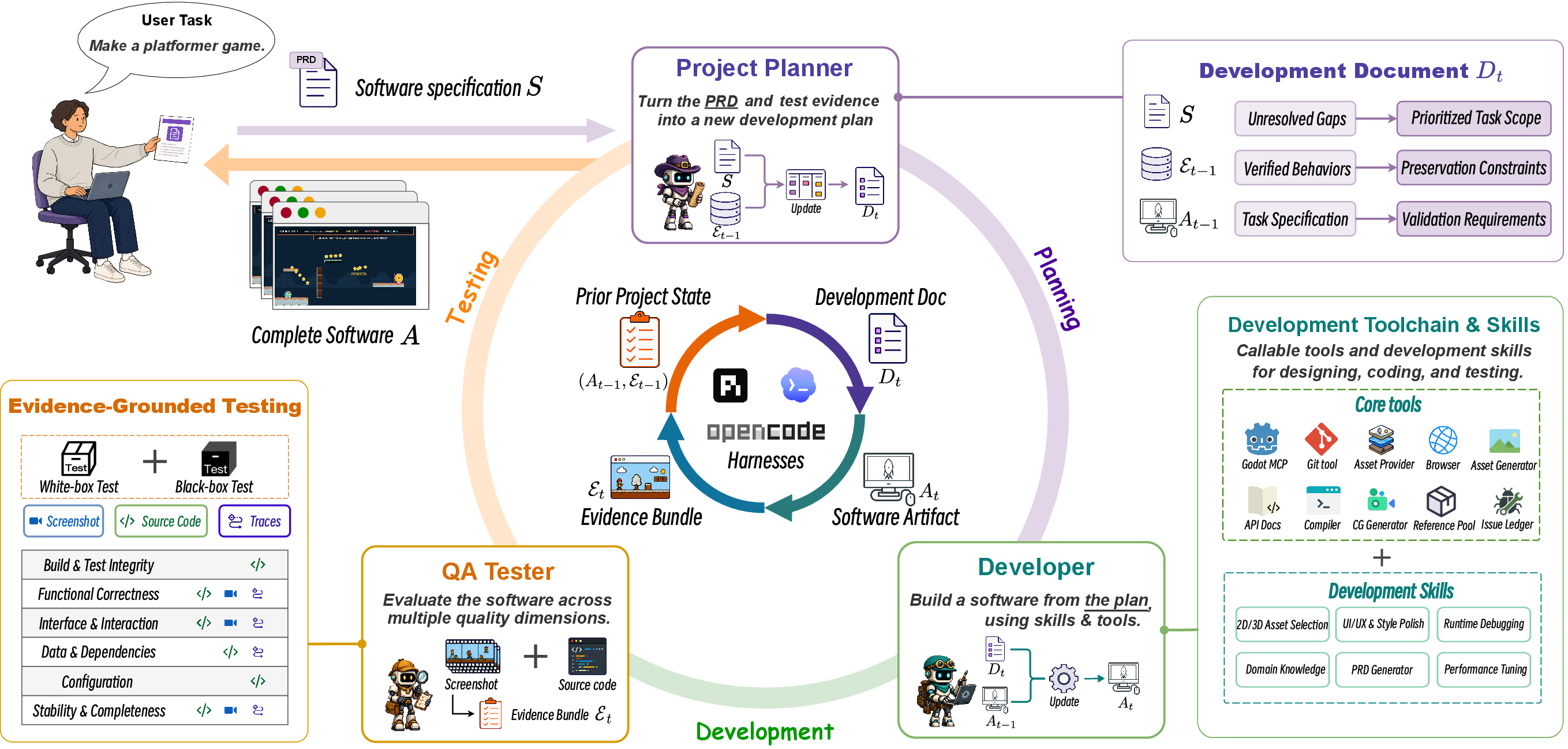
HoH divides the AI’s work into three separate roles. These roles are like members of a small software team.
Project Planner
The Project Planner looks at:
- The original instructions for the project
- What has already been built
- Which tests have passed
- Which problems are still unresolved
It then chooses one small but useful goal for the next round.
For example, instead of saying “finish the whole game,” the planner might say:
“Add working enemy characters that can follow and attack the player, while keeping the existing movement and health systems working.”
This makes the task easier to manage and test.
Developer
The Developer changes the software to complete the planner’s goal. It can decide how to write the code, which tools to use, and how to solve technical problems.
The developer also tests its own changes while working. This is similar to a student checking a math answer after solving part of a problem.
However, the developer is not allowed to decide by itself that the project is finished. Its own tests are only an early check.
QA Tester
The QA Tester independently checks the updated software. “QA” means quality assurance, which is the process of checking whether something works properly.
The tester examines the software in two main ways:
- Black-box testing: Using the software like a normal user, without looking inside it. For a game, this might mean starting the game, moving the character, fighting enemies, and checking what happens.
- White-box testing: Looking inside the software at its code, settings, files, logs, and internal state to help understand how it works or why it failed.
Keeping the tester separate from the developer is important. It is similar to having one person write a science experiment and another person check whether the experiment really produced the claimed result.
Remembering progress
HoH keeps two kinds of information between rounds:
- The artifact state, meaning the current code, files, settings, and other parts of the project.
- The evidence state, meaning the test results, known problems, completed requirements, and behaviors that have already been verified.
This is like saving both a computer game and a notebook explaining which levels have been completed and which problems still need fixing.
HoH also uses:
- Version histories, so earlier working versions can be restored.
- Progressive disclosure, where the AI first sees a short summary and looks at detailed information only when needed.
- Structured outputs, which require each role to return information in a predictable format.
- Role-specific tools, so each AI role has the tools most useful for its job.
4. How did the researchers test HoH?
The researchers compared HoH with ordinary coding agents, called Vanilla systems. A Vanilla system makes one normal development attempt without the HoH process.
They tested three different AI coding setups:
- Codex with GPT-5.5
- OpenCode with DeepSeek-V4-Pro
- Pi with MiniMax-M3
They used three software-development tests:
- GameCraft-Bench: Building playable games from written descriptions.
- FrontierSWE: Completing challenging software-engineering tasks.
- ProgramBench: Rebuilding programs so that they behave like an original program, even when the AI only receives the original program’s documentation and compiled version.
For the main comparison, HoH was allowed to complete three planning, coding, and testing rounds.
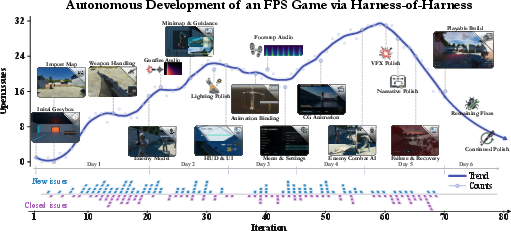
The researchers also ran a longer experiment in which HoH worked for more than 70 rounds over several days. In this experiment, it built a first-person shooter game from a high-level description.
5. What did the researchers find?
HoH produced better software
HoH performed better than the ordinary Vanilla systems in all three benchmarks and with all three AI setups.
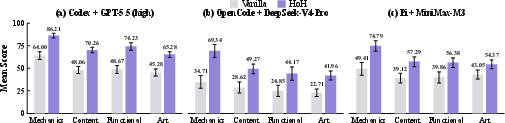
On GameCraft-Bench, the average scores improved after three HoH rounds:
| AI coding setup | Vanilla | HoH after 3 rounds |
|---|---|---|
| Codex + GPT-5.5 | 49.58 | 71.52 |
| OpenCode + DeepSeek-V4-Pro | 26.90 | 48.98 |
| Pi + MiniMax-M3 | 42.16 | 58.78 |
The paper reports an average relative improvement of 52.25%, with the largest improvement reaching 82.86%.
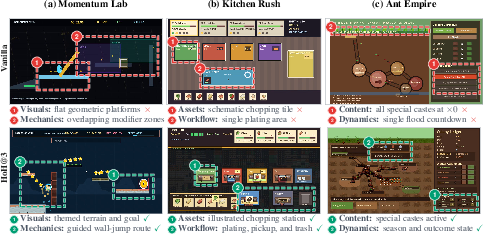
HoH improved several parts of the games, including:
- Core gameplay mechanics
- Amount and quality of content
- Visual functionality
- Overall artistic and presentation quality
This means the system did not merely make the software run. It often made the result more complete and enjoyable to use.
The system kept improving over time
The results generally improved from the first HoH round to the second and then to the third. This suggests that the testing information from earlier rounds helped the AI make better decisions later.
In one FrontierSWE experiment, the researchers continued for ten rounds. The system’s performance rose substantially compared with the ordinary one-pass system.
This is important because large projects usually cannot be completed well in a single attempt. They need repeated improvement.
HoH was better than simply repeating the ordinary system
The researchers also checked whether HoH worked only because it gave the AI more chances to code.
They compared HoH with a Vanilla system that was simply told to continue working for the same number of rounds. HoH still performed better. After three development passes:
- Vanilla continuation reached a score of 58.24.
- HoH reached 71.52.
This suggests that the organization of the work—planning, independent testing, saved evidence, and small goals—was more useful than simply allowing the AI to keep making changes.
HoH built a complex game
In the long-term experiment, HoH created a human-playable first-person shooter game. The finished game included:
- A connected story
- Combat
- Weapons
- Enemies
- Player instructions
- Menus and displays
- Animated scenes
- Visual effects
- Music and sound
This shows that the system can work on a complicated project involving many connected features.
6. Why are these findings important?
AI coding agents often make mistakes during long tasks. They may:
- Forget earlier requirements
- Fix one problem while creating another
- Repeat the same failed approach
- Stop before important features are complete
- Claim that something works without properly checking it
HoH is designed to reduce these problems. Its repeated process gives the AI a clearer path:
- Choose a manageable goal.
- Make the change.
- Test it.
- Record what happened.
- Use that information to choose the next goal.
The separate tester is especially important because the AI that writes the code is not trusted to be the only judge of whether the code works.
7. What could this mean for the future?
The research suggests that AI may eventually be able to build larger and more complicated software with much less human supervision. Systems like HoH could help create games, websites, tools, simulations, and other programs from broad descriptions.
However, the paper does not prove that AI can replace human software developers completely. The experiments are limited, and AI systems can still make serious mistakes. Human experts may still be needed to:
- Define the original goals
- Judge whether the software is safe and useful
- Handle unusual problems
- Check quality and fairness
- Make important design decisions
The main lesson is that better organization can make AI coding agents much more capable. Instead of asking an AI to build everything in one attempt, it may be more effective to give it a repeating cycle of planning, building, testing, and learning from the results.
Knowledge Gaps
Knowledge gaps, limitations, and open questions
The paper leaves the following issues unresolved:
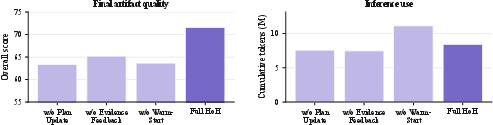
- The contribution of individual HoH components is not isolated. The experiments do not fully disentangle the effects of role separation, iterative planning, independent QA, persistent evidence, progressive disclosure, versioning, structured output validation, and role-specific tools.
- The ablation analysis is incomplete. There is no systematic comparison against variants that remove or modify one mechanism at a time, such as planner–developer separation, QA independence, artifact freezing, evidence state, or bounded incremental objectives.
- The causal advantage over repeated agent execution remains uncertain. Although HoH is compared with a Vanilla Continuation baseline for one configuration and benchmark, equivalent pass-controlled comparisons are not reported across all harness–model pairs and benchmarks.
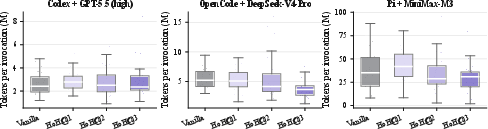
- The evaluation does not establish whether gains result from better reasoning or simply greater context and token consumption. HoH uses more tokens than Vanilla, but the paper does not provide compute-, latency-, or cost-normalized comparisons.
- The reported results rely on only three harness–model configurations. It remains unclear whether HoH generalizes to other models, model sizes, reasoning modes, coding harnesses, open-weight systems, or non-LLM development agents.
- The benchmark sample is limited and partially selected for convenience. Only 45 of 140 GameCraft-Bench tasks and 15 of 17 FrontierSWE tasks are evaluated, leaving uncertainty about performance on the excluded tasks and on alternative task distributions.
- The generalizability beyond the selected benchmarks is unresolved. The benchmarks emphasize games, software engineering tasks, and program reconstruction; performance on production-scale repositories, scientific software, data systems, embedded systems, safety-critical applications, or long-lived commercial projects is not tested.
- The evidence that HoH supports genuinely long-horizon development is limited. The controlled evaluations primarily use three iterations, while the ten-iteration analysis is restricted to one harness–model pair and 15 FrontierSWE tasks.
- The multi-day game demonstration is not a controlled evaluation. It provides qualitative evidence of capability but does not establish how often similar outcomes occur, how much human curation was involved before or during execution, or how the result compares with relevant baselines.
- The definition of “autonomous” is not independently verified. The paper does not fully document whether human intervention occurred through environment maintenance, asset selection, prompt changes, failure recovery, infrastructure management, or post-processing during the multi-day deployment.
- The reliability of the QA role is not established. The paper assumes that an independently invoked model can provide effective acceptance testing, but it does not measure QA false positives, false negatives, evaluator calibration, or agreement with human experts.
- Independence between implementation and QA may be weaker than claimed. The same model and underlying harness are used for planning, development, and testing, so shared model biases, context artifacts, tools, or evaluation heuristics may undermine practical independence.
- The quality of generated test scenarios is not evaluated. QA criteria are derived from the specification and development document, but the paper does not test whether the tester systematically discovers requirements omitted from those documents.
- Hidden or emergent failures may remain undetected. The evaluation framework focuses on scenario-specific tests and available benchmark verifiers; robustness to rare states, adversarial inputs, long-running execution, concurrency, security vulnerabilities, resource leaks, and environment changes is not demonstrated.
- Regression prevention across many iterations is insufficiently quantified. The paper claims that validated behavior is preserved, but it does not report regression rates, rollback frequency, failed iterations, or the proportion of previously verified functionality rechecked after later changes.
- The conditions under which iteration eventually harms quality are unknown. Results show improvement through selected checkpoints, but the paper does not characterize saturation, oscillation, degradation, or catastrophic regression after substantially more loops.
- The iteration budget is not adaptively justified. The paper does not provide a principled stopping criterion for deciding when the artifact is complete, when further development is unproductive, or when the system should roll back.
- The planner’s prioritization quality is not measured. It remains unclear whether the planner selects globally beneficial increments, whether it systematically neglects low-visibility requirements, and how it resolves conflicts between repair, feature growth, and quality improvement.
- The representation of evidence may introduce information loss or misleading priorities. The paper does not evaluate whether concise indexes, structured reports, or progressive disclosure omit important historical details or cause later planners to overweight recent evidence.
- Versioning and rollback benefits are not separately demonstrated. Although the framework maintains versioned project histories, the experiments do not quantify how often this mechanism prevents failure or improves recovery compared with ordinary checkpoints.
- The role of external tools and skills is confounded in the open-ended demonstration. The multi-day game setting adds tools for engine interaction, asset generation, retrieval, testing, and project management, making it difficult to attribute the final quality specifically to HoH.
- Tool availability and tool failure are not systematically studied. The paper does not examine how HoH behaves when external tools are unavailable, unreliable, rate-limited, biased, or produce low-quality assets and execution results.
- The framework’s dependence on structured output compliance is unclear. Retry behavior, schema-violation frequency, retry costs, and the effect of repeated malformed outputs on trajectory quality are not reported.
- Resource and infrastructure requirements are underreported. The paper does not provide sufficient analysis of wall-clock time, GPU or API costs, storage growth, parallelism constraints, environment setup, or operational failure recovery for multi-day runs.
- Cross-provider token accounting limits cost comparisons. Because token accounting differs across model providers and may include cached context reads, the reported interaction volume cannot support reliable cross-configuration efficiency conclusions.
- Statistical significance and variance are incompletely reported. Aggregate means and bootstrap intervals are shown for some results, but the paper does not consistently report per-task variance, paired significance tests, effect-size uncertainty, or sensitivity to random seeds.
- The results may be sensitive to prompt and implementation details. The paper does not report robustness to alternative role prompts, schema formats, context indexes, planner instructions, or runtime policies.
- The benchmark evaluators may not capture real-world usability. Programmatic scores and benchmark rubrics do not fully establish maintainability, readability, accessibility, security, documentation quality, deployment reliability, or user satisfaction.
- Human-playability and qualitative software quality are not independently validated. The game demonstration asserts a human-playable and polished experience, but no systematic user study, expert review, usability test, or inter-rater evaluation is reported.
- The framework’s behavior under ambiguous, contradictory, or evolving requirements is unknown. The experiments use fixed specifications and do not test requirement changes, stakeholder conflicts, incomplete requirements, or new constraints introduced during development.
- Safety and security risks are not examined. Autonomous modification of software and execution environments could introduce malicious dependencies, insecure code, privacy violations, destructive commands, or unsafe behavior, none of which are systematically evaluated.
- The scalability of evidence and project state is unresolved. It is unclear whether filesystem-based histories and progressive disclosure remain effective for large repositories, extensive assets, many dependencies, or hundreds of iterations.
- The framework’s applicability to collaborative or multi-developer environments is unknown. HoH uses a single-writer artifact boundary and does not address merge conflicts, parallel development, code ownership, human review, or integration with existing team workflows.
- Failure modes specific to model or harness updates are unexplored. The framework assumes a fixed model–harness configuration within a run, leaving open how to preserve continuity when models, tools, APIs, dependencies, or execution environments change.
- The relationship between benchmark improvements and deployable software quality remains uncertain. Higher benchmark scores do not necessarily imply that the resulting systems are maintainable, extensible, secure, or suitable for production deployment.
Practical Applications
Immediate Applications
The paper’s demonstrated gains suggest that HoH can be integrated into existing coding-agent workflows today, particularly for bounded, testable software projects. These applications depend on access to a capable LLM, a tool-enabled coding harness, executable tests, and sufficient compute and token budgets.
- Autonomous prototyping for software teams (software engineering, startups, product development) Teams can provide a high-level product specification and use HoH to generate an initial working prototype, such as a web application, command-line tool, game, API, or internal dashboard. The planner–developer–QA loop can progressively add features while preserving previously validated behavior. Dependencies: clear requirements, a runnable development environment, automated build and test procedures, and human review before production deployment.
- Long-running issue resolution and repository maintenance (enterprise software, DevOps) HoH can be used to address accumulated bugs, incomplete features, and regression failures in an existing codebase. The evidence state can maintain a prioritized record of unresolved defects and validated functionality, reducing repeated inspection and forgotten fixes. Dependencies: reliable repository-level tests, safe write permissions, version control, rollback mechanisms, and controls for sensitive production code.
- Automated regression and release-readiness workflows (quality assurance, continuous integration/continuous delivery) Organizations can place HoH between implementation and release: the developer makes a bounded change, while an independent tester evaluates functional behavior, regressions, usability, and other product-specific criteria. Structured QA reports can become release gates or inputs to the next development cycle. Dependencies: independently executable tests, stable test environments, candidate freezing, and evaluation criteria that cover both visible behavior and important internal properties.
- Greenfield game and interactive-media development (gaming, simulation, education technology) The results on GameCraft-Bench and the multi-day first-person-shooter deployment indicate an immediate use case for generating playable prototypes, educational simulations, interactive demonstrations, and game-jam projects. HoH is particularly suitable for projects whose progress can be observed through executable interactions and visual outputs. Dependencies: engine integration, asset libraries or generation tools, automated playability checks, and human evaluation of aesthetics, accessibility, and user experience.
- Program reconstruction and compatibility implementation (software compatibility, migration, cybersecurity research) The ProgramBench results suggest that iterative evidence-guided development can improve attempts to reproduce the behavior of an existing executable or undocumented system. A HoH workflow could iteratively compare a reconstructed implementation against reference inputs and hidden or differential tests. Dependencies: legal access to the reference software, sufficiently informative documentation or behavioral probes, reliable differential testing, and safeguards against unauthorized software replication.
- Internal developer-support tools with reduced supervision (engineering productivity) Companies can deploy HoH as a controlled “autonomous junior engineer” for low-risk tasks such as test generation, documentation-backed utilities, configuration updates, small refactors, and implementation of isolated backlog items. Role-specific permissions allow organizations to separate planning, code modification, and acceptance. Dependencies: strict repository permissions, code review for high-impact changes, secret isolation, reproducible environments, and monitoring of token and compute costs.
- Research infrastructure for studying autonomous agents (academia, AI engineering) Researchers can use HoH as an experimental framework for comparing models, harnesses, memory strategies, testing policies, and role assignments. Its persisted artifacts, iteration histories, and candidate-bound reports provide traceable development trajectories rather than only final outputs. Dependencies: standardized benchmarks, reproducible model and harness versions, complete logging, and evaluation protocols that distinguish genuine improvement from simply using more inference budget.
- Policy and governance controls for AI-generated software (technology governance, compliance) The framework’s separation of planner, developer, and independent tester can be adapted into an auditable governance workflow. Each iteration can retain the specification, code changes, test evidence, permissions, and acceptance decision, supporting traceability for regulated or high-assurance software. Dependencies: sector-specific compliance requirements, tamper-resistant logs, identity and access management, and human accountability for final approval.
- Personal automation for small software projects (daily life, education, creators) Individuals could use an HoH-based tool to build personal websites, data-management utilities, hobby games, or automation scripts from natural-language requirements. Iterative testing is more appropriate than one-shot code generation for users who cannot independently inspect every implementation detail. Dependencies: simplified interfaces, sandboxed execution, protection of personal data, clear user consent for external actions, and understandable explanations of failures.
Long-Term Applications
The longer-term opportunities involve scaling HoH from demonstrative and benchmark settings to high-stakes, heterogeneous, and continuously evolving environments. They require stronger reliability guarantees, better cost control, broader testing, and evaluation beyond the paper’s reported tasks.
- Autonomous end-to-end product engineering (software industry) A mature HoH system could transform product requirements into deployable services, maintain them over weeks or months, monitor operational failures, and plan subsequent improvements. Versioned project histories could support continuous evolution rather than a single development episode. Dependencies: persistent memory and project-state management, production observability, secure deployment automation, rollback and recovery, robust requirements interpretation, and safeguards against specification drift.
- Self-improving enterprise software platforms (ERP, CRM, business operations) HoH could prioritize enhancements from user feedback, telemetry, support tickets, and failed workflows, then implement and independently validate small changes. This could enable semi-autonomous adaptation of internal business software. Dependencies: reliable feedback-to-requirement translation, privacy-preserving data access, regression suites covering business-critical processes, and governance for changes that affect financial or operational records.
- High-assurance development in healthcare, finance, and public infrastructure (regulated sectors) The planner–developer–independent-QA separation could form part of a certified pipeline for clinical software, financial systems, public-service applications, or industrial control interfaces. Evidence states could document which requirements were tested and which remain unsupported. Dependencies: formal verification or stronger assurance than ordinary black-box and white-box testing, certified toolchains, domain-expert oversight, explainable audit trails, cybersecurity testing, and compliance with applicable regulation. The paper does not establish that HoH is currently safe for autonomous deployment in these domains.
- Autonomous robotics and embodied-system programming (robotics, manufacturing, logistics) HoH could iteratively develop robot behaviors, simulation environments, task planners, and perception–control integrations. Independent QA could test behaviors in simulation and eventually on hardware, while versioned states enable recovery from regressions. Dependencies: high-fidelity simulation, hardware-in-the-loop testing, safety constraints, deterministic evaluation, real-world sensor variability handling, and strict separation between simulated and physical execution permissions.
- Autonomous scientific-computing and research software development (academia, scientific computing) Researchers could specify computational goals and have HoH implement analysis pipelines, simulation code, benchmarking tools, or reproducible experiment packages. Independent testing could check numerical correctness, performance, data provenance, and reproducibility. Dependencies: domain-expert specifications, scientifically valid test oracles, reproducible datasets and environments, numerical stability checks, and safeguards against agents producing plausible but scientifically invalid results.
- Adaptive educational software and simulations (education, training) HoH could build and iteratively improve tutoring systems, interactive laboratories, accessibility features, or scenario-based training applications. QA criteria could include correctness, usability, learning-flow completeness, and age-appropriate content. Dependencies: pedagogical validation, learner-data protection, accessibility standards, human educator review, and evaluation of learning outcomes rather than only software functionality.
- Multi-agent development ecosystems with specialized tools and skills (AI platforms, developer tooling) The role-specific tools described in the paper could evolve into marketplaces or orchestration platforms offering domain experts, retrieval systems, asset generators, formal analyzers, security scanners, and deployment services. HoH would select and reuse these capabilities rather than recreate them in every project. Dependencies: standardized tool interfaces, reliable tool selection, provenance tracking, permission isolation, compatibility across harnesses, and mechanisms for detecting malicious or low-quality external tools.
- Autonomous software maintenance driven by real-world telemetry (cloud operations, cybersecurity, reliability engineering) A future HoH system could consume logs, performance metrics, vulnerability reports, and user complaints to plan bounded repairs and improvements. Independent testing could validate patches against replayed production scenarios before deployment. Dependencies: trustworthy observability data, privacy controls, secure sandboxing, adversarial testing, accurate incident diagnosis, and human authorization for changes affecting live systems.
- Formalized policy for accountable autonomous development (government and standards bodies) The paper’s artifact/evidence distinction could inform standards requiring AI-generated software to retain version histories, test provenance, role permissions, and explicit records of unsupported requirements. Such standards could support procurement rules or certification schemes for autonomous coding systems. Dependencies: agreement on audit formats, measurable quality and safety thresholds, independent certification bodies, liability rules, and evidence that persisted agent reports reliably correspond to actual system behavior.
- General-purpose autonomous creation of complex digital products (games, media, productivity tools, virtual worlds) The multi-day game demonstration points toward systems that can coordinate code, assets, narrative, audio, visual design, and user testing over extended trajectories. Future products could emerge from high-level creative briefs rather than detailed implementation plans. Dependencies: improved multimodal planning, consistent asset and style management, copyright and licensing controls, scalable inference budgets, robust long-horizon memory, and reliable evaluation of subjective qualities such as originality and artistic coherence.
- Self-optimizing harnesses and development processes (AI research, software automation) Although HoH keeps the underlying model and harness fixed within an experiment, future systems could use accumulated evidence to optimize prompts, role contracts, tool allocation, iteration length, and testing strategies. This could produce adaptive development processes tailored to project type and model capability. Dependencies: careful causal evaluation, protection against optimizing benchmark scores without improving real quality, stable metrics, prevention of reward hacking, and comparisons at equal compute and interaction budgets.
Glossary
- Agent harness: The operational system that supplies an AI agent with information, tools, permissions, and execution management. “Modern coding agents operate within a harness---the surrounding system that provides tools, manages execution and mediates the LLMâs interaction with the development environment”
- Agent–computer interface: A system through which an AI agent perceives and acts on a computer environment. “Research has progressed from localized code generation and self-contained programs~\citep{chen2021codex,huang2023agentcoder} to repository-level issue resolution, agent--computer interfaces, general software-engineering agents, and refactoring”
- Agentic coding: Software development performed by an AI agent that can plan and execute coding-related actions. “Such autonomous development poses a fundamentally longer-horizon problem than conventional agentic coding tasks”
- Artifact lineage: The traceable history connecting a software artifact to the changes that produced it. “This boundary makes responsibility for the transition from to explicit and keeps the candidate lineage unambiguous.”
- Autonomous software development: The creation of complete software systems by AI agents without ongoing human guidance or intervention. “In this study, we pursue a more ambitious goal: autonomous software development~(Figure 2b)”
- Black-box testing: Testing that evaluates externally observable behavior without examining internal implementation details. “Black-box tests exercise the candidate through ordinary inputs and rendered outputs to examine user-observable behavior, state transitions, and end-to-end flows.”
- Bootstrap confidence interval: An uncertainty interval estimated by repeatedly resampling observed data. “error bars indicate 95\% bootstrap confidence intervals.”
- Bounded episode: A restricted execution period or task context within which an agent operates. “Existing coding harnesses typically organize development within a bounded episode”
- Candidate-bound record: Evidence explicitly associated with one particular software version or artifact. “A criterion is verified only when candidate-bound records support the required behavior.”
- Cleanroom program reconstruction: Reimplementing software from externally observable information without access to its original source code. “ProgramBench is a cleanroom program-reconstruction benchmark in which agents receive only a compiled executable and documentation and must rebuild a codebase whose behavior matches the reference program.”
- Context engineering: Deliberately organizing and supplying information in an AI model’s context to influence its behavior. “Prompting and context engineering shape model-facing state”
- Continuous signal: A numerical evaluation measure that preserves gradations of performance rather than reporting only discrete success or failure. “We use this continuous signal for relative comparisons between Vanilla and HoH”
- Cross-loop state management: Preserving software and evaluation information across repeated development cycles. “\subsection{Cross-Loop State Management}”
- Dominance score: A comparative metric measuring how often a system outperforms competing configurations. “We additionally report the official dominance score, defined as the average task-level win rate against a randomly selected competing configuration from the 12 evaluated harness--condition combinations.”
- End-to-end flow: A complete sequence of interactions spanning the system from input to final output. “Black-box tests exercise the candidate through ordinary inputs and rendered outputs to examine user-observable behavior, state transitions, and end-to-end flows.”
- Evidence state: The accumulated, validated information about tested behavior, failures, and unsupported claims. “The evidence state carries the validated knowledge needed to decide how that implementation should change.”
- Execution evidence: Records and observations produced while running and evaluating software. “Each cycle produces a bounded software increment, verifies the resulting candidate, and carries both the candidate and its execution evidence into the next cycle.”
- Greenfield development: Building a software system from the beginning rather than modifying an existing implementation. “HoH builds on these harnesses and extends their use to iterative greenfield development”
- Hidden behavioral test: An undisclosed test that checks whether a program exhibits expected externally observable behavior. “For ProgramBench, we report Avg. Test Pass Rate, computed as the mean across tasks of the fraction of hidden behavioral tests passed for each task.”
- Human-in-the-loop: A setting in which humans supervise, guide, review, or intervene in an automated system. “Despite their growing adoption, most coding agents still largely operate under a human-in-the-loop setting”
- Independent acceptance: Determining whether a software result satisfies requirements by an evaluator separate from the implementer. “The final decision is whether the resulting behavior satisfies observable requirements.”
- Incremental development: Developing software through small additions that progressively expand the system. “Each plan must both address outstanding problems and deliver a small yet concrete new capability, following the principle of iterative and incremental development”
- Iterative development: Repeatedly revising a system based on feedback from earlier versions or evaluations. “The design follows iterative and incremental software development”
- Long-horizon task: A task requiring an agent to maintain effective planning and execution across many dependent steps or an extended period. “Such autonomous development poses a fundamentally longer-horizon problem than conventional agentic coding tasks”
- Model-facing state: The information and context presented to a LLM during an interaction. “Prompting and context engineering shape model-facing state”
- Multi-agent orchestration: Coordinating multiple specialized agents or roles to accomplish a shared objective. “GPTSwarm represents multi-agent orchestration as an optimizable graph”
- Observability: The extent to which a system’s relevant internal or external behavior can be measured or inspected. “The scope of an increment is therefore determined by a coherent observable behavior”
- Progressive disclosure: Revealing information incrementally, beginning with a concise overview and providing details only when needed. “HoH adopts progressive disclosure rather than a dedicated memory module”
- Quality assurance (QA): Systematic evaluation intended to determine whether software meets specified functional and quality requirements. “The QA Tester independently evaluates the resulting system against both the overall requirements and the development plan”
- Regression surface: The set of existing behaviors or components that might be unintentionally affected by a software change. “After each meaningful change, it reruns the corresponding path and inspects the affected implementation, execution results, and adjacent regression surface.”
- Repository-level issue resolution: Fixing software problems that require understanding and modifying an entire code repository rather than an isolated function. “LLM-based coding agents have progressed from localized assistance, such as function completion, to increasingly complex tasks, including navigating large codebases and resolving repository-level issues”
- Role contract: A formal specification of an agent role’s permissions, responsibilities, inputs, and required outputs. “Fixed: model , harness , and role contracts”
- Scenario-specific evaluation: Testing criteria tailored to the particular software context and behavior under examination. “HoH therefore derives scenario-specific, checkable evaluation criteria from and rather than applying the same generic test to every candidate.”
- Shift-left testing: Moving testing earlier in the software-development process so that defects are detected closer to the changes that introduce them. “This baseline--change--retest cycle follows the software-engineering principle commonly known as shift-left testing.”
- Single-writer boundary: An access-control arrangement in which only one designated agent may modify a shared artifact. “Artifact development follows a single-writer boundary: only the Developer may modify the evolving artifact.”
- Stratified random sampling: Random sampling performed separately within predefined subgroups to ensure subgroup representation. “We sample 45 tasks using stratified random sampling by game family”
- Structured artifact: An output organized according to a predefined schema so that it can be validated or processed reliably. “Each role must return a structured artifact, and outputs that violate the required schema trigger a retry.”
- Testable increment: A small software addition whose completion can be evaluated through explicit tests or observable conditions. “The system grows through small, testable changes while preserving behavior that has already been validated.”
- Vanilla baseline: The standard version of a system used for comparison without the proposed method or protocol. “We compare HoH against Vanilla, the corresponding harness--model configuration without the HoH protocol.”
- Version control: A system for recording, comparing, and restoring successive states of software and related project files. “Finally, HoH maintains a versioned record of project evolution at both the agent role and iteration levels.”
- White-box testing: Testing that examines a program’s internal implementation, configuration, state, or execution records. “White-box tests inspect the source, configuration, resource bindings, runtime state, and logs.”