SMELT: Scaling Laws for Compute-Matched MoE Looped Transformers
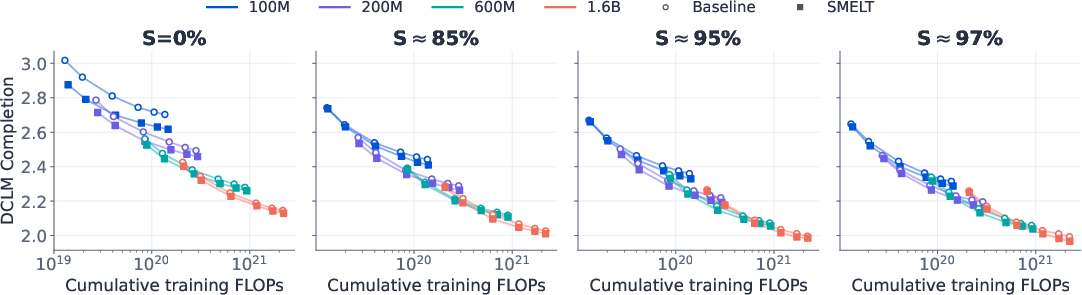
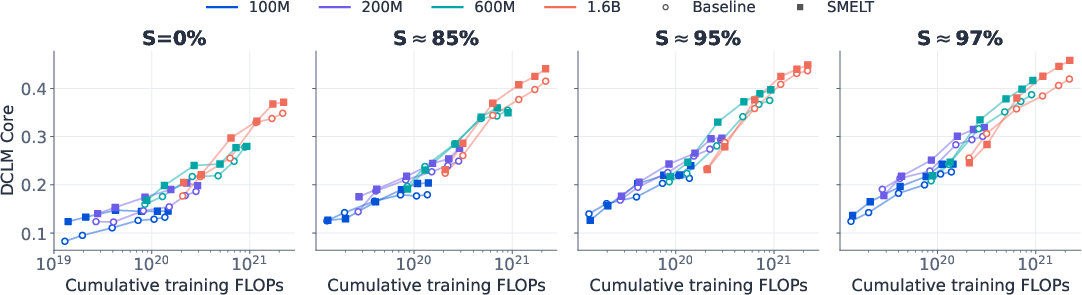
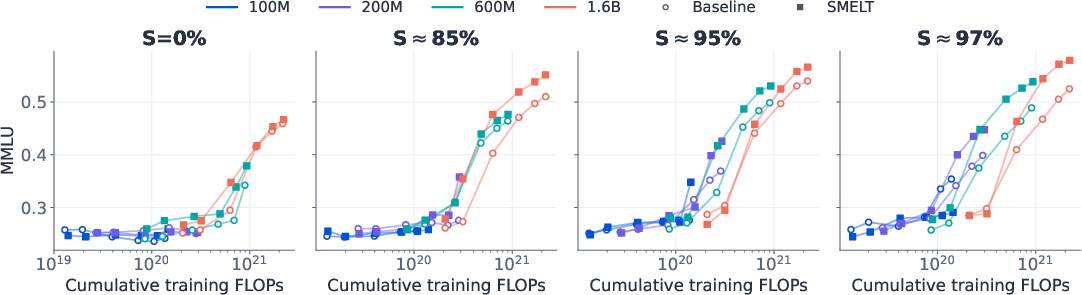
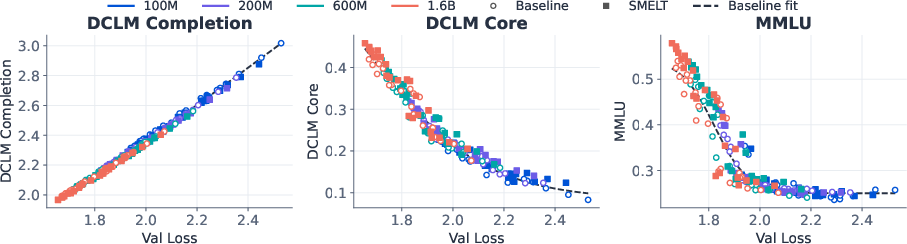
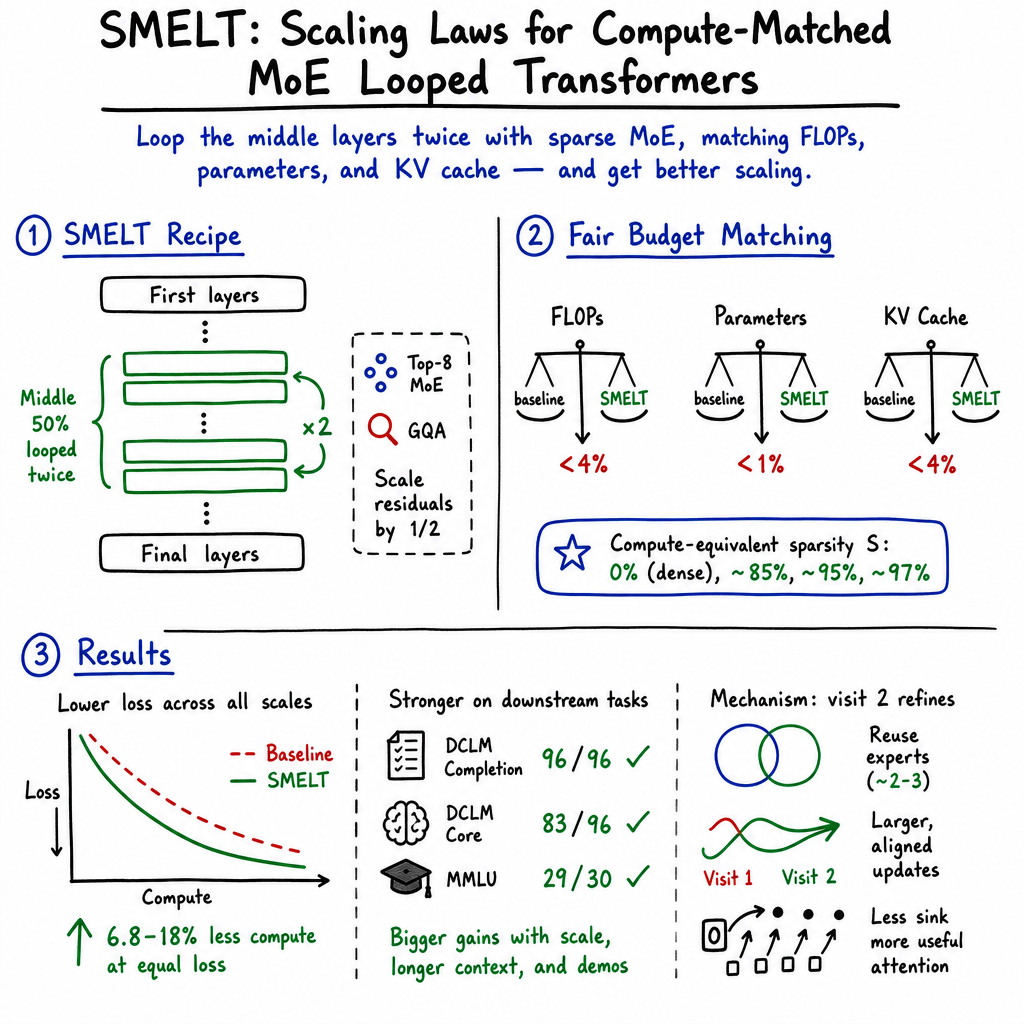
Abstract: Looped Transformers increase effective depth by iterating a shared block of layers, but most evaluations compare at fixed model size, conflating architectural advantage with extra FLOPs. We study looping on Mixture-of-Experts Transformers while closely matching per-token FLOPs, total non-embedding parameters, and KV cache. Through a series of ablations, we arrive at a recipe we call SMELT (Sparse MoE Transformer, middle layers Loop Twice), which loops the middle half of layers twice while matching the unlooped Baseline on all three budgets. We scale SMELT across four sizes up to 54B non-embedding parameters and fit a separate Chinchilla-style scaling law for each architecture. SMELT's loss drops faster with compute, saving 6.8--18.0\% of training FLOPs on the compute-optimal frontier. The advantage transfers to downstream benchmarks beyond what validation loss predicts, is largest on Code, and grows with sample length and the number of in-context examples. Mechanistic analysis shows that the second visit reduces the attention sink and redirects mass toward content-relevant tokens, an inductive bias that may underlie the observed performance gains. These results show that looping can improve Transformers even under budget matching, offering a practical recipe that turns depth reuse into measurable gains.
Paper Prompts
Sign up for free to create and run prompts on this paper.
Top Community Prompts
Explain it Like I'm 14
1. What is this paper about?
This paper studies a way to improve LLMs called looping.
A normal Transformer LLM passes text through a series of different layers once. A looped Transformer sends the text through some of those layers more than once. This is like giving a student a difficult problem and letting them use the same helpful set of steps again for a second look.
The researchers introduce a model design called SMELT, which stands for Sparse Mixture-of-Experts Transformer whose middle layers are looped twice.
The main question is:
Does looping actually make a LLM better, or do earlier studies only seem successful because their looped models secretly use more computing power?
2. What questions did the researchers ask?
The paper focuses on several related questions:
- Can a looped model perform better than a normal model when both use almost the same:
- computing power,
- number of stored parameters, and
- memory for handling long text?
- Which layers should be repeated?
- How many times should the layers be repeated?
- Does looping help models of different sizes, from about 100 million to 54 billion stored parameters?
- Does looping improve only the model’s general language score, or does it also help with tasks such as coding, reasoning, and answering questions using examples?
- What happens inside the model during the second visit through the repeated layers?
The researchers especially wanted a fair comparison. If one model uses more computing power than another, it may perform better simply because it received more resources—not because its design is better.
3. How did they conduct the research?
Comparing two kinds of models
The researchers compared:
- Baseline: a regular, unlooped Mixture-of-Experts Transformer.
- SMELT: a model that repeats the middle half of its layers twice.
Both models were based on the same general Transformer design, used the same training data, and followed the same training process.
What is a Mixture-of-Experts model?
A Mixture-of-Experts, or MoE, model contains many smaller specialist networks called experts. For each token—a word or part of a word—the model chooses only a few experts to use.
An analogy is a school with hundreds of teachers, where each question is sent only to the eight teachers most suited to answer it. The school has a lot of total knowledge, but each question does not require every teacher to work.
This lets the researchers store many parameters while using fewer calculations for each token.
Making the comparison fair
Looping adds extra layer executions, which normally increases computing cost. To balance this, the researchers made several adjustments:
- They made the looped model slightly narrower, reducing its hidden dimension.
- They added more experts to recover the number of stored parameters.
- They adjusted the attention heads and grouped-query attention to keep memory use, called the KV cache, similar.
The KV cache is like a notebook containing information about earlier words. A larger cache can help with longer text, but it also requires more memory.
The final models were usually matched within approximately:
- 4% for computing cost,
- 1% for total parameters, and
- 4% for KV-cache memory.
Testing different loop designs
At one model size, the researchers tested different choices:
- Repeating a small, medium, or large part of the network.
- Repeating the middle layers or other layer ranges.
- Repeating the selected layers two, three, or four times.
They found that repeating the middle half of the layers twice worked especially well. This became the SMELT design.
Training and evaluation
The models were trained on roughly 205 billion text tokens, with some extra training branches using new data.
The researchers measured:
- Training loss: how surprised the model is by the correct next token. Lower loss means better prediction.
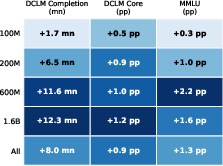
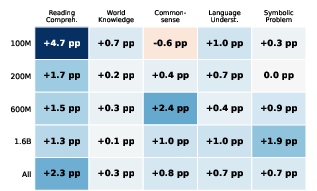
- DCLM Core accuracy: performance on 22 tasks involving reading comprehension, world knowledge, commonsense reasoning, language understanding, and symbolic problem solving.
- DCLM Completion loss: how well the model predicts the exact answer to free-response questions.
- MMLU accuracy: performance on a broad set of academic and general-knowledge questions.
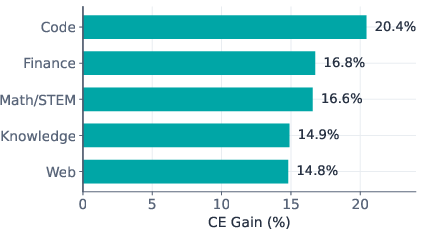
- Performance on different types of training data, including code, mathematics, science, finance, and web text.
They also tested in-context learning. This means giving the model a few examples in the prompt and seeing whether it can use them to solve a new problem.
Finally, they examined the model’s internal behavior, including which tokens it paid attention to during the first and second visits through the repeated layers.
4. What were the main findings?
SMELT had lower training loss
Across all 16 tested combinations of model size and sparsity, SMELT finished with a lower training loss than the Baseline.
In simple terms, SMELT became better at predicting text even though it used nearly the same overall budgets as the regular model.
SMELT needed less computing power for the same quality
The researchers fitted scaling laws. These are mathematical rules that estimate how model performance changes as the amount of data and computing power increases.
Their results suggested that SMELT reached the same validation loss using 6.8% to 18.0% fewer training FLOPs than the Baseline.
A FLOP is one basic mathematical operation performed by a computer. Billions or trillions of FLOPs are needed to train a LLM.
This is important because training large models is very expensive. Saving even 10% of the computing cost could mean a major saving in money, electricity, and time.
The improvement appeared at every tested size
The researchers tested models with active scales of approximately:
- 100 million parameters,
- 200 million parameters,
- 600 million parameters, and
- 1.6 billion parameters.
The largest models stored up to about 54 billion non-embedding parameters because of their many experts.
SMELT performed better than the Baseline at all tested sizes and sparsity levels, rather than helping only one particular model size.
The middle layers were most useful to repeat
Repeating the middle part of the network worked better than repeating the entire network or only a very small section.
The best general recipe was:
- Keep the early layers for understanding the input.
- Repeat the middle half of the layers.
- Let the later layers finish the processing.
- Repeat the middle section twice, not three or four times.
This suggests that the middle layers may be especially useful for refining and organizing information.
Downstream task performance improved
SMELT also performed better on many separate tests, including tasks involving:
- coding,
- reasoning,
- language understanding,
- world knowledge,
- commonsense,
- symbolic problem solving, and
- MMLU questions.
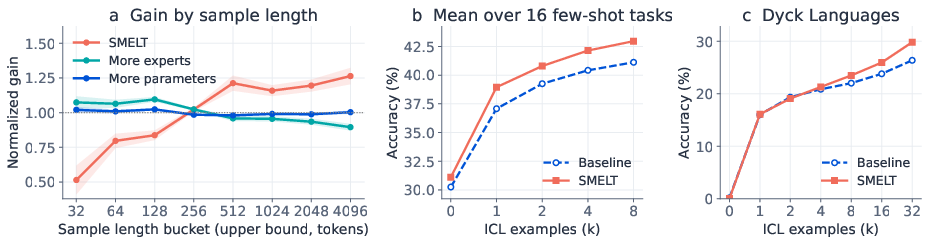
The paper says that the gains on these tasks were often larger than would be expected from the validation-loss improvement alone.
The benefit was strongest for code and other structured information. SMELT also improved more when:
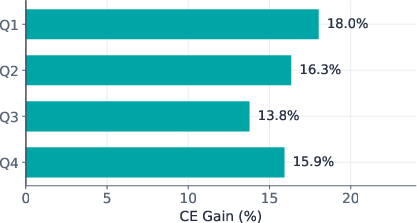
- the input examples were longer, and
- the prompt included more demonstrations.
This suggests that looping may help the model find and use patterns in complicated prompts.
The second visit did more than simply repeat the first
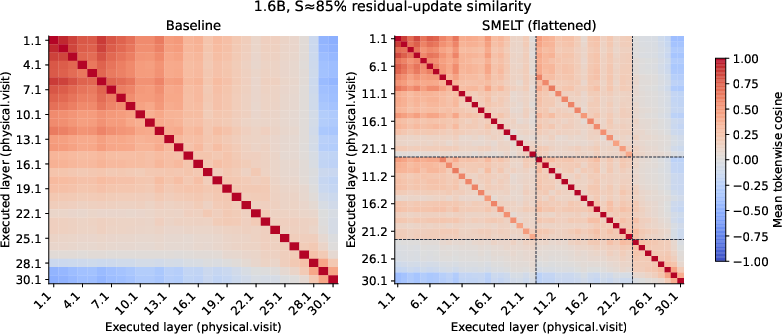
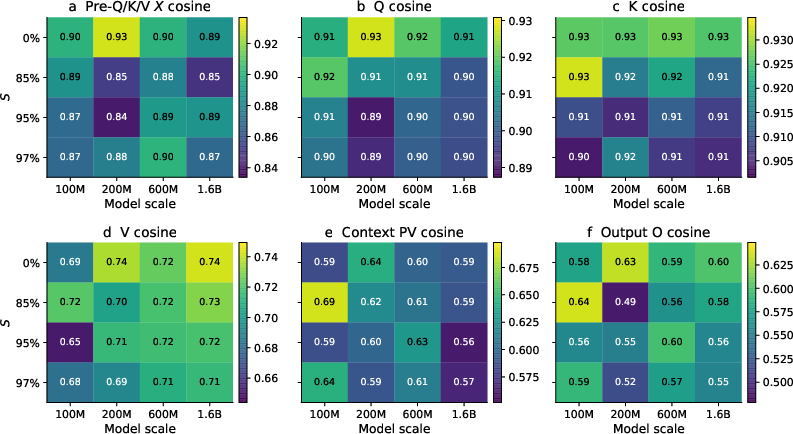
The researchers examined what happened when the model passed through the looped layers a second time.
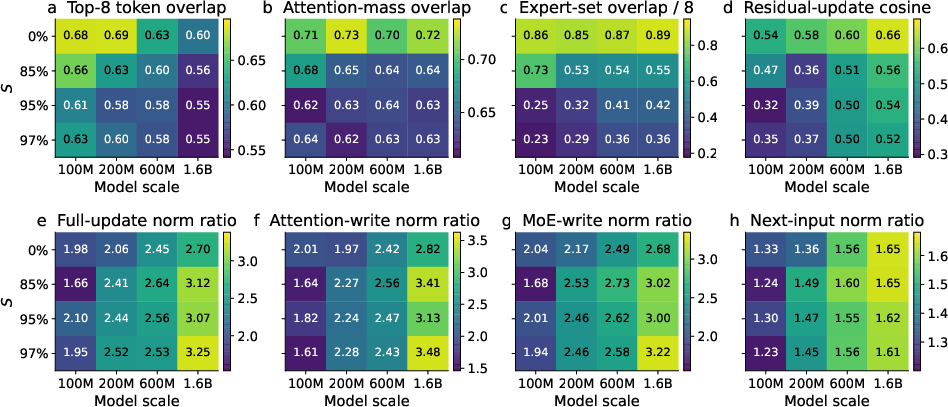
The second visit often:
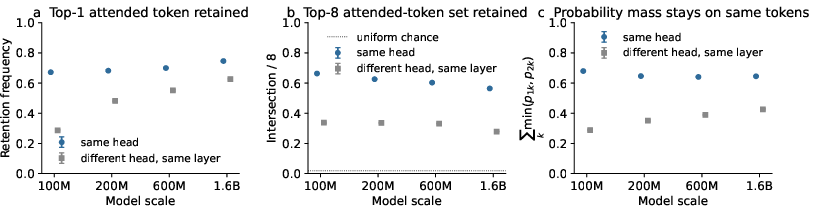
- selected many of the same experts,
- looked at many of the same tokens,
- produced larger and more focused changes, and
- strengthened useful information instead of replacing it completely.
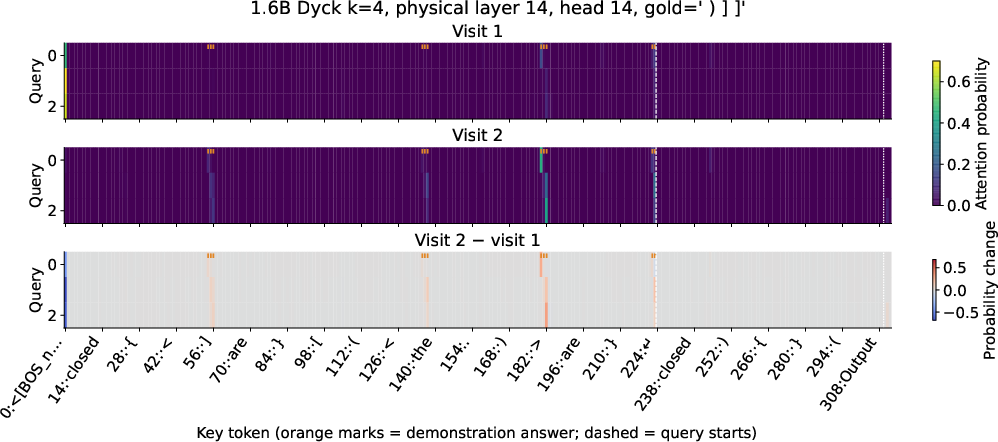
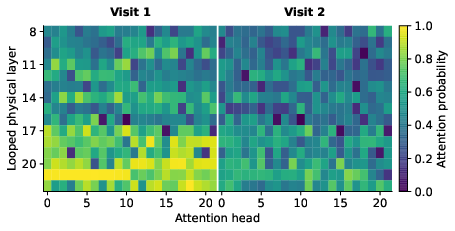
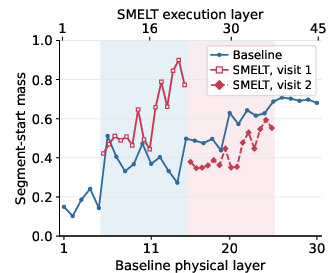
The second visit also reduced an effect called an attention sink.
An attention sink happens when a model gives too much attention to certain early tokens, even when those tokens are not very meaningful. It is somewhat like a student repeatedly looking at the first line of a page instead of the important information in the middle.
In SMELT, the second visit redirected more attention toward content-related tokens. This may help explain why the model improved at in-context learning.
5. Why are these findings important?
Earlier research often showed that looped models were powerful, but the looped models sometimes used more computation than their comparison models. That made it unclear whether the improvement came from looping or simply from doing extra work.
This paper tries to solve that problem by matching three important resources:
- Computing cost: how much mathematical work the model performs.
- Parameter count: how much information the model can store.
- KV-cache memory: how much information the model can keep while reading long text.
Because these resources were kept nearly equal, the results provide stronger evidence that the architecture itself—reusing the middle layers twice—can make a difference.
6. Possible impact of the research
If the results hold up in future studies, SMELT-like models could make LLMs:
- cheaper to train,
- more efficient,
- better at coding and reasoning,
- stronger at using examples in a prompt, and
- more effective when working with long or complicated text.
The idea could be especially useful for companies and researchers who want powerful models without constantly adding more unique layers and parameters.
However, the paper also has limitations. The models use a proprietary Transformer architecture and private training data, so other researchers cannot completely reproduce the experiments. The provided text also mainly reports training and benchmark results; more testing would be needed on other model families, datasets, languages, and real-world applications.
Overall, the paper’s central message is:
Reusing the middle layers of a sparse LLM twice can improve its abilities, even when the model is carefully designed to use almost the same resources as a regular model.
Knowledge Gaps
Knowledge gaps, limitations, and open questions
The paper leaves the following issues unresolved or insufficiently explored:
- Reproducibility is limited by the proprietary model stack. The complete Transformer architecture, optimizer settings, initialization, tokenizer, routing implementation, and training infrastructure are not released, making independent replication difficult.
- The contribution of individual architectural changes is not isolated. SMELT simultaneously changes loop span, effective depth, hidden dimension, expert count, attention-head geometry, GQA ratio, and residual scaling; the paper does not fully disentangle which modification causes the observed gains.
- The benefit of residual-update scaling remains unclear. Scaling looped residual updates by $1/r$ is built into the method, but there is no complete comparison against alternative scaling rules, learned scaling, or no scaling across all model sizes and sparsity levels.
- The optimal loop span is not established beyond the reported 200M ablation. The span search is conducted at one scale and only two sparsity levels, so it is unknown whether the middle 50% remains optimal for larger models, different depths, or other MoE configurations.
- The loop-count ablation does not establish general optimality of two passes. The reported preference for two passes may depend on the selected width, expert count, residual scaling, training horizon, or compute budget; broader searches over , especially at larger scales, are needed.
- Alternative loop placements are underexplored. The study focuses on contiguous middle spans and does not systematically compare noncontiguous layers, asymmetric prelude/loop/coda layouts, learned layer selection, or token-dependent recurrence.
- The role of MoE routing in the gains is unresolved. It is unclear whether SMELT benefits primarily from recurrence, from the increased expert pool used to compensate for reduced width, or from changes in routing diversity across repeated visits.
- Routing behavior is not analyzed sufficiently across visits. The paper reports substantial overlap in selected experts, but does not quantify whether routing divergence, load balance, expert specialization, auxiliary-loss behavior, or token dropping differs between Baseline and SMELT.
- The three-way budget matching is approximate rather than exact. Residual mismatches reach roughly 4% for per-token FLOPs and KV cache, particularly in less-sparse settings. The extent to which these mismatches contribute to performance differences is not tested through controlled sensitivity analyses.
- The budget-matching procedure introduces architectural confounds. SMELT uses narrower hidden dimensions, different expert counts, and altered attention geometry than the Baseline. These changes may affect optimization, representational bottlenecks, and routing independently of looping.
- The compute-equivalent sparsity measure may not reflect actual computational cost. The definition is based on modeled FLOPs and mean packed-document length, but does not establish equivalence in wall-clock latency, communication overhead, memory bandwidth, kernel utilization, or energy consumption.
- Inference efficiency is not empirically validated. KV-cache ratios are reported, but end-to-end decoding throughput, latency across batch sizes, prefill cost, expert communication cost, and serving efficiency are not measured.
- The experiments use only one context and packing configuration. Training uses 4096-token packed sequences with segment-level masks, leaving the behavior of SMELT under longer contexts, un-packed documents, different sequence-length distributions, and full cross-document attention unresolved.
- Generalization beyond the internal pretraining corpus is uncertain. Because training data are proprietary and internally curated, it is unknown whether the scaling advantage transfers to publicly reproducible corpora or to substantially different data mixtures.
- The data-mixture mechanism behind the reported gains is not identified. Code reportedly benefits most, but the paper does not determine whether this results from algorithmic structure, sequence length, formatting conventions, token distribution, contamination controls, or domain-specific training proportions.
- The scaling-law extrapolations are weakly validated at the largest claimed compute ranges. The scaling surfaces are fitted using a finite grid ending at 54B total non-embedding parameters, and the paper does not demonstrate that the claimed compute-optimal frontier remains reliable outside the observed training regime.
- The separate scaling-law fits may embed unequal model-family flexibility. Baseline and SMELT have different parameterizations and effective depths, but the paper does not report whether identical functional forms, parameter constraints, fit diagnostics, or cross-validation procedures provide equally reliable estimates for both.
- Uncertainty in the scaling-law frontier is not fully reported. The compute-saving estimates of 6.8–18.0% are presented without sufficiently detailed confidence intervals, sensitivity to fit range, or uncertainty from residual budget mismatches and run-to-run variation.
- The relationship between validation loss and downstream performance remains unexplained. SMELT’s benchmark gains reportedly exceed what the validation-loss gap predicts, but the paper does not establish whether this reflects calibration, task distribution, in-context learning, contamination, or a systematic limitation of loss-based predictors.
- Downstream evaluation is relatively narrow. The main evaluation relies on DCLM Core and MMLU, with limited coverage of generation quality, factuality, calibration, multilingual performance, safety, robustness, tool use, long-context reasoning, and interactive inference.
- The reported in-context learning advantage may be benchmark- and protocol-specific. Few-shot demonstrations are sampled from a limited task suite and evaluated under fixed formatting and shot-selection procedures; the effect of demonstration order, relevance, diversity, distractors, and prompt templates is not systematically tested.
- The statistical treatment of benchmark improvements is incomplete. Although some paired permutation tests and multi-seed averages are reported, the paper does not clearly provide uncertainty intervals and multiple-comparison corrections for the full collection of tasks, domains, shot counts, scales, and sparsity levels.
- The “attention-sink” mechanism is correlational. Reduced attention-sink mass on the second visit is associated with better performance, but no intervention demonstrates that suppressing or redirecting sink attention is causally responsible for the gains.
- Attention-sink measurements may not capture the full mechanism. The analysis focuses primarily on attention distributions and residual changes, leaving unresolved how recurrence affects value representations, MLP transformations, normalization statistics, logits, and information flow across layers.
- The role of repeated computation versus weight sharing is unclear. The paper does not compare SMELT with an untied model having the same effective depth and matched budgets, nor with partially untied loop blocks such as LoRA-adapted or visit-specific parameters.
- Optimization stability and training dynamics are undercharacterized. The paper does not fully analyze gradient norms, update correlations, routing collapse, loss curvature, sensitivity to learning rate, warmup length, batch size, or optimizer choice.
- The training-token regime may favor one architecture. Both models receive the same token budget and fresh decay data, but the optimal token-to-parameter allocation may differ between recurrent and unrolled architectures; architecture-specific token-optimal training schedules are not established.
- The dense-reference control is not a fully matched dense comparison for SMELT. At , the SMELT configuration still uses a sparse top-8 routing structure with a larger expert pool, so the interpretation of the dense-reference condition is limited.
- The effect of total parameter count versus active parameter count remains ambiguous. SMELT and Baseline match total parameters approximately while differing in active parameters and width, making it difficult to determine which capacity notion best predicts the observed scaling behavior.
- The conclusions may not transfer to dense Transformers. The central claims are demonstrated in MoE models, and it remains unresolved whether comparable gains occur under exact compute, parameter, and KV-cache matching in dense architectures.
- Hardware and systems constraints are not incorporated into the architectural conclusions. The practical value of increasing expert count while narrowing width depends on accelerator topology, expert parallelism, routing all-to-all communication, and memory capacity, none of which are evaluated.
- The paper does not test robustness to distribution shift or adversarial inputs. It remains unknown whether repeated middle-layer processing improves or harms performance on noisy, corrupted, adversarial, or out-of-domain sequences.
- Long-horizon recurrence behavior is unresolved. The study evaluates two visits to a block, but does not determine whether additional visits eventually cause oversmoothing, instability, loss of diversity, or improved iterative refinement under longer contexts and harder reasoning tasks.
- Theoretical understanding of the observed scaling advantage is incomplete. The paper proposes mechanistic explanations involving content redirection and residual amplification, but does not derive a predictive theory linking loop span, expert capacity, effective depth, and the fitted scaling-law exponents.
Practical Applications
Immediate Applications
The paper’s findings support practical applications primarily in language-model training, inference optimization, evaluation, and infrastructure planning. These uses are feasible now because they rely on existing Transformer, MoE, GQA, and scaling-law tooling, although the reported results were obtained with a proprietary architecture and internal data.
- Compute-matched MoE model design for language-model developers
- Adopt the SMELT design pattern: repeat the middle 50% of Transformer layers twice, scale loop residual updates by $1/2$, narrow the hidden dimension to offset the extra execution cost, and increase the expert pool to preserve total parameter capacity.
- This can be used when developing models for general text generation, coding assistants, retrieval-augmented generation, and enterprise question answering.
- Dependencies: The model must support sparse MoE routing, weight sharing across layers, and suitable hardware/software kernels. The reported recipe may require retuning for different tokenizers, datasets, sequence lengths, expert-routing schemes, or model scales.
- Lower-cost pretraining at a fixed quality target
- Use the reported scaling-law result—approximately 6.8–18.0% lower training FLOPs on the compute-optimal frontier—to select SMELT-like models when a project has a fixed quality target and limited training budget.
- A practical workflow would fit separate loss-versus-compute curves for a baseline MoE and a looped MoE, then choose the architecture that reaches the target validation loss with fewer accelerator-hours.
- Dependencies: The savings are estimates from fitted scaling surfaces rather than guarantees for every dataset or hardware platform. They should be validated with pilot runs before committing to a full training program.
- Efficient deployment of high-capacity sparse models
- Deploy models with a large stored expert pool but only top-8 experts activated per token. This provides greater total parameter capacity without proportionally increasing per-token computation.
- Potential products include lower-cost chatbots, code-generation APIs, document assistants, and domain-specific copilots.
- Because SMELT approximately matches the baseline’s KV-cache budget, it can be evaluated as an alternative where serving context length and memory capacity are limiting factors.
- Dependencies: Large expert pools still consume storage and may create routing, memory-bandwidth, and communication overhead. Real-world latency depends on batching, expert placement, interconnect bandwidth, and inference-kernel support—not only theoretical FLOPs.
- Improved long-context and in-context-learning workflows
- The paper reports that SMELT’s advantage increases with sample length and the number of in-context demonstrations. Developers can therefore test looped MoE architectures for workflows involving:
- few-shot classification,
- code completion from examples,
- multi-document question answering,
- structured extraction from long documents,
- prompt-based task adaptation.
- The mechanism is potentially useful when the input contains substantial retrievable structure rather than a short isolated query.
- Dependencies: The evidence comes from benchmark-style in-context learning and does not establish robustness on arbitrary long-context applications. Context-window length, truncation policy, demonstration quality, and prompt ordering remain important.
- Code-generation and software-engineering assistants
- Since the largest domain-specific benefit was observed on Code, SMELT-like models can be prioritized for code completion, repository-level search, test generation, bug explanation, and automated refactoring.
- A practical development workflow would compare baseline and looped models on repository-level benchmarks, unit-test pass rates, compilation success, vulnerability detection, and human review—not only language-model loss.
- Dependencies: Code-domain gains may depend on training-data composition and contamination controls. Production use also requires security filtering, licensing review, sandboxed execution, and evaluation on the target programming languages.
- Budget-aware architecture selection in AI infrastructure
- The paper’s three-budget framework—per-token FLOPs, total parameters, and KV cache—can be incorporated into model procurement and serving decisions.
- Teams can build an architecture spreadsheet or automated search tool that estimates:
- training and inference FLOPs,
- stored model size,
- active parameters,
- KV-cache consumption,
- expert count and routing cost,
- expected quality from fitted scaling laws.
- This is useful for cloud providers, model-serving platforms, and organizations choosing between dense, MoE, and recurrent architectures.
- Dependencies: The matching procedure is approximate: reported residual mismatches reach roughly 4% for FLOPs and KV cache in some configurations. Hardware-specific measurements are still necessary.
- Evaluation protocols that separate architectural gains from resource advantages
- Researchers and engineering teams can reproduce the paper’s evaluation principle by comparing models under matched:
- per-token computation,
- total non-embedding parameters,
- KV-cache capacity,
- token budgets,
- training data and optimizer settings.
- This can improve internal model-selection experiments and reduce misleading comparisons in which a looped model receives more computation than its baseline.
- Dependencies: Exact matching is difficult because hardware-aligned hidden dimensions, expert sizes, attention heads, and routing configurations form a coarse grid. Results should report measured rather than nominal budgets.
- Attention-sink monitoring as a model diagnostic
- The mechanistic analysis suggests that a second visit through the shared middle block reduces attention paid to segment-start or initial tokens and redirects attention toward content-relevant tokens.
- Developers can add attention-sink profiles to model debugging dashboards to identify whether a model is over-attending to document beginnings, BOS tokens, or packed-sequence boundaries.
- This may be useful for diagnosing failures in long-document processing and packed-context training.
- Dependencies: Attention concentration is not by itself a quality or safety metric. Reduced sink mass may be beneficial in some settings but harmful in others, such as streaming inference strategies that intentionally exploit attention sinks.
- Improved research and teaching workflows for scaling laws
- Academic groups can use the paper’s four-scale, multi-sparsity evaluation design as a template for studying model families rather than reporting results from a single checkpoint.
- Reusable tools could automate scaling-law fitting, compute-optimal frontier estimation, few-shot seed aggregation, and confidence intervals for matched architecture comparisons.
- Dependencies: Scaling-law extrapolation is sensitive to the compute range, data distribution, optimization schedule, and metric choice. It should not be treated as a substitute for validation at the intended deployment scale.
Long-Term Applications
The following applications require additional research, hardware support, large-scale validation, or integration with domain-specific systems before they can be considered dependable.
- Commercial foundation models with recurrent or iterated reasoning depth
- SMELT could become a foundation-model architecture for general assistants that perform more sequential computation without proportionally increasing unique parameter count.
- Future products might dynamically apply repeated middle-layer computation to difficult prompts while using fewer passes for simple requests, creating a quality–latency trade-off.
- Dependencies: Dynamic looping would require stable halting or routing mechanisms, predictable latency, safeguards against error amplification, and training objectives that teach the model when additional computation is useful.
- Adaptive-compute coding agents
- Coding agents could allocate extra looped computation to tasks with more structure, such as debugging, program synthesis, multi-file refactoring, or reasoning over test failures.
- A future workflow might use a lightweight pass for autocomplete and a deeper recurrent pass for repository-wide changes, planning, and verification.
- Dependencies: The paper demonstrates stronger aggregate performance on code-related data but does not establish reliable software-engineering autonomy. Execution-based verification, repository-scale context handling, and security controls are essential.
- Long-context document intelligence
- Reduced attention-sink behavior could support systems for legal discovery, scientific literature analysis, financial filings, medical records, and enterprise knowledge bases.
- A future product could combine SMELT-like processing with retrieval, document segmentation, citation tracking, and persistent memory to identify relevant content across very long inputs.
- Dependencies: Long-context performance must be tested beyond 4,096-token packed training sequences and benchmark prompts. Sensitive domains also require privacy protection, provenance tracking, and domain-specific accuracy validation.
- On-device and edge AI
- Parameter sharing may reduce the amount of unique weight storage required for a model with a given effective depth, while MoE sparsity can limit active computation per token.
- Potential applications include offline translation, personal assistants, robotics, industrial inspection, and embedded code-generation tools.
- Dependencies: The paper matches total parameters and KV cache but does not demonstrate low-memory or low-power deployment. Expert storage, random memory access, thermal limits, quantization behavior, and specialized accelerator support may dominate practical cost.
- Robotics and embodied agents
- The model’s apparent benefit on structured information and iterative computation could be relevant to planning, tool use, multi-step instruction following, and code generation for robots.
- A robotics workflow might use a looped LLM to repeatedly refine a world-state representation or action plan before issuing commands.
- Dependencies: The evidence is from language-model benchmarks, not physical robots. Real deployment requires grounded multimodal inputs, real-time guarantees, uncertainty estimation, action safety, and resistance to compounding planning errors.
- Domain-specific models in healthcare, finance, and science
- High-capacity sparse models could store broad domain knowledge while activating only a subset of experts for each medical, financial, or scientific query.
- Possible systems include clinical-document assistants, financial research copilots, scientific literature agents, and domain-specific coding or symbolic-reasoning tools.
- Dependencies: The paper’s internal pretraining corpus and proprietary architecture limit direct transfer claims. Domain adaptation, regulatory compliance, auditability, bias assessment, and expert review are required; benchmark gains cannot be assumed to imply safety or professional reliability.
- Learned expert specialization combined with recurrent refinement
- Increasing the expert pool while keeping top-8 routing fixed may allow experts to specialize by domain, language, programming language, reasoning pattern, or document type. Repeated visits could then refine representations using related or different experts.
- A future model could expose routing traces to support interpretability, load balancing, or domain-specific adaptation.
- Dependencies: The paper notes substantial overlap in experts and attended tokens across visits, so the extent of useful specialization remains uncertain. Expert collapse, routing imbalance, communication overhead, and catastrophic domain interference must be studied.
- Hardware and compiler support for looped MoE Transformers
- The findings could motivate accelerator kernels and compilers that efficiently reuse weights across repeated layer executions, fuse residual scaling, optimize GQA/KV-cache operations, and route tokens across large expert pools.
- Such support could convert theoretical FLOP savings into actual reductions in latency, energy use, and operating cost.
- Dependencies: Weight reuse is beneficial only if it reduces memory movement rather than causing synchronization or cache conflicts. Actual wall-clock gains must be measured on GPUs, TPUs, inference ASICs, and distributed expert-parallel systems.
- Energy-efficient AI training and inference
- If the reported compute savings generalize, SMELT-like architectures could reduce accelerator-hours, electricity use, and carbon emissions for large-scale model training and serving.
- Organizations could incorporate architecture-specific energy measurements into carbon-aware training schedules and data-center capacity planning.
- Dependencies: FLOP reductions do not automatically translate into proportional energy reductions. Communication, memory access, cooling, expert replication, and hardware utilization may offset theoretical savings.
- Policy and procurement standards for fair model comparison
- The paper’s matched-budget methodology could inform evaluation standards requiring model disclosures for active parameters, total parameters, per-token FLOPs, KV-cache requirements, training tokens, and effective depth.
- Public-sector or enterprise procurement could compare models on quality per unit of compute, memory, latency, and energy rather than parameter count alone.
- Dependencies: Standardized accounting is needed for routing overhead, context-dependent attention cost, sparsity, hardware utilization, and training-data differences. Scaling-law projections should be clearly distinguished from independently verified deployment results.
- Curriculum and adaptive training based on structured data
- Because improvements appear particularly strong on code and structured tasks, future training systems could allocate additional looped-model capacity or specialized experts to code, mathematics, symbolic reasoning, and algorithmic data.
- This could produce models optimized for programming education, automated theorem assistance, data transformation, and technical tutoring.
- Dependencies: The paper does not prove that looping itself causes the domain-specific gains; they may depend on data mixture, model scale, or optimization interactions. Controlled domain-balanced experiments are required.
Glossary
- Ablation: An experiment that varies one design factor to measure its effect. “Through a series of ablations, we arrive at a recipe we call SMELT”
- AdamW: An optimization algorithm that combines Adam with decoupled weight decay. “We use AdamW~\cite{loshchilov2019decoupled} with a warmup-stable-decay (WSD) schedule”
- Attention head: A parallel subcomponent of a Transformer’s multi-head attention mechanism. “alongside a smaller attention head size at a higher GQA ratio”
- Attention sink: The tendency of an autoregressive model to assign disproportionate attention to initial tokens. “Autoregressive Transformers concentrate attention mass on initial tokens regardless of semantic content.”
- Autoregressive: Generating or processing a sequence one token at a time using preceding tokens as context. “Autoregressive Transformers concentrate attention mass on initial tokens”
- BOS token: The beginning-of-sequence marker used to indicate the start of an input sequence. “All evaluations preserve the beginning-of-sequence (BOS) token”
- Chinchilla-style scaling law: An empirical relationship modeling performance as a function of model size, data, and compute. “fit a separate Chinchilla-style scaling law for each architecture”
- Compute-equivalent sparsity: A sparsity measure inferred from the ratio of a model’s per-token FLOPs to those of a fully active reference model. “We measure this fraction against a fully active control”
- Compute-optimal frontier: The set of model and data configurations achieving the best performance for a given computational budget. “SMELT's frontier drops faster”
- Cross-entropy loss: A loss function measuring the discrepancy between predicted and actual probability distributions. “Validation loss is the token-weighted cross-entropy on the held-out validation set”
- Decoder-only Transformer: A Transformer architecture composed solely of causal decoder layers, typically used for language generation. “Each model is a decoder-only Transformer with sparse MoE feed-forward layers.”
- Decoupled weight decay: A regularization method that applies weight decay independently of the gradient-based parameter update. “We use AdamW~\cite{loshchilov2019decoupled}”
- Effective depth: The number of sequential computational transformations applied to each token, including repeated layers. “Looped Transformers increase a model's effective depth”
- Expert: A specialized feed-forward subnetwork within a mixture-of-experts model. “Every MoE layer routes each token to its top-8 experts.”
- Few-shot learning: Performing a task using a small number of task examples supplied in the input. “The shot sweep of Section~\ref{sec:length-icl} covers 16 few-shot tasks”
- FLOPs: Floating-point operations, used as a measure of computational cost. “per-token FLOPs, which set training and inference cost”
- Forward pass: One complete computation of a model’s output from an input. “within a single forward pass, a second weight-tied visit reduces sink mass”
- Grouped-query attention (GQA): An attention variant in which multiple query heads share key and value heads. “Attention uses grouped-query attention (GQA)~\cite{ainslie2023gqa}.”
- Held-out validation set: Data excluded from training and used to measure generalization during evaluation. “The held-out validation set covers 39 individual sources”
- Hidden dimension: The width of the internal vector representations maintained by a Transformer. “ is the hidden dimension”
- Inductive bias: A built-in modeling preference that influences what patterns a learning system favors. “an inductive bias that may underlie the observed performance gains”
- In-context learning (ICL): Adaptation to a task from examples provided in the prompt without updating model parameters. “which may relate to the observed ICL advantage”
- Inference: Using a trained model to produce predictions or outputs. “per-token FLOPs, which set training and inference cost”
- Iso-FLOP: Having the same number of floating-point operations. “looped models against both iso-parameter and iso-FLOP baselines”
- KV cache: Stored key and value activations reused during autoregressive generation to avoid recomputation. “KV cache, which limits servable context length”
- Layer tying: Sharing the same parameters across multiple layers or repeated executions. “an early instance of full cross-layer tying”
- Mixture of Experts (MoE): An architecture containing multiple expert subnetworks in which a router selectively activates only some experts for each token. “Mixture-of-Experts Transformers make this budget matching feasible”
- Micro average: An aggregate metric computed by pooling individual predictions or tokens before averaging. “DCLM Completion is the token-weighted (micro) average of these losses”
- Multi-head attention: An attention mechanism that processes representations through multiple learned attention heads in parallel. “attention, normalization, and router weights together”
- Perplexity: An exponentiated measure of average predictive uncertainty, commonly used to evaluate LLMs. “looped models have worse perplexity than the iso-FLOP baseline”
- Physical depth: The number of distinct layers stored in a model, excluding repeated executions of shared layers. “For physical depth and loop-span length ”
- Power law: A relationship in which one quantity changes proportionally to a power of another. “Kaplan et al.~\cite{kaplan2020scaling} established power-law relations”
- Residual stream: The running representation formed by accumulating layer outputs through residual connections. “this prevents correlated weight-tied updates from inflating the residual stream”
- Residual update: The contribution added by a layer or sublayer to the residual stream. “each sublayer's residual update within the looped span is scaled by $1/r$”
- Routing divergence: Differences in which experts are selected for tokens across repeated or different routing decisions. “routing divergence across visits recovers expressivity lost to weight tying”
- Scaling ladder: A series of model configurations spanning multiple sizes or computational scales. “across a full scaling ladder when per-token FLOPs, total parameters, and KV cache are all matched”
- Segment-level attention mask: An attention restriction that prevents tokens from attending across separate packed documents or segments. “Training sequences are packed into 4096-token contexts with segment-level attention masks”
- Sparse layer: A layer in which only a subset of available parameters or subnetworks is activated for each token. “Lee et al.~\cite{lee2026sparse} find that sparse layers are critical to scaling looped models”
- Token-weighted: Aggregated with contributions weighted according to the number of tokens rather than treating examples equally. “Validation loss is the token-weighted cross-entropy”
- Untied model: A model in which different layers have independent parameter sets rather than shared weights. “relative to larger untied models”
- Warmup-stable-decay (WSD) schedule: A learning-rate schedule consisting of an initial warmup, a constant phase, and a decay phase. “We use AdamW~\cite{loshchilov2019decoupled} with a warmup-stable-decay (WSD) schedule”
- Weight tying: Sharing one set of parameters among multiple computational positions or executions. “the second visit amplifies the first rather than overwriting it”
- Zero-shot: Performing a task without providing task-specific demonstrations in the input. “Zero-shot tasks (e.g.\ LAMBADA, Winograd) are deterministic”

