Learning Agile Perceptive Traversal of Sparse 3D Structures for Humanoids
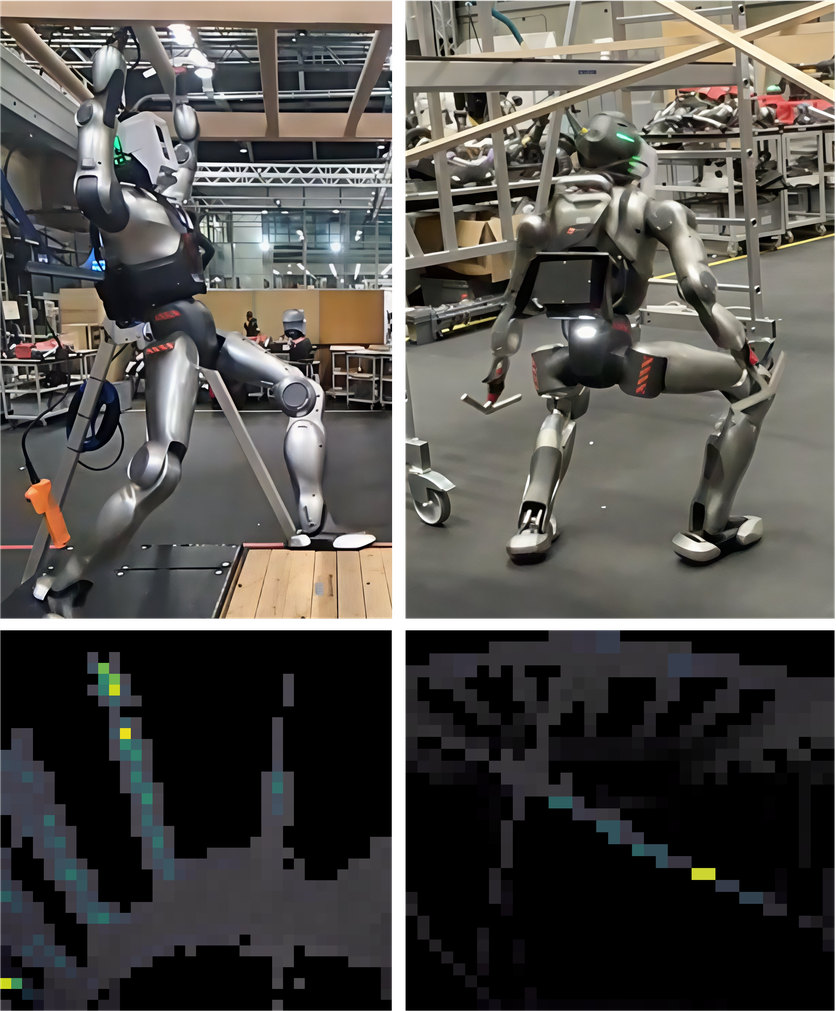
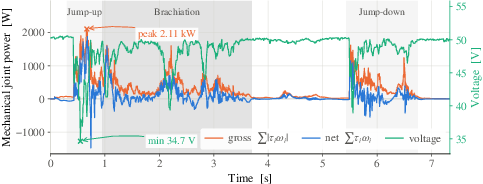
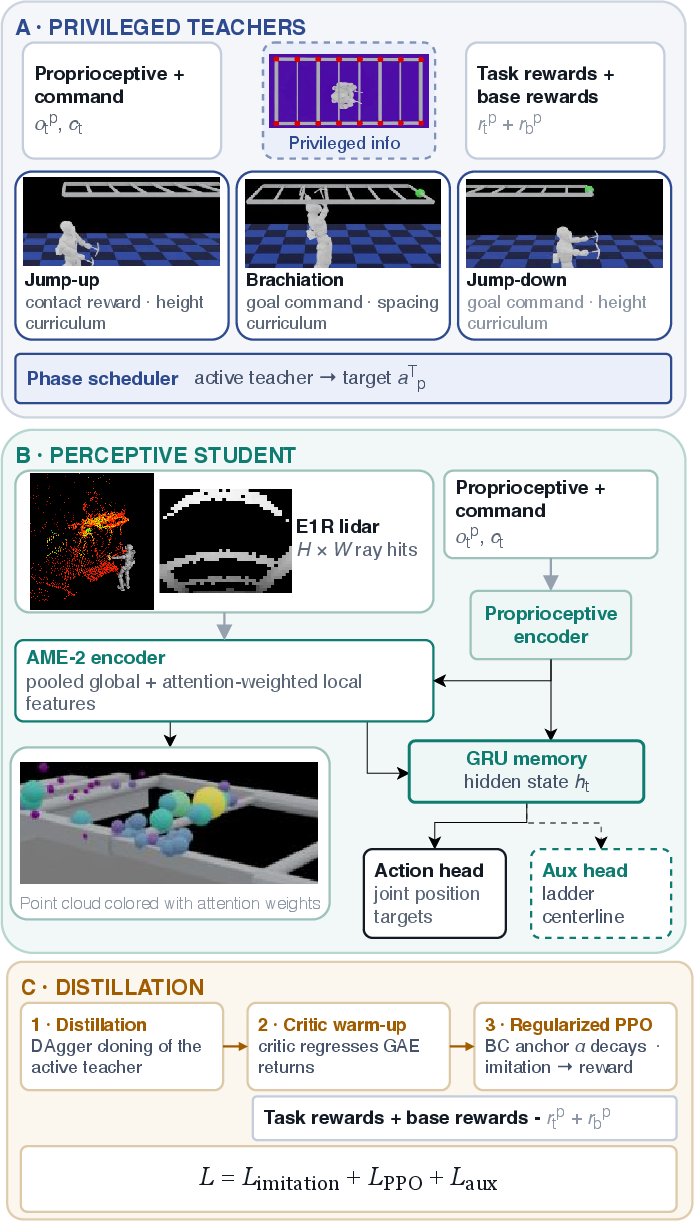
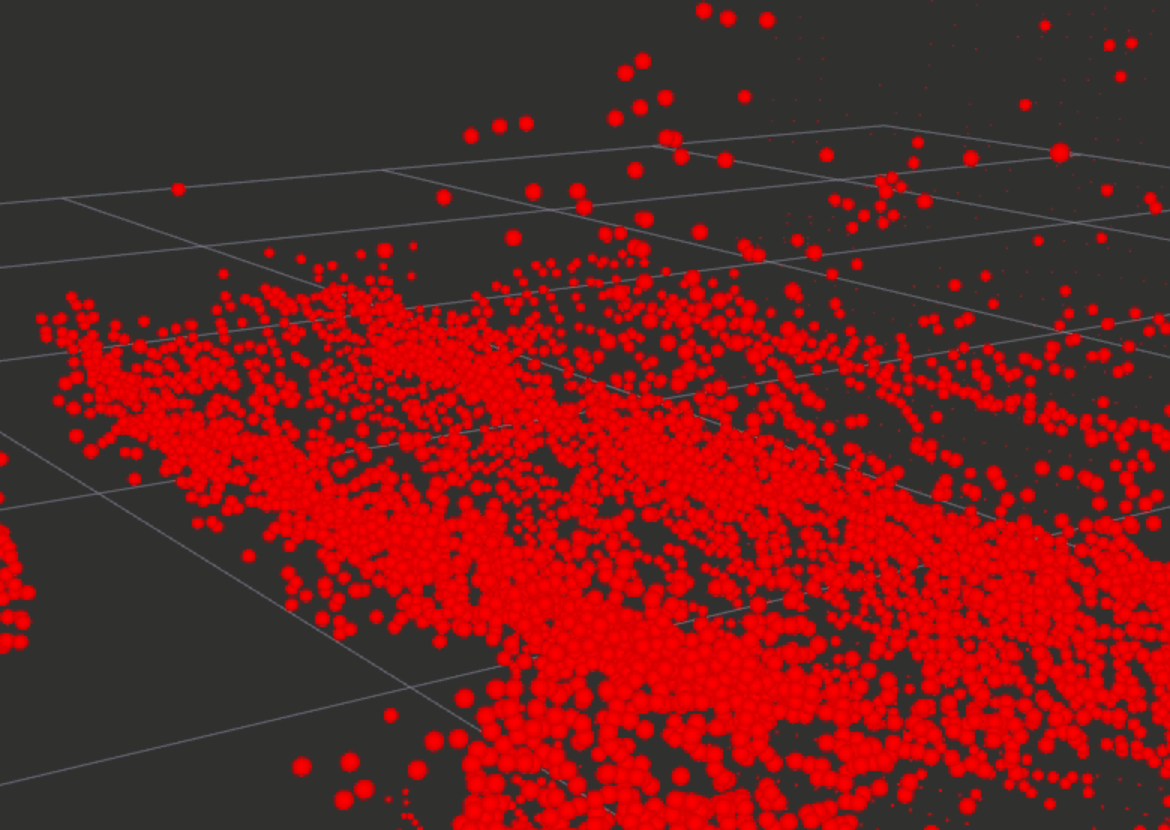
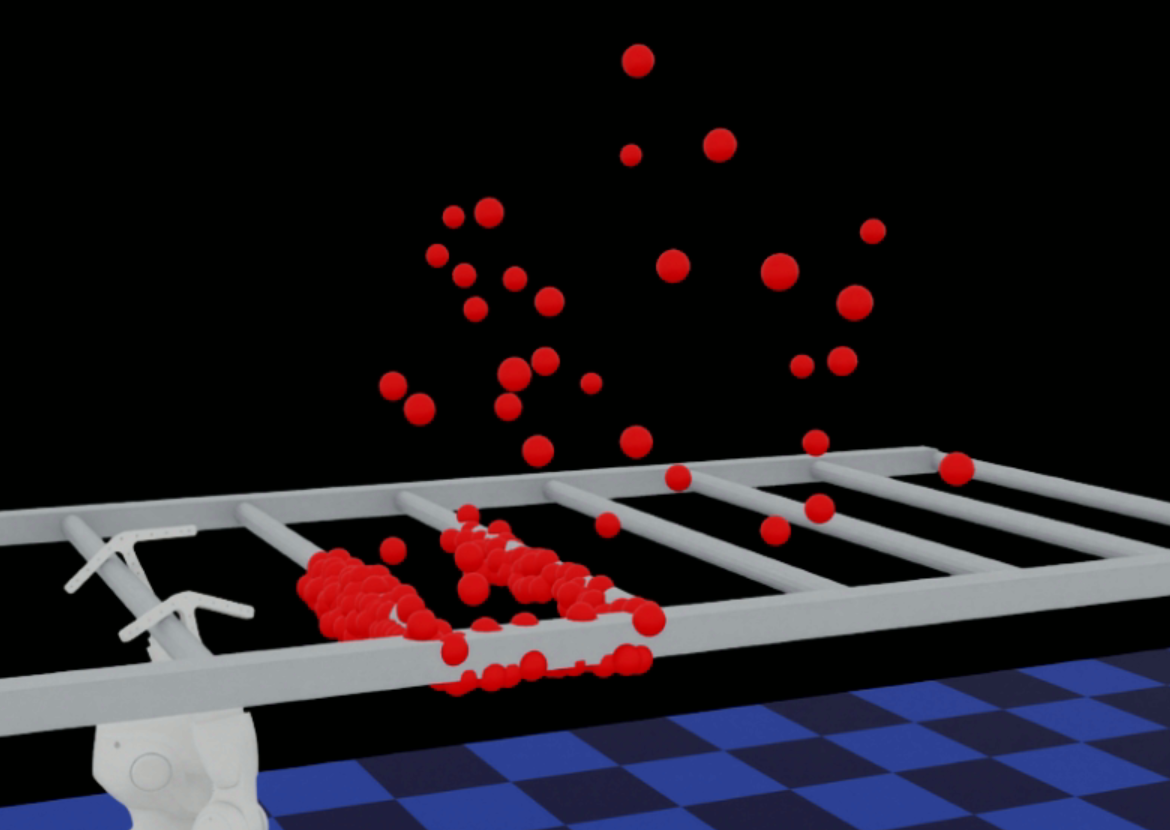
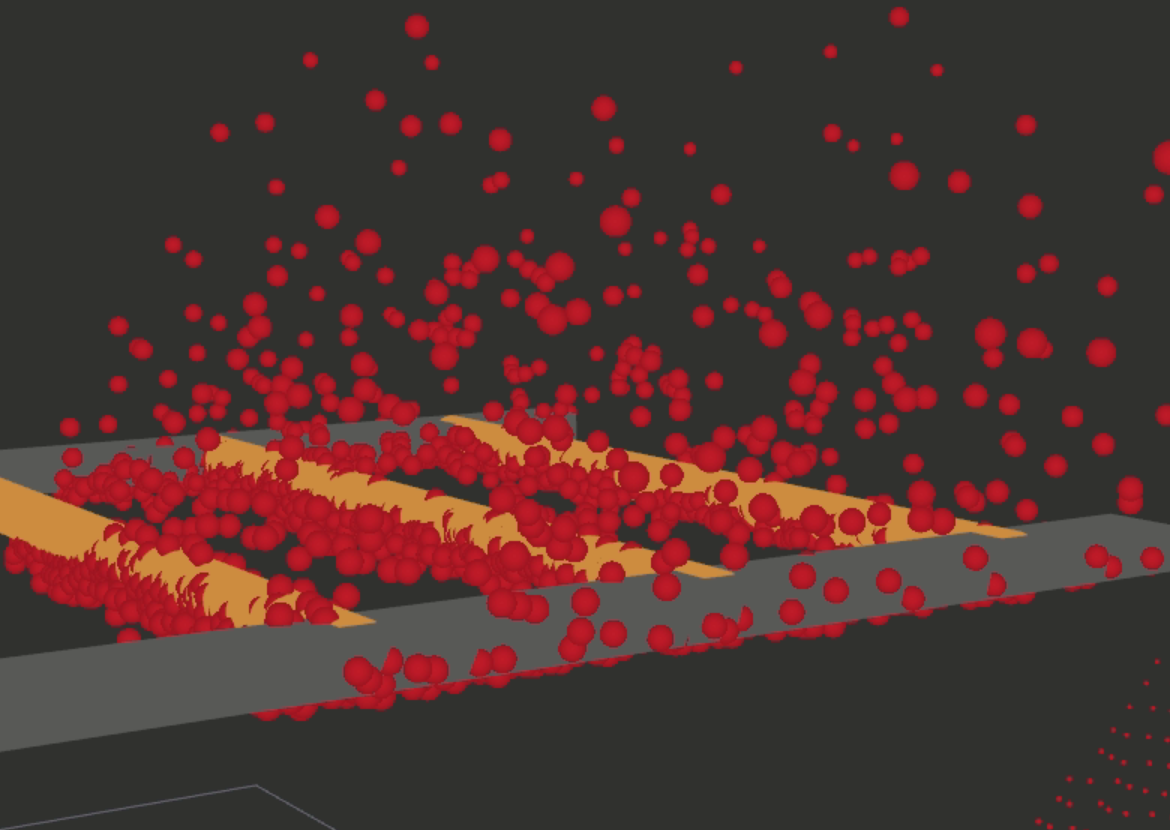
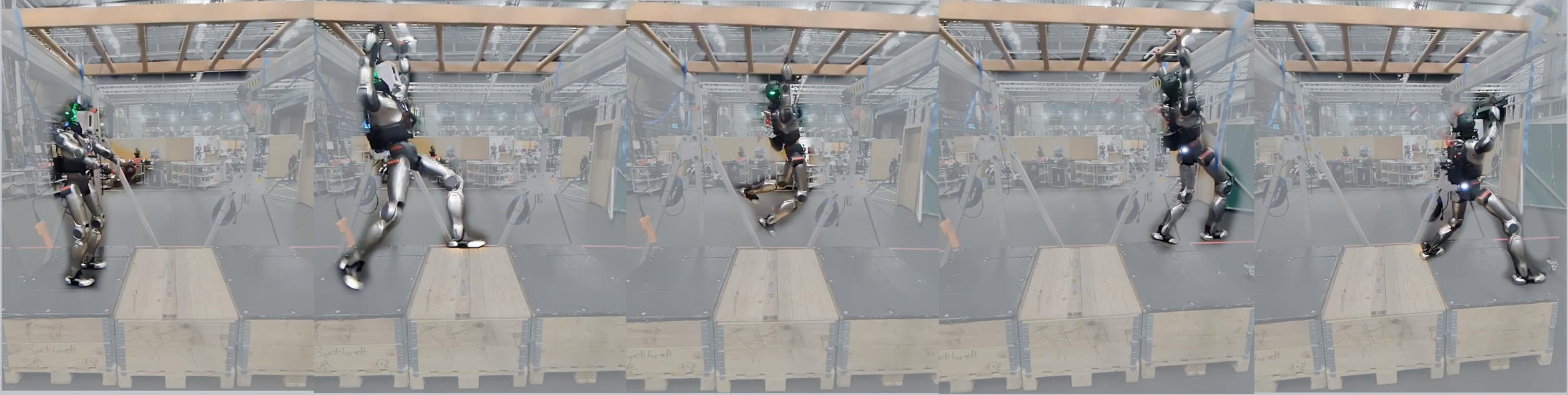
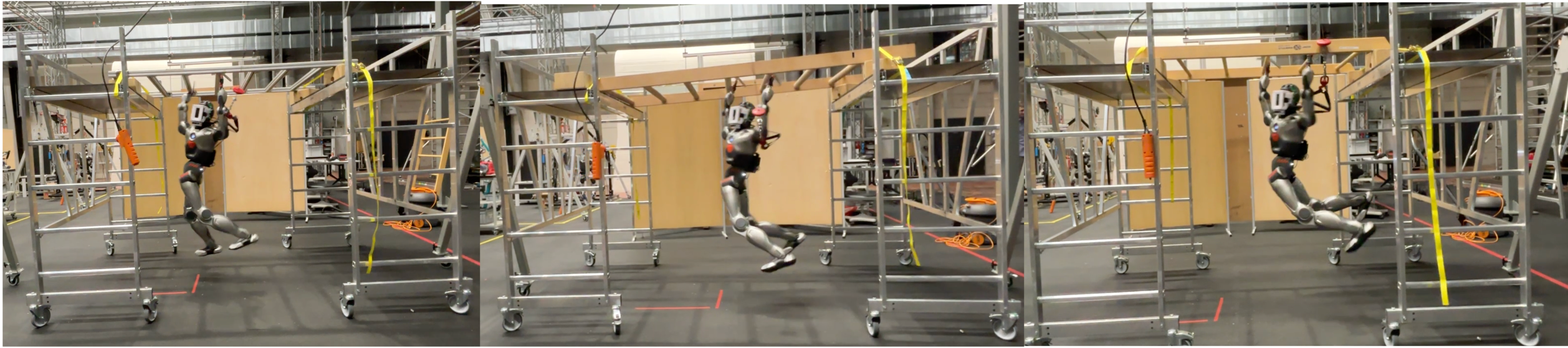
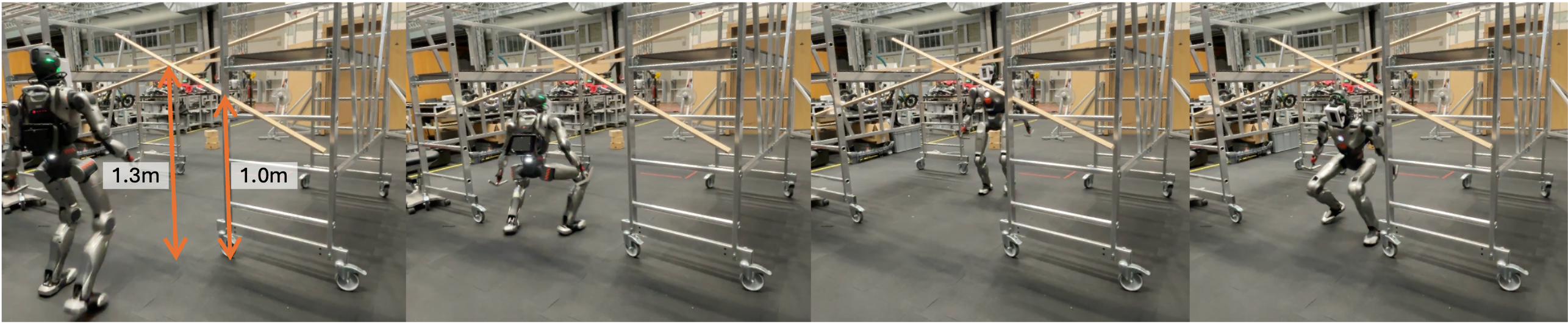
Abstract: Traversing sparse 3D structures requires humanoid robots to perceive thin, overhanging geometry while executing agile, accurate whole-body motions. We study this problem through monkey-bar traversal, where the robot must jump to the structure, traverse it through sparse bar interactions, and land safely. For this task, we present a reinforcement-learning-based perceptive control system that operates directly on observations from a head-mounted solid-state lidar. To extract task-relevant geometry from the sparse returns, the policy consumes the raw lidar scan through an attention-based encoder with recurrent memory. This policy is obtained by a phase-scheduled teacher- student pipeline that combines privileged experts for jumping up, brachiating, and jumping down. For transfer to hardware, we model lidar noise, battery-voltage sag, and actuator thermal limits, and equip the humanoid with passive hook end-effectors for robust bar interaction. On hardware, the resulting policy completes the full jump-up->brachiation->jump-down sequence in 14 of 15 trials across three bar configurations and reaches brachiation speeds up to 0.5 m/s. Beyond brachiation, the same perception backbone supports a separately trained policy that ducks beneath thin overhead obstacles with 2 cm cross-sections.
Paper Prompts
Sign up for free to create and run prompts on this paper.
Top Community Prompts
Explain it Like I'm 14
1. ¿De qué trata el artículo?
Este artículo explica cómo enseñar a un robot humanoide a moverse por estructuras formadas por barras delgadas, parecidas a las barras de un parque infantil.
El robot debe realizar una secuencia difícil:
- Saltar para agarrarse a la primera barra.
- Avanzar balanceándose de una barra a otra, como un mono.
- Soltarse y aterrizar de forma segura.
Para hacerlo, el robot usa un sensor llamado LiDAR, instalado en su cabeza. El LiDAR funciona como una especie de radar con luz: lanza muchos rayos y mide cuánto tardan en regresar para saber dónde están los objetos.
La idea principal del artículo es que el robot puede aprender a actuar usando directamente los datos sin procesar del LiDAR, sin tener que convertirlos primero en un mapa detallado del entorno.
2. ¿Qué preguntas intenta responder el estudio?
Los investigadores querían saber principalmente:
- ¿Puede un robot humanoide detectar barras muy delgadas y usarlas para moverse?
- ¿Puede aprender una secuencia completa de saltos, balanceos y aterrizajes?
- ¿Qué tipo de sistema de inteligencia artificial interpreta mejor los datos del LiDAR?
- ¿Funcionará en un robot real y no solamente en una simulación?
- ¿Puede el mismo sistema ayudar al robot a evitar obstáculos delgados que estén por encima de su cabeza?
En pocas palabras, querían comprobar si un robot podía ver estructuras difíciles, decidir rápidamente qué hacer y mover todo su cuerpo de manera segura.
3. ¿Cómo realizaron la investigación?
Entrenamiento mediante simulación
Primero, los investigadores entrenaron al robot en un programa de simulación. Una simulación es como un videojuego de física: permite probar miles de saltos y caídas sin romper el robot real.
El robot aprendió mediante aprendizaje por refuerzo. Este método funciona de forma parecida a enseñar a un animal con premios y castigos:
- Recibe una recompensa cuando se acerca a una barra, se agarra correctamente o aterriza de pie.
- Recibe una penalización si se cae, golpea su cuerpo contra algo, usa demasiada fuerza o sobrecalienta sus motores.
Se entrenaron tres “profesores” virtuales, cada uno especializado en una parte:
- Saltar hacia arriba para alcanzar la estructura.
- Balancearse entre las barras.
- Saltar hacia abajo y aterrizar.
Estos profesores podían conocer información perfecta, como la posición exacta de cada barra. Sin embargo, el robot real no puede conocer esa información. Por eso, después se entrenó un único sistema “estudiante” para imitar a los profesores usando solamente el LiDAR y los sensores internos del robot.
El sistema de visión
El estudiante utiliza dos componentes principales:
- Un codificador de atención, que decide qué puntos del escaneo del LiDAR son importantes. Es parecido a cuando una persona mira una habitación y presta atención a una puerta o a una escalera, en lugar de analizar cada punto por igual.
- Una memoria recurrente, que recuerda información de los instantes anteriores. Esto es útil porque una barra puede no aparecer claramente en un solo escaneo, pero sí puede reconocerse al combinar varios escaneos.
El robot recibe estos datos aproximadamente 10 veces por segundo y produce órdenes de movimiento 50 veces por segundo.
También se añadió una tarea auxiliar: el sistema intentaba estimar la posición y la dirección de la barra más cercana. Esta tarea ayudaba a la inteligencia artificial a entender mejor la forma de la estructura.
Preparación para el mundo real
La simulación nunca es exactamente igual que la realidad. Para solucionar esto, los investigadores hicieron la simulación más imperfecta a propósito:
- Cambiaron el peso del robot y la fricción.
- Añadieron errores en la posición de las articulaciones.
- Simularon empujones y pequeños movimientos inesperados.
- Imitaron el ruido y los errores del LiDAR.
- Modelaron la pérdida de energía de la batería.
- Modelaron el calentamiento de los motores.
La batería puede perder voltaje cuando el robot necesita mucha fuerza, igual que un teléfono puede funcionar peor cuando su batería está casi vacía. Además, algunos motores pueden calentarse si trabajan demasiado tiempo. Incluir estos problemas en la simulación ayudó al robot a prepararse para ellos.
Ganchos en lugar de manos
El robot recibió unos ganchos metálicos pasivos en los brazos. “Pasivo” significa que el gancho no necesita un motor especial para agarrarse a la barra.
Los ganchos tienen una abertura grande, por lo que el robot no necesita colocar el brazo con precisión perfecta. Para soltarse, solo gira la muñeca y el gancho sale de la barra.
4. ¿Cuáles fueron los principales resultados?
Los resultados fueron positivos.
El robot pudo completar la secuencia
En las pruebas reales:
- Completó toda la secuencia en 14 de 15 intentos.
- Esto equivale a un éxito del 93 %.
- Probó tres configuraciones diferentes de barras.
- Alcanzó velocidades de balanceo de hasta 0,5 metros por segundo.
La única caída ocurrió porque, después de saltar correctamente a la estructura, uno de los ganchos no avanzó hasta la siguiente barra.
El sistema de atención funcionó mejor
Los investigadores compararon varios métodos para interpretar los datos del LiDAR:
- Un sistema basado en atención.
- Una red convolucional, parecida a las usadas para imágenes.
- Una red más grande basada en capas totalmente conectadas.
- Un robot “ciego”, que no utilizaba la información del LiDAR.
El sistema de atención obtuvo los mejores resultados. Además, necesitaba muchos menos parámetros, es decir, era más pequeño y eficiente que los otros sistemas.
El robot sin LiDAR obtuvo los peores resultados. Esto demuestra que sentir la posición de sus propias articulaciones no era suficiente: necesitaba observar las barras.
También pudo esquivar obstáculos delgados
Los investigadores entrenaron otra versión del sistema para que el robot caminara agachándose bajo obstáculos.
El robot pudo pasar por debajo de barras de madera de solo 2 por 2 centímetros. En 10 pruebas con barras colocadas en posiciones diferentes, logró pasar correctamente en todas.
La simulación fue útil
En otra simulación, usando un programa y un modelo de LiDAR diferentes de los usados durante el entrenamiento, el robot siguió funcionando con una tasa de éxito del 70 % al 90 %.
Esto es importante porque muestra que el sistema no dependía solamente de una simulación perfecta o de una única configuración.
5. ¿Por qué es importante este trabajo?
Las estructuras delgadas y colgantes son difíciles para muchos robots. Los mapas tradicionales pueden ignorarlas porque ocupan muy poco espacio o porque están por encima del suelo. En cambio, este sistema analiza directamente los puntos del LiDAR y puede detectar esas estructuras.
El trabajo demuestra varias cosas importantes:
- Un robot humanoide puede usar sensores relativamente simples para realizar movimientos muy rápidos y complicados.
- La inteligencia artificial puede aprender una tarea completa combinando varios “profesores” especializados.
- Modelar problemas reales, como la batería baja, el calentamiento y el ruido del sensor, ayuda a pasar de la simulación al robot físico.
- El mismo sistema de percepción puede reutilizarse para tareas diferentes, como balancearse o agacharse.
Conclusión
Este artículo presenta un robot humanoide que aprende a saltar, agarrarse a barras, balancearse entre ellas y aterrizar usando un LiDAR instalado en la cabeza. En lugar de construir un mapa completo del entorno, el robot analiza directamente los datos del sensor y se concentra en los puntos más importantes.
El resultado es un robot capaz de completar una tarea parecida a la braquiación de un mono con un éxito del 93 % en pruebas reales. También puede esquivar obstáculos muy delgados situados sobre su cabeza.
En el futuro, esta tecnología podría ayudar a robots a desplazarse por lugares difíciles, como zonas de rescate, instalaciones industriales o entornos con escaleras, tuberías y estructuras irregulares. Sin embargo, todavía debe probarse con muchos más tipos de estructuras y aprender a recordar mejor el entorno durante tareas largas.
Knowledge Gaps
Knowledge Gaps, Limitations, and Open Questions
The paper demonstrates promising hardware performance, but leaves the following issues unresolved:
- Limited statistical evidence: The full traversal is evaluated in only 15 hardware trials, with just 2–4 trials per ladder configuration; confidence intervals, repeated-seed results, and statistical significance are not reported.
- Insufficient baseline comparisons: The system is not compared against voxel-grid, elevation-map, depth-camera, raw point-cloud, model-based, or separately switched-policy baselines under identical conditions.
- Incomplete ablation of the training pipeline: The individual contributions of phase scheduling, multi-teacher distillation, PPO refinement, phase-wise advantage normalization, battery modeling, thermal modeling, and lidar randomization are not isolated.
- Unclear impact of auxiliary supervision: The centerline loss is evaluated mainly through behavior-cloning and post-hoc prediction losses; its effect on final simulated and hardware success rates is not established.
- Narrow geometry distribution: Training and evaluation use ladder-like structures with bar radii of 1–3 cm, limited spacing and height ranges, and small tilt angles. Generalization to irregular layouts, missing bars, curved or nonuniform bars, branching structures, rails, rings, or mixed obstacle types remains unknown.
- Limited evaluation of bar material and contact properties: The effects of different materials, surface friction, compliance, wear, wetness, and deformability on hook engagement and release are not quantified.
- Unexplored structural motion: Although some weakly supported ladders are tested, the paper does not systematically evaluate moving, vibrating, rotating, or substantially deformable structures.
- Restricted sensing conditions: Robustness to strong ambient illumination, reflective or absorptive surfaces, transparent objects, dust, rain, occlusion, reduced return density, sensor saturation, and lidar failure is not assessed.
- Dependence on a single sensor and platform: Transfer to other lidar models, scan patterns, mounting locations, humanoid morphologies, actuator systems, or end-effectors is not demonstrated.
- Unquantified localization dependence: Hardware experiments rely on lidar-inertial odometry, but the effects of odometry drift, impact-induced estimator failure, delayed state estimates, and degraded localization on traversal success are not reported.
- Short-horizon memory remains uncharacterized: The recurrent policy is not evaluated on tasks requiring long-term spatial memory, revisiting previously observed geometry, remembering occluded bars, or recovering after extended sensor interruptions.
- No explicit recovery behavior: The system does not characterize recovery from missed hooks, premature releases, wrong-bar contacts, slips, partial grasps, failed jumps, or unexpected obstacles.
- Safety is demonstrated only indirectly: The paper does not report quantitative fall-risk, impact-force, damage, emergency-stop, tethering, or human-safety evaluations during failure cases.
- Thermal and battery models lack independent validation: The proposed voltage-sag and thermal integrator models are tuned using logs and failure cases, but their predictive accuracy, parameter uncertainty, and validity across battery states, ambient temperatures, and repeated sequences are not reported.
- Long-duration operation is unexplored: The experiments do not establish whether the policy remains reliable over many consecutive traversals, battery-discharge cycles, actuator heating cycles, or hardware-aging conditions.
- Energy and performance trade-offs are not analyzed: The relationship between traversal speed, success probability, energy consumption, voltage sag, actuator heating, and mechanical stress remains unresolved.
- The sim-to-real gap is only partially tested: MuJoCo provides sim-to-sim validation, but the paper does not systematically compare simulated lidar distributions, contact forces, joint tracking, timing, and dynamics against hardware measurements.
- Domain-randomization coverage is not justified: The selected randomization ranges are listed but are not linked to measured parameter distributions or sensitivity analyses, leaving uncertainty about whether they are sufficient or unnecessarily broad.
- Command and initialization robustness are unclear: Performance under inaccurate goal positions, different starting orientations, larger initial pose errors, nonzero initial velocities, and delayed or noisy jump-down triggers is not evaluated.
- Failure characterization is incomplete: The single reported full-sequence failure is attributed to failure of hook advancement, but the paper does not provide a systematic taxonomy, frequency analysis, or diagnostic analysis of failures across simulation and hardware.
- The ducking evaluation is small and specialized: Ten real-world ducking passes with one obstacle material and a limited clearance range do not establish robustness to repeated contacts, multiple consecutive obstacles, varying heights, obstacle motion, or cluttered environments.
- Task-policy scalability is unresolved: The framework currently requires separately trained policies for traversal and ducking; it is unknown whether additional behaviors can be integrated without interference, increased memory cost, or degraded performance.
- No unified task selection or sequencing mechanism is provided: The robot cannot autonomously decide when to switch between jumping, brachiation, ducking, climbing, or recovery behaviors in a complex environment.
- Generalization beyond goal-directed traversal is untested: The approach has not been evaluated for exploration, route planning across multiple structures, bidirectional multi-section traversal, or navigation involving alternative contact opportunities.
- Computational and real-time requirements are underreported: Inference latency, memory use, processor load, sensor-to-actuator delay, and deployment constraints for the attention encoder and recurrent policy are not quantified.
- Reproducibility is incomplete: The paper does not provide detailed network hyperparameters, training duration, random seeds, teacher-success rates, curriculum schedules, raw sensor datasets, or sufficient implementation details to reproduce the reported results.
- The role of passive hooks versus learned control is unresolved: There is no controlled comparison with alternative hook geometries, active grippers, or the original hands, so the relative contribution of end-effector design and policy robustness cannot be determined.
- Human-level comparison is limited: The reported 0.5 m/s brachiation speed is compared with human speed, but differences in structure geometry, safety constraints, number of swings, efficiency, and success probability are not controlled.
Practical Applications
Immediate Applications
The demonstrated system is closest to deployment in controlled environments where the robot, sensor configuration, and traversable structures can be calibrated in advance. The reported hardware results—14 successful full traversals in 15 trials and successful ducking under thin obstacles—support feasibility, but not yet unrestricted commercial operation.
- Robotic inspection of elevated and sparse structures — Industrial robotics, infrastructure
- A humanoid equipped with head-mounted solid-state LiDAR and passive hooks could inspect monkey-bar-like frames, industrial platforms, ladders, overhead rails, scaffolding, and maintenance structures.
- The robot could autonomously approach a structure, attach to bars, traverse horizontally, and dismount while carrying a lightweight inspection payload such as a thermal camera or gas sensor.
- Classification: Immediate Application in test facilities or purpose-built environments.
- Dependencies and assumptions: The structure must support the robot’s dynamic loads; bar diameter, spacing, height, and clearance must remain within ranges similar to those tested; reliable LiDAR-inertial odometry and emergency-stop mechanisms are required. The current system was validated on only three ladder configurations and a limited number of trials.
- Humanoid mobility through obstacle-rich indoor environments — Search and rescue, security, emergency response
- The ducking policy can enable a robot to pass beneath thin, low-clearance obstacles that may be difficult to represent in elevation maps, such as collapsed beams, cables, pipes, or temporary barriers.
- A practical workflow could combine conventional walking with a raw-LiDAR obstacle-avoidance policy that triggers crouching or ducking when an overhead obstruction is detected.
- Classification: Immediate Application for supervised demonstrations and controlled disaster-response training sites.
- Dependencies and assumptions: The obstacle must be detectable within the LiDAR’s range and field of view. The current demonstration concerns a cm slat at approximately $1.2$ m clearance; rubble, dust, smoke, moving objects, and irregular surfaces may substantially reduce reliability.
- Agile access in warehouses and industrial facilities — Logistics and manufacturing
- A robot could use the learned perception backbone to identify thin rails, overhead supports, narrow passages, or sparse fixtures without building a dense voxel map.
- Potential products include a low-latency “agile mobility module” for humanoid robots, consisting of a LiDAR encoder, GRU-based temporal memory, and phase-conditioned control policies.
- Classification: Immediate Application for fixed layouts and pre-approved routes.
- Dependencies and assumptions: The robot must be retrained or fine-tuned for its specific morphology, actuator limits, payload, and environment. The paper’s policy outputs joint position targets at 50 Hz and assumes compatible low-level PD control.
- Hardware-aware reinforcement-learning simulation — Robotics software and digital twins
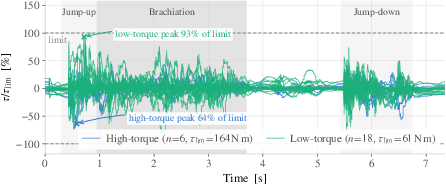
- The battery-voltage sag, actuator-thermal, torque-budget, and sensor-noise models can be incorporated into IsaacLab, MuJoCo, or comparable simulators to train dynamic robot behaviors that respect real hardware limits.
- This can support safer policy development, hardware selection, battery sizing, actuator evaluation, and regression testing before physical experiments.
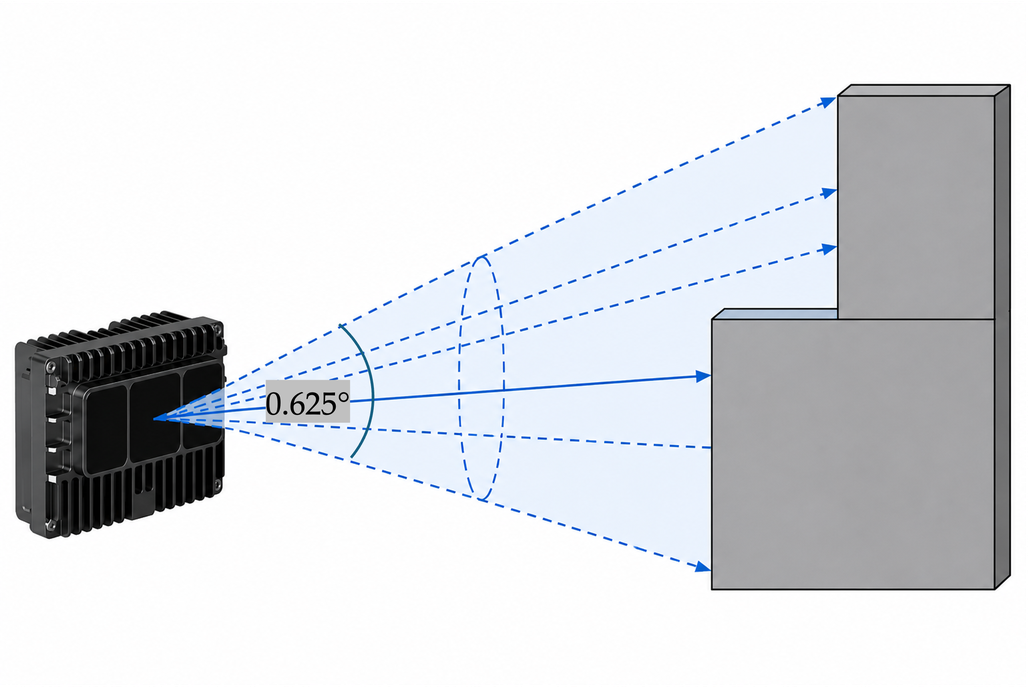
- The LiDAR model is particularly useful for simulating beam divergence, edge bleed, missing returns, mixed-depth measurements, calibration error, frame freezes, and range noise.
- Classification: Immediate Application as a software and research workflow.
- Dependencies and assumptions: The models must be calibrated for the target robot and sensor. The paper identifies parameters for the RoboSense E1R and the PM-01; these values should not be transferred directly to other devices without measurement.
- Compact perception modules for embedded robot control — Edge AI and robotics platforms
- The attention-based point-cloud encoder achieved lower behavior-cloning loss than CNN, MLP, and blind baselines while using substantially fewer parameters than the compared CNN and MLP architectures.
- This suggests a deployable embedded module for selecting task-relevant LiDAR returns without constructing a full 3D map.
- Classification: Immediate Application for prototype robots and edge-compute platforms.
- Dependencies and assumptions: Lower parameter count does not by itself guarantee real-time performance, low power consumption, or robustness across sensors. Deployment requires profiling inference latency, memory use, and synchronization between 10 Hz LiDAR observations and 50 Hz control.
- Training methodology for multi-stage robotic skills — Academia and industrial R&D
- The phase-scheduled multi-teacher pipeline can be reused when a task consists of distinct subtasks, such as approach–grasp–manipulate–release or climb–traverse–descend.
- A practical workflow is to train privileged experts for individual phases, distill them into one partially observed student, warm up the critic, and then refine the student with PPO while maintaining a decaying behavior-cloning anchor.
- Classification: Immediate Application as a transferable learning framework.
- Dependencies and assumptions: Each phase must be identifiable or schedulable, privileged training information must be available in simulation, and reward scales should be normalized to avoid one phase dominating training.
- Passive hook end-effectors for robust contact — Robotics hardware design
- The simple symmetric hook can be adapted for robots that must catch, hang from, or traverse cylindrical bars. Its large opening tolerates contact-placement error, while wrist rotation enables disengagement without lifting the entire body.
- Similar end-effectors could be used in laboratory climbing robots, amusement or inspection robots, and structured test rigs.
- Classification: Immediate Application for specialized robots and experimental platforms.
- Dependencies and assumptions: Hooks are appropriate only where compatible bars or rails are present. They do not replace dexterous hands for arbitrary manipulation and may introduce collision or entanglement risks.
- Safety-oriented motion and energy management — Industrial safety and robot operations
- The reward terms and simulated hardware limits provide a template for limiting joint position, velocity, torque, thermal load, battery voltage, body contact, and limb-level torque expenditure during learning.
- Operators could use the resulting telemetry to schedule cooldowns, restrict high-load maneuvers at low battery state of charge, and reject policies that approach unsafe thermal or electrical conditions.
- Classification: Immediate Application for supervised operation and policy validation.
- Dependencies and assumptions: The thermal integrator is a proxy rather than a complete motor-temperature model. Independent runtime safety monitors, current limits, fault detection, and mechanical containment remain necessary.
Long-Term Applications
The broader applications require scaling beyond the limited geometries, hardware platform, and evaluation size reported in the paper. They would also require stronger guarantees of safety, generalization, and recovery from perception or contact failures.
- General-purpose humanoid traversal in unstructured environments — Robotics, disaster response
- Extending the raw-LiDAR backbone and recurrent memory could allow humanoids to navigate environments containing thin beams, overhead pipes, ladders, rails, hanging structures, and partially occluded obstacles.
- A future unified policy could select among walking, ducking, climbing, hanging, jumping, and crawling rather than relying on separately trained task policies.
- Classification: Long-Term Application.
- Dependencies and assumptions: The authors explicitly identify the current limitation to a small set of separately trained policies and limited geometry diversity. Long-horizon memory, robust task switching, recovery behaviors, contact uncertainty estimation, and larger-scale validation are required.
- Autonomous search-and-rescue traversal — Emergency services
- A future system could use agile whole-body traversal to move through collapsed buildings, industrial accidents, or underground infrastructure where thin and overhanging structures make standard elevation maps inadequate.
- The robot might carry cameras, microphones, radiation sensors, or medical supplies while choosing contact points directly from onboard perception.
- Classification: Long-Term Application.
- Dependencies and assumptions: Rescue environments contain unstable structures, dust, darkness, deformable debris, unknown load-bearing capacity, and humans. The reported 93% success rate on controlled trials is insufficient for unsupervised deployment; formal risk assessment, redundancy, remote supervision, and failure recovery are essential.
- Maintenance of overhead infrastructure — Energy, transportation, utilities
- Humanoids could traverse rails, support frames, bridge trusses, transmission-related structures, or industrial pipe racks while inspecting corrosion, cracks, thermal anomalies, or loose connections.
- A product could combine the traversal controller with non-contact inspection sensors and a digital-twin workflow that maps observations to infrastructure assets.
- Classification: Long-Term Application.
- Dependencies and assumptions: Infrastructure geometry and materials vary widely, and some structures cannot tolerate dynamic impact loads. The controller would need payload-aware planning, surface-condition estimation, certified attachment mechanisms, and conservative load testing.
- Adaptive locomotion across thin and overhanging terrain — Outdoor robotics
- The method could support robots operating in forests, mines, construction sites, caves, and cluttered urban areas where thin branches, cables, ledges, and overhangs are important but easily discarded by 2.5D maps.
- The attention mechanism could prioritize only geometrically relevant returns, reducing the computational cost of full-resolution 3D mapping.
- Classification: Long-Term Application.
- Dependencies and assumptions: Outdoor sensing introduces rain, fog, sunlight interactions, vegetation motion, dust, longer ranges, and highly variable reflectivity. The current range gate of $0.3$–$1.5$ m and the E1R-specific noise model would need substantial extension.
- Reusable raw-sensor policy backbone across robot tasks — Robotics software platforms
- The demonstrated reuse of the same attention encoder and GRU for brachiation and ducking suggests a general representation-learning layer for sparse 3D geometry.
- Future robot software could expose a common perception interface to multiple task heads: obstacle avoidance, grasp-point selection, ladder climbing, bar traversal, crouching, and contact recovery.
- Classification: Long-Term Application.
- Dependencies and assumptions: Reusing the architecture does not ensure reuse of learned weights or zero-shot transfer. Multi-task interference, task-conditioned memory, domain adaptation, calibration changes, and safe switching between policies require further research.
- Human–robot collaboration in shared environments — Manufacturing and public-space robotics
- Robots capable of ducking under obstacles and traversing overhead structures could operate in changing workspaces without requiring every obstacle to be converted into a prebuilt map.
- In factories, this might enable robots to continue operating beneath temporary fixtures or around suspended equipment while maintaining a safe crouched posture.
- Classification: Long-Term Application.
- Dependencies and assumptions: Human motion is dynamic and unpredictable, while the current policies were not evaluated with people, moving obstacles, or deliberate interference. Human-aware perception, certified speed and force limits, intent prediction, and fail-safe stopping are prerequisites.
- Policy and regulatory frameworks for agile robots — Public policy and standards
- The paper provides concrete engineering variables that could inform testing standards: success rate over geometry distributions, minimum clearance, battery sag, thermal exposure, contact force, actuator-limit margin, and recovery after failed catches.
- Regulators and procurement bodies could require scenario-based evaluation rather than demonstrations on a single fixed obstacle course.
- Classification: Long-Term Application.
- Dependencies and assumptions: Standardized benchmarks must cover sensor failures, structural movement, battery state, actuator aging, and unseen geometries. The paper’s small hardware sample and controlled ladders are useful for protocol design but not sufficient as a safety certification basis.
- Energy-aware planning for dynamic robots — Energy systems and robot fleet management
- The battery model could eventually support planners that select between walking, climbing, brachiating, or waiting based on predicted voltage sag, remaining energy, and actuator temperature.
- Fleet-management software could assign high-power traversal tasks only to robots with adequate battery and thermal headroom.
- Classification: Long-Term Application.
- Dependencies and assumptions: The current model captures voltage sag using a simplified first-order approximation and uses a proxy for actuator temperature. Accurate deployment requires battery aging models, cell-level monitoring, ambient-temperature effects, actuator-specific thermal dynamics, and validated energy costs for diverse maneuvers.
Glossary
- Actuator thermal limits: Constraints preventing motors from overheating during operation. “battery-voltage sag, actuator thermal limits, and lidar noise”
- Advantage normalization: Rescaling reinforcement-learning advantage estimates to reduce differences in reward magnitude. “normalizing advantages per phase”
- Attention-based encoder: A neural network that assigns different importance to input elements when extracting features. “an attention-based encoder with recurrent memory”
- Auxiliary loss: An additional training objective that provides supplementary supervision to the main task. “we introduce an auxiliary bar-centerline prediction loss”
- Behavior cloning: Learning a policy by imitating actions demonstrated by another policy or agent. “Distillation: pure behavior cloning”
- Beam divergence: The angular spreading of a sensing beam as it travels from its source. “the divergence of the lidar ray-cone”
- Brachiation: Locomotion in which a robot or animal moves by swinging between overhead supports using its arms. “jump-upbrachiationjump-down sequence”
- Brownout: A substantial temporary reduction in electrical voltage that can impair or shut down a system. “the jump-up drew enough current to brown out the robot”
- Clipped PPO surrogate: The bounded objective used in Proximal Policy Optimization to prevent excessively large policy updates. “using the clipped PPO surrogate and a decaying BC anchor”
- Clipped inverse return variance: A bounded weighting factor based on the inverse variance of returns, used to balance value-learning updates. “weight the value loss by clipped inverse return variance”
- Collision-detection cost: The computational effort required to determine whether simulated objects intersect. “reducing collision-detection cost in simulation”
- Curriculum: A training strategy that gradually increases task difficulty. “a curriculum of increasing ladder height”
- DAgger: Dataset Aggregation, an imitation-learning method that iteratively labels visited states with expert actions. “typically via DAgger”
- Domain randomization: Randomizing simulation parameters during training to improve transfer to varying real-world conditions. “Domain randomization.”
- Egocentric: Represented from the viewpoint of the robot or sensing agent. “egocentric depth for quadruped and humanoid parkour”
- End-effector: The device at the end of a robot arm that directly interacts with the environment. “The end-effector must fulfill four roles”
- Exteroception: Sensing of the external environment, as opposed to sensing the robot’s own internal state. “Map-free approaches feed raw exteroception directly to the policy”
- First-order lag: A dynamic model in which a variable gradually approaches a target with a single characteristic time constant. “drives a first-order lag”
- GAE returns: Returns estimated using Generalized Advantage Estimation, which balances bias and variance in policy-gradient learning. “The critic regresses unclipped GAE returns”
- GRU: Gated Recurrent Unit, a recurrent neural-network architecture that uses gates to preserve and update temporal information. “A GRU memory module is fed the perception features”
- Height map: A spatial representation assigning elevation values to locations in a horizontal grid. “this height map is teacher-only”
- Hinge penalty: A loss or reward penalty that activates when a quantity crosses a specified threshold. “the battery voltage are penalized directly”
- Inverse-square weighting: Weighting measurements by the inverse of the square of their distance or range. “the per-sample hits are fused with inverse-square weighting”
- Leaky integrator: A state accumulator that gradually forgets or decays previous values. “Each of these joints therefore carries a leaky integrator”
- Lidar: A sensing technology that measures distance using emitted and returned light pulses. “a head-mounted solid-state lidar”
- Mixed-pixel effect: A depth-sensing artifact in which one pixel receives returns from multiple surfaces at a depth discontinuity. “the mixed-pixel effect known from time-of-flight cameras”
- Motion-induced scanning distortion: Measurement errors caused by sensor or scene motion during sequential scanning. “the motion-induced scanning distortion”
- Multi-teacher distillation: Training one student policy to reproduce the behavior of several specialized teacher policies. “A phase-scheduled multi-teacher distillation scheme”
- No-regret online learning: Online learning in which the cumulative performance approaches that of the best fixed decision in hindsight. “to No-Regret Online Learning”
- Partially observable: Describing an environment in which the agent cannot directly access the complete underlying state. “partially observable structures that require long-horizon spatial memory”
- Passive hook end-effector: A mechanically simple arm attachment that engages with bars without requiring active gripping force. “passive hook end-effectors for robust bar interaction”
- Phase-scheduled distillation: Knowledge transfer in which different teacher policies are selected according to the current stage of a task. “phase-scheduled distillation”
- Privileged observation: Information available during training but unavailable to the deployed robot. “The state is a privileged observation”
- Proprioception: Sensing of the robot’s own joint positions, velocities, orientation, and related internal states. “The student observes proprioception”
- Proximal Policy Optimization (PPO): A policy-gradient reinforcement-learning algorithm that limits the size of policy updates for stability. “PPO refinement”
- Raycaster: A simulator component that traces rays to compute virtual sensor measurements and intersections. “a custom raycaster written in Warp”
- Ray-cone model: A sensor model representing each measurement as rays distributed within a finite angular cone. “The ray-cone model behind both simulators”
- Recurrent memory: A temporal state mechanism that retains information from previous observations. “a recurrent memory to integrate them over time”
- Reinforcement learning: A learning paradigm in which an agent improves behavior through reward-based interaction with an environment. “solved by reinforcement learning of privileged experts”
- Restitution: A parameter describing the bounciness of a collision between physical bodies. “Restitution & all bodies”
- Sim-to-real transfer: The transfer of a policy trained in simulation to a physical robot. “models of battery voltage sag, actuator thermal limits, and lidar noise that enable sim-to-real transfer”
- Sim-to-sim validation: Evaluation of a policy in a different simulator or simulation configuration from the one used for training. “Sim-to-Sim Validation Model”
- Solid-state lidar: Lidar with electronically controlled scanning and no mechanically rotating scanning assembly. “a solid-state lidar with an integrated IMU”
- Spatial disturbances: Variations or perturbations in the robot’s surrounding geometry or physical conditions. “For robustness against spatial disturbances”
- Teacher–student training: Training in which an expert teacher guides a student policy that may have restricted observations. “Teacher--student training”
- Time-of-flight camera: A camera that estimates depth from the travel time of emitted light. “time-of-flight cameras”
- Truncated BPTT: Truncated Backpropagation Through Time, which trains recurrent networks over limited temporal segments. “with an MSE loss through truncated BPTT”
- Visuomotor policy: A policy that maps visual or visual-like sensory input to motor actions. “a depth-based visuomotor policy”
- Voxel grid: A three-dimensional grid of volumetric cells used to represent spatial geometry. “voxel grids pay steeply in memory and compute as resolution grows”
- Whole-body control: Coordinated control of all relevant robot joints and body parts to achieve a task. “agile, accurate whole-body motions”

