LadderMan: Learning Humanoid Perceptive Ladder Climbing
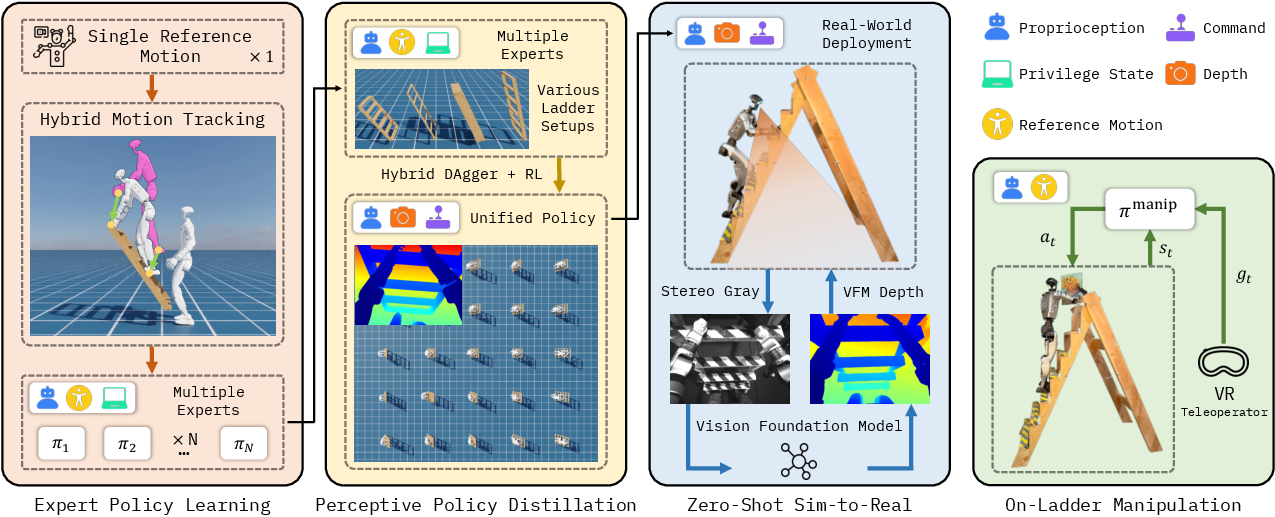
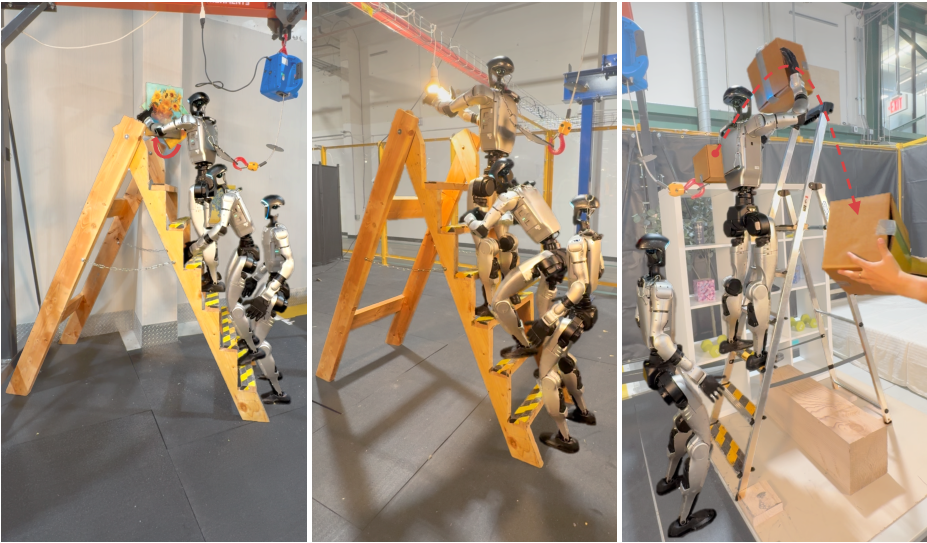
Abstract: Humanoid robots hold great promise for operating in human-centered environments, yet ladder climbing remains one of the most challenging tasks due to sparse footholds and handholds, complex whole-body coordination, and sensitivity to perception and control errors. We present \textbf{LadderMan}, a unified system that enables humanoid robots to robustly climb diverse ladders and perform manipulation under such constrained conditions. Our climbing policy is built on a scalable two-stage learning pipeline, where we use hybrid motion tracking to learn multiple climbing experts from a single reference motion, and distill these experts into a unified depth-based visuomotor climbing policy via hybrid imitation and reinforcement learning. To enable real-world deployment, we leverage vision foundation models to bridge the sim-to-real gap in depth perception. Building on the learned climbing policy, we further train a separate manipulation policy using a dual-agent formulation, allowing stable on-ladder manipulation via teleoperation. Experiments demonstrate that LadderMan achieves robust ladder climbing across a wide range of geometries, successfully transfers to real-world hardware in a zero-shot manner, and supports various manipulation tasks under challenging ladder constraints. Video results are available at https://ladderman-robot.github.io .
Paper Prompts
Sign up for free to create and run prompts on this paper.
Top Community Prompts
Explain it Like I'm 14
What this paper is about
This paper introduces LadderMan, a system that teaches a human‑shaped robot (a humanoid) to climb different kinds of ladders and do simple tasks while standing on a ladder, like adjusting a painting or changing a light bulb. The big deal is that the robot learns in a computer simulation and then works in the real world without extra fine‑tuning or special hardware.
What questions the researchers asked
- Can a single, vision‑based controller help a humanoid climb many types of ladders reliably?
- Can the robot use what it sees (depth images) to place its hands and feet on thin, narrow rungs without slipping?
- Can the robot keep its balance and still use its arms to do tasks while on a ladder?
- What training tricks are necessary to make the jump from simulation to the real world work on the first try?
How they taught the robot (in simple terms)
Climbing a ladder is hard for a robot because:
- The rungs are small and far apart.
- The robot must coordinate both hands and both feet perfectly.
- Tiny mistakes in seeing or moving can cause a fall.
To handle this, the team used a two‑stage “teacher‑and‑student” learning plan:
Stage 1: Train “expert” climbers in simulation
- They recorded one real climb and used it as a reference “example” of how climbing should look.
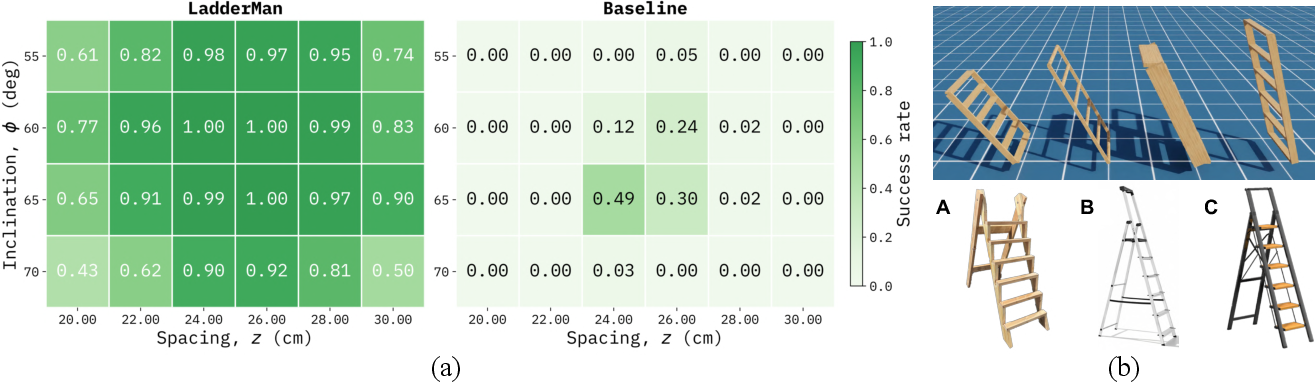
- In simulation, they trained several expert policies, each specialized for a different ladder shape (different angles and rung spacing).
- Instead of copying the example exactly, they used “hybrid motion tracking,” which strongly keeps the legs’ rhythm but lets the arms adjust to each ladder. Think of it like following dance steps for your feet, but letting your hands reach differently depending on where the handrails are.
- They also added rewards that focus on making proper hand and foot contact with the rungs, so the robot learns to grab and step in the right spots.
Stage 2: Distill experts into one vision‑based student
- Next, they taught a single “student” policy that looks at depth images (a kind of 3D camera view) plus the robot’s own body senses and outputs whole‑body movements.
- Training combined imitation (copy what the experts do) and reinforcement learning (figure out what actually works best). Starting with imitation makes learning safe and stable; then reinforcement learning helps the student recover from mistakes and handle new situations.
Bridging simulation to real life: better robot “eyes”
- Cameras in the real world are noisy, and ladder rungs are thin, so vision mistakes can be dangerous.
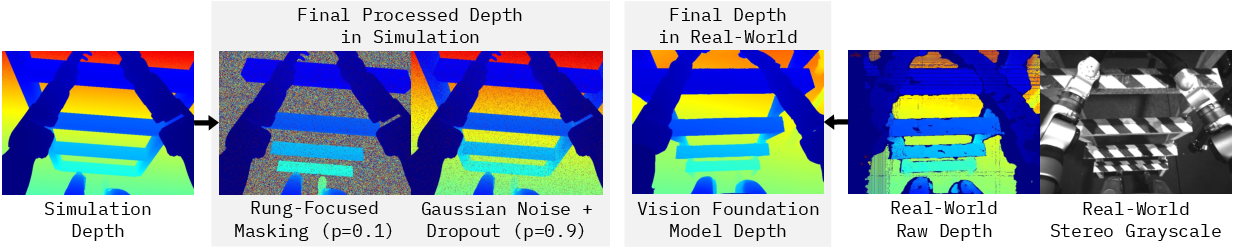
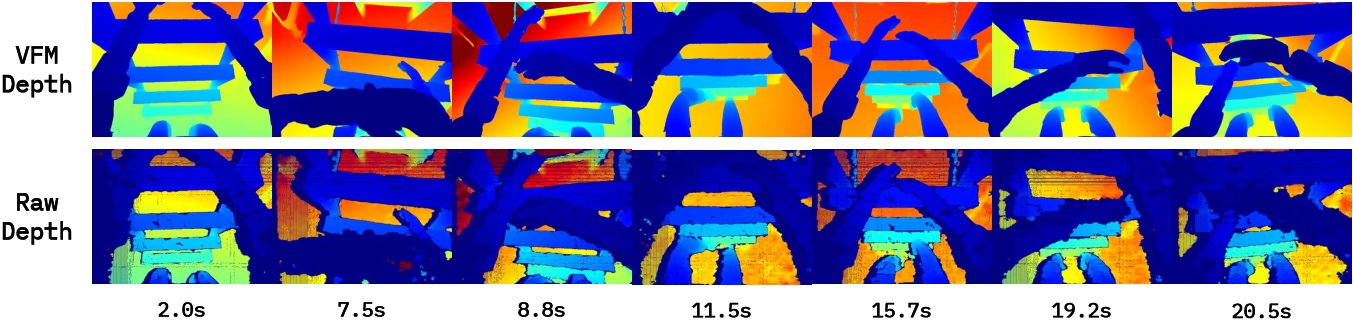
- Instead of piling on lots of random noise in training, they used a fast “vision foundation model” for depth (Fast‑FoundationStereo) on the real robot. It cleans up the depth images in real time so the rungs look crisp and accurate.
- During training, they also sometimes masked everything except rung‑like areas in the images. This nudges the policy to focus on the most important parts—the rungs—rather than background clutter.
Doing tasks while on a ladder
- To let the robot work with its hands while staying steady, they trained a “dual‑agent” controller:
- One part focuses only on keeping balance on the ladder.
- The other part follows teleoperated arm targets (from a VR headset and controllers).
- Splitting the job this way makes the robot much less likely to wobble or fall while reaching with its arms.
What they found and why it matters
- Robust climbing across many ladders: In simulation tests with different angles and rung spacings, the vision‑based policy succeeded broadly and outperformed a baseline that didn’t use vision.
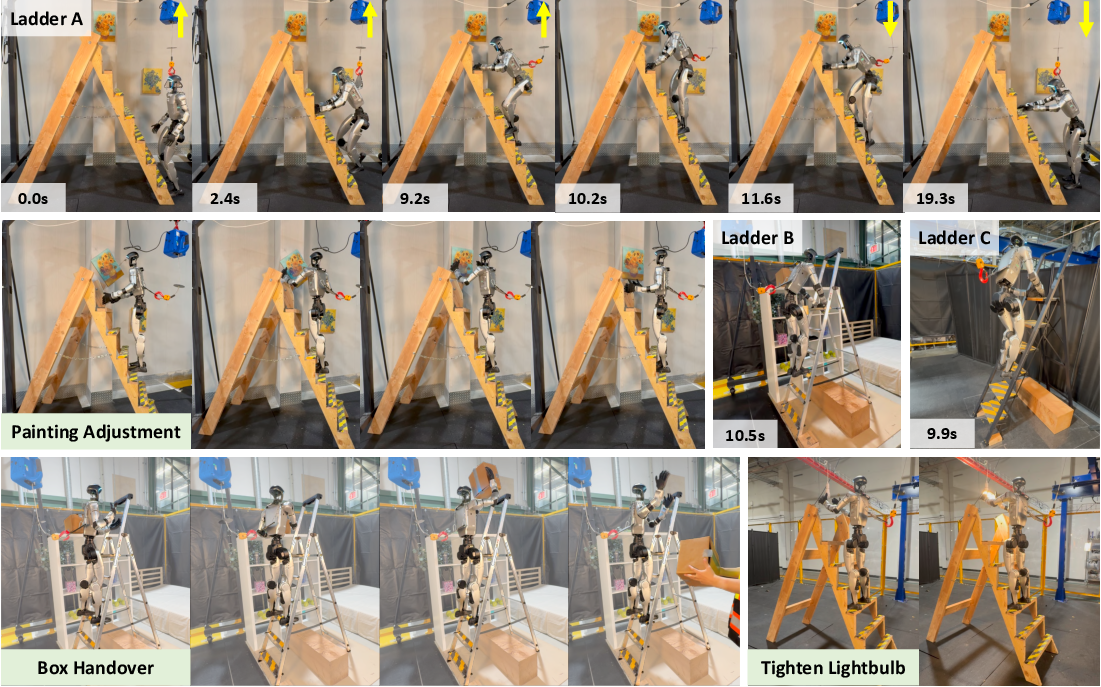
- Zero‑shot sim‑to‑real: Without extra fine‑tuning, the policy worked on a real Unitree G1 humanoid using only onboard sensors and computer. It climbed several different real ladders made from different materials.
- Real manipulation on a ladder: With the dual‑agent design and VR teleoperation, the robot could adjust a painting, replace a light bulb, and pass a box while staying steady.
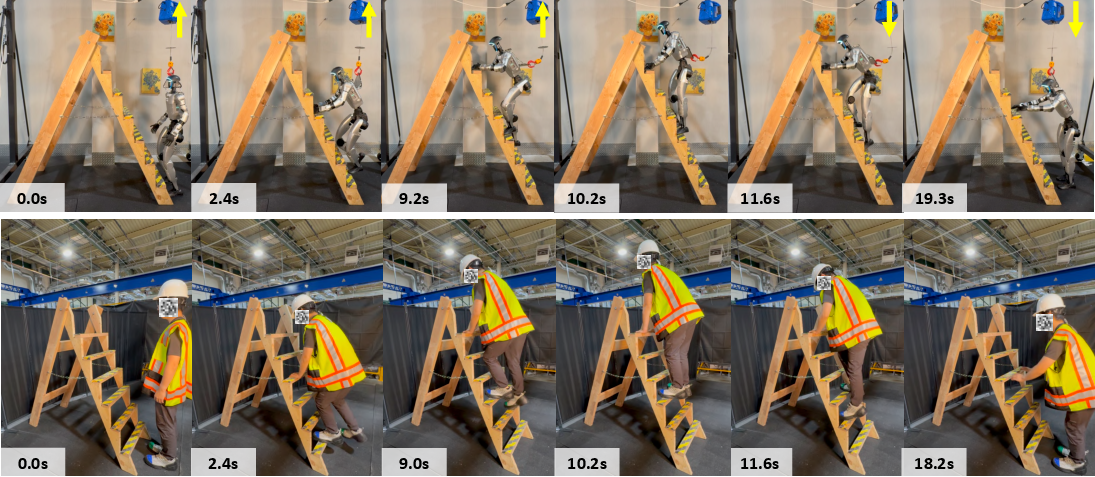
- Comparable speed to humans: On average, the robot climbed at about 3.4 seconds per rung; two human testers averaged about 3.2 seconds per rung—pretty close.
- Key ingredients that made it work:
- Mixing imitation with reinforcement learning for the student policy improved recovery and robustness.
- The vision foundation model for depth made real‑world perception reliable without lots of manual tuning.
- Rung‑focused masking in training helped the robot “pay attention” to the relevant parts of the scene.
- The hybrid motion tracking approach let them learn many ladder experts from just one recorded climb.
Why this research is important
- Practical usefulness: Many workplaces—construction sites, warehouses, maintenance—use ladders. A humanoid that can safely climb and work on a ladder could help with tasks that are repetitive, risky, or require reaching high places.
- Less hand‑crafting: Instead of carefully programming every motion, the robot learns good behavior from examples and experience, making it more adaptable to new ladder designs.
- Strong sim‑to‑real transfer: Showing that a robot can learn in simulation and work in reality, first try, is a big step toward faster and cheaper robot development.
- Foundation for safer teleoperation: The dual‑agent design separates balance from arm control, which could make future human‑controlled robots safer and easier to use.
Limitations and future steps
- Ladder types: The system currently focuses on inclined ladders (up to about 75°), not fully vertical ones, which are tougher and may require new strategies.
- Hands: The robot used simple grippers; adding more dexterous hands could enable finer, more practical tasks.
Overall, LadderMan shows that with the right training strategy and vision tools, a humanoid robot can learn to climb varied ladders and do useful work while up there—bringing real‑world deployment of humanoids a step closer.
Knowledge Gaps
Knowledge gaps, limitations, and open questions
Below is a consolidated list of what remains missing, uncertain, or unexplored in the paper, phrased as concrete, actionable items for future work.
- Vertical and near-vertical ladders: No evaluation on ladders ≥80–90°; methods for larger contact forces, smaller support polygons, and different climbing strategies remain unexplored.
- Broader ladder types: No tests on rope/flexible ladders, caged ladders, step ladders (A-frame treads), ladders with deforming/loose rungs, or ladders with highly rounded/very thin rungs beyond simulated primitives.
- Environmental robustness: Robustness under outdoor lighting, glare, low texture, dust, fog, water, or reflective metal surfaces (where stereo/VFM may fail) is unquantified.
- Dynamic ladders and disturbances: No experiments with ladder sway/flex, base motion, external pushes, vibration, or wind; recovery behaviors under such perturbations are not characterized.
- Slippery or contaminated contacts: Real-world performance under wet, oily, icy, or dusty rung/rail surfaces (low, variable, or spatially nonuniform friction) is not evaluated.
- Payloads and tool-carrying: Climbing while carrying tools/loads, or manipulating while bearing weight, is untested; effects on balance and contact forces are unknown.
- Transition behaviors: Mounting and dismounting the ladder, platform transitions at the top, lateral moves between adjacent ladders, and turning around on the ladder are not addressed.
- Missing/damaged rungs: The policy’s ability to detect and re-plan around missing, bent, or obstructed rungs is not studied.
- Wider geometry range: Generalization is not evaluated for more extreme rung spacings (<20 cm or >30 cm), atypical rung depths/widths, or very narrow ladder widths.
- Perception failure handling: No safety fallback or controller behavior is reported for camera dropouts, miscalibration, severe latency spikes, or VFM failure cases.
- Sensor and model dependence: Generalization to other sensors (e.g., different stereo baselines, monocular depth, LiDAR) or across camera placements is not analyzed.
- Dynamics sim-to-real gap: Beyond depth, actuator/rigid-body dynamics alignment (e.g., friction cones, joint backlash, compliance) is not explicitly addressed or measured.
- Single platform evaluation: Results are shown only on Unitree G1; portability to different humanoid morphologies, sizes, and hand/foot designs is untested.
- Contact sensing and force control: The system does not leverage tactile/force sensing or impedance control; benefits for slip detection, grip modulation, and precise force placement remain open.
- Contact schedule flexibility: Expert learning depends on a single annotated contact sequence; automatic discovery of alternative contact sequences or rung-skipping strategies is unexplored.
- Manual contact annotations: Even if minimal, annotation of contact indicators is manual; automatic extraction from motion or video and scalability across tasks are open problems.
- Reward dependence on known ladder geometry (training): Training rewards use ladder-centric targets; robustness when training on imperfect or partially known ladder models is not examined.
- Perception attention: Rung-focused masking (RFM) is a heuristic; learning data-driven attention/segmentation for task-relevant structures, and its effect on generalization, is not investigated.
- Autonomy in manipulation: On-ladder manipulation is teleoperated; learning vision- and force-aware autonomous manipulation (e.g., search, align, tighten) while maintaining balance remains open.
- Collision-aware manipulation: Upper-body ladder collisions are disabled during training; safe, contact-aware training and execution to leverage bracing without damaging hardware is not addressed.
- Coordination during manipulation: The dual-agent split may limit coordinated whole-body responses for tasks that require purposeful CoM shifts or stepping during manipulation; joint optimization strategies are untested.
- Performance metrics: Energy use, joint torques, contact force profiles, hardware wear, and repeatability over long runs are not measured or benchmarked.
- Failure analysis: Systematic categorization of real-world failure modes (perception, contact, control) and their frequencies is absent.
- Human-robot comparisons: Aside from speed, comparisons to human strategies (e.g., safety margins, hand/foot placement variability) and to prior robotic baselines are limited.
- Task-level planning: The policy accepts only a binary up/down command; integrating rung detection, step planning, rung indexing, and high-level goal sequencing is left open.
- Safety and compliance: Formal safety monitors, fall-arrest integration, constraint enforcement, and verification for industrial deployment are not considered.
- Long-term reliability: Robustness across many repeated climbs, battery/thermal limits, and degradation over time are not reported.
- Compute and latency budgets: End-to-end perception-control latencies, control frequencies, and their safety margins on embedded hardware are not quantified.
- Data and training scalability: The number of experts, training time, and sample efficiency for covering larger geometry spaces (or additional tasks) are not reported.
- Leveraging rails: RFM may de-emphasize side rails, yet hands often use rails; learning to intentionally utilize rails as additional supports is unexplored.
Practical Applications
Immediate Applications
Below are actionable, deployable-now use cases grounded in the paper’s demonstrated capabilities, with sector tags, prospective tools/workflows, and key assumptions or dependencies.
- Robust ladder climbing for light maintenance and inspection (construction, manufacturing, energy; industry)
- Tools/workflows: LadderMan climbing policy deployed on Unitree G1; on-board stereo depth via Fast-FoundationStereo; rung-focused masking preprocessor; remote VR teleoperation for upper-body actions.
- Example tasks: bulb replacement, signage/painting adjustment, visual inspection of overhead fixtures, pulling small tags/tapes.
- Assumptions/dependencies: inclined ladders (≤75°), rung spacing/geometry within trained range, non-dexterous grippers sufficient, safety supervisor on site, reliable VFM depth inference, Jetson Orin-class compute.
- Warehouse and facility operations for on-ladder assistance and ergonomics (logistics; industry)
- Tools/workflows: “On-ladder box handover” routine; dual-agent policy (lower-body stabilization + operator-driven upper body); human-robot handoff protocol.
- Assumptions/dependencies: compliant ladder types, human partner training, clear co-working zone, institutional buy-in to reduce human ladder exposure.
- Telepresence in hazardous ladder-access tasks (chemical plants, utilities; industry/policy)
- Tools/workflows: VR teleoperation via PICO 4 Ultra or similar; site network uplink; LadderMan failsafe behaviors (e.g., pause/descend commands).
- Assumptions/dependencies: connectivity with low latency, pre-task ladder parameterization, emergency stop procedures, insurance/safety approval.
- Rapid ladder configuration surveying and pre-deployment checks (software/robotics; industry/academia)
- Tools/workflows: ladder parameter extraction (inclination φ, rung spacing z, rung width w) via quick scan; deployment checklist: friction check, rung consistency, depth sanity via VFM; automated report.
- Assumptions/dependencies: reliable ladder pose estimation; minimal site calibration; adherence to training ranges.
- Benchmarking and reproducible research in multi-contact visuomotor control (robotics; academia)
- Tools/workflows: open-source LadderMan training/inference code; IsaacSim environments; NVIDIA Warp depth rendering; hybrid DAgger+RL training scripts; hybrid motion-tracking reward templates.
- Assumptions/dependencies: access to Unitree G1 or similar humanoid; compatible PD control stack; stereo camera and GPU.
- Perception robustness pipeline for thin/sparse structures (software/robotics; academia/industry)
- Tools/workflows: packaged VFM-based stereo depth node; minimalist depth augmentation; rung-focused masking (RFM) module; ROS 2 integration.
- Assumptions/dependencies: stereo camera baseline and calibration; acceptable compute footprint for real-time inference; mask heuristics configured to site ladders.
- Human-robot co-working protocols to reduce ladder injuries (policy/industry)
- Tools/workflows: pilot programs documenting incident reduction; SOPs for supervision, task handoff, and exclusion zones; training curricula for operators.
- Assumptions/dependencies: organizational readiness, legal/regulatory approval for robot ladder use, near-term insurance endorsement for pilots.
- Teaching labs and capstone projects on multi-contact control and sim-to-real transfer (education; academia)
- Tools/workflows: course modules derived from hybrid motion tracking, dual-agent control; assignments on sim depth vs VFM; reproducible ladder tasks.
- Assumptions/dependencies: lab access to humanoid hardware or high-fidelity simulation; institutional safety policies.
- Site-safe “climb–manipulate–descend” task templates (software/robotics; industry)
- Tools/workflows: parameterized routines (upward/downward command, dwell time at target rung, manipulation window with lower-body stabilization); deployment GUI.
- Assumptions/dependencies: operator oversight; task complexity limited to gross manipulation (tightening, repositioning, handovers).
- Incident documentation and ROI analysis for facilities (finance/policy)
- Tools/workflows: pre/post deployment risk logs; cost-of-injury baseline vs robot-assisted ladder use; maintenance scheduling incorporating robot availability.
- Assumptions/dependencies: access to incident records, willingness to track operational metrics, pilot-scale deployments.
Long-Term Applications
The following applications require further research, scaling, and/or development beyond the paper’s scope and current limitations (e.g., vertical ladders, dexterous manipulation).
- Fully autonomous ladder operations without teleoperation (software/robotics; industry)
- Tools/products: end-to-end visuomotor planner with contact reasoning; failure recovery policies; autonomy health monitor.
- Dependencies: broader coverage of ladder geometries including vertical ladders, robust multi-contact planning, formal safety verification.
- Vertical ladder climbing and tower ascent in harsh environments (energy, utilities, disaster response; industry/policy)
- Tools/products: high-force contact control, better stability margins, environmental robustness (wind, rain, dust).
- Dependencies: stronger actuation, refined perception of narrow structures, new climbing strategies and training data.
- Dexterous on-ladder maintenance (electrical, HVAC, instrumentation) (construction, facilities; industry)
- Tools/products: dexterous hands/end-effectors, tool use (drivers, cutters), force-sensing and compliance controllers.
- Dependencies: hardware upgrades, skill libraries for tool manipulation, safety certification for energized work.
- Standardization and certification for humanoid ladder work (OSHA-like frameworks) (policy/industry)
- Tools/workflows: safety standards for robot ladder interactions, acceptance tests, operator licensing, inspection protocols.
- Dependencies: multi-stakeholder process (regulators, unions, insurers), evidence base from pilots, liability models.
- Generalized multi-contact traversal (scaffolding, catwalks, handrail-assisted movement) (construction, manufacturing; industry)
- Tools/products: extended perception and control for diverse sparse footholds and handholds; environment-aware contact planners.
- Dependencies: broader datasets, new reward/shaping schemes for varied structures, sim-to-real for complex geometries.
- BIM/digital twin integration for preplanned robot ladder routes (software; industry)
- Tools/workflows: BIM-aware task planner; automatic extraction of ladder/structure metadata; route validation; scheduling integration.
- Dependencies: standardized facility models, robust localization, middleware between BIM and robot stack.
- Emergency response tasks requiring elevated access (disaster response; policy/industry)
- Tools/products: rapid deployment kits, smoke/low-visibility perception enhancements, autonomous “go to valve/switch” behaviors.
- Dependencies: ruggedization, comms resilience, training with first responders, incident command system integration.
- Cross-platform portability to diverse humanoids (robotics; industry/academia)
- Tools/products: LadderMan SDK with hardware abstraction; calibration tools; policy retargeting to different morphologies.
- Dependencies: standardized APIs, dataset/domain randomization for varied robots, validation across platforms.
- Consumer-grade home maintenance robots (daily life; consumer robotics)
- Tools/products: safe, compact humanoid or assistive device that can climb household ladders/step stools for light tasks.
- Dependencies: significant cost reduction, strong safety assurances, user-friendly teleop/autonomy interfaces.
- Comprehensive toolchain and productization (software/robotics; industry)
- Tools/products: packaged LadderMan stack (perception, control, safety); operator UI; deployment analytics; simulation asset packs.
- Dependencies: long-term support, vendor ecosystem, integration services, enterprise IT/security alignment.
- Research extensions to multi-agent control and sim-to-real (academia)
- Tools/workflows: applying dual-agent decoupling to other constrained loco-manipulation tasks; richer datasets on multi-contact dynamics; standardized evaluation.
- Dependencies: broader benchmarks, shared datasets, community adoption.
- Economic modeling and insurance products for robot-assisted ladder work (finance/policy)
- Tools/workflows: actuarial models quantifying injury reduction; new coverage terms for robotic operations; financing for deployments.
- Dependencies: multi-year operational data, regulatory clarity, vendor reliability metrics.
Glossary
- AMASS: A large dataset of human motion capture sequences used for learning or sampling realistic human poses. "upper-body target joint poses are randomly sampled from the AMASS~\citep{AMASS} dataset,"
- asymmetric tracking reward: A motion-tracking reward that weights different body parts unequally (e.g., stricter for legs, looser for arms) to encourage task-oriented adaptation. "we use the following asymmetric tracking reward:"
- contact termination condition: A termination rule that ends an episode when required contacts (e.g., hand/foot on rung) are missing for too long. "we further introduce a ladder-specific contact termination condition, where episodes terminate if required ladder contacts are lost for more than $30$ consecutive frames."
- DAgger: An imitation learning algorithm (Dataset Aggregation) that iteratively collects expert corrections to reduce covariate shift. "DAgger-style imitation learning~\citep{dagger}"
- domain randomization: Randomizing simulation parameters (e.g., physics, geometry, noise) during training to improve real-world transfer. "For domain randomization, in addition to physical parameter and initialization state randomization, we apply local perturbations to ladder configurations around each target configuration , together with rung geometry and friction properties, to improve robustness during expert policy learning."
- dual-agent formulation: A control design that decomposes a policy into two coordinated agents (e.g., lower-body stabilization and upper-body manipulation). "using a dual-agent formulation, allowing stable on-ladder manipulation via teleoperation."
- elevation maps: 2.5D grid maps encoding terrain height used for foothold planning and locomotion control. "converted into terrain representations such as elevation maps to guide foothold selection and control."
- end-effector: The robot’s terminal link that interacts with the environment (e.g., hand or foot centers). "the current end-effector position,"
- end-to-end policy: A model that maps raw sensory inputs directly to actions without explicit intermediate modeling or planning. "using an end-to-end policy,"
- exteroceptive sensing: Sensors that perceive the external environment (e.g., LiDAR, cameras), as opposed to internal state. "using exteroceptive sensing such as LiDAR and depth cameras."
- Fast-FoundationStereo: A real-time vision foundation model for stereo depth estimation that provides cleaner, consistent depth maps. "we use Fast-FoundationStereo~\citep{wen2026fastfoundationstereo}, a pretrained vision foundation model (VFM) for stereo depth estimation,"
- goal-conditioned reinforcement learning: RL where the policy is conditioned on a goal specification, enabling multiple tasks/targets within one framework. "We formulate the problem as a goal-conditioned reinforcement learning problem within a Markov Decision Process (MDP)"
- IsaacSim: NVIDIA’s robotics simulator used for high-fidelity training and evaluation of policies. "We use IsaacSim~\citep{NVIDIA_Isaac_Sim} for policy training and evaluation."
- Kullback–Leibler (KL) divergence: A measure of dissimilarity between probability distributions often used as a regularizer for policy imitation. "and the KL term encourages imitation of expert behaviors."
- ladder-centric contact tracking: Tracking and rewarding contacts relative to ladder geometry to guide precise hand/foot placements. "incorporate ladder-centric contact tracking and climbing rewards."
- LiDAR: A range sensing technology that measures distances using laser light to reconstruct 3D structure. "such as LiDAR and depth cameras."
- Markov Decision Process (MDP): A formalism for sequential decision making defined by states, actions, transitions, and rewards. "within a Markov Decision Process (MDP)"
- NVIDIA Warp: A GPU-accelerated framework used here to render depth images efficiently in simulation. "depth images are rendered using NVIDIA Warp~\citep{macklin2022warp} for high-throughput simulation."
- PD controller: A proportional-derivative controller that tracks target joint positions/velocities for low-level actuation. "executed through a PD controller."
- perceptive locomotion: Locomotion policies that leverage perception to navigate and place contacts on complex terrain. "Perceptive locomotion enables legged robots to traverse complex terrains using exteroceptive sensing"
- policy distillation: Combining multiple expert policies into a single policy that generalizes across scenarios. "distill these experts into a unified visuomotor policy"
- Proximal Policy Optimization (PPO): A popular on-policy RL algorithm that stabilizes policy updates via clipped objectives. "the PPO~\citep{schulman2017proximalpolicyoptimizationalgorithms} objective"
- proprioception: Internal sensing of the robot’s body state (e.g., joint angles, velocities) used as policy input. "takes proprioception, depth observations, and a binary climbing direction command as input"
- privileged inputs: Information available during training (e.g., motion capture, exact geometry) but not at test time. "their method relies on privileged inputs such as motion capture and known ladder geometry,"
- rung-focused masking (RFM): Masking non-rung regions in depth images during training to focus learning on task-relevant structures. "we introduce rung-focused masking (RFM), which masks non-rung regions during training with probability ."
- sim-to-real gap: The mismatch between simulated and real-world observations or dynamics that hinders transfer. "sim-to-real gap in depth observations"
- stereo depth estimation: Inferring scene depth from a pair of images taken from two horizontally offset cameras. "a pretrained vision foundation model (VFM) for stereo depth estimation,"
- support polygon: The convex hull of contact points (e.g., hands/feet) used for assessing static stability. "unstable support polygons,"
- teleoperation: Human-in-the-loop remote control of a robot, often via VR or motion capture interfaces. "via teleoperation"
- Vision Foundation Model (VFM): A large, pre-trained vision model adapted to downstream tasks (here, stereo depth). "a pretrained vision foundation model (VFM) for stereo depth estimation,"
- visuomotor policy: A control policy that maps visual inputs to motor commands for action. "a unified depth-based visuomotor climbing policy"
- zero-shot sim-to-real transfer: Deploying a policy on real hardware without any additional real-world fine-tuning. "zero-shot sim-to-real transfer."

