The Gold Rush in AI4Math: Where Are We Now?
Abstract: Recent advances in AI have sparked growing interest in its use for mathematical research. While some view this as a major opportunity for discovery, others have raised concerns about its impact on traditional research practices. Despite extensive debate, empirical evidence on how AI is actually being used in mathematics remains limited. To address this gap, we collected all 32,944 arXiv submissions posted between March 1 and August 20, 2026, whose primary or secondary categories included Mathematics. We identified 3,575 submissions that explicitly disclosed author use of AI, of which 1,712 involved at least one substantive mathematical contribution. Our analysis reveals several broad patterns. First, disclosed AI use increased sharply over the study period, with substantive use growing from 1.39% of Mathematics submissions in March to 14.09% through August 20. Second, substantive AI use is highly uneven across fields: Combinatorics has the largest number of such papers, while Metric Geometry has the highest substantive-use rate. Third, substantive AI use is geographically concentrated: under weighted author counts, the United States and China together account for about two-thirds of the recognized country weight. Fourth, AI is already being applied to open research problems: among 717 named open-problem records associated with substantive use, 71% are labeled as fully resolved based on the authors' descriptions, with proofs of the conjectured statement more common than counterexamples or disproofs. Finally, AI-system use is also highly concentrated, with OpenAI systems appearing most frequently, followed by Anthropic. Together, these findings suggest that AI-assisted mathematics is expanding rapidly but remains at an early and uneven stage of adoption.
Paper Prompts
Sign up for free to create and run prompts on this paper.
Top Community Prompts
Explain it Like I'm 14
1. What is this paper about?
This paper studies how mathematicians are actually using AI in their research.
Many earlier studies asked whether AI can solve difficult mathematics problems. This paper asks a different question:
How often are mathematicians using AI, what are they using it for, and where is this happening?
The authors call this rapid growth a “gold rush” in AI4Math, meaning a sudden rush of interest and activity in using AI for mathematics.
2. What questions did the researchers ask?
The researchers wanted to find out:
- Is the use of AI in mathematical research increasing?
- How many papers report using AI for real mathematical work, rather than only for writing or editing?
- Which areas of mathematics use AI the most?
- Is AI being used to work on difficult, unsolved problems?
- Which countries, universities, authors, and AI companies are most involved?
- What kinds of tasks do AI systems help with?
They separated AI use into two broad groups:
| Type of AI use | Meaning |
|---|---|
| Substantive use | AI helps with actual mathematical research, such as creating proofs or checking them |
| Non-substantive use | AI helps with writing, formatting, references, computer code, or other supporting tasks |
For example, asking AI to improve the grammar of a paper would be non-substantive use. Asking AI to suggest a new proof would be substantive use.
3. How did they do the research?
The researchers examined 32,944 mathematics papers posted on arXiv between March 1 and August 20, 2026. arXiv is an online website where scientists and mathematicians share research papers.
They searched these papers for statements in which the authors disclosed using AI. A disclosure is a sentence such as, “We used ChatGPT to help construct the proof.”
They found:
- 3,575 papers that openly mentioned using AI.
- 1,712 papers in which AI was reported to make a meaningful contribution to the mathematics.
To study the papers, the researchers used another AI system to read the text and complete a questionnaire. The questionnaire asked questions such as:
- Did AI help create a proof?
- Did AI help check or formalize a proof?
- Did AI help suggest a research problem?
- Did the paper discuss an unsolved mathematical question?
- Which AI system was used?
- Where were the authors based?
The AI reviewer was required to provide direct quotations from the papers as evidence. The researchers also manually checked some papers. However, the manual checking was still in progress, so not every classification had been examined by a human.
An important idea here is classification. This means putting papers into groups based on what the authors said about their AI use. The researchers did not independently check every proof to see whether it was correct.
4. What did they find?
AI use grew very quickly
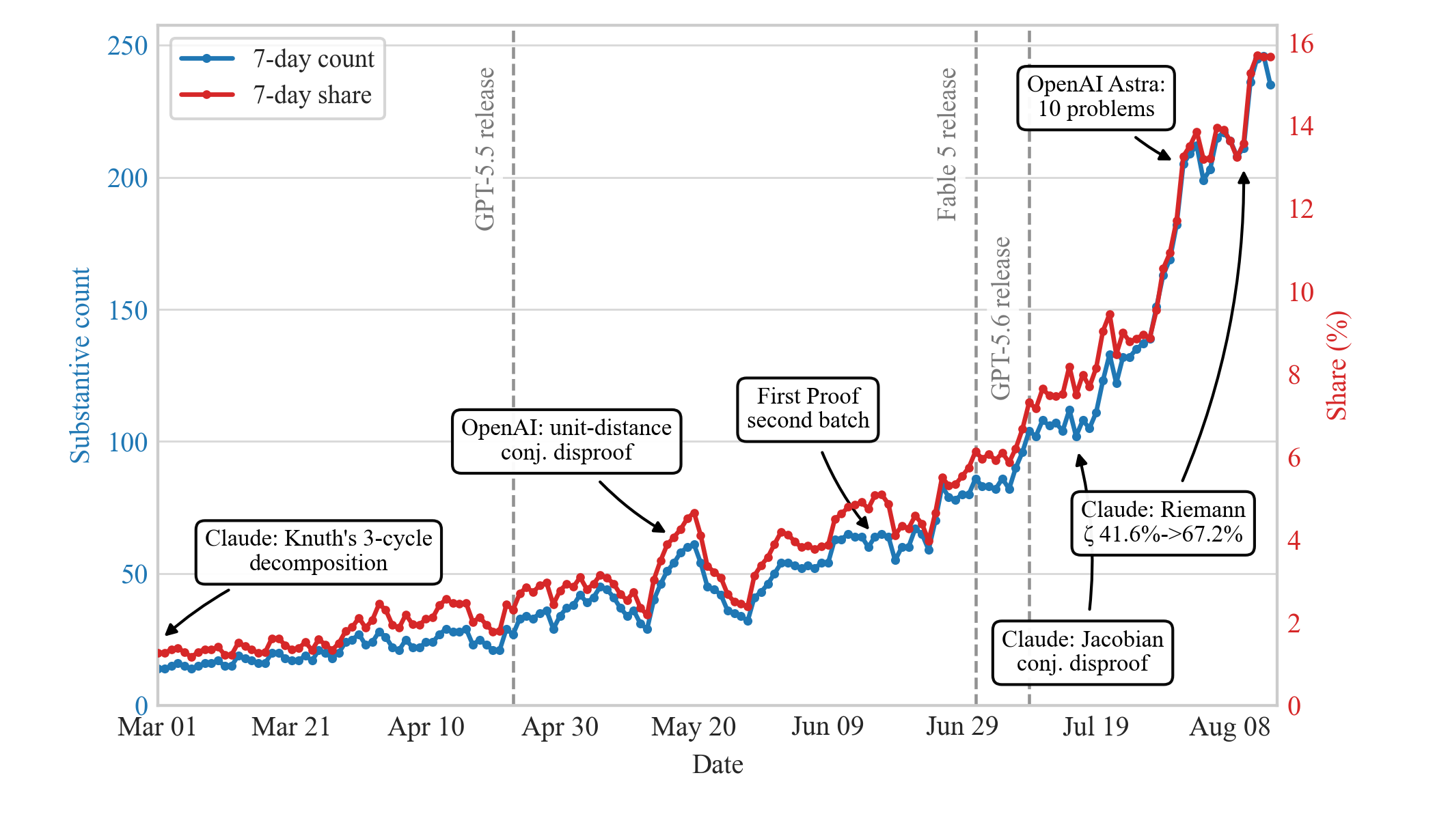
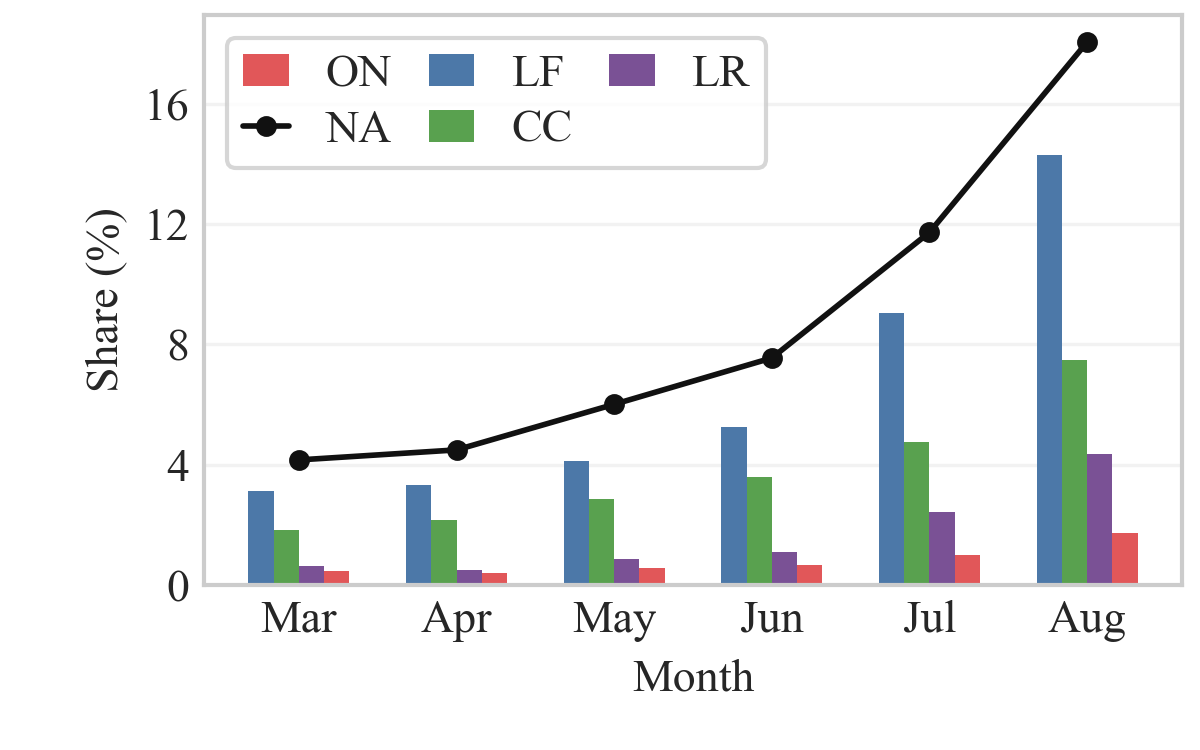
The percentage of mathematics papers reporting any AI use rose from 4.75% in March to 24.14% by August 20.
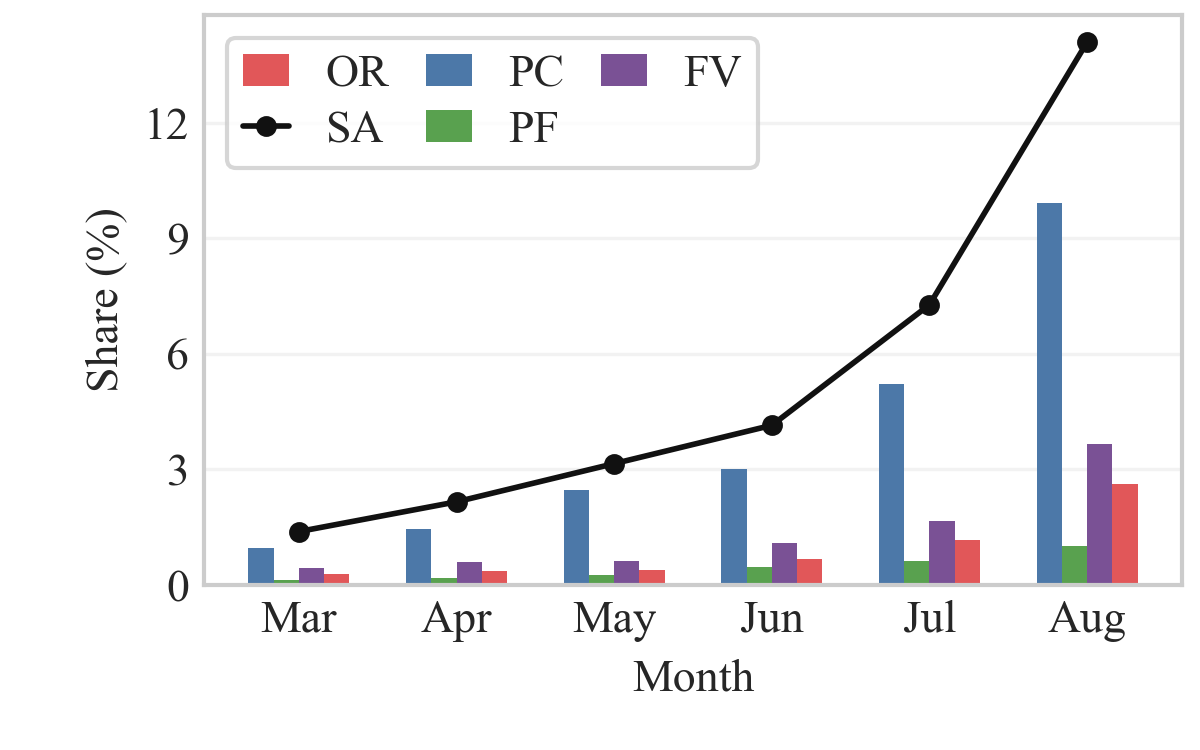
The percentage reporting substantive mathematical AI use rose from 1.39% to 14.09%.
This suggests that AI use was spreading rapidly during the six-month study period.
However, the most common individual use was still language and formatting help. AI was often used like an editor to improve writing.
Among the more serious mathematical uses:
- 1,225 papers reported help with constructing proofs.
- 427 papers reported help with formalizing or checking mathematics.
- 289 papers reported other kinds of research assistance.
- 146 papers reported help with forming mathematical problems or questions.
A paper could belong to more than one group.
Some mathematical fields used AI more than others
AI use was not spread evenly across mathematics.
Combinatorics, the study of arrangements and counting, had the largest number of papers involving substantive AI use, with 397 papers.
Other fields with many such papers included:
- Number theory
- Probability
- Algebraic geometry
When the researchers considered the size of each field, Metric Geometry had the highest rate: about 13.11% of its papers involved substantive AI use. Combinatorics followed at 11.74%.
This may be because some areas, such as combinatorics and number theory, are especially suitable for computer-assisted searches, pattern finding, and proof construction. But the study cannot prove exactly why some fields use AI more than others.
AI was being used on unsolved problems
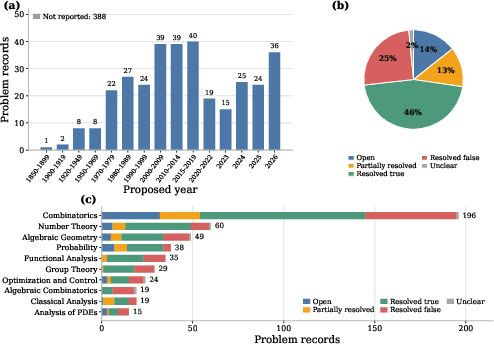
The researchers found 717 records of named open problems or conjectures in papers involving substantive AI use.
A conjecture is a mathematical idea that someone believes is true but has not yet proved. An open problem is a question that mathematicians have not fully solved.
According to the descriptions in the papers:
- 103 problems were still open.
- 93 problems were partly solved.
- 510 problems were described as fully resolved.
- 329 were reported as proved true.
- 181 were reported as disproved using counterexamples.
- 11 had an unclear status.
This is an exciting result because it suggests that AI is being used not only for ordinary exercises, but also for serious research questions.
However, there is a major warning: these results were based on the authors’ descriptions and the reviewing AI’s interpretation. The researchers did not independently verify all the claimed solutions. Some proofs could contain mistakes, repeat an earlier result, or need further checking by experts.
AI research was concentrated in certain countries and institutions
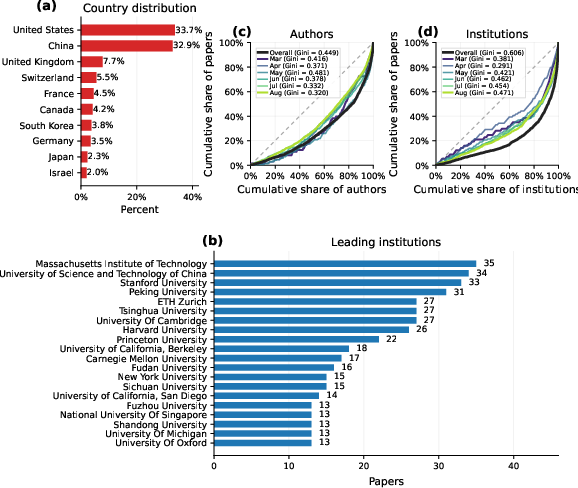
The United States and China together accounted for about two-thirds of the recognized country share of substantive AI use.
The universities appearing most often included:
- Massachusetts Institute of Technology
- University of Science and Technology of China
- Stanford University
- Peking University
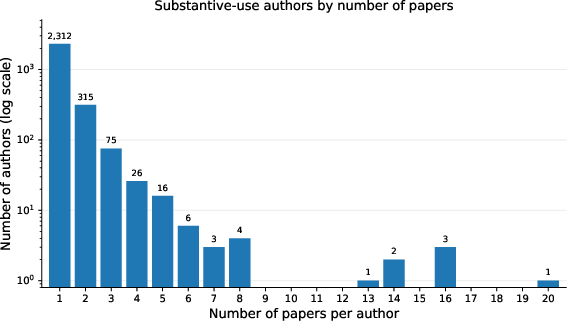
AI use was also concentrated among a relatively small group of authors. Most authors appeared on only one or two papers, while a few authors appeared on many papers.
This may mean that early AI-assisted mathematics was being led by specialized research groups and institutions with access to powerful AI systems.
A few AI companies were used most often
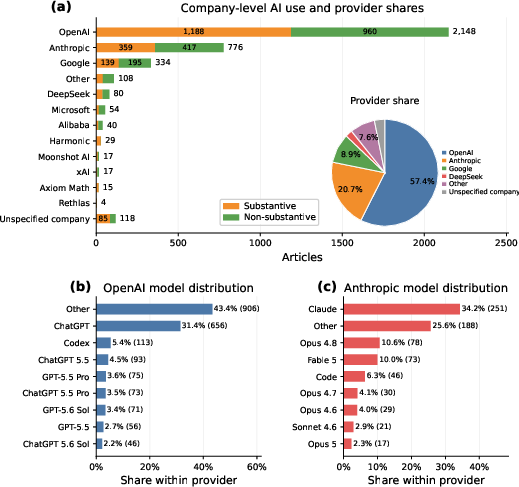
The most frequently reported provider was OpenAI, appearing in about 60% of the papers that disclosed AI use.
Anthropic was second, appearing in about 22%, followed by Google and DeepSeek.
These percentages can overlap because one paper might mention more than one AI provider.
5. Why are these findings important?
The paper gives one of the first large-scale pictures of AI adoption in real mathematical research.
It shows that:
- AI is becoming common very quickly.
- Much AI use still involves writing and other support tasks.
- AI is also beginning to help with proofs and research ideas.
- Some mathematicians are using AI to investigate long-standing open problems.
- Adoption is uneven across fields, countries, universities, and research groups.
This matters because AI could change what mathematical research looks like. In the future, mathematicians might use AI as a partner that helps them:
- Search through many possible ideas
- Find examples or counterexamples
- Suggest proof strategies
- Translate ideas into computer-checkable proofs
- Explore difficult problems more quickly
But mathematicians will still need to check the results carefully. AI can produce convincing-looking arguments that are actually wrong. Human experts are also needed to decide whether an idea is genuinely new and whether it is understandable and useful.
Conclusion
The paper argues that AI-assisted mathematics is growing rapidly, but it is still in an early stage. AI is not yet replacing mathematicians. Instead, it is becoming a powerful tool used by some researchers, especially in areas where computers can search for patterns or help build proofs.
The study also shows why transparency is important. Researchers should clearly explain when and how they used AI, while human mathematicians should remain responsible for checking the final work.
The authors recommend repeating this type of study in the future. That would help reveal whether the current growth is only a short period of excitement or the beginning of a lasting change in how mathematics is discovered and proved.
Knowledge Gaps
Knowledge gaps, limitations, and open questions
The paper leaves the following issues unresolved:
- Undisclosed AI use is not measured. The reported prevalence may substantially underestimate actual adoption because researchers may omit AI-use disclosures or follow inconsistent disclosure practices.
- Disclosure behavior may vary across fields, countries, institutions, and author groups. The study does not determine whether observed differences in adoption reflect genuine differences in AI use or differences in willingness and norms of disclosure.
- The reliability of the LLM-based classification is not yet quantified. Manual validation is described as ongoing, but the paper does not report sensitivity, specificity, inter-rater agreement, confidence calibration, or error rates for the AI-use labels.
- The use of a single proprietary LLM for data extraction limits reproducibility. Results may depend on GPT-5.6 Terra, its prompt, model updates, undocumented behavior, and the use of low reasoning effort; robustness to alternative models and prompting strategies is unknown.
- The keyword-based screening procedure may miss AI disclosures. Papers that mention AI systems indirectly, use unfamiliar tools, or describe AI assistance without model names may be underrepresented in the manually validated candidate set.
- The study does not establish how often the extracted evidence actually supports the assigned labels. Although quotations were required, the paper does not provide a systematic audit of whether cited passages accurately justify substantive-use or non-substantive-use classifications.
- The boundary between substantive and non-substantive AI use remains subjective. Categories such as “other research assistance,” proof construction, coding, and formalization may be interpreted inconsistently across papers and mathematical fields.
- The analysis does not distinguish the extent or importance of AI contribution. A binary label treats brief assistance and central dependence on an AI-generated idea or proof as equivalent, leaving the distribution of contribution intensity unresolved.
- Human involvement is not characterized. The paper does not measure how much researchers directed, corrected, independently reconstructed, or verified AI-generated arguments.
- The observed time trend may reflect changing disclosure norms, model releases, arXiv policy effects, or seasonal submission patterns rather than increased underlying adoption. No design separates these explanations.
- The six-month observation window is too short to establish durable adoption trends. It is unknown whether the sharp increase continued, plateaued, or reversed after August 20, 2026.
- The study does not compare mathematics with appropriate scientific or computer-science control groups. Consequently, the distinctiveness of AI adoption in mathematics cannot be determined.
- Field comparisons are potentially confounded by differences in disclosure norms, paper types, team size, model accessibility, and the suitability of mathematical tasks for current AI systems. The paper does not model or disentangle these factors.
- Small subfields have unstable rate estimates. Percentages based on very few submissions may be highly sensitive to individual papers, but uncertainty intervals or statistical comparisons across fields are not reported.
- The analysis does not examine topic-level or problem-level heterogeneity within arXiv subfields. It remains unclear which specific mathematical tasks, techniques, or research areas attract substantive AI use.
- Country and institution estimates may be biased by missing, ambiguous, or inferred affiliations. The extent and distribution of unmatched records and affiliation errors are not fully reported, and the impact of alternative affiliation-matching rules is unknown.
- The geographic analysis does not account for researcher mobility, multiple affiliations, or the location of computational resources. Country shares therefore may not represent where AI-assisted research was actually conducted.
- Author and institution concentration measures may be affected by name disambiguation errors. The paper does not report validation of canonical author identities or the sensitivity of Gini coefficients to ambiguous names and name collisions.
- The concentration analysis is descriptive and does not explain why adoption is concentrated. Possible mechanisms—including funding, institutional access to proprietary models, collaboration networks, technical expertise, and disciplinary culture—remain untested.
- Model-use frequencies do not measure actual usage intensity or model capability. Product names are inconsistently specific, may refer to multiple versions, and are non-exclusive; the number of interactions, tokens, costs, or task-specific performance is unknown.
- The study cannot determine whether provider concentration reflects researcher preference, institutional licensing, model availability, or disclosure differences.
- Open-problem records may not represent distinct problems. The paper does not fully resolve duplicate records, variant names, repeated appearances of the same conjecture, or cases in which one paper addresses multiple formulations of a problem.
- The historical open status of the listed problems is not independently established. Some problems may have been previously solved, weakened, reformulated, or incorrectly described as open in the source manuscripts.
- The claimed resolution of open problems is not independently verified. The reported 71% full-resolution rate is based on authors’ descriptions and LLM interpretation, without systematic expert checking, formal verification, replication, or post-publication correction tracking.
- The role of AI in each claimed resolution is not established. The analysis records whether authors describe AI as critical but does not independently determine whether AI generated the key idea, supplied an existing argument, assisted exposition, or merely helped with routine steps.
- The study does not measure the validity, novelty, or significance of purported AI-assisted results. A claimed proof or counterexample may be correct but non-novel, technically minor, or dependent on unacknowledged prior work.
- The outcome categories may oversimplify partial or conditional results. “Resolved true” and “resolved false” do not capture proofs under additional assumptions, restricted cases, computational evidence, conditional disproofs, or unresolved technical gaps.
- No follow-up tracks whether reported resolutions survive peer review and subsequent mathematical scrutiny. The long-term reliability of AI-assisted claims remains unknown.
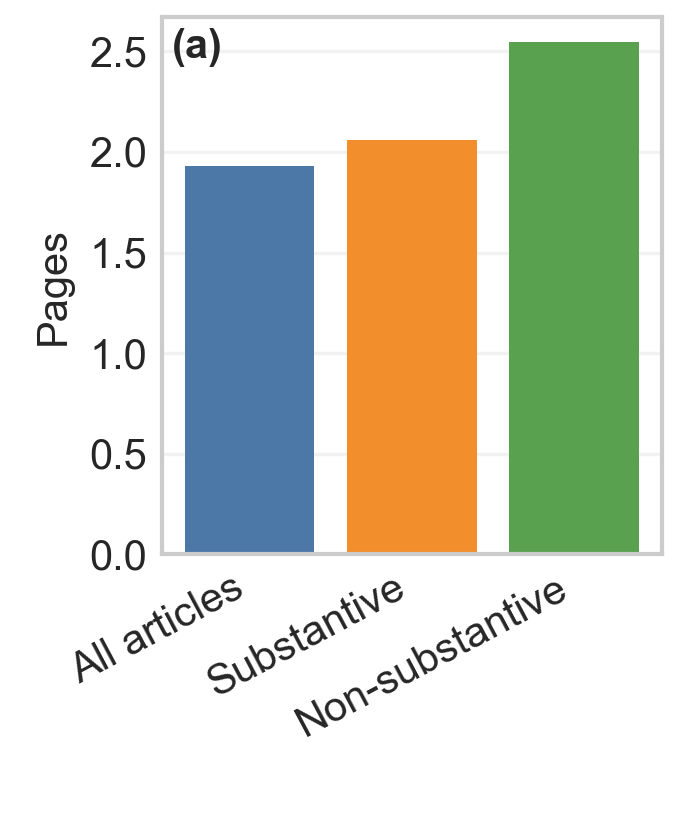
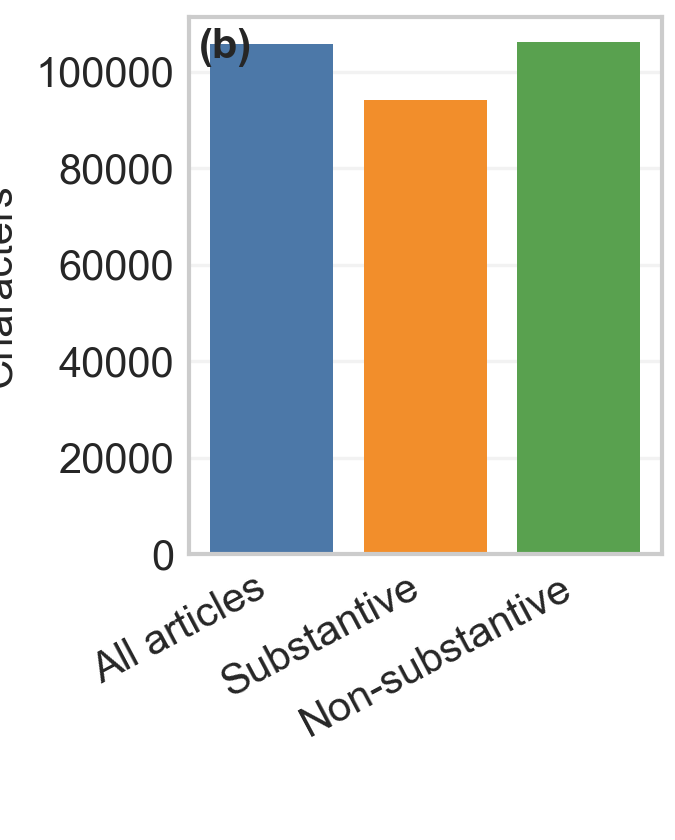
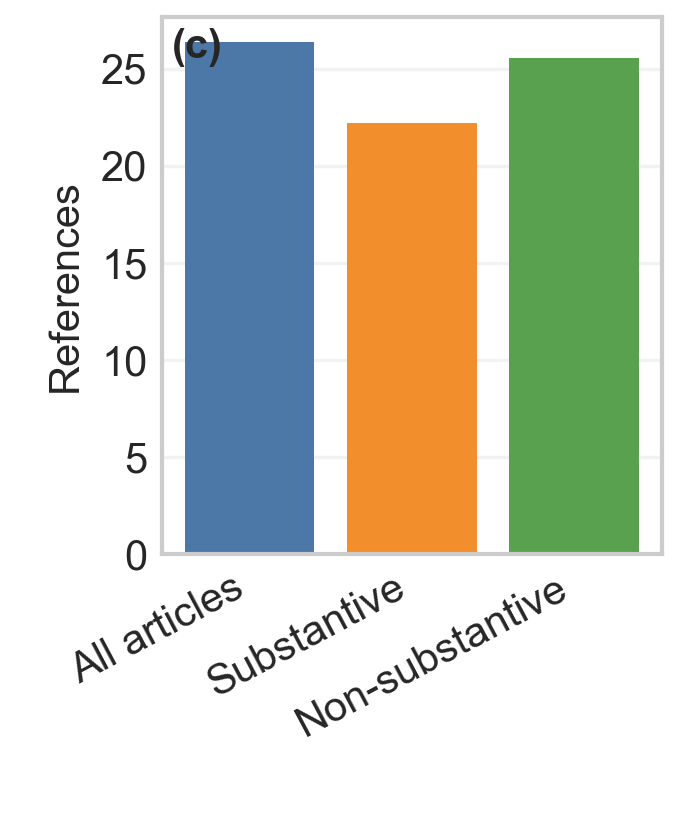
- The manuscript-length comparison is not adequately adjusted for confounding. Differences between substantive and non-substantive papers may be explained by field, authorship, paper genre, journal or arXiv norms, topic, or submission timing rather than AI use.
- The paper does not investigate research outcomes associated with AI use. Effects on acceptance, citation, replication, proof correctness, research speed, collaboration, or career outcomes remain unexplored.
- No causal evidence is provided that AI improves mathematical productivity or discovery. The data show reported use, not whether AI assistance generated more, better, faster, or more original mathematics.
- The dataset and coding materials are not described sufficiently for complete replication. The full prompts, extracted texts, model outputs, validation sample, affiliation-resolution procedures, deduplication rules, and analysis code are not clearly made available.
- The analysis does not address privacy, consent, or ethical concerns arising from automated extraction of author affiliations and inferred institutional information.
- Potential data-quality problems in PDF extraction are insufficiently assessed. Although 1,007 papers were truncated, the paper does not test whether truncation, parsing errors, tables, equations, or corrupted text alter AI-use and open-problem classifications.
- The study does not establish whether arXiv submissions are representative of mathematical research more broadly. Private manuscripts, journal-only publications, conference papers, books, technical reports, and research conducted outside arXiv are omitted.
- The paper does not examine how disclosure policies themselves shape future adoption and reporting. It remains open whether stronger disclosure requirements would improve measurement, suppress reporting, or change researchers’ AI-use practices.
Practical Applications
Immediate Applications
The paper primarily provides an empirical monitoring framework and evidence of current AI adoption; it does not itself introduce a deployable mathematical AI system. The following applications can nevertheless be implemented using existing tools and workflows.
- AI-use monitoring for scholarly publishers and repositories — Academia / scholarly communication
- Apply the paper’s pipeline—PDF retrieval, text extraction, disclosure detection, structured questionnaire, evidence quotation, and manual validation—to arXiv, institutional repositories, conference submissions, or journal manuscripts.
- A practical product could be an AI-disclosure audit dashboard reporting adoption rates by field, institution, country, model provider, and type of use.
- Dependencies: Reliable PDF parsing, standardized disclosure terminology, privacy-compliant author and affiliation processing, and calibration against manually reviewed samples. Because undisclosed use is invisible, results must be presented as lower-bound estimates.
- Automated compliance screening for AI-disclosure policies — Publishing / research administration
- Publishers and universities can use disclosure classifiers to flag manuscripts that mention AI-assisted proof construction, coding, writing, literature search, or formalization but lack an appropriate disclosure statement.
- The system could generate an audit trail containing the relevant sentence from the manuscript, the inferred category, and a confidence score.
- Dependencies: Human review remains necessary because the paper’s classifications are LLM-generated and may confuse incidental model mentions with substantive use.
- Researcher-facing AI-use disclosure assistants — Academia
- Integrate a questionnaire into manuscript-submission systems to help authors record which tools were used, for what purpose, and whether AI contributed to mathematical reasoning, code, proof formalization, or exposition.
- The tool could produce a standardized disclosure paragraph and preserve model/version and date information for reproducibility.
- Dependencies: Researchers must accurately report use; institutions and publishers must agree on a common taxonomy. The paper shows that broad labels such as “ChatGPT” and “Claude” are insufficient for precise model attribution.
- Literature discovery and trend analysis in mathematics — Academic research / information services
- Use the paper’s field-level and temporal coding approach to identify areas where AI-assisted work is emerging, such as combinatorics, number theory, probability, algebraic geometry, and metric geometry.
- Libraries or research groups could build searchable collections of AI-assisted papers organized by task: proof construction, problem formulation, verification, computation, or editing.
- Dependencies: Field comparisons should account for field size, differences in disclosure norms, and incomplete or ambiguous arXiv metadata.
- Human-in-the-loop review of AI-assisted mathematical claims — Mathematics / peer review
- Create a workflow in which AI systems identify claimed resolutions of open problems, extract the claimed result and supporting passages, and route them to expert referees for verification.
- The paper’s distinction between “resolved true,” “resolved false,” “partially resolved,” “open,” and “unclear” provides a useful triage structure.
- Dependencies: LLM classifications cannot replace proof checking, historical-priority searches, or peer review. The paper explicitly warns that its 510 apparently fully resolved records are not independently verified.
- Open-problem repository enrichment — Academia / knowledge management
- Link AI-assisted papers to existing databases of conjectures, including information about the problem’s proposed date, field, reported outcome, AI model, and verification status.
- This could improve navigation of long-standing problems and identify claims requiring replication or formalization.
- Dependencies: Entity resolution is difficult because problem names are inconsistent, records may be duplicated, and many proposed years are missing. All “resolved” labels should initially be treated as author-reported claims.
- Training and professional-development programs for mathematicians — Education / academia
- Universities and mathematical societies can use the observed distribution of AI tasks to teach practical skills: prompting for proof exploration, counterexample search, code generation, literature assistance, and formal proof translation.
- Training should emphasize verification, attribution, disclosure, and preservation of human mathematical understanding.
- Dependencies: Current adoption is concentrated geographically and institutionally, so training programs should address unequal access to proprietary models and computational resources.
- Institutional benchmarking of responsible AI adoption — University administration / policy
- Research offices can reproduce the paper’s author-, institution-, and country-level analyses to evaluate whether AI access is concentrated among a small number of groups.
- Results could inform shared model access, compute grants, formal-verification support, and workshops for less represented departments.
- Dependencies: Rankings are sensitive to affiliation inference, team size, missing affiliations, and the paper’s weighted-counting choices; they should not be interpreted as measures of research quality.
- Practical assistance for individual mathematical work — Daily academic life
- Researchers can use current AI tools for literature organization, language editing, exploratory computations, candidate-example generation, proof-idea brainstorming, and conversion of informal arguments into formal-assistant syntax.
- A safe workflow is: generate hypotheses or proof sketches, test them computationally, formalize them in Lean or a similar system where possible, and obtain independent human review.
- Dependencies: AI-generated arguments may contain subtle logical errors, hallucinated references, invalid generalizations, or incorrect claims of novelty. Human authors remain responsible for the final result.
Long-Term Applications
These applications require stronger validation, larger datasets, formal tooling, institutional coordination, or evidence beyond the paper’s observational results.
- A global longitudinal observatory for AI-assisted mathematics — Policy / academia
- Extend the six-month arXiv audit into a continuously updated observatory covering journals, preprints, conferences, code repositories, and formal-library contributions.
- The observatory could track adoption by field, task, model, geography, institution, and disclosure practice, while measuring whether claimed AI-assisted results survive peer review.
- Dependencies: Longitudinal comparability requires stable definitions, changing model taxonomies, repeated manual audits, and methods for estimating undisclosed use. Disclosure rates may change because of policy rather than actual adoption.
- Benchmark suites based on real mathematical research tasks — AI research / software
- Construct benchmarks from the paper’s categories: proof construction, problem formulation, formalization, counterexample discovery, literature synthesis, and verification of open-problem claims.
- Unlike standard competition datasets, these benchmarks would evaluate whether systems produce novel, correct, reproducible, and independently checkable mathematics.
- Dependencies: Problems must be held out from training data, solutions must be assessed by experts, and evaluation must distinguish genuine discovery from retrieval or contamination.
- Integrated AI research agents with formal verification — Software / mathematical research
- Develop systems that search for conjectures, generate candidate proofs or counterexamples, run symbolic and numerical experiments, translate arguments into Lean, and submit machine-checkable certificates for human review.
- The paper’s evidence that proof construction and formalization are already prominent uses suggests a natural demand for such integrated workflows.
- Dependencies: Current models are not reliably self-verifying. Formalization is labor-intensive, many areas lack mature formal libraries, and successful deployment requires domain-specific theorem provers, compute, provenance tracking, and expert oversight.
- AI-assisted discovery in applied sectors — Healthcare, energy, finance, engineering, and robotics
- Once mathematical claims can be reliably verified, research agents could help derive optimization methods, stability guarantees, uncertainty bounds, control policies, coding schemes, and mathematical models for applied systems.
- Examples include improved treatment scheduling, energy-grid optimization, portfolio constraints, robotic motion planning, and engineering design.
- Dependencies: The paper studies mathematical research rather than downstream performance. Applications would require domain validation, safety analysis, calibrated uncertainty, regulatory approval where relevant, and proof that abstract results transfer to noisy real-world data.
- Machine-readable mathematical knowledge graphs — Education / research infrastructure
- Combine papers, conjectures, proofs, counterexamples, formal statements, authors, institutions, and AI-use metadata into a searchable graph.
- Such a system could reveal relationships among open problems, detect duplicated claims, identify missing citations, and recommend relevant techniques or collaborators.
- Dependencies: Natural-language mathematics is difficult to normalize; names and affiliations are ambiguous; and automated links require expert validation to avoid propagating incorrect or duplicated claims.
- Reproducibility standards for AI-assisted proofs — Policy / scholarly publishing
- Establish requirements to archive prompts, model versions, sampling settings, generated code, intermediate outputs, formal proof files, and human edits for substantive AI-assisted work.
- Journals could introduce an “AI-assisted mathematics reproducibility package” analogous to data and code availability statements.
- Dependencies: Proprietary models may be inaccessible or change behavior over time; prompts may contain confidential ideas; and archival standards must balance reproducibility with intellectual-property and privacy concerns.
- Causal studies of AI’s effect on mathematical productivity and quality — Academia / labor policy
- Build on the paper’s descriptive findings with controlled or longitudinal studies measuring proof-correction rates, time to discovery, citation quality, originality, researcher training, and career outcomes.
- This would test whether AI improves mathematics or merely increases the volume of manuscripts and reported claims.
- Dependencies: The current study cannot establish causality, and substantive-use papers differ across fields, authors, institutions, and topics. Studies must address selection effects, undisclosed use, model access, and changing research norms.
- Equity and access policies for mathematical AI — Public policy / education
- The strong concentration of substantive use in the United States, China, and a limited set of institutions could motivate public funding for open models, shared compute, formalization infrastructure, and multilingual mathematical tools.
- National laboratories, universities, and learned societies could provide secure access to capable systems without requiring researchers to rely exclusively on commercial providers.
- Dependencies: Open systems may lag behind proprietary models in capability; compute and maintenance costs are substantial; and access alone will not eliminate differences in expertise, training, or research networks.
- AI-mediated mathematics education and tutoring — Education / daily life
- Mature systems could guide students from conjecture formation to proof, generate counterexamples, explain formal proofs, and distinguish valid from invalid reasoning.
- The paper’s taxonomy could support educational tools that separate acceptable editorial assistance from substantive solution generation.
- Dependencies: Educational deployment requires reliable correctness, age-appropriate explanations, protection against answer laundering, and policies defining authorship and acceptable assistance. Current evidence does not establish that AI-generated mathematical explanations are pedagogically effective.
- Automated historical verification and priority checking — Academia / scholarly communication
- Systems could compare newly reported AI-assisted resolutions with historical literature and open-problem databases to identify prior solutions, independent rediscoveries, or conflicts with established results.
- This is especially relevant given the paper’s warning that author-reported resolutions may overlap with prior work or later prove erroneous.
- Dependencies: Historical mathematical literature is incomplete, paywalled, inconsistently digitized, and terminology-rich. Automated priority claims must remain provisional until checked by domain experts.
Glossary
- Affiliation normalization: The process of standardizing institution names so equivalent variants are treated as the same institution. “Institution names were normalized to merge equivalent variants, such as
University of Cambridge'' andCambridge University.''” - Algebraic geometry: The study of geometric objects defined by polynomial equations. “Combinatorics stands out with 397 substantive-use papers, followed by Number Theory (135), Probability (110), and Algebraic Geometry (95).”
- ArXiv category: A subject classification used to organize submissions in the arXiv repository. “There were 32,944 submissions whose primary or secondary categories included Mathematics.”
- Automated reasoning: The use of computational systems to derive logical or mathematical conclusions automatically. “This is consistent with recent observations that automated reasoning has been particularly successful in areas such as combinatorics, algebra, number theory, and discrete geometry.”
- Canonical author: A deduplicated author identity obtained by treating variants of a person’s name as one author. “The 1,712 substantive-use manuscripts in our sample involve 2,764 canonical authors and 744 university-level institutions.”
- Category theory: A branch of mathematics that studies abstract relationships between mathematical structures using objects and morphisms. “Category Theory & math.CT & 216 & 21 & 8 & 3.70\%”
- Combinatorics: The study of discrete structures, arrangements, and counting problems. “Combinatorics stands out with 397 substantive-use papers, followed by Number Theory (135), Probability (110), and Algebraic Geometry (95).”
- Conjecture: A mathematical statement proposed as true but not yet established by a proof or disproof. “The second group of questions identifies whether the article addresses any open problems or conjectures.”
- Counterexample: An example demonstrating that a universal mathematical claim is false. “Soon afterward, an unreleased OpenAI model produced a counterexample to Erd\H{o}s's nearly 80-year-old unit-distance conjecture”
- Critical line: The vertical line in the complex plane on which the Riemann zeta function’s nontrivial zeros are conjectured to lie. “Claude improved the unconditional lower bound for the proportion of simple zeros of the Riemann zeta function on the critical line from to ”
- Dynamical systems: Mathematical systems whose states evolve over time according to specified rules. “Dynamical Systems & math.DS & 1,166 & 69 & 22 & 1.89\%”
- Erdős–Szemerédi sum-product conjecture: A conjecture concerning the minimum growth of additive and multiplicative combinations of finite sets of numbers. “The table also contains the Erd\H{o}s--Szemer " edi sum-product conjecture”
- Formal proof assistant: Software that represents mathematical statements formally and mechanically checks proofs. “Formal proof assistants such as Lean can also help verify AI-generated proofs mechanically”
- Formalization: The translation of informal mathematical reasoning into a precise formal language that can be mechanically checked. “Proof construction is the largest substantive subcategory, with 1,225 papers, followed by formalization and verification (427)”
- Functional analysis: The study of infinite-dimensional vector spaces and the functions and operators defined on them. “Functional Analysis & math.FA & 988 & 104 & 52 & 5.26\%”
- Gini coefficient: A numerical measure of inequality or concentration in a distribution, ranging from complete equality to maximal inequality. “In the pooled substantive-use sample, the author-level Gini coefficient is 0.449.”
- Hamiltonian cycle: A cycle in a graph that visits every vertex exactly once before returning to its starting point. “Claude Opus 4.6 found a general construction for an open Hamiltonian-cycle decomposition problem”
- Homology: An algebraic-topological method for studying holes and other structural features of mathematical spaces. “K-Theory and Homology & math.KT & 52 & 4 & 4 & 7.69\%”
- Jacobian conjecture: A conjecture stating, roughly, that a polynomial map with a nonzero constant Jacobian determinant has a polynomial inverse. “In July, Alp\"oge and Claude produced an explicit counterexample to the Jacobian conjecture in dimension three.”
- K-theory: A field of algebra and topology that studies vector bundles, modules, and related algebraic invariants. “K-Theory and Homology & math.KT & 52 & 4 & 4 & 7.69\%”
- LLM-based review: Evaluation or classification performed using a LLM. “These labels are assigned by the LLM-based review from the authors' own descriptions in the manuscripts”
- Lorenz curve: A graph showing the cumulative distribution of a quantity and the degree of inequality in that distribution. “Panel~(c) of Figure~\ref{fig:author-institution-gini} quantifies this concentration using Lorenz curves and Gini coefficients.”
- Metric geometry: The study of geometric spaces defined primarily through distance functions rather than coordinates or angles. “Metric Geometry has the highest substantive-use rate, with 40 of 305 papers (13.11%)”
- Non-exclusive coding: A classification procedure in which one item may receive multiple category labels simultaneously. “Under our non-exclusive coding, 1,225 papers report AI involvement in proof construction.”
- Open problem: A mathematical question that has not yet been definitively solved. “Among the substantive-use papers, our review identifies 717 named open-problem records.”
- Permutation comparison: A statistical procedure that assesses differences by repeatedly rearranging or reallocating observed data. “The permutation comparisons indicate statistically detectable differences in page count and extracted text length”
- Proof construction: The process of developing a logically valid mathematical argument establishing a statement. “Proof construction is the largest substantive subcategory, with 1,225 papers”
- Proof assistant: A computer program that checks formally encoded mathematical proofs. “Formal proof assistants such as Lean can also help verify AI-generated proofs mechanically”
- Riemann zeta function: A complex-valued function central to analytic number theory, especially the study of prime numbers. “Claude improved the unconditional lower bound for the proportion of simple zeros of the Riemann zeta function on the critical line”
- Substantive AI use: Use of artificial intelligence that contributes directly to mathematical research rather than only to editorial or administrative tasks. “We identified 3,575 papers with confirmed disclosed author use of AI, including 1,712 with at least one substantive mathematical contribution.”
- Symplectic geometry: The study of geometric structures associated with Hamiltonian mechanics and symplectic forms. “Symplectic Geometry & math.SG & 167 & 11 & 4 & 2.40\%”
- Unit-distance conjecture: A conjecture concerning configurations of points or graphs determined by pairs of points at unit distance. “Soon afterward, an unreleased OpenAI model produced a counterexample to Erd\H{o}s's nearly 80-year-old unit-distance conjecture”
- Weighted author count: A counting method that assigns each author a fractional contribution based on the number of coauthors. “To account for differences in team size, we use weighted author counts: if a manuscript has authors, each author contributes a weight of $1/m$.”
- Zeta-function zero: A complex number at which a zeta function evaluates to zero. “Claude improved the unconditional lower bound for the proportion of simple zeros of the Riemann zeta function on the critical line”

