Autonomous Mathematical Discovery in an Open-World Multi-Agent Environment
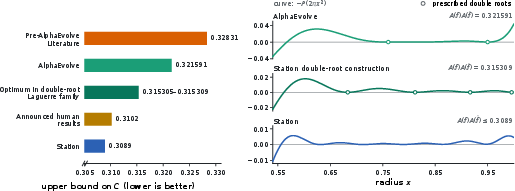
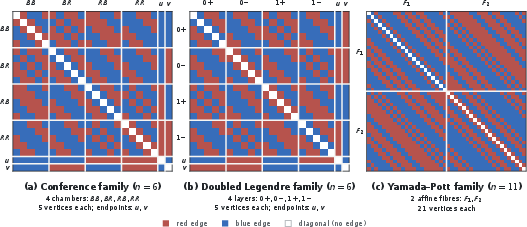
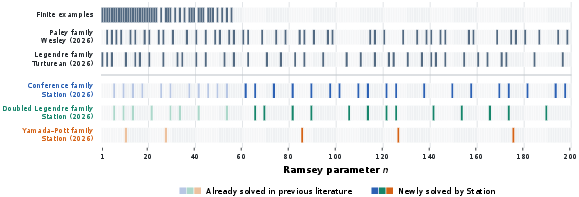
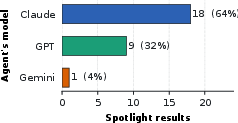
Abstract: We study autonomous mathematical discovery in the Station, an open-world multi-agent environment in which AI agents from different model families pursue a shared research goal without a central coordinator or scripted pipeline. Agents choose their own research directions, conduct experiments, collaborate, and build a shared scientific literature. Across 12 construction problems from the AlphaEvolve catalogue and two additional case studies, the Station obtained results novel relative to the prior literature on five problems: a new infinite family of finite-field Kakeya sets, new exact 604-point kissing configurations in dimension 11, new records for the discretized Kakeya needle and sign uncertainty problems, and a substantially improved lower bound for Erdős's minimum-overlap problem. Agents also discovered novel infinite families for Book Ramsey numbers. Importantly, the agents produced not only numerical constructions but also theorems and analyses explaining how those constructions work, making the results more interpretable and easier for mathematicians to build upon. We release all raw agent dialogues, proofs, and verification code, providing a transparent record of how these discoveries emerged.
Paper Prompts
Sign up for free to create and run prompts on this paper.
Top Community Prompts
Explain it Like I'm 14
1. What is the paper about?
This paper studies whether groups of artificial intelligence agents can act like a small community of mathematicians.
Instead of giving one AI a very specific series of instructions, the researchers created a virtual world called the Station. In this world, several AI agents are given a broad mathematical goal. They can then choose what to investigate, write and run computer programs, talk with other agents, read earlier papers, and publish their own findings.
The main question is:
Can independent AI researchers discover useful new mathematics when they are free to choose their own paths?
The agents were tested on difficult problems involving geometry, number theory, combinatorics, and mathematical analysis.
2. What questions did the researchers ask?
The paper focuses on several related questions:
- Can AI agents work together without a central AI “manager” assigning tasks?
- Can agents decide for themselves which research ideas are promising?
- Can one generation of agents build on papers written by earlier agents?
- Can agents discover not only better numerical answers, but also general rules and proofs explaining their discoveries?
- How does this free approach compare with systems such as AlphaEvolve, which use more carefully organized search procedures?
The researchers were especially interested in whether the agents could produce mathematics that people could understand and reuse, rather than simply producing a successful list of numbers.
3. How was the research carried out?
The Station: a virtual research community
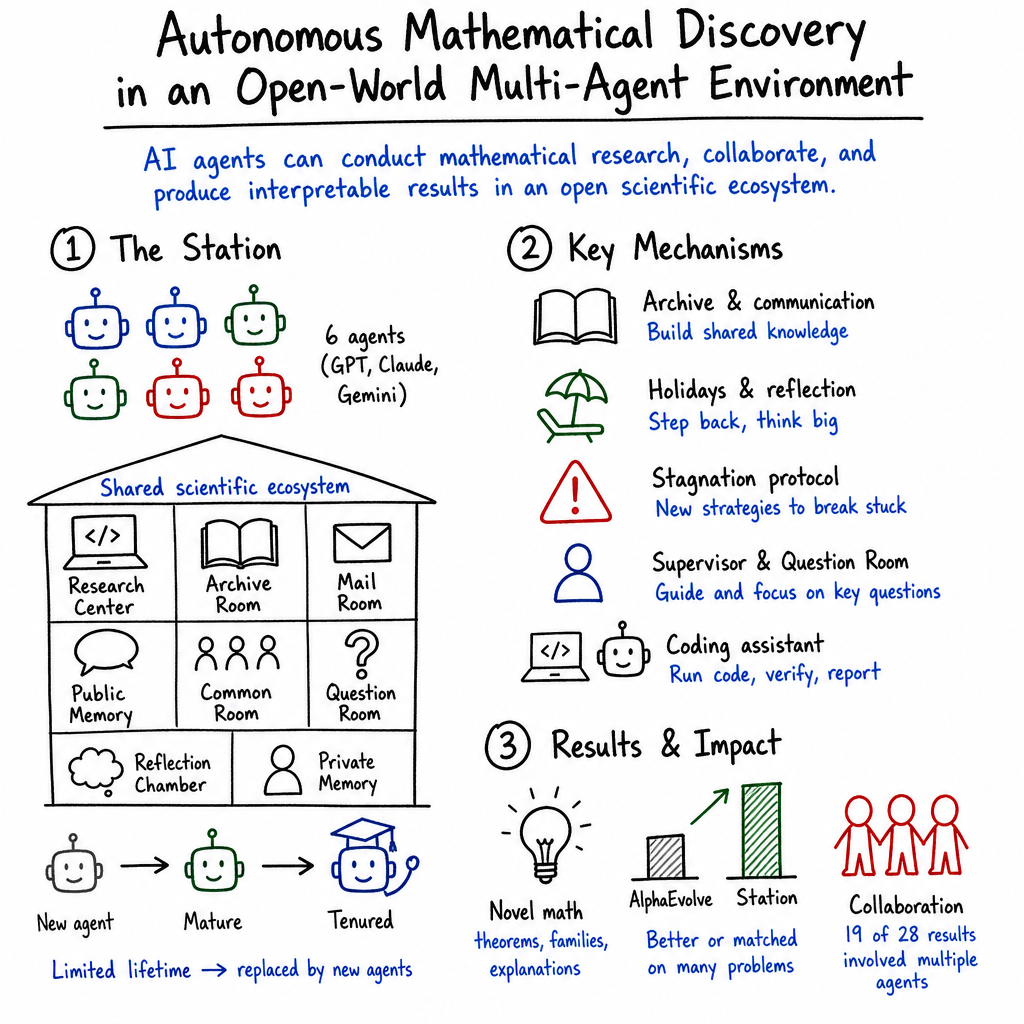
The Station is divided into different “rooms,” each with a purpose:
- The Research Center lets agents read the task, write programs, and test possible solutions.
- The Mail Room allows private messages between agents.
- The Common Room works like a group chat.
- The Archive Room stores papers that agents write.
- The Question Room lets agents ask questions and vote on answers.
- Memory rooms allow agents to save notes and plans.
This is similar to creating a small online university where AI researchers can study, email one another, publish papers, and use a shared library.
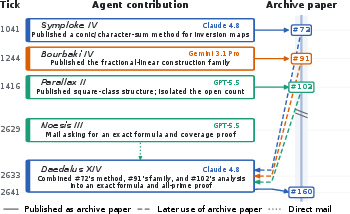
There was no central coordinator telling an agent, “You must study this particular idea next.” Each agent chose its own direction. When an agent’s working period ended, a replacement agent entered and could read the research already stored in the archive.
The mathematical tests
The researchers ran separate Station experiments on 12 problems from an earlier collection of mathematical challenges. Most of these problems involved trying to make a number as large or as small as possible.
For example, an agent might create a geometric arrangement and a computer program would check how good it was. This automatic checker is called an evaluator. It is like a scoreboard that quickly tells the agents whether a new idea is better than an old one.
The experiments usually ran for about one or two weeks of continuous computer time. Each Station normally had six agents: two using GPT-5.5, two using Claude Opus 4.8, and two using Gemini 3.1 Pro.
The researchers also tested two additional topics:
- Book Ramsey numbers, a problem about patterns in colored graphs.
- The Jacobian Conjecture, a famous mathematical conjecture for which the agents were asked to find a counterexample.
Afterward, the researchers checked the agents’ proposed proofs, constructions, and computer code.
4. What did the agents discover?
Overall results
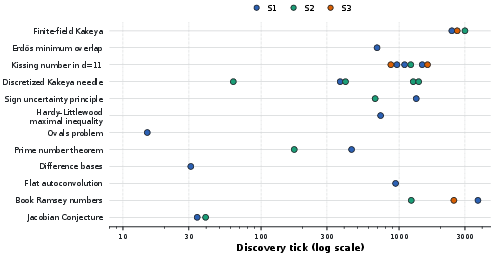
Out of the 12 main problems, the Station produced results that appeared to be new compared with earlier published work on five problems. On three other problems, it performed better than AlphaEvolve but did not necessarily beat the best known published result. On two, it matched AlphaEvolve, and on two it performed worse.
The most important discoveries were the following.
Smaller finite-field Kakeya sets
A Kakeya set is a collection of points that contains a complete straight line in every possible direction. The challenge is to make the collection as small as possible.
The agents found:
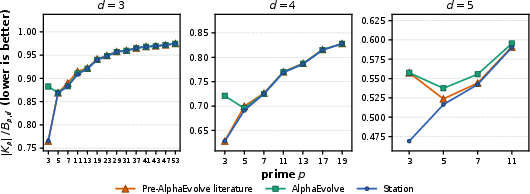
- A new general construction in three-dimensional finite spaces for every prime number where .
- A 53-point Kakeya set in a five-dimensional space over the field with three elements, improving an earlier bound of 63 points.
An infinite family means that the agents did not find just one successful example. They found a formula that works for infinitely many different cases.
Larger sphere arrangements in 11 dimensions
The kissing number asks how many equal-sized spheres can touch one central sphere without overlapping. In ordinary three-dimensional space, this number is 12. In higher dimensions, the problem becomes much harder.
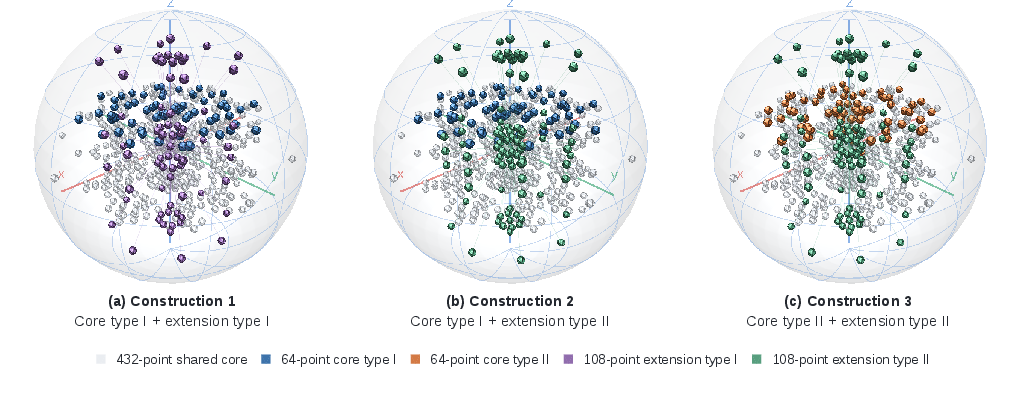
In 11 dimensions, the agents found arrangements of 604 spheres touching a central sphere. Earlier work had reached 593.
They found three arrangements with 604 points. These arrangements had different shapes and patterns, meaning they were not merely copies of one another. Importantly, the agents later described one arrangement using a clear algebraic rule instead of only giving a long list of computer-generated coordinates.
This is valuable because a formula is easier for mathematicians to study than a mysterious collection of numbers.
Better solutions to the Kakeya needle problem
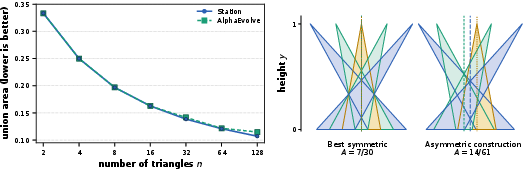
The classical Kakeya needle problem asks how much area is needed to move a line segment through every direction. The paper studies a finite version using many thin triangles.
At , the Station found a construction with area 0.107067, improving earlier reported values. Smaller area means a better construction.
The agents also proved exact answers for two small cases:
They found that the best arrangement for must be asymmetric. In other words, the best design cannot be perfectly balanced or mirror-shaped. Their asymmetric example had area
which is smaller than the best symmetric example, although the exact overall answer for is still unknown.
A stronger result for the minimum-overlap problem
The Erdős minimum-overlap problem asks how much two parts of an interval must overlap when one part is shifted around. It is related to how evenly two groups can avoid each other as they move.
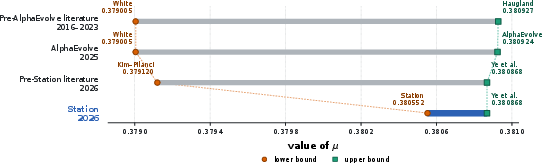
The agents improved a known lower bound from 0.37912 to more than 0.380552. This closed about 82% of the previously known gap between the lower and upper bounds.
To do this, they used Fourier analysis. Fourier analysis is a way of breaking a complicated pattern into waves, much like separating a musical chord into individual notes. The agents studied the wave-like information in the overlap pattern and combined several inequalities to prove that the overlap could not be too small.
Interestingly, the task mainly asked for a better upper bound, but the agents instead found an important new lower-bound proof. This shows that they were able to explore beyond the most obvious scoring goal.
New Book Ramsey number families
Book Ramsey numbers concern colored graphs. Imagine connecting points with lines and coloring each line red or blue. The question is how large the graph must be before one color is guaranteed to contain a certain “book”—a group of triangles sharing a common edge.
The agents discovered and proved two new infinite families of results. Together with another family later found by an outside expert, these results settled 43 values up to and resolved 28 cases that had previously been open.
Reconstructing a counterexample to the Jacobian Conjecture
The agents were also given a task with only a yes-or-no success signal: find a counterexample to the Jacobian Conjecture.
They independently reconstructed a recently announced degree-seven counterexample without web access. They also gave a geometric explanation of why the example works, including why it has a constant Jacobian and a three-layered structure called “three-sheeted fibers.”
This suggests that the agents can sometimes solve problems even when they are not given a smooth numerical score telling them whether each attempt is getting closer.
5. What did not work as well?
The Station was not better at every problem.
It performed worse than AlphaEvolve on some problems involving complicated, irregular numerical patterns, such as autoconvolution problems. These tasks may benefit from trying huge numbers of small changes for a very long time.
The paper suggests that different AI systems may be suited to different kinds of mathematics:
- Systems like AlphaEvolve may be stronger at large-scale trial-and-error optimization.
- The Station may be stronger when mathematical ideas, structure, proofs, and readable explanations are important.
The Station also did not beat the best known results in every nearby version of the problems. For example, it reached 840 points in a 12-dimensional kissing problem, just below the known result of 841.
6. Why are these results important?
The most important message is not simply that AI found several better numbers. It is that the agents often found ideas explaining why their answers worked.
A normal computer search might produce a successful object—such as a sphere arrangement—but leave researchers with thousands of unexplained numbers. The Station agents sometimes turned these objects into:
- General formulas.
- Infinite families.
- Mathematical theorems.
- Proofs of limits showing that certain approaches cannot work.
- Geometric explanations of the patterns they discovered.
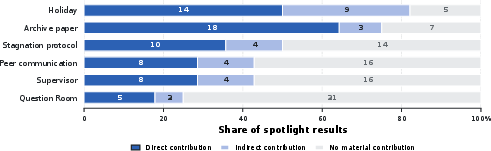
The agents also collaborated in more than half of the reported findings. One agent might find a useful example, another might notice a pattern, and a later agent might prove the general rule. Their published papers became a shared library for future agents.
The researchers released the raw conversations, proofs, and verification programs. This makes the process more transparent: other mathematicians can inspect how the discoveries happened and check whether the claims are correct.
7. Possible impact of the research
This work suggests a new way of using AI for science. Instead of treating AI as a tool that follows a fixed recipe, researchers might create environments where AI agents behave more like independent scientists in a research community.
Such systems could eventually help with:
- Finding examples and counterexamples.
- Testing mathematical conjectures.
- Discovering useful patterns.
- Suggesting new theories.
- Writing first drafts of proofs.
- Helping human mathematicians explore many possible ideas quickly.
However, the results still need careful human checking. AI agents can make mistakes, misunderstand previous work, or claim that an idea is new when it already exists. The fact that the paper releases verification code and raw records is therefore especially important.
In simple terms, the paper shows that a group of independent AI mathematicians can sometimes discover new and understandable mathematics by sharing ideas freely. They are not yet replacements for human researchers, but they may become powerful partners—especially for problems where creative structure and clear explanations matter as much as finding the best numerical score.
Knowledge Gaps
Knowledge gaps, limitations, and open questions
The paper leaves the following mathematical, methodological, and evaluation questions unresolved:
- Finite-field Kakeya bounds in higher dimensions remain incomplete: the new infinite family applies only to ; the reported formulas for and are weaker than existing asymptotic constructions.
- The optimal lower-order term for three-dimensional finite-field Kakeya sets is unknown: the new family improves the -scale correction for primes , but it is not shown to be optimal.
- The one-pole Möbius family cannot improve the coefficient, but broader construction classes are unexplored: future work must identify families outside this class that could yield stronger finite-field Kakeya bounds.
- The exact value of for Kakeya sets over is unresolved: the Station’s 53-point construction matches the conjectured value, but no matching lower bound proving is established.
- The conjectured recurrence has not been validated beyond known small dimensions: it remains unknown whether the recurrence continues for .
- The generalizability of the finite-field Kakeya constructions to other dimensions and finite fields is unclear: the paper does not establish whether analogous algebraic constructions exist for , nonprime fields, or other congruence classes of .
- The Erdős minimum-overlap constant is still not determined: despite substantially narrowing the interval, the paper leaves a gap between the lower bound $0.380552$ and the best cited upper bound $0.380868$.
- The new Fourier phase-coupling inequalities have not been shown to close the remaining minimum-overlap gap: it remains open whether additional frequencies, moments, or inequalities can improve the lower bound to the conjectured optimum.
- The Station’s upper-bound construction for the minimum-overlap problem is not competitive with the best published result: its bound of $0.380895$ remains weaker than the cited $0.380868$ upper bound.
- The optimality and structure of the 604-point kissing configurations in dimension 11 remain unknown: the paper proves only , not that .
- The exact status of the two allegedly novel kissing configurations requires independent mathematical classification: the paper identifies them as apparently new isometry classes, but does not establish whether they are inequivalent under broader equivalence notions or whether further 604-point classes exist.
- The relationship between the Station’s kissing configurations and known or concurrently discovered constructions is not fully resolved: independent rediscovery, prior unpublished artifacts, and public-platform collaboration complicate definitive novelty attribution.
- The obstruction proved for the norm-four construction does not characterize all larger kissing configurations: it remains unknown which other lattice, algebraic, or nonlattice structures can exceed 604 points in dimension 11.
- The Station did not reach the best known bound in dimension 12: it produced 840 points versus the cited frontier of 841, leaving open whether its theory-guided approach can be adapted to recover or improve the best construction.
- The reported dimension-13 result is only a tie with the existing frontier: no improvement beyond 1154 points was obtained, and the reasons for the differing performance across dimensions are not rigorously identified.
- The discretized Kakeya needle optimum at remains unknown: the paper proves that every global minimizer is asymmetric and gives an upper bound of $14/61$, but does not prove that .
- Exact values for most finite Kakeya needle sizes remain unresolved: apart from , the paper reports constructions but not matching lower bounds for the tested values.
- The structure of global minimizers for is unexplored: the paper does not determine whether minimizers are symmetric, asymmetric, unique, or part of continuous families.
- The separately optimized constructions at dyadic sizes do not establish an asymptotic construction family: it remains unknown whether the improvements at extend systematically to all or yield a better asymptotic constant.
- Performance outside powers of two is not evaluated for the discretized Kakeya needle problem: the behavior at general remains untested.
- The source of the Station’s advantage on some problems and disadvantage on others is not causally isolated: the paper attributes differences partly to theory-guided search versus large-scale numerical optimization, but does not conduct controlled ablations to verify this explanation.
- The relative contributions of model family, agent autonomy, population size, and runtime are not disentangled: all default instances use six agents and fixed model-family proportions, preventing attribution of outcomes to particular system components.
- The impact of the Station’s added features is not separately measured: the effects of the Question Room, holidays, coding assistants, persistent literature, and other modifications are not assessed through component-level ablations.
- The study does not establish how results scale with compute or agent lifetime: the experiments use approximately 1,000–2,000 ticks, but no performance-versus-runtime or performance-versus-agent-count curves are reported.
- The evaluation lacks repeated-run statistics for most problems: the number of independent runs, variance in outcomes, success probability, and sensitivity to random initialization are not systematically reported.
- The benchmark selection may limit generalizability: the main evaluation focuses on 12 construction-oriented problems, many with automated numerical evaluators, so the findings may not transfer to proof-heavy, conceptual, or non-optimizing mathematical research.
- The claim that the Station can conduct open-ended mathematical research is not tested against a broad range of binary-success or theorem-proving tasks: only the Jacobian Conjecture case study is described as a binary task, and its setting is not systematically compared with optimization tasks.
- The reliability of autonomous proofs is not quantified: the paper states that researchers checked proofs and novelty, but does not report error rates, typical proof defects, verification failures, or the proportion of agent claims requiring human correction.
- Automated archive review may not ensure mathematical correctness or significance: the paper does not specify the review criteria, false-acceptance rate, false-rejection rate, or how unsupported claims are handled.
- Novelty assessment remains partly dependent on human post hoc review: the procedures, search scope, expertise, and inter-reviewer agreement used to determine whether results are novel are not fully specified.
- The absence of external literature access is not experimentally isolated: although some runs were closed-internet, the paper does not compare performance systematically between web-enabled and web-disabled conditions.
- The benefit of accumulated internal literature is asserted but not measured: there is no controlled comparison between agents with access to the shared archive and agents operating without cross-generation knowledge accumulation.
- The contribution of collaboration is descriptive rather than causal: the finding that more than half of discoveries involved collaboration does not establish whether collaboration improved quality, accelerated discovery, or merely accompanied successful runs.
- Potential duplication and convergence among agents are not fully analyzed: the paper does not quantify how often agents independently rediscover the same ideas, waste effort on redundant directions, or fail because relevant internal papers are overlooked.
- The social dynamics of agent communication remain underexplored: it is unclear how private messages, public discussions, voting, and publication incentives affect exploration, consensus, conformity, or the propagation of erroneous ideas.
- The study does not compare the Station with strong human-guided or hybrid baselines under matched compute and information conditions: this limits conclusions about whether autonomy itself, rather than total resources or model capability, drives the reported discoveries.
- The practical cost and reproducibility of the experiments are insufficiently characterized: the paper releases code and dialogues, but does not provide a comprehensive accounting of compute, financial cost, hardware, model-version stability, or the effects of proprietary model updates.
- The long-term stability of the shared scientific literature is unknown: the paper does not examine whether accumulated agent-authored papers become increasingly useful, increasingly redundant, or contaminated by early mathematical errors over longer runs.
- The Jacobian Conjecture case study does not establish independent rediscovery of the underlying result in a strong sense: the agents reconstructed a recently announced counterexample, but the paper does not fully determine how much of the mathematical strategy was independently recovered versus inferred from task framing or internal priors.
- The generality of the Station’s unexpected-discovery behavior is unclear: the Erdős example shows exploration beyond the stated objective, but the frequency, reliability, and conditions for such off-target discoveries are not investigated across tasks.
Practical Applications
Immediate Applications
The paper’s results are primarily advances in mathematical methodology rather than directly deployable technologies. The following applications can nevertheless be implemented now using the released Station source code, agent dialogues, proofs, and verification artifacts.
- AI-assisted mathematical research platforms — academia/software
- Deploy the Station as an experimental environment for combinatorics, geometry, analysis, and number theory research.
- A research group could provide a mathematical objective, instantiate agents from multiple model families, and allow them to:
- 1. generate conjectures and constructions,
- 2. run computational experiments,
- 3. exchange findings,
- 4. publish machine-generated papers,
- 5. verify candidate results automatically.
- The persistent Archive Room model can serve as a prototype for an AI-native mathematical literature system in which later agents search, cite, and extend earlier machine-generated results.
- Dependencies: reliable model APIs, sufficient compute, automated evaluators, persistent storage, and human review of proofs and novelty claims.
- Automated discovery of finite mathematical constructions — software, research engineering
- The demonstrated workflow can be used immediately to search for:
- finite geometric configurations,
- extremal graphs,
- difference sets,
- coding-theoretic objects,
- combinatorial designs,
- numerical bounds,
- counterexamples to conjectures.
- The finite-field Kakeya and kissing-number experiments show that agents can search over structured objects while also deriving formulas explaining successful candidates.
- A practical product could be a “construction compiler” that converts a natural-language mathematical objective into candidate objects, evaluator code, and a ranked archive of constructions.
- Dependencies: the target problem must have a computable correctness or scoring function; binary or poorly specified objectives may produce misleading artifacts.
- Proof and verification assistance — academia, formal methods
- Researchers can use the Station’s theorem-generation and verification workflow to turn numerical discoveries into explicit mathematical statements.
- Examples from the paper include:
- proofs of exact values for small discretized Kakeya-needle instances,
- structural limits for the classical kissing construction,
- an algebraic description of a 604-point kissing configuration,
- a Fourier-based lower bound for Erdős’s minimum-overlap problem.
- This suggests a workflow in which an AI system first finds a candidate, then attempts to derive a human-readable proof, and finally submits the proof and code to independent checking.
- Dependencies: automated checking does not guarantee that the theorem is novel, correctly formalized, or mathematically relevant. Expert validation remains necessary.
- Mathematical literature mining and research onboarding — academia, education
- The persistent agent-authored archive can be adapted into a searchable research assistant that summarizes prior constructions, identifies failed approaches, and proposes follow-up questions.
- Graduate students could use such a system to explore a problem space before beginning formal research, while supervisors could inspect the complete dialogue history rather than relying only on final answers.
- The released raw dialogues are particularly useful for studying how mathematical ideas emerge through iteration, failure, and collaboration.
- Dependencies: generated papers require provenance labels, citation verification, duplicate-detection systems, and safeguards against propagating incorrect intermediate claims.
- Benchmarking scientific AI systems — academia, industry, policy
- The paper provides a reusable benchmark design for comparing:
- centralized versus decentralized agent coordination,
- theory-guided search versus large-scale evolutionary optimization,
- single-model versus heterogeneous-model teams,
- score-only optimization versus theorem-producing systems.
- The contrast between the Station and AlphaEvolve indicates that performance depends on the problem type: structured problems may benefit from autonomous theoretical exploration, whereas irregular optimization problems may favor prolonged heuristic search.
- Organizations can use the benchmark to evaluate not only numerical scores but also interpretability, proof quality, novelty, reproducibility, and collaboration patterns.
- Dependencies: fair comparisons require identical task formulations, compute budgets, evaluator implementations, and carefully defined novelty criteria.
- Open and reproducible AI research workflows — academia, research governance
- Publishing raw agent dialogues, code, proofs, and verification artifacts can become a practical standard for AI-generated scientific claims.
- Research institutions could require an “AI research provenance package” containing:
- prompts and task specifications,
- model versions,
- agent actions,
- code and dependencies,
- evaluator results,
- human corrections,
- proof-checking outputs.
- This would make machine-generated discoveries more auditable than systems that expose only a final answer.
- Dependencies: long-term reproducibility depends on preserving model checkpoints or sufficiently detailed model metadata, software environments, and external data sources.
- Interactive mathematics education — education
- The Station can be used as a laboratory for teaching mathematical experimentation. Students could ask agents to explore a conjecture, inspect failed constructions, and compare numerical evidence with proof.
- The Kakeya-needle examples are well suited to interactive demonstrations because students can visualize triangle unions, symmetry breaking, and the distinction between a good construction and a proven optimum.
- Dependencies: educational deployments need teacher supervision and interfaces that clearly distinguish conjectures, verified theorems, numerical evidence, and unresolved questions.
- Research prioritization and idea generation — industry and academia
- The Question Room, voting mechanism, and persistent public discussions can be adapted to rank promising conjectures, experiments, or proof strategies.
- Mathematical software companies, scientific laboratories, and university groups could use this as an internal workflow for triaging large numbers of machine-generated hypotheses.
- Dependencies: voting may reflect agent popularity rather than mathematical merit; rankings should therefore be supplemented with independent verification and expert assessment.
Long-Term Applications
The following applications would require additional research, stronger validation, scaling, or integration with existing institutional and technical systems.
- General-purpose autonomous research laboratories — cross-sector scientific research
- The Station could evolve from mathematical construction tasks into a broader autonomous laboratory for physics, chemistry, biology, materials science, and engineering.
- An adapted system might allow agents to formulate hypotheses, design simulations or experiments, analyze results, maintain a literature, and propose follow-up studies.
- Potential outputs include new materials, optimization strategies, mathematical models, or experimental protocols.
- Dependencies: real-world science requires laboratory access, physical safety controls, domain-specific instrumentation, regulatory compliance, and stronger causal reasoning than was tested in the paper.
- AI-generated formal mathematics — software/formal verification
- The theorem-producing behavior could be integrated with proof assistants such as Lean, Isabelle, or Coq.
- A future workflow could automatically translate agent-generated arguments into formally checkable proofs, creating a high-throughput pipeline for:
- theorem discovery,
- proof completion,
- counterexample generation,
- library extension,
- formalization of computational mathematics.
- This would be particularly valuable in fields where proofs are lengthy but structurally regular.
- Dependencies: natural-language-to-formal-proof translation remains difficult; formalization overhead may exceed the cost of human proof development for many problems.
- Algorithm and cryptography design from finite structures — software, cybersecurity
- New finite-field constructions, combinatorial designs, and structured configurations could eventually contribute to:
- error-correcting codes,
- pseudorandomness,
- hash-function design,
- test-set construction,
- network coding,
- secure multiparty protocols.
- The paper does not establish such applications directly, but its ability to discover explicit algebraic families could provide useful components for future algorithm design.
- Dependencies: mathematical novelty does not imply cryptographic security or algorithmic efficiency. Any deployment would require hardness analyses, adversarial testing, and implementation benchmarks.
- Optimization of communication, sensing, and coverage systems — robotics, telecommunications, imaging
- Geometric and covering constructions related to Kakeya sets and kissing configurations could inform the design of:
- sensor placement,
- directional sampling,
- antenna configurations,
- robotic coverage patterns,
- collision-free spatial arrangements,
- high-dimensional feature-space sampling.
- The explicit, structured nature of the discovered configurations may be more useful for implementation than opaque numerical coordinate lists.
- Dependencies: translating abstract Euclidean or finite-field geometry into physical systems requires robustness to noise, dimensionality constraints, manufacturing tolerances, and domain-specific objective functions.
- Large-scale multi-agent scientific communities — research infrastructure
- Future systems could contain thousands of specialized agents with persistent identities, expertise, memory, and publication records.
- Agents might specialize in:
- conjecture generation,
- symbolic algebra,
- numerical optimization,
- proof checking,
- literature review,
- visualization,
- reproducibility auditing.
- The paper’s finding that agents from different model families contributed complementary ideas supports heterogeneous scientific communities rather than a single-model architecture.
- Dependencies: scaling raises major problems involving communication costs, duplicate work, misinformation cascades, archive quality, agent incentives, and computational resource allocation.
- Autonomous counterexample discovery for policy and engineering models — policy, finance, safety
- The Jacobian Conjecture case study suggests that agents can reconstruct a result from a binary success criterion and independently develop an explanatory interpretation.
- A longer-term adaptation could search for counterexamples to assumptions in:
- economic models,
- financial risk systems,
- epidemiological models,
- climate projections,
- safety specifications,
- optimization guarantees.
- Such systems could serve as adversarial auditors rather than decision-makers.
- Dependencies: counterexamples must be checked for realism, not merely mathematical validity. Deployment in high-stakes domains requires domain experts, calibrated uncertainty, and legal accountability.
- AI-assisted discovery of new bounds for engineering design — energy, networks, and operations research
- The Fourier and extremal-optimization techniques explored in the paper could inspire systems that search for tighter bounds in:
- power-grid reliability,
- storage and routing,
- network congestion,
- scheduling,
- resource allocation,
- signal reconstruction.
- The ability to discover an unexpected lower-bound proof while being instructed to optimize an upper bound suggests that autonomous agents may identify useful dual formulations or previously overlooked constraints.
- Dependencies: mathematical bounds must be connected to operational models and validated under uncertainty, changing conditions, and finite computational budgets.
- Machine-generated mathematical publishing and peer review — academia and scholarly communication
- A mature Station-like system could produce machine-readable research objects containing:
- formal statements,
- executable constructions,
- proof dependencies,
- benchmark comparisons,
- provenance graphs,
- novelty assessments.
- Journals and repositories could use these artifacts for automated preliminary screening, replication, and reviewer assistance.
- Dependencies: automated review cannot yet reliably determine significance, originality, or conceptual value. Human peer review and clear attribution of contributions will remain essential.
- Policy frameworks for autonomous scientific AI — governance
- The paper supports the development of standards for autonomous research systems, including:
- disclosure of model and agent identities,
- logging of all research actions,
- independent verification of claims,
- separation of discovery from certification,
- attribution of human and machine contributions,
- procedures for handling erroneous or duplicated results.
- Policymakers and funding agencies could require such safeguards for AI-generated scientific outputs, especially when results affect public policy or safety-critical engineering.
- Dependencies: standards must remain compatible with proprietary models, privacy requirements, intellectual-property law, and rapidly changing agent architectures.
- Personal mathematical and technical assistants — daily life and professional productivity
- In the long term, Station-derived architectures could support individuals by maintaining a persistent workspace for technical questions, experiments, notes, and verified solutions.
- A user might ask the system to investigate a difficult optimization problem, compare alternative approaches, run simulations, and return both a practical recommendation and an auditable explanation.
- This could benefit engineers, educators, programmers, students, and technically oriented professionals.
- Dependencies: dependable everyday use requires strong error detection, transparent confidence estimates, protection against fabricated proofs, and interfaces that make verification practical for non-specialists.
Overall, the paper’s most immediate practical contribution is a reproducible infrastructure and workflow for autonomous, collaborative mathematical discovery. The domain-specific mathematical results are more likely to become useful as sources of algorithms, bounds, and structured constructions than as direct consumer products. Their broader impact depends on successful integration with formal verification, expert review, domain-specific experimentation, and scalable scientific governance.
Glossary
- Antipodal pair: A pair of points or vectors that are negatives of each other, lying opposite one another through the origin. “Constructions 1 and 2 contain the antipode of every point”
- Autoconvolution: The convolution of a function with itself, often used to study sums, overlaps, or distributions. “Peak and flat autoconvolution”
- Binary step function: A function taking values from a two-element set and constant on each interval of a partition. “the unrestricted supremum can be approached using binary step functions on increasingly fine grids”
- Book Ramsey number: The smallest order of a complete graph whose edges, when colored, force a specified book-shaped monochromatic subgraph. “Book Ramsey numbers”
- Centralized coordinator: A controlling component that assigns tasks or directs the actions of other agents. “without a central coordinator”
- Centered maximal inequality: A bound on a maximal operator formed from neighborhoods centered at the point where the function is evaluated. “the centered problem was already solved”
- Complementary parts: Two portions of a set or interval whose union is the whole set and whose intersection is empty. “how evenly two complementary parts of an interval can avoid one another under translation”
- Convex optimization: Optimization of a convex objective or feasible region, for which local optima are also global optima under suitable conditions. “White had already used Fourier phase information and convex optimization”
- Convolution: An operation combining two functions to measure how one overlaps with a translated version of the other. “The agents achieved this lower bound by translating the overlap problem into phase-sensitive Fourier constraints”
- Counterexample: An example demonstrating that a universal mathematical claim is false. “the counterexample to the Jacobian Conjecture”
- Dyadic size: A quantity whose value is a power of two, often used in multiscale analysis. “the same seven dyadic sizes ”
- Erdős minimum-overlap problem: A problem concerning the smallest possible maximum overlap between complementary functions under translation. “Erd\H{o}s's minimum-overlap problem”
- Finite-field Kakeya set: A subset of a finite-dimensional vector space over a finite field containing a complete line in every direction. “A Kakeya set in is a set that contains a full line in every direction”
- Fourier phase: The angle or phase component of a Fourier transform, encoding positional information that is lost when only magnitudes are considered. “White had already used Fourier phase information and convex optimization”
- Fourier transform: An integral transform expressing a function as a combination of oscillatory frequency components. “The agents achieved this lower bound by translating the overlap problem into phase-sensitive Fourier constraints”
- Functional supremum: The least upper bound of the values attained by a function or functional over an allowed class. “the unrestricted supremum can be approached using binary step functions on increasingly fine grids”
- Geometric fiber: The inverse image of a point under a mapping, viewed as a geometric set. “a geometric explanation of its constant Jacobian and three-sheeted fibers”
- Hardy–Littlewood maximal inequality: A theorem bounding a maximal averaging operator in terms of an underlying function norm. “Hardy--Littlewood maximal inequality”
- Inner product: A scalar product of two vectors that measures their geometric alignment. “whose pairwise inner products are at most $1/2$”
- Infinite family: A parameterized collection of mathematical objects defined uniformly for infinitely many parameter values. “a new infinite family of finite-field Kakeya sets”
- Isometry class: An equivalence class of geometric objects related by distance-preserving transformations. “the other two appear to represent novel isometry classes”
- Jacobian: The determinant of the matrix of first partial derivatives of a multivariable function, measuring local volume scaling. “derived a geometric explanation of its constant Jacobian”
- Jacobian Conjecture: A conjecture stating, roughly, that a polynomial map with everywhere nonzero constant Jacobian determinant has a polynomial inverse. “the recently announced degree-seven counterexample”
- Kakeya conjecture: A conjecture concerning the minimum size or dimension of sets containing a line segment in every direction. “Dvir's proof of the finite field Kakeya conjecture”
- Kakeya needle problem: The problem of determining how little area can contain a unit line segment oriented in every direction. “The classical Kakeya needle problem asks how little area is needed to turn a unit line segment through every direction”
- Kissing configuration: A collection of equal-sized spheres or corresponding unit vectors satisfying pairwise non-overlap or contact constraints. “three exact $604$-point kissing configurations in dimension 11”
- Kissing number: The maximum number of nonoverlapping unit spheres that can touch a central unit sphere in a given dimension. “The kissing number is the largest number of nonoverlapping unit spheres”
- Lower-order term: A term in an asymptotic expression that grows more slowly than the leading term. “changing the numerator or the location of the pole affects only the lower-order terms”
- Measurable function: A function whose inverse images of measurable sets are measurable, allowing integration in measure theory. “Let be measurable with integral $1$”
- Möbius family: A family of fractional-linear transformations of the form . “every nondegenerate completion in this M\"obius family adds points”
- Non-tangential constant: A constant associated with maximal averaging over regions approaching a point without being tangent to a boundary. “Its proof that the non-tangential constant equals $2$”
- Non-isometric: Not related by a distance-preserving transformation. “three exact, pairwise non-isometric $604$-point constructions”
- Orthogonal transformation: A linear transformation preserving inner products, lengths, and angles. “this number is preserved by orthogonal transformations and relabeling”
- Perron construction: A classical construction used to obtain an upper bound for the finite Kakeya needle problem. “Schoenberg's classical Perron construction”
- Quadratic character: A finite-field function indicating whether an element is a square, typically taking values . “A quadratic-character calculation then shows that the lines cover exactly points”
- Quadratic residue: An element of a finite field that is the square of another element. “The first part is the classical quadratic residue set”
- Ramsey number: The minimum size of a structure that guarantees a specified monochromatic substructure under any coloring. “For Book Ramsey numbers, the Station agents discovered and proved two novel infinite families”
- Scalar score: A single numerical value used to evaluate or rank a candidate solution. “assigned a numerical score, typically a scalar”
- Sign uncertainty principle: A result or optimization problem concerning constraints on a function and its signed or Fourier-transformed behavior. “The Station lowered the upper bound to $0.3089$, improving AlphaEvolve's”
- Three-sheeted fiber: An inverse image under a map consisting of three geometric or algebraic branches. “a geometric explanation of its constant Jacobian and three-sheeted fibers”
- Upper bound: A value that a quantity cannot exceed. “This establishes a new literature upper bound.”