Best Practice Critic Optimization
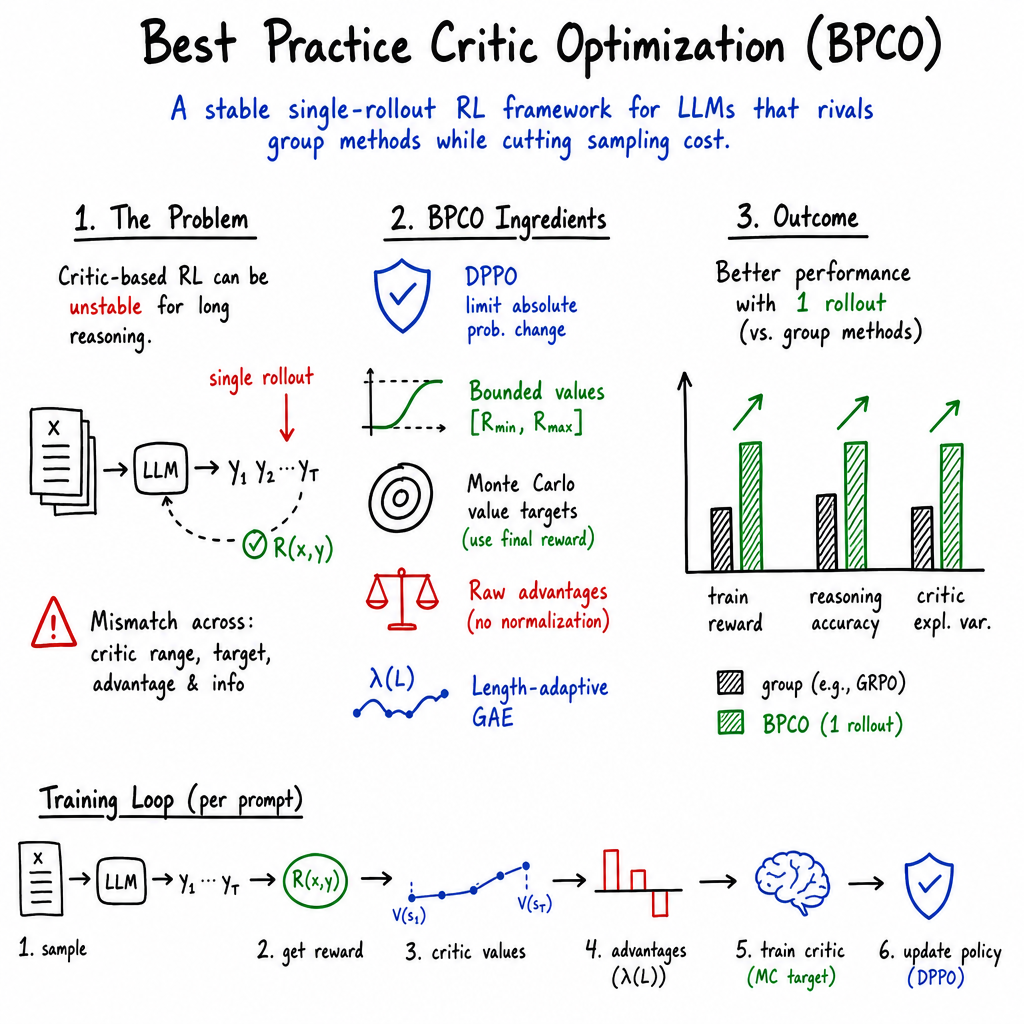
Abstract: Group-based reinforcement learning methods such as GRPO for LLMs avoid training a critic by sampling multiple responses for each prompt. A reliable critic could instead estimate token-level advantages from one response, but standard critic-based training recipes are often unstable. We study this instability and develop Best Practice Critic Optimization (BPCO), a recipe that combines DPPO, value predictions bounded to the reward range, Monte Carlo value targets, unnormalized policy advantages, and length-adaptive generalized advantage estimation. Because the critic is used only during training, BPCO can also condition it on reward-defining information, such as a reference answer or grading rubric, that is hidden from the policy. Controlled experiments isolate the effect of each design choice. Across mathematical reasoning tasks with models ranging from 1.5B parameters to 30B-A3B mixtures of experts, BPCO improves a strong critic-based baseline consistently, and matches or exceeds a group-based baseline while sampling one response per prompt. The same recipe also improves learning with rubric-based rewards. These results show that a carefully designed critic provides a reliable alternative to group-relative advantage estimation. Code is available at https://github.com/QPHutu/golden_critic.
Paper Prompts
Sign up for free to create and run prompts on this paper.
Top Community Prompts
Explain it Like I'm 14
1. What is this paper about?
This paper introduces a new way to train LLMs, such as ChatGPT-like systems, to give better answers. The method is called Best Practice Critic Optimization, or BPCO.
The main problem is that training LLMs with reinforcement learning can sometimes become unstable. The model may improve at first, then suddenly get worse. The researchers argue that this happens because the model’s “critic”—a helper that judges how promising each step is—may be trained poorly.
BPCO combines several improvements to make this critic more reliable.
2. What questions are the researchers asking?
The paper mainly asks:
- Can a critic estimate how useful each token in an answer is?
- Why do critic-based training methods sometimes become unstable?
- Which design choices make the critic more accurate and training more stable?
- Can a model learn effectively from only one response per question, instead of generating many responses?
- Can the critic use extra information, such as a correct answer or grading rubric, even when the LLM itself cannot see it?
The goal is to reduce the amount of sampling needed while still improving the model’s reasoning and instruction-following abilities.
3. How does the method work?
Reinforcement learning for LLMs
In reinforcement learning, a system learns through rewards. For example, imagine teaching a robot to solve a maze:
- It receives a reward for reaching the exit.
- It receives little or no reward for wandering around.
- Over time, it learns which actions are more likely to lead to success.
For a LLM, the “actions” are the individual tokens it writes. A complete answer might receive a reward of 1 if it is correct and 0 if it is incorrect.
The challenge is deciding which tokens helped produce the good answer.
Group-based methods
Methods such as GRPO generate several answers to the same question. They compare the rewards of those answers. If one answer scores better than the others, the model learns from it.
This is like asking a student to solve the same problem 16 times and then studying the best attempt. It can work, but it uses a lot of computer power because many answers must be generated.
Critic-based methods
A critic is another model component that predicts how likely a partial answer is to eventually receive a good score.
For example, while a LLM is solving a math problem, the critic might estimate:
“Given everything written so far, there is a 70% chance this solution will be correct.”
This helps the training system decide which individual tokens were useful, even when only one answer was generated.
However, ordinary critics can make bad predictions and cause unstable learning. BPCO improves the process in several ways.
The main BPCO improvements
The researchers combine five important ideas:
- DPPO instead of standard PPO PPO limits how much the model can change during one update. DPPO improves this by limiting the actual change in the probability of a chosen token, rather than using the same percentage limit for every token. This is like making sure every student’s score changes by a similar number of points, instead of changing everyone’s score by the same percentage.
- Value predictions are kept within the reward range If rewards can only be between
0and1, the critic should not predict values such as-4or8. BPCO forces its predictions to stay between the smallest and largest possible rewards. - The critic learns directly from the final result Instead of repeatedly relying on its own earlier guesses, the critic learns from the actual final reward. This is similar to checking the answer key directly rather than judging an answer using an uncertain prediction from earlier.
- Advantages are not normalized across the batch An “advantage” measures whether a token or action was better or worse than expected. Common methods rescale these advantages so every batch has the same average size. The researchers argue that this can be harmful near the end of training: when the model is already doing well, the real improvements are small, but normalization can make random differences look large. BPCO keeps the original scale.
- The method adjusts itself for response length Long answers need different treatment from short answers. With a fixed setting, information about the final reward may become too weak for tokens near the beginning of a long response. BPCO adjusts the calculation based on answer length.
Privileged information
The critic can sometimes receive information that the LLM does not see during normal use. This might include:
- A reference answer
- An official mathematical solution
- A grading rubric
This is called privileged information. It is like allowing a teacher to see the answer key while training a student, while still requiring the student to solve the test without seeing it.
The critic is used only during training and is discarded afterward, so the LLM does not need this extra information when answering users.
4. What did the researchers find?
The researchers tested BPCO in several settings.
Small mathematical training test
They first used a small set of math problems that the model should already have been able to solve. A good training method should reach almost perfect performance on this set.
They found that:
- Standard PPO sometimes improved at first but then collapsed.
- DPPO was more stable.
- Keeping critic predictions within the reward range improved stability.
- Training the critic directly from final rewards worked better than using biased predictions.
- Removing advantage normalization reduced over-aggressive updates.
- Adjusting the method for response length helped balance fast learning and good performance on new problems.
Larger mathematics datasets
On a dataset containing about 40,300 math problems, BPCO consistently performed better than the stronger critic-based baseline.
It also performed as well as or better than the group-based method, even though BPCO generated only one response per prompt rather than many.
This is important because generating fewer responses can reduce the computational cost of training.
Larger LLMs
The researchers also tested BPCO on much larger models with about 30 billion total parameters, using a type of model called a mixture of experts.
BPCO continued to improve upon the critic baseline. In some tests:
- The ordinary critic method stopped improving because its training became unstable.
- BPCO achieved higher math accuracy.
- BPCO matched or beat the group-based method while using one response per question.
Rubric-based rewards
The researchers tested open-ended tasks judged by a rubric rather than by a simple correct-or-incorrect answer.
For example, a rubric might check whether an answer is:
- Helpful
- Clear
- Complete
- Correctly organized
BPCO learned faster than the comparison methods. Giving the rubric to the critic improved the critic’s predictions, although it did not always improve the LLM’s final performance.
5. Why are these findings important?
The results suggest that critics are not automatically unreliable. They may work well when their predictions, training targets, and inputs are designed carefully.
BPCO is useful because it can:
- Train a LLM using only one response per prompt.
- Reduce the need to generate many alternative answers.
- Give more detailed feedback about which parts of an answer were helpful.
- Work on both mathematical problems and more subjective tasks judged by rubrics.
- Make training more stable, especially for long answers and larger models.
The use of privileged information is also promising. A critic may learn faster if it can see a reference answer or rubric, while the final LLM still works normally without that information.
However, there are limits. The experiments mainly focused on mathematics and rubric-based rewards. BPCO also requires knowing the possible reward range, and training a critic uses extra memory and computer power. Privileged information can also cause overfitting, meaning the model may perform well on training problems but worse on new ones.
Simple conclusion
This paper presents BPCO, a carefully designed method for training LLMs with reinforcement learning. The central idea is that a critic can be a useful training helper, but only if it gives sensible predictions and receives appropriate learning signals.
The researchers show that BPCO can make training more stable and efficient. It may allow future LLMs to learn better reasoning and instruction-following skills while generating fewer trial answers during training. This could make advanced model training less expensive and more practical, although further testing on a wider range of tasks is still needed.
Knowledge Gaps
The paper leaves the following knowledge gaps, limitations, and open questions unresolved:
- Limited task diversity: BPCO is evaluated only on mathematical reasoning and rubric-based reward tasks; its effectiveness on coding, factuality, dialogue, tool use, safety, and multimodal tasks remains unknown.
- Dependence on known reward bounds: The bounded value head assumes that and are known and reliable. It is unclear how BPCO should handle unbounded, dynamically scaled, heavy-tailed, or poorly calibrated rewards.
- Unclear robustness to reward-model noise: The experiments do not establish whether bounded values and Monte Carlo targets remain beneficial when rewards come from inaccurate, inconsistent, or adversarial reward models and judges.
- Insufficient statistical evidence: The paper does not report the number of random seeds, confidence intervals, or statistical significance tests, leaving the reproducibility and consistency of the reported gains uncertain.
- Incomplete hyperparameter analysis: The sensitivity of BPCO to the length-adaptation parameter , policy and critic learning rates, DPPO clipping thresholds, critic warm-up duration, batch size, and update frequency is not systematically studied.
- Unresolved bias–variance trade-off: The paper uses for critic training and length-adaptive GAE for policy training, but does not determine when alternative values of , , or would be preferable under different response lengths, reward variances, or critic capacities.
- Limited comparison of component interactions: The ablations mostly add or remove individual components sequentially. The contribution and interaction effects of combinations such as DPPO with bounded values, unnormalized advantages, and privileged inputs are not fully factorially isolated.
- Unclear generality beyond outcome rewards: BPCO is formulated and tested primarily with terminal outcome rewards. Its behavior with dense, delayed, multi-stage, or mixed process-and-outcome rewards is not evaluated.
- Uncertain performance under highly variable response lengths: Although length-adaptive GAE is motivated by long responses, the experiments do not provide systematic results across controlled length distributions or establish how it behaves near context-window limits and truncation boundaries.
- Potential mismatch between the critic’s target and the deployment policy: The critic estimates values under the behavior policy , while the policy changes throughout training. The paper does not quantify how quickly critic estimates become stale or how BPCO performs under larger policy updates and more severe distribution shift.
- Critic architecture is underexplored: The study does not compare different critic parameterizations, model sizes, initialization strategies, shared versus separate backbones, or critic ensembles. It is therefore unclear whether the reported improvements depend on a particular implementation.
- Privileged-information leakage and availability: Privileged critic inputs require access to reference answers, official solutions, or rubrics during training. The practical applicability of this approach when evaluator information is incomplete, expensive, proprietary, or unavailable is not established.
- Risk of privileged-critic overfitting: The paper observes earlier validation degradation with privileged information but does not determine how to detect, prevent, or control this overfitting through regularization, dropout, data augmentation, early stopping, or restricted privileged inputs.
- Questionable invariance assumption for privileged information: The claim that reward-defining information does not alter the ideal value function relies on that information being fixed and fully determined by the prompt. The consequences of ambiguous, noisy, prompt-dependent, or partially observed evaluator information remain unexplored.
- Unmeasured computational cost: Comparisons match trajectory counts but do not comprehensively measure wall-clock time, GPU memory, throughput, energy use, critic-training overhead, or inference latency. Thus, the practical efficiency advantage over group-based methods is unresolved.
- No direct cost-quality frontier: The paper does not compare BPCO and group-based methods across multiple rollout budgets, including settings where group sampling may provide better accuracy despite higher sampling cost.
- Limited scaling evidence: Only 1.5B and two 30B-A3B models are tested. The behavior of BPCO with smaller models, dense frontier-scale models, much larger mixture-of-experts models, and different model families is unknown.
- Restricted baseline coverage: The evaluation does not compare against all relevant contemporary critic methods, adaptive critic-update schemes, pretraining or warm-start strategies, or single-rollout alternatives under matched implementations and compute budgets.
- Unclear effect of DPPO independent of BPCO: All broader experiments use DPPO, so the extent to which BPCO’s gains persist with standard PPO or other policy objectives is not established.
- Generalization remains narrowly measured: Mathematical performance is primarily assessed using AIME 2025 avg@32. Broader transfer to unseen problem distributions, different difficulty levels, adversarial problems, and alternative sampling budgets is not demonstrated.
- Possible benchmark and data contamination: The paper does not analyze contamination or overlap between training datasets, reference solutions, judge data, and evaluation benchmarks, which may affect the reported generalization results.
- Long-term policy behavior is not examined: The study does not investigate whether BPCO causes reward hacking, verbosity inflation, shortcut learning, mode collapse, or degradation of instruction-following and safety outside the optimized reward.
- Stopping and convergence behavior is unresolved: The experiments cover finite training horizons, but do not establish whether BPCO remains stable near convergence, under continued training, or after the critic and policy have nearly eliminated residual advantages.
- Reliability of explained variance as a diagnostic is uncertain: Although explained variance against Monte Carlo targets is reported, its relationship to actual policy improvement, token-level advantage accuracy, and downstream generalization is not quantitatively validated.
- Single-response advantage quality is not directly compared: The paper shows aggregate training and validation outcomes but does not compare BPCO’s token-level advantages against oracle advantages, group-relative estimates, or independently estimated value functions.
- Asynchronous and distributed settings are not evaluated: BPCO is tested in synchronous training setups, leaving its stability under asynchronous rollout collection, stale critics, heterogeneous workers, and large-scale distributed RL unresolved.
- Robustness to incomplete or truncated trajectories is unknown: The treatment of generation truncation, invalid responses, timeouts, rejected samples, and missing terminal rewards is not described or systematically evaluated.
Practical Applications
Immediate Applications
The paper’s main near-term contribution is an implementable recipe for stabilizing single-rollout, critic-based reinforcement learning for LLMs. The following uses can be deployed with existing LLM-RL infrastructure, provided the reward function and training data meet the stated assumptions.
- More compute-efficient LLM post-training (software and AI infrastructure) — Integrate BPCO into existing PPO/GRPO systems such as
verlor comparable RLHF frameworks. Sampling one response per prompt can replace group-based sampling with fewer rollouts while preserving or improving reasoning performance.- Potential workflow: generate one completion, score it, train a reward-range-bounded critic on the observed outcome, compute length-adaptive advantages, and update the policy with DPPO.
- Dependencies: the critic introduces additional GPU memory, model computation, and engineering complexity. “One response per prompt” does not necessarily mean lower total cost if critic forward passes and training overhead dominate.
- Mathematical reasoning model training (education, tutoring, scientific software, and automated problem solving) — Use reference answers or official solutions as training-only critic inputs while keeping them hidden from the deployed policy.
- This can accelerate learning on contest mathematics, theorem-proving tasks, symbolic manipulation, and step-by-step quantitative reasoning.
- Assumptions: reference solutions are available, correctly aligned with each prompt, and used only during training. The policy must not gain access to them at inference time.
- Rubric-driven instruction tuning (customer support, writing assistants, enterprise copilots, and content generation) — Apply BPCO to rewards produced by a rubric-based judge, such as criteria for correctness, completeness, tone, formatting, or policy compliance.
- Potential product: a post-training pipeline in which an evaluator or judge scores responses against a prompt-specific rubric, while the critic receives the rubric to improve token-level credit assignment.
- The paper shows that BPCO improves learning even without privileged rubric input; therefore, bounded values and raw advantages can be adopted independently.
- Dependencies: judge quality, rubric consistency, and protection against reward-model or evaluator bias. A higher critic explained-variance score does not guarantee better validation performance.
- Long-response and chain-of-thought optimization (reasoning models and agentic software) — Use length-adaptive GAE for tasks involving responses of thousands of tokens, iterative planning, code generation, or tool-use traces.
- This reduces the risk that early tokens receive a weak or overly bootstrapped signal as response length increases.
- Assumptions: the reward is primarily available at the end of a trajectory or can be represented as an outcome reward. Tasks with dense, rapidly changing intermediate rewards may require modified targets.
- Stabilization of existing PPO-based LLM training runs (ML engineering) — Adopt the individual BPCO components as diagnostic fixes rather than replacing an entire training system:
- bound critic values to the known reward interval;
- train the critic against Monte Carlo outcome targets;
- remove batch-wise advantage normalization;
- use DPPO’s absolute-probability clipping;
- use separate critic and policy GAE settings.
- Potential tool: a training “stability profile” that monitors reward, response length, value range, raw advantage magnitude, explained variance against observed rewards, and held-out accuracy.
- Dependencies: the reward interval must be known or reliably estimated. Incorrect bounds can distort value learning.
- Reduced rollout and evaluator load (AI platform operations) — For expensive judge models, human evaluators, simulators, or external tools, single-rollout critic training can reduce the number of generated responses and reward evaluations per prompt relative to group methods.
- Potential sectors: code evaluation, mathematical verification, browser agents, and enterprise workflows with costly external APIs.
- Caveat: the paper compares trajectory counts, not complete wall-clock or energy costs. Critic training may offset savings.
- Training-time use of evaluator information without changing deployment interfaces (privacy-sensitive or controlled AI development) — Expose information such as answer keys, grading rubrics, or hidden task metadata to a critic that is discarded after training, while preserving the policy’s production input format.
- This is analogous to privileged training information in centralized-training/decentralized-execution systems.
- Dependencies: strict data-flow controls are required to prevent leakage through model checkpoints, logs, prompts, or accidental policy inputs.
- Academic research and reproducible baselines (academia) — Use BPCO as a controlled baseline for studying critic quality, policy optimization, reward modeling, and long-context RL.
- Researchers can reproduce the paper’s ablations to distinguish instability caused by policy clipping, critic parameterization, target bias, normalization, or response length.
- Dependencies: results should be validated beyond mathematical and rubric rewards, since the paper’s evidence is limited to those settings.
Long-Term Applications
The following applications are plausible extensions of the findings but require broader validation, better infrastructure, or additional research before dependable deployment.
- General-purpose reasoning and agentic models (software agents, robotics, and tool-using systems) — Extend BPCO to multi-step agents that call APIs, browse the web, execute code, or interact with environments.
- A privileged critic could receive tool traces, simulator state, execution logs, or task specifications that are unavailable to the deployed policy.
- Research requirements: handle state changes, intermediate rewards, partial observability, delayed tool outcomes, and nonstationary environments. The paper only directly studies language-model completion tasks with outcome-based rewards.
- Robotics and embodied AI training (robotics and autonomous systems) — Use bounded critics and unbiased trajectory targets when rewards have known physical limits, such as task completion, safety, or energy scores.
- A training critic might access simulator state, privileged object poses, or future trajectory information while the deployed controller uses only onboard observations.
- Dependencies: continuous actions, noisy sensors, safety constraints, sim-to-real transfer, and much longer or branching trajectories require adaptations beyond the discrete-token formulation evaluated in the paper.
- Healthcare decision-support model optimization (healthcare) — Train models to produce clinically useful summaries, triage recommendations, or explanations using rubric-based rewards from expert review, guideline matching, and factuality checks.
- A critic could receive clinical guidelines, reference plans, or structured evaluation criteria during training while the deployed model receives the patient case and authorized context.
- Dependencies: expert-validated rewards, privacy-preserving data, regulatory oversight, calibration, and rigorous prospective evaluation. BPCO cannot by itself establish clinical safety or correctness.
- Financial analysis and compliance assistants (finance) — Apply rubric-based rewards to improve report generation, numerical reasoning, risk explanations, and regulatory compliance.
- Privileged critic inputs could include internal checklists, approved filings, or policy documents during training.
- Dependencies: current and legally authorized data, robust safeguards against hallucinated financial claims, auditable reward models, and resistance to distribution shifts. The paper does not evaluate high-stakes financial decisions.
- Adaptive educational tutors (education) — Optimize explanations, hints, and feedback using rubrics that score pedagogical quality, correctness, level appropriateness, and student-support behavior.
- Reference solutions and grading rubrics could guide the critic without being exposed directly to students.
- Dependencies: reliable measurement of learning outcomes rather than surface-level answer quality, protection against overfitting to benchmark solutions, and human evaluation of pedagogical effects.
- Energy-efficient large-scale RLHF infrastructure (energy and data-center operations) — If single-rollout training produces equivalent policy quality with substantially fewer generations, BPCO could reduce inference energy and evaluator utilization at scale.
- Potential product: an adaptive trainer that switches between group-based and critic-based estimation according to reward cost, critic accuracy, response length, and hardware utilization.
- Dependencies: end-to-end energy measurements are needed. The paper demonstrates trajectory efficiency but does not quantify electricity, latency, or total carbon reduction.
- Automatic training-data and reward diagnostics (AI governance and quality assurance) — Build monitoring systems around BPCO’s indicators to detect critic extrapolation, unstable updates, excessive response-length growth, reward hacking, or overfitting.
- Useful signals include violations of the reward range, divergence between explained variance and held-out quality, shrinking raw advantages, and declining validation performance.
- Dependencies: these metrics are diagnostic rather than definitive. They require task-specific thresholds and should be combined with external quality, safety, and fairness evaluations.
- Hybrid critic/group training algorithms (reinforcement-learning research) — Combine BPCO’s critic with occasional group samples for calibration, uncertainty estimation, or difficult prompts.
- A system could use one rollout by default and request additional samples only when critic uncertainty is high or the prompt is out of distribution.
- Research requirements: methods for estimating critic uncertainty, deciding when to allocate extra rollouts, and preventing biased sampling of difficult examples.
- Privileged critics for confidential or proprietary evaluation (enterprise AI and policy) — Develop secure training systems where critics access confidential grading rules, internal policies, or protected reference materials without transferring those materials into deployable models.
- Dependencies: formal privacy guarantees, checkpoint auditing, access controls, and evidence that privileged information cannot be reconstructed from policy outputs. The paper establishes the training concept but does not provide such security guarantees.
- Policy and governance standards for critic-based LLM training (public policy and AI regulation) — Use the paper’s assumptions to inform documentation standards requiring developers to disclose reward ranges, evaluator sources, privileged critic inputs, rollout budgets, and validation procedures.
- Regulators or auditors could require evidence that training-only information was not available to the deployed policy and that gains generalize beyond the training reward.
- Dependencies: agreement on audit metrics and sector-specific standards; BPCO itself is an optimization method, not a governance framework.
Glossary
- Advantage estimate: A quantity measuring how much better an action performs than the expected value of its state, used to guide policy updates. “Given an advantage estimate bAt, PPO maximizes”
- Advantage normalization: Rescaling advantages within a batch, typically to have zero mean and unit variance. “Many PPO implementations normalize advantages within each batch before the policy update”
- Actor–critic: A reinforcement-learning architecture combining a policy model (actor) with a value estimator (critic). “We combine these choices into Best Practice Critic Optimization (BPCO), a single-rollout actor–critic recipe.”
- Autoregressively: Generating a sequence one element at a time, with each element conditioned on preceding elements. “a LLM with parameters θ generates a response y = (y1, . . . , yT )autoregressively.”
- Bootstrapping: Estimating a value target partly from the critic’s own predictions rather than solely from observed outcomes. “The value of λ controls the degree of bootstrapping.”
- Centralized training with decentralized execution: A multi-agent learning arrangement in which training can use shared information but deployed agents act using local information. “This observation parallels centralized training with decentralized execution in multi-agent RL”
- Clipping boundary: A limit restricting how much a policy probability or probability ratio may change during an update. “DPPO instead defines the clipping boundary in terms of the sampled token’s probability change.”
- Critic: A model that estimates the expected future reward from a state or response prefix. “A reliable critic could instead estimate token-level advantages from one response”
- Critic target: The value quantity used as the regression target when training a critic. “Many implementations construct the critic target as”
- Divergence Proximal Policy Optimization (DPPO): A PPO variant that constrains absolute changes in sampled-token probabilities rather than applying a uniform probability-ratio threshold. “Divergence Proximal Policy Optimization (DPPO) instead defines the clipping boundary in terms of the sampled token’s probability change.”
- Explained variance: A statistic measuring how much of a target’s variance is accounted for by a model’s predictions. “We track how much target variance the critic explains using”
- Generalized Advantage Estimation (GAE): An estimator that combines temporal-difference residuals across multiple future steps using exponentially decaying weights. “Generalized advantage estimation (GAE) (Schulman et al., 2015b) first computes temporal-difference residuals and then forms an exponentially weighted sum”
- Group-based reinforcement learning: Reinforcement learning that estimates advantages by comparing multiple sampled responses for the same prompt. “Group-based reinforcement learning methods such as GRPO for LLMs avoid training a critic by sampling multiple responses for each prompt.”
- Group-relative advantage estimation: Advantage estimation based on a response’s reward relative to the rewards of other responses sampled for the same prompt. “These results show that a carefully designed critic provides a reliable alternative to group-relative advantage estimation.”
- Held-out metric: A performance measure computed on data not used for training, usually to assess generalization. “we monitor AIME 2025 avg@32, the mean accuracy over 32 sampled responses per problem, as a held-out metric.”
- Length-adaptive GAE: A form of generalized advantage estimation whose parameter changes according to response length. “Following VAPO and SAO (Yue et al., 2025; Hou et al., 2026), we use length-adaptive GAE.”
- Mixture of experts (MoE): A neural architecture containing specialized subnetworks, of which only a subset is activated for each input. “two 30B-A3B mixture-of-experts models”
- Monte Carlo estimate: An estimate based directly on a sampled complete outcome rather than on predicted intermediate values. “With λ = 1, the sum telescopes toR(x, y) − Vϕold (st), which is an unbiased Monte Carlo estimate without bootstrapping.”
- Monte Carlo value target: A critic-training target formed from an observed complete return, without bootstrapped value predictions. “We therefore use separate parameters for the policy advantage and the critic target.”
- Outcome reward: A scalar reward assigned to a completed response, with no intermediate rewards. “We consider outcome rewards: a completed response receives a scalar reward R(x, y), and all intermediate rewards are zero.”
- Policy advantage: An estimate of the benefit of selecting an action under the current policy relative to the expected value of its state. “For the policy update, it preserves the scale of the raw advantages”
- Privileged information: Information available to a training component but withheld from the deployed policy. “Because the critic is discarded after training, it may receive reward-defining information that is unavailable to the policy.”
- Proximal Policy Optimization (PPO): A policy-gradient algorithm that limits policy updates using a clipped probability-ratio objective. “Proximal Policy Optimization (PPO) uses a clipped surrogate objective”
- Reference answer: A correct answer supplied to an evaluator or training process for assessing a generated response. “For mathematical reasoning,q(x) can be the reference answer.”
- Reward range: The known minimum and maximum possible values of a reward or return. “It bounds value predictions to the reward range”
- Reward-defining information: Information used to determine how a response should be evaluated or rewarded. “A critic also creates an opportunity that group-relative estimators do not directly exploit.”
- Rollout: A sampled trajectory consisting of a prompt, generated response, states, actions, and rewards. “Group-based methods avoid a critic by sampling G responses”
- Single-rollout: Using one sampled response per prompt during an iteration or policy update. “Together, these choices align the critic’s output, target, and inputs with the policy signal it produces.”
- Temporal-difference residual: The discrepancy between an observed reward plus estimated next-state value and the estimated current-state value. “Generalized advantage estimation (GAE) (Schulman et al., 2015b) first computes temporal-difference residuals and then forms an exponentially weighted sum”
- Telescoping sum: A sum in which consecutive terms cancel, leaving only boundary terms. “With γ = 1 and outcome-only rewards, the target telescopes tobVt = bAGAE(1)t + Vϕold (st) = R(x, y).”
- Trust region: A constrained region limiting the magnitude of policy changes to improve optimization stability. “forming a trust region to stabilize training”
- Unbiased estimator: An estimator whose expected value equals the quantity it estimates. “Decoupling the estimators retains the variance reduction of λπ < 1 for the policy while removing bootstrapping bias for the critic target.”
- Value function: The expected return obtainable from a given state or response prefix under a policy. “The value function isV μ(st) = Eμ[R(x, y) | st]”
- Value head: The output layer of a model that predicts the value of a state or response prefix. “Most existing recipes use a linear head to predict the value directly”
- Variance–bias trade-off: The tension between reducing estimator variability and reducing systematic estimation error. “where α > 0 controls the bias–variance trade-off.”

