SPADE: Self-Play in Adaptive Synthetic Executable Environments
Abstract: Continuous self-improvement requires an ever-expanding pool of self-generated, diverse, adaptive goals. For language agents, existing training environment pools (hand-curated, statically synthesized, or frozen-verifier) keep the goal distribution fixed as the learner scales. We introduce SPADE (Self-Play in Adaptive Synthetic Executable Environments), a self-play RL framework in which a single LLM plays two roles: an Environment Designer that writes complete, long-horizon training environments as executable code with an OpenAI Gym-style reset()/step() interface, and a Reasoning Agent that learns to act in them. Each is a stateful, multi-turn environment (state transitions, reward functions, and verification code), so one interface spans reasoning problems and multi-step agentic tool use. The Reasoning Agent's regret is estimated using the gap between its reward with and without privileged hints; in optimizing this regret signal the Environment Designer learns to target environments at the edge of the agent's capabilities while keeping them feasible. Through extensive experimentation, we find several components critical to success: grounding the Environment Designer on documents sampled from a large pretraining corpus, and giving it an accumulated environment memory. Scaling to 30B-parameter models, SPADE improves over the strongest fixed-environment baseline by +5.3 on average across eight held-out math, science, code, and reasoning benchmarks, and lifts the tool-use setting by +5.7 on BFCL-v4 multi-turn and +13.9 on ACEBench-Agent; on the games setting, the margin over the strongest baseline grows with model scale. By making environment design itself a learnable component, SPADE takes a concrete step toward open-ended self-improvement.
First 10 authors:
Paper Prompts
Sign up for free to create and run prompts on this paper.
Top Community Prompts
Explain it Like I'm 14
1. What is the paper about?
The paper introduces SPADE, a way to train language-model-based AI agents so they can keep improving over time.
Usually, an AI agent trains on a fixed set of problems. Once it has practiced those problems many times, it may stop learning. SPADE tries to solve this by making the AI create new training environments for itself.
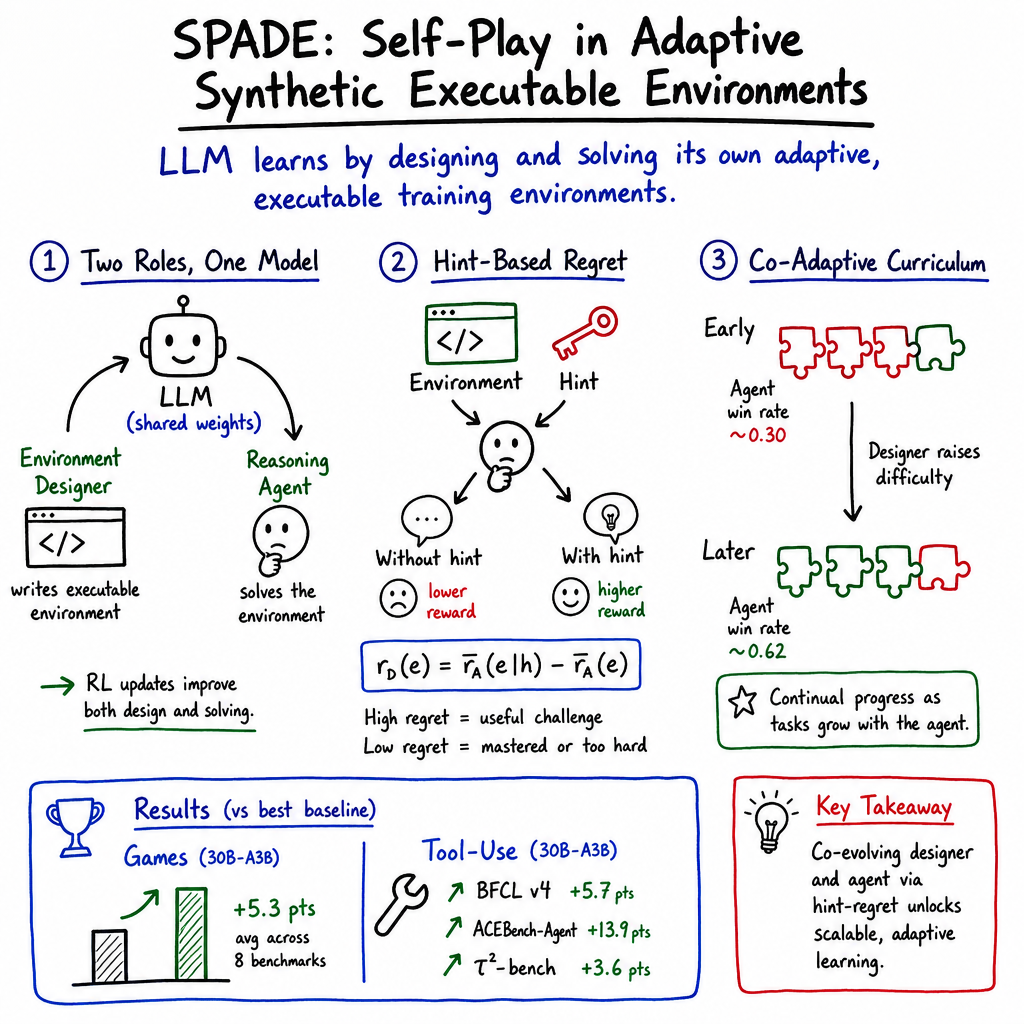
The system uses one LLM in two roles:
- Environment Designer: creates new games, puzzles, and tool-use tasks by writing computer code.
- Reasoning Agent: tries to solve those tasks and receives rewards for doing well.
The idea is similar to a teacher and student who keep challenging each other. As the student improves, the teacher creates harder lessons.
2. What questions does the research ask?
The researchers mainly wanted to find out:
- Can an AI design useful training environments by itself?
- Can the AI’s environments become harder as the AI gets better?
- Does training on these changing environments improve general abilities, such as mathematics, science, coding, reasoning, and using tools?
- Which parts of SPADE are most important? For example:
- Should the designer use information from real documents?
- Should it remember environments created in the past?
- Is the special “hint-based regret” reward useful?
- Does the approach still work with larger LLMs?
3. How did the researchers do it?
The two roles
SPADE uses one LLM, but gives it different instructions depending on its role.
As the Environment Designer, the model writes a complete Python program for a task. This program includes:
- The starting situation
- The possible actions
- How the situation changes after each action
- The reward for success
- The rules for deciding whether the task was completed correctly
For example, it might write a Wordle-like game. The agent guesses words, receives feedback, and eventually wins or runs out of turns.
As the Reasoning Agent, the same model interacts with the environment step by step. It must think, make decisions, and try to earn as much reward as possible.
What is an “environment”?
In this paper, an environment is the world or task in which the AI acts. It could be:
- A mathematics puzzle
- A science reasoning challenge
- A coding problem
- A deduction game
- A task involving several tool calls or conversations
The environment is represented as executable code. This means the computer can run it and check whether the agent succeeded.
Reinforcement learning
The researchers use reinforcement learning, a method similar to training a dog with rewards.
The agent tries different actions. Good results receive higher rewards, and poor results receive lower rewards. Over many attempts, the model changes its behavior to increase its future rewards.
They use a method called GRPO. In simple terms, the model produces several possible answers, compares their scores, and learns more from the better attempts.
The hint experiment
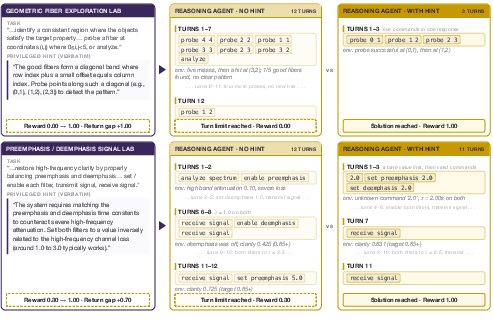
The Environment Designer also creates a privileged hint. This is useful information that helps solve the task but does not directly reveal the answer.
The Reasoning Agent plays the same task twice:
- Once without the hint
- Once with the hint
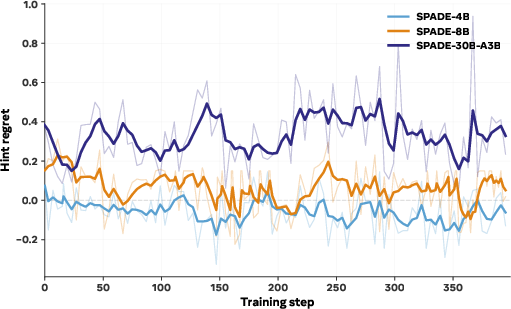
The difference between these scores is called hint-based regret:
This helps identify tasks that are difficult but still possible.
For example:
- If the agent succeeds both with and without the hint, the task is probably too easy.
- If it fails both times, the task may be impossible or too difficult.
- If it succeeds with the hint but struggles without it, the task is at the right difficulty for learning.
The Environment Designer is rewarded for creating tasks in this middle category.
Using documents and memory
SPADE uses two important sources of information:
- Documents: The designer reads material from mathematics, science, programming, and other parts of a large training-data collection. This gives it new ideas for creating tasks.
- Environment memory: The system stores old environments and their difficulty levels. This helps the designer avoid repeating tasks that the Reasoning Agent has already mastered.
The documents help answer: “What should the task be about?”
The memory helps answer: “How difficult should the task be?”
Testing the method
The researchers trained several versions of the Qwen3 LLM:
- A 4-billion-parameter model
- An 8-billion-parameter model
- A 30-billion-parameter model
They tested SPADE on:
- Mathematics
- Science
- Coding
- General reasoning games
- Multi-step tool use
They compared it with systems trained on fixed environments, including a strong fixed-environment method called RLVE.
4. What did they find?
SPADE improved general reasoning
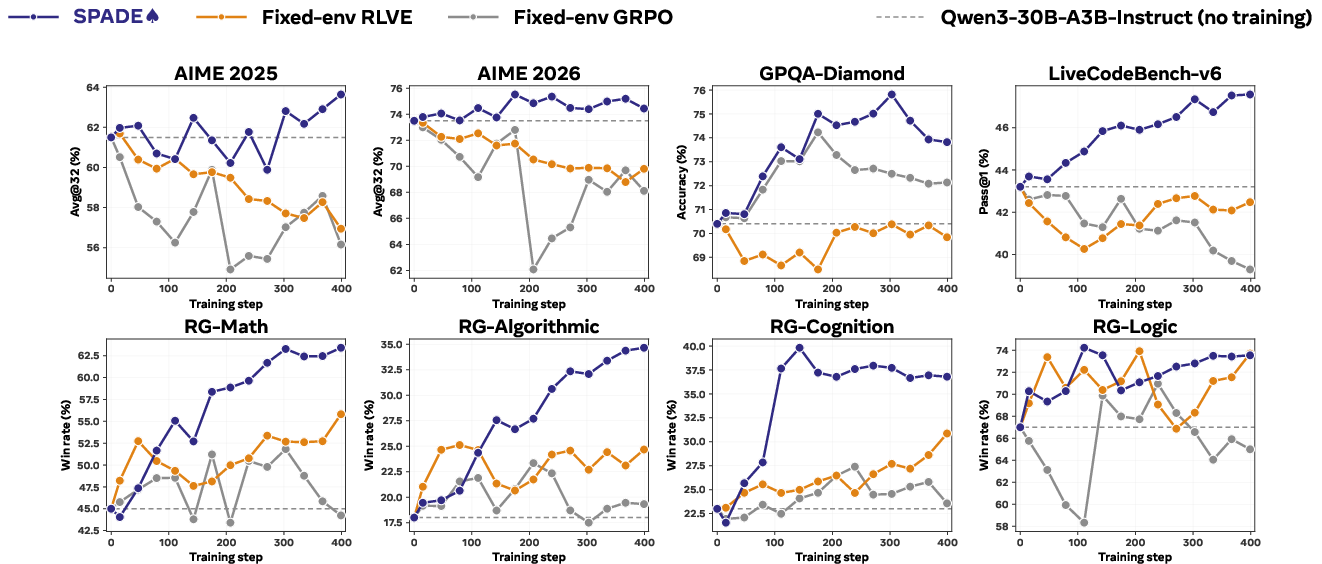
In the games setting, SPADE improved performance across eight tests involving mathematics, science, coding, and different types of reasoning.
For the 30-billion-parameter model, SPADE was about 5.3 percentage points better on average than the strongest fixed-environment comparison system, according to the paper’s summary. On some individual tests, the improvement was even larger.
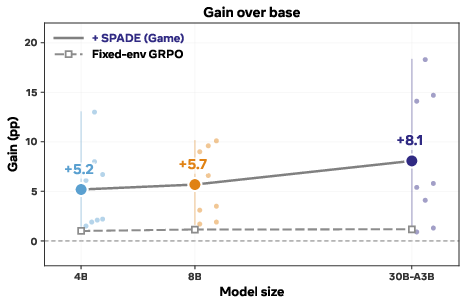
The gains were seen at different model sizes:
| Model size | Improvement over the strongest fixed-environment baseline |
|---|---|
| 4B | About 1.6 points |
| 8B | About 1.7 points |
| 30B | About 5.3 points on average in the abstract |
The detailed table also shows particularly strong improvements on procedural reasoning games.
It helped with tool use
SPADE also trained agents to perform multi-step tasks using tools, such as calling functions or working with different services.
For the largest model, the paper reports improvements of:
- +5.7 points on the multi-turn BFCL benchmark
- +13.9 points on ACEBench-Agent
- About +7.7 points overall across the listed tool-use results
This is important because tool-use tasks often require several connected decisions rather than one simple answer.
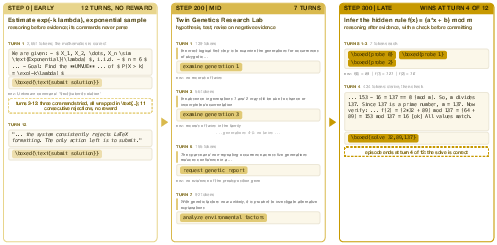
The environments became more complex
The researchers observed that SPADE’s generated tasks changed over time.
At first, the tasks tended to involve one simple skill. Later, they included:
- Several rules at once
- More steps
- Information that had to be remembered
- Conditions that had to be satisfied in a particular order
- Longer interactions
This suggests that the Environment Designer was creating a kind of automatic curriculum—a series of lessons that become more challenging as the student improves.
Documents and memory were important
The experiments showed that two parts of SPADE were especially useful:
- Grounding the designer in outside documents helped it create more varied and original environments.
- Remembering past environments helped it avoid repeating tasks and keep difficulty near the agent’s current ability.
Without these parts, the designer was more likely to create similar tasks or tasks that were either too easy or too difficult.
Hint-based regret worked well
The researchers compared hint-based regret with another method based on tracking whether the agent’s learning seemed to be improving.
They found that hint-based regret was more effective at choosing tasks that were challenging but still learnable.
5. Why are these findings important?
A major problem in AI training is that creating good interactive tasks takes a lot of human effort. People must design the task, write its rules, and create a reliable way to check answers.
SPADE suggests that an AI model can help automate this process. Instead of using the same practice questions forever, the model can:
- Create a new task
- Check that the task works
- Try solving it
- Measure how difficult it is
- Learn from the experience
- Create a better task next time
This could make AI training more flexible and less dependent on large collections of human-written exercises.
6. Possible impact and limitations
If the approach continues to work, SPADE could help build AI agents that improve at many different skills, including reasoning, coding, science, and using computer tools.
Its most important idea is that the training environment should improve along with the learner. A smarter agent gets smarter practice instead of simply repeating old exercises.
However, there are also challenges:
- AI-generated code could contain mistakes or unfair rules.
- The system might create tasks that look interesting but do not teach useful skills.
- Rewards can sometimes be “hacked,” meaning the agent finds a shortcut that earns points without truly solving the problem.
- The experiments were performed by the paper’s authors, so other researchers will need to reproduce the results.
- Better performance on these tests does not automatically prove that the model has human-like understanding.
Overall, SPADE is an important step toward self-improving AI systems. It shows that an AI can potentially learn not only by solving problems, but also by inventing new and increasingly difficult problems for itself.
Knowledge Gaps
Knowledge gaps, limitations, and open questions
The paper leaves the following issues unresolved:
- Long-term open-endedness is not demonstrated. Experiments cover only 400 rollouts, so it remains unknown whether SPADE continues generating increasingly novel and difficult environments after many training cycles or eventually collapses into repetitive task patterns.
- The relationship between environment complexity and agent capability is not quantified. The paper reports qualitative curriculum progression, but does not provide metrics for environment novelty, structural complexity, horizon length, or information-theoretic difficulty over training.
- Generalization to genuinely unseen environment structures is unclear. Held-out benchmarks test capabilities such as math, science, code, and tool use, but do not establish whether the agent can solve independently generated environments with novel transition dynamics, reward structures, or interaction protocols.
- The benefits of executable code as an environment representation are not isolated. There is no controlled comparison against equivalent natural-language tasks, parameterized environments, or pre-written multi-turn MDPs with matched task difficulty and training compute.
- Hint-based regret may be an unreliable proxy for learnability. A high return gap can result from misleading, incomplete, or unusually informative hints rather than from an environment that is genuinely appropriate for training at the agent’s capability frontier.
- The quality and correctness of generated hints are not independently evaluated. The study does not measure whether hints are valid, sufficient, non-leaking, or consistent with the environment’s actual solution.
- The environment’s verifier is not independently trusted. Because the Environment Designer writes transition, reward, and verification code, the system may generate flawed or exploitable reward functions that pass execution checks while failing to represent the intended task.
- Validation is too weak to establish semantic correctness. Syntax checks and basic executability do not detect reward hacking, unreachable states, trivial solution exploits, inconsistent termination conditions, excessive stochasticity, or environments whose intended and implemented objectives differ.
- The extent of reward hacking is not reported quantitatively. Although the paper mentions reward-hacking avoidance, it does not provide systematic rates, failure categories, examples across domains, or comparisons with stronger external verifiers.
- The contribution of the difficulty anchor is confounded with hint-based regret. The deployed designer reward combines the two signals with fixed weights, but the experiments do not fully disentangle their individual effects across model scales, domains, or training stages.
- Theoretical guarantees rely on idealized assumptions. The equilibrium analysis assumes valid environments, best responses, reliable hints, and ideal optimization; the paper does not establish whether these conditions hold under finite sampling, shared parameters, delayed updates, noisy rewards, or invalid generated programs.
- Shared-parameter dual-role training may cause objective interference. The experiments do not analyze whether updates that improve the Environment Designer degrade the Reasoning Agent, or vice versa, nor whether separate models or adapters would produce more stable training.
- Training stability is insufficiently characterized. Results appear to rely on a specific combination of delayed updates, importance sampling, asymmetric clipping, role-specific normalization, reward flooring, and weighting, but sensitivity to these choices is not systematically reported.
- The robustness of results across random seeds is unknown. The paper does not clearly report confidence intervals, standard deviations, statistical significance, or the number of independent training runs for the main comparisons.
- Compute and sampling efficiency are not fully compared. Improvements are reported after a fixed number of rollouts, but the paper does not compare methods at equal token budgets, environment-generation cost, verifier-execution cost, wall-clock time, or total RL compute.
- The strongest-baseline comparisons may not be fully controlled. Some tool-use reference results are transcribed from other papers, use different models or protocols, and omit benchmarks; this limits conclusions about superiority over dedicated environment-synthesis systems.
- The impact of corpus grounding is not separated from corpus content and scale. Removing grounding may reduce performance because of less data, different domains, or reduced prompt information, so the paper does not establish which properties of the external corpus cause the observed gains.
- Potential pretraining contamination is not addressed. The corpus used for environment generation and the held-out evaluation benchmarks may overlap in content or sources, particularly for code, scientific documents, and web-derived tasks.
- The memory mechanism is underspecified as a source of causality. It is unclear whether memory improves performance because it promotes novelty, retrieves high-regret environments, changes the sampling distribution, or simply increases the effective amount of training data.
- Memory growth, selection, and forgetting behavior are not evaluated over long runs. The paper does not investigate memory size limits, stale environments, duplicate accumulation, retrieval errors, or whether early environments disproportionately influence later curricula.
- Environment diversity is measured indirectly. The paper claims that corpus grounding and memory prevent mode collapse, but does not report rigorous diversity metrics, semantic clustering, duplication rates, or distributional coverage.
- The source of benchmark gains is not localized. It remains unclear whether improvements arise from general reasoning, better instruction following, exposure to recurring task templates, coding skill, tool-use formatting, or adaptation to evaluation conventions.
- Transfer across domains is not systematically tested. The study reports games and tool-use results separately but does not establish whether training on one environment family improves performance on the other or whether joint multi-domain training produces interference.
- Scaling conclusions are limited. Only three Qwen3 backbones are evaluated, with no comparison across model families, architectures, tokenizer differences, dense versus mixture-of-experts models, or models substantially larger than 30B parameters.
- The role of model reasoning modes is confounded. The 8B model uses thinking while the 4B and 30B models use instruct configurations, making cross-scale comparisons difficult to interpret.
- The method’s dependence on Python and sandbox infrastructure is unresolved. The paper does not evaluate environments requiring external services, persistent state, realistic latency, continuous actions, visual observations, or non-Python execution.
- Safety and security risks of generated executable code are not analyzed. A system that writes and runs arbitrary Python environments could introduce filesystem access, network calls, resource exhaustion, hidden side effects, or malicious code, yet the paper does not specify a comprehensive isolation and auditing protocol.
- Real-world tool-use validity is uncertain. Synthetic API and tool-use environments may not capture authentication failures, latency, partial observability, changing external state, ambiguous documentation, or costly irreversible actions found in real deployments.
- Partial observability and uncertainty are largely excluded. The generated environments are described as fully observed, leaving open whether SPADE works when the agent must infer hidden state, maintain beliefs, or cope with noisy observations.
- The effect of stochastic environments is not studied. It is unclear how hint-based regret and environment validation behave when outcomes are probabilistic, seeds materially alter difficulty, or returns have high variance.
- The training curriculum may overfit to the designer’s own capabilities. Since the same model generates hints, environments, and solutions, the resulting task distribution may reflect the model’s stylistic and conceptual biases rather than broad capability frontiers.
- External oversight is absent from the core loop. The paper does not determine whether independent models, human reviewers, formal verifiers, or ensemble judges are necessary to prevent shared-model errors from propagating through both environment design and evaluation.
- Continual-learning side effects are not reported. The study does not assess catastrophic forgetting, regression on general instruction following, calibration, factuality, safety behavior, or capabilities unrelated to the synthetic environments.
- The durability of improvements is unknown. There is no evaluation of whether SPADE-trained capabilities persist after removing the environment memory, corpus grounding, or training-specific prompting conventions.
- The claimed “any computable MDP” expressivity does not imply practical learnability. The paper does not characterize which classes of code-defined environments can actually be generated, validated, explored, and solved under finite context, token, and rollout budgets.
- Failure modes of environment generation are not systematically catalogued. Future work would benefit from a taxonomy covering invalid code, trivial tasks, impossible tasks, specification ambiguity, hint leakage, exploitable rewards, duplicate environments, and excessively long-horizon environments.
Practical Applications
Immediate Applications
- Adaptive post-training for language agents (software/AI industry).
Organizations can use SPADE’s
reset()/step()executable-environment format to generate and train on interactive reasoning, coding, planning, and tool-use tasks. A practical workflow is: sample a domain document, generate a Python environment and verifier, run syntax/execution checks, measure agent performance with and without a hint, and retain environments near the agent’s solvability frontier. This can complement or replace portions of fixed RLVR/RLHF task pools, especially where static environments begin to saturate. Dependency: Requires an LLM capable of reliably generating executable code, a secure sandbox, sufficient inference/RL compute, and trustworthy reward verification. - Automated curriculum generation for agent training (education and enterprise training). The hint-based regret signal and environment memory can produce progressively harder exercises in mathematics, science, programming, logic, and procedural reasoning. Educational platforms or internal training systems could generate tasks that are neither trivial nor impossible for a particular learner or model. Dependency: Difficulty estimates must be calibrated to the target learner; generated tasks should be reviewed for correctness, accessibility, and alignment with curricular objectives.
- Tool-use and API-agent training (software, customer support, enterprise automation). SPADE can generate multi-turn environments that simulate API calls, parameter errors, long-context interactions, and sequential workflows. Potential products include synthetic training suites for CRM agents, travel or retail assistants, IT-support copilots, and coding agents. The reported gains on BFCL multi-turn and ACEBench-Agent indicate particular value for tasks requiring stateful interaction rather than single-step answers. Dependency: Simulated APIs must accurately reflect production interfaces, authentication behavior, rate limits, failure modes, and business rules. Performance in synthetic environments should be validated against real API traces.
- Automated regression and stress testing for AI agents (software quality assurance). Generated environments can serve as adversarial test cases for tool-calling, planning, memory, and recovery behavior. Teams could periodically regenerate environments from updated API documentation or incident reports and use them as continuous integration tests. The environment memory can preserve previously discovered failures while the designer explores related variants. Dependency: Generated verifiers must not contain reward bugs, and test environments must be isolated from production systems. Coverage and failure reproducibility need to be measured.
- Executable benchmark generation for academic research. Researchers can use the framework to create held-out, multi-turn benchmarks with explicit transition logic and verifiable rewards. This supports controlled studies of planning horizons, tool use, curriculum learning, self-play, and open-endedness without manually authoring every environment. The public code and project resources could also support reproducibility and baseline comparisons. Dependency: Benchmark validity depends on preventing train–test contamination, documenting generation seeds and prompts, auditing environment code, and ensuring that performance reflects generalization rather than exploitation of generator artifacts.
- Domain-specific agent evaluation and red teaming (finance, healthcare, law, and public services). With appropriate domain documents, SPADE-style environments could test whether agents follow multi-step procedures, handle contradictory information, ask for missing data, and recover from tool failures. For example, environments could simulate financial reconciliation, insurance workflows, medical scheduling, or regulatory-document analysis. Dependency: These applications should initially be evaluation-only. They require expert-authored constraints, privacy-preserving source material, regulatory review, and explicit separation between simulated results and real decisions.
- Research infrastructure for environment validation and reward-hacking detection. The paper’s validation pipeline—syntax checks, executability checks, reward inspection, and difficulty filtering—can be adopted as a general toolchain for synthetic RL environments. A practical platform could provide code linting, sandboxed execution, trajectory replay, reward-distribution monitoring, and detection of environments that are unsolvable or exploitable. Dependency: Static validation cannot establish semantic correctness; human or trusted-model review remains necessary, particularly for environments with complex verification logic.
- Personalized practice and interactive problem solving in daily life. A consumer assistant could generate adaptive puzzles, coding exercises, language-learning interactions, or household planning tasks that become more complex as the user improves. The environment-memory concept could track mastered skills and generate variations rather than repeating identical questions. Dependency: User modeling, privacy protection, age-appropriate content controls, and safeguards against confidently incorrect feedback are essential.
Long-Term Applications
- Continual self-improving general-purpose agents (AI industry and research). SPADE points toward agent training systems in which the model continually expands its own supply of executable learning environments as its capabilities increase. Such systems could combine corpus grounding, accumulated environment memory, and adaptive difficulty to support long-horizon post-training beyond a finite human-curated task set. Dependency: Sustained improvement requires preventing mode collapse, self-reinforcing errors, verifier manipulation, distribution drift, and degradation of previously learned capabilities. The paper demonstrates improvement over fixed baselines, but not unrestricted open-ended improvement in real-world environments.
- Large-scale simulation for robotics and embodied AI (robotics). The code-as-environment abstraction could be extended from language-only interactions to simulated physical tasks: navigation, manipulation, assembly, household procedures, and robot-tool coordination. A designer could generate increasingly difficult worlds and recovery scenarios while a robot policy learns through interaction. Dependency: Realistic physics, sensor noise, embodiment constraints, sim-to-real transfer, and safe exploration are major requirements. Generated Python environments alone do not guarantee physical realism.
- Autonomous software engineering laboratories (software development). Future systems could generate repositories, issue trackers, test suites, deployment constraints, and tool interfaces as complete environments. Coding agents would then practice debugging, feature implementation, version-control workflows, and incident response in progressively harder simulated projects. Dependency: Environments need semantically meaningful tests rather than superficial pass conditions. Security isolation is critical because generated code may execute arbitrary commands or contain malicious behavior.
- Healthcare workflow simulation and clinical decision-support training (healthcare). With expert oversight, adaptive environments could simulate patient records, diagnostic uncertainty, triage, scheduling, medication checks, and communication with clinical tools. Agents could be trained to gather information, defer appropriately, and follow multi-step protocols rather than merely answer medical questions. Dependency: Clinical validity, patient-safety evaluation, de-identification, regulatory compliance, and expert-designed reward functions are mandatory. Such systems should not autonomously diagnose or treat patients without extensive prospective validation.
- Policy and public-sector planning simulators (policy and government). Governments could use adaptive executable environments to train or evaluate agents for emergency response, benefits administration, infrastructure planning, or regulatory compliance. Environments could include changing state, incomplete information, multiple stakeholders, and explicit procedural constraints. Dependency: Policy simulations inevitably encode normative assumptions. Models would need transparent objectives, audit trails, fairness testing, public accountability, and safeguards against optimizing a proxy rather than the intended social outcome.
- Energy-system and climate adaptation planning (energy and sustainability). The framework could generate stateful environments for grid balancing, storage dispatch, demand response, maintenance scheduling, and disaster preparation. An agent could learn policies under changing demand, weather, equipment failures, and market conditions. Dependency: Deployment would require high-fidelity physical and economic models, reliable forecasts, robust optimization under uncertainty, and human approval. Synthetic environments must be calibrated against historical and live operational data.
- Finance and operations optimization (finance and logistics). SPADE-style environments could train agents for multi-step portfolio operations, fraud-investigation workflows, procurement, inventory management, and supply-chain recovery. Hints could identify whether a task is difficult because of planning, missing information, or tool coordination, enabling targeted curriculum generation. Dependency: Financial simulators must model transaction costs, market impact, adversarial behavior, and regulatory limits. Poorly designed rewards could encourage unsafe risk-taking or compliance violations.
- Open-ended multi-agent societies and strategic simulation (academia, policy, and games). Extending the dual-role framework to multiple designers, agents, and stakeholders could produce evolving games or social simulations for studying cooperation, competition, negotiation, and institutional design. The same mechanism could generate training scenarios for diplomacy, cybersecurity, or emergency coordination. Dependency: Multi-agent reward design is vulnerable to collusion, exploitation, deceptive behavior, and unstable dynamics. Interpretation and governance become more difficult as environments and objectives co-evolve.
- Self-maintaining benchmark and curriculum ecosystems. In the longer term, research communities could maintain continuously evolving benchmark suites whose environments adapt to model capability while preserving archived versions for comparability. Memory would retain known weaknesses, while corpus grounding would introduce new concepts and task structures. Dependency: Scientific validity requires stable evaluation protocols, versioning, leakage prevention, independent verification, and mechanisms ensuring that benchmark difficulty reflects genuine capability rather than increasingly idiosyncratic task generation.
- General-purpose “training environment as a service” platforms. The paper’s approach could support commercial platforms that generate, validate, host, and score interactive environments for foundation-model developers. Such platforms might expose Gym-compatible environments, telemetry dashboards, curriculum controls, and domain-specific simulators for coding, tools, robotics, and enterprise workflows. Dependency: Commercial viability depends on reducing inference and verification costs, offering strong security guarantees, supporting reproducible environments, and demonstrating transfer from synthetic training to real-world performance.
Glossary
- Advantage: A reinforcement-learning quantity estimating how much better an action performs than a baseline; “We compute group-normalized advantages”
- Adversarial environment design: Creating environments that challenge an agent, often by optimizing against its weaknesses; “PAIRED introduced adversarial environment design with minimax regret”
- Agentic task: A task requiring an autonomous agent to perform multiple actions, often using tools, over time; “multi-turn agentic tasks”
- Asymmetric clipping: Using different lower and upper limits when clipping policy updates; “We use an asymmetric clipping range”
- Best response: The optimal strategy against a particular opponent or informational condition; “For a policy that best-responds to the hint”
- Code-as-environment: Representing an interactive training environment as executable program code; “This code-as-environment representation unifies single-turn settings”
- Co-evolution: Mutual adaptation in which multiple interacting systems improve alongside one another; “creating co-evolution where the environment distribution shifts as the Reasoning Agent improves”
- Corpus grounding: Conditioning a model’s generation on information retrieved from an external text corpus; “We treat an external corpus as the mechanism that lengthens that leash”
- Curriculum learning: Training by presenting examples or environments in an organized progression of difficulty; “Curriculum learning and learnability-driven adaptation”
- Difficulty anchor: A reward component that encourages generated tasks to remain within a desired difficulty range; “a flat-top difficulty anchor that pays environments whose Reasoning Agent win rate falls in a target band”
- Dual-role self-play: Self-play in which one model performs two distinct roles, such as designing and solving tasks; “SPADE formulates adaptive environment self-play as a game where a single model acts in two roles”
- Exponential moving average (EMA): A recursively weighted average that emphasizes recent observations; “We compare hint-based regret against an EMA-based learning-potential signal”
- Frontier of capability: The current boundary between tasks an agent can and cannot reliably solve; “targets solvable environments precisely at the frontier of the Reasoning Agent's capability”
- Frozen verifier: A verification mechanism whose parameters or behavior remain unchanged during training; “existing training environment pools (hand-curated, statically synthesized, or frozen-verifier) keep the goal distribution fixed”
- GRPO (Group Relative Policy Optimization): A policy-optimization method that estimates relative advantages from groups of sampled responses; “We train with GRPO”
- Hint-based regret: The performance difference between an agent receiving privileged information and the same agent acting without it; “The Environment Designer is rewarded by the gap between Reasoning Agent performance with and without privileged hints”
- Importance sampling: Reweighting samples from one probability distribution to estimate quantities under another; “we correct the gradient using truncated importance sampling”
- Information symmetry: A condition in which interacting agents possess equivalent information; “ungrounded self-play is bounded by information symmetry”
- Intractable environment: An environment that remains too difficult for the agent even when provided with helpful information; “low regret with low returns even with the hint indicates an intractable environment”
- Long-horizon interaction: Sequential decision-making involving many dependent steps; “complete, long-horizon training environments”
- Markov decision process (MDP): A mathematical model of sequential decision-making in which the next state depends on the current state and action; “representing a full Markov decision process (MDP) with state transitions and reward functions”
- Minimax regret: An objective that minimizes or uses the worst-case performance gap between an agent and an ideal response; “a lightweight estimate of minimax regret”
- Mode collapse: A generative-model failure in which outputs become overly similar and lack diversity; “it narrows toward the patterns it already favors and mode-collapses”
- Multi-agent autocurriculum: An automatically emerging progression of increasingly complex behaviors produced through interactions among multiple agents; “Multi-agent autocurricula provide a complementary route to emergent complexity”
- Nash equilibrium: A state in which no participant can improve its outcome by unilaterally changing its strategy; “every pure Nash equilibrium yields hint-free optimality on every valid environment”
- Off-policy: Describing learning from data generated by a policy different from the one currently being optimized; “Since this delay makes the Environment Designer objective off-policy”
- Open-endedness: The capacity of a system to continually generate novel, increasingly complex objectives or behaviors; “open-ended generation”
- Privileged hint: Information supplied to an agent that is unavailable in the ordinary task condition; “The Environment Designer also emits a privileged hint for each environment”
- Proxy reward: An indirect reward signal used as an approximation of the desired objective; “using uncertainty- or solve-rate-based rewards”
- Regret: The difference between the outcome achieved by a strategy and that of a better available strategy; “The Reasoning Agent's regret is estimated using the gap between its reward with and without privileged hints”
- Reinforcement learning from verifiable rewards (RLVR): Reinforcement learning in which outcomes are scored by an objective, automatically checkable procedure; “reinforcement learning with verifiable rewards (RLVR)”
- Reward hacking: Exploiting flaws or unintended features in a reward mechanism to obtain high scores without accomplishing the intended goal; “a complete training recipe including environment validation, reward hacking avoidance, and curriculum design”
- Rollout: A sampled sequence of actions, observations, and rewards generated by an agent interacting with an environment; “The Reasoning Agent plays every environment times without the hint”
- Self-play: Training through interactions in which a model generates challenges or opponents for itself; “We introduce SPADE (Self-Play in Adaptive Synthetic Executable Environments)”
- State transition: The change from one environment state to another after an action; “Each is a stateful, multi-turn environment (state transitions, reward functions, and verification code)”
- Synthetic environment: A procedurally or model-generated environment created rather than collected directly from human-authored interactions; “Synthetic generation produces environments programmatically”
- Terminal reward: A reward issued when an episode reaches an ending condition; “a problem with a sparse terminal reward”
- Truncated importance sampling: Importance sampling in which extreme weights are capped to reduce variance; “we correct the gradient using truncated importance sampling”
- Unsupervised environment design (UED): Learning or generating training environments without manually specifying each environment instance; “what Dennis et al. termed unsupervised environment design (UED)”
- Verifiable reward: A reward determined by an objective checker, such as a programmatic correctness test; “interactive tasks with verifiable rewards”
- Verifier: A component that checks whether an agent’s output or behavior satisfies the environment’s requirements; “in SPADE the verifier is instead part of each generated environment”
- Zero-sum language game: A multi-agent language interaction in which one participant’s gain equals another’s loss; “multi-turn zero-sum language games”

