Scaling Domain Data Repetition in LLM Pretraining
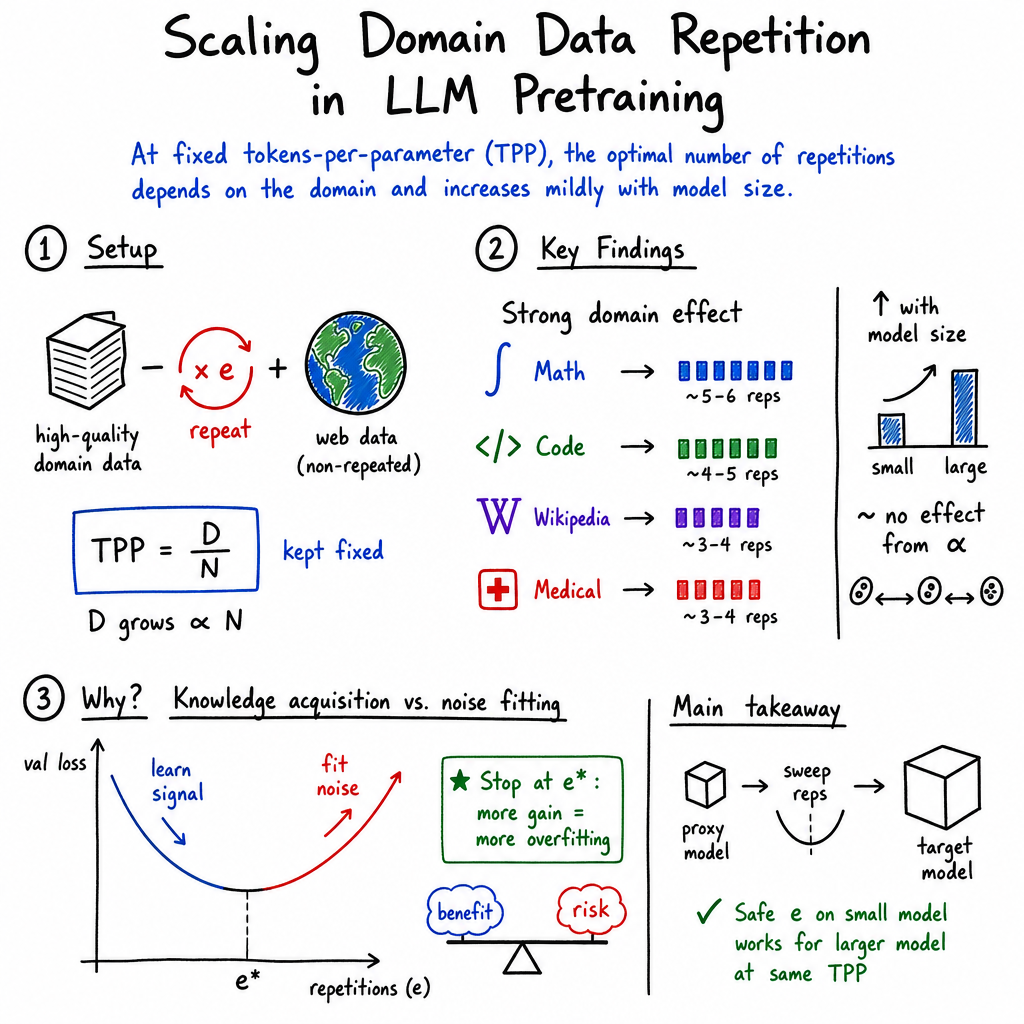
Abstract: As LLMs scale, their training-token budgets must also increase to maintain an appropriate tokens-per-parameter ratio ((\mathrm{TPP})). However, high-quality domain data is much harder to scale than general web data. As model size and the training-token budget increase, its fraction in the training mixture tends to decrease. Repeating the available high-quality data provides an effective way to counteract this dilution, but excessive repetition may lead to overfitting. We study this trade-off under practical LLM scaling, where the training-token budget grows proportionally with model size. For a fixed domain, we first find that, surprisingly at a fixed (\mathrm{TPP}), the optimal repetition count mildly increases with model size. Across different domains, we find that the optimal repetition count is strongly negatively correlated with the final validation loss of a domain: domains with lower loss can generally benefit from more repetitions. In contrast, the amount of unique domain data is only weakly related to the optimal repetition count. These findings suggest that repetition counts tuned on smaller proxy models with the same (\mathrm{TPP}) can provide a practical estimate for larger models.
Paper Prompts
Sign up for free to create and run prompts on this paper.
Top Community Prompts
Explain it Like I'm 14
1. What is this paper about?
This paper studies how many times a LLM should see the same high-quality information while it is being trained.
LLMs learn from huge collections of text, including websites, programming code, mathematics, Wikipedia, and medical writing. General web data is plentiful, but some special types of high-quality data are limited. For example, there may not be enough excellent medical or mathematical text to train a very large model.
One solution is to repeat the available high-quality data. However, repeating the same examples too much can make the model memorize them instead of learning general patterns. The paper investigates how to find the best balance.
2. What questions did the researchers ask?
The researchers mainly wanted to know:
- How many times should high-quality domain data be repeated?
- Does the best repetition number change when the model becomes larger?
- Do different types of data—such as math, code, Wikipedia, and medical text—need different repetition levels?
- Does the amount of unique data affect the best repetition number?
- Can researchers test repetition settings on a smaller model and use the results to train a larger model?
- Does repeating one domain hurt the model’s ability to learn other topics?
- How does the learning-rate schedule affect the amount of repetition a model can handle?
A key idea in the study is the tokens-per-parameter ratio, or TPP. It means:
the total number of training tokens divided by the number of model parameters.
For example, if a model has 1 billion parameters and is trained on 200 billion tokens, its TPP is 200. In realistic large-model training, bigger models usually receive proportionally more training tokens. The researchers kept this ratio roughly fixed.
3. How did the researchers study the problem?
Training different models
The researchers trained models of several sizes. For each model, the total amount of training data increased in proportion to the model’s size.
They separately tested four high-quality data domains:
- Mathematics
- Programming code
- Wikipedia
- Medical information
They also used ordinary web data to fill the rest of the training set.
Changing the amount and repetition of data
For each domain, the researchers changed two things:
- Unique-data fraction: how much different, never-before-seen domain data was available.
- Repetition count: how many times the same selected examples were shown.
They tested repetition counts from 1 to 7. A repetition count of 1 means the examples were shown once; a count of 5 means they were shown five times.
The total training budget stayed the same. Therefore, if more domain examples were repeated, less ordinary web data was used.
An everyday analogy is studying for an exam:
- You have a fixed amount of study time.
- You can read many different pages once.
- Or you can reread a smaller number of especially useful pages several times.
- Rereading may help, but rereading the same pages too much may prevent you from learning anything new.
Measuring performance
The researchers measured validation loss, which is a way of checking how well the model predicts text it has not seen before. Lower validation loss means better performance.
They checked two kinds of performance:
- In-domain performance: how well the model handled the same type of information it was trained on, such as new math text after training on math data.
- Out-of-domain performance: how well it handled different topics, such as news or scientific papers.
Using a simple theoretical model
The paper also developed a mathematical model to explain the experiments. This model divides the effects of training into two competing parts:
- Knowledge acquisition: repeated training helps the model learn important information.
- Noise fitting: repeated training can make the model memorize random details or errors.
The best repetition level is reached when the benefit of learning more knowledge is balanced by the harm from memorization.
4. What did the researchers find?
Different domains need different repetition levels
The best repetition count depended strongly on the type of data.
Approximate results were:
| Domain | Approximate best repetition count |
|---|---|
| Math | 5–6 times |
| Code | 4–5 times |
| Wikipedia | 3–4 times |
| Medical data | 3–4 times |
This means there is no single repetition rule that works equally well for every subject.
Mathematics was more tolerant of repetition. Repeating math examples several times caused only a small performance decrease. Wikipedia, code, and medical data generally became worse sooner when the same examples were repeatedly reused.
Larger models can tolerate slightly more repetition under fixed TPP
When the total training data was increased along with model size, larger models generally benefited from slightly more repetition.
This result may seem surprising because larger models are often thought to overfit more easily. The explanation is that, in this experiment, larger models also received more total training tokens. The additional data helped them continue learning before memorization became a serious problem.
This is different from an experiment where all models receive exactly the same amount of training data. With a fixed data budget, larger models may overfit earlier because they have more capacity but no extra data.
The amount of unique data had little effect on the best repetition count
The researchers changed the amount of unique high-quality data, but the best repetition count stayed nearly the same.
For example, using more unique math data improved the model’s overall score, but it did not greatly change how many times the data should be repeated.
This suggests that researchers do not need to perfectly match the target amount of unique data when testing repetition on a smaller model.
Easier-to-learn domains can handle more repetition
The strongest relationship was between the best repetition count and the domain’s validation loss.
Domains where the model achieved a lower validation loss—meaning the model learned the material more easily—usually benefited from more repetitions. Domains with higher loss tended to overfit sooner.
In simple terms:
If a subject is easier for the model to learn well, the model can often review the same examples more times before the review becomes harmful.
Repetition mainly affects the repeated domain
When the researchers kept the total amount of domain data and web data fixed, replacing unique examples with repeated examples mostly affected performance inside that domain.
For example, repeating math data changed performance on math validation tests, but it caused only small changes on unrelated data such as news and scientific papers.
This suggests that repeating one domain does not necessarily damage the model’s general abilities, as long as the overall mixture of domain and web data is controlled.
The learning-rate schedule matters
The learning rate controls how much the model changes after seeing each training example.
The researchers found that:
- If the learning rate decreased early, the model began suffering from repetition sooner.
- If the learning rate stayed high for longer, the model tolerated more repetitions.
- A constant learning rate allowed the greatest amount of repetition before performance declined.
One possible reason is that a low learning rate makes it easier for the model to closely memorize repeated examples.
5. Why are these findings important?
High-quality training data is expensive and difficult to collect. If researchers can safely repeat some data, they can train larger models without needing an equally large supply of new, specialized examples.
The paper suggests a practical strategy:
- Train a smaller test model using the same TPP as the planned large model.
- Try several repetition counts for each domain.
- Find the repetition level that gives the lowest validation loss without clear overfitting.
- Use that result as a cautious starting point for the larger model.
This can save time, money, and computing power because testing many training recipes on a huge model would be very expensive.
Simple conclusion
The paper shows that repeating training data is neither always good nor always bad. It is a trade-off.
Repeating high-quality examples can help a LLM learn valuable information when new data is scarce. But repeating them too often can cause the model to memorize those examples and perform worse on new material.
The best repetition level depends mostly on:
- What kind of data is being repeated
- How easily the model learns that domain
- The size of the model
- The learning-rate schedule
Under realistic scaling, where larger models receive more training tokens, larger models can usually handle slightly more repetition. The results also suggest that small models can be useful “practice versions” for deciding how to train much larger models. Future research will need to study what happens when several domains are repeated at the same time and how to predict the ideal repetition count more precisely.
Knowledge Gaps
The paper leaves the following knowledge gaps, limitations, and open questions unresolved:
- Limited model-scale range: The empirical claim that optimal repetition increases with model size is based on a restricted and unspecified set of model sizes; it remains unclear whether the trend persists for substantially larger frontier-scale models or eventually reverses.
- Unspecified architecture generality: The experiments do not establish whether the findings hold across different model architectures, parameterizations, tokenizer designs, sequence lengths, or sparsity patterns.
- Narrow tokens-per-parameter regime: Results are reported for a fixed TPP greater than 100, leaving unresolved how the optimal repetition count changes across compute regimes, especially at lower TPP values and near data-constrained training.
- No systematic TPP scaling law: The paper shows behavior at one fixed TPP but does not quantify how optimal repetition varies as a function of TPP or identify a principled joint scaling rule in model size, data size, and repetition count.
- Restricted repetition grid: Repetition counts are evaluated only for . Optima outside this range, including potentially much larger repetition counts for highly learnable domains, are not characterized.
- Uncertainty in estimated optima: Optimal repetition counts are inferred by fitting quadratic functions to a small number of discrete measurements, but confidence intervals, sensitivity to the fitted functional form, and statistical uncertainty across runs are not reported.
- Insufficient treatment of random variation: The paper does not clearly report the number of random seeds or quantify variation caused by initialization, data-subset selection, batch ordering, and optimization randomness.
- Limited unique-data fractions: The conclusion that the optimum is insensitive to unique-data fraction is supported only for . It remains unknown whether this holds for much smaller or larger fractions, or when the unique dataset is comparable to the full training budget.
- Confounding between domain and domain quality: The strong correlation between minimum validation loss and optimal repetition count does not establish that validation loss itself determines repetition tolerance. Domain identity, dataset cleanliness, length distribution, difficulty, redundancy, and tokenization may all be confounded with validation loss.
- No causal mechanism for the validation-loss correlation: The paper does not identify which measurable properties of a domain—such as entropy, noise rate, compositional structure, duplication, or knowledge density—cause low-loss domains to benefit from more repetition.
- Limited domain coverage: Only code, mathematics, Wikipedia, and medical data are studied. The conclusions may not generalize to multilingual, conversational, legal, financial, multimodal, safety-related, or low-resource domains.
- Unclear dataset representativeness: Dataset construction, filtering, deduplication, contamination checks, and the exact amount of genuinely unique content are not described in sufficient detail to determine whether the results depend on particular corpus-processing choices.
- Token-level uniqueness may not equal semantic uniqueness: The experiments treat selected subsets as unique at the token level, but do not test semantic duplication, near-duplicate documents, templated examples, or repeated concepts that may substantially affect overfitting.
- Repetition schedule is not fully characterized: The study appears to revisit fixed subsets, but does not compare contiguous epochs, uniformly interleaved repetition, curriculum-based repetition, or adaptive schedules. The ordering of repeated examples may materially affect memorization.
- Single-domain repetition only: Each run repeats one high-quality domain while filling the remainder with web data. The interactions among simultaneously repeated domains, including competition for model capacity and transfer between domains, remain unexplored.
- No optimization of total domain allocation and repetition jointly: The paper varies repetition while keeping the overall token budget fixed, but does not derive how to jointly choose unique-data amount, repeated-data amount, domain weight, and web-data weight across multiple domains.
- Limited analysis of cross-domain transfer: The OOD evaluation uses only ArXiv and News validation sets and focuses mainly on language-model loss. It does not determine whether repetition improves or harms transfer to downstream tasks, reasoning, coding, factuality, or other domains.
- OOD stability is not broadly established: The conclusion that repetition has limited OOD impact may depend on the selected OOD corpora and fixed-mixture setup; broader evaluations are needed, including domains semantically related and unrelated to the repeated corpus.
- Final-loss evaluation omits training dynamics: The analysis focuses primarily on validation loss at the end of training. It does not characterize when knowledge acquisition, memorization, or degradation occurs during training, nor whether early stopping could outperform fixed-budget training.
- Learning-rate findings are incomplete: Although several schedules are compared, the study does not quantify interactions between repetition and learning-rate magnitude, warmup length, batch size, weight decay, dropout, optimizer choice, or parameter-specific learning rates.
- Optimizer and regularization generality is unclear: Results use Muon with dropout and model-size-dependent hyperparameters, so it is unresolved whether the reported optima apply to AdamW, SGD-like methods, other regularizers, or different hyperparameter-transfer rules.
- Proxy-to-target transfer is not directly validated: The proposed procedure of tuning repetition on a small proxy model is suggested as conservative, but the paper does not provide a systematic held-out evaluation across proxy sizes, target sizes, domains, and repetition choices.
- No quantitative proxy scaling rule: The paper identifies correlations but does not provide a predictive formula or calibrated uncertainty estimate for mapping proxy-model validation loss and optimal repetition to a target model.
- The theoretical model is highly simplified: The one-hot linear-regression model with power-law knowledge frequencies, Gaussian noise, coordinate truncation, and full-batch gradient descent does not capture contextual language modeling, attention, representations, nonlinear feature learning, or parameter sharing.
- Theory–experiment correspondence is under-identified: The theoretical noise variance, source exponent, knowledge-frequency exponent, and stopping iteration are not empirically estimated or mapped to the four language domains, making it unclear which theoretical quantities explain the observed results.
- Theoretical assumptions may not hold for LLM data: Conditions such as , independent one-hot observations, and Gaussian additive noise are not justified for natural-language corpora with correlated sequences, structured labels, contamination, and nonstationary token frequencies.
- The theory addresses optimization time rather than explicit data epochs: The theoretical repetition/stopping variable is not fully connected to the empirical number of dataset revisits under changing learning-rate schedules and token presentation orders.
- Generalization beyond validation loss is unresolved: Lower in-domain loss may correspond to memorization rather than useful domain acquisition. The paper does not evaluate factual accuracy, benchmark performance, calibration, robustness, privacy leakage, or verbatim memorization.
- Potential safety and privacy effects are unexamined: Repeating medical or other sensitive data may increase memorization and privacy risk, but the paper does not measure extraction, membership inference, or harmful retention as a function of repetition.
- Data contamination effects are not assessed: Repeated data may increase overlap with validation or downstream evaluation sets, yet contamination analysis and its influence on the reported optima are not discussed.
- Compute and systems costs are not analyzed: Repetition may reduce data-loading and storage costs but increase optimization or deduplication requirements. The paper does not compare repetition strategies by wall-clock time, energy, memory, or total training cost.
- The safe-repetition claim lacks worst-case guarantees: The statement that a repetition count safe for a smaller model is unlikely to overfit a larger model is empirical and limited to the tested setup; its failure modes and confidence bounds remain unknown.
Practical Applications
Immediate Applications
The paper’s findings can be translated into practical workflows for data-constrained LLM pretraining without requiring a new model architecture. These applications are most feasible when organizations can hold the total token budget and tokens-per-parameter ratio approximately constant.
- Domain-specific pretraining recipe selection for LLM developers (software, cloud AI, enterprise AI)
- Potential tool/workflow: an automated data-mixture tuning pipeline that evaluates repetition counts such as
1–7, fits a quadratic curve to validation loss, and recommends a safe repetition interval. - Assumptions/dependencies: the proxy and target models must use comparable architectures, objectives, optimization settings, data preprocessing, and TPP. The paper’s transfer result is empirical and is not yet a universal scaling law.
- Potential tool/workflow: an automated data-mixture tuning pipeline that evaluates repetition counts such as
- Lower-cost utilization of scarce high-quality datasets (healthcare, education, scientific AI, programming tools)
- Potential products: mathematics tutors, code-completion systems, scientific search models, and domain-adapted assistants trained with carefully repeated expert datasets.
- Assumptions/dependencies: repetition should be optimized by domain; repeating medical or encyclopedic content too heavily may produce larger in-domain degradation. Data licensing, privacy, and copyright constraints remain decisive.
- Domain-aware data mixture optimization (LLM infrastructure, data engineering)
- Potential tool: a mixture configuration file or training scheduler specifying domain, unique-token fraction, repetition count, and validation metrics.
- Assumptions/dependencies: these approximate ranges come from the paper’s tested corpus and model scales; they should not be interpreted as universal defaults for other datasets, languages, or model architectures.
- Compute and data-budget planning (cloud infrastructure, AI operations, finance)
- Operational use: estimate storage, preprocessing, and training costs by separating unique-data acquisition from total token presentations.
- Assumptions/dependencies: the total token budget must scale approximately linearly with model size. If the training-token budget is fixed instead, the paper predicts that larger models become more vulnerable to repetition-induced overfitting.
- Validation-driven monitoring for memorization and overfitting (MLOps, model evaluation)
- Potential workflow: maintain separate IID, OOD, memorization, and downstream-task dashboards.
- Assumptions/dependencies: validation sets must be held out, representative, and free from contamination. Stable OOD loss does not guarantee safe behavior on domain-specific tasks.
- Learning-rate schedule adjustment during repeated-data training (training systems, optimization research)
- Potential tool: a repetition-aware scheduler that changes decay timing based on domain-specific validation curves.
- Assumptions/dependencies: the finding was tested with particular optimizer and training configurations. It may not transfer directly to other optimizers, batch sizes, model architectures, or fine-tuning regimes.
- Academic benchmarking of data-efficient pretraining (academia)
- Useful metrics: minimum validation loss, estimated optimal repetition count, IID–OOD trade-offs, and sensitivity to learning-rate schedules.
- Assumptions/dependencies: comparisons require consistent TPP, data cleaning, tokenizer, model family, and training duration; otherwise repetition effects may be confounded.
- Policy and procurement guidance for public-sector AI datasets (public policy, education, healthcare)
- Potential policy use: require documentation of unique-token volume, repetition counts, validation loss, data provenance, and downstream performance in publicly funded model development.
- Assumptions/dependencies: the paper does not evaluate fairness, temporal freshness, demographic coverage, or safety risks, all of which may worsen when a narrow corpus is repeatedly used.
Long-Term Applications
The results also support broader systems that automatically predict and manage data reuse, but these applications require more validation across models, domains, and deployment settings.
- Automated scaling laws for repetition-aware data mixture optimization (AI infrastructure, research platforms)
- Potential product: a “data recipe compiler” that outputs domain weights, unique-data requirements, repetition schedules, and estimated validation performance before full-scale training.
- Research needed: a quantitative transfer rule beyond the paper’s conservative heuristic, particularly for simultaneous repetition of multiple domains.
- Multi-domain repetition scheduling (general-purpose LLMs, multimodal models)
- Potential workflow: increase repetition for domains with low validation loss and reduce it for domains that show early overfitting, while preserving a minimum web-data fraction.
- Dependencies: interactions among repeated domains may be nonlinear; repeating several domains could alter generalization, interference, and the effective regularization supplied by web data.
- Adaptive online data reuse during pretraining (continual learning, autonomous training systems)
- Potential product: a closed-loop training controller integrated with distributed data loaders and evaluation services.
- Research needed: reliable early-warning signals, low-latency evaluation, stability under changing mixtures, and safeguards against repeatedly selecting only easy or popular examples.
- Quality-aware data acquisition and curation (data markets, scientific publishing, healthcare, education)
- Potential application: rank candidate datasets by marginal value per dollar, distinguishing “repeatable” corpora from “data-expansion-critical” corpora.
- Dependencies: validation loss is only a proxy for usefulness. It may not capture factuality, safety, fairness, novelty, task performance, or distributional coverage.
- Privacy-preserving and regulated-domain training strategies (healthcare, finance, government)
- Potential systems: locally trained or federated models using controlled repetition of institution-specific data.
- Dependencies: repetition can increase memorization and privacy leakage, so differential privacy, membership-inference testing, deduplication, and strict access controls would be required. The paper does not establish that repetition is privacy-safe.
- Data scarcity planning for specialized robotics and edge systems (robotics, embedded AI, industrial automation)
- Potential products: compact code-and-instruction models for robots, factory assistants, or offline technical-support systems.
- Dependencies: the paper studies text pretraining rather than interactive trajectories, multimodal sensor data, or embodied feedback. Transfer to robotics requires experiments with temporal, visual, and action distributions.
- Curriculum design for educational and tutoring models (education)
- Potential workflow: repeat foundational mathematical examples while introducing fresh problems, proofs, and learner contexts to reduce rote memorization.
- Dependencies: lower language-model validation loss does not necessarily imply improved student learning. Human evaluation, pedagogical outcomes, misconception testing, and originality assessments are necessary.
- Auditing standards for training-data reuse (policy, model governance)
- Potential standard: disclose per-domain unique tokens, repetition counts, TPP, sampling schedules, data freshness, and IID/OOD validation results.
- Dependencies: standardized definitions of semantic duplication, near-duplicate content, and domain boundaries are needed. Exact repetition counts alone may miss paraphrased or cross-source duplication.
- Theoretical models for repetition, noise, and model capacity (academia)
- Potential research direction: derive domain- and architecture-specific stopping rules that incorporate label noise, data entropy, model sparsity, tokenizer effects, and compute constraints.
- Dependencies: the theoretical results rely on a simplified one-hot linear-regression model and assumptions such as power-law frequencies and source conditions. More realistic validation is needed before using the formulas for production decisions.
Overall, the most immediately deployable contribution is a proxy-model sweep with fixed TPP, domain-specific validation, and conservative repetition transfer. The main practical caution is that repetition is not a substitute for data diversity in general: its value depends strongly on domain characteristics, optimization schedules, model scale, data quality, and the distinction between in-domain competence and broader generalization.
Glossary
- AdamW: An optimization algorithm that combines Adam’s adaptive updates with decoupled weight decay. “Optimization used the Muon optimizer [24], a variant of AdamW.”
- Binomial distribution: A probability distribution describing the number of successes in a fixed number of independent Bernoulli trials. “where denotes the Binomial distribution.”
- Chinchilla scaling law: An empirical scaling relationship specifying how model parameters and training data should increase together for compute-efficient language-model training. “One line of work extends the Chinchilla scaling law”
- Compute-optimal training: Training in which the model size and data volume are balanced to achieve the best performance for a fixed computational budget. “As model size increases, compute-optimal training also requires an increasing number of training tokens”
- Conservative transfer: Applying a configuration from a smaller model to a larger model in a way intended to avoid harmful overfitting or performance degradation. “It also supports conservative transfer from smaller proxy models”
- Continuous estimate: A real-valued approximation to a quantity that is originally restricted to discrete values. “This continuous estimate reduces the effect of the discrete repetition grid”
- Crossover scale: A threshold at which the dominant behavior of a system changes from one regime to another. “The crossover scale satisfies”
- Data dilution: The reduction in the proportion of a particular data source when the total training dataset grows while that source remains fixed. “repetition offers a direct way to counteract data dilution”
- Data mixture optimization: The process of determining how a fixed training budget should be allocated among multiple data domains. “Data mixture optimization studies how to allocate a fixed training budget across domains”
- Data-repetition scaling law: A quantitative relationship describing how model performance changes as reused training data, model size, or compute budget changes. “deriving repetition-aware mixture scaling laws that jointly characterize domain allocation and data reuse.”
- Domain-specific data: Data associated with a particular subject area and often curated for specialized knowledge or capabilities. “high-quality domain-specific data”
- Excess risk: The difference between a model’s expected prediction loss and the irreducible or optimal prediction loss. “For , define the population excess risk”
- Full-batch gradient descent: An optimization method that computes each update using the entire training dataset rather than a sampled mini-batch. “and run full-batch gradient descent”
- Generalization: The ability of a trained model to perform well on previously unseen examples. “while heavier reuse yields diminishing returns.”
- Global batch size: The total number of training examples processed in one optimization update, potentially aggregated across devices. “we set the learning rate and global batch size for different model sizes”
- Held-out validation set: Data excluded from training and reserved for evaluating model performance. “is the held-out validation set from the same high-quality domain.”
- Implicit regularization: A bias toward particular solutions or behaviors produced by an optimization procedure without an explicit regularization term. “which may reduce this effect through stronger optimization noise and implicit regularization.”
- In-distribution (IID): Evaluation using data drawn from the same distribution as the target training domain. “the in-distribution metric is”
- Knowledge-acquisition error: Error caused by the model failing to learn or represent knowledge units present in the underlying data distribution. “knowledge-acquisition error”
- Knowledge-dense domain: A subject area containing a high concentration of specific, informative facts or concepts. “knowledge-dense domains may only be learned once their mixing ratio exceeds a critical threshold”
- Knowledge unit: An individual conceptual, factual, or informational component represented in the theoretical model. “where each coordinate represents a knowledge unit”
- Learning-rate schedule: The rule governing how the optimization learning rate changes during training. “Finally, we examine whether the optimal repetition count depends on the learning-rate schedule.”
- Marginal effect: The incremental change in an objective caused by a small additional change in an input or training choice. “the optimal repetition count is the point at which the latter marginal effect begins to dominate.”
- Muon optimizer: A specific optimizer used for neural-network training, described in the paper as a variant of AdamW. “Optimization used the Muon optimizer [24]”
- Negative log-likelihood: The negative logarithm of the probability assigned by a model to observed data; lower values indicate better probabilistic prediction. “we define the token-averaged negative log-likelihood as”
- Noise-fitting error: Error resulting from fitting random noise in the training labels rather than the underlying signal. “noise-fitting error”
- Out-of-distribution (OOD): Evaluation on data drawn from a distribution different from the training or target-domain distribution. “We evaluate each trained model using both in-distribution and out-of-distribution validation losses.”
- Power law: A relationship in which one quantity varies as a fixed power of another, often producing heavy-tailed distributions. “and its frequency follows a power law.”
- Population risk: The expected loss of a model over the underlying data-generating distribution rather than a finite sample. “To evaluate the performance, we define population risk and the total expected risk.”
- Proxy model: A smaller or less expensive model used to estimate training behavior or hyperparameters for a larger target model. “we first train a smaller proxy model with the same tokens-per-parameter ratio as the target model”
- Regularization: A mechanism that discourages undesirable model solutions, such as memorization or excessive complexity. “general data can regularize repeated domain data”
- Repetition-aware mixture scaling law: A scaling relationship that incorporates both data-domain allocation and the reuse of finite datasets. “Recent work [23, 31] relaxes this assumption by deriving repetition-aware mixture scaling laws”
- Source condition: A mathematical assumption restricting the decay or structure of the coefficients of a target function to enable theoretical analysis. “###### Assumption 4.1 (Source Condition).”
- Stopping time: The number of optimization iterations at which training is stopped, especially when selected to minimize expected risk. “define the earliest optimal integer stopping time by”
- Tokens-per-parameter ratio (TPP): The number of training tokens processed per model parameter, defined as . “TPP := , where is the total number of training tokens and is the model size.”
- Token-averaged loss: A loss computed by averaging prediction errors over individual tokens rather than over documents or sequences. “we define the token-averaged negative log-likelihood as”
- Training mixture: The combined collection of data domains and their relative proportions used during model pretraining. “its fraction in the training mixture tends to decrease.”
- Validation loss: A model’s loss measured on held-out evaluation data, commonly used to assess generalization and overfitting. “The optimal repetition count is strongly negatively correlated with the final validation loss of a domain.”
- Warmup: An initial training phase in which the learning rate is gradually increased from a small value. “The learning rate was linearly warmed up for the first 200 optimization steps”
- Warmup-stable-decay (WSD): A learning-rate schedule consisting of an initial warmup, a stable period, and a later decay phase. “We compare a warmup-stable-decay (WSD) schedule”
- Weighted signal energy: A measure of the squared magnitude of a target signal after weighting each component by its probability or frequency. “The total weighted signal energy is finite”
- One-hot linear regression: A linear-regression setting in which each input is a standard basis vector, activating exactly one coordinate. “we consider a one-hot linear regression problem in .”