Towards Physics of Multimodal Pretraining: Knowledge Flow, Modality Synergy, Early Unification, and Recipes
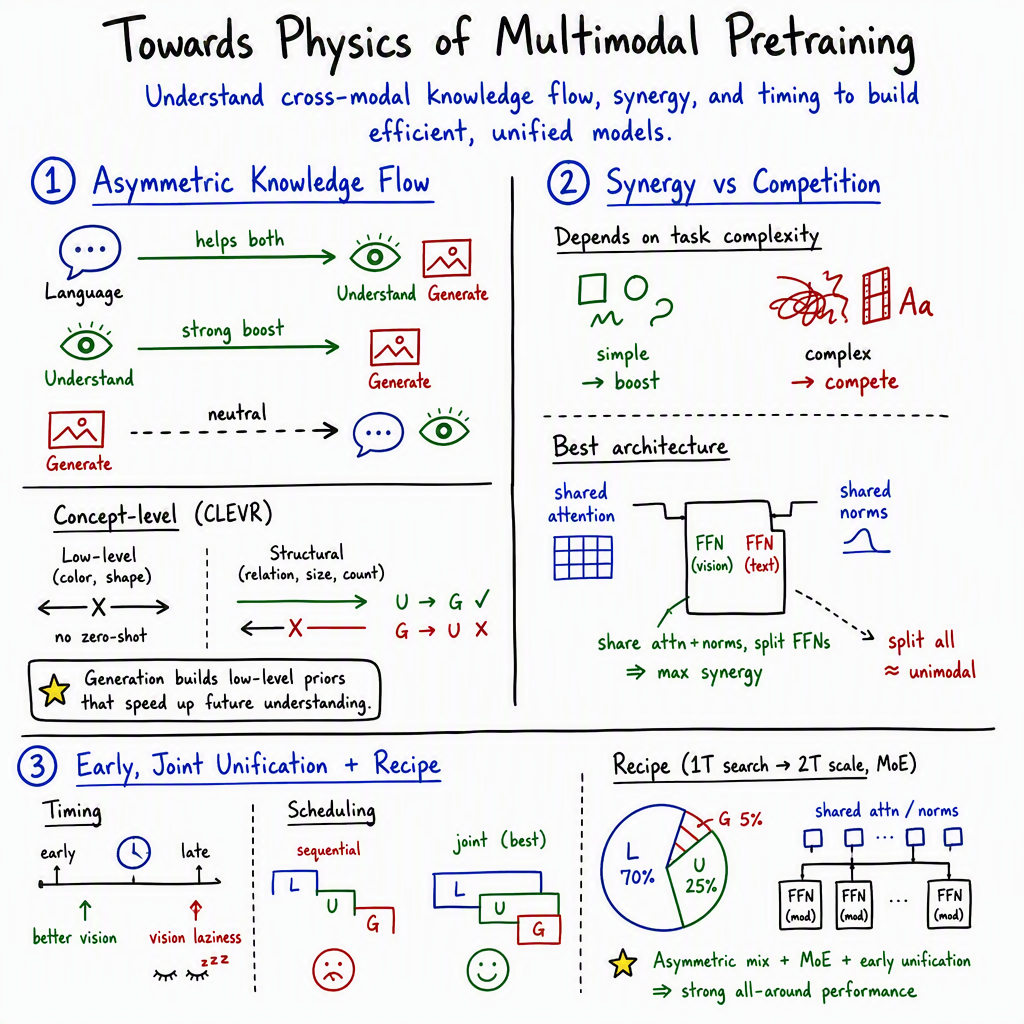
Abstract: Vision offers a critical axis for advancing foundation models, driving a shift towards natively unified multimodal pretraining. Despite this momentum, the design space and the fundamental mechanisms of how modalities interact during unified training remain underexplored. We provide empirical clarity through a systematic exploration of multimodal pretraining. Our controlled experiments on both synthetic and large-scale real-world datasets yield four key insights into the physics of multimodal pretraining: (i) Knowledge Flow: We disentangle how language, visual understanding, and visual generation transfer knowledge across modalities, revealing distinct patterns of influence and asymmetry; (ii) Synergy vs. Competition: We show that data "complexity" largely determines whether modalities are synergistic, identify architectural choices that promote synergy: such as shared attention and normalization with modality-specific feed-forward layers, and find that these behaviors generalize across different visual tokenizer designs; (iii) Early Unification: Unifying modalities from the very early stages and training them jointly is shown to be more effective than late alignment or sequential training. This process uncovers a vision laziness phenomenon, where delayed integration leads models to rely on language priors; (iv) Recipes: We derive efficient pretraining recipes that achieve strong generative performance using only 5% of the compute budget. These core findings are subsequently validated at scale by training multiple 13.5B MoE models on 2T tokens. We hope this study provides a principled foundation for understanding and scaling multimodal pretraining.





Paper Prompts
Sign up for free to create and run prompts on this paper using GPT-5.
Top Community Prompts
Explain it Like I'm 14
Plain-language summary of “Towards Physics of Multimodal Pretraining”
What is this paper about?
This paper studies how AI models that handle both text and images should be trained from the start. The authors want simple, evidence-based rules for building one model that can:
- read and understand text,
- look at and understand images, and
- create images from text.
They call this “unified multimodal pretraining.” Think of it like teaching one student to read, see, and draw—all in the same class—rather than sending them to three separate classes.
What questions did the researchers ask?
The team focused on four big questions:
- Knowledge Flow: If a model learns one skill (like language), does that help its other skills (like generating images)? In which directions does help flow?
- Synergy vs. Competition: When the model learns multiple skills together, do they help each other or fight for attention and memory?
- Early Unification: Is it better to train text and images together from the very start, or add images later?
- Recipes: Based on the answers above, what simple training tips reliably work well and cheaply?
How did they study it?
The authors ran many controlled experiments, like good science labs:
- One model for everything: They used a single Transformer (the standard building block behind many AI models) to handle both text and image tasks. You can imagine the Transformer as a very flexible calculator that reads lists of small chunks called “tokens.” Text becomes word-like tokens; images become grid-like tokens (either raw pixels or compressed versions).
- Real and synthetic data:
- Real-world: Web text for language; millions of image–text pairs for seeing and generating images.
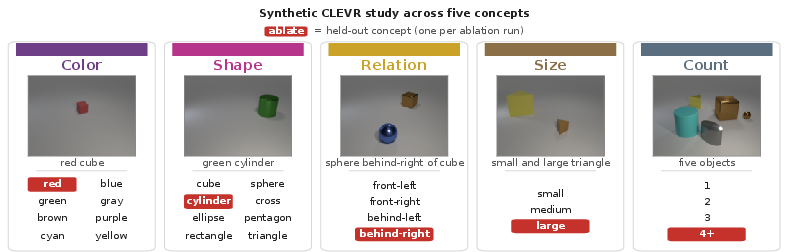
- Synthetic (CLEVR): Computer-made scenes with colored shapes. Because every detail is known, they could carefully remove certain ideas (like “yellow” or “in front of”) from one learning path and see if the model still picks them up from the other. This lets them test cause and effect, not just guess from messy real data.
- Turning knobs on the model:
- Data mix: They tried different amounts of text vs. image data.
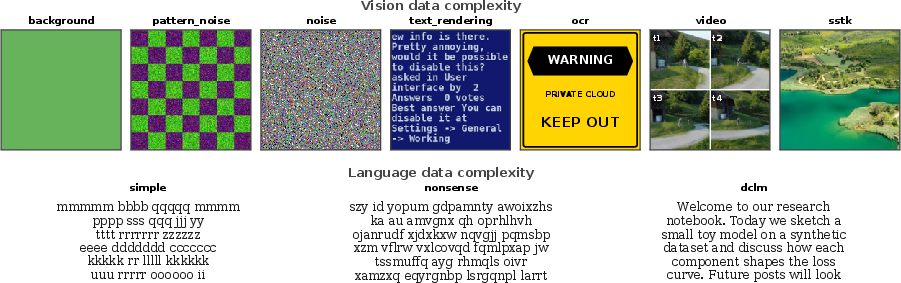
- Task difficulty: They made the vision or language tasks very simple or very complex.
- Architecture sharing: They tested which parts of the network should be shared between text and images (like shared attention) and which should be separate (like separate feed-forward layers), to reduce fighting over capacity.
- Training timing: They introduced vision early or late to see how timing changes learning.
- Measuring results:
- Language understanding: Standard question-answer and reasoning tests.
- Visual understanding: Visual question answering (VQA), OCR-like tasks (reading text in images), spatial reasoning, charts, and more.
- Image generation: How well images match text prompts and overall image quality.
In everyday terms: they treated the model like a student, tried different teaching schedules and classroom setups, and measured test scores across subjects.
What did they find, and why does it matter?
Here are the main takeaways and why they’re important.
- Knowledge Flow (who helps whom)
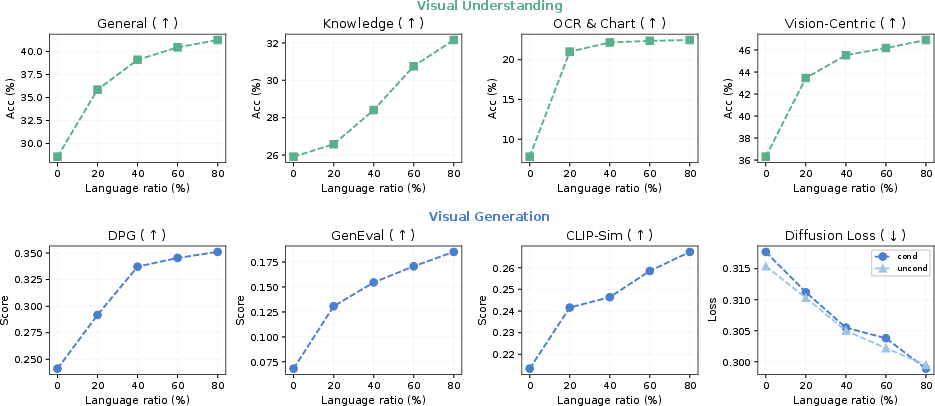
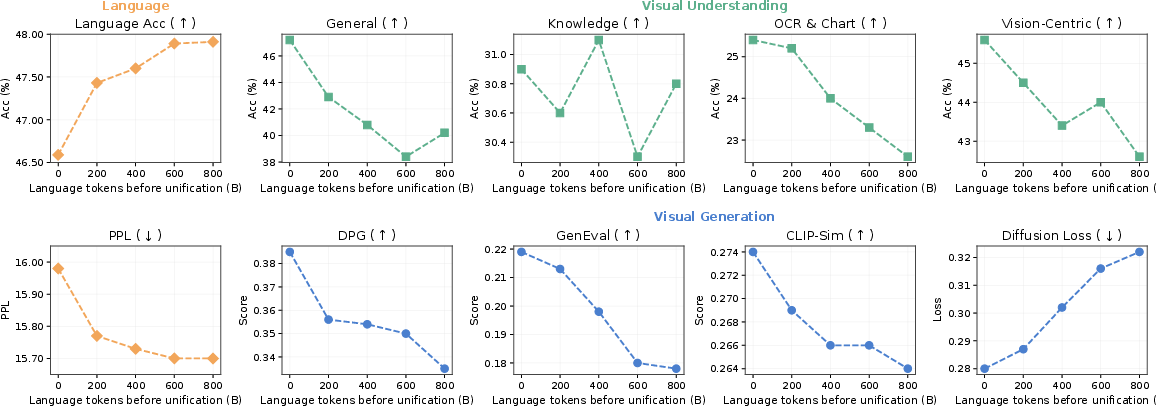
- Language strongly helps vision. More text training improves both understanding images and generating them. Reason: strong language gives the model a good mental map of the world.
- Visual understanding helps image generation. If the model gets good at describing what it sees, it gets better at drawing from descriptions.
- Image generation doesn’t clearly help language or visual understanding by itself. It doesn’t usually hurt, but it rarely boosts the other skills.
- Concept-dependent transfer (from the synthetic CLEVR tests)
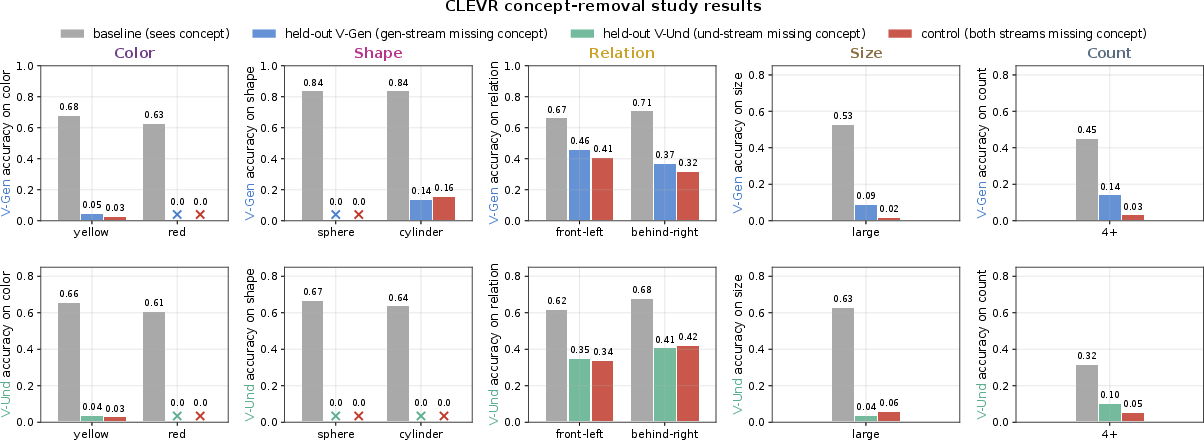
- Low-level details (color, shape) don’t transfer zero-shot between understanding and generation. If the model never learned “yellow” in generation, it can’t generate yellow—no matter how well it recognized yellow in understanding. And vice versa.
- Higher-level structure (spatial relations like “in front of,” size, and counting) does transfer from understanding to generation. Learning to describe structure helps the model draw that structure.
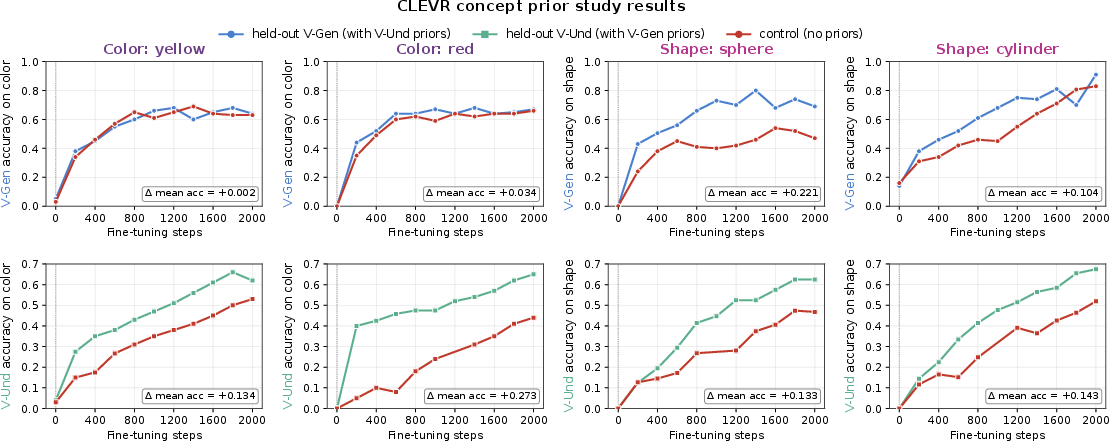
- Hidden priors: Even when zero-shot transfer fails, generation can secretly build useful low-level visual foundations. After a little fine-tuning, models that practiced generation learn to understand colors/shapes faster than models with no prior. In short: generation trains the eye; understanding trains the language and logic.
- Synergy vs. Competition (when do skills help or hurt each other?)
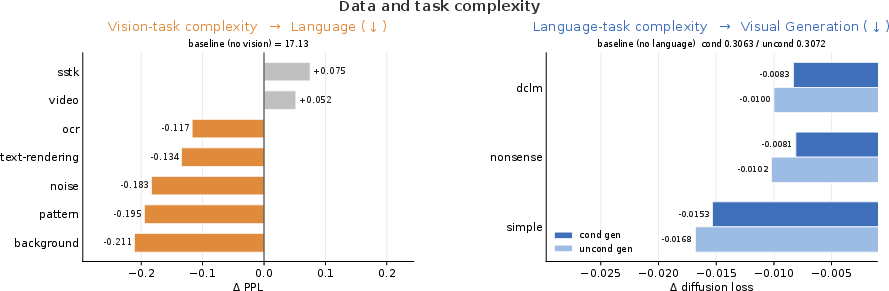
- Simple tasks boost the other modality. Pairing language with very simple vision (like solid-color images) can actually make the LLM better, and simple language can help image generation the most.
- Complex tasks can compete for capacity. Realistic photos and videos plus rich language push the model to its limits, and the skills can start to clash unless the architecture is designed well.
- Architecture matters:
- Share attention and normalization layers across text and image to encourage synergy (they help the model line up what it reads and what it sees).
- Keep feed-forward layers separate per modality to reduce fighting (each skill gets its own “workbench”).
- Early Unification (train together from the start)
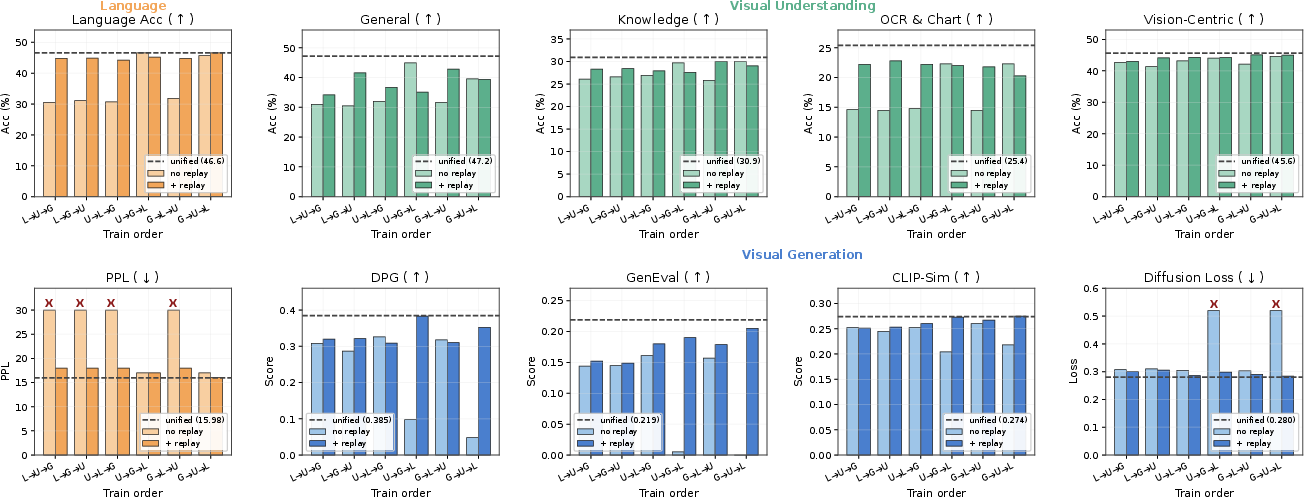
- Start training with text and images together. If you add vision late, the model leans too heavily on language shortcuts and becomes “vision-lazy,” making it harder to learn strong visual skills later.
- Practical Recipes (what to actually do)
- Use more language than vision data (asymmetric mix) because language is a great teacher for vision.
- Train text and images together from the beginning (early unification).
- In the Transformer block, share attention and normalization, but split the feed-forward networks by modality.
- These choices let them reach strong image generation with only about 5% of the usual compute. They also validated the rules at larger scale (mixture-of-experts models trained on trillions of tokens).
So what’s the impact?
- For building smarter multimodal AIs: These results give clear, evidence-based rules for training one model to read, see, and draw more efficiently and effectively.
- For safer, cheaper scaling: The recommended recipes save compute while improving quality, which is good for both research and industry.
- For better design choices: The findings explain why some techniques work (or don’t), helping teams avoid guesswork—share the right parts of the network, separate others, and train early and jointly.
- For future capabilities: Stronger, more unified models could lead to better assistants that understand instructions, read documents, analyze charts, and create accurate images—all in one place.
Knowledge Gaps
Knowledge gaps, limitations, and open questions
Below is a single, consolidated list of concrete gaps and open questions the paper leaves unresolved. Each item identifies a missing piece or uncertainty that future work could address.
- Generalizability of knowledge-flow asymmetry beyond specific datasets: Does the observed language→vision and understanding→generation transfer asymmetry hold on different web-scale mixtures (e.g., LAION, COYO, academic VL corpora) and domains (medical, scientific, multilingual)?
- Compute-confounding in ratio sweeps: Several “add-on” ratio experiments increase total tokens rather than holding compute constant; how do conclusions change under strictly compute-matched comparisons (fixed total FLOPs/tokens)?
- Limited statistical robustness: Most experiments use a single random seed (0) and report no confidence intervals; how sensitive are findings to initialization, data order, and decoding randomness?
- Loss-balancing sensitivity: The diffusion/flow-matching objective is up-weighted by 3.0; how do knowledge flow, synergy/competition, and “vision laziness” vary with different loss weights or dynamic balancing schemes?
- Sampling and inference choices: Results use 25-step Euler sampling with CFG=5.0 and x-pred; do generation quality and cross-modal transfer trends persist under alternative samplers (DDIM, Heun), guidance scales, or v/ε-predictions?
- Architectural scope: The core conclusions about “shared attention + norm, split FFNs” are tested on a Llama-3-like 1.5B backbone (with limited reporting at 13.5B MoE). Do these design rules hold across substantially larger dense models, different depths/widths, and non-Llama architectures?
- Granularity of parameter sharing: What is the optimal layer-wise sharing pattern (early vs middle vs late layers), head-level sharing, or blockwise routing to balance synergy and isolation?
- Routing and MoE policies: How do modality-aware experts, shared experts, or learned routing constraints affect synergy vs competition compared to simple shared/split blocks?
- Tokenizer coverage: Findings are validated on four visual tokenizers (RAE with frozen SigLIP-2, Raw Pixels, CLIP+VAE, UniTok AR). Do conclusions persist for other families (masked image modeling tokens, Tokenizer-free diffusion, VAEs with different downsampling, semantic vs perceptual quantizers)?
- Frozen encoder default: Many default experiments rely on a frozen SigLIP-2 encoder; does end-to-end training of the vision encoder (and resolution scaling) alter knowledge flow, especially for low-level concept transfer?
- Resolution and OCR limits: Most setups operate at 224–256 px with a 16×16 or 32×32 latent grid; how do conclusions change at higher resolutions crucial for OCR/DocVQA/Charts (e.g., 512–1024 px, multi-scale features)?
- Video modality scope: “Video” appears only as a complexity rung; there is no unified video generation or temporally coherent training recipe. Do the synergy/competition rules extend to full video understanding/generation?
- Early unification scheduling details: The claim that early joint training is necessary lacks systematic schedules (e.g., staged annealing, curriculum mixing, alternating phases); which schedules minimize “vision laziness” and maximize cross-modal co-evolution?
- Mechanistic evidence for “vision laziness”: The phenomenon is described behaviorally; where in the network do gradients, activations, or representational drift indicate modality under-optimization? Can intervention (e.g., gradient balancing, orthogonality constraints) reverse it?
- Complexity as a driver of (de)synergy: Complexity is treated qualitatively via curated rungs; can we formalize/quantify data “entropy,” mutual information, or learnability to predict when synergy turns into competition?
- Fine-tuning confounding in understanding scores: Visual understanding is evaluated after Cambrian-7M SFT; to what extent do pretraining effects persist in pure zero-shot or with linear probes, removing instruction-tuning confounds?
- Limited language evaluation breadth: Language ability is assessed via 11 MC tasks and perplexity; do results generalize to coding, mathematics, long-context reasoning, tool use, multilingual tasks, and instruction following?
- Generation evaluation dependence on automated metrics: CLIP-based alignment, GenEval, and DPG-Bench may be biased or gameable; are findings upheld by human evaluations, aesthetics/photorealism raters, FID/Precision-Recall, or diverse preference models?
- Synthetic CLEVR judge reliability: Zero-shot generation of held-out concepts is judged by Qwen3-VL-8B; what is the judge’s accuracy ceiling and bias on CLEVR-style images, and how does that affect transfer conclusions?
- CLEVR concept coverage: Concept ablations focus on color, shape, relation, size, and count; do transfer/prior patterns hold for material, texture, lighting, occlusion, viewpoint changes, physical interactions, and compositional attributes?
- Leakage and ablation rigor: CLEVR ablations rely on regex filtering and renderer metadata; is there any residual leakage across streams (e.g., indirect cues) that could inflate transfer estimates?
- Cross-modal interference diagnostics: Perplexity and diffusion loss are proxies; can per-layer CKA/CCA, gradient cosine similarity, representational overlap, or forgetting metrics provide a more direct view of interference/synergy?
- Dynamic data-mix policies: The paper proposes static asymmetric recipes; can adaptive mixing (e.g., curriculum over ratios, performance-aware schedulers, RL controllers) outperform fixed recipes?
- Losses beyond next-token and flow matching: Would alternative objectives (masked modeling, contrastive, cycle consistency, reconstruction with perceptual losses) change the directionality and strength of knowledge flow?
- Multimodal context structure: How does interleaving frequency, number of images per context, and long multimodal contexts (>4k) affect synergy and competition?
- Safety, bias, and robustness: The study does not analyze harmful content, bias propagation (from DCLM/SSTK), adversarial robustness, or spurious correlations; how do unification choices influence safety and fairness?
- Multilingual and cross-domain generalization: Most experiments appear English-centric; do asymmetries and recipes transfer to multilingual corpora and domain-specific vision/language (e.g., medicine, law, industry)?
- Scaling laws across modalities: There is no systematic scaling-law analysis linking model size, data mix, and modality performance; can we derive predictive laws for unified training similar to unimodal LLM scaling?
- Compute accounting and efficiency claims: The “5% compute” recipe is asserted without detailed FLOP accounting across modalities/objectives; how do wall-clock efficiency, memory bandwidth, and sampling costs compare to baselines at scale?
- Integration of additional modalities: The physics of unification is studied for text and images; do the identified rules (early unification, shared attention/norms, split FFNs) extend to audio, speech, 3D, and sensory streams?
- Downstream task transfer: Beyond VQA and image generation, how do unified models transfer to detection/segmentation, pose/3D, captioning, retrieval, or agentic multimodal tasks without additional heads?
- Open-source reproducibility: Key assets (data filters, exact SSTK subsets, training code/configs, checkpoints) are not fully detailed for replication; can the community reproduce the core findings end-to-end?
Practical Applications
Immediate Applications
The following opportunities can be put into practice with today’s tooling and modest engineering effort, drawing directly from the paper’s findings on knowledge flow, synergy vs. competition, early unification, and efficient recipes.
- Compute‑efficient unified pretraining recipes for AI labs and startups (software/AI)
- What: Adopt early‑unified training with asymmetric data mixes, shared attention and normalization, and modality‑split FFNs; combine with MoE to reach strong generative and understanding performance at ~5% of conventional compute.
- Tools/workflows: Training configs that implement Transfusion-style joint losses (discrete XE for text, flow matching for images); parameter templates for “shared-attn + shared-norm + split-FFN”; data-mix scheduler favoring more language and understanding data for better generation.
- Assumptions/dependencies: Access to mixed image–text data; diffusion/AR visual tokenizers (RAE, CLIP+VAE, raw pixels, or UniTok); MoE infrastructure; license-compliant language corpora.
- Data strategy that exploits asymmetric knowledge flow (multiple sectors: creative tools, enterprise software, healthcare, robotics)
- What:
- Prioritize language tokens to boost text-to-image alignment and compositionality.
- Add visual understanding (image→text) data to improve text→image generation.
- Do not expect visual generation to improve language or understanding directly (plan explicit exposure where needed).
- Tools/workflows: Data-mix dashboards; per-modality budget planning; curriculum templates that front-load structural concepts (relations, size, count) in understanding streams to aid generation.
- Assumptions/dependencies: Reliable caption/VQA data quality; prompt distributions that reflect target use; monitoring for domain shift between V+L datasets.
- Training schedules that prevent “vision laziness” (safety-critical and high-fidelity vision sectors: robotics, healthcare, autonomous systems)
- What: Introduce vision from the very start and train modalities jointly; avoid late alignment which induces over-reliance on language priors and under-optimized vision components.
- Tools/workflows: Unified data loaders from step 0; co-optimization schedules (no sequential modality blocks); early multimodal probes to confirm co-evolution of visual layers.
- Assumptions/dependencies: Stable multimodal batching and loss balancing; early availability of vision data; monitoring hooks into vision submodules.
- Architecture upgrades for unified Transformers (software/AI)
- What: Use shared attention and shared normalization to promote synergy; keep modality-specific FFNs to isolate capacity competition.
- Tools/workflows: Layerwise toggle for sharing/splitting (FFN, attention, final norm); regression tests across tokenizers (RAE, CLIP+VAE, raw pixels, AR codes).
- Assumptions/dependencies: Implementation parity with Llama-3–like blocks; validation overhead to ensure no regressions for target tasks.
- Product-side boosts for text-to-image systems (creative industries, marketing, design)
- What: Increase language pretraining proportion to improve alignment and compositional generation (lower diffusion loss; higher CLIP/Geneval/DPG metrics).
- Tools/workflows: Language-augmentation phases in T2I training; long-prompt evaluation buckets; prompt-engineering aids that exploit stronger language prior.
- Assumptions/dependencies: Legal text corpora; safe prompting and content filtering; branding/style control layers.
- Document intelligence and data visualization assistants (finance, legal, enterprise software, education)
- What: Leverage language priors to lift OCR and chart VQA; pair with understanding data to further improve layout/diagram tasks; generate visualizations from textual analyses.
- Tools/workflows: Unified models fine-tuned on OCR/ChartQA; pipelines that round-trip between explanation (text) and visualization (image).
- Assumptions/dependencies: High-resolution OCR training data; privacy/compliance controls; evaluation on domain-specific forms and charts.
- Low-cost auxiliary tasks to stabilize and boost cross-modal learning (software/AI; low-resource labs)
- What: Inject simple synthetic tasks (e.g., colored backgrounds, noise, text rendering) to act as cross-modal boosters that improve the counterpart modality under constrained compute.
- Tools/workflows: Synthetic data generators with controllable complexity ladders; curriculum that starts simple to harvest synergy and gradually escalates.
- Assumptions/dependencies: Synthetic data doesn’t distort downstream distributions; careful loss balancing to avoid overfitting trivial tasks.
- Faster adaptation via “latent priors” from generation (retail/industry inspection, AR/VR, robotics)
- What: Pretrain on visual generation to build strong low-level priors (color/shape), then fine-tune briefly on understanding tasks to rapidly acquire recognition of missing low-level concepts.
- Tools/workflows: Two-phase schedule (gen pretrain → short understanding fine-tune) for new visual SKUs or environments.
- Assumptions/dependencies: Close match between generative and target visual domains; availability of small labeled understanding datasets for quick fine-tune.
- Pre-deployment QA using controlled concept transfer tests (academia, platform QA, safety teams)
- What: Use CLEVR-style per-concept ablations to verify what transfers across objectives; test that structural concepts (relations/size/count) transfer from understanding to generation, and that low-level concepts receive explicit exposure.
- Tools/workflows: Synthetic scene graph renderers; regex/metadata-based concept filters; concept-by-concept reporting.
- Assumptions/dependencies: Synthetic evaluations correlate with real-world failure modes; automated judging (e.g., Qwen3-VL) is validated for these diagnostics.
- Greener training and cost savings (cross-sector)
- What: Apply the 5% compute recipes to cut cost and emissions without sacrificing capability.
- Tools/workflows: Budget planners; carbon accounting; checkpoint reuse policies aligned with early-unified training.
- Assumptions/dependencies: Comparable hardware efficiency; careful token budgeting and scaling laws awareness.
Long-Term Applications
These opportunities are plausible extensions that likely require more research, scaling, or integration work before broad deployment.
- Natively unified multimodal assistants (consumer and enterprise software, accessibility)
- What: Single models that robustly see, read, reason, and generate visuals with tight alignment to language across long prompts and dense scenes.
- Potential products: On-device camera assistants, vision-aware copilots for slideware and documentation, accessibility narrators that can also generate tactile-ready diagrams.
- Dependencies: Further scaling; compression/quantization; robust long-context vision; safety layers for generative outputs.
- Embodied AI with co-evolving vision and language (robotics, AR/VR, autonomy)
- What: Early-unified training extended to action/video streams; models that avoid language-dominant shortcuts and learn spatial/physical priors useful for planning and control.
- Potential tools: World models that couple understanding→generation for structural scene rollouts; policy learning that exploits generative priors.
- Dependencies: High-quality egocentric video+action datasets; sim-to-real pipelines; real-time inference constraints.
- Domain-specialized unified models (healthcare, remote sensing, scientific imaging)
- What: Unified models that interpret complex images and generate visualizations/explanations using strong language priors; structural knowledge from understanding aids generative diagnostic aids.
- Potential products: Radiology reporting with counterfactual image generation; microscopy tutors; SAR/EO fusion analysis assistants.
- Dependencies: Domain-licensed data, de-identification, regulatory approval, rigorous bias and safety testing.
- Enterprise document intelligence with bidirectional visual reasoning (finance, insurance, government)
- What: Systems that explain charts, reconcile documents, and generate compliant visual summaries and what-if dashboards from textual policies and narratives.
- Potential products: Analyst copilots; audit-ready report generators with visual evidence trails.
- Dependencies: Secure data enclaves; traceability/provenance; policy-constrained generation.
- AutoML for modality synergy and data-mix optimization (software/AI platforms)
- What: Services that automatically tune data ratios, curriculum complexity, and sharing/splitting of Transformer components given a target task and compute budget.
- Potential tools: “Synergy-aware” schedulers; knowledge-flow dashboards; architecture search for share/split patterns.
- Dependencies: Standardized telemetry; reproducible training pipelines; cross-benchmark objective functions.
- Standards and policy for unified pretraining disclosure (policy, governance)
- What: Reporting norms that include knowledge-flow metrics, data-mix schedules, concept-transfer audits, and carbon accounting for multimodal models.
- Potential outcomes: Comparable model cards; procurement guidelines favoring early-unified, efficient training; safeguards recognizing stronger language→generation influence.
- Dependencies: Community consensus; benchmark stewardship; third-party auditing capacity.
- Safety and alignment frameworks tailored to unified models (platform safety, regulators)
- What: Evaluations and mitigations acknowledging that strong language priors steer visual generation; guardrails against text-consistent but factually wrong visuals; watermarking for generated assets.
- Potential tools: Cross-modal contradiction detectors; per-concept robustness tests; safety-tuned schedulers.
- Dependencies: Curated red-team datasets; standard harm taxonomies for multimodal outputs.
- Hardware–software co-design for unified objectives (semiconductor, cloud)
- What: Accelerators and kernels optimized for mixed discrete (XE) and continuous (flow matching) training, with memory patterns that favor shared attention and split FFNs.
- Potential products: Runtime libraries with modality-aware routing; low-latency samplers for diffusion+text decoding.
- Dependencies: Compiler support; model-parallel ergonomics; vendor–framework collaboration.
- On-device unified models for edge scenarios (mobile, wearables, IoT)
- What: Small unified models enabling private OCR, chart understanding, and constrained image generation offline.
- Potential products: Smart glasses that read and sketch; field tools for technicians generating annotated visuals.
- Dependencies: Aggressive distillation/quantization; efficient visual tokenizers; energy-aware scheduling.
- Multimodal education and curriculum design (education technology)
- What: Training curricula that mirror the paper’s insights—start with simple auxiliary tasks to unlock synergy, then progressively increase complexity; tools that generate visual aids from textual lessons and vice versa.
- Potential products: Tutors that both explain and draw; courseware authoring assistants.
- Dependencies: Age-appropriate, bias-aware datasets; LMS integration; evaluation rubrics for multimodal learning gains.
Glossary
- AdamW: An adaptive stochastic optimizer with decoupled weight decay that improves generalization compared to Adam. "Training is optimized using AdamW with , , weight decay of $0.1$, and gradient clipping at $1.0$, following a cosine decay schedule with a linear warm-up over the first 8000 steps."
- AR (autoregressive): A generative modeling approach that predicts each token conditioned on previously generated tokens. "we implement an autoregressive configuration using discrete visual codes from UniTok"
- bf16 precision: A 16-bit floating-point format (bfloat16) that speeds training with minimal accuracy loss. "Models are trained with a context length of 4096 tokens in bf16 precision under FSDP-2."
- BPE tokenizer: A subword tokenization method based on byte-pair merges to create a compact, efficient vocabulary. "We use the Llama-3 BPE tokenizer with a vocabulary size of approximately , augmented with a small set of multimodal control tokens."
- CLEVR: A procedurally generated synthetic dataset for controlled visual reasoning experiments. "We build a controlled testbed using the procedurally generated CLEVR dataset~\citep{johnson2017clevr} and extend its shape library."
- classifier-free guidance: A diffusion sampling technique that blends conditional and unconditional scores to steer generation without a classifier. "decoded with a 25-step Euler sampler with a classifier-free guidance scale of 5.0."
- CLIP similarity scores: A text–image alignment metric computed as cosine similarity between CLIP embeddings. "we report CLIP similarity scores~\citep{clipscore} across three prompt-length bucketsâshort (<10 words), medium (10-30 words), and long (30-50 words), each comprising a few hundred prompts."
- cosine decay schedule: A learning-rate schedule that decreases according to a cosine curve. "following a cosine decay schedule with a linear warm-up over the first 8000 steps."
- cross-entropy objective: The standard negative log-likelihood loss for classification and autoregressive prediction. "a dedicated causal depth head predicts the codebook factors sequentially under a cross-entropy objective."
- DPG-Bench: A benchmark for evaluating dense-prompt text-to-image generation. "and evaluate dense-prompt generation via DPG-Bench~\citep{dpgbench}."
- diffusion loss: The denoising/flow objective used to train diffusion or flow-matching generative models. "we report the held-out diffusion loss measured on a validation set containing 1000 samples."
- Early Unification: A strategy that introduces and jointly trains all modalities from the start rather than aligning them later. "(iii) Early Unification: Unifying modalities from the very early stages and training them jointly is shown to be more effective than late alignment or sequential training."
- Euler ODE step: A first-order numerical update used in ODE-based diffusion/flow sampling. "converted on-the-fly to a velocity for the loss and each Euler ODE step, rather than directly regressing velocity."
- Euler sampler: An ODE-based sampler that uses Euler integration steps to generate samples. "decoded with a 25-step Euler sampler with a classifier-free guidance scale of 5.0."
- FFN (Feed-Forward Network): The per-token multilayer perceptron submodule inside a Transformer block. "These groups are: the feed-forward network (FFN), the attention mechanism (Attention, which includes Q/K/V/O projections and cross-modal routing), and the final layer normalization (FinalNorm)."
- FinalNorm: The final layer-normalization operation in a Transformer block. "the final layer normalization (FinalNorm)."
- FlashAttention: A memory- and compute-efficient attention algorithm that fuses operations to accelerate Transformers. "featuring SwiGLU, RoPE (), pre-RMSNorm, grouped-query attention, QK-norm, and FlashAttention."
- flow matching: A continuous-time generative training objective that matches probability flow between data and noise. "that unifies discrete next-token prediction for text and continuous flow matching for visual generation within a single model."
- FSDP-2: A Fully Sharded Data Parallel training mode that shards model states and gradients across devices. "Models are trained with a context length of 4096 tokens in bf16 precision under FSDP-2."
- GenEval: An evaluation suite for compositional text-to-image generation. "We measure compositional text-to-image capability using GenEval~\citep{geneval},"
- Grouped Query Attention (GQA): An attention variant that shares K/V across groups of query heads to reduce memory and compute. "using Grouped Query Attention (GQA) with 32 query heads, 8 key-value heads, and an FFN expansion multiplier of 1.5."
- logit-normal distribution: A distribution on (0,1) obtained by applying the logistic transform to a normal variable; used here for timestep sampling. "Training timesteps are sampled from a logit-normal distribution."
- Mixture of Experts (MoE): A sparsely activated architecture that routes tokens through a subset of expert networks. "by training multiple 13.5B MoE models on 2T tokens."
- Platonic Representation Hypothesis: The hypothesis that mature language representations capture modality-agnostic world structure that benefits vision. "supports the Platonic Representation Hypothesis~\citep{huh2024platonic,huang2025cross,ziyin2025proof},"
- pre-RMSNorm: A Transformer design that applies RMS normalization before attention/FFN sublayers. "featuring SwiGLU, RoPE (), pre-RMSNorm, grouped-query attention, QK-norm, and FlashAttention."
- QK-norm: Normalization applied to query and key projections to stabilize attention. "featuring SwiGLU, RoPE (), pre-RMSNorm, grouped-query attention, QK-norm, and FlashAttention."
- RAE (Representation Autoencoder): An autoencoding decoder used to reconstruct images from a learned semantic latent space. "RAE (default): a frozen SigLIP-2 ViT-400m/14 encoder~\citep{siglip,tschannen2025siglip} processes images into a grid of 256 semantic tokens used for both understanding and generation, with generation performing flow matching in the SigLIP latent space and decoded by a Representation Autoencoder~\citep{zheng2025diffusion}."
- rectified flow: A variant of flow matching that improves stability and sample quality. "For the diffusion-based configurations, models are trained with rectified flow and decoded with a 25-step Euler sampler with a classifier-free guidance scale of 5.0."
- residual-quantized codes: Discrete image representations formed by stacking residual vector-quantization codebooks. "Images are represented by residual-quantized codes, which are predicted autoregressively across spatial positions."
- RoPE (Rotary Positional Embeddings): A positional encoding method that rotates queries/keys to encode relative positions. "featuring SwiGLU, RoPE (), pre-RMSNorm, grouped-query attention, QK-norm, and FlashAttention."
- SigLIP-2 ViT-400m/14: A large SigLIP-family Vision Transformer used as a frozen visual encoder. "a frozen SigLIP-2 ViT-400m/14 encoder~\citep{siglip,tschannen2025siglip}"
- SwiGLU: An activation that gates a linear unit with a sigmoid-weighted GLU variant. "featuring SwiGLU, RoPE (), pre-RMSNorm, grouped-query attention, QK-norm, and FlashAttention."
- Transfusion framework: A unified approach combining discrete next-token prediction for text with continuous flow matching for images. "we adopt the Transfusion framework~\citep{zhou2024transfusion} that unifies discrete next-token prediction for text and continuous flow matching for visual generation within a single model."
- UniTok: A discrete visual tokenizer producing code sequences for autoregressive image modeling. "we implement an autoregressive configuration using discrete visual codes from UniTok~\citep{jiao2025unitoken}."
- VAE latent space: The compressed continuous representation learned by a variational autoencoder, used as a generation target space. "generation operates at in the Stable Diffusion~3 VAE latent space ( downsampling, 16 channels), denoising a latent grid."
- visual tokenizer: A method that converts images into discrete tokens for Transformer processing. "and find that these behaviors generalize across different visual tokenizer designs;"
- vision laziness: A pathology where late vision integration leads the model to over-rely on language priors and under-optimize vision. "delaying integration triggers a "vision laziness" bias."
- VQA: Visual Question Answering—answering natural-language questions about images. "we perform one epoch of supervised fine-tuning on the Cambrian-7M instruction dataset after pretraining to obtain visual-understanding scores. Fine-tuning uses AdamW ... Following the visual question answering (VQA) evaluation protocol"
- x-prediction: A diffusion modeling choice where the network predicts the clean sample instead of velocity/noise. "we adopt -prediction: the network outputs the clean sample , which is converted on-the-fly to a velocity for the loss and each Euler ODE step, rather than directly regressing velocity."
- zero-shot transfer: Applying a learned concept to a new modality or task without additional training on that concept. "Zero-shot transfer strictly fails for low-level concepts in both directions."
Collections
Sign up for free to add this paper to one or more collections.

