STARFlow2: Bridging Language Models and Normalizing Flows for Unified Multimodal Generation
Abstract: Deep generative models have advanced rapidly across text and vision, motivating unified multimodal systems that can understand, reason over, and generate interleaved text-image sequences. Most existing approaches combine autoregressive language modeling with diffusion-based image generators, inheriting a structural mismatch between causal text generation and iterative visual denoising. We observe that autoregressive normalizing flows are autoregressive Transformers--sharing the same causal mask, KV-cache mechanism, and left-to-right structure as LLMs--making them the most natural paradigm for true unified multimodal generation. We present STARFlow2, built on the Pretzel architecture that vertically interleaves a pretrained VLM stream with a TarFlow stream via residual skip connections, both operating under the same causal mask. Combined with a deep-shallow flow design and a unified FAE latent space, STARFlow2 enables cache-friendly interleaved generation where both text and visual outputs directly enter the KV-cache without re-encoding. Experiments demonstrate strong performance across image generation and multimodal understanding benchmarks, validating autoregressive flows as a viable foundation for unified multimodal modeling.

Paper Prompts
Sign up for free to create and run prompts on this paper using GPT-5.
Top Community Prompts
Explain it Like I'm 14
What is this paper about?
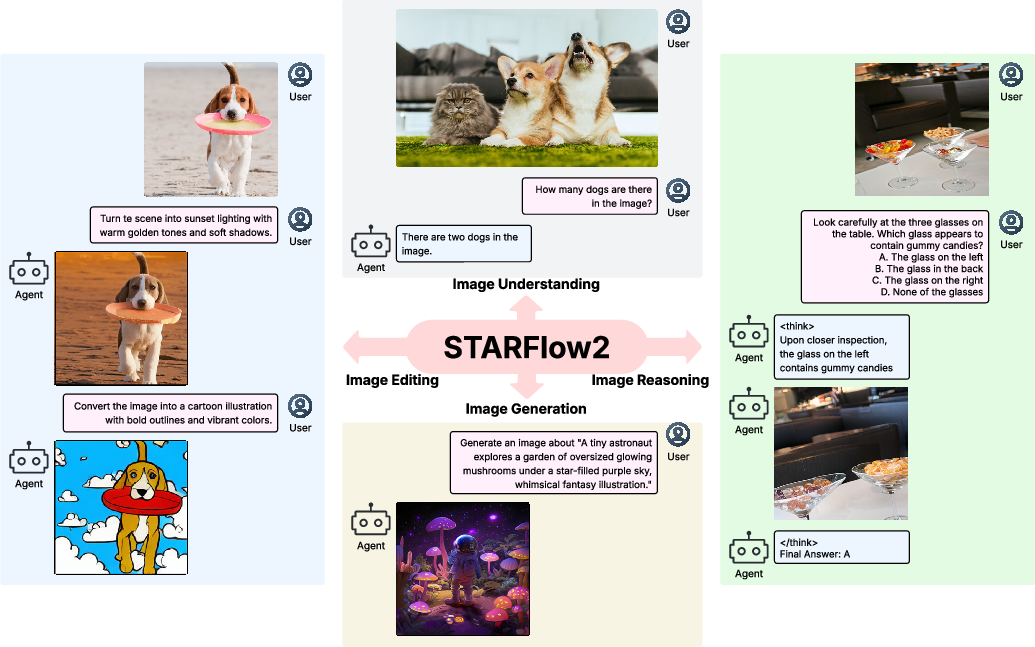
This paper introduces STARFlow2, a single AI model that can both understand and create text and images together—like a smart assistant that can read a picture, talk about it, and also draw a new picture based on your words. The key idea is to use the same “step-by-step” process for writing text and making images so everything works smoothly together.
The big questions the paper asks
The authors want one model that:
- Keeps strong understanding skills from an existing vision-LLM (so it still “gets” images and text well).
- Makes high-quality images without turning them into clunky “word-like” tokens that lose detail.
- Uses the same simple, one-pass, left-to-right process for both text and images (no slow, multi-step image denoising).
How does STARFlow2 work? (Simple picture)
Think of the model as two teammates writing a comic strip together, one word and one panel at a time:
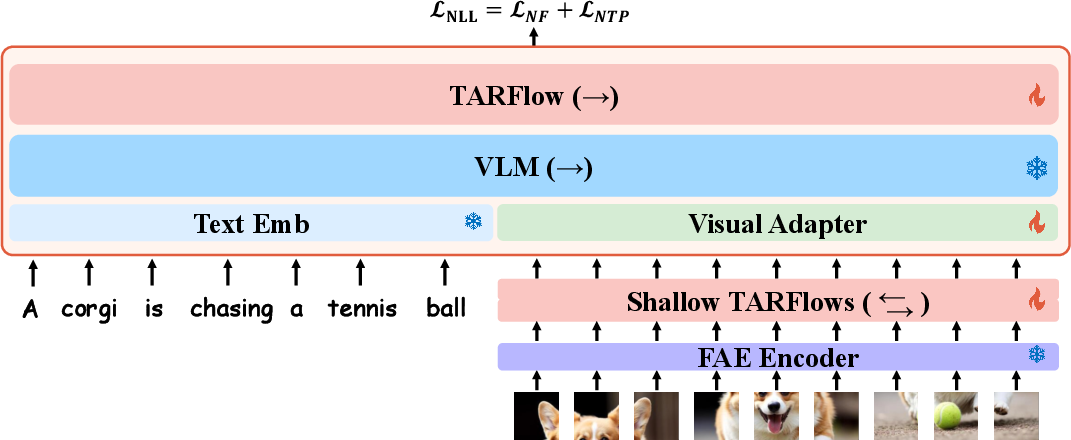
- The “Writer” (a frozen, pretrained Vision-LLM, or VLM) is great at understanding and language.
- The “Artist” (a trainable image generator called a TARFlow) is great at drawing realistic images.
They both read the same script, in the same order, and pass notes straight up and down between each other at every step—this “crossing” design looks like a pretzel, which the paper calls the Pretzel architecture. Because both teammates follow the same step-by-step rhythm, their collaboration is fast and consistent.
Why older approaches fall short
- Turning images into lots of discrete “tokens” (like words) makes images lose fine details.
- Mixing a text generator with a multi-step image denoiser (diffusion) creates two very different processes that don’t work seamlessly together.
- Some models split text and image pathways into different sub-networks; that can hurt either understanding or generation when you try to train both.
STARFlow2 avoids these problems by using one unified, causal (left-to-right) process for everything.
The key ideas explained with everyday language
Here are the main parts, using simple analogies:
- Autoregressive normalizing flows (TARFlow): Imagine you draw a picture by placing one small patch at a time, always using what you’ve already drawn to guide the next patch. That’s what TARFlow does—but instead of discrete tiles, it works in a smooth, continuous “image code” space, which keeps details crisp. It’s single-pass and left-to-right, like typing a sentence.
- Pretzel architecture (two streams, one rhythm): The Writer (VLM) and Artist (TARFlow) both process the same growing story—text and image pieces—in the same order. They pass quick “skip connections” (shortcuts) back and forth vertically so each can help the other in real time. The VLM stays frozen to preserve its understanding skills; the TARFlow learns to draw.
- Shared image “latent” space (FAE): Before drawing, images are compressed into a smooth set of numbers (like a clean shorthand) using a Feature Auto-Encoder (FAE). This makes it easier to both understand and generate images within the same representation.
- Deep–shallow flow design:
- Shallow flow blocks handle local touch-ups—like fixing small textures or edges.
- A deep flow handles global structure—like composition and how text instructions shape the whole image.
- This split makes generation both efficient and detailed.
- KV-cache as memory: As the model generates text and images, it keeps a memory of what’s already produced (like notes you can reread). Because both text and images use the same step-by-step process, images can be reused as context without extra re-encoding.
How was it trained?
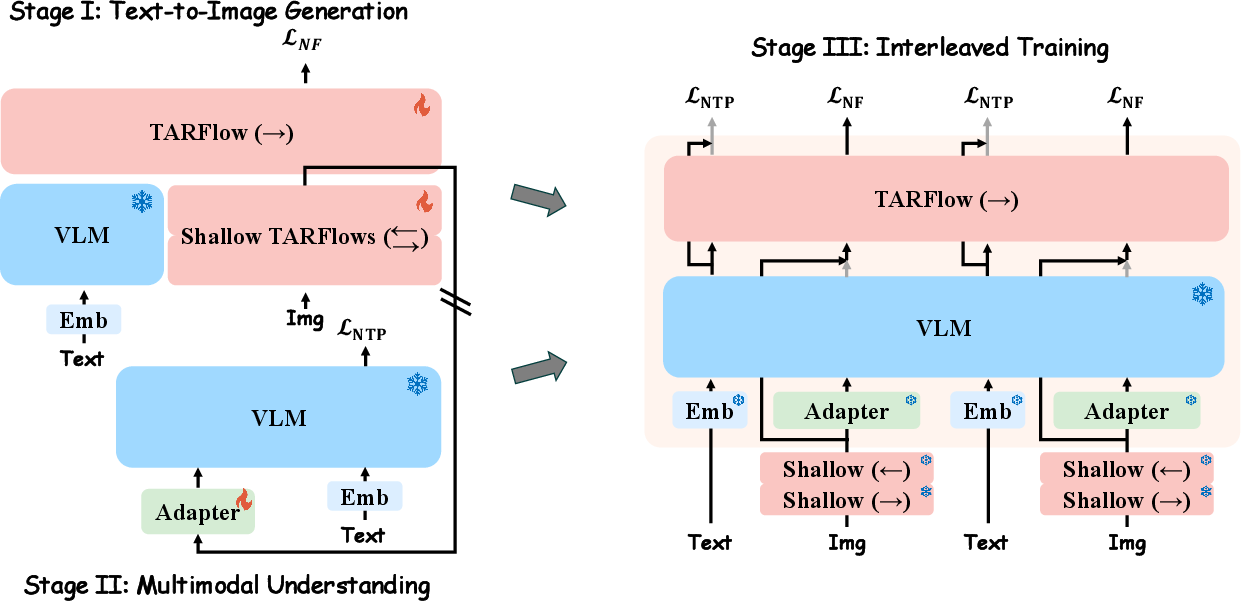
Training happens in three stages, like learning in layers:
- Build the Artist: Train the TARFlow and shallow image modules to generate images from text. The Writer (VLM) stays frozen, providing useful context.
- Align understanding: Train a small adapter so the image codes are perfectly understood by the frozen Writer for tasks like captioning and visual Q&A.
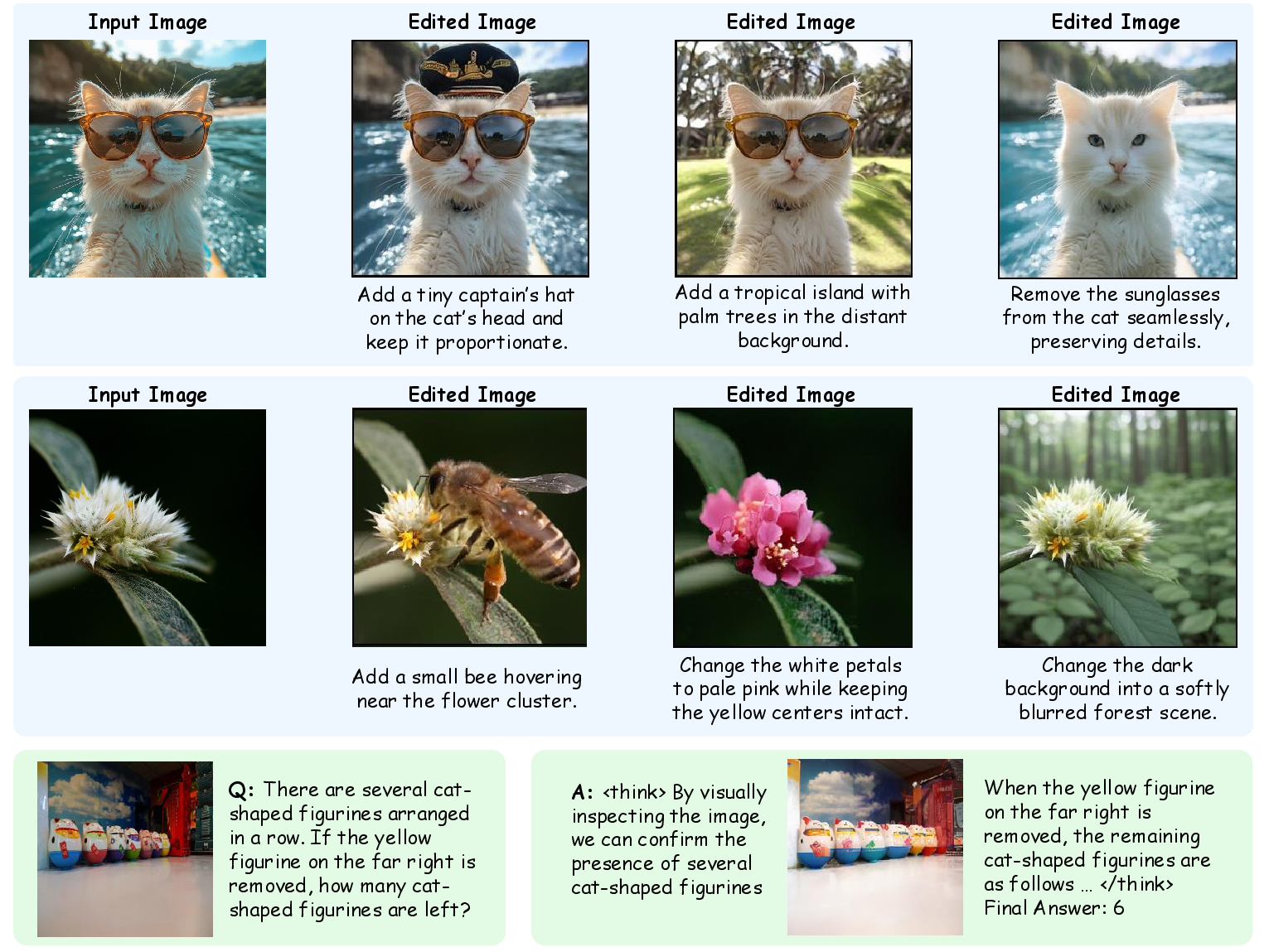
- Teamwork time: Turn on the vertical “skip connections” and train on mixed tasks—image generation, image editing, describing images, and step-by-step interleaved text–image conversations—so both teammates work in sync.
What did they find, and why it matters?
- Strong image generation with one-pass decoding: The model scores well on text-to-image tests that check if images follow instructions (for example, 0.82 on GenEval and 84.94 on DPG-Bench), while keeping the process simple and fast (no iterative denoising).
- Preserved understanding: Because the Writer (VLM) stays frozen and is carefully connected to the Artist (TARFlow), the model keeps good performance on multimodal understanding benchmarks (like GQA, MMBench, and more).
- Better together: Joint training with the Pretzel connections made image generation noticeably better than training the image side alone (on one test, GenEval, the overall score improved from 0.51 to 0.82).
- True unification: Both text and images follow the same left-to-right, cache-friendly process. This means generated images can immediately be “remembered” and used in the next steps without extra work.
Why this is a big deal
- Faster, smoother interactions: Because text and images use the same step-by-step method, the model can handle multi-turn tasks—like “draw a scene, then change the hat to red, then write a caption”—more efficiently.
- Higher image quality without token tricks: By staying in a continuous image space (instead of forcing images into word-like tokens), the model preserves visual detail.
- Keeps what it already knows: Freezing the understanding part ensures you don’t “forget” vision-language skills while teaching the model to draw.
- A cleaner blueprint for future multimodal AI: Using the same causal mechanism for everything simplifies design, speeds up inference, and makes it easier to build systems that read, write, and draw in one go.
Final takeaway
STARFlow2 shows that you can build one model that writes and draws together, step by step, using the same simple rhythm. Its Pretzel design—two streams, tightly linked—lets the model keep strong understanding while producing high-quality images, all without complex, multi-step image procedures. This could power future assistants that chat about photos, create illustrations on the fly, and edit images during a conversation—quickly and coherently. The current version works at 256×256 resolution, and the authors note that scaling to higher resolutions and even finer detail is a promising next step.
Knowledge Gaps
Knowledge gaps, limitations, and open questions
The following points summarize what remains missing, uncertain, or unexplored in the paper, framed to guide concrete future research.
- Resolution and aspect ratio limitations
- The entire system (FAE and training) is constrained to 256×256; there is no evaluation or method for higher resolutions, variable aspect ratios, or multi-scale decoding, nor analysis of how the AR ordering scales with larger images.
- Fidelity and human preference assessment
- No reporting of perceptual fidelity metrics (e.g., FID/KID, PickScore, HPSv2) or human preference studies for either generation or editing; it is unclear how TARFlow-based images compare perceptually to SOTA diffusion/flow-matching models at matched resolutions.
- Efficiency, latency, and memory
- Claims of “cache-friendly” decoding and elimination of re-encoding are not quantified; there are no measurements of throughput, latency, or memory vs. diffusion hybrids and discrete-token models for single-turn and multi-turn interleaved generation.
- The memory overhead of maintaining both VLM and TARFlow KV caches with dense visual tokens is not characterized, especially for long interleaved sequences.
- Understanding performance regression and its sources
- Multimodal understanding lags the frozen base VLM and top unified models; there is no attribution study teasing apart causes (FAE resolution, adapter alignment, skip-connection effects, loss weighting, or data mixture).
- No evaluation on pure text benchmarks to confirm that language-only abilities remain intact after Stage 3.
- End-to-end vs. frozen VLM
- The VLM is kept frozen to preserve understanding, but the trade-off space is not explored (e.g., selective/low-rank finetuning, adapter tuning, layer-wise unfreezing, or elastic weight consolidation) to potentially improve generation or alignment without degrading understanding.
- Visual latent space and adapter design
- The choice of DINOv2-g/14–based FAE is not ablated against alternatives (e.g., SigLIP, other FAEs), token counts, or patch sizes; the impact on fidelity, instruction following, and understanding is unknown.
- The FiLM-style adapter with noise-level modulation is introduced but not compared to other adapters (LoRA, cross-attn adapters, hypernetworks), and its effect on alignment and generalization is not quantified.
- AR visual token ordering and positional encoding
- The specific 1D ordering of 2D visual tokens (raster, zig-zag, Hilbert, serpentine) and its impact on locality, long-range dependencies, and quality is not described or ablated; no study of positional encodings tailored for 2D structure.
- Deep–shallow flow factorization
- There is no ablation on the number/depth of shallow blocks, scan directions, or compute–quality trade-offs; the benefit over a single deep AR flow is not quantified under matched FLOPs/params.
- Training dynamics and loss balancing
- The joint objective combines exact NLL and cross-entropy with a scalar λ, but there is no analysis of optimization stability, gradient interference, curriculum/scheduling strategies, or sensitivity to λ and data-mix ratios.
- Quantitative MoT vs. Pretzel comparison
- The MoT comparison is qualitative and limited; controlled, quantitative baselines (same data, params, compute) for MoT, cross-attention fusion, and other vertical/horizontal fusions are missing.
- Interleaved generation and editing benchmarks
- While qualitative examples are shown, there is no quantitative evaluation of multi-turn interleaved generation or editing (e.g., EditBench, InstructPix2Pix-style metrics, region-identity preservation, instruction adherence, success rates).
- Diversity and controllability
- The model’s output diversity, mode coverage, and prompt adherence are not measured (e.g., intra-set CLIP dispersion, ImageReward); mechanisms for guidance/control (CFG analogs for flows, classifier-free conditioning, temperature/sigma schedules) are not described or evaluated.
- Robustness and generalization
- Robustness to OOD images, occlusions, heavy clutter, adversarial prompts, and very long interleaved contexts is untested; the effect of growing KV caches on stability and quality over multi-turn interactions is unknown.
- Likelihood utility and calibration
- Exact likelihood is a key claim, yet no negative log-likelihood/bits-per-dimension is reported, and there is no evidence that likelihood correlates with downstream quality or can be used for calibration, OOD detection, or uncertainty estimation.
- KV-cache reuse for visuals
- The mechanism and stability of injecting generated visual latents directly into the VLM KV-cache across multiple turns is not analyzed; numerical drift, distribution shift between encoded and generated latents, and potential accumulation of errors remain unexamined.
- Color/attribute weaknesses and error analysis
- GenEval shows a notable weakness in “Color Attributes” (0.56); there is no error analysis or targeted interventions (e.g., attribute-aware objectives, data augmentation, contrastive attribute losses).
- Variable-size inputs for understanding
- Understanding is conducted via 256×256 FAE latents; the impact of downscaling high-res inputs on reasoning performance and fine-grained perception is not analyzed or mitigated (e.g., multi-scale encoders, tiled FAEs).
- Text-side TARFlow contribution
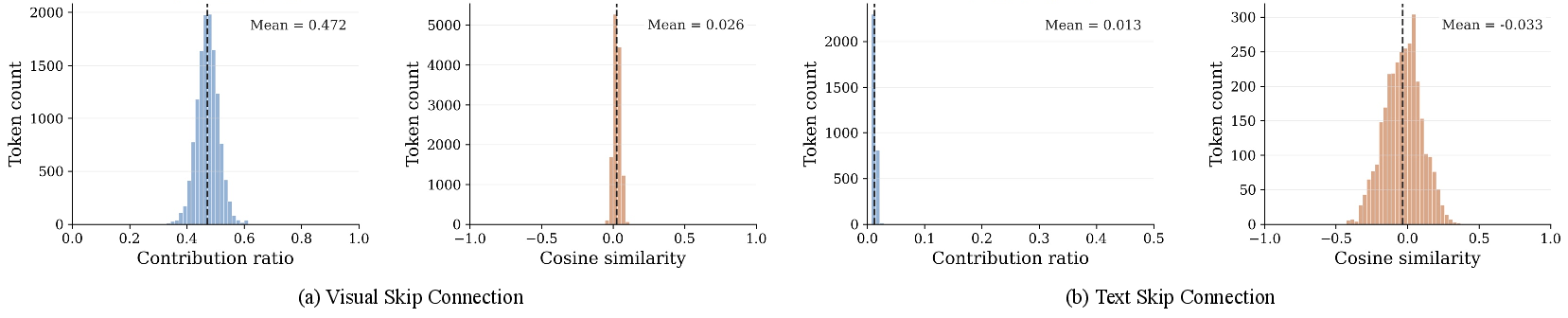
- TARFlow’s role at text positions is only sketched; it is unclear how much TARFlow improves or perturbs language modeling, and whether removing TARFlow’s text-side skip yields similar understanding—an ablation is missing.
- Compute and reproducibility
- Training uses large in-house datasets (800M+ pairs) and 10.6B parameters without reporting compute budgets or releasing data/FAE checkpoints; reproducibility and accessibility for the community are uncertain.
- Safety, bias, and privacy
- There is no analysis of bias, safety, or harmful content generation; flows’ exact-likelihood training raises unaddressed privacy concerns (e.g., memorization, membership inference, reconstruction risks).
- Extension to additional modalities
- The approach is framed as “unified multimodal,” but extensions to video (spatiotemporal AR flows), audio, or 3D are not explored; it is unclear how Pretzel scales to temporal modalities with long contexts.
- Guidance for resolution scaling
- Concrete strategies to scale beyond 256×256 (e.g., progressive growing, multi-scale flows, latent pyramids, tiled decoding with boundary harmonization, two-pass refinement) are not proposed or validated.
- Fairness of baseline comparisons
- Some baselines employ prompt rewriters; evaluation settings, seeds, and guidance strengths are not fully harmonized, limiting the interpretability of reported margins.
- Practical deployment considerations
- The real-world benefits of “no re-encoding” (e.g., latency reductions in multi-turn UX) and the engineering constraints (memory headroom, batching strategies, cache eviction for visuals) are not demonstrated.
Practical Applications
Immediate Applications
The following applications can be deployed with the methods and performance reported (256×256 images, frozen VLM, FAE latents, cache-friendly interleaved decoding). Each item names target sectors, likely tools/workflows, and key assumptions/dependencies.
- Software and AI products
- Interleaved multimodal chat assistants that “think, talk, and draw” in one session (e.g., generate a sketch, then refine with follow-up text). Tools: chat SDKs that expose an interleaved text–image API and a cache-aware inference server that keeps visual latents in the KV-cache. Assumptions: GPU memory sufficient for KV-cache with visual latents; model license compatibility (Qwen2.5-VL and FAE); 256×256 resolution suffices for UX.
- Design/edit copilot for quick iterations on UI mockups, icons, social images via instruction-following edits. Workflows: prompt → image → text edits → updated image without re-encoding. Assumptions: brand safety filters; low-res acceptable for ideation.
- Creative industries and marketing
- Text-driven product photo editing (background swaps, color/attribute changes) for e-commerce catalogs. Tools: batch editing pipeline using the flow head + editing prompts; audit logs of edit prompts and latents. Assumptions: rights to original assets; moderation for sensitive content; 256×256 upscaled post-hoc with a super-res model.
- Creative A/B testing at scale (caption variants → consistent, edited visuals). Workflows: prompt templates + interleaved refinement during review calls. Assumptions: consistent style controls; lightweight guardrails.
- Education
- Visual tutoring that inserts small, on-the-fly diagrams into explanations (math, physics, biology). Tools: LMS plugin that calls the model mid-lesson; “show steps” with visuals cached for later Q&A. Assumptions: diagram legibility at 256×256; instructor-in-the-loop review for grading and safety.
- Assessment authoring: auto-generate distractor diagrams and visual variants aligned to text questions. Assumptions: rubric alignment; bias screening of generated imagery.
- Robotics and manufacturing
- Work-instruction cards with stepwise images generated inline from textual procedures (assembly, maintenance). Workflows: author text SOPs → interleaved prompt refinement → export as visual SOP. Assumptions: non-safety-critical guidance; human validation; downstream print/upscale pipeline.
- Goal-image creation for visual servoing or imitation-learning datasets (robots match generated target states). Assumptions: domain gap between synthetic and real imagery; data governance for synthetic training.
- Healthcare (non-diagnostic)
- Patient education leaflets with explanatory visuals (procedures, rehab exercises) generated/edited from clinician notes. Tools: EMR/consent form integrations producing educational panels. Assumptions: clearly labeled as illustrative; clinical validation; strict content safety and PHI controls.
- Synthetic but anatomically plausible illustrations for training materials. Assumptions: not for diagnosis; governance for synthetic content provenance.
- Academia and research
- A unified testbed to study autoregressive flows vs diffusion in multimodal tasks (exact likelihood training + causal decoding). Workflows: reproduce the multi-stage pipeline; ablations on skip connections and shallow flows. Assumptions: access to GPUs; adherence to dataset licenses.
- Teaching modules on “Next Gaussian Prediction” as a continuous analogue to next-token prediction (curriculum and notebooks). Assumptions: open-source repo availability.
- Trust & safety and policy operations
- Content moderation hooks that operate directly on continuous latents before decoding (e.g., lightweight detectors on FAE space). Workflows: latent-level nudity/violence filters prior to rendering. Assumptions: availability of latent-level classifiers; policy mappings to visual cues.
- KV-cache auditability in interleaved sessions (log and redact visual latents across turns). Assumptions: session isolation; secure memory handling; privacy reviews.
- Data and ML operations
- Unified latent store for RAG that indexes both text and image latents from the same interaction (context reuse without re-encoding). Tools: cache-aware serving; session replay/branching using stored latents. Assumptions: retention policies; vector DB integration with FAE embeddings.
- Cost/latency reductions versus diffusion hybrids in interleaved workflows (single-pass decoding, no re-encode). Assumptions: compatible serving stack; batch/stream scheduling for mixed tokens.
- Daily life
- Personal photo edits (background cleanup, color tweaks) via quick prompts. Assumptions: consumer-friendly UI; content safety.
- DIY/how-to guides that include generated step images inline (cooking, crafts, repairs). Assumptions: clarity at low resolution; disclaimers for safety-critical tasks.
Long-Term Applications
These require further research, scaling (e.g., high-resolution FAEs), safety validation, or productization beyond the current 256×256 model and datasets.
- High-fidelity media generation (creative, advertising, print)
- Native 1K–4K image generation and consistent multi-image campaigns using the unified causal mechanism. Tools: high-res FAE training; multi-resolution shallow flows; style/identity control. Dependencies: new FAE/encoder at high res; compute; brand governance.
- Video, 3D, and multimodal simulation
- Autoregressive flow extensions to temporal tokens for video generation and interleaved text–image–video editing. Tools: temporal FAE and shallow flows; cache-aware streaming across frames. Dependencies: large-scale video data; motion safety; storage/throughput optimization.
- 3D asset and scene card generation from specs for digital twins and XR. Dependencies: 3D-aware latents; differentiable renderers; licensing of 3D data.
- Robotics and embodied AI
- Closed-loop agents that generate visual subgoals mid-policy (visual thoughts/plans) and condition control on the same cache. Workflows: interleaved plan → sense → edit → act loops. Dependencies: sim-to-real; safety envelopes; latency guarantees on edge hardware.
- Synthetic data factories for perception and manipulation with curriculum generation. Dependencies: domain randomization; labeling pipelines; regulatory guidance for synthetic data use.
- Healthcare and life sciences
- Rare-condition augmentation and anonymized training sets (image synthesis/editing with clinical style control). Dependencies: IRB/ethics approvals; expert review; bias/shift audits; watermarking and C2PA provenance.
- Patient-specific educational tools that tailor visuals across languages and literacy levels. Dependencies: accessibility standards; medical policy compliance.
- Finance, enterprise analytics, and operations
- “Spec-to-dashboard” systems that generate audited visuals (charts, infographics) inline with narrative. Tools: programmatic chart backends + flow-based styling. Dependencies: hallucination controls; compliance logging; lineage/provenance overlays.
- Multimodal report copilots that weave generated images with retrieved evidence under governed caches. Dependencies: enterprise authz; retention; redaction.
- Trust, provenance, and standards
- Latent-space watermarking and provenance for continuous flows integrated with C2PA. Dependencies: robust watermark schemes for NF latents; standardization; cross-vendor verification tooling.
- Policies for cache retention and privacy in interleaved multimodal KV-caches. Dependencies: legal guidance; privacy-by-design implementations; telemetry minimization.
- Developer tooling and platforms
- IDE and design suite plugins that turn requirements into multi-turn visual prototypes (UI screens, architecture diagrams) and keep them consistent across iterations. Dependencies: higher-res quality; vector/diagram-aware decoders; domain adapters.
- On-device unified assistants leveraging efficient flow blocks for low-latency image reasoning/generation. Dependencies: model compression, distillation to smaller backbones; hardware acceleration for affine transforms and causal attention.
- Scientific and academic research
- Multimodal reasoning with “visual thoughts” (intermediate generated imagery that aids proof or explanation). Dependencies: training data for chain-of-thought with visual steps; evaluation protocols for faithfulness.
- Scaling laws and safety evaluations for autoregressive flows as a foundation model class. Dependencies: large-scale compute and datasets; benchmarking consortia.
Cross-cutting assumptions and dependencies
- Technical
- Current model is trained at 256×256 and relies on a specific FAE; scaling requires new FAEs and retraining shallow/deep flows.
- GPU memory for KV-cache that includes visual latents; cache-aware serving stack and session isolation are needed.
- Safety filters for both text and continuous latents; detectors must operate pre- and post-decoding.
- Licensing and data governance (Qwen2.5-VL, datasets); commercial use may require alternative backbones or licenses.
- Product and compliance
- Content provenance/watermarking expected in commercial rollouts; clear disclosures for synthetic images.
- Domain-specific validation (e.g., healthcare, industrial safety) and human-in-the-loop review before use in critical contexts.
- Bias, fairness, and IP considerations for generated imagery; red-teaming and monitoring pipelines.
These applications leverage STARFlow2’s core innovations—continuous, single-pass, causal image generation; vertical skip “Pretzel” fusion that preserves pretrained VLM understanding; deep–shallow flow factorization; and cache-friendly interleaved text–image decoding—enabling practical multimodal products now and setting a roadmap for higher-fidelity, multi-temporal, and safety-governed systems next.
Glossary
- adaptive LayerNorm modulation: Conditioning mechanism that modulates LayerNorm statistics using learned, context-dependent scales and shifts (e.g., conditioned on noise level) to adapt representations. "and then applies adaptive LayerNorm modulation conditioned on the noise level."
- affine transformation: A linear scaling and translation operation parameterized by mean and scale, used here to transform continuous latents in flow models. "the flow predicts affine transformation parameters for continuous latents."
- Autoregressive Flows (AFs): A class of normalizing flows that factorize transformations sequentially so each variable is conditioned on previous ones, enabling single-pass sampling. "They instantiate Autoregressive Flows (AFs) by stacking multiple invertible autoregressive flow (AF) blocks with alternating orderings."
- autoregressive normalizing flows: Normalizing flows parameterized to generate elements sequentially in a causal order, aligning structurally with LLMs. "We observe that autoregressive normalizing flows are autoregressive Transformers---sharing the same causal mask, KV-cache mechanism, and left-to-right structure as LLMs"
- causal mask: Attention masking that restricts each position to attend only to previous positions, enforcing left-to-right generation. "Both streams process the same interleaved multimodal sequence under the same causal mask, achieving true architectural unification (D3)."
- change-of-variables formula: The mathematical identity used to compute exact likelihoods under invertible transformations by accounting for volume changes via the Jacobian determinant. "Derived from the change-of-variables formula, NFs can be trained end-to-end via a tractable maximum-likelihood objective:"
- deep-shallow flow design: A factorization where shallow visual-only flow blocks absorb local structure and a deep autoregressive block models global and cross-modal dependencies. "Following STARFlow~\citep{gu2025starflow}, \methodname{} addresses this with a deep-shallow flow design that factorizes the generative process into two stages."
- diffusion-based denoising: Iterative generative procedure that progressively removes noise to produce images, typically requiring multiple passes unlike single-pass autoregressive decoding. "A more popular paradigm combines autoregressive language modeling for text with diffusion-based denoising for images within a single backbone"
- Feature Auto-Encoder (FAE): An autoencoder that produces compact, continuous visual latents serving both understanding and generation in a shared space. "\methodname{} operates in the latent space of a Feature Auto-Encoder (FAE), which provides a compact continuous representation serving both understanding and generation."
- FiLM-style adapter: A conditioning module (Feature-wise Linear Modulation) that injects control signals by scaling and shifting intermediate activations. "we introduce a FiLM-style~\citep{perez2018film} adapter, which first projects visual latents through a lightweight MLP stack and then applies adaptive LayerNorm modulation conditioned on the noise level."
- interleaved text-image generation: Joint generation setting where text and image elements are produced in a shared sequence, allowing alternating outputs. "and interleaved text-image generation datasets"
- Jacobian: The matrix of partial derivatives of a transformation whose determinant captures local volume change, critical for exact likelihood in flows. "and the Jacobian term J_f accounts for the local volume change induced by f_\theta, preventing the model from collapsing."
- KV-cache: The cached key–value pairs from previous attention steps that enable efficient incremental decoding in Transformers. "Generated images cannot directly enter the causal KV-cache as reusable context"
- Mixture-of-Transformers (MoT): An architectural scheme that routes tokens to modality-specific feed-forward modules while sharing attention, effectively mixing experts within a Transformer. "Mixture-of-Transformers (MoT)~\citep{liang2024mixture}, adopted in BAGEL~\citep{deng2025emerging}, routes different modalities to modality-specific feed-forward parameters while sharing attention."
- negative log-likelihood (NLL): The standard loss for likelihood-based models; minimizing it maximizes the probability assigned to data. "The model is trained with a unified NLL objective."
- Next Gaussian Prediction (NGP): The continuous analogue of next-token prediction where the model predicts a Gaussian (mean and scale) for the next continuous latent. "the TARFlow stream performs Next Gaussian Prediction (NGP) in -space---the continuous counterpart of next-token prediction"
- normalizing flows (NFs): Likelihood-based generative models that learn invertible mappings between simple and complex distributions, enabling exact log-likelihoods and single-pass sampling. "Normalizing flows (NFs)~\citep{dinh2014nice,rezende2015variational,dinh2016density,kingma2018glow,ho2019flow++} are likelihood-based generative models that learn an invertible mapping between a simple distribution (e.g., a standard Gaussian) and a complex data distribution."
- quantization: Discretization of continuous data into finite codes, which can induce information loss that degrades image fidelity. "quantization introduces information loss and limits generation fidelity"
- self-exclusive causal mask: A causal attention pattern that prevents each position from attending to itself as well as to future positions in autoregressive flows. "under a self-exclusive causal mask"
- TARFlow: A Transformer-parameterized autoregressive normalizing flow used for continuous image generation within the shared causal sequence. "The TARFlow stream is an autoregressive flow block that operates on the same multimodal sequence under the same causal mask."
- unified multimodal generation: A framework where different modalities (text and images) are generated within a single causal mechanism and shared sequence. "a natural paradigm for truly unified multimodal generation that is continuous, single-pass, and purely causal."
- vertical skip connections: Cross-stream residual links that fuse representations between a frozen VLM stream and a trainable flow stream at each position. "we activate the vertical skip connections of the \pretzel{} architecture"
- vision-LLM (VLM): A pretrained model that jointly processes visual and textual inputs to enable multimodal understanding and reasoning. "Most current approaches build on pretrained vision-LLMs (VLMs) that already achieve strong multimodal understanding"
Collections
Sign up for free to add this paper to one or more collections.