HumanCLAW: Can Vision-Language Models Act Through a Body?
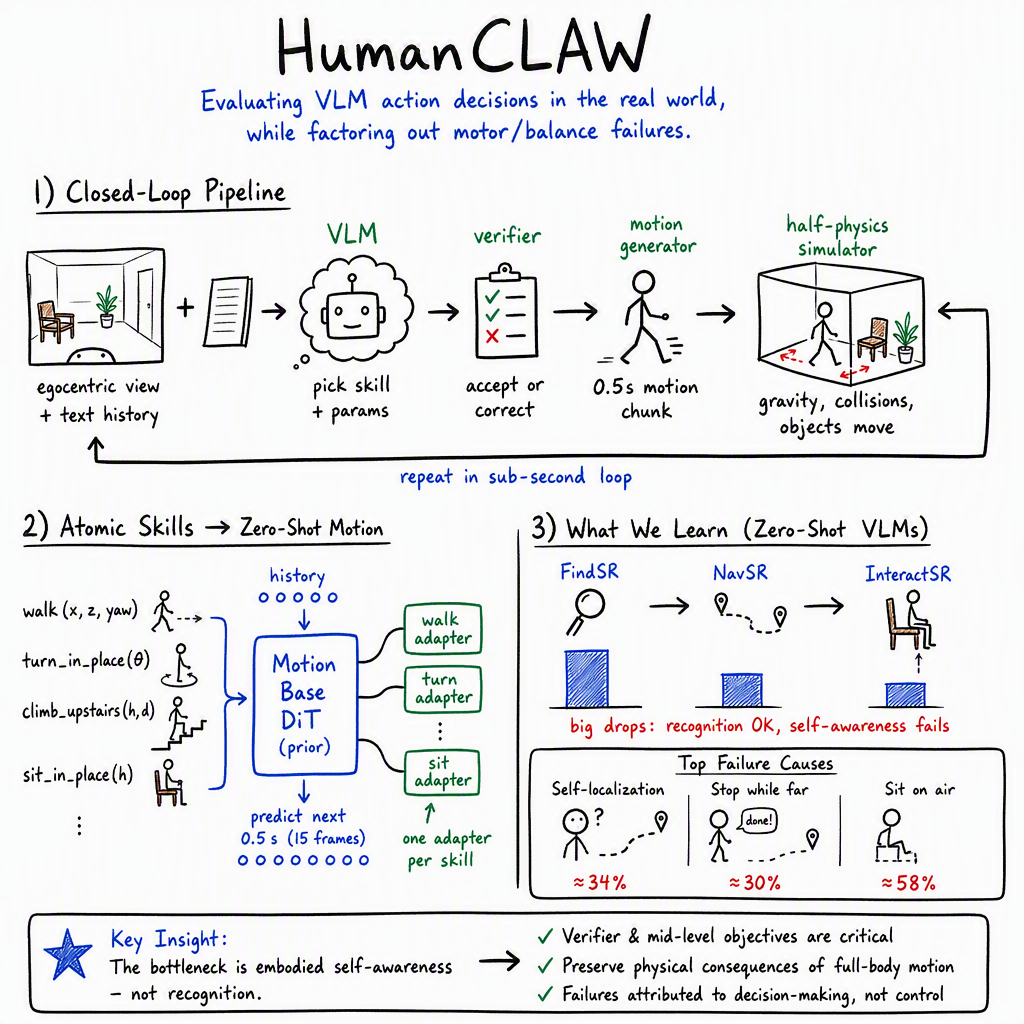
Abstract: Evaluating whether a vision-LLM (VLM) can act through a physical body is challenging. The outcome of an action couples the VLM's decision with motor control. When a task fails, it is hard to tell whether the VLM made a bad choice or the motor controller simply failed to execute it, e.g., losing balance and falling. In this work, we introduce HumanCLAW, an evaluation framework that decouples action decision-making from low-level execution. At every step, a harnessed, off-the-shelf VLM issues an atomic skill command, and the command is translated into a sub-second chunk of continuous full-body motion with real physical consequences, including gravity and collisions. The body can therefore act freely in the physical world, while execution-side disturbances, balance and motor errors, are factored out. What remains measurable is the model's action intelligence: its moment-to-moment choice of what the body should execute next. Based on this framework, we build HumanCLAW-Bench: 1,218 long-horizon, egocentric find-navigate-interact episodes across 41 indoor scenes. We test nine state-of-the-art VLMs and find that none solves the benchmark; the best model reaches only a 16.8% success rate. Recognizing the target is not the bottleneck. What current VLMs lack is embodied self-awareness: they lose track of their own body, failing to tell where it is, whether it has reached the goal, or whether it has hit an obstacle.
First 10 authors:
Paper Prompts
Sign up for free to create and run prompts on this paper using GPT-5.
Top Community Prompts
Explain it Like I'm 14
What this paper is about (in simple terms)
This paper asks a big question: If you give an AI that understands pictures and words a “body,” can it choose the right moves to reach a goal in the real world? The authors build a test system called HumanCLAW to check this fairly. They make sure we judge the AI’s choices (what to do next) without blaming it for clumsy muscles or bad balance.
What the researchers wanted to find out
They set out to learn:
- Can today’s vision-LLMs (VLMs) make good, moment‑by‑moment decisions for a moving body?
- Do these models know where their body is, whether they’ve reached a goal, or if they’ve bumped into something?
- If they fail, is it because they couldn’t “see” the target, or because they couldn’t act sensibly after seeing it?
How they tested it (explained simply)
Think of a first‑person video game where you control a character. At each tiny step (half a second), the AI:
- Sees what the character sees.
- Remembers recent steps.
- Chooses one small, clear “move” (an atomic skill), like:
- walk a bit forward,
- turn left by a certain angle,
- side‑step,
- climb stairs one step,
- sit down to a certain height,
- stop.
Here’s how the system keeps things fair and understandable:
- Atomic skills: The AI can only choose simple, unambiguous moves (like pressing a single button), not vague commands like “go sit on the sofa,” which hide a lot of sub‑steps.
- Skill-to-motion engine: A motion generator turns the chosen skill into realistic full‑body movement (legs, hips, torso) for 0.5 seconds. This is like a very smart animation system that reliably does exactly the move asked.
- “Half‑physics” world: Gravity, walls, bumps, and pushing objects are real. But balance failures (like tripping) are turned off. Picture a strong puppet: it won’t fall just because it mis‑stepped, but it can’t walk through walls and will knock over a vase if it hits it. This way, if the task fails, it’s the AI’s decision at fault—not clumsy legs.
- Decision harness: Before each move, the AI writes down what it thinks it sees (objects, distances, obstacles), sets a short‑term plan (e.g., “approach the couch”), then picks a specific skill with numbers (e.g., turn 20°, walk 0.3 m). A quick checker (verifier) blocks unsafe or premature moves (like trying to sit when the seat isn’t there yet).
Finally, they created a big benchmark: 1,218 “find → navigate → interact” episodes inside 41 virtual homes. Typical goal: “Find a sofa and sit on it.” The scenes vary in distance, choices (turns/rooms), and clutter (obstacles).
What they discovered and why it matters
Main results:
- No model solved the benchmark. The best model finished only 16.8% of full tasks (find, reach, and sit).
- Seeing isn’t the main problem. When the target was actually visible on screen, the models usually recognized it correctly.
- The real weakness is “embodied self‑awareness.” Models often:
- Lose track of where their body is,
- Can’t tell if they’ve actually arrived,
- Don’t notice collisions or think they’ve made progress when they haven’t.
- After “seeing,” performance drops sharply:
- Finding targets was okay (up to about 65%).
- Turning that into arrival (navigation) was much worse (down to ~42% or far lower).
- Completing the interaction (like sitting on the sofa) was the hardest (best was 16.8%).
- The motion layer was reliable. When told to “walk 0.3 m” or “turn 30°,” the body did that consistently. So failures mostly come from poor decisions, not poor movement execution.
Why this matters:
- It shows a clear gap between recognizing the world and acting well inside it.
- It pinpoints what to fix next: give models better body awareness and state tracking, not just better object recognition.
What this could change going forward
- Better embodied AI: Future systems need a sense of “where my body is right now” and “what my last move did,” similar to how you know your feet’s position without looking. This could involve improved memory, self‑tracking, and checks after each move.
- Fairer testing: HumanCLAW cleanly separates decision‑making from low‑level control. That means researchers can improve planning and awareness without being masked by balance failures.
- Practical impact: More dependable home robots, AR/VR characters, and game agents that safely reach goals, avoid knocking things over, and know when they’ve actually completed a task.
- Extendable skills: The “plug‑and‑play” skill system makes it easy to add new moves without retraining everything, speeding up progress.
In short, the paper shows that today’s AIs can see, but they struggle to act through a body. HumanCLAW gives a solid way to measure and improve that missing piece: embodied self‑awareness and smart, step‑by‑step action choices.
Knowledge Gaps
Knowledge gaps, limitations, and open questions
Below is a concise, actionable list of what remains missing, uncertain, or unexplored in the paper’s approach and benchmark.
- Physical abstraction gap (half-physics): How do conclusions change under a fully dynamic, torque-driven humanoid with balance and motor failures in the loop? Quantify sensitivity to physics parameters (friction, contact stiffness, timestep) and validate whether decision-level attributions still hold.
- Sim-to-real transfer: Can a VLM+skills agent that succeeds in HumanCLAW operate on a real humanoid (or high-fidelity digital twin)? What adaptations (latency, sensing, domain randomization) are required to preserve performance?
- Limited embodiment diversity: Does the framework generalize beyond a human body (e.g., quadrupeds, wheeled bases, multi-arm manipulators), and what skill abstractions and harness changes are needed for other embodiments?
- Restricted skill set: The atomic skills exclude manipulation (reach, grasp, push, open/close, door-handling), gaze control (look up/down), explicit approach-to-seat micro-adjustments, or recovery behaviors. How does adding these skills affect success and “embodied self-awareness” errors?
- Skill reliability biases: Stair skills underachieve commanded riser height (~0.74–0.79 gain). To what extent do such systematic biases skew decision evaluation (e.g., repeated failed climbs)? Provide calibration/normalization or report sensitivity analyses per skill.
- Scaling skill count: One ControlNet adapter per skill scales linearly with skill vocabulary. What are the computational/data trade-offs for 50–200 skills, and can parameter-efficient multi-skill conditioning avoid adapter proliferation?
- Motion prior domain limits: AMASS/BABEL filtering ensures “commonsense” motion, but may underrepresent tight spaces, sharp turns, clutter navigation, or furniture–contact subtleties. How does expanding/curating motion priors for indoor navigation contexts change outcomes?
- Lack of explicit proprioception: The VLM sees only RGB; no explicit body state, odometry, joint angles, contact forces, or collision flags are provided. Do explicit state estimators (e.g., learned odometry, contact sensing) measurably close the “embodied self-awareness” gap?
- No depth or mapping: The agent lacks depth, semantic maps, or SLAM. How much do depth, online mapping, or memory of explored regions improve find–navigate–interact success versus pure RGB+text history?
- Verifier dependence and generality: The skill-specific LLM verifier is critical but hand-authored and short-context. How robust is it across models and tasks, and can programmatic/geom-check verifiers (or learned constraint critics) reduce hallucination and improve reliability?
- Prompt/harness sensitivity: Prompt, history formatting, and mid-level scaffolding strongly influence results. How do per-model prompt tuning, different reasoning scaffolds, or structured-memory variants (graphs, planners) affect performance and token cost?
- Missing oracle and classical baselines: There is no upper bound from an oracle decider (with privileged state/map) or a classical pipeline (detection + SLAM + planner + rule-based skill selection). Provide ceilings to contextualize VLM deficits and headroom.
- Metric dependence on subjective acknowledgement: Staged success requires the agent to “recognize” completion, potentially penalizing competent motion without correct self-report. How robust are conclusions to alternative metrics (pure geometric success/time-to-goal/success-weighted cost)?
- Chunk duration design: All decisions occur at 0.5 s chunks. What is the effect of finer/coarser control periods on stability, collision rates, and final success? Identify optimal temporal granularity for VLM-in-the-loop control.
- Real-time feasibility: Token budgets are reported, but not wall-clock latency. Can the full loop (vision → reasoning → verification → act) meet real-time constraints on-device, and how does streaming/low-latency inference change behavior?
- Physics fidelity of contacts: Sitting success = pelvis–mesh contact, but no soft-body compliance, seat deformation, or human soft-tissue. Does lack of high-fidelity contact modeling produce false positives/negatives for “interact” success?
- Partial observability of contact/collision: The agent infers collisions/sitting from vision alone. Would adding explicit tactile/collision events (binary or graded) reduce mis-awareness without trivializing the problem?
- Scene and task coverage: Only indoor HSSD houses, six categories, and a single interaction (sit). Extend to more object categories, multi-step interactions (open fridge, place object), articulated obstacles (doors), stairs with landings, and outdoor/industrial settings.
- Difficulty scoring vs. true control complexity: Distance/choice/obstacle scores derive from static A* routes; they may not capture dynamic clutter or narrow clearances that matter for full-body motion. Develop control-aware difficulty metrics (e.g., clearance profiles, maneuver complexity).
- Body-aware diagnostics: The paper attributes failures to “embodied self-awareness,” but does not isolate which internal estimates fail (pose, heading, clearance, arrival, contact). Introduce targeted probes (e.g., heading error estimation, wall-distance queries, arrival detection tasks) to localize deficits.
- Learning vs. zero-shot: Only off-the-shelf VLMs are tested. Can lightweight fine-tuning, RL over the skill space, or imitation from expert planners substantially improve action intelligence without sacrificing generality?
- Cross-model stability: Closed-source APIs (e.g., Gemini, GPT) evolve. Freeze model checkpoints or release cached decisions to ensure benchmark stability and enable longitudinal comparisons.
- Robustness to visual factors: Evaluate sensitivity to FOV, camera height, lighting, motion blur, and occlusions. Does altering egocentric camera parameters or adding head-control skills improve find and arrival detection?
- Failure taxonomy and recovery: Provide a standardized taxonomy of failure modes (premature sit, oscillatory turning, stop-too-early, wall-scraping) and study recovery strategies (replan-after-collision, goal-reacquisition policies).
- Safety/collision costs: Collisions and object displacements are counted but not optimized. Explore cost-aware decision-making (collision penalties, disturbance minimization) and trade-offs with success and time.
Practical Applications
Immediate Applications
Below are concrete, deployable uses of HumanCLAW’s framework, motion generation, and benchmark that organizations can adopt now.
- CI-style benchmarking and regression testing for embodied agents
- Sectors: software, robotics, QA
- What: Integrate HumanCLAW-Bench and its staged metrics (Find/Nav/Interact SR, collisions, disturbance, motion jerk, token cost) into continuous integration to evaluate decision-making policies before deploying to hardware.
- Tools/products/workflows: “HumanCLAW-CI” test suite; nightly runs comparing branches/models; red/green gates on collision fraction and NavSR; dashboards showing landing rate (NavSR/FindSR).
- Assumptions/dependencies: Access to AI Habitat/Bullet or equivalent; GPU budget for VLM inference; acceptance that half-physics is an abstraction (not full dynamics).
- Skill-verifier guardrails for agentic pipelines
- Sectors: robotics, software
- What: Embed skill-specific verifiers (e.g., “don’t walk into obstacle,” “don’t sit without seat visible”) as light-weight checks around LLM/VLM actions to reduce rollout drift and unsafe proposals.
- Tools/products/workflows: “Verifier Pack” library with per-skill checklists and JSON schemas; plug-ins to popular agent frameworks.
- Assumptions/dependencies: Verifiers rely on accurate ego-view parsing and short-context prompts; requires defined atomic-skill vocabulary.
- Modular skill interface standardization across teams
- Sectors: robotics, software, standards
- What: Adopt atomic, parameterized skill APIs (e.g., walk<x,z,y>, turn<θ>, sit<h>) as the lingua franca between high-level reasoning and motion layers.
- Tools/products/workflows: Internal “Skill Registry” with JSON contracts, unit tests for parameter tracking; adapters for different simulators/robots.
- Assumptions/dependencies: Coverage limited to locomotion and sitting as provided; additional skills (grasp, open, place) require new adapters/data.
- Synthetic egocentric datasets for training/self-supervision
- Sectors: academia, software, robotics
- What: Use the loop to generate labeled egocentric video paired with explicit spatial state, reasons, and action traces to supervise embodied self-awareness modules (e.g., arrival detection, contact awareness).
- Tools/products/workflows: “Egocentric Data Generator” producing multimodal logs; auto-labels for target visibility, AABB distance, collisions, object displacement.
- Assumptions/dependencies: Domain gap to the real world; model licenses and dataset terms (AMASS/BABEL/HSSD) must be respected.
- Pre-deployment planning evaluation for service robotics
- Sectors: healthcare, facilities, hospitality, retail
- What: Offline evaluation of route-finding and interaction policies in realistic, cluttered interiors to catch collision-prone behavior and navigation hesitancy before real-world trials.
- Tools/products/workflows: Scenario banks per site (rooms, obstacles); KPI reports on collision fraction and #disturbed objects per episode.
- Assumptions/dependencies: Half-physics abstracts balance; requires mapping target facilities into Habitat-compatible assets.
- Physically grounded motion control for DCC/real-time engines
- Sectors: media/entertainment, XR/VR, game dev
- What: Use the skill-conditioned motion generator (DiT + ControlNets) for consistent, parameter-accurate locomotion and sitting with smooth transitions in Unity/Unreal/Blender.
- Tools/products/workflows: “Skill ControlNet SDK” with walk/turn/side/step-back/sit/stairs; timeline authoring by specifying parameters; auto-transitioning between skills.
- Assumptions/dependencies: Alignment to the asset’s skeleton/scale; coverage limited to provided locomotor skills; license terms for redistribution.
- Coursework and labs for embodied intelligence
- Sectors: academia, education
- What: Course modules where students design verifiers, mid-level planning scaffolds, and self-awareness heads; reproducible benchmark for ablations.
- Tools/products/workflows: Assignments using HumanCLAW-Bench; grading by staged SR and motion jerk; student-tuned harness prompts.
- Assumptions/dependencies: Compute allocation for cohorts; simplified scenes for classroom timelines.
- Safety research sandboxes for policy teams
- Sectors: policy, standards, safety engineering
- What: Experiment with metrics such as “collision-step fraction” and “scene disturbance per episode” to draft early guidelines for embodied-AI acceptability thresholds in indoor spaces.
- Tools/products/workflows: Policy pilots mapping threshold bands to use contexts (lab-only vs. public-facing); evidence bundles for IRB/safety boards.
- Assumptions/dependencies: Metrics stem from simulation; real-world validation needed before enforcement.
- Agent profiling and cost-performance optimization
- Sectors: software, cloud, MLOps
- What: Compare VLM backbones by success vs. token cost and motion jerk to choose cost-effective models for embedded/edge deployments.
- Tools/products/workflows: Pareto dashboards; automated prompt/harness searches subject to token budgets.
- Assumptions/dependencies: Comparable prompting and verifier settings; up-to-date model versions.
- Spatial layout playtesting with human-like navigation
- Sectors: AEC (architecture/engineering/construction), UX for public spaces, retail
- What: Use human-like, contact-aware motion to check wayfinding difficulty and clutter sensitivity in indoor digital twins (e.g., narrow aisles causing frequent collisions).
- Tools/products/workflows: Route-difficulty scores (distance/choice/obstacle); what-if tests on furniture rearrangements.
- Assumptions/dependencies: Fidelity of scene geometry and material properties; human crowd dynamics not modeled.
Long-Term Applications
The following opportunities become feasible as embodied self-awareness improves, more skills are added, and sim-to-real gaps narrow.
- Household and clinical humanoid assistants with decoupled cognition-control
- Sectors: healthcare, eldercare, home robotics
- What: Pair robust torque controllers with high-level decision modules trained/validated in HumanCLAW-style loops; extend skills (open/close, grasp/place, transfer).
- Tools/products/workflows: “Reasoning Head + Skill Library” stack; safety verifiers for each manipulation skill; continuous replanning in ego-view.
- Assumptions/dependencies: Reliable sim-to-real transfer; expanded skill adapters; real-time embodied self-awareness; formal safety cases.
- Formal safety certification for embodied AI
- Sectors: policy, standards, insurance
- What: Standardize staged SR, collision fraction, object disturbance, and token-cost limits as part of certification for indoor service robots and embodied agents.
- Tools/products/workflows: Test suites with difficulty stratification; minimum-landing-rate thresholds; incident-replay logs.
- Assumptions/dependencies: Broad industry consensus; correlation to real-world incident rates; independent test labs.
- Self-awareness modules as first-class components
- Sectors: robotics, software, healthcare
- What: Dedicated “embodied self-awareness heads” that track body pose, arrival state, contact/collision, and recent causal effects to inform decisions in real time.
- Tools/products/workflows: Multimodal state estimators trained on synthetic-and-real egocentric data; uncertainty-aware stopping/commit policies.
- Assumptions/dependencies: Robust on-device perception; tight latency budgets; calibration per embodiment.
- Large-scale pretraining for visuomotor decision policies
- Sectors: robotics, software
- What: Use HumanCLAW-like generators to create massive closed-loop, physically grounded corpora for pretraining mid-level decision models (beyond imitation of scripted actions).
- Tools/products/workflows: Curriculum over difficulty tiers; contrastive objectives on “do vs. don’t” near obstacles; retrieval-augmented planning memories.
- Assumptions/dependencies: Scaling compute; diversity of skills and scenes; bridging biases from synthetic data.
- Cross-domain skill marketplaces
- Sectors: software, robotics, media/XR
- What: A “SkillNet” marketplace where new atomic skills (e.g., kneel, lean, open-drawer) ship as plug-and-play ControlNet adapters with standardized JSON schemas.
- Tools/products/workflows: Versioned skill packs; continuous calibration tests for parameter fidelity; royalties/licensing.
- Assumptions/dependencies: Interoperable skeletons/interfaces; curation to avoid style leakage; IP considerations on motion data.
- Digital twins with human-in-the-loop, embodied AI co-design
- Sectors: AEC, retail, logistics
- What: Co-simulate human-like agents and robots in facilities to optimize layouts, signage, and task stations for accessibility and throughput.
- Tools/products/workflows: KPI suites mixing landing rate, collision heatmaps, time-to-target; automated redesign suggestions.
- Assumptions/dependencies: High-fidelity assets and physics; coupling with crowd models and moving obstacles.
- XR training/coaching with physics-grounded avatars
- Sectors: education, sports/rehab, workplace safety
- What: AI tutors embodied in avatars that react to user actions with realistic contacts and constraints, teaching navigation, ergonomics, and hazard avoidance.
- Tools/products/workflows: Scenario authoring via atomic skills; on-device self-awareness to detect unsafe posture or proximity.
- Assumptions/dependencies: Real-time inference on headsets; personalization; validated transfer to user outcomes.
- Human-robot shared autonomy with verifier-backed safeguards
- Sectors: manufacturing, field robotics
- What: Robots propose actions; human supervisors approve/reject aided by verifier predictions of physical outcomes; reduces operator load while maintaining safety.
- Tools/products/workflows: “Outcome Preview” UIs; green/red gating from verifiers; audit logs for decisions.
- Assumptions/dependencies: Reliable outcome prediction beyond locomotion; explainable verifiers; HRI usability.
- Disaster response and hazardous environment scouting
- Sectors: public safety, defense
- What: Embodied agents reason through cluttered, partially known spaces with robust self-awareness and conservative verifiers to minimize contact risks.
- Tools/products/workflows: Domain-adapted skill sets (crawl, duck, step-over); uncertainty-aware planning.
- Assumptions/dependencies: Ruggedized platforms; sim domains reflecting debris and deformables; comms constraints.
- End-to-end embodied agent MLOps platforms
- Sectors: software, cloud
- What: Full-stack platforms combining benchmarks, verifiers, skill libraries, telemetry, and safety analytics for lifecycle management of embodied agents.
- Tools/products/workflows: “Embodied MLOps” with dataset curation, auto-eval, prompt/skill A/B tests, and safety dashboards.
- Assumptions/dependencies: Vendor-neutral standards; governance for model/data/versioning; cost control for large-scale simulation.
Notes on Cross-Cutting Assumptions and Dependencies
- Physics realism vs. feasibility: Half-physics preserves contact/collision outcomes but abstracts balance and motor torques; transfer to fully dynamic control requires additional controllers and validation.
- Skill coverage: Immediate work covers locomotion and sitting; many real tasks need manipulation skills and richer affordances.
- Data and IP: Training/adapting new skills depends on curated motion data (e.g., AMASS/BABEL) and scene assets (e.g., HSSD) with proper licensing.
- Compute and latency: VLM inference and verifier calls incur token and time costs; real-time deployments need optimized backbones or distilled policies.
- Generalization: Results highlight a gap in embodied self-awareness; many long-term applications depend on closing this gap through new models, sensors, or training curricula.
Glossary
- A*: A heuristic shortest-path search algorithm on graphs; used to reconstruct navigation routes on grids. "running A* on a per-floor 5 cm 2D occupancy grid"
- AABB (Axis-Aligned Bounding Box): A box aligned with coordinate axes used to bound objects for distance/collision checks. "the minimum distance between the human agent and the target object's axis-aligned bounding box (AABB) is less than 20 cm."
- adaLN-Zero: An adaptive LayerNorm conditioning scheme initialized at zero to inject conditions into transformers. "injected through adaLN-Zero in every DiT block"
- AI Habitat: A 3D simulator for embodied AI research and navigation tasks. "we build our environment on AI Habitat (Savva et al., 2019)"
- AMASS: A large corpus of human motion capture sequences used to train motion models. "We train the backbone on AMASS motions"
- articulated objects: Physically simulated objects with joints or linkages allowing relative motion. "including collision, friction, gravity, articulated objects, and movable objects."
- atomic skill: A minimal, unambiguous motion primitive used as a building block for actions. "We address this tension by defining a finite set of atomic, semantically unambiguous motion skills."
- BABEL: A dataset providing action labels for human motions, used alongside AMASS. "trained once on AMASS/BABEL"
- Bullet (physics engine): An open-source rigid-body physics engine used for simulation. "with the Bullet (Coumans, 2015) physics engine."
- classifier-free guidance: A diffusion-model sampling technique that conditions generation without an external classifier. "We do not use classifier guidance or classifier-free guidance;"
- ControlNet: An adapter network that conditions a frozen diffusion model to follow specific control signals. "Each skill is a ControlNet adapter injected through a zero-initialized We, leaving the base frozen."
- Diffusion Transformer (DiT): A transformer-based diffusion model backbone for generative tasks. "A skill-agnostic Motion Base DiT predicts the velocity field"
- Douglas–Peucker: A polyline simplification algorithm used to measure path “branchiness.” "the number of >30° turns on the Douglas- Peucker-simplified path"
- egocentric RGB observation: A first-person color image captured from the agent’s viewpoint. "a 2D egocentric RGB observation ot"
- embodied self-awareness: The agent’s ability to estimate its body state and its relation to the environment in real time. "We call this missing capacity embodied self-awareness"
- flow matching: A training objective for continuous generative models that predicts velocity fields between noise and data. "via flow matching."
- Fourier features: Sinusoidal positional encodings used to represent continuous inputs for neural networks. "use Fourier features before projection to the DiT hidden dimension."
- geodesic distance: The shortest navigable path length within the environment. "distance, the dataset geodesic distance to the nearest same-category goal"
- half-physics: A hybrid simulation where the world is fully physical but the humanoid is driven kinematically, factoring out motor control. "adopts an intermediate half-physics (Siyao et al., 2025) simulation mechanism"
- harness: A structured prompting and reasoning wrapper that guides a VLM’s perception-to-action pipeline. "HumanCLAW employs a contextual reasoning harness"
- kinematic velocities: Velocities computed from pose differences and applied directly to drive a model without torque control. "it is driven by equivalent kinematic velocities derived from the generated motion sequence."
- locomotion-decoupled physical simulator: A simulator that applies physics to outcomes while separating high-level decisions from low-level motor control. "a locomotion-decoupled physical simulator W executes this chunk"
- motion jerk: The third derivative of position over time; used to quantify action smoothness. "We measure action smoothness using motion jerk"
- occupancy grid: A discretized map marking free and occupied cells for navigation planning. "a per-floor 5 cm 2D occupancy grid of walls and static furniture"
- ODE midpoint solver: A numerical integrator used to solve ordinary differential equations during diffusion sampling. "solve the learned ODE with a 30-step midpoint solver."
- passive-body simulation: Simulation where the body is not actively torque-controlled, enabling compliant contact responses. "Following prior passive-body simulation practice (Siyao et al., 2025)"
- receding-horizon continuation: Generating short future motion chunks conditioned on recent history in a rolling fashion. "is trained for receding-horizon continuation."
- rigid-body physics: Physics modeling of solid bodies with collisions, friction, and gravity. "the world follows rigid-body physics, including collision, friction, gravity, articulated objects, and movable objects."
- skill-conditioned motion generator: A model that produces continuous motion based on selected skills and their parameters. "A skill-conditioned motion generator supplies what the VLM cannot emit"
- skill-specific verifier: A check that validates or corrects proposed actions based on current spatial context. "applies a short-context verifier specialized to the proposed skill."
- tangent space: The local linear space used to compute angular velocities from rotations. "with rotational components computed from relative rotations in the corresponding tangent space."
- velocity field: Predicted per-time-step velocities that define how motion evolves. "predicts the velocity field of 15 future frames"
- Vision-LLM (VLM): A model that jointly processes visual inputs and text to make decisions or generate outputs. "Evaluating whether a vision-LLM (VLM) can act through a physical body is challenging."
- yaw: Rotation about the vertical axis; used to specify orientation changes. "For turning, it is the final body yaw."
Collections
Sign up for free to add this paper to one or more collections.