- The paper reveals that quantum gravity corrections (𝜔̃) and PFDM (ζ) act as chaos regulators in photon orbits, impacting black hole shadow and QPO observables.
- It employs Hamiltonian methods and Lyapunov diagnostics—including Poincaré sections and KS entropy—to quantify nonlinear dynamics in strong gravitational fields.
- Global tools like DIC maps illustrate how increased PFDM expands chaotic regions while quantum corrections contract regular phase space, suggesting observable astrophysical signatures.
Probing Quantum Gravity with Chaotic Photon Orbits in Quantum-Improved Kerr Black Holes with Perfect Fluid Dark Matter
Introduction and Motivation
This study analyzes nonlinear photon dynamics in a quantum-improved Kerr black hole spacetime embedded in perfect fluid dark matter (PFDM), focusing on strong-field chaos diagnostics and mapping the interplay of quantum gravity corrections and environmental dark matter effects. The motivation stems from the necessity of quantum gravity corrections in resolving singularities and modifying the causal structure of black holes, with recent developments emphasizing their impact on astrophysical observables. The research addresses the critical question of how quantum corrections (parametrized by ω~) and PFDM contributions (ζ) affect the stability and chaoticity of null geodesic motion—directly linking spacetime microphysics to potentially observable photon trajectories, black hole shadows, and QPO observables.
Quantum-Improved Kerr Black Hole in PFDM
The metric construction starts from a spherically symmetric black hole surrounded by PFDM, where the dark matter induces a logarithmic modification in the gravitational potential, effectively captured by the parameter ζ. Quantum corrections are incorporated via a scale-dependent effective Newton constant, G(r), leading to a quantum-improved lapse function following an RG-improvement prescription. Applying a modified Newman–Janis algorithm yields a rotating, stationary, and axisymmetric geometry characterized by three key parameters: the black hole mass M, the rotation parameter a, the quantum improvement parameter ω~, and the PFDM strength ζ. Notably, m(r)=r2+ω~GGMr2−2ζln∣ζ∣r encapsulates both corrections, resulting in transcendental horizon and photon sphere structures. The quantum parameter ω~ modifies the approach to the classical singularity, whereas ζ0 modulates the strength and sign of the dark matter envelope.
Null Geodesics and Chaos Diagnostics
The geodesic equations for photons are derived via the Hamiltonian formalism, exploiting the spacetime's stationarity and axial symmetry. Null orbits on the equatorial plane (ζ1) are governed by an effective radial potential, with the dynamics summarized as
ζ2
where ζ3 and ζ4 encode the quantum and PFDM modifications. The analysis identifies circular null geodesics and assesses their stability through the Lyapunov exponent, quantifying sensitivity to perturbations and underlying chaos.
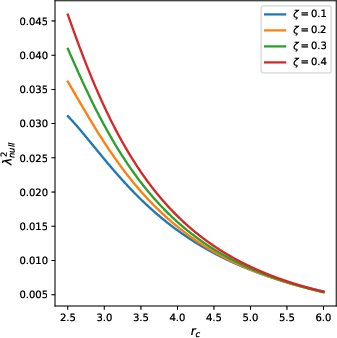
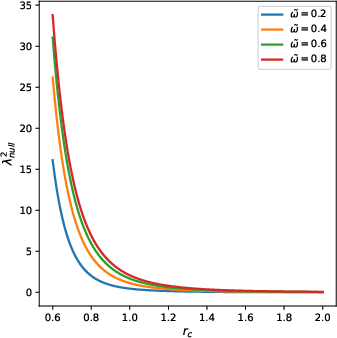
Figure 1: Variation of Lyapunov exponent versus ζ5 for different ζ6 and ζ7, illustrating the effect of quantum and dark matter sectors on orbit stability.
The results in Figure 1 demonstrate that both ζ8 and ζ9 reduce the magnitude of the Lyapunov exponent at a fixed rotation, indicating decreased instability but not necessarily increased regularity—since chaos can persist via multi-dimensional effects in phase space.
Structure of Phase Space: Poincaré Sections
Poincaré sections reveal intricate transitions in orbital stability as system parameters are varied. Systematic scans show how increasing ζ0 (PFDM) expands the accessible phase-space region, distorts invariant tori, and thickens chaotic layers. Conversely, increasing ζ1 contracts the radial extent of regular regions and enhances phase-space mixing, especially near the horizon.
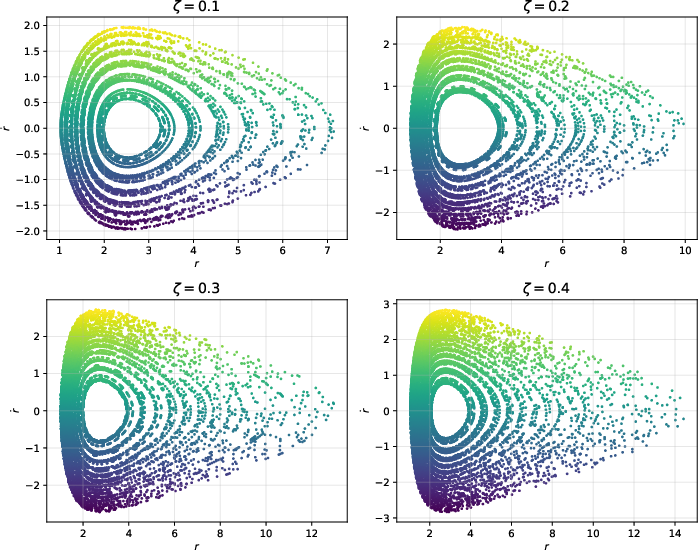
Figure 2: Poincaré sections for varying ζ2 at fixed PFDM, showing contraction of regular regions and amplification of chaos with stronger quantum corrections.
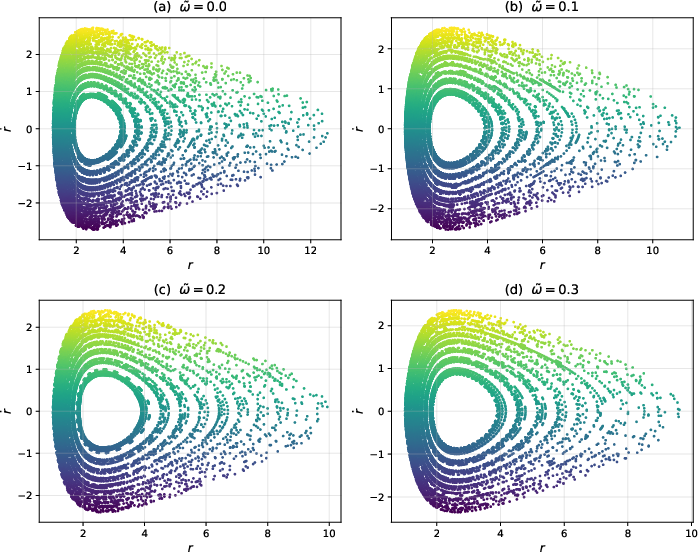
Figure 3: Poincaré sections versus increasing photon energy ζ3 (other parameters fixed), highlighting expansion and complexification of chaotic regions at higher energies.
These global diagnostic plots indicate a highly nontrivial phase space: the parameters ζ4, ζ5, and ζ6 each systematically control the formation, destruction, and morphology of islands of stability and chaotic seas.
Lyapunov Indicators: LLE and FLI
A suite of chaos indicators provides quantitative measures of instability beyond linearized exponents. The Largest Lyapunov Exponent (LLE) and Fast Lyapunov Indicator (FLI) are both computed for ensembles of orbits with fine parameter scans.
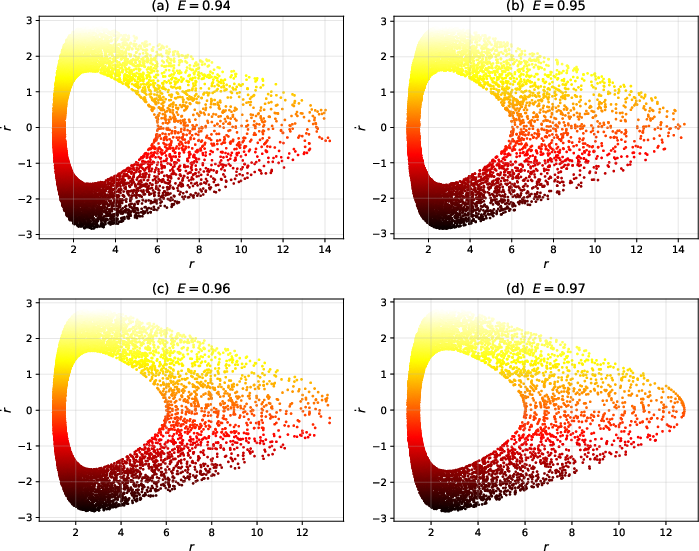
Figure 4: ζ7 (LLE) versus ζ8 for various ζ9 across increasing G(r)0; early-time divergence is strongly dependent on PFDM, converging to reduced instability at late times.
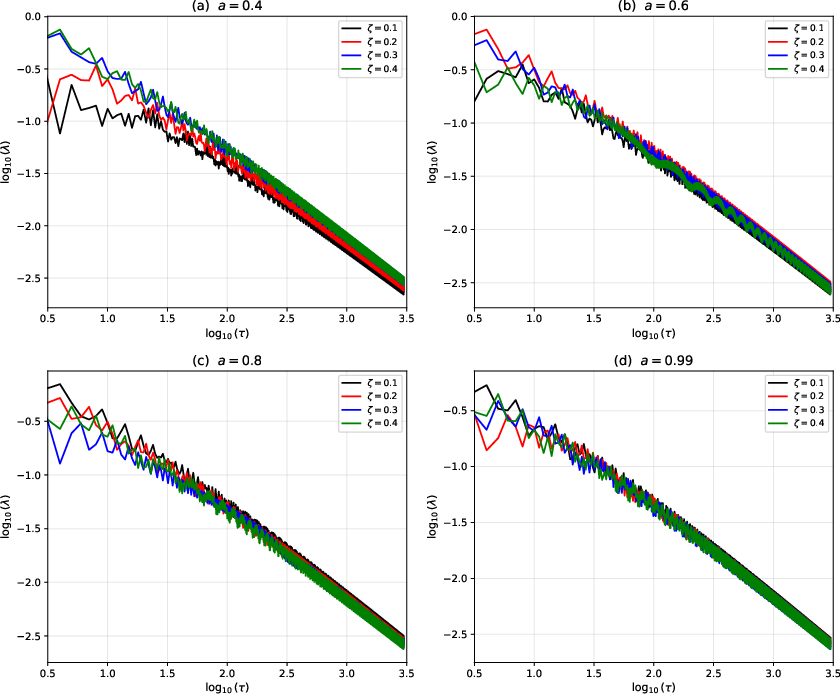
Figure 5: G(r)1 versus time for different G(r)2. The transient sensitivity is pronounced; quantum corrections primarily affect non-asymptotic dynamics.
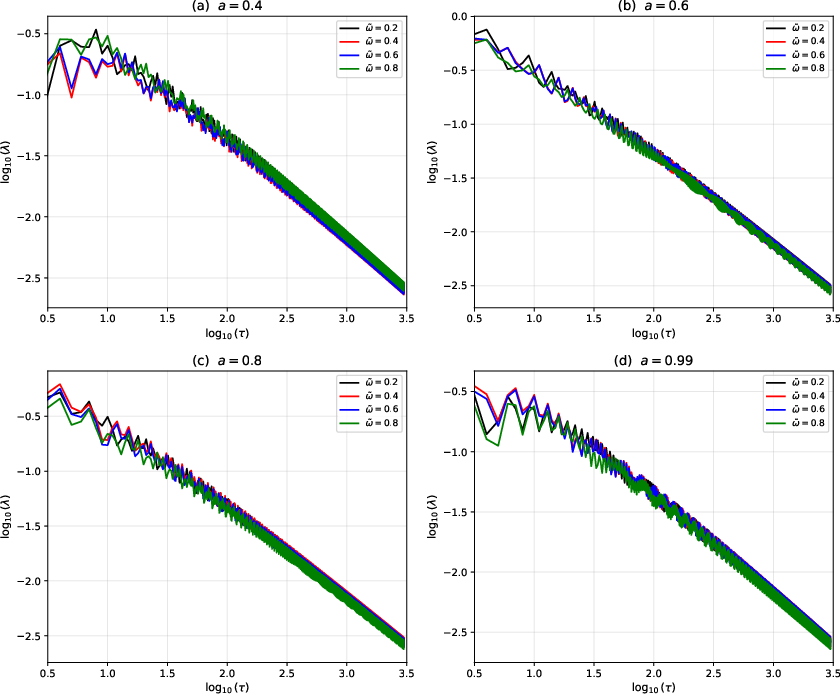
Figure 6: FLI curves with increasing G(r)3, showing separation of regular and chaotic dynamical regimes. Transition from linear (regular) to exponential (chaotic) divergence is evident.
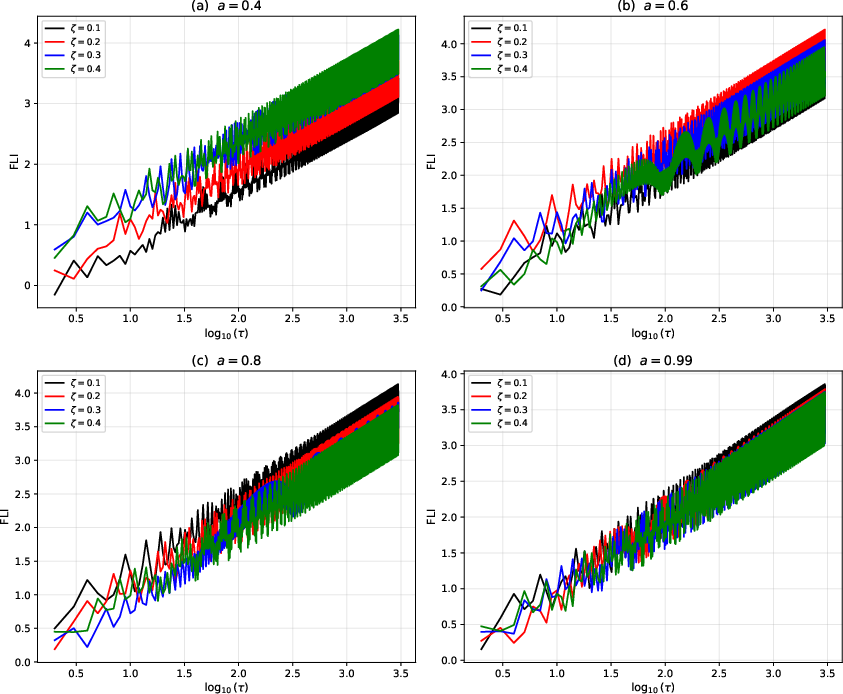
Figure 7: FLI for increasing G(r)4, showing that quantum gravity corrections rapidly enhance chaotic divergence, especially at moderate rotation.
Lyapunov diagnostics confirm that both dark matter and quantum corrections significantly modulate photon path instability and the boundaries between regular and chaotic orbital regimes.
Entropic Diagnostics: Kolmogorov-Sinai Entropy
Kolmogorov-Sinai (KS) entropy quantifies the total rate of chaos via the sum of positive Lyapunov exponents. For photon orbits, this enables mapping of the global predictability loss in phase space.
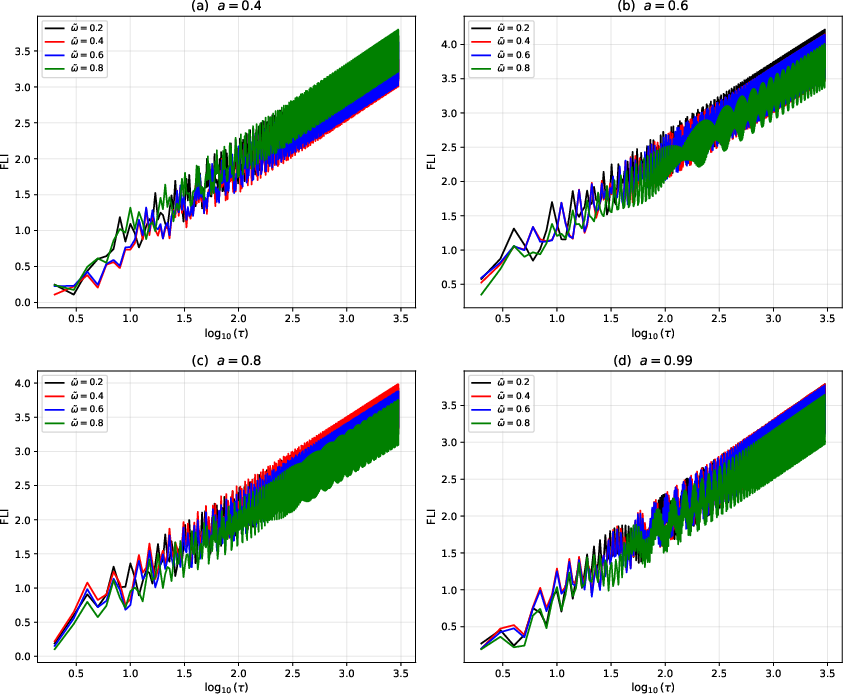
Figure 8: KS entropy G(r)5 versus proper time for varying G(r)6; larger PFDM magnitudes raise both the amplitude and persistence of chaos-induced entropy fluctuations.
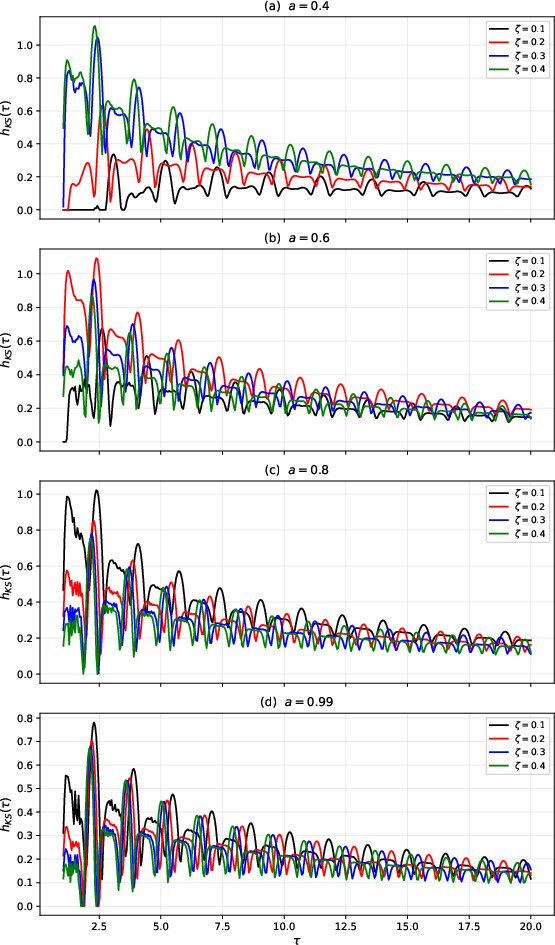
Figure 9: G(r)7 for varying G(r)8; increased quantum corrections initially raise entropy but, in strong rotation, lead to more rapid damping—highlighting complex interplay with frame dragging.
Entropic measures indicate that both G(r)9 and M0 can tune the degree and decay rate of strong-field chaos, with rotation parameter M1 crucially modulating these effects.
Global Detection: Weighted Birkhoff Average and DIC Maps
Weighted Birkhoff Average (WBA) and Dynamical Indicator of Chaos (DIC) provide fast, high-resolution, global stability/chaos diagnostics. DIC quantifies orbit regularity across initial conditions in M2 phase space.
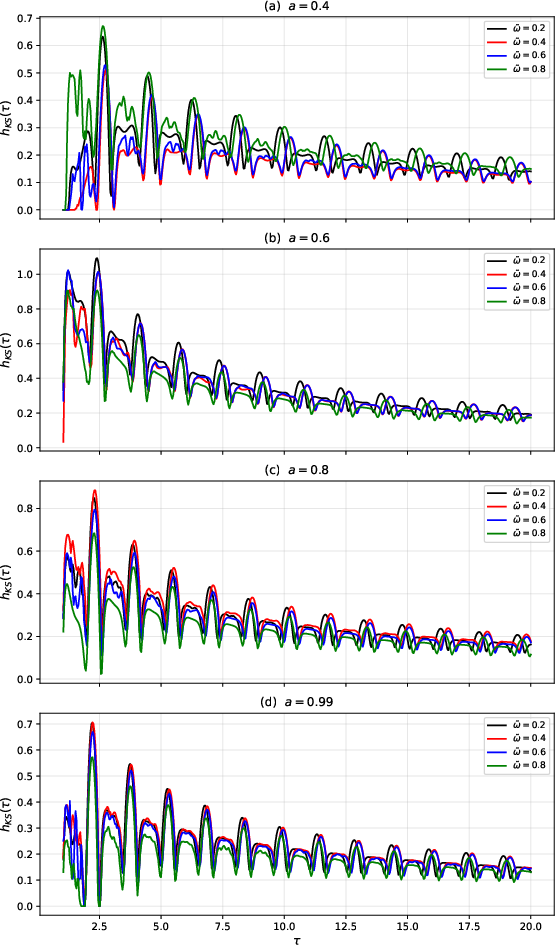
Figure 10: DIC maps for increasing M3, revealing shrinking regular islands and expanding chaotic layers with higher PFDM.
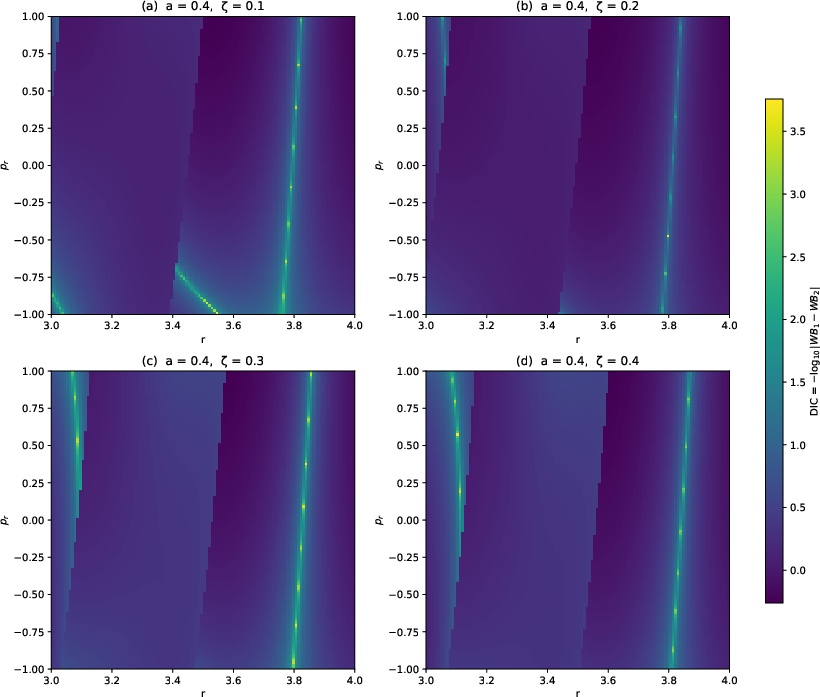
Figure 11: DIC maps for increasing M4, exhibiting less abrupt but systematic topology changes in phase space; quantum corrections introduce subtle restructuring.
The global structure of DIC maps confirms the coexistence of stable and chaotic photon motion and underscores the capability of the PFDM and quantum-improved sectors to modulate the balance and boundaries of chaos in realistic astrophysical settings.
Implications and Outlook
The analysis demonstrates that quantum corrections (M5) and PFDM (M6) produce distinct—but interrelated—modifications of photon orbit stability and chaos in rotating black hole spacetimes. Larger PFDM broadens and destabilizes phase space, while quantum corrections enhance dynamical mixing near the horizon. These findings directly impact theoretical predictions for black hole shadows, multi-messenger lensing, and strong-field orbital resonance phenomena (potentially observable with future high-resolution interferometry and timing resources). The parameter-dependent control of photon ring structure and chaos may enable indirect observational constraints on quantum gravity corrections and dark matter distributions via precision astrometry and QPOs.
Conclusion
The study rigorously quantifies the nonlinear interplay of quantum gravity corrections and environmental dark matter in Kerr black hole spacetimes, providing a systematic, multi-diagnostic mapping of chaos and stability in photon geodesics (2607.14170). The results indicate that both M7 and M8 can be interpreted as strong-field chaos regulators, with substantial implications for the astrophysical phenomenology of black hole environments. The diagnostic framework—combining geometric, entropic, and global statistical tools—offers a comprehensive template for future investigations of quantum-informed gravity in realistic cosmological backgrounds.

