- The paper demonstrates that magnetic charge and the DM parameter significantly lower the ISCO and MBO radii, altering orbital energy and angular momentum thresholds.
- It employs numerical analyses of the effective potential to reveal how PFDM and NED modify periodic orbit taxonomy and induce enhanced gravitational wave amplitudes.
- The study concludes that perfect fluid dark matter exerts a dominant effect over magnetic charge, with implications for precision modeling in gravitational wave astronomy.
Introduction and Motivation
The study "Equatorial periodic orbits and gravitational waveforms in Bardeen black holes surrounded by perfect fluid dark matter" (2607.03714) investigates the dynamical and observational signatures arising from the interplay of non-linear electrodynamics (NED) and perfect fluid dark matter (PFDM) in the context of black hole solutions. By generalizing the regular Bardeen black hole to include a PFDM environment, the paper explores how key orbital dynamics—specifically periodic orbits and the resulting gravitational waveforms in extreme mass-ratio inspirals (EMRIs)—are influenced by both the magnetic charge (from NED) and the DM parameter (from PFDM).
The work is motivated by (1) the physical importance of regular black holes as non-singular alternatives to Schwarzschild and Reissner-Nordström solutions, (2) the astrophysical relevance of dark matter environments, and (3) the prospect that gravitational waveforms from EMRIs encode fine details of the spacetime geometry and matter content around SMBHs.
Background: Bardeen Black Holes with PFDM and Their Metric
The central object considered is the Bardeen black hole surrounded by perfect fluid dark matter (BPFDM BH), which emerges from a coupling between nonlinear electromagnetic fields and a PFDM energy-momentum tensor. The resulting spacetime is static, spherically symmetric, and contains the parameters: ADM mass M, magnetic charge g, and a DM parameter α (in the notation of the manuscript). The solution generalizes to Schwarzschild by setting α,g→0; the presence of PFDM destroys the regularity of the original Bardeen solution.
The metric function incorporates contributions from both NED and DM, and all subsequent geodesic analyses originate from this background. The paper employs units G=c=M=1.
Effective Potential and Bound Orbits
The dynamics of test particles are governed by the effective potential derived from the geodesic equations. Both the ISCO (innermost stable circular orbit) and MBO (marginally bound orbit) are identified by extremization conditions on the potential:
- ISCO: Simultaneous solution to Veff(r)=E2, ∂rVeff=0, and ∂r2Veff=0
- MBO: Veff(r)=1, ∂rVeff=0
Comprehensive numerical analysis is provided on the dependence of ISCO and MBO radii, energies, and angular momenta on the parameters g0 and g1. A notable result is that increased values of either g2 or g3 decrease the radii and requisite angular momenta for both ISCO and MBO, indicating that both NED and DM components effectively strengthen the gravitational well.
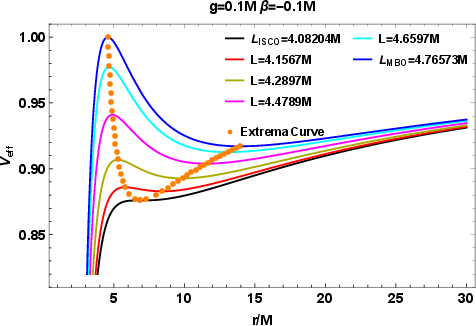
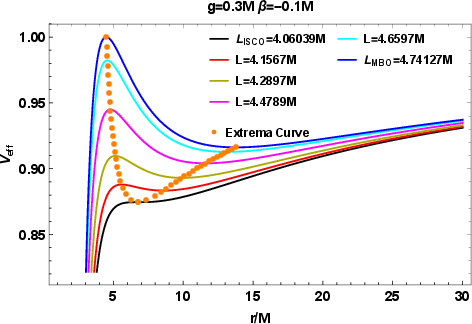
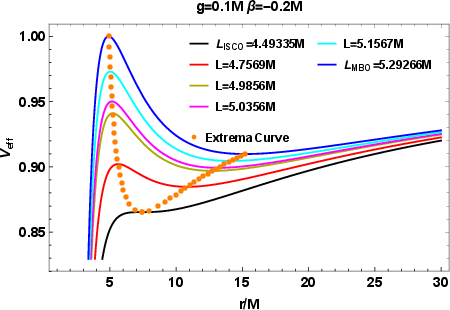
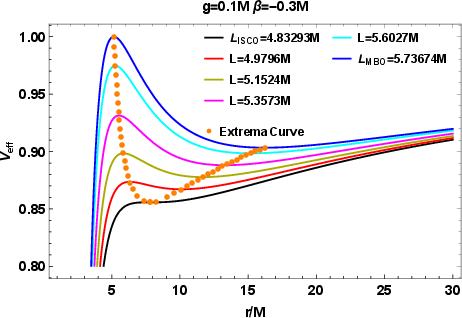
Figure 1: The effective potential g4 versus g5 for different values of model parameters.
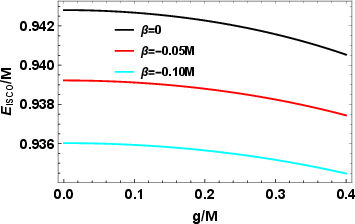
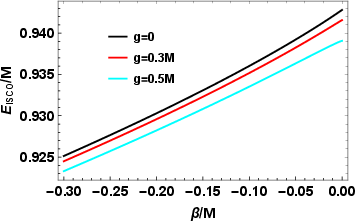
Figure 2: Variation of ISCO radius with magnetic charge g6 (left) and DM parameter g7 (right).
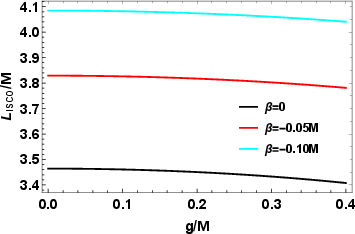
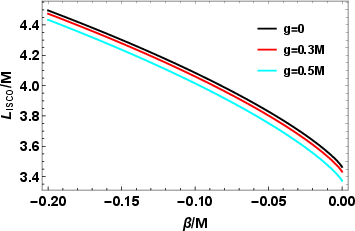
Figure 3: Angular momentum at ISCO as a function of magnetic charge g8 (left) and DM parameter g9 (right).
Figure 4: ISCO energy dependence on magnetic charge α0 (left) and DM parameter α1 (right).
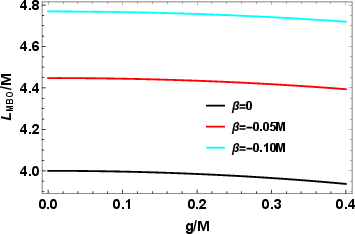
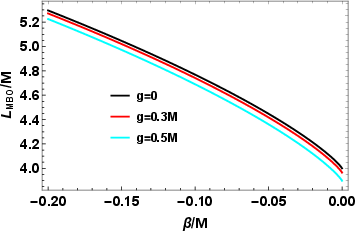
Figure 5: Marginally bound orbit (MBO) radius as a function of α2 (left) and α3 (right).
Figure 6: Angular momentum for MBO as a function of magnetic charge α4 (left) and DM parameter α5 (right).
Moreover, the α6 parameter space for bound orbits broadens with increasing α7, while increasing α8 shrinks the permissible region, indicating a stronger effect of DM on orbital stability than magnetic charge.
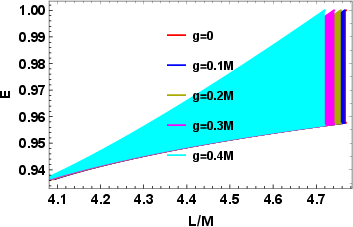
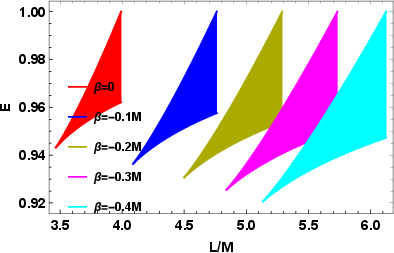
Figure 7: Parameter space of timelike bound orbits—the allowed region’s variation with α9 (left, α,g→00 fixed) and with α,g→01 (right, α,g→02 fixed).
Periodic Orbits and the α,g→03 Taxonomy
Periodic orbits—those for which the azimuthal angle accumulated over a radial period results in a closed trajectory—are characterized by a rational number α,g→04 and labeled by the triplet α,g→05: the number of zooms, whirls, and vertices visited, respectively. The paper quantifies how α,g→06 depends on α,g→07, α,g→08, α,g→09, and G=c=M=10.
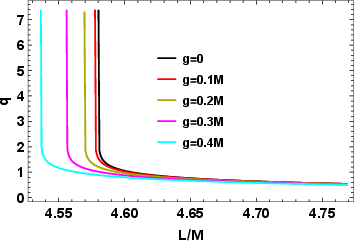
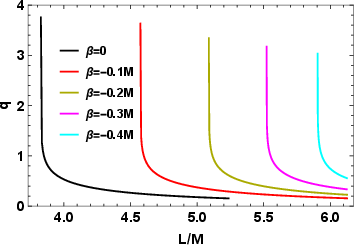
Figure 8: Rational number G=c=M=11 as a function of angular momentum G=c=M=12. Left: varying G=c=M=13 at fixed G=c=M=14; right: varying G=c=M=15 at fixed G=c=M=16.
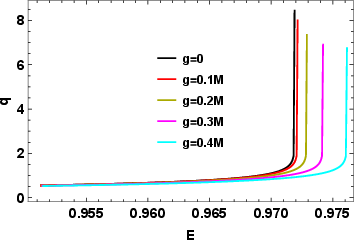
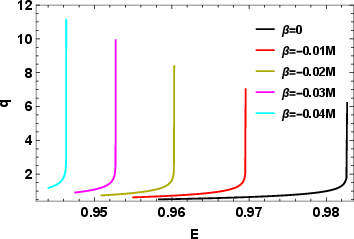
Figure 9: Rational number G=c=M=17 as a function of energy G=c=M=18. Left: varying G=c=M=19 at fixed Veff(r)=E20, right: varying Veff(r)=E21 at fixed Veff(r)=E22.
Key findings include:
- For fixed energy, Veff(r)=E23 diverges as Veff(r)=E24 approaches its minimal value (ISCO), signifying an onset of extreme whirl behavior.
- Increasing Veff(r)=E25 or Veff(r)=E26 causes this divergence to happen at even lower angular momentum, reflecting enhanced strong-field effects.
- For fixed Veff(r)=E27, increasing Veff(r)=E28 brings on extreme whirling at higher energies as either Veff(r)=E29 or ∂rVeff=00 increases.
- For fixed ∂rVeff=01, required energy and angular momentum systematically decrease with increasing ∂rVeff=02 or ∂rVeff=03.
Visualizations of these periodic orbits for various ∂rVeff=04 in the equatorial plane reveal increasing topological richness and strong-field residence with larger ∂rVeff=05 and ∂rVeff=06.
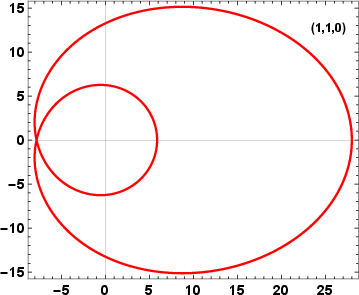
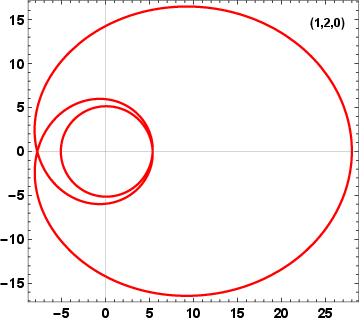
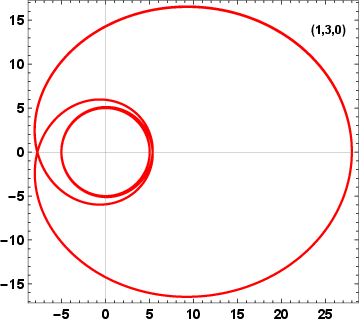
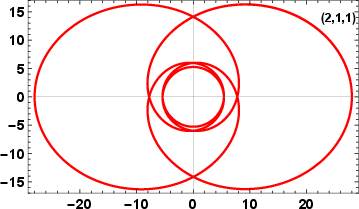
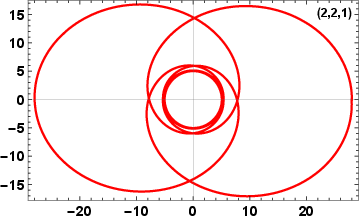
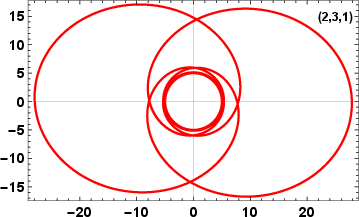
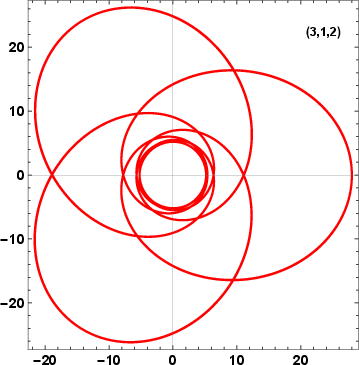
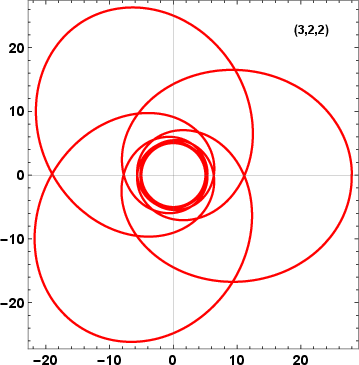
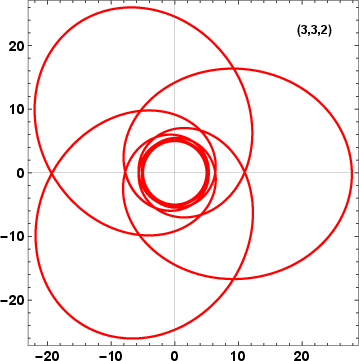
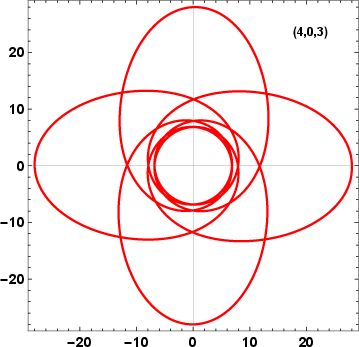
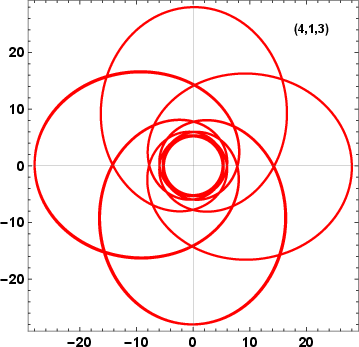
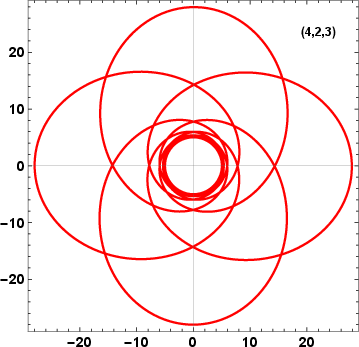
Figure 10: Example periodic orbits for various ∂rVeff=07 configurations (∂rVeff=08, ∂rVeff=09, ∂r2Veff=00).
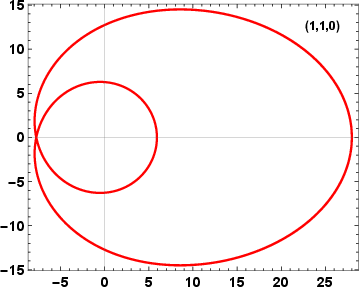
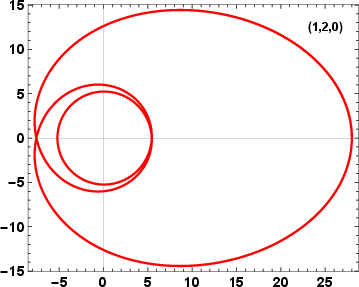
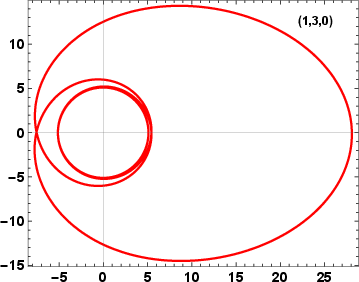
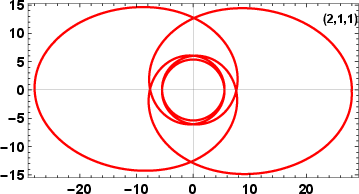
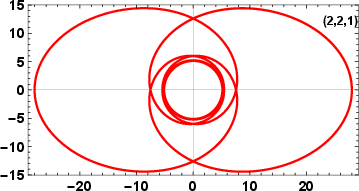
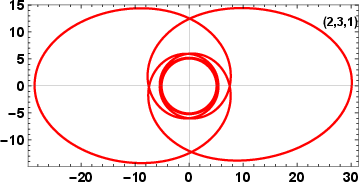
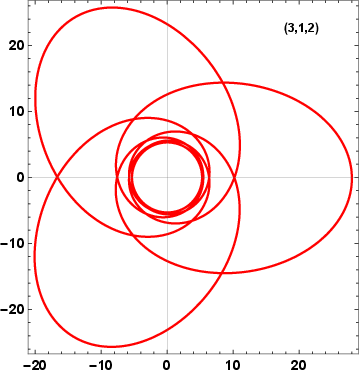
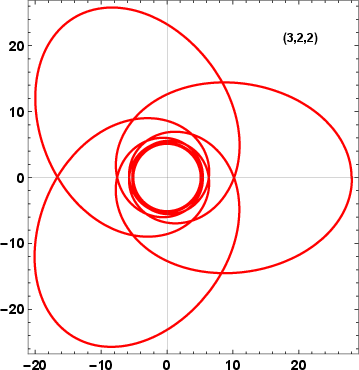
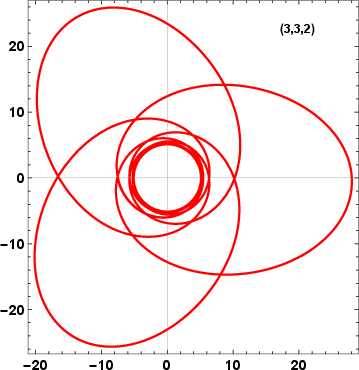
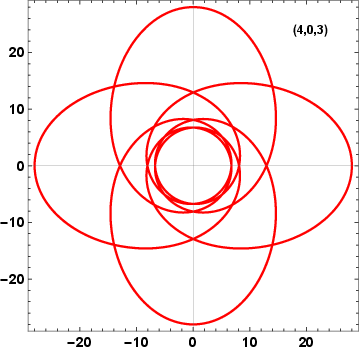
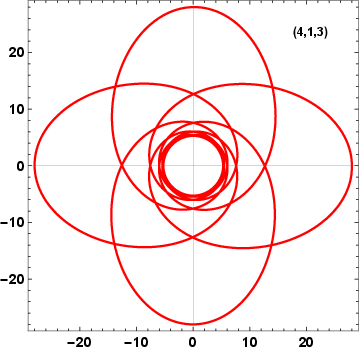
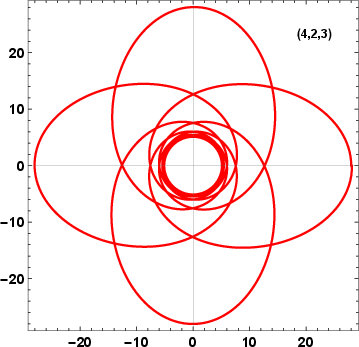
Figure 11: Example periodic orbits for different ∂r2Veff=01 at fixed ∂r2Veff=02.
Gravitational waves emitted by periodic orbits in EMRI systems (with a BPFDM SMBH as the central object) are computed using the numerical "Kludge" method combined with the quadrupole approximation. Under the adiabatic regime, this approach is justified as radiation reaction can be neglected over a single orbit.
A central result is that both ∂r2Veff=03 and ∂r2Veff=04 enhance the GW amplitude and decrease the orbital period, but the impact of ∂r2Veff=05 (DM) is more pronounced than that of ∂r2Veff=06 (magnetic charge), with no notable change in waveform topology.
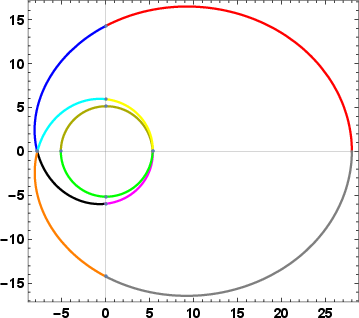
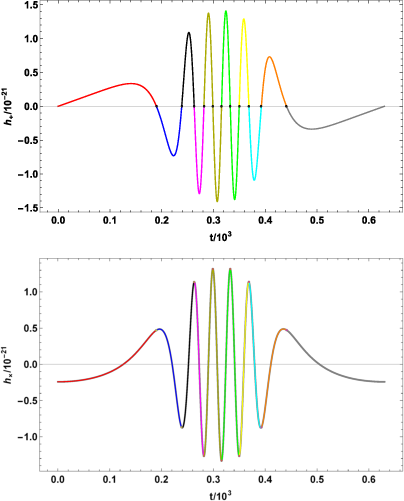
Figure 12: Gravitational waveform for a periodic orbit with ∂r2Veff=07. Left: particle trajectory; right: waveforms for ∂r2Veff=08 and ∂r2Veff=09. Colors indicate different orbital segments.
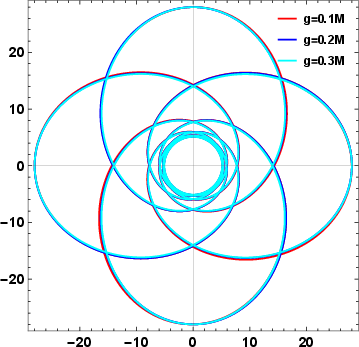
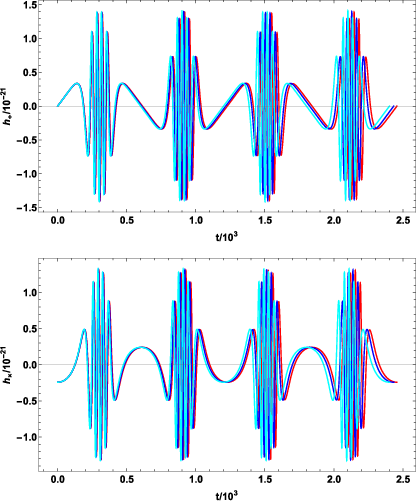
Figure 13: Periodic orbits and GWs for various magnetic charge values at Veff(r)=10.
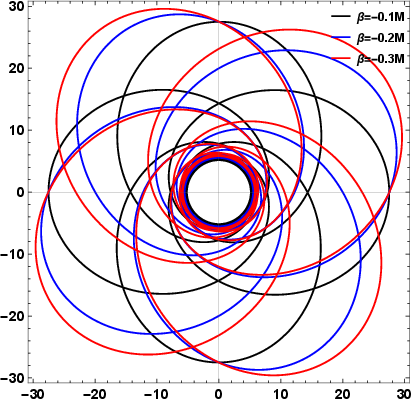
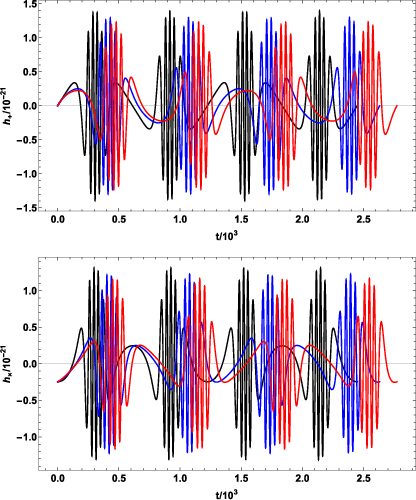
Figure 14: Periodic orbits and GWs for various DM parameter values at Veff(r)=11.
Distinct zoom-whirl phases in the orbit manifest as correspondingly modulated GW segments: low amplitude during zooms, high-frequency and high-amplitude bursts during whirls near periapsis. As Veff(r)=12 or Veff(r)=13 is increased, the peak amplitude of the GW grows, and the oscillation period shortens, reflecting deeper plunges into the strong-field regime.
Implications and Outlook
This analysis demonstrates that both NED (through Veff(r)=14) and PFDM (Veff(r)=15) imprint significant dynamical signatures on equatorial periodic orbits and gravitational waveforms in EMRIs. In particular, DM effects are more pronounced, affecting both the parameter space for bound orbits and the amplitude/timescale of emitted GWs.
The theoretical implications include:
- A new route for discriminating black hole environments (regular vs. singular, NED vs. vacuum, DM vs. no DM) directly through GW signatures in the strong-field regime.
- Quantitative relationships for ISCO, MBO, and periodic orbit parameters as a function of Veff(r)=16 and Veff(r)=17, enabling precision modeling for GW data analysis.
- Demonstration that even minimal PFDM coupling can destroy regularity and fundamentally alter geodesic structure.
For future developments:
- GW detectors sensitive to EMRIs (e.g., LISA) will provide data where such environmental effects may become observable, motivating further refinement, including radiation reaction and non-equatorial orbits.
- These results call for generalization to rotating Bardeen or other regular black holes with realistic DM distributions.
- The explicit parameter dependencies may inform constraints on alternative gravity or DM models as more precise waveform templates are constructed.
Conclusion
The paper provides a thorough technical analysis of how perfect fluid dark matter and non-linear electrodynamics modify key dynamical features—bound orbit structure, periodic orbit taxonomy, and gravitational waveform emission—in Bardeen black hole spacetimes. The main numerical findings demonstrate that both magnetic charge and DM parameter strongly influence the orbital and GW phenomenology, with DM effects being dominant. These results have immediate applicability for precision GW astronomy and theoretical modeling of black hole environments, establishing a framework for future comparisons with observational data and more sophisticated EMRI simulations.