- The paper establishes that PFDM significantly constrains black hole shadows, quasinormal modes, and Hawking radiation, while Euler–Heisenberg corrections remain subleading for moderate charge.
- It employs null geodesic analysis and eikonal approximations to derive photon sphere properties and energy emission rates under combined gravitational and QED effects.
- The findings suggest that observational signals, such as VLBI shadows and ringdown spectra, can differentiate dark matter influences from intrinsic quantum corrections.
Optical, Dynamical, and Radiative Phenomena of the Euler–Heisenberg Black Hole in Perfect Fluid Dark Matter
Introduction and Theoretical Framework
The paper systematically examines the optical signature, dynamical perturbations, and Hawking radiative behavior of an Euler–Heisenberg (EH) black hole embedded in a perfect fluid dark matter (PFDM) background, extending classical Reissner–Nordström models by incorporating leading-order QED vacuum polarization (through EH nonlinear electrodynamics) and a phenomenological matter halo. The action synthesizes the Einstein-Hilbert gravitational sector, EH-corrected Maxwell dynamics, and a PFDM stress-energy yielding a logarithmic deformation of the spacetime, parameterized by an EH coupling α and PFDM density parameter λ. The geometry remains asymptotically flat; in limiting regimes (α→0, Q→0, λ→0), the metric interpolates to previously studied families (Schwarzschild/charged/PFDM).
Photon Spheres and Black Hole Shadow Properties
The authors obtain the photon sphere radius rp and shadow radius Rsh via null geodesic analysis, with nontrivial modifications due to dark matter and nonlinear electrodynamics. The critical result is that both increasing ∣Q∣ and ∣λ∣ monotonically reduce rp and λ0, but the sensitivity to λ1 is much weaker except in strong-charge regimes. The dark-matter halo introduces a dominant suppression, contracting the observable shadow even at moderate λ2.
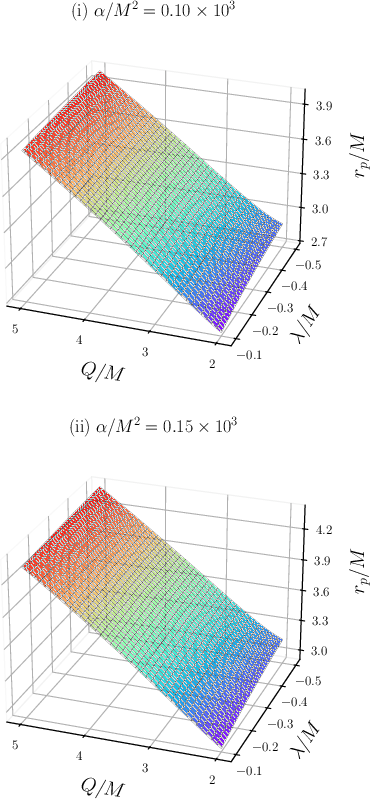
Figure 1: Three-dimensional visualization of the photon sphere radius as a function of λ3 and λ4 for two values of λ5.
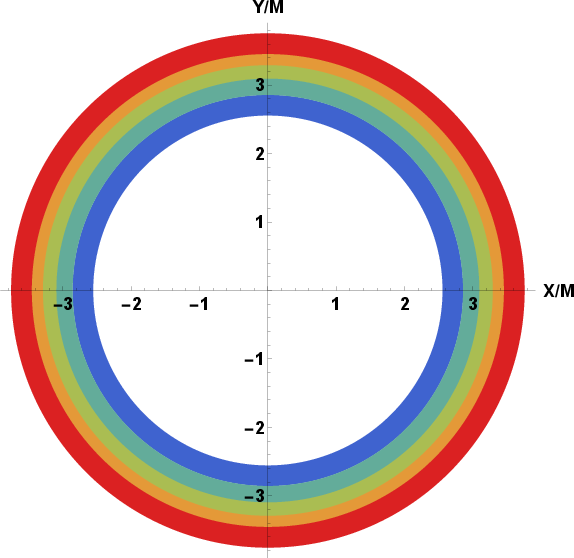
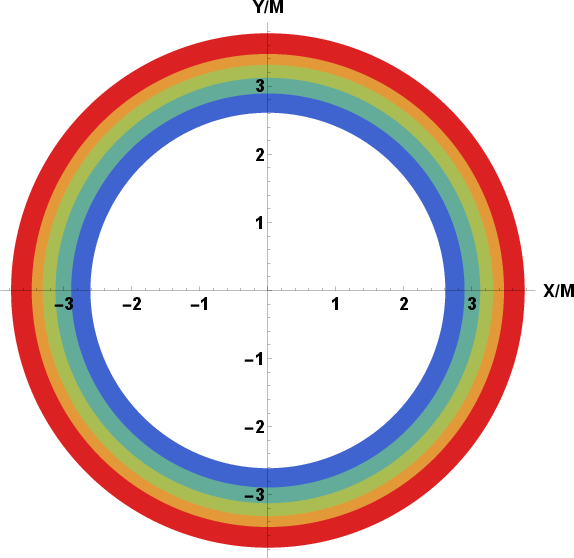
Figure 2: Annular photon rings for varying λ6 and fixed λ7; an increase in λ8 expands the size of the rings.
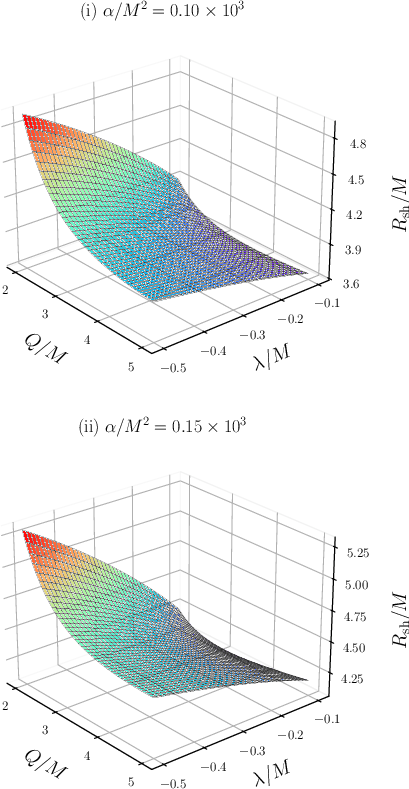
Figure 3: Three-dimensional plot of the black hole shadow radius λ9, highlighting the parameter dependencies.
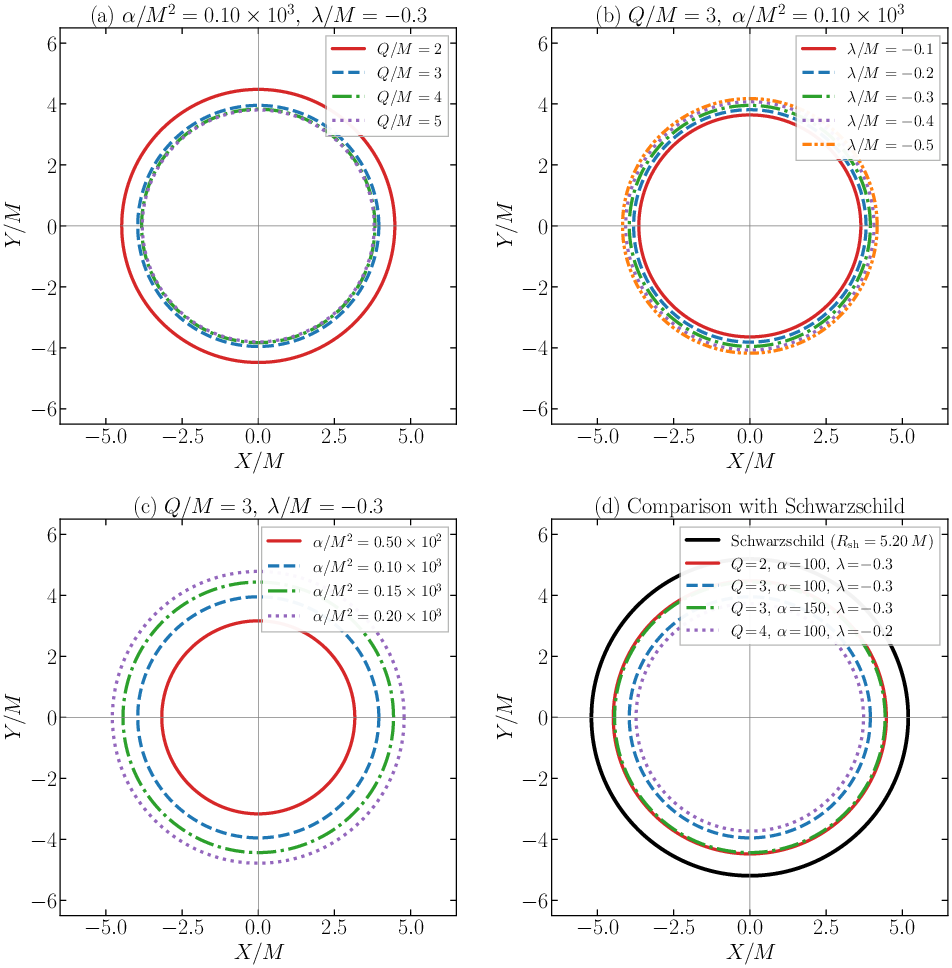
Figure 4: Shadow silhouettes in the observer’s celestial plane for various α→00, α→01, and α→02; all lie within the Schwarzschild shadow.
It is emphasized that for most of the parameter space, the EH corrections to the shadow are subleading. However, at large α→03 and α→04, the effect is visible and distinguishable. The shadow is highly sensitive to the PFDM background, suggesting the surrounding matter profile can in principle be constrained by high-resolution VLBI observations.
Scalar Perturbations and Eikonal Quasinormal Modes
The scalar field perturbation equation in this background produces a modified Regge–Wheeler potential. The effective potential is shown to be mainly deformed by α→05, with only minor α→06-dependence in most cases.
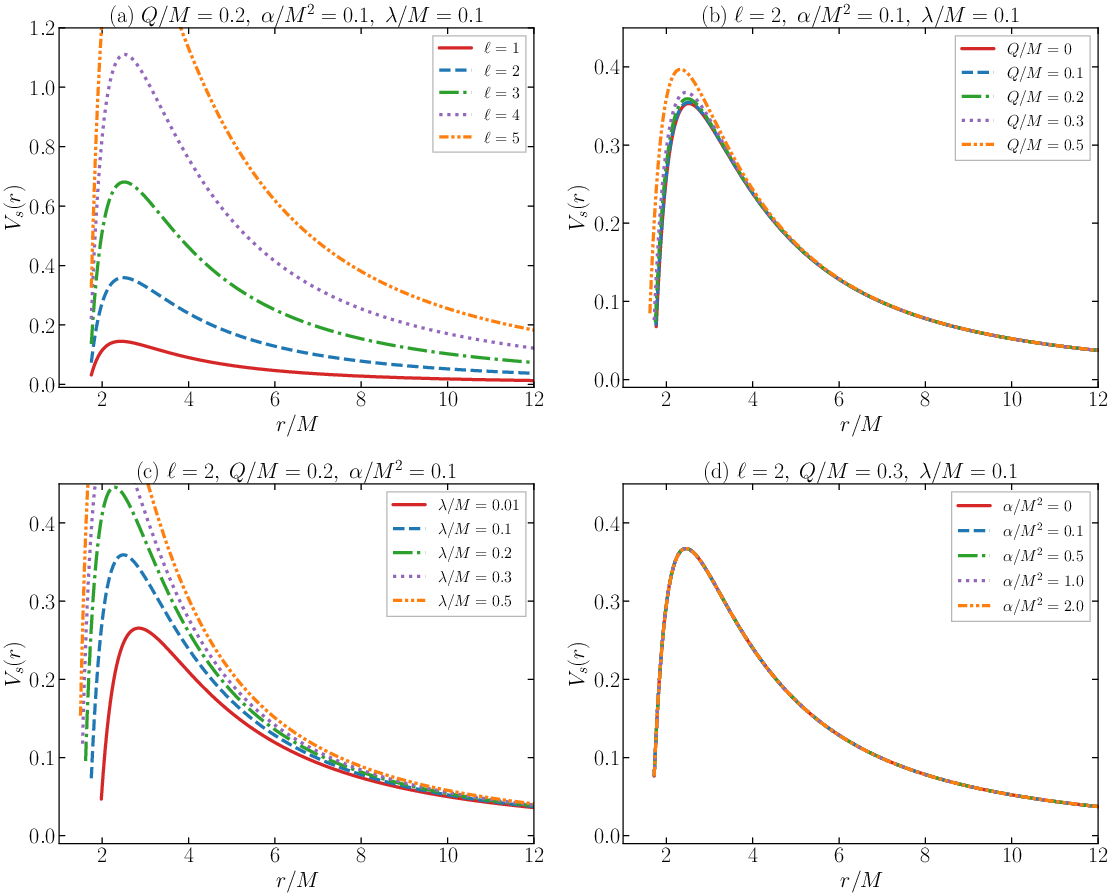
Figure 5: Effective potential α→07 for massless scalar waves as various background parameters are varied.
In the eikonal regime (α→08), the quasinormal mode (QNM) spectrum is governed by photon sphere properties via the geodesic correspondence: α→09, with Q→00 and Q→01 being the angular velocity and Lyapunov exponent at Q→02. Both quantities grow with Q→03 and Q→04, but the PFDM parameter is the principal driver. Variations in Q→05 can be significant only at high Q→06.
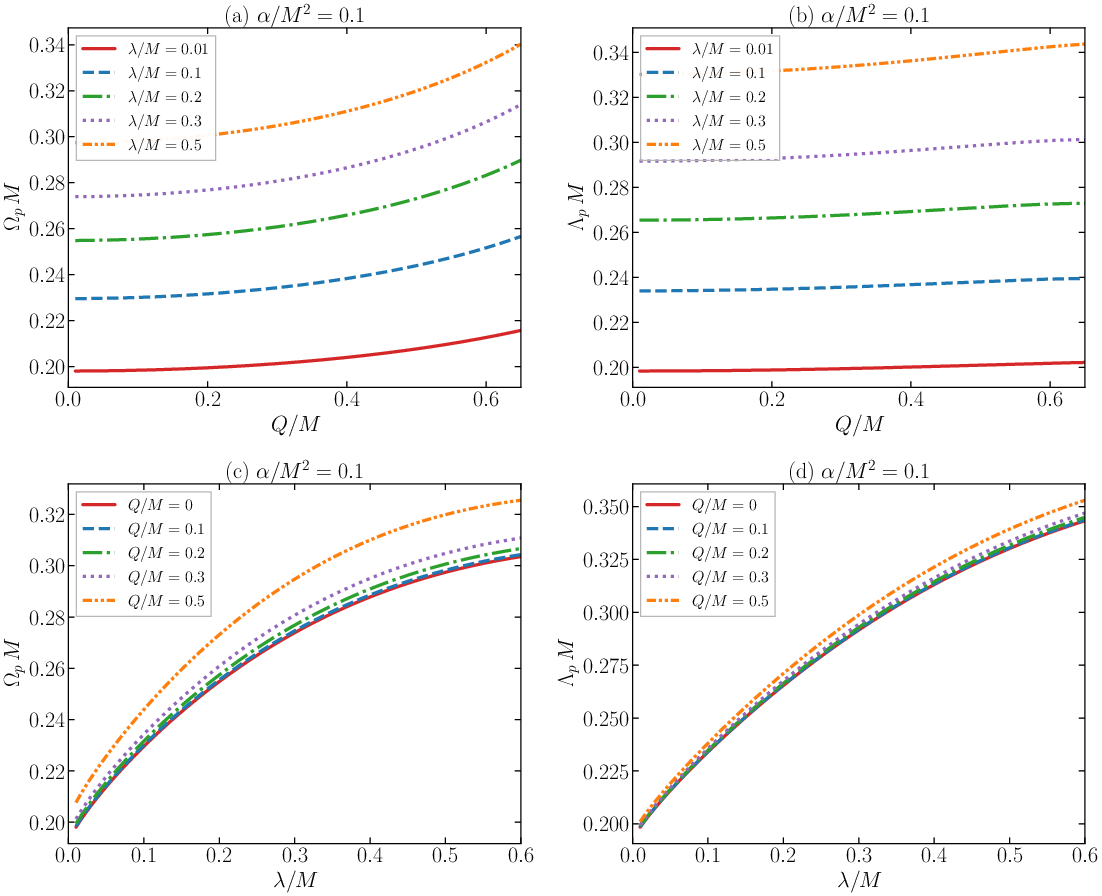
Figure 6: Eikonal QNM quantities at fixed Q→07, demonstrating the monotonic dependence on Q→08 and Q→09.
The QNM spectra show that the PFDM environment dominates the real and imaginary components, dictating oscillation frequency and damping rate, respectively. This establishes a hierarchy of phenomenological imprint: λ→00 in most cases.
Eikonal Grey-Body Factors and Radiative Transport
Using the QNM-Grey Body Factor correspondence, the transmission probability as a function of frequency is derived in the eikonal limit. The transition threshold λ→01 and the shape of the sigmoid are set mainly by λ→02 and λ→03.
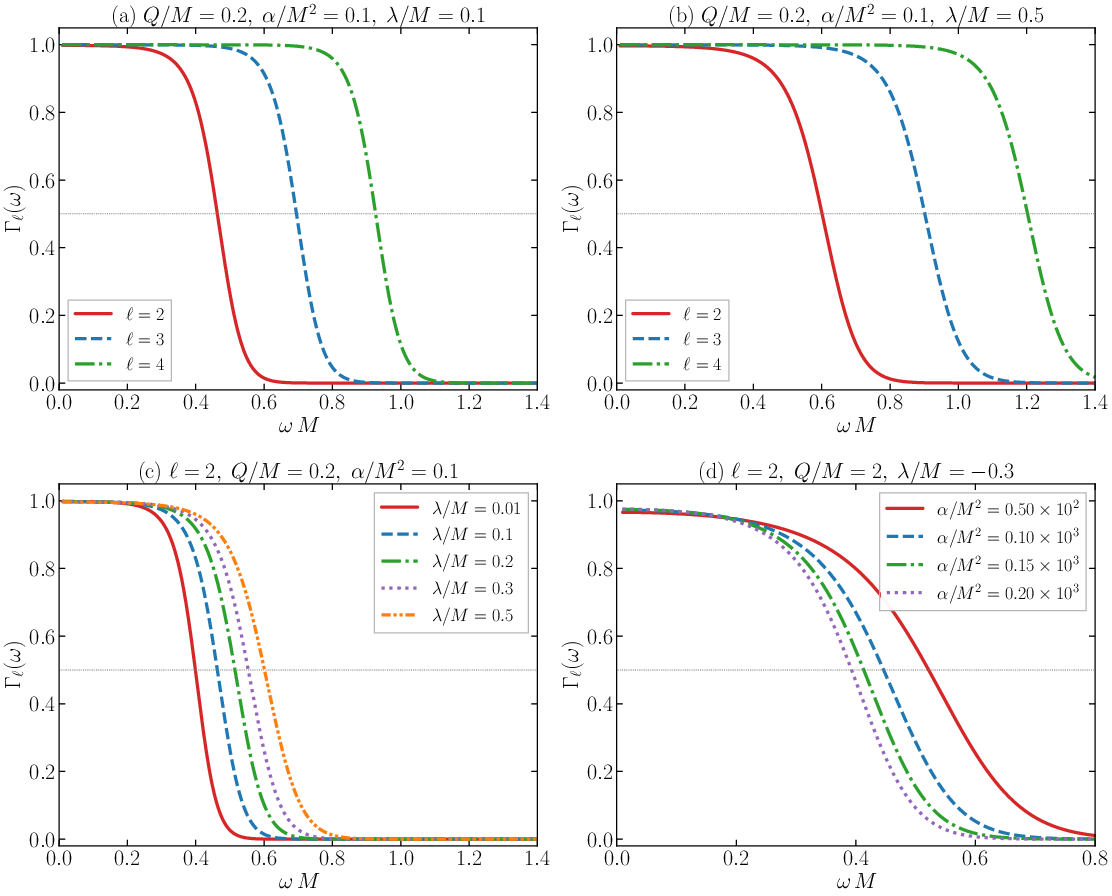
Figure 7: Eikonal grey-body factor λ→04 illustrating the influence of multipole index, λ→05, and λ→06 (in high-λ→07 configurations).
The analysis demonstrates that the PFDM parameter yields the largest shift in the transition threshold and broadening of the sigmoid. Only in strongly charged regimes does λ→08 manifest as an observable correction to the spectral transmission profile.
Hawking Radiation: Temperature, Sparsity, and Emission Rates
The Hawking temperature follows from the deformed surface gravity, with λ→09 enhanced by rp0 and decreased by rp1. The sparsity parameter rp2, quantifying deviations from continuous blackbody emission, is invariably much larger than unity across the explored parameter space—confirming that the Hawking cascade is well within the sparse regime.
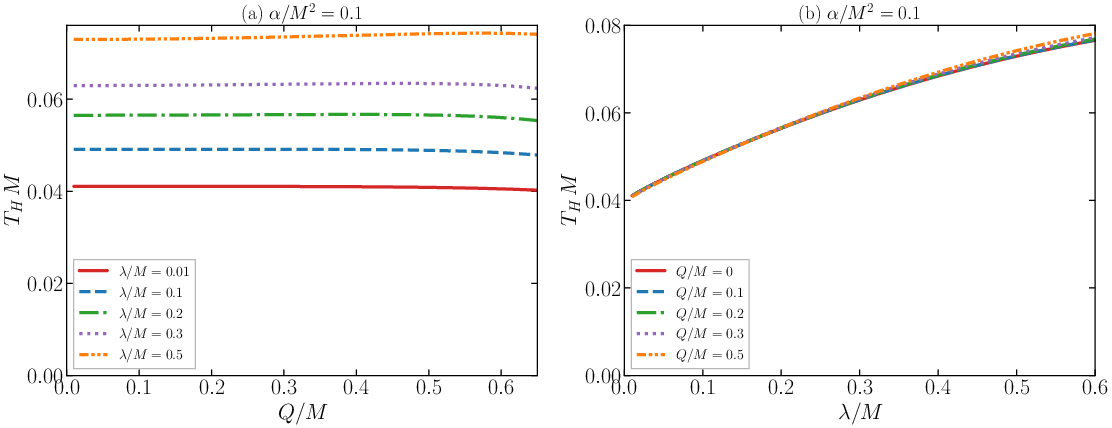
Figure 8: Hawking temperature as a function of rp3 and rp4 at fixed rp5.
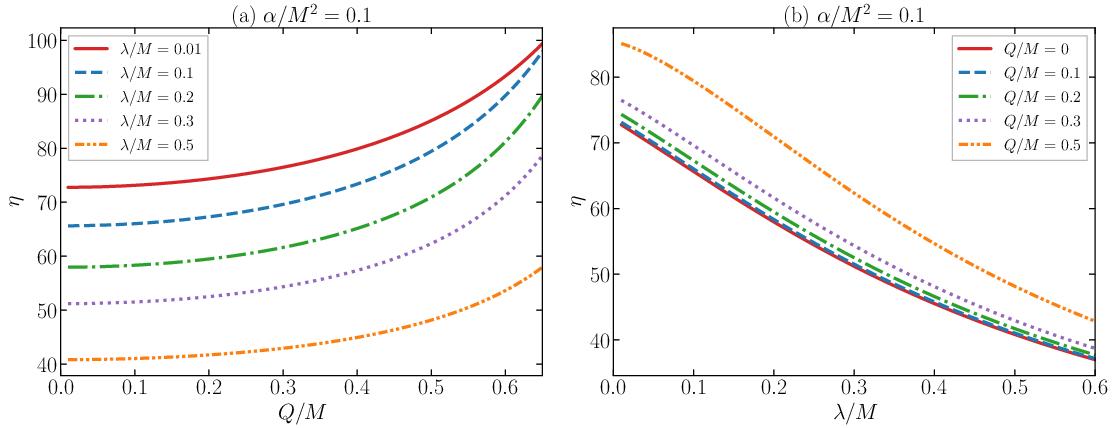
Figure 9: Dimensionless sparsity parameter rp6 characterizing the Hawking emission, as a function of rp7 and rp8.
Energy emission spectra in the geometric-optics limit reflect the combined effect of the shadow (as effective area) and temperature. The flux peak and cutoff frequencies are principally regulated by the PFDM parameter; the impact from EH corrections is negligible except at high charge.
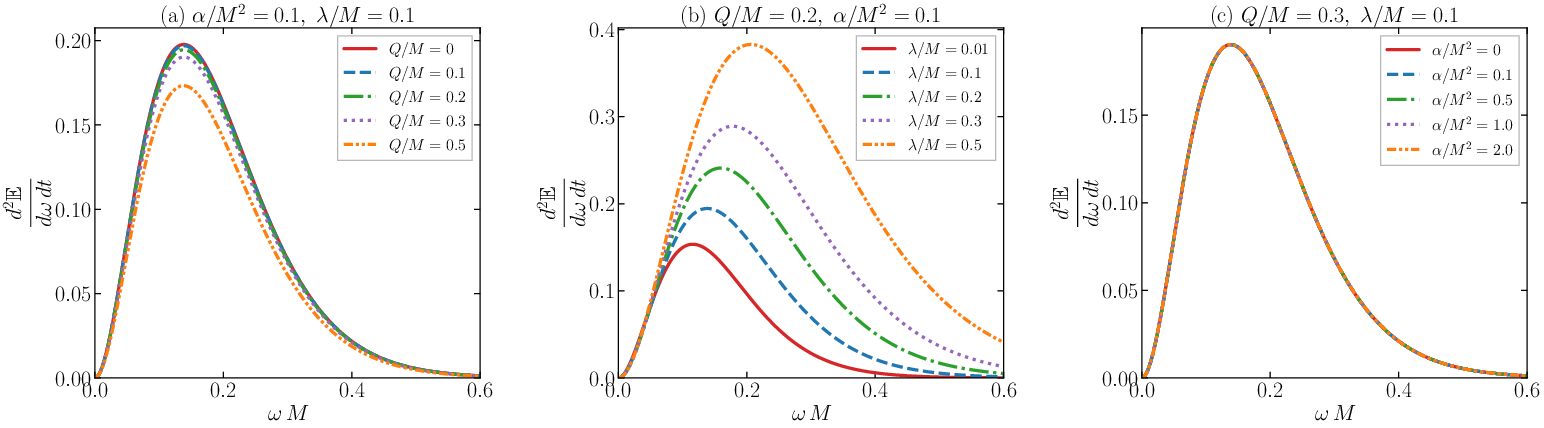
Figure 10: Spectral energy emission rate rp9 illustrating suppression/enhancement by Rsh0 and Rsh1 across frequencies.
Implications and Future Directions
This unified treatment demonstrates that the presence of a PFDM background strongly constrains the observable phenomenology of charged black holes, offering observational handles on matter profiles through shadow and ringdown spectra. The EH electrodynamics corrections—though of fundamental theoretical importance for strong-field QED—are subdominant for moderate Rsh2, and require either extremely high charge or next-generation precision to be disentangled in shadow and emission data.
For gravitational wave astrophysics, both the real and damping frequencies of the ringdown, as well as the temporal structure of Hawking emission, are set primarily by environmental PFDM effects. This suggests care must be taken in attributing deviations from vacuum general relativity to intrinsic quantum gravity signals when a matter halo is present. The paper's analytic hierarchy implies that shadow/ringdown/energy emission observables probe the ambient matter distribution much more robustly than nonlinear QED.
Theoretically, the study motivates extending this framework to axisymmetric spinning solutions, coupling to more realistic dark matter models, and considering higher-order QED corrections for extremal configurations. Further, the sparsity analysis accentuates the fundamentally quantum nature of black hole evaporation even with matter halos, reinforcing the need for quantum gravity completions in such backgrounds.
Conclusion
The analysis establishes a clear dominance of PFDM-induced effects over Euler–Heisenberg electrodynamics in shaping the optical, dynamical, and radiative properties of charged black holes in the leading-parameter regime. The PFDM parameter Rsh3 sets the scale for shadow contraction, QNM oscillation and damping, grey-body spectral thresholds, and Hawking temperature enhancement, while the EH coupling Rsh4 imprints only a perturbative correction that is detectable predominantly in high-charge situations. Consequently, black hole shadow and ringdown signals are more effective diagnostics of dark matter environments than of strong-field QED effects in this model. Future work should pursue axes of observational discrimination and higher-order corrections, with implications for both astrophysical black hole phenomenology and the program of quantum gravity phenomenology.
Reference: "Shadow, Quasinormal Modes, Sparsity, and Energy Emission Rate of Euler-Heisenberg Black Hole Surrounded by Perfect Fluid Dark Matter" (2604.16628).

