- The paper demonstrates that coupling nonlinear electrodynamics with perfect fluid dark matter produces novel thermodynamic behaviors and distinct phase transitions in black holes.
- It employs parameterized modeling and MCMC analysis to show how magnetic charge and PFDM modify ISCO locations, effective potentials, QPO frequencies, and shadow sizes.
- These findings provide actionable insights for testing deviations from general relativity and for guiding multiwavelength observational strategies in astrophysics.
Black Holes with Nonlinear Electrodynamics in Perfect Fluid Dark Matter: Thermodynamics, Dynamics, QPOs, and Shadow
Introduction and Model Framework
The paper "Black holes in general relativity coupled with NEDs surrounded by PFDM: thermodynamics, epicyclic oscillations, QPOs, and shadow" (2604.13140) presents a systematic analysis of static, spherically symmetric black holes arising from general relativity coupled to nonlinear electrodynamics (NED), embedded in a perfect fluid dark matter (PFDM) environment. The metric derives from a specific NED Lagrangian and incorporates a logarithmic correction to model PFDM, parameterized by λ, alongside a magnetic charge q. This class of solutions unifies two crucial lines of research in black hole physics: regular (nonsingular) black hole models via NED, and environmental effects due to dark matter halos.
The work addresses thermodynamic structure, test particle dynamics, epicyclic and quasi-periodic oscillatory signatures, statistical constraints from observed QPOs, and shadow phenomena. This comprehensive analysis reveals parametric dependencies and potential observational discriminants for black holes in astrophysically realistic, non-vacuum contexts.
Horizon Structure and Thermodynamics
The lapse function f(r) depends on mass M, charge q, and PFDM parameter λ. Horizon locations are roots of f(r)=0. Increasing either q or λ systematically reduces the event horizon radius.
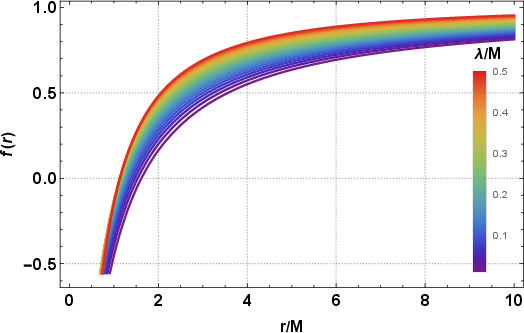
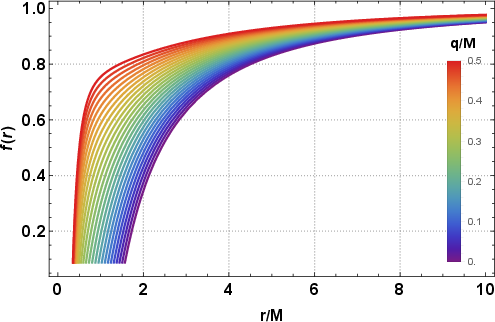
Figure 1: Behavior of the metric function for different values of λ and q0.
Thermodynamic properties are substantially altered compared to Schwarzschild. The Hawking temperature q1 exhibits a non-monotonic dependence on horizon radius q2 in the presence of q3 or q4. There exists a peak temperature, after which q5 decreases, unlike the strictly decreasing Schwarzschild profile.
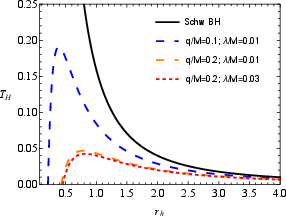
Figure 2: Hawking temperature q6 vs. event horizon radius q7. Modified solutions demonstrate a peak, lower maximal temperatures compared to Schwarzschild, and return to Schwarzschild-like behavior at large q8.
Heat capacity q9 undergoes sign changes and divergences at critical radii, marking second-order phase transitions and delineating stable (f(r)0) and unstable (f(r)1) thermodynamic branches. This is in stark contrast to Schwarzschild, which lacks such thermodynamically stable regimes.
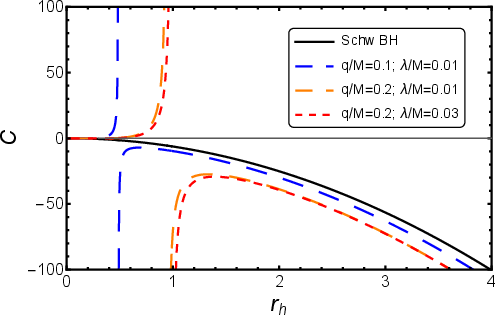
Figure 3: Heat capacity f(r)2 as a function of f(r)3, showing divergences and a sign change indicative of phase transitions absent in Schwarzschild.
These features signal a fundamentally enriched thermodynamic phase structure due to the NED and PFDM contributions, with possible implications for small black hole remnants and nontrivial endpoint configurations.
Test Particle Motion: Effective Potential, ISCO, and Epicyclic Structure
The dynamics of neutral test particles are encoded by the effective potential f(r)4, which is sensitive to f(r)5 and f(r)6. These parameters shift the location and depth of the potential minimum, resulting in an outward displacement of stable circular orbits and a shallower binding potential.
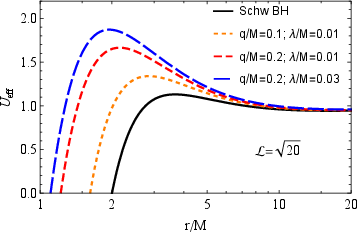
Figure 4: Effective potential f(r)7 as a function of f(r)8 under varying PFDM and charge parameters.
The effective radial force also displays a pronounced dependence on f(r)9 and M0, modulating the strength and the spatial profile of gravitational attraction/repulsion for test particles.
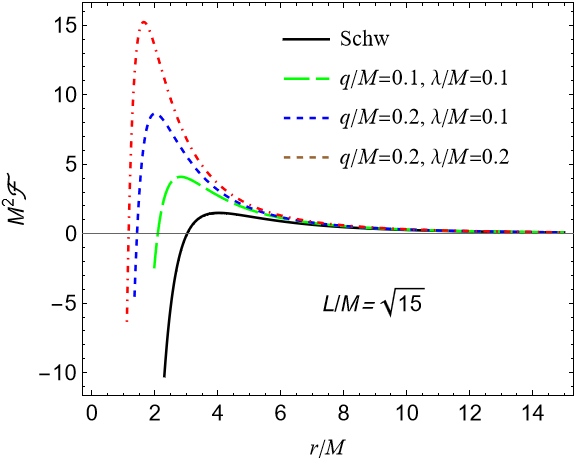
Figure 5: Radial force as a function of M1 for representative values of M2 and M3.
Examination of circular orbits identifies the innermost stable circular orbit (ISCO), where both M4 and M5 reduce the ISCO radius relative to Schwarzschild, potentially shifting the inner edge of accretion disks and affecting high-energy emission.
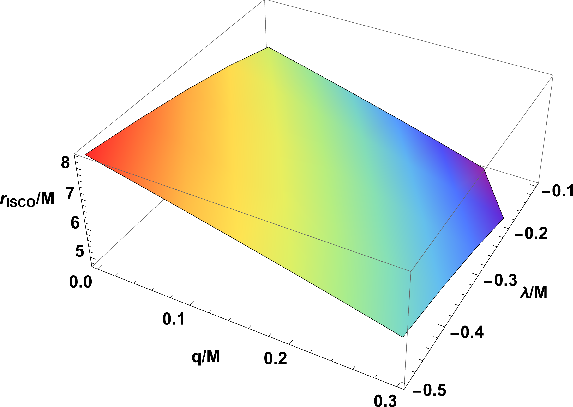
Figure 6: Three-dimensional plot of ISCO radius as a function of M6 and M7.
Test particle trajectories, including bound and unbound orbits, confirm significant deviations from Schwarzschild geodesics, especially in the strong-field regime.
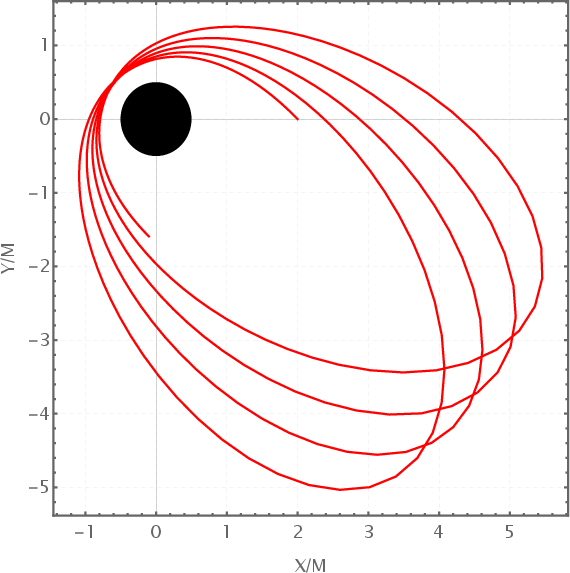
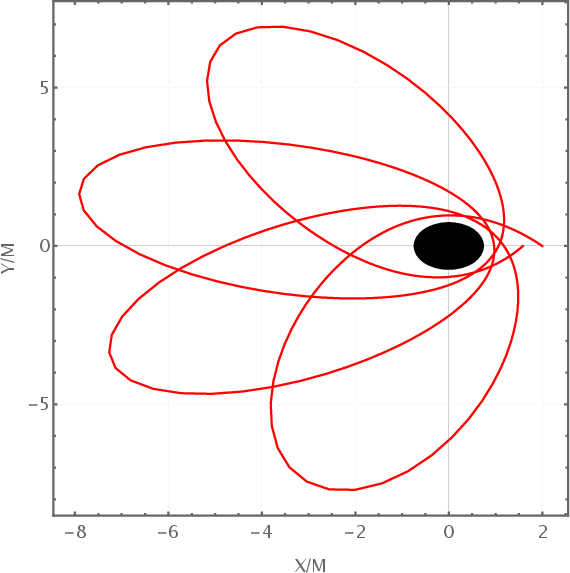
Figure 7: Particle trajectory in the M8 plane under fixed M9 and varying q0.
Epicyclic frequencies, crucial for modeling QPOs, show that both orbital and radial frequencies are enhanced by increasing q1 and q2. This alters the coupling of geodesic motion to observable phenomena in the accretion flow.
QPO Modeling and Bayesian Constraints
The paper applies the relativistic precession (RP) model to interpret twin-peak QPOs in four accreting compact sources, using coordinate frequencies of geodesic motion in the derived spacetime. Both the upper (q3) and lower (q4) QPO frequencies systematically shift to higher values for increasing q5 and q6, for a fixed ISCO.
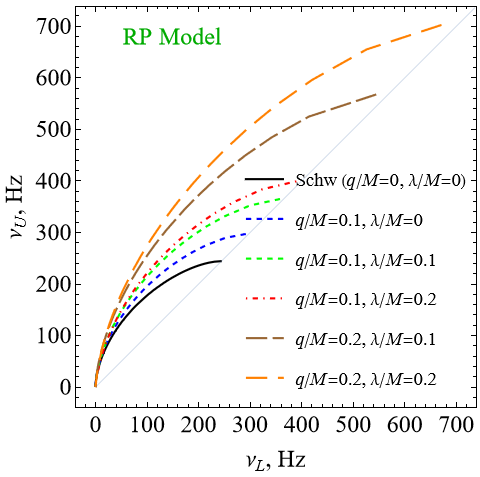
Figure 8: Correlation between QPO frequencies q7 and q8 in the RP model. Larger q9 and λ0 raise both frequencies compared to Schwarzschild.
A MCMC parameter estimation was carried out to constrain λ1 using observed QPO data. Posterior distributions for these parameters converge to small, positive λ2 and narrow intervals for λ3, with the best-fit QPO-generative radius near λ4 across sources (stellar and IMBH regimes).
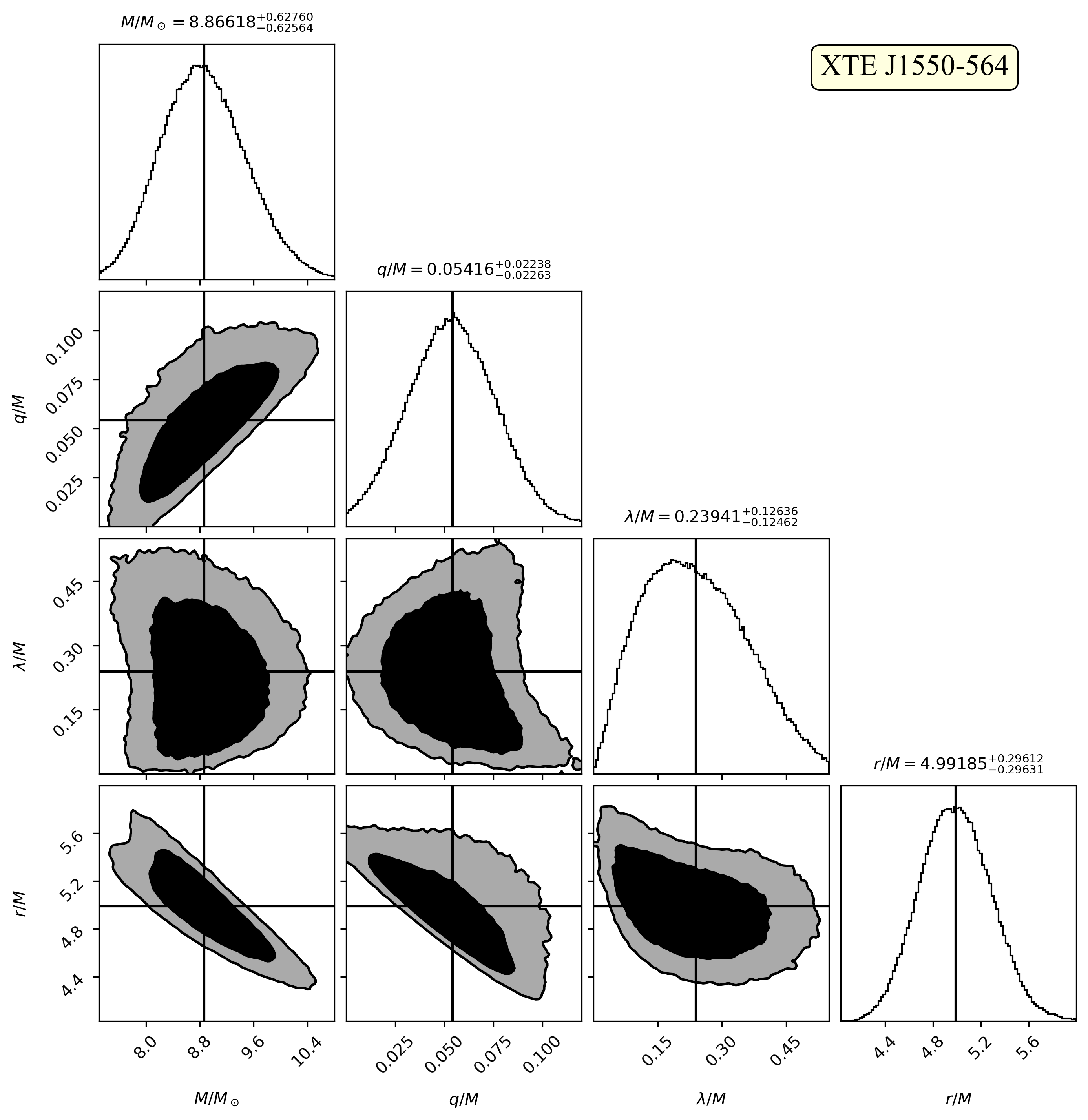
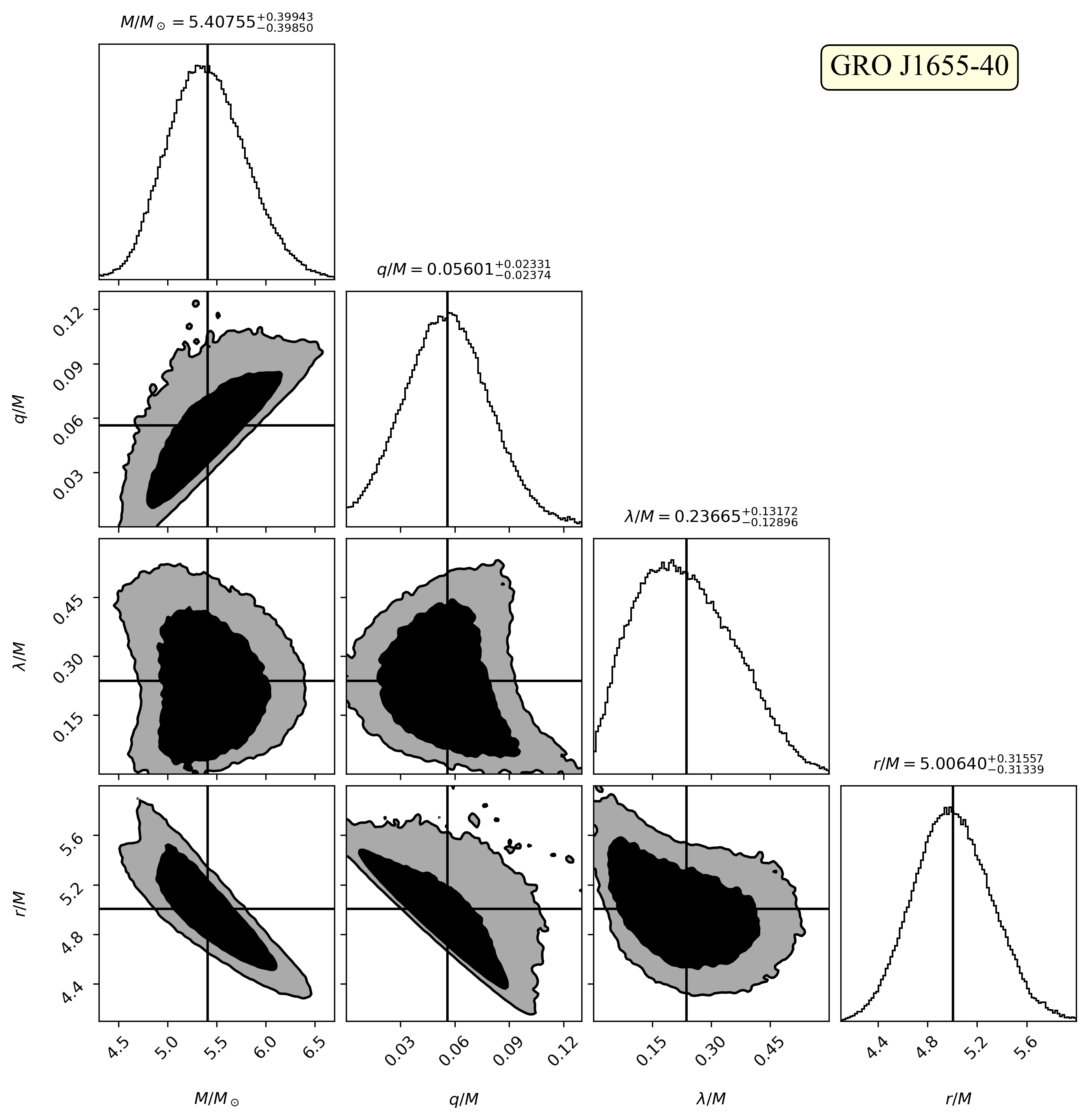
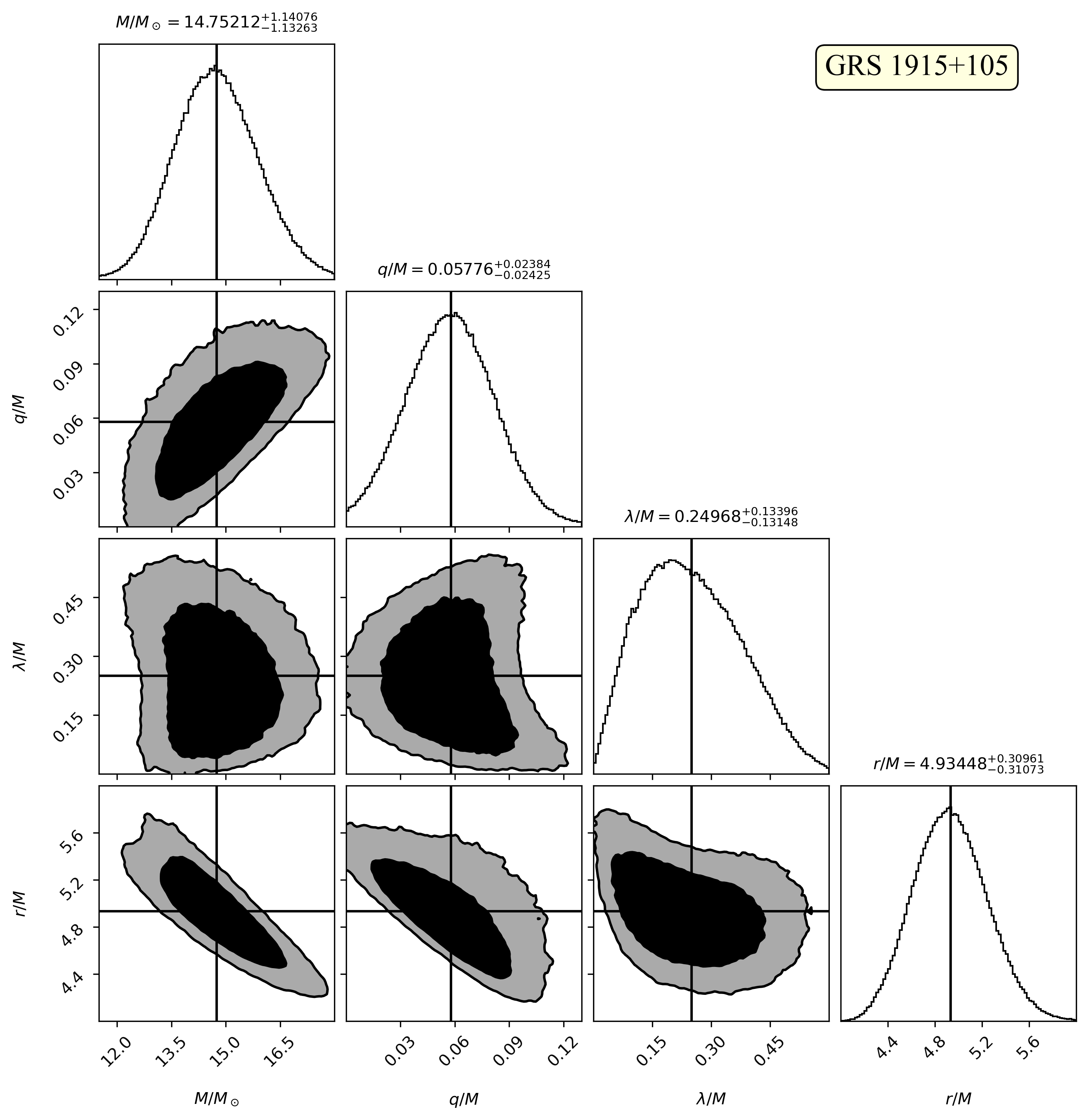
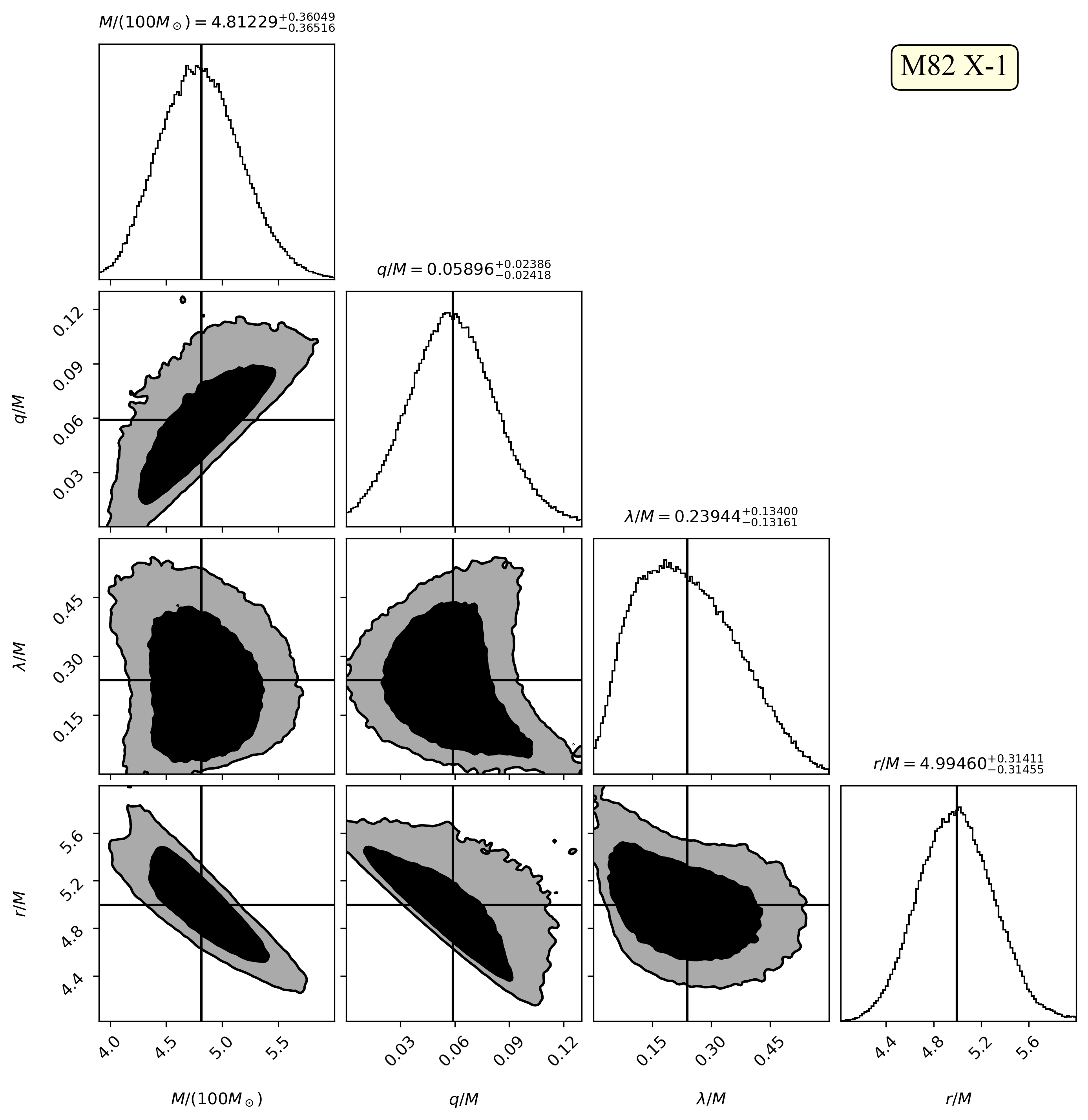
Figure 9: Posterior distributions of λ5, λ6, λ7, and λ8 from the MCMC fit to QPO data from multiple XRB and ULX sources.
Importantly, the analysis demonstrates not only consistency with independent dynamical mass estimates but also that QPO observations can robustly constrain non-GR parameters—particularly the magnetic charge and dark matter environment, which are otherwise inaccessible to electromagnetic imaging.
Black Hole Shadow and Null Geodesics
The black hole shadow, determined by the unstable photon sphere, exhibits reduced angular size for increasing λ9 and f(r)=00. The shadow remains nearly circular due to the underlying spherical symmetry but is systematically contracted compared to Schwarzschild.
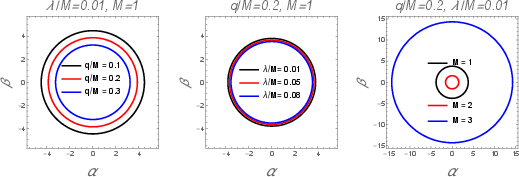
Figure 10: Shadow profiles in celestial coordinates under varying f(r)=01, f(r)=02, and f(r)=03.
The three-dimensional analysis of photon sphere and shadow radii confirms that the primary reduction in shadow size arises from magnetic charge, with PFDM parameter playing a subdominant environmental role.
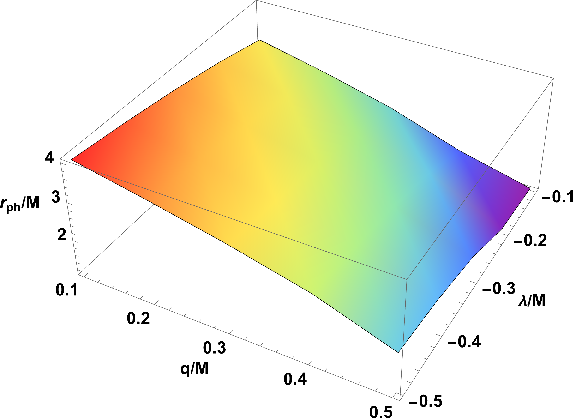
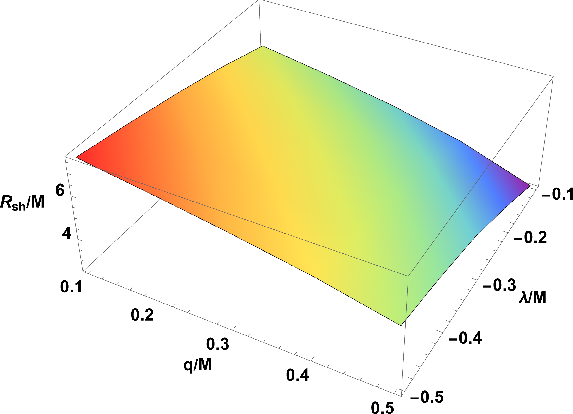
Figure 11: 3D dependence of photon sphere and shadow radius on f(r)=04 and f(r)=05.
This makes shadow measurements, such as those performed by the Event Horizon Telescope, a valuable diagnostic for disentangling intrinsic (NED-induced) from environmental (PFDM-induced) effects.
Implications and Future Directions
The paper provides clear numerical evidence for nontrivial thermodynamic phase structure, observable deviations in QPO spectra, and distinct shadow morphologies for black holes in NED with PFDM, relative to pure Schwarzschild backgrounds. The strong correlations among thermodynamic, dynamical, and optical signatures establish the value of this spacetime as a testbed for probing both high-energy physics beyond GR and dark matter phenomenology in the vicinity of black holes.
Practically, the combined approach—leveraging multiwavelength timing (QPOs), gravitational lensing, and horizon-resolving shadow observations—offers a blueprint for constraining non-GR parameters with current and future observational techniques.
Conclusion
The analysis of black holes in nonlinear electrodynamics surrounded by perfect fluid dark matter elucidates the intertwined effects of intrinsic quantum-inspired regularization and environmental dark sector physics. There are robust, observable signatures in thermodynamics, particle dynamics, QPO phenomenology, and shadow properties. This spacetime serves as a unifying framework for connecting strong-field gravity, electromagnetic analogs of quantum corrections, and realistic dark matter environments in astrophysical contexts. Future developments could extend the analysis to rotating solutions and incorporate plasma or further dark sector microphysics to support the next generation of multi-messenger black hole probes.

