- The paper presents the E3 framework, which formalizes minimum-sufficient execution and introduces the Agent Cognitive Redundancy Ratio to quantify redundant effort.
- It demonstrates that the E3 framework significantly reduces costs, tokens, and inspected files compared to max-context-first strategies, achieving up to 92% reduction in redundancy.
- The framework is validated through synthetic benchmarks and real-world LLM tests, confirming robust efficiency improvements and adaptability across varying task complexities.
Complexity-Aware Reasoning and Execution in LLM Agents: The E3 Framework
Current LLM-based autonomous agents frequently employ maximum-context-first strategies in multi-step engineering and informatics workflows, resulting in significant execution inefficiencies, especially for tasks with low intrinsic complexity. Despite their accuracy, these agents typically fail to appraise task difficulty, leading to redundant actions such as unnecessary file and dependency inspections for trivial edits. The paper formalizes the concept of minimum-sufficient execution—the minimal effort trajectory guaranteeing task success—and introduces the Agent Cognitive Redundancy Ratio (ACRR) as a normalized measure of wasted effort relative to an oracle-established baseline. This quantifies execution inefficiency and exposes the deficiency in task-aware execution-scope estimation.
The E3 Framework: Estimate, Execute, Expand
The E3 framework addresses the inefficiencies by replacing maximum-context-first with a three-stage approach: Estimate, Execute, Expand. The agent initially estimates the task's operating point x0=(d^,s^,r^,c^) based on the query, a cheap probe of the environment, and prior experience. The minimum viable execution path is then carried out according to the estimate. If verification fails or confidence is low, progressive scope expansion is triggered, and the plan is revised.
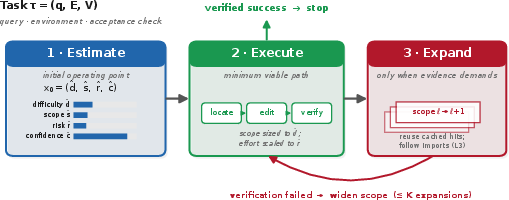
Figure 1: The E3 framework operational cycle: initial task-state estimation, minimum viable execution, and scope expansion only upon verification failure.
E3's estimator leverages lexical and structural cues to categorize tasks while maintaining intentional imperfection—errors in scope estimation are recoverable via expansion. The minimum viable trajectory is dynamically chosen to match the estimated difficulty and scope, collecting only necessary context. Expansion incrementally broadens context, bounded by K expansions, avoiding exhaustive strategies except when unavoidable.
Benchmarking and Policy Evaluation
MSE-Bench provides a deterministic, capability-invariant evaluation of 121 edits in a simulated environment, isolating execution redundancy. Tasks span three complexity tiers: single-file, cross-file, and repository-level refactors involving both direct and indirect sites. Each task has a corresponding oracle defining the minimum-sufficient trajectory.
Comparative evaluation involves four policies: Max-Context-First (MCF), Fixed ReAct, Adaptive Retrieval (AR), and E3. MCF represents an upper-bound redundancy model; Fixed ReAct is a non-adaptive search-edit loop; AR embodies adaptive retrieval and tracing; E3 operationalizes task-aware scope estimation. E3 matches the 100% success of MCF and AR but reduces mean cost by 85%, tokens by 91%, and inspected files by 92% compared to MCF, and exceeds AR by 16% cost reduction.
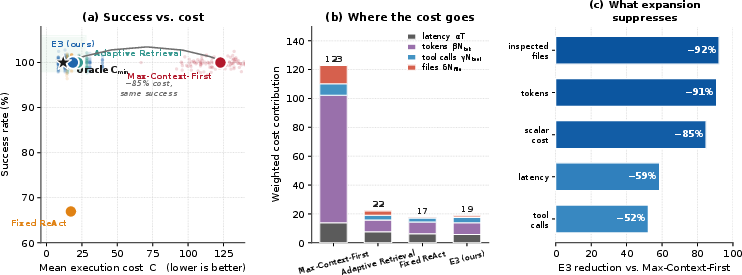
Figure 2: Success vs mean cost for all policies; E3 approaches the oracle floor, outperforming adaptive and maximal-context baselines.
Further analysis demonstrates that redundancy (ACRR) is highest on the simplest tasks, with MCF incurring the most waste on Level 1 edits. E3 achieves low and relatively flat ACRR across task tiers, with advantage concentrated on low-complexity tasks. On repository-level refactors, AR and E3 are competitive; E3's optimism occasionally necessitates an extra expansion, increasing cost, but expands only when justified.
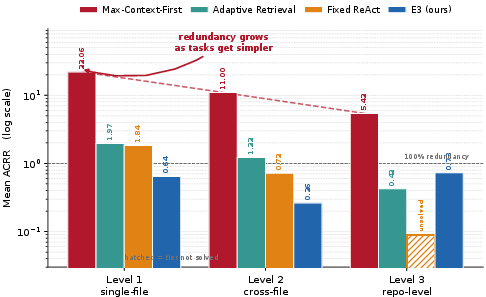
Figure 3: Mean ACRR by task level; E3 remains efficient across tiers, with maximal redundancy observed in Max-Context-First.
Robustness and Ablation Studies
Ablation of the E3 stages confirms the necessity of both estimation and expansion. Without expansion, E3 loses robustness, undershooting deceptive tasks. Without estimation, cost increases across tiers, especially for complex tasks. E3 maintains 100% success under held-out, paraphrased instructions designed to evade estimator cues, raising mean cost by only 8.7%, affirming the architectural resilience provided by progressive expansion.
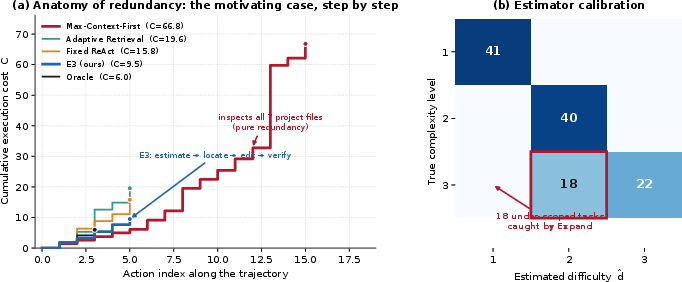
Figure 4: Anatomy of redundancy and estimator calibration; only deceptive Level-3 tasks are initially under-scoped, with expansion recovering all cases.
Comprehensive sensitivity analysis over 4000 random cost weightings reveals that E3 is the cheapest fully-successful policy in 99.8% of cases, independent of the cost weighting vector, demonstrating the broad generalizability of its efficiency claims.
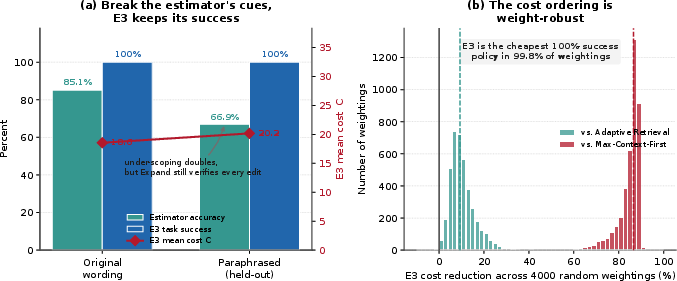
Figure 5: Robustness under cost weighting and instruction paraphrasing; E3 preserves efficiency and reliability across adversarial settings.
Real-LLM Validation: LLM-Case Harness
To address potential synthetic limitations, the LLM-Case harness validates the E3 framework using gpt-4o agent runs over real open-source library tasks, graded by true pytest acceptance suites. Distinct policies are implemented as system prompts with the same tool interface, eliminating hand-coded trajectories. The real-agent behavior confirms the phenomenon: all policies are frugal (1–4 files), severe redundancy is not observed, and E3 is the leanest and fastest overall, particularly on token-heavy refactors. Over-provisioned agents fail due to rate limiting or excessive step budgets.
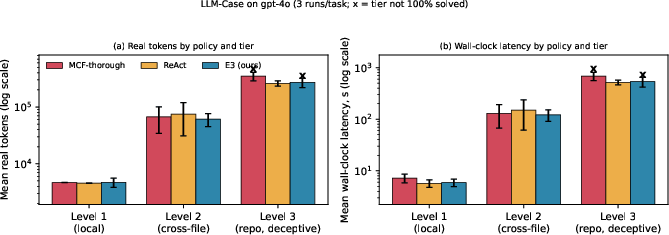
Figure 6: LLM-Case token and latency results; E3 achieves minimal real token consumption and latency across all task tiers, outperforming explicit over-reading and ReAct prompts.
Analogous Engineering Principles: Power-Flow Case Study
Drawing on power-system engineering, the analogy reveals that initializing a solver at a structured operating point yields rapid and stable convergence, while poor initialization leads to excessive iterations and unreliable results. This mirrors task-state estimation in E3, substantiating the engineering-grounded AI (EGAI) paradigm: agents must anchor their reasoning in task structure and only expand effort when required.
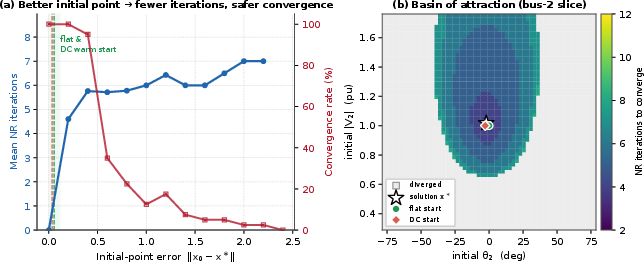
Figure 7: Power-flow analogy demonstrates that structured initial guesses lie inside the basin of attraction, analogous to E3's task-state estimation.
Implications and Future Directions
The findings suggest that complexity-aware execution is critical for engineering informatics, especially where efficiency rivals correctness. E3’s Estimate–Execute–Expand loop avoids waste on trivial tasks and scales gracefully to complexity, providing a robust mechanism for redundancy reduction. The formalization of ACRR and minimum-sufficient execution enables comparable metrics across diverse tasks and environments, essential for future agent benchmarking.
The implications are both practical and theoretical. Practically, adopting E3-like architectures in autonomous agents can yield substantial operational savings. Theoretically, this supports EGAI: AI agents should not only maximize correctness but calibrate effort, mirroring human engineers' rapid scope appraisal. Integration with per-step effort routers, more sophisticated learned estimators, and extended benchmarks promise further reductions in computational overhead and improved reliability.
Conclusion
Task-aware execution is underrepresented in LLM-agent research. The E3 framework demonstrates superior efficiency in capability-controlled settings, with strong performance retained under real-model evaluation. Complexity-aware agents achieve both reliability and operational savings by anchoring effort in structured task-state estimates and employing progressive expansion only when necessary. The study lays foundational metrics—minimum-sufficient execution and ACRR—for further research into engineering-grounded AI architectures and provides an extensible benchmark for evaluating complexity-adaptive computation.