RAGU: A Multi-Step GraphRAG Engine with a Compact Domain-Adapted LLM
Abstract: Graph retrieval-augmented generation (GraphRAG) enhances LLMs with structured knowledge, yet existing systems construct knowledge graphs in a single extraction pass, producing noisy entities and brittle retrieval. RAGU, an open-source modular GraphRAG engine, addresses this by separating extraction from consolidation: entities and relations pass through two-stage typed extraction, DBSCAN-backed deduplication, LLM summarization, and Leiden community detection. A key insight motivates a compact extractor: the skills an in-pipeline LLM needs - comprehension, extraction, reasoning over context - are language skills that grow only weakly with model size, unlike factual world knowledge. Accordingly, we train Meno-Lite-0.1, a 7B model optimized for language skills, which outperforms Qwen2.5-32B on knowledge-graph construction (+12.5% relative harmonic mean) and matches it on English GraphRAG tasks. On GraphRAG-Bench (Medical), RAGU retrieves the most complete context at every factoid level (evidence recall up to 0.84 vs. 0.76) and overtakes HippoRAG2 on synthesis tasks; on multi-hop factoid QA, the apparent HippoRAG2 advantage is shown to be largely an answer-format artifact. RAGU is installable via $\texttt{pip install graph_ragu}$, runs on a single GPU, and is released under MIT. The source code is publicly available at https://github.com/RaguTeam/RAGU, and the Meno-Lite-0.1 model can be obtained from https://huggingface.co/bond005/meno-lite-0.1.

Paper Prompts
Sign up for free to create and run prompts on this paper.
Explain it Like I'm 14
What is this paper about?
This paper introduces RAGU, a new tool that helps AI systems find and use information more accurately. Instead of just searching for text snippets, RAGU builds a “map of facts” (a knowledge graph) from documents and then uses that map to answer questions. The authors also create a small, efficient AI model called Meno-Lite-0.1 that’s trained to read and extract information well, rather than memorize the world. Together, these two ideas make question‑answering more complete, cheaper, and easier to run on a single GPU.
What questions were the researchers trying to answer?
They focused on three main questions:
- Can we build cleaner, more reliable “maps of facts” by splitting the process into careful steps instead of doing it all at once?
- Do we really need huge, expensive AI models for this, or can a smaller model that’s good at reading and extracting work just as well?
- Can we make a GraphRAG system (graph-based retrieval-augmented generation) that’s easy to install, safe to use, and practical for everyday developers?
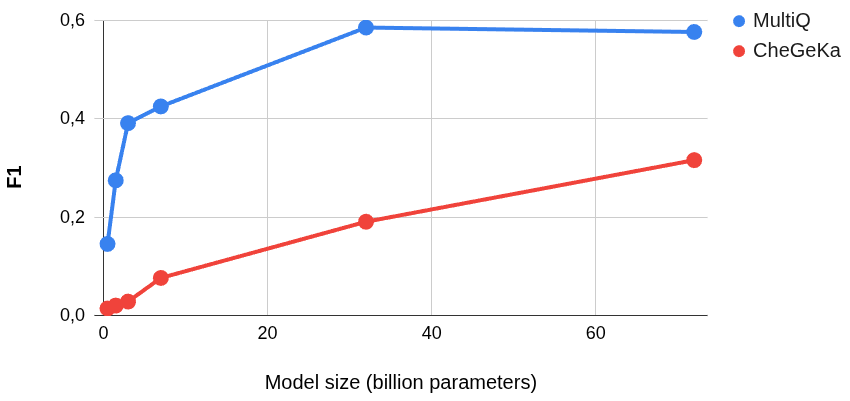
Their big idea: tasks inside this pipeline mostly need language skills (like reading and summarizing), not encyclopedic memory. Language skills don’t grow as fast with model size as memorized facts do—so a compact, well‑trained model might be enough.
How did they do it? (Methods explained simply)
Imagine you’re making a study guide from a pile of articles:
- Split the text into pieces
- Like cutting a long article into small, meaningful paragraphs so it’s easier to process.
- Extract in two passes
- First pass: find the important “things” (people, places, organizations—like highlighting names in a textbook).
- Second pass: find how those things are connected (who works with who, what belongs where—like drawing arrows between the highlights).
- They use a standard “label set” (called a schema) to keep the types consistent.
- Clean and merge duplicates
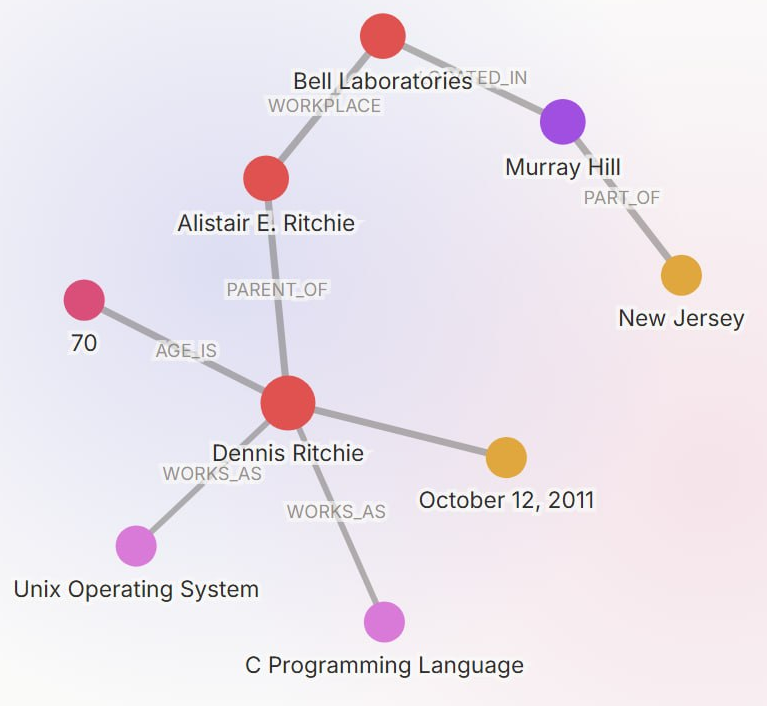
- If the same person shows up with slightly different names (e.g., “Bell Labs” vs “Bell Laboratories”), group them together and merge their information. Think of it like cleaning up duplicate entries in your contacts.
- Group related topics
- They cluster related entities into communities—like sorting your notes into folders by theme—so it’s easier to retrieve the right context later.
- Store and search efficiently
- They provide several search strategies: local lookups in the graph, global summaries of communities, and a mix of different retrieval modes. All are engineered for safety and reliability.
Alongside this pipeline, they trained Meno‑Lite‑0.1, a 7‑billion‑parameter model that’s tuned to read and extract from the provided text instead of trying to recall facts from memory. It has a long context window, runs on a single GPU, and is designed to be efficient.
Key terms in everyday language:
- Knowledge graph: a map of facts showing “things” (nodes) and how they’re connected (edges).
- Deduplication: merging different mentions that mean the same thing.
- Clustering: grouping related items, like sorting notes by topic.
- Retrieval-augmented generation (RAG): answering questions by first finding helpful documents, then writing the answer using that evidence.
- GraphRAG: like RAG, but it uses a connected map of facts for smarter searches.
What did they find, and why does it matter?
Here are the main results and what they mean:
- Cleaner graphs with multi-step consolidation RAGU’s separate “extract, then clean and merge” approach built tidier, more connected knowledge graphs than single-pass systems. This made it better at pulling together all the needed evidence for an answer.
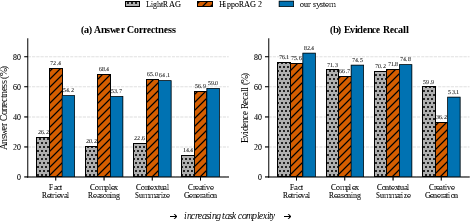
- More complete evidence during retrieval On a medical benchmark, RAGU recovered more of the relevant context than other systems at every fact-heavy level (evidence recall up to ~84% vs ≤76%). This means it’s better at gathering everything you need before answering.
- Strong at broad, synthesis-heavy tasks When questions required summarizing or combining many facts (not just finding a single fact), RAGU outperformed a leading system (HippoRAG 2) on answer accuracy and coverage. In short: it’s great at “big-picture” answers.
- Smaller model, similar performance The new 7B model, Meno‑Lite‑0.1, matched or beat much larger models for building knowledge graphs. It even outperformed a 32B model on the graph-building benchmark they used, because it was trained specifically for reading and extracting from the given text.
- Fairness in comparisons: the answer format matters In some multi-step question tests, it first looked like another system was better. But that was mostly because of how answers were formatted (long explanations vs short direct answers). When everyone used the same short format, RAGU tied on one benchmark and closed gaps on others. The takeaway: be careful to compare systems fairly.
- Practical and safe engineering RAGU is easy to install (pip install graph_ragu), validated for safe outputs, tested extensively, and runs on a single GPU. That makes it accessible for students, researchers, and smaller teams.
Why this research matters
- Better study buddy for complex questions If you want an AI that can read a bunch of documents and explain a topic clearly—especially when the answer isn’t just one fact—RAGU’s approach shines. It pulls together more relevant pieces and writes more grounded responses.
- Cheaper and greener A smaller, skill-focused model that runs on a single GPU is much cheaper than using giant models or paid APIs. That means more people can use advanced tools without huge costs.
- Safer and more reliable tools By validating outputs and providing a tested, modular system, RAGU reduces common errors and security risks. It’s built with real-world use in mind.
- A template for future systems The paper suggests a shift in thinking: for many practical tasks, training models to read and use the given text can be more valuable than training them to memorize the world. That could shape how future AI tools are built.
In one sentence
RAGU shows that carefully building and cleaning a “map of facts,” plus using a small model that’s great at reading, can beat or match bigger systems for many real tasks—making smart, reliable AI more affordable and accessible.
Practical Applications
Below is an overview of practical, real-world applications enabled by the paper’s findings and artifacts (RAGU engine and the Meno-Lite-0.1 model). Each item names sectors, describes the application and likely tools/workflows, and notes assumptions or dependencies that affect feasibility.
Immediate Applications
- Enterprise knowledge graph indexing and search (software/IT, enterprise KM) — Use RAGU’s multi-step consolidation (typed IE, DBSCAN dedup, Leiden clustering) to turn wikis, policies, tickets, and PDFs into a coherent graph searchable via Local/Mix/Global engines. — Tools/workflows: pip-installable RAGU, Qdrant for hybrid retrieval, NetworkX→Neo4j adapter, Pydantic-validated IE, async ingestion with incremental upserts and consistency audits. — Assumptions/dependencies: domain schema adaptation beyond NEREL; GPU (single consumer GPU) for extraction; quality and cleanliness of source docs; security approvals for internal data.
- Cost-efficient LLM extraction at the edge (software/IT, SMEs) — Replace API-based extractors with Meno-Lite-0.1 to reduce indexing costs by orders of magnitude while preserving graph quality for RAG pipelines. — Tools/workflows: vLLM deployment, swap-in “index LLM” in RAGU config, monitoring via Evidence Recall and Coverage metrics. — Assumptions/dependencies: English/Russian coverage is strong; other languages need adaptation; sufficient VRAM (consumer GPU) available.
- Customer support and help center copilots (SaaS, contact centers) — Build support KGs from tickets, docs, and release notes; favor RAGU when broad, faithful synthesis and coverage are critical (e.g., “how-to” or long-form solutions). — Tools/workflows: MixSearch with cross-encoder re-ranking; community reports for curated answers; connectors to Zendesk/ServiceNow/Slack. — Assumptions/dependencies: stable data connectors; human evaluation of answer quality; chain-following single-fact queries may still benefit from specialized chain-traversal modules.
- Biomedical literature synthesis and briefing (healthcare, pharma R&D) — Summarize and group related medical evidence with high coverage for reviews, safety signals, and guideline comparisons. — Tools/workflows: community summaries for topic briefs; LocalSearch for evidence sets; dashboards tracking Evidence Recall. — Assumptions/dependencies: map NEREL to biomedical ontologies (e.g., UMLS/SNOMED) for best results; strict human oversight and compliance for clinical use; licensing for full-text corpora.
- Legal e-discovery and compliance mapping (legal, GRC) — Extract entities, relations, and cross-document links to organize exhibits, contracts, and precedents, supporting discovery and policy mapping. — Tools/workflows: two-stage typed IE to reduce spurious relations; community clustering for themes; Pydantic validation for structured outputs. — Assumptions/dependencies: domain-specific schemas (e.g., parties/obligations/clauses); chain-of-custody and audit trails; privacy and redaction tools.
- Financial research and risk synthesis (finance) — Consolidate filings, research notes, and news to surface relationships (executives, subsidiaries, suppliers) and retrieve comprehensive context for investment memos or risk briefs. — Tools/workflows: ingestion from EDGAR/news feeds, graph DB backend (Neo4j) for scaling, community-level summaries for sectors/peer groups. — Assumptions/dependencies: data licensing; need to tune schema (e.g., FIBO); compliance with MNPI and internal data policies.
- Engineering and DevOps knowledge assistant (software engineering, DevOps) — Turn design docs, ADRs, and postmortems into navigable KGs to support onboarding, incident reviews, and architectural Q&A. — Tools/workflows: semantic chunkers and rerankers to improve splits; Local/Mix engines for retrieval; “RemoveIsolatedNodes” for refinement. — Assumptions/dependencies: consistent documentation practices; access to internal repositories; governance on proprietary code/data.
- Academic literature reviews and course material organizers (academia, education) — Build topic-centric communities and summaries to assist systematic reviews or prepare course packs and study guides. — Tools/workflows: GlobalSearch for overview queries; community reports (title/summary/findings) exported into reading lists; Evidence Recall tracking. — Assumptions/dependencies: PDF/OCR quality; citation/ontology alignment optional but beneficial; faculty oversight for accuracy.
- OSINT and threat intelligence graphing (cybersecurity, public sector) — Extract and cluster entities and relationships from public sources to map threat actors, infrastructures, and campaigns with coverage-oriented retrieval. — Tools/workflows: typed IE with ICL examples for domain tuning; community detection to discover clusters; LocalSearch for multi-hop traversals. — Assumptions/dependencies: false-positive control; adversarial text robustness; periodic expert vetting.
- Investigative journalism and research desks (media) — Build subject graphs across archives to contextualize people, events, and organizations; generate concise community narratives. — Tools/workflows: consolidation to reduce entity duplication; GlobalSearch for backgrounders; provenance tracing via deterministic IDs. — Assumptions/dependencies: editorial fact-checking; bias awareness from source corpora.
- Personal knowledge management and study aids (daily life, education) — Index notes, articles, and PDFs locally to get graph-based study summaries and high-coverage answers. — Tools/workflows: lightweight local deployment; integration with note apps (e.g., an Obsidian/Notion plug-in); community summaries for topics. — Assumptions/dependencies: basic GPU access; schema simplification for personal domains; user-friendly UI wrappers.
- Safer structured LLM pipelines (software/IT) — Adopt Pydantic-validated structured outputs to eliminate eval()-style code paths and JSON parsing pitfalls in IE workflows. — Tools/workflows: RAGU’s Pydantic models; consistency auditor; CI with deterministic mock LLM server. — Assumptions/dependencies: integration effort to retrofit existing pipelines; validation schema upkeep.
- RU/EN multilingual enterprise search (government, regional enterprises) — Leverage Meno-Lite-0.1’s tokenizer efficiency and long context to serve bilingual corpora at lower cost. — Tools/workflows: bilingual indexing; retrieval with hybrid dense+sparse; long-context queries (128K window). — Assumptions/dependencies: adaptation for specialized domains; content skew across languages.
- Evidence-centric QA and retrieval analytics (software QA, data teams) — Use Evidence Recall and Coverage as system health metrics, aligning retrieval tuning with downstream answer quality. — Tools/workflows: retrieval telemetry; evaluation harness integration; A/B tests with query planning vs. mix search. — Assumptions/dependencies: instrumentation pipelines; shared evaluation standards across teams.
- Knowledge base consolidation and deduplication (enterprise KM) — Reduce duplicated entries and unify definitions across siloed sources to improve findability and reduce noise. — Tools/workflows: DBSCAN-backed dedup + LLM summarization; merge policies; deterministic ID lineage for traceability. — Assumptions/dependencies: naming conventions/entity normalization; tuning DBSCAN parameters per domain.
Long-Term Applications
- Web-scale, low-latency graph search (software/IT, enterprise search) — Operate on millions of nodes/edges with real-time updates and horizontal scaling. — Tools/workflows: dedicated graph DB adapters (e.g., Neo4j/TigerGraph), streaming ingestion, sharded vector stores, caching layers. — Assumptions/dependencies: distributed infra; monitoring; query cost controls.
- Domain-ontology integration and schema generalization (healthcare, legal, finance) — Replace/augment NEREL with UMLS/SNOMED, legal ontologies, or FIBO for precise domain semantics. — Tools/workflows: schema mapper modules, ontology alignment, domain ICL libraries. — Assumptions/dependencies: ontology licensing; annotation investment; evaluation on domain benchmarks.
- Hybrid retrieval: chain-following + consolidated recall (cross-sector) — Combine personalized PageRank/graph traversal for multi-hop precision with RAGU’s high-coverage consolidation for synthesis. — Tools/workflows: multi-engine orchestration (QueryPlanEngine), dynamic strategy selection by query type. — Assumptions/dependencies: robust query classification; added complexity; latency tuning.
- Multilingual and low-resource expansion (government, global enterprises) — Train Meno-Lite family variants for additional languages and code-switching corpora. — Tools/workflows: continued pretraining and SFT on target languages; tokenizer adaptations; cross-lingual IE schemas. — Assumptions/dependencies: data availability; evaluation resources; fairness considerations.
- Continual, non-parametric memory and streaming updates (software/IT) — Maintain evolving knowledge bases with non-parametric memory (inspired by HippoRAG approaches) and minimal downtime. — Tools/workflows: incremental graph updates, concept drift detection, data retention policies. — Assumptions/dependencies: change-data-capture connectors; governance for deletions/rollbacks.
- Human-in-the-loop curation and active learning (all sectors) — Use feedback to refine entity/relationship definitions and cluster boundaries, and to generate better ICL exemplars. — Tools/workflows: annotation UIs tied to deterministic IDs, reviewer workflows, auto-suggest corrections. — Assumptions/dependencies: staff time and training; feedback quality; privacy for annotators.
- Safety, compliance, and governance suites (policy, regulated industries) — Add PII/PHI detection, bias audits, audit logs, and explainability tooling for GraphRAG deployments. — Tools/workflows: content filters, lineage dashboards, SOC2-aligned logging, fairness metrics on IE outputs. — Assumptions/dependencies: regulatory change tracking; organizational adoption of governance processes.
- Clinical decision support and guideline alignment (healthcare) — Assist clinicians by surfacing comprehensive, provenance-rich evidence summaries aligned to guidelines. — Tools/workflows: EHR integration (read-only), UMLS mapping, clinician-in-the-loop validation, safety rails. — Assumptions/dependencies: regulatory clearance; rigorous prospective evaluations; clear scope limits (assistive, not diagnostic).
- Regulatory and policy impact mapping (public policy, legal) — Build relationship graphs of bills, amendments, agencies, and stakeholders to analyze impact pathways and cross-references. — Tools/workflows: ingestion from legislative portals, temporal graph analytics, community reports for policy briefs. — Assumptions/dependencies: data standardization; versioning; neutral presentation to avoid bias.
- Cross-disciplinary scientific discovery support (academia, R&D) — Detect non-obvious links and communities across fields to inspire hypotheses and collaborations. — Tools/workflows: cross-domain corpora ingestion, topic community analysis, hypothesis logging with evidence trails. — Assumptions/dependencies: access to full texts/metadata; handling of paywalled content; researcher oversight.
- Supply-chain and fraud network analytics (manufacturing, finance) — Construct relationship graphs from invoices, shipments, and communications to flag anomalies and hidden relationships. — Tools/workflows: connectors to ERP/SCM systems, temporal community drift detection, alerting workflows. — Assumptions/dependencies: data integration complexity; false positive management; compliance constraints.
- Personalized education orchestration (education/EdTech) — Generate study plans, concept maps, and assessments from course materials grounded in the knowledge graph. — Tools/workflows: curriculum-aligned schemas, student-model interfaces, proficiency tracking. — Assumptions/dependencies: pedagogical validation; privacy constraints for student data.
- Robotics/field maintenance copilots (robotics, industrial) — Retrieve step-by-step procedures and link to parts/diagrams from maintenance manuals and logs. — Tools/workflows: device/operator interfaces, offline-capable deployments, multimodal extensions (images/diagrams). — Assumptions/dependencies: modality expansion beyond text; safety certifications for industrial settings.
- Asset and incident knowledge for energy/utilities (energy) — Consolidate SOPs, incident reports, and standards into asset-centric graphs for reliability engineering and audits. — Tools/workflows: schema for assets/failures/causes, event timelines, inspection planning support. — Assumptions/dependencies: integration with CMMS; compliance and safety reviews.
- Agentic systems and orchestration (cross-sector) — Use QueryPlanEngine to decompose tasks into DAGs that call retrieval, summarization, and verification tools. — Tools/workflows: tool-augmented agents with structured I/O, verifiers using Evidence Recall thresholds. — Assumptions/dependencies: robust tool contracts; latency budgets; failure-handling strategies.
- GraphRAG-as-a-Service and ecosystem products (software/IT) — Managed platforms with connectors (SharePoint/Drive/Confluence), admin consoles, metric dashboards, and schema marketplaces. — Tools/workflows: multi-tenant infra, billing, autoscaling, plugin ecosystem for domain adapters. — Assumptions/dependencies: security certifications; connector maintenance; vendor lock-in concerns.
- Standards and benchmarking for evidence-centric RAG (academia, industry consortia) — Promote adoption of Evidence Recall, Coverage, and Faithfulness metrics; standardized evaluation harnesses. — Tools/workflows: open benchmarks, reproducible CI pipelines, public leaderboards. — Assumptions/dependencies: community coordination; agreement on task/task-format definitions.
Notes and caveats that apply broadly:
- RAGU’s strengths are highest on synthesis and breadth-oriented tasks; chain-following multi-hop precision may require hybrid retrieval or additional traversal heuristics.
- Graph quality remains sensitive to extraction LLM and schema fit; poor schemas or weak base models introduce structural noise.
- The default NetworkX backend is not suited to very large corpora; plan graph DB deployment for scale.
- Meno-Lite-0.1 prioritizes language skills over parametric world knowledge; it is not a standalone KB and should be grounded in trusted corpora, with human oversight in sensitive domains.
Glossary
- Answer Correctness (AC): An automatic evaluation metric indicating whether a system’s answer is correct, typically judged by another model. "Metrics include Answer Correctness (AC; LLM-judge)"
- BioASQ: A biomedical question-answering benchmark used to evaluate retrieval and reasoning in the medical domain. "BioASQ~\cite{BioASQ2023}"
- BM25: A classical sparse retrieval ranking function that scores documents based on term frequency and inverse document frequency. "selected by semantic, BM25, hybrid, or random strategies."
- CheGeKa: A world-knowledge quiz benchmark (in Russian) used to assess factual recall in LLMs. "CheGeKa F1 grows 21.1 from 0.5\,B to 72\,B;"
- chrF++: A character n-gram F-score metric for text generation quality, often used for definition similarity. "Def\,=\,entity definition (chrF++), RDef\,=\,relation definition (chrF++)"
- Context Relevancy: A metric assessing how relevant the retrieved or provided context is to the user’s query. "Metrics include Answer Correctness (AC; LLM-judge), ROUGE-L, Coverage, Faithfulness, Evidence Recall~(ER), and Context Relevancy."
- Coverage: A metric measuring how completely the retrieved or generated content covers relevant information. "Cov\,=\,Coverage"
- Cross-encoder reranking: A reranking approach where a cross-encoder jointly encodes query and candidate items to refine retrieval results. "All support cross-encoder reranking and hybrid dense+sparse retrieval via Qdrant."
- DAG decomposition: Breaking a complex query into a directed acyclic graph of sub-steps for planning and execution. "QueryPlanEngine (DAG decomposition)."
- DBSCAN: A density-based clustering algorithm that groups points closely packed together while marking outliers as noise. "applies DBSCAN clustering and LLM summarization."
- Evidence Recall (ER): The fraction of gold-standard evidence successfully retrieved by the system. "Metrics include Answer Correctness (AC; LLM-judge), ROUGE-L, Coverage, Faithfulness, Evidence Recall~(ER), and Context Relevancy."
- F1 score: The harmonic mean of precision and recall, commonly used for classification and extraction tasks. "F1 scores on MERA~\cite{fenogenova2024mera}."
- Faithfulness: A metric evaluating how well the generated answer adheres to the retrieved evidence without introducing unsupported claims. "Coverage, Faithfulness, Evidence Recall~(ER), and Context Relevancy."
- Graph retrieval-augmented generation (GraphRAG): A RAG approach that builds and uses a knowledge graph for retrieval and reasoning. "Graph retrieval-augmented generation (GraphRAG) enhances LLMs with structured knowledge,"
- Graph traversal: Navigating nodes and edges of a graph to retrieve connected information during search. "using graph traversal during retrieval"
- GraphRAG-Bench: A benchmark suite for evaluating graph-based RAG methods across tasks and difficulty levels. "On GraphRAG-Bench (Medical), RAGU retrieves the most complete context"
- Harmonic mean: A type of average that emphasizes lower values, used here to aggregate multiple IE metrics. "HM\,=\,harmonic mean of all four tasks."
- Hybrid dense+sparse retrieval: A retrieval strategy combining vector (dense) and lexical (sparse) methods for improved recall and precision. "hybrid dense+sparse retrieval via Qdrant."
- In-context learning (ICL): Providing examples within the prompt so the model can adapt its behavior without parameter updates. "Optional in-context-learning (ICL) examples are injected at both stages,"
- Leiden clustering: A community detection algorithm for partitioning graphs into well-connected communities. "Hierarchical Leiden clustering partitions the deduplicated graph;"
- LLM-as-judge: An evaluation setup where a LLM acts as the judge of answer quality. "LLM-as-judge evaluations use google/gemini-3-flash-preview,"
- MD5 identifier: A deterministic hash-based identifier used to trace artifacts back to source text. "Every domain object (entity, relation, chunk) carries a deterministic MD5 identifier,"
- MERA: A comprehensive evaluation benchmark (in Russian) for LLMs covering multiple tasks. "F1 scores on MERA~\cite{fenogenova2024mera}."
- MuSiQue: A multi-hop QA dataset created by composing single-hop questions, used to evaluate reasoning chains. "MuSiQue~\cite{trivedi2022musique}"
- Multi-hop QA: Question answering that requires combining information across multiple steps or documents. "on multi-hop factoid QA,"
- NEREL schema: An information-extraction schema defining entity and relation types, used for typed extraction. "validated against the NEREL schema (29 entity types, 49 relation types),"
- Passkey retrieval: A diagnostic task for long-context models checking whether they can recover a specific token (“passkey”) from long inputs. "passkey retrieval 0.98 at 128K"
- Personalized PageRank: A graph ranking algorithm biased toward specific nodes, used to follow reasoning chains and pinpoint facts. "its personalized PageRank pins down single facts"
- Pydantic v2: A Python data validation library used to enforce structured LLM outputs and prevent unsafe parsing. "Structured LLM outputs are validated through Pydantic v2,"
- Qdrant: A vector database supporting dense and hybrid retrieval used in the system’s search engines. "hybrid dense+sparse retrieval via Qdrant."
- Retrieval-augmented generation (RAG): Techniques that ground LLM outputs in external documents retrieved at inference time. "Retrieval-augmented generation~(RAG) grounds LLMs in external knowledge"
- ROUGE-L: A text-overlap metric based on longest common subsequence, used to evaluate generation quality. "Metrics include Answer Correctness (AC; LLM-judge), ROUGE-L, Coverage, Faithfulness, Evidence Recall~(ER), and Context Relevancy."
- Snowball stemming: A stemming algorithm used to reduce words to their roots, here applied in evaluation metrics. "addressed by Snowball stemming in the metric"
- Two-stage typed extraction: Separating entity extraction from relation extraction under a predefined schema to reduce noise. "two-stage typed extraction, DBSCAN-backed deduplication, LLM summarization, and Leiden community detection."
- Upsert: A database operation that inserts a record if it doesn’t exist or updates it if it does. "Incremental upsert/update/delete"
- vLLM: A high-throughput LLM serving framework enabling efficient single-GPU inference. "single-consumer-GPU deployment via vLLM~\cite{kwon2023efficient}."
- Vector store: A storage system for embedding vectors enabling vector-similarity search. "graph database, key-value store, vector store"