- The paper's main contribution is a rigorous certification protocol for passive multiresonator quantum-memory interfaces, establishing finite spectral-admittance bounds via exact continuum proofs.
- It introduces a passive quantum memory model that quantifies worst-case write efficiency through coherent isometry and leverages Bode–Fano bounds as performance limits.
- A computer-assisted continuum certification using Sturm root counting verifies over 99.6% worst-case efficiency, paving the way for robust hardware synthesis and design standards.
Passive Spectral-Admittance Bounds and Continuum Certificates for Multiresonator Quantum-Memory Interfaces
Introduction and Motivation
The paper introduces a rigorous framework for passive broadband quantum-memory interfaces, highlighting the operational distinction between reversible storage transfer and mere absorption, as well as the limitations of standard efficiency metrics (peak, average, modal, and worst-case) for continuous-band signal spaces. Passive one-port multiresonator architectures are modeled using positive-real spectral admittance and controlled output channels, enabling precise quantification of the worst-case quantum memory write efficiency over arbitrary admitted waveforms. The work develops not only analytic limitations—most notably a finite Bode--Fano lower bound on reflection—but also introduces an exact, rerunnable computer-assisted protocol for continuum certification of explicit rational passive designs.
Passive Quantum Memory Model
The interface is modeled as a linear, passive multiresonator network. The central object is a positive-real self-energy Σ(s) coupled to a signal resonator and input/output channels. Reflection from the signal port is expressed as a rational function of s (Laplace variable). Crucially, the operational memory guarantee arises only after a controlled-output dilation: admitted controlled fields are mapped by a coherent isometry onto a long-lived register, thus quantifying the memory-write probability. The worst-case over all normalized spectra in a design signal band is characterized by the supremum of the reflection modulus over the band, i.e., 1−∥r∥L∞(B)2.
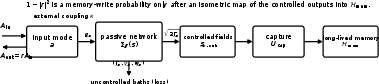
Figure 1: Operational qualification of the passive interface—rational admittance fixes signal-port scattering into controlled output fields, with reflection defect becoming write probability only after a coherent isometry into a long-lived register.
Stationary Passive Limitations and Bode--Fano Bound
A major theoretical result is the finite-band limitation: no finite passive rational interface can achieve zero reflection over a nontrivial interval. The Bode--Fano bound,
∥r∥L∞(B)≥exp[−2Bπκ],
is proved as the stationary minimax floor, restricting worst-case write efficiency for any linear, passive time-invariant design. The result clarifies the asymptotic unattainability of perfect broadband memory using stationary passive hardware. All order improvements necessarily converge to the Bode--Fano bound rather than overcome it.
Minimax Synthesis and Quasiconvexification
The passive minimax synthesis problem is proven to be quasiconvex over oscillator strengths for fixed pole locations (detuning and linewidths), leading to a semi-infinite convex optimization over these parameters while global pole placement remains nonconvex. The synthesis procedure employs local and convex optimization, warm-starting in increasing order N, and grid-based ripple diagnostics, but resists classification as globally optimal except in the analytically solvable single-mode case. The methodology distinguishes between validated continuum upper certificates for explicit devices and the open problem of optimal pole placement.
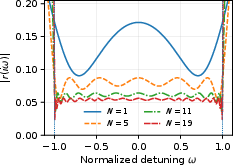
Figure 2: Reflection magnitude for several symmetric candidates shows spectral flattening with increasing number of controlled internal modes.
Exact Computer-Assisted Continuum Certification
A central advance is an exact, integer-arithmetic, computer-verifiable continuum bound: For explicit rational designs, verifying ∣r(iω)∣<ρˉ on ∣ω∣≤B is reduced to univariate positivity of a constructed polynomial Hρˉ(x) for x in [0,1], established by Sturm root counting. Stability and minimum-phase are certified via exact Routh--Hurwitz criteria. For the 11-mode design in the normalized model, the rigorous reflection envelope is
s0
yielding a worst-case write efficiency strictly greater than s1.
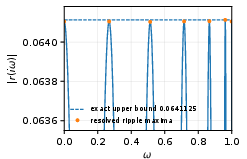
Figure 3: Positive-frequency half of the 11-mode reflection spectrum; the dashed line is the exact continuum upper bound, with markers indicating numerically resolved maxima.
This approach is agnostic to spectral grid sampling—circumventing the traditional dangers of missed sharp features in the band—and provides a portable, compact proof object: rational parameters, coefficient hashes, and Sturm/Hurwitz signatures.
Robustness Analysis and Sensitivity
Experimental feasibility requires robustness to parameter uncertainties. The deterministic sensitivity to bounded uncertainties in the self-energy is analytically upper-bounded. Additionally, a diagnostic Monte Carlo (log-normal) perturbation study quantifies statistical sensitivity for the 11-mode design, demonstrating that the minimax-optimized surface remains sharp under small perturbations, foregrounding the likely necessity of robust or retunable synthesis under fabrication uncertainty.
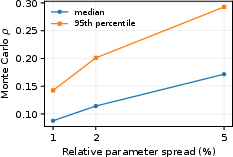
Figure 4: Monte Carlo sensitivity of the 11-mode candidate to independent mean-preserving log-normal parameter perturbations, showing median and 95th percentile of in-band maximum reflection.
Implications, Practical and Theoretical
This work reframes the standard for certifying quantum-memory interfaces: numeric grid maxima are replaced by exact continuum theorems on explicit rational devices. The separation of universal Bode--Fano limits, main-sequence certified upper bounds, and local synthesis diagnostics refines communication of performance and open conjectures. Implications include:
- Experimental reporting: Adoption of continuum certificates, explicit controlled/uncontrolled ports, and reproducible proof objects for hardware qualification.
- Memory modeling: Recognition of operational write probability only with controlled-output isometry and explicit loss accounting.
- Synthesis paradigm: Integration of exact certification into design/fabrication pipelines, motivating robust synthesis, postfabrication retuning, and extension to matrix-valued, multiport situations.
- Open theoretical questions: Rate of convergence to the Bode--Fano floor with order, extension to the general multiport scenario, and incorporation of interval-valued or sum-of-squares techniques for uncertain parameters.
Conclusion
The paper establishes an exact, rerunnable certification protocol for passive rational multiresonator quantum-memory interfaces, proving operationally meaningful worst-case write probabilities under clean and principled assumptions on the hardware and signal space. The strongest certified device achieves worst-case efficiency above s2 in normalized units, directly bounded by machine-verifiable code and proof record, not subject to grid error or heuristic extrapolation. The work delineates practical reporting standards for quantum memories and highlights both current capabilities and critical open problems for future rational-synthesis and certification research.
References
For complete bibliography and deterministic code/data artifacts, see the source paper "Passive spectral-admittance bounds and exact continuum certificates for multiresonator quantum-memory interfaces" (2607.10704).