- The paper demonstrates a continuous quantum memory protocol using traveling-wave Brillouin-active waveguides, achieving efficient photon–phonon state transfer.
- Its analytical models and numerical simulations reveal robust performance marked by pronounced Rabi oscillations and high fidelity across various nonclassical Gaussian states.
- The approach supports scalable, chip-integrated, broadband operation and effective entanglement preservation even at elevated temperatures.
Solid-State Quantum Memory in Continuous Optoacoustic Brillouin-Active Waveguides
Introduction
The realization of efficient, broadband quantum memories for optical states is a foundational milestone for scalable quantum networks, quantum information processing, and quantum-enhanced sensing. While many paradigms for quantum memories rely on atomic ensembles or discrete-mode optomechanical cavities, these approaches often face trade-offs among fidelity, bandwidth, integration, and operational temperature. The discussed work presents and analyzes a fully continuous quantum memory protocol using traveling-wave Brillouin-active solid-state waveguides, leveraging coherent photon–phonon transduction mediated by the Brillouin anti-Stokes process. This solid-state protocol exploits the large bandwidth and flexibly accessible continuum of optical and acoustic states intrinsic to these platforms, with performance metrics derived via both analytical models and extensive numerical simulations.
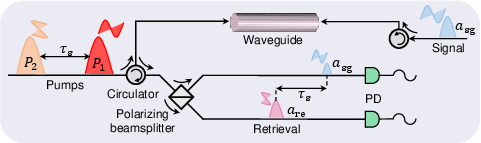
Figure 1: Schematic of the quantum memory protocol in a Brillouin-active waveguide. The protocol involves state mapping from input signal light to propagating phonons and subsequent retrieval via two orthogonally polarized pump pulses.
Theory of Quantum State Swap via Brillouin Interaction
The memory protocol employs two temporally separated pump pulses, P1 and P2, aligned with orthogonal polarizations. The storage step maps a propagating quantum optical state onto a traveling-wave acoustic phonon via a beam-splitter-type Brillouin interaction mediated by P1. After a programmable delay, P2 reverses the process, transferring the phononic excitation back into the optical domain.
The theoretical framework directly addresses the continuum nature of both photon and phonon modes in realistic nanofabricated Brillouin waveguides. Mode evolution is captured by a set of coupled Heisenberg-Langevin equations, with decoherence arising from both optical and acoustic dissipation rates (γ, Γ), and environmental phonon occupation (nth). In the strong-coupling regime (g≫γ,Γ), energy is coherently exchanged between optical and acoustic sectors, producing pronounced Rabi oscillations in mean excitation numbers, with state-swap fidelity ultimately limited by decoherence.
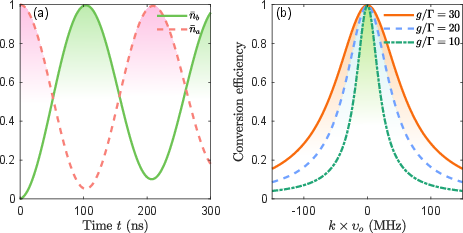
Figure 2: (a) Rabi oscillations in the occupation numbers during strong photon–phonon coupling. (b) High conversion efficiency persists across a wide range of momentum modes, evidencing the protocol’s broadband capability.
Fidelity and Robustness in Squeezed State Quantum Storage
The protocol’s primary operational figure is the quantum state fidelity between the initial optical state and the retrieved photonic state after round-trip transduction and storage. The manuscript considers various classes of nonclassical Gaussian states—squeezed vacuum, squeezed thermal, and squeezed coherent—showing that, with realistic Brillouin gain coefficients and loss rates, the fidelity can significantly exceed classical bounds even at elevated temperatures (Ten∼1 K).
Time evolution of quadrature variances and fidelity are shown for representative parameter sets. Squeezed states, as quantified by reduction of the variance of the appropriate quadrature, are efficiently mapped to acoustic phonons and subsequently retrieved. The transfer is robust against moderate increases in temperature and acoustic loss, due to the short operational timescale relative to the decoherence rates.
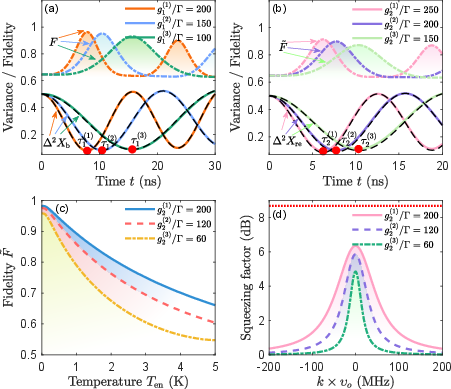
Figure 3: (a)–(d) Numerical results for squeezed-state memory: quadrature variances and fidelity during writing, storage, and readout, and dependence on mode index and temperature. High fidelities are attainable even outside the deep cryogenic regime.
Supplementary simulations in Figure 4 and Figure 5 confirm similar performance for squeezed thermal and squeezed coherent input states.
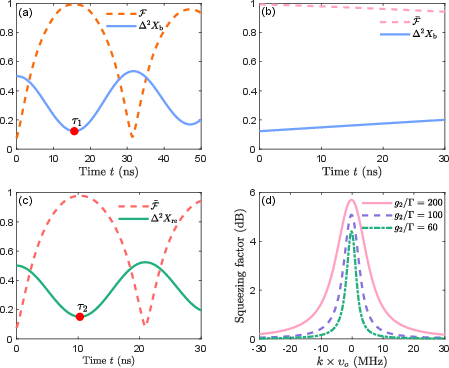
Figure 4: Quantum memory performance for squeezed thermal states, demonstrating robust storage and retrieval even for non-pure states at finite temperature.
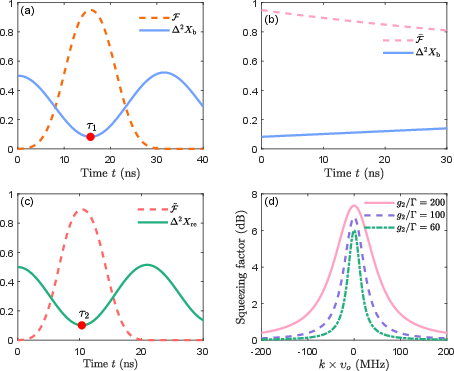
Figure 5: Quantum memory for squeezed coherent input states; efficient state transfer is maintained for a broad class of Gaussian states.
Entanglement Preservation and Retrieval
A critical benchmark for any quantum memory is the preservation of entanglement. The protocol's efficacy is further validated via the storage of one mode of an optical two-mode squeezed vacuum, quantifying entanglement using logarithmic negativity. The simulations show that significant bipartite entanglement between the idler (reference) and the retrieved signal can be preserved after a memory interval—well above the separability threshold.
The time evolution of both negativity and fidelity follows the oscillatory dynamics characteristic of strong coupling, with optimal retrieval at the swap points of the Rabi cycle. These results confirm the feasibility of using Brillouin-active continuum waveguides for quantum repeater or entanglement distribution applications.
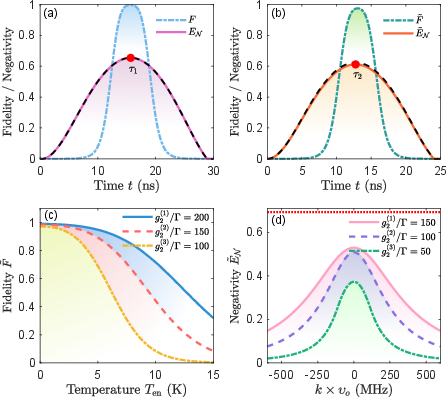
Figure 6: Temporal and modal evolution of (a-b) logarithmic negativity and fidelity for entangled state storage and retrieval, and (c-d) dependence on temperature and frequency channel.
Practical and Theoretical Implications
The analysis demonstrates that this solid-state, cavity-free approach realizes a quantum memory combining high-fidelity, large bandwidth (set by the Brillouin gain—hundreds of MHz), and scalable, chip-integrated architecture. Notably, state swaps are possible without requiring ground-state cooling of phonons at millikelvin temperatures—a requirement that severely limits many competing protocols—instead tolerating operational temperatures in the kelvin range due to the GHz-frequency phonon modes.
Temperature-insensitive operation further increases robustness, and the absence of a cavity removes restrictions related to discrete spectral modes, facilitating true multimode operation for broadband photonic processors.
Future extensions may include the application of this protocol to other non-Gaussian input states, further increases in storage time via material engineering of mechanical dissipation, and integration with photonic circuits for practical network-enabled quantum devices.
Conclusion
This work establishes a comprehensive protocol for quantum memory based on coherent photon–phonon state exchange in traveling-wave Brillouin-active waveguides. Key outcomes include:
- Analytical and numerical demonstration of high-fidelity, broadband quantum memory for various nonclassical states.
- Robust operation over a range of experimental conditions, without the need for extreme cryogenic cooling or discrete optical cavities.
- Theoretical predictions validated by figures of merit (fidelity, negativity) surpassing classical thresholds for quantum storage and entanglement.
These advances position continuous optoacoustic solid-state systems as a viable and scalable platform for quantum memories integral to next-generation quantum networks and photonic information processing.