- The paper develops an empirical certification framework using Gram matrices to guarantee reliable warm-start continuation in structured quantum representations.
- The methodology provides explicit trace distance and spectral norm diagnostics, ensuring that coarse-to-fine transfers meet strict objective improvement bounds.
- Empirical results demonstrate that topology and resource constraints critically influence performance, paving the way for certified optimizations in quantum variational tasks.
Gram-Certified Resource Continuation for Audited Structured Quantum Representation
Overview
"Gram-Certified Resource Continuation for Structured Quantum Representation Audits" (2607.10360) presents a formal framework for certifying when structured quantum representations—such as tensor-network ansätze for pure n-qubit states—can be reliably transferred or "warm-started" from a lower-cost resource model to a richer one. The work addresses foundational obstacles in classical and quantum variational optimization, providing empirical certificate bounds and geometric tests for the validity of coarse-to-fine initialization. The methods apply exclusively to structured, noise-free, synthetic settings and do not claim quantum advantage or hardware guarantees.
The exponential scaling of quantum state spaces (2n amplitudes for n qubits) prohibits dense classical storage for large n. Instead, structured representations—tensor networks, bounded-bond matrix product states (MPS), tree tensor networks (TTN)—coupled with local variational optimization become essential. A recurring practical question is when a solution found with fewer resources (e.g., lower bond dimension, fewer qubits, restricted topology) serves as a justified initialization for a more expressive model.
This work frames and solves the audit problem: for a declared isometry connecting coarse and fine resource levels, can a solution's empirical objective be certified to remain near-optimal on the more expressive rung, and under what conditions and diagnostics should continuation be rejected? The analysis requires full complex amplitudes and structurally declared contractions, precluding heuristic parameter copying.
Theoretical Contributions
Trace-Distance Certificate and Gram Construction
The paper develops a $2m$-dimensional Gram-implicit transfer certificate: Given m training states, the complex amplitude overlaps between coarse- and fine-level encodings are arranged into a block Gram matrix K, which, along with a signed operator S, produces a low-dimensional matrix B=RSR†. The nonzero spectrum of B equals that of the fine density minus the lifted coarse density, yielding the empirical trace distance 2n0 and spectral norm diagnostic 2n1, both computable without dense Hilbert space operators.
The central result is that if the coarse-level flag is 2n2-suboptimal, the corresponding fine-level suboptimality is at most 2n3, and the factor two is shown to be sharp. This gives a deterministic, empirical certificate of transferability:
2n4
No spectral gap or further smoothness assumption is invoked; the guarantee is a training-objective statement, not generalization assurance.
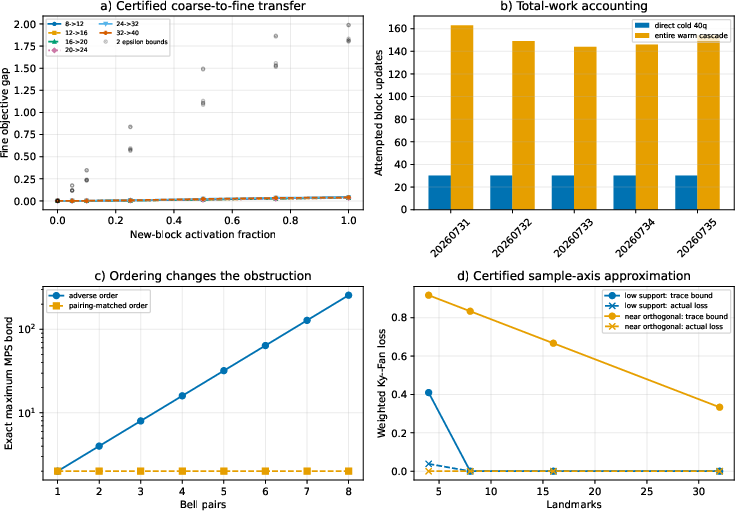
Figure 1: a) Verified transferred-flag gaps and 2n5 acceptance bounds; b) total work for continuation cascade versus direct cold solve; c) maximum MPS bond for various Bell-pair orderings; d) landmark certificate losses for contrasting support regimes.
Distinguishing Encoder Changes from Prolongation
A crucial conceptual advance is the separation between (1) encoder change (isometric lift of the Hilbert space), (2) resource-family prolongation (e.g., increasing bond caps or block sizes within a fixed encoding), and (3) geometric stability of learned subspaces (Davis–Kahan-type results). The certificates rigorously separate these scenarios and make explicit that only (1) and (2) can provide objective-value guarantees agnostic to eigengaps.
The work demonstrates that while nested capped sets (e.g., bounded bond dimension) allow for exact prolongation, fixed-rank manifolds are stratified—zero padding does not yield a regular point in the higher-rank family, so activation of new tensor directions must be certified by objective improvement, not by parameter copy alone.
Geometric Stability and Limitations
The geometry of quantum manifolds is addressed via flag and Grassmann structures. The audit framework includes computable geometric acceptance via eigenvalue gaps and operator-norm perturbations (2n6, with 2n7 a spectral gap), enabling Davis–Kahan-type guarantees for individual projectors.
The paper establishes a path-independent limitation: no continuation, schedule, or warm starting can circumvent the final Schmidt rank set by the resource family. For example, representing 2n8 Bell pairs across an MPS cut with maximum bond 2n9 yields fidelity at most n0, effectively tying simulability to declared topology and cross-cut entanglement rather than to variational optimization alone.
Empirical Evaluation
Deterministic synthetic experiments were executed on an 8-to-40-qubit "ladder" of structured models, measuring:
- The magnitude of the trace-norm gap n1 and transferred objective gaps under exact and inexact embeddings.
- Work savings (number of block updates) from warm versus cold initialization.
- The cost of continuation cascades relative to direct fine-rung optimization.
- Topological effects: for eight Bell pairs, the MPS bond required ranges from 2 (adjacent pairing) to 256 (central cross-cut).
- Validation of exact prolongation (e.g., merging tensor blocks) and landmark-based Gram approximation.
Key observations:
- Exact ancilla lifts had negligible gaps (n2).
- For small block activation steps (n3), acceptance bounds were met with observed gaps two orders of magnitude below the certificate.
- At full activation, n4 exceeded 0.9 on average, correctly triggering audit rejection.
- Warm starts reduced final block updates from 30 to 20 but, due to cascade cost, the total work increased by 4.8–5.4× compared to a direct solve.
- Topology choice alters resource requirements by orders of magnitude, underscoring that bond scaling alone does not capture classical hardness.
Practical and Theoretical Implications
This framework advances the formal auditing of quantum resource transfer and contributes operational tools for certified warm starting in high-dimensional quantum variational tasks:
- Warm starting is validated only when certified via explicit amplitude Gram diagnostics; heuristic parameter copying is explicitly invalidated as a certificate.
- The method delineates when a declared initialization is empirically justified and when continuation must be rejected due to excessive distributional drift or entanglement barrier.
- The analysis clarifies that classical simulability regimes depend not only on resource counts but also critically on topology and cross-amplitude access (not merely fidelities).
- The methods are strictly conditional on access to full amplitude overlaps and do not establish general simulability or quantum hardness.
For classical simulability claims and quantum machine learning audits, this work offers a rigorous, transparent protocol for distinguishing certified improvements from heuristic or artifactual performance increases.
Future Directions
Future extensions could include:
- Rigorous integration with train/validation/test regimes for empirical generalization auditing.
- Extension to noisy, hardware-executed, or open-system scenarios, where density matrices are estimated rather than exact.
- Application to Pareto studies crossing topology, rank, and resource axes, implemented on tensor-network backends and NISQ hardware with shot-aware resource accounting.
- Incorporation of entry-efficient landmark selection and pivoted Gram methods for very large sample counts.
- Exploration of meta-learning protocols for dynamic resource allocation guided by real-time certificate rejection.
Conclusion
"Gram-Certified Resource Continuation for Structured Quantum Representation Audits" (2607.10360) provides a mathematically rigorous, practically implemented audit framework for certifying when structured quantum solutions remain valid upon transfer to richer resource models. The framework leverages the symmetries of flag manifolds, exact and approximate prolongation, and Gram-implicit low-dimensional certificates to deliver deterministic guarantees. Synthetic benchmarks reveal that certified continuation reduces final optimization cost but does not guarantee overall savings; topology emerges as a primary determinant of classical tractability. The work supplies a template for controlled, reproducible studies in quantum machine learning and representation theory, setting a formal standard for future classical and quantum resource audits.