- The paper introduces a dual spectral criterion that balances mode decay rates and overlap weights to enhance local-excitation retention.
- It employs a non-Hermitian Hamiltonian and biorthogonal eigenmode decomposition to capture both coherent shifts and dissipative dynamics in impurity-assisted arrays.
- Through inverse design with experimental constraints, optimized aperiodic geometries achieve significant retention improvements, reducing decay rates to as low as 2.43×10⁻⁵ γ₀.
Spectral Design in Impurity-Assisted Atomic Arrays for Local-Excitation Retention
Introduction
The investigation addresses the cooperative radiative phenomena in impurity-assisted atomic arrays, where a single storage atom, initially excited, interacts with a surrounding ensemble of atoms. The central focus is on local-excitation retention—specifically, the survival probability of the initial excitation in the absence of active write or retrieval fields. Unlike prior works that optimize for global subradiance or photon-memory protocols, this study emphasizes spectral mechanisms underpinning excitation survival, proposing a compact criterion and demonstrating inverse design under experimentally motivated constraints.
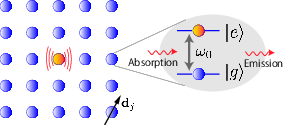
Figure 1: Conceptual schematic depicting an impurity atom (orange) surrounded by an atomic array (blue), highlighting the impurity-assisted cooperative storage setup.
Theoretical Framework and Spectral Criteria
Effective Non-Hermitian Hamiltonian and Biorthogonal Decomposition
The system is modeled as N two-level atoms (identical transition frequency ω0 and dipole orientation), where the decay dynamics are captured by a non-Hermitian Hamiltonian H^ under the single-excitation subspace. The dynamics of the storage atom excitation amplitude follow:
dtd∣ψ(t)⟩=−iH^∣ψ(t)⟩,
with H^ specifying both coherent (collective Lamb shifts) and dissipative (collective decay) contributions via photon-mediated dipole interactions. The decay process and survival probability are analyzed using the biorthogonal eigenmode decomposition of H^, which yields right/left eigenstates {∣ψℓR⟩,∣ψℓL⟩} associated with complex eigenvalues κℓ (with decay rates Γℓ=−2Imκℓ).
The probability that the system remains in its initial state at time t can be exactly decomposed as:
ω00
where ω01 are the complex overlap weights between the initial state and each eigenmode.
Subradiance, Mode Overlap, and Oscillatory Dynamics
The spectral analysis reveals that neither the minimum decay rate nor geometric configuration alone can adequately predict excitation retention. Instead, both the spectral decay rates and the corresponding overlap weights ω02 with the initial state are decisive. When multiple subradiant modes possess substantial overlap, their interference induces pronounced non-single-exponential (oscillatory) dynamics in ω03, with oscillation frequencies set by energy differences of long-lived modes.
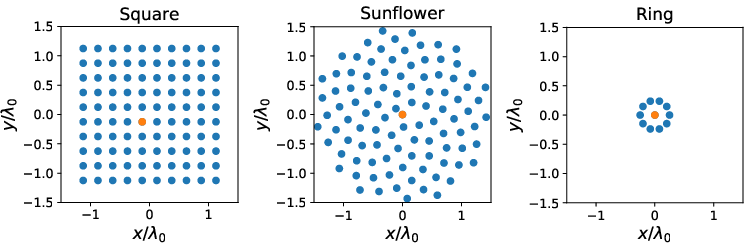
Figure 2: Geometric configurations used to probe spectral mechanisms—square, sunflower, and ring topologies.
Representative geometries demonstrate that periodic structures like square lattices may host highly subradiant modes with negligible initial-state overlap, leading to poor retention compared to aperiodic (sunflower, ring) configurations, where a dominant subradiant mode can possess both extended lifetime and large initial overlap.
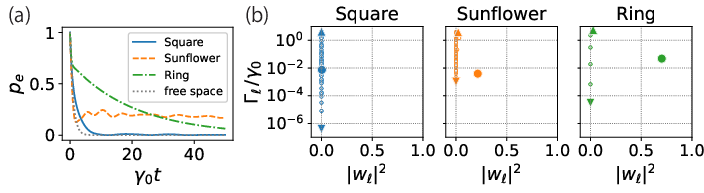
Figure 3: (a) Time evolution of ω04 for various geometries; subradiant lifetimes and initial overlaps jointly govern performance. (b) Mode weight versus decay rate scatterplots, showing that optimal retention correlates with both low decay and high overlap.
Spectral Surrogate Objective
Given the complexity of the multimode regime, the paper introduces a physically motivated surrogate objective function for structure optimization:
ω05
where ω06 is the normalized amplitude weight, and (ω07, ω08) are hyperparameters. The first term penalizes large ω09 on rapidly decaying modes, while the second term (Shannon entropy) enforces mode concentration. This surrogate is shown to have strong empirical correlation with actual time-domain retention metrics, outperforming naive minimization of H^0 alone.
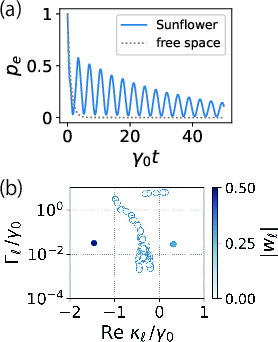
Figure 4: Example of pronounced oscillations in H^1 for the sunflower geometry driven by multimode interference.
Inverse Design: Constrained Atomic Geometry Optimization
A practical inverse-design demonstration is conducted by optimizing the atom positions surrounding the storage impurity, subject to a minimum interatomic distance constraint (H^2), reflecting experimental feasibility limits.
Optimization, starting from a symmetric ring configuration, converges to aperiodic geometries with enhanced local-excitation retention. The optimal structures depend sensitively on H^3; lower H^4 enables tighter packing, fostering stronger collective effects and yielding both larger overlap weight and lower dominant mode decay.
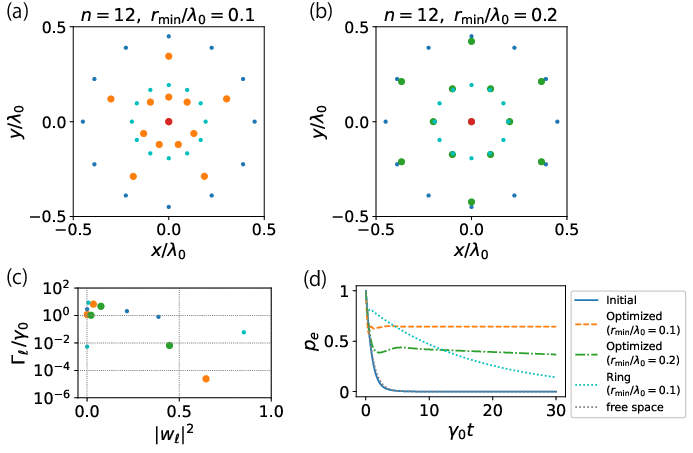
Figure 5: Geometries before and after spectral optimization for two H^5 values, showing convergence to aperiodic, performance-enhancing arrangements.
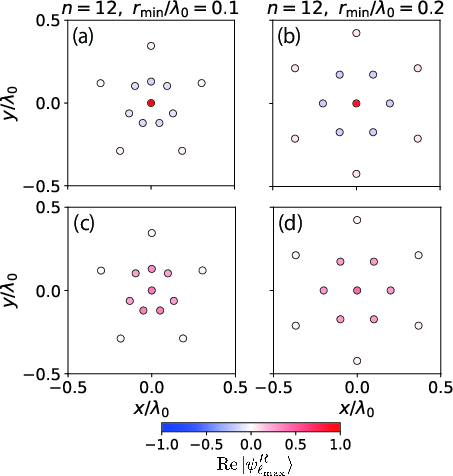
Figure 6: Dominant right eigenstates for optimized arrays (H^6 and H^7), illustrating localized storage atom amplitude and out-of-phase interference on concentric rings.
Empirically, the optimization achieves:
- For H^8: dominant weight H^9, eigenmode decay reduced to dtd∣ψ(t)⟩=−iH^∣ψ(t)⟩,0, final retention dtd∣ψ(t)⟩=−iH^∣ψ(t)⟩,1.
- For dtd∣ψ(t)⟩=−iH^∣ψ(t)⟩,2: dominant weight dtd∣ψ(t)⟩=−iH^∣ψ(t)⟩,3, decay dtd∣ψ(t)⟩=−iH^∣ψ(t)⟩,4, retention dtd∣ψ(t)⟩=−iH^∣ψ(t)⟩,5.
By contrast, reference ring/square configurations, while sometimes hosting large weights, exhibit significantly larger decay rates.
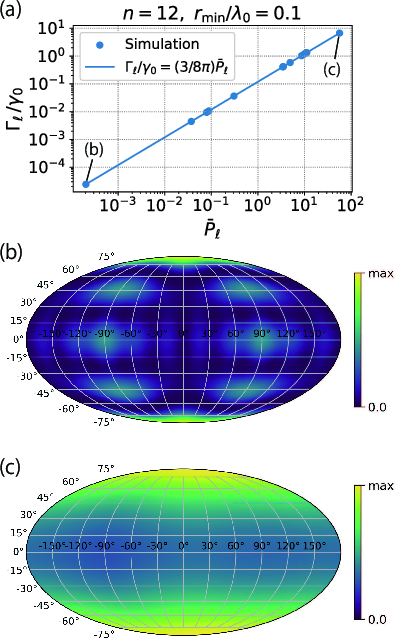
Figure 7: (a) Mode-wise proportionality between integrated far-field radiation and decay rate. (b, c) Angular radiation profiles for minimum and maximum decay-rate modes; subradiant eigenmodes show strong far-field suppression via destructive interference.
Modal and Far-Field Interpretation
Analysis of the dominant eigenstates elucidates the physical mechanism: the optimized structures exhibit destructive interference patterns (out-of-phase arrangement of surrounding atoms with respect to the storage impurity), leading to suppressed far-field emission and pronounced subradiance. The radiative decay rate dtd∣ψ(t)⟩=−iH^∣ψ(t)⟩,6 is shown to be directly proportional to the integrated far-field emission, with highly subradiant modes demonstrating angularly broad suppression.
Implications and Future Directions
The main findings have several implications:
- Design Principle: Effective local-excitation retention requires not just minimal collective radiative decay, but spectral concentration—maximizing weight on a single (or few) long-lived subradiant mode(s).
- Surrogate-Guided Optimization: Spectrum-based surrogate objectives enable practical, gradient-based optimization over large, constrained parameter spaces, yielding physically realizable aperiodic geometries with enhanced retention under feasible fabrication constraints.
- Spectral Transparency: The eigenmode-based approach provides physically transparent diagnostics (modal weights, decay rates, far-field patterns) for guiding, assessing, and interpreting cooperative light-matter system design.
- Generalization: Although demonstrated on a minimal impurity-storage scenario, the spectral surrogate approach is extensible to larger system sizes, different initial states, or inclusion of write/read control fields.
Future extensions could include robustness analysis under atomic position/detuning disorder, explicit inclusion of dynamical storage and retrieval protocols, larger arrays with more complex impurity arrangements, and application to photonic or nanophotonic platform design.
Conclusion
The study establishes that optimal local-excitation retention in impurity-assisted atomic arrays is governed by a dual spectral criterion: excitation must predominantly populate a single, long-lived subradiant mode while minimizing multimode overlap that induces detrimental oscillations. A physically motivated surrogate objective encompassing these constraints enables constrained atomistic inverse design. The resulting aperiodic configurations achieve strong suppression of radiative decay, confirmed by both time-domain survival metrics and modal far-field emission analyses. This spectral optimization paradigm provides a robust foundation for designing next-generation cooperative photonic storage devices and informs theoretical development in quantum memory and light-matter interface engineering.