- The paper presents the first large-scale, repository-anchored dataset of verified MCP implementations, setting a new empirical baseline.
- The study uses a multi-stage GitHub-based pipeline and rule-based role classification to validate 2,297 operational MCP projects.
- Empirical analysis shows predominant client-server roles with Python/TypeScript usage, highlighting implications for agentic interoperability.
Large-Scale Evidence-Centered Characterization of MCP Implementations on GitHub
Introduction
The transition of LLM-driven systems from monolithic text generators to agentic architectures necessitates structured interoperability protocols for tool and data integration. The Model Context Protocol (MCP) represents the leading standard for such interoperability, formalizing how agent hosts, external tools, and heterogeneous resources interact in reproducible, modular, and composable pipelines. This paper—"A Large-Scale Dataset of MCP Implementations on GitHub" (2607.10123)—addresses the empirical gap in our understanding of how the MCP specification is realized across open-source environments. Prior studies have focused largely on secondhand registry data or protocol documentation, providing insufficient code-grounded evidence. Here, a repository-centric, multi-stage discovery and validation pipeline recovers 2,297 discrete, operational MCP projects, setting a new empirical baseline for ecosystem analysis.
Dataset Construction Methodology
The study presents a pipeline centered on GitHub API queries, pattern-based discovery, and source-level verification, as summarized below.
A combined REST and GraphQL query suite identifies 3,238 candidate repositories through targeted keyword and context patterns relevant to MCP integration, such as explicit protocol mentions, role-specific indicators (client, server, gateway), and usage in defined agent frameworks like Claude Desktop. Rigorous filtering for recent commit activity and exclusion of documentation-only and unmodified forks produces a refined corpus. The verification pipeline then applies three layers of evidence checks—manifest/dependency inspection, directory and entry-point analysis, and environmental integration (CI/CD, containerization, host configurations)—resulting in the removal of 660 non-operational artifacts and 11 implementation scaffolds.
Precision of automated verification is measured through manual review of 170 repositories, yielding an 83% precision at 95% confidence. Error analysis and rule refinement eliminate an additional 90 false positives, resulting in the final dataset of 2,297 validated MCP projects.
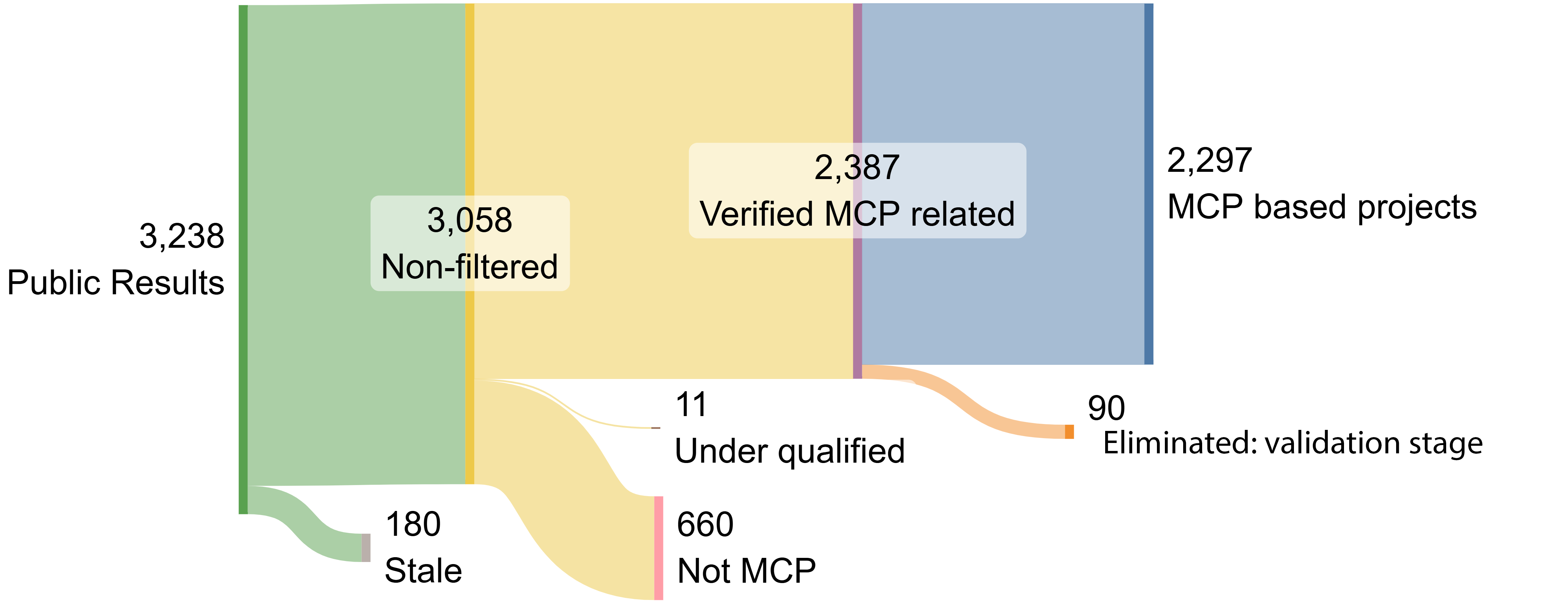
Figure 1: Flow of dataset construction from initial GitHub results to the final verified MCP implementations.
MCP Execution Model and Role Classification
MCP operational semantics are grounded in three principal roles: Client, Server, and Gateway. Client implementations are responsible for initiating tool invocations via MCP communication channels to external Servers, which expose MCP-compliant tools, resources, or prompts. Gateways mediate, route, or bridge protocol interactions, enabling extensions across heterogeneous systems or security domains.
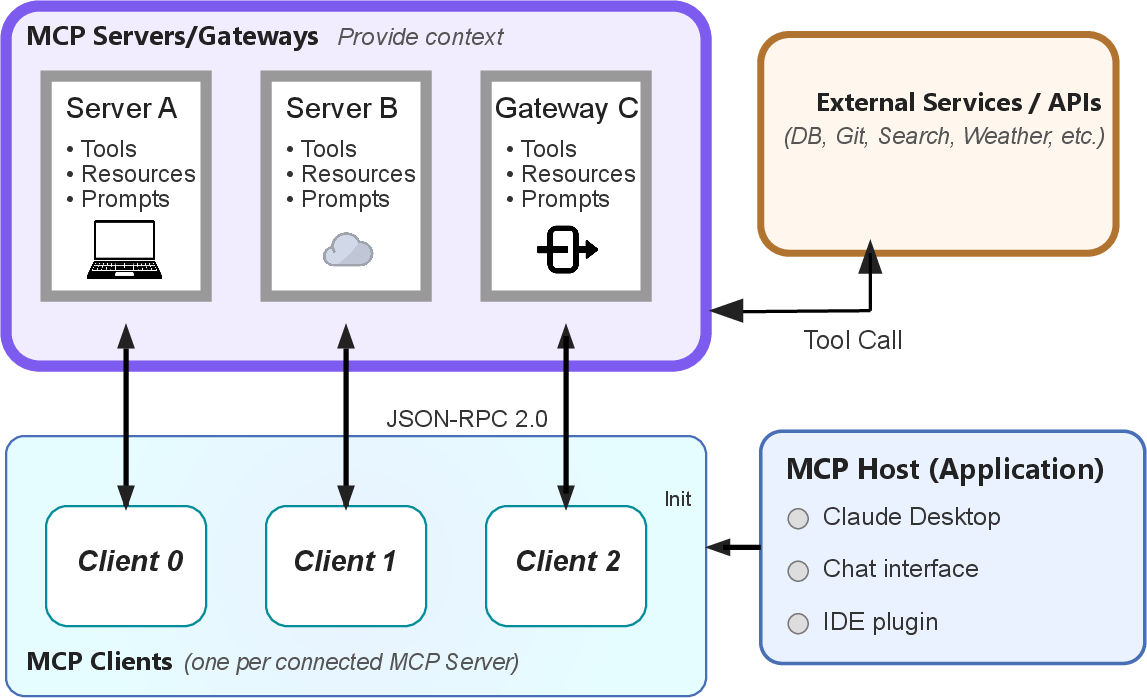
Figure 2: MCP architecture showing the host, clients, and servers/gateways exposing tools and resources.
An evidence-weighted, rule-based scoring system assigns each repository a primary operational role based on manifest references, structural entry-points, and explicit tool invocation or exposure logic. The decision logic incorporates overrides and manual disambiguation for ambiguous or multi-role codebases. Empirically, the study finds 1,962 Servers, 1,462 Clients, and 80 Gateways—repositories can exhibit multiple roles, and 36 are classified as Unclassified due to ambiguous evidence.
Hybrid and gateway architectures are prevalent, especially at the intersection of orchestration and language-bridging patterns. The latter is specifically represented by subtypes such as transport relay, policy enforcement, and sandboxing, with orchestration emerging as the most prevalent gateway pattern.
Language and Development Dynamics
Role-resolved language analysis reveals that Python and TypeScript are the modal languages for both server and client implementations, with JavaScript following. Gateway repositories display a distinct composition, with Go as a significant third language, particularly in high-performance routing and bridging contexts.
The dataset schema is highly normalized, capturing repository metadata, language composition, verification evidence, development history (commits, contributors, PRs), and structural role assignments.
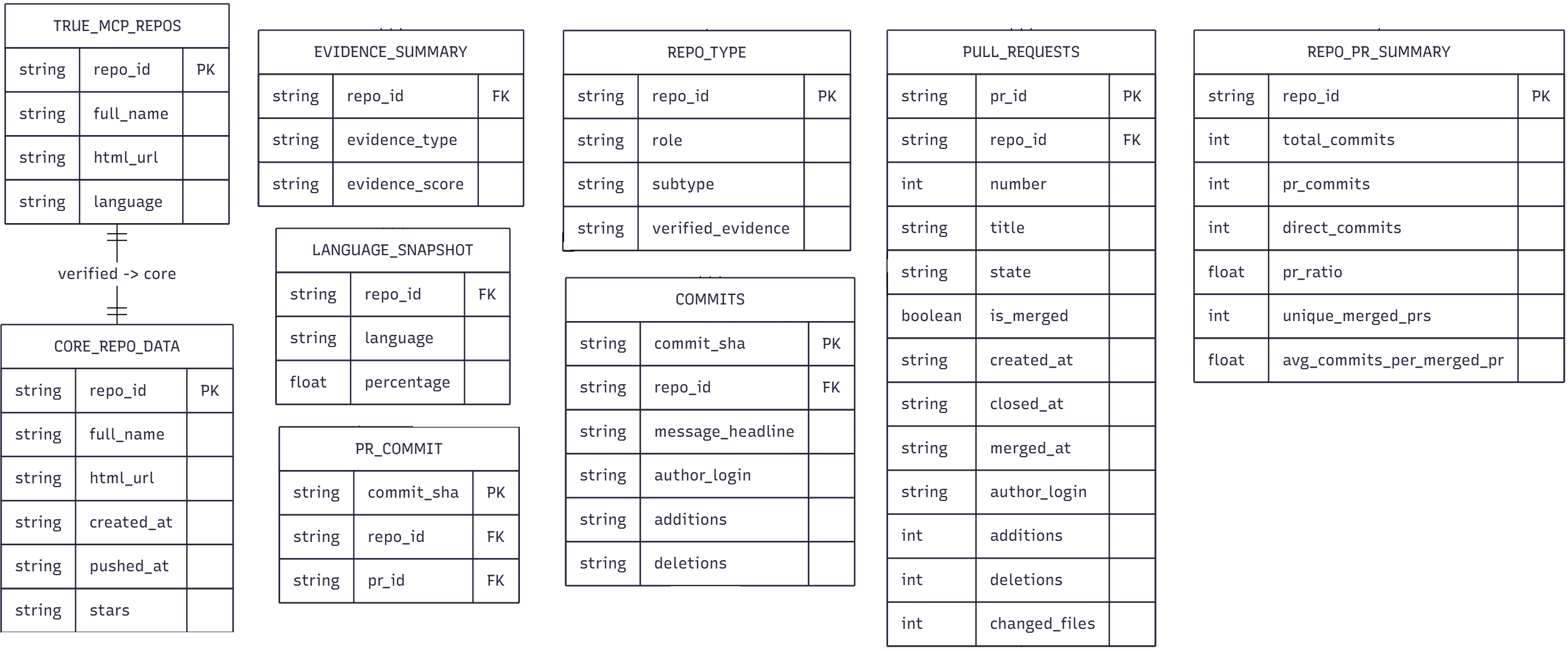
Figure 3: Dataset Schema and Entity Relationships for the MCP Repository Dataset.
Development process analysis indicates a pattern of small-step, iterative contributions: median commits per repo cluster around 70, with a low median file change footprint and contributor base per project. Gateways evidence elevated PR activity (mean = 49.6), likely reflecting heightened complexity and interfacing requirements.
Empirical Impacts and Comparison
This work distinguishes itself from prior registry-derived studies such as MCPCorpus [lin2025large] and MCPCrawler by enforcing repository-first evidence collection: only projects with verifiable, code-level MCP fingerprints are included. This constraint sharply increases dataset reliability for downstream tasks such as vulnerability surface measurement [hasan2025model], security benchmarking [yang2025mcpsecbench], and protocol-level semantic drift analysis.
Contrasting registry-based approaches—which may conflate descriptive listings, non-functional templates, or detached metadata—this dataset guarantees direct traceability between protocol adoption claims and operational code. By embracing a transparent, auditable, and reproducible workflow, it aligns with FAIR and open science principles, supporting both evolutionary and comparative studies of protocol adoption.
Implications and Future Directions
The dataset enables high-confidence empirical research on MCP-driven software supply chains, security audits, architecture drift, and rapid compositional integration, supporting analyses at both snapshot and longitudinal time scales. The strong presence of hybrid and gateway roles reflects a move toward more complex agentic orchestration, which demands robust protocol extension and interface reconciliation mechanisms. The robust presence of Python and TypeScript suggests tooling and framework monocultures, with attendant risks for both security and long-term protocol diversity.
Prospects for future work include automated detection and fine-grained typing of protocol extensions, analysis of co-evolving dependency networks, detection of implementation anti-patterns, and continuous tracking of MCP adoption trends in the broader context of protocol-agnostic integration platforms [ding2025unified, ding2025toolregistry]. For the agentic AI field, repository-first evidence datasets of this kind are prerequisites for questions ranging from code security to interoperability, compliance, and agent traceability.
Conclusion
This paper delivers the first large-scale, repository-anchored dataset of verified MCP implementations from open-source development. Through its multi-layered verification pipeline, rule-based role attribution, and structured data organization, it sets a new empirical standard for the study of protocol-driven agent ecosystems. It provides the technical conditions necessary for rigorous analysis of integration strategies, language and tool patterns, and the evolution of modular agentic architectures (2607.10123).