- The paper formalizes a taxonomy of MCP server architectures by defining five primary patterns and four anti-patterns to standardize LLM integrations.
- The study employs empirical evaluations including latency benchmarks and tool selection accuracy to validate the proposed architectural designs.
- The analysis highlights practical implications for secure protocol design, schema evolution, and maintenance in LLM-integrated server environments.
MCP Server Architecture Patterns for LLM-Integrated Applications
MCP: Standardization and Ecosystem Structuring
The Model Context Protocol (MCP), introduced in late 2024, established a standardized interface to connect LLMs with external tools, resources, and prompts. By decoupling the agent from capability providers, MCP precipitated rapid ecosystem growth, enabling LLMs like Claude, GPT-4, and Gemini to interface with heterogeneous backends via uniform protocols. Prior to MCP, such integration required ad-hoc schemas and custom glue code per model; MCP's client–server abstraction achieves uniformity and operational efficiency.
The paper systematizes the architectural landscape of MCP servers. It catalogs five primary structural patterns—Resource Gateway, Tool Orchestrator, Stateful Session Server, Proxy Aggregator, and Domain-Specific Adapter—identified across fifteen independently developed servers (Celabe's ANSYR production deployments and community implementations). Each pattern is formally described using the “context, problem, solution, consequences” template. The study further outlines four anti-patterns and cross-cutting concerns such as authentication, versioning, and observability.
Architectural Patterns in MCP Server Design
Resource Gateway
Resource Gateway abstracts backend data sources, exposing them to LLMs in a stable, queryable form. The pattern's critical property is the placement of a sanitization layer to prevent prompt injection attacks, as LLMs are vulnerable to malicious content when consuming raw external data. Gateway mediation localizes schema changes and access control, benefiting maintenance and security.
Tool Orchestrator encapsulates composite workflows involving multiple backend systems into single callable tools. This abstraction alleviates the LLM's need to understand multiple APIs or coordinate intermediate state, improving operational reliability and reducing schema surface complexity. Latency can be minimized, but orchestration logic may become opaque and risk redundancy between server code and documentation.
Stateful Session Server
Stateful Session Server manages session-dependent state for multi-turn LLM interactions, preserving transactional context across request cycles. Sessions are identified by tokens and may be stored in-memory or in distributed stores such as Redis. This design enables interactions requiring stateful continuity but introduces challenges around session scaling, memory management, and correct LLM client behavior.
Proxy Aggregator
Proxy Aggregator federates multiple upstream MCP servers, exposing a unified tool catalog to clients. This enables centralized authentication and audit but can increase tool count per context, which empirically degrades LLM tool selection accuracy. The recommended variant is “scoped aggregation,” filtering tools on-demand to maintain bounded context size, critical to preserving high selection accuracy in LLMs.
Domain-Specific Adapter
Domain-Specific Adapter translates non-LLM-friendly APIs into semantically meaningful tool interfaces. It normalizes inputs, enriches outputs, and provides precise natural language tool descriptions, improving LLM usability and absorbing upstream API evolution. Over-design risk arises if source APIs are inherently LLM-compatible.
Anti-Patterns and Cross-Cutting Concerns
Four anti-patterns are highlighted: the “God Tool” (undifferentiated schema), unsanitized resource content, synchronous exposure of long-running operations, and vague or missing tool descriptions. Each corresponds to recurring failure modes observed in production. The mitigation strategies improve LLM selection, protect against prompt injection, and maximize robustness.
Authentication, error handling, versioning, and observability are presented as essential cross-cutting strategies. Transport-layer authentication with Bearer tokens, structured error responses, versioned tool schemas, and robust audit logging are required to maintain operational integrity and facilitate debugging LLM agent interactions.
Quantitative Evaluation
Pattern Classification Reliability
The paper reports substantial inter-rater reliability (Cohen’s κ=0.76) for pattern classification on a held-out corpus of 54 servers using two independent LLM raters. Notable classification ambiguities are concentrated at pattern boundaries, particularly with statefulness and domain logic, reflecting the need for implementation-derived signals beyond capability lists.
Transport Latency Benchmarks
Empirical latency measurements of MCP transports show in-host overheads (stdio: 0.01 ms p50; HTTP loopback: 0.39 ms p50) are negligible compared to network RTT for same-region remote paths (≈30 ms p50 baseline). Aggregation adds further overhead due to additional network hops, emphasizing the importance of network-aware architectural decisions.
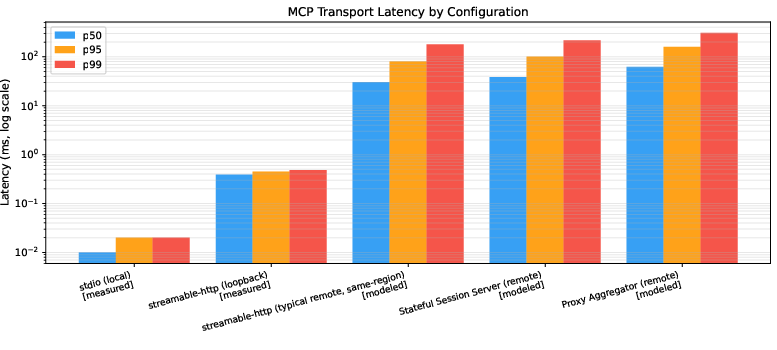
Figure 1: MCP transport latency (p50 for various server configurations); protocol overhead is dwarfed by network RTT in cross-host deployments.
Observational production telemetry reveals accuracy drops below 90% between 10–15 tools per context for Claude Haiku 4.5, and between 20–30 tools for Sonnet 4. Latency increases with tool count, directly informing context budgeting in Resource Gateway and Tool Orchestrator designs. Tool count limitation, combined with retrieval-based tool exposure, is recommended to mitigate prompt bloat and preserve agent efficacy.
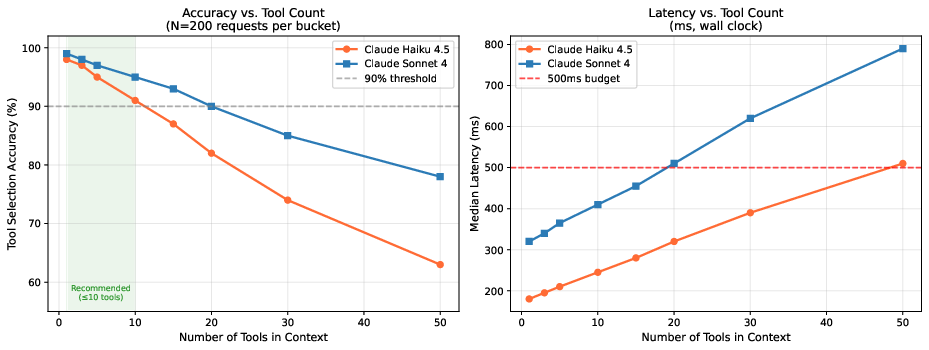
Figure 2: Tool count versus accuracy and latency for Claude Haiku 4.5 and Sonnet 4; shaded region denotes recommended operational range (≤10 tools per context).
Maintenance, API Design, and Taxonomical Implications
Pattern taxonomy reduces complex server design to modular, maintainable seams. For practitioners, structural choices localize schema evolution, facilitate centralized governance, and improve client usability. Descriptions are load-bearing for LLM selection and must be maintained rigorously, as schema drift correlates directly with underperformance.
For researchers, the pattern catalog provides a foundation for empirical studies on architectural reliability, latency, and security. It also motivates studies combining human and multi-model LLM raters to resolve ambiguities and expand taxonomy coverage. Maintenance concerns align with software smell analysis and prompt injection mitigation literature.
Limitations and Threats to Validity
Limitations include reliance on a small, domain-constrained corpus for pattern derivation, modeling rather than measuring certain transport latencies, and lack of independent human dual-coding. External validity may be constrained by domain-specific tool inventories and operational requirements. Conclusion validity is supported by the bootstrap confidence intervals, but further scale studies are warranted.
Practical and Theoretical Implications
MCP's architecture patterns impose novel constraints on API design: LLMs select tools by reading natural language, not by consulting documentation. This reframes schema and description design as an operational, not merely documentation, concern. The cataloged patterns and anti-patterns inform production deployment choices, improve maintainability, and are directly linked to operational metrics such as latency and tool selection accuracy.
Future directions include large-scale, stratified analysis of MCP servers, quantitative selection accuracy studies across pattern variants, and systematic security evaluation, especially regarding prompt injection vectors.
Conclusion
This paper delivers a formal taxonomy of MCP server architecture patterns, validated by substantial inter-rater reliability and production measurements. Empirical findings specify transport latency overheads and contextual tool-count constraints, guiding operational server design for LLM integration. The catalog and anti-pattern enumeration equip practitioners and researchers with actionable guidance, while motivating further ecosystem-scale empirical studies and security analyses.

