- The paper introduces MCPZoo, an automated framework that transforms static MCP repositories into 64,611 runtime servers to enable comprehensive security analysis.
- The methodology reveals significant ecosystem issues, including over 90% code duplication and only 19.6% of projects achieving complete native deployment.
- The scanner evaluation shows low average precision (45.53%) and minimal cross-tool agreement, questioning the reliability of scanner-generated risk alerts.
Large-Scale Security Assessment of MCP Servers: Design, Measurement, and Limitations of Scanner-Based Risk Evaluation
MCPZoo Dataset Construction and Ecosystem Characterization
The Model Context Protocol (MCP) is an interface standard for enabling LLM-agent interaction with external tools, providing agents with the ability to invoke capabilities ranging from file access to network communication and system-level operations. Despite its centrality in autonomous agent architectures, prior security analyses were constrained by insufficient scale and lack of runtime deployments: risk measurement thus often depended on static code analysis or limited dynamic sampling, with minimal empirical validation.
The paper introduces MCPZoo: a fully automated, multi-agent framework that, for the first time, systematically transforms static MCP repositories into 64,611 unique, runtime-verifiable MCP servers (37,288 supporting dynamic analysis). The framework iteratively emulates expert deployment practices—including environment inference, failure diagnosis, and feedback-driven repair—thereby resolving practical deployment defects (missing artifacts, misconfigurations, external dependencies) that previously impeded ecosystem-wide reproducibility. The resulting corpus enables high-fidelity, protocol-level interaction for dynamic behavioral analysis.
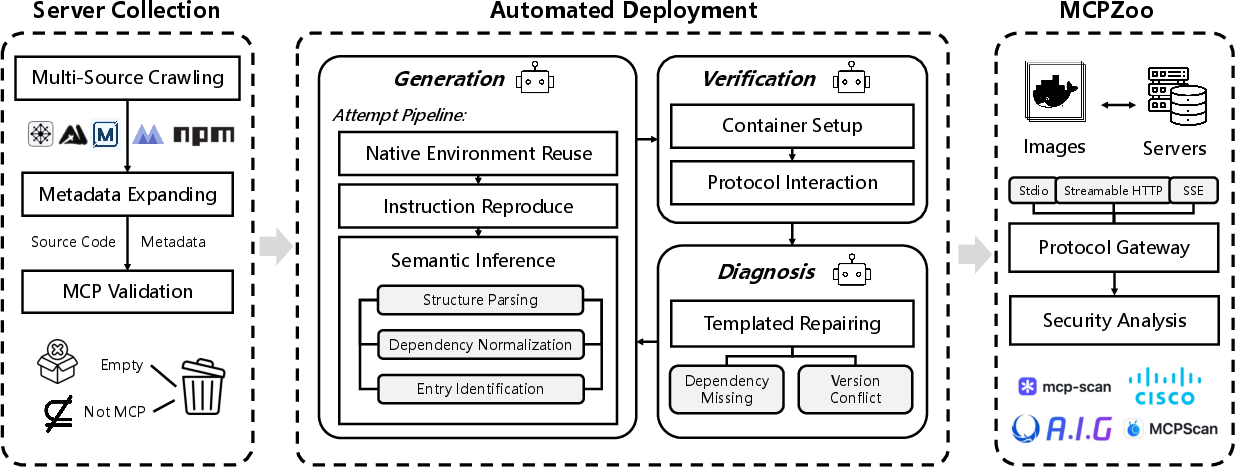
Figure 1: Automated multi-agent workflow of MCPZoo for large-scale collection, build, deployment, and runtime validation.
A critical ecosystem finding is the prevalence of duplication and redundancy across MCP markets. Cross-market overlap frequently exceeds 90%; 28.3% of servers are duplicate code-derived entities resulting from forks, mirrors, or template-driven replication, severely inflating ecosystem-scale metrics. Only 46,327 represent unique codebases after de-duplication. Template reuse is especially pronounced: e.g., the remote-mcp-server-authless template generates 537 nearly identical deployments.
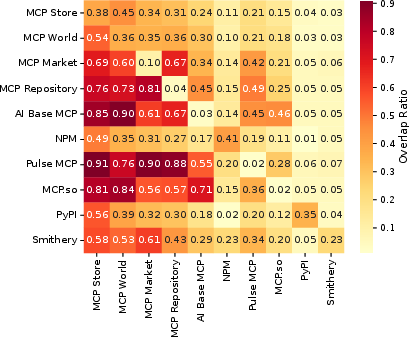
Figure 2: Intersection ratio matrix reveals dominant cross-market duplication and codebase overlap among MCP servers.
Deployment success is markedly limited by ecosystem engineering practices. Explicit Dockerfile presence is observed in only 21.4% of projects, and successful native deployment (with Dockerfile, README, Config present) occurs in merely 19.6%. The MCPZoo agent-driven pipeline achieves a global interaction rate of 57.7%, but failures persist, mainly due to external dependency requirements and source-level defects.
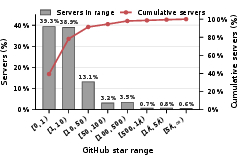
Figure 3: Distribution of GitHub stars across MCP servers illustrates the long-tailed popularity pattern and the prevalence of low-visibility projects.
Tool Exposure, Capability Distribution, and Domain-Specific Risk Surfaces
Analysis of runtime-exposed tool sets shows that “super-servers” may expose thousands of tools, but 85.53% provide fewer than 10, pointing to concentrated capability domains. High-risk capabilities constitute 37.66% of all tools, including command/script execution, file modification, and outbound data transfer. Notably, server function classifications exhibit distinct risk surface profiles: developer tool servers concentrate 83.15% of command execution tools, while web search, finance, and medical servers dominantly utilize remote info retrieval.
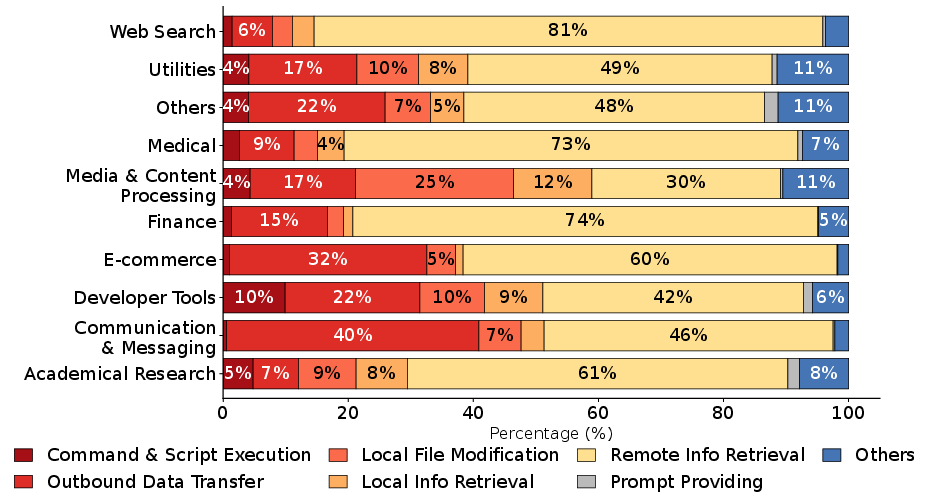
Figure 4: Distribution of tool capabilities within each functional server domain, highlighting domain-specific risk concentrations.
The mapping between server functionality and tool capability reveals non-uniform exposure: communication and e-commerce servers allocate the majority of tools to outbound data transfer (critical for data exfiltration scenarios), while media content servers disproportionately expose local file modification primitives.
Empirical Security Scanner Analysis: Reliability, Precision, and Cross-Consistency
The paper evaluates eight widely used MCP security scanners—spanning static, dynamic, and hybrid methods—across the 37,288 interactable MCPZoo servers. Raw results are alarmist: 96.89% of servers are flagged as risky by at least one scanner, irrespective of star-popularity stratification, and none are flagged by all scanners simultaneously.
A comprehensive precision and recall validation uncovers strong limitations. Manual review indicates an average precision rate of 45.53%, with extreme variation (low-performing scanner at 10.4%, “conservative” scanners >70%). CVE-based recall benchmarking shows that even the best-performing scanner identifies only 74.29% of known vulnerable servers, while several high-precision scanners fail to detect any CVE cases, evidencing the tradeoff between coverage and true positive rate.
Cross-scanner agreement is minimal: the average pairwise Jaccard similarity for flagged servers is 15.66% globally and <6% for specific vulnerability categories (prompt injection, command execution, data leakage). Scanners differ not only in flagged volume, but in reporting category distribution and sensitivity to capability and metadata patterns.
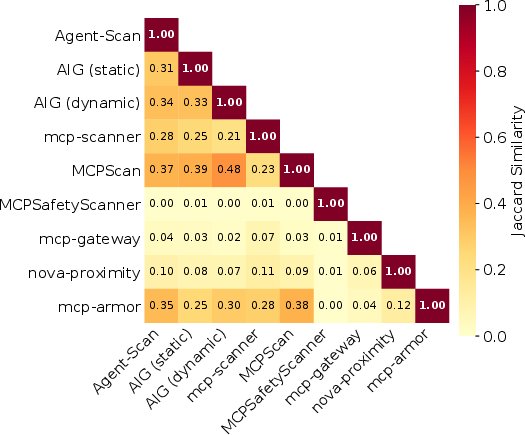
Figure 5: Low pairwise Jaccard similarity among scanner outputs evidences lack of cross-tool consensus on risk claims.
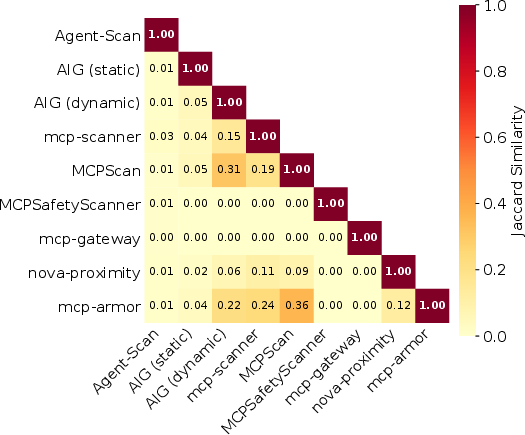
Figure 6: Category-level Jaccard similarity for prompt injection reveals severe inter-scanner divergence.
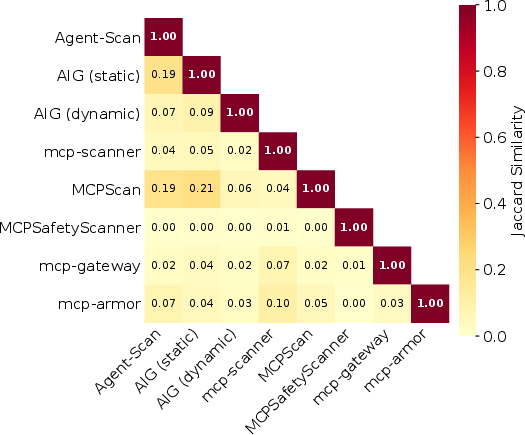
Figure 7: Category-level Jaccard similarity for command execution illustrates major inconsistency in scanner findings.
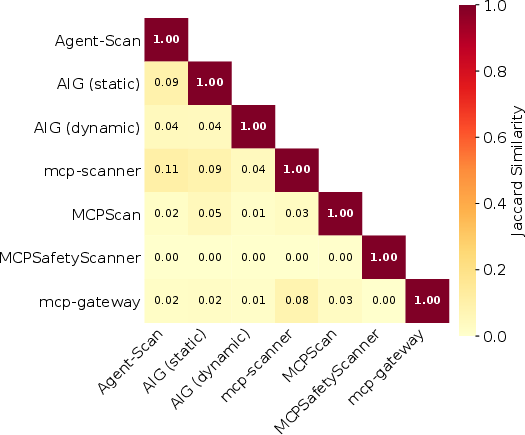
Figure 8: Category-level Jaccard similarity for data leakage further confirms unreliable cross-scanner overlap.
Root causes of false positives and negatives are linked to scanner design: metadata-based approaches conflate capability with vulnerability; LLM-driven dynamic scanning suffers from probe instability and failure misinterpretation; static code analysis overstates risk due to semantic path reconstruction without runtime exploitability verification; rule-based scanners rely on pattern matching that poorly generalizes to emergent vulnerabilities.
Practical and Theoretical Implications
The findings decisively reject the claim that scanner-reported risk prevalence accurately reflects ecosystem-level insecurity. Instead, systematic risks arise from structural ecosystem factors—duplication, template replication, poor deployment hygiene—that amplify attack surfaces and propagate vulnerabilities across markets. However, scanner-based measurement neither provides actionable ground truth nor reliably identifies the attack surface without concrete exploit validation.
This undermines the utility of scanner reports for ecosystem triage: treating scanner alerts as direct evidence of vulnerability leads to both overestimation and risk-masking. Scanner outputs are useful as triage signals, but actual security posture assessment requires systematic validation and runtime exploit testing. The release of a public query interface, mapping MCP servers to scanner and validation outcomes, supports more cautious, evidence-driven risk assessment.
Practically, the dataset and methodology are foundational for future MCP security research—supporting more reproducible measurements, validation-driven scanner development, and scalable dynamic benchmarking of defense strategies. Theoretical implications include new directions for protocol-hardening, agent capability management, and vulnerability propagation modeling in agent-tool ecosystems.
Conclusion
This work provides an authoritative ecosystem-scale assessment of MCP server security, supported by the MCPZoo corpus and systematic scanner evaluation. While the MCP ecosystem exhibits structural risk factors, scanner-reported risk claims are neither reliable nor sufficiently validated. This highlights the necessity for dynamic, empirical vulnerability analysis and trusted validation pipelines, shifting security assessment practice beyond scanner-oriented methodologies (2607.11086).